
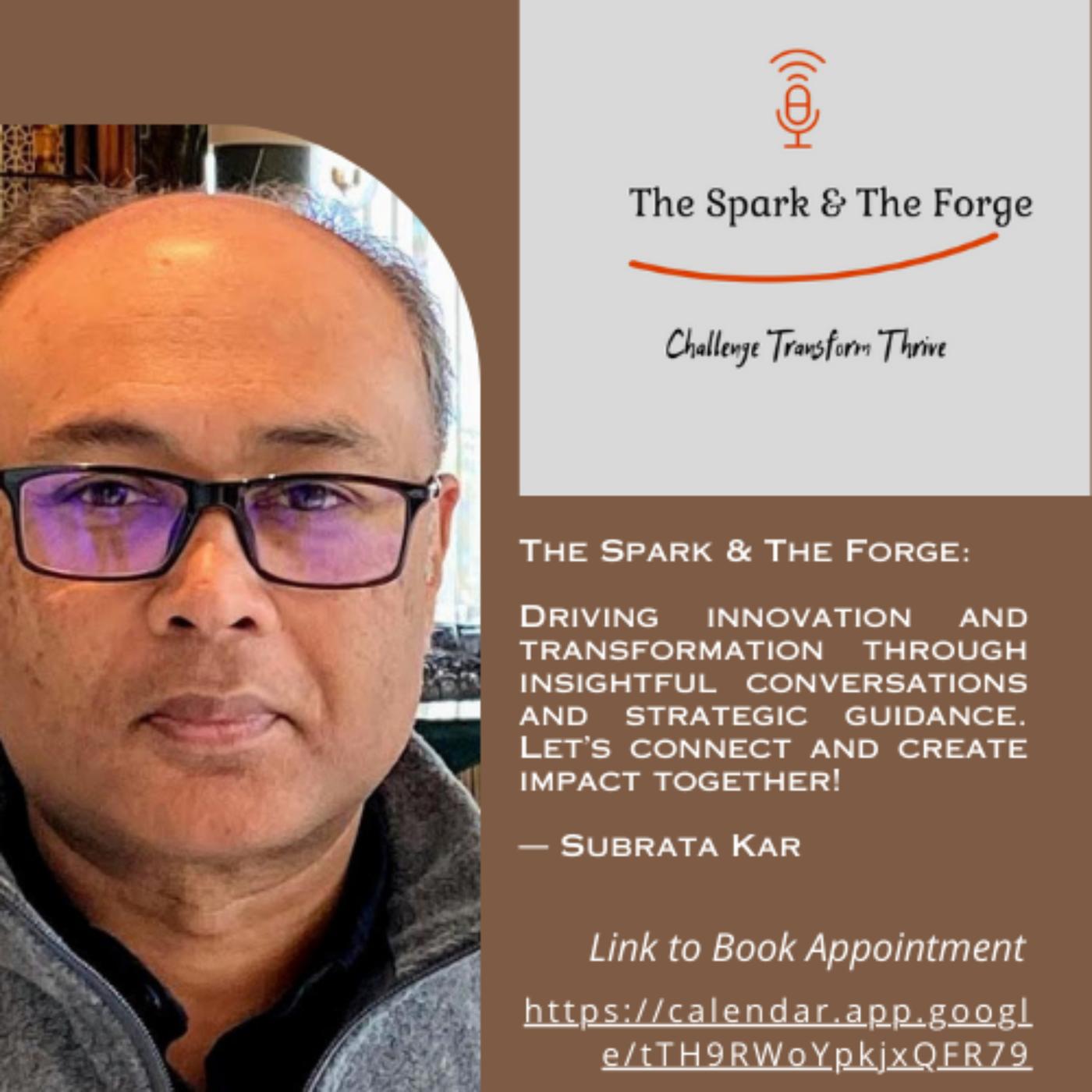
À PROPOS DE CE PODCAST 🔗
Extracting scaling patterns from 200+ conversations with leaders building AI, healthcare, and enterprise systems.
This isn't theory—it's what's working in production. Each episode breaks down decisions, frameworks, and approaches practitioners used to scale successfully (and what failed).
Topics: AI governance, enterprise scaling, product-market fit, GTM strategy, leadership hiring, deeptech innovation.
Host: Subrata Kar, mentor at T-Hub & NASSCOM DeepTech Club, 40 years in enterprise systems.
For founders and CTOs who need specifics, not buzzwords.
Animateurs :
Fréquence de mise à jour:
every 12 days
Durée audio moyenne:
47 minutes
Entretiens avec des invités
Anglais
États-Unis
22 épisodes
depuis 16 janvier 2025
episodic
DANS CE PODCAST 🔗
DERNIER ÉPISODE 🔗
What stayed with me after recording Episode 86 with Dr. Anand Iyer?
He described the idea of having your “doctor in your pocket” — something that sees what is happening and guides you through it, moment by moment.
But the more I thought about our conversation, the more complicated that idea became.…
RECHERCHER LES ÉPISODES PASSÉS
Rechercher les épisodes précédents de The Spark & The Forge: Patterns That Actually Work.
ÉPISODES PRÉCÉDENTS 🔗
What happens when AI becomes your health coach — learning from your data and helping you make decisions in real time?
Dr. Anand Iyer describes the idea as having your “doctor in the pocket.” But how much should we trust it?
In E86 of The Spark & The Forge, I sit down with Dr. Anand Iyer, Chief …
What happens when AI stops being a tool you use and starts becoming part of how the enterprise operates?
Enterprise software is already a landscape — ERP, CRM, HR, procurement, finance, service and industry-specific systems. AI agents can increasingly operate across that landscape, interpret inform…
AI is changing how enterprise software gets built. But what does that mean for ERP?
The ERP problem has changed.
The old problem was customization — and the technical debt that came with it. SaaS standardized the core, but enterprises increasingly became landscapes of systems: SAP or Oracle for fin…
Does AI really understand what it writes — or can it produce an answer that looks like understanding?
Prof. Luis Lamb and I start with a deceptively simple question: how do we know whether AI has given us knowledge — or just a very good guess?
From there, we explore what happens when AI moves from …
Who decides when an algorithm gets it wrong?
That's the question at the heart of this conversation with Professor Renée Cummings—a criminologist who spent two decades in criminal justice before becoming one of the world's leading voices in AI governance.
Every day, AI systems influence decisions th…
Your AI contract was written for a per-seat world. The meter is running in a token world. Microsoft reversed course on Claude Code. Uber burned through its entire 2026 AI coding budget in four months. Both for the same reason — token-based billing scales faster than anyone budgeted for.
Four pricin…
AI is changing software engineering faster than most teams are prepared for.
AI coding tools are generating code faster than engineers can review it. Junior hiring is slowing down. And the value of engineering work is shifting from pure execution toward validation, judgment, ownership, and context.…
In April 2026, Anthropic released Mythos — an AI model that read a 30-year-old system and found what humans missed for 27 years. Autonomously.
This is not a security story. It is a contracts story.
Every managed-services SLA running right now was written for a world where human diligence was the …
Software is getting 60-80% cheaper to build. That's changing everything about buying versus building enterprise software.
Last September, Chamath Palihapitiya made a bold claim: one company is replacing a $15 million-per-year SaaS vendor using what he calls a Software Factory. Not switching to a c…
Avertissement: Le podcast et les illustrations intégrés sur cette page proviennent de Subrata Kar , qui est la propriété de son propriétaire et n'est ni affilié ni approuvé par Listen Notes, Inc.
MOTEUR DE RECHERCHE DE PODCASTS
Vous pouvez utiliser notre site Web pour rechercher des podcasts3,829,318et des épisodes196,592,684par personnes, lieux ou sujets.

I have no special talent. I am only passionately curious, and
I listen to podcasts.
‐ Albert "Llamacorn" Einstein
RECHERCHER LES ÉPISODES PASSÉS
Rechercher les épisodes précédents de The Spark & The Forge: Patterns That Actually Work.
DEMANDER CE PODCAST
Why to claim podcasts?
If you are a podcaster, the best way to manage your podcasts on Listen Notes is by claiming your Listen Notes
podcast pages.
It is a great, free way to engage the podcast community and increase the visibility of your podcasts.
After claiming your Listen Notes podcast pages, you will be able to:
✓
Manually refresh the RSS feed to sync up
✓
Get a verified badge (
✓
) alongside with your podcast name on Listen Notes
✓
Post petites annonces for sponsorship,
guests, co-hosts,
cross-promotion...
✓
Respond to listener comments on Listen Notes
✓
Use speech-to-text techniques to transcribe your show and
edit transcripts
✓
Improve the presence of your podcasts, e.g., self-service
interview de podcasteur...
✓
If you share your Listen Notes page and at-mention @ListenNotes
on X (formerly Twitter),
notre compte officiel sur X (anciennement Twitter) will retweet to promote
your show to our followers.
Coming soon:
◯ Self-service promotion on Listen Notes
◯ Track your podcast stats on Listen
Notes, e.g., listens, page
views...
◯ Manage episodes
MODIFIER
Merci de nous avoir aidé à tenir la base de données de podcasts à jour.
