
OM DENNA PODDSÄNDNING 🔗
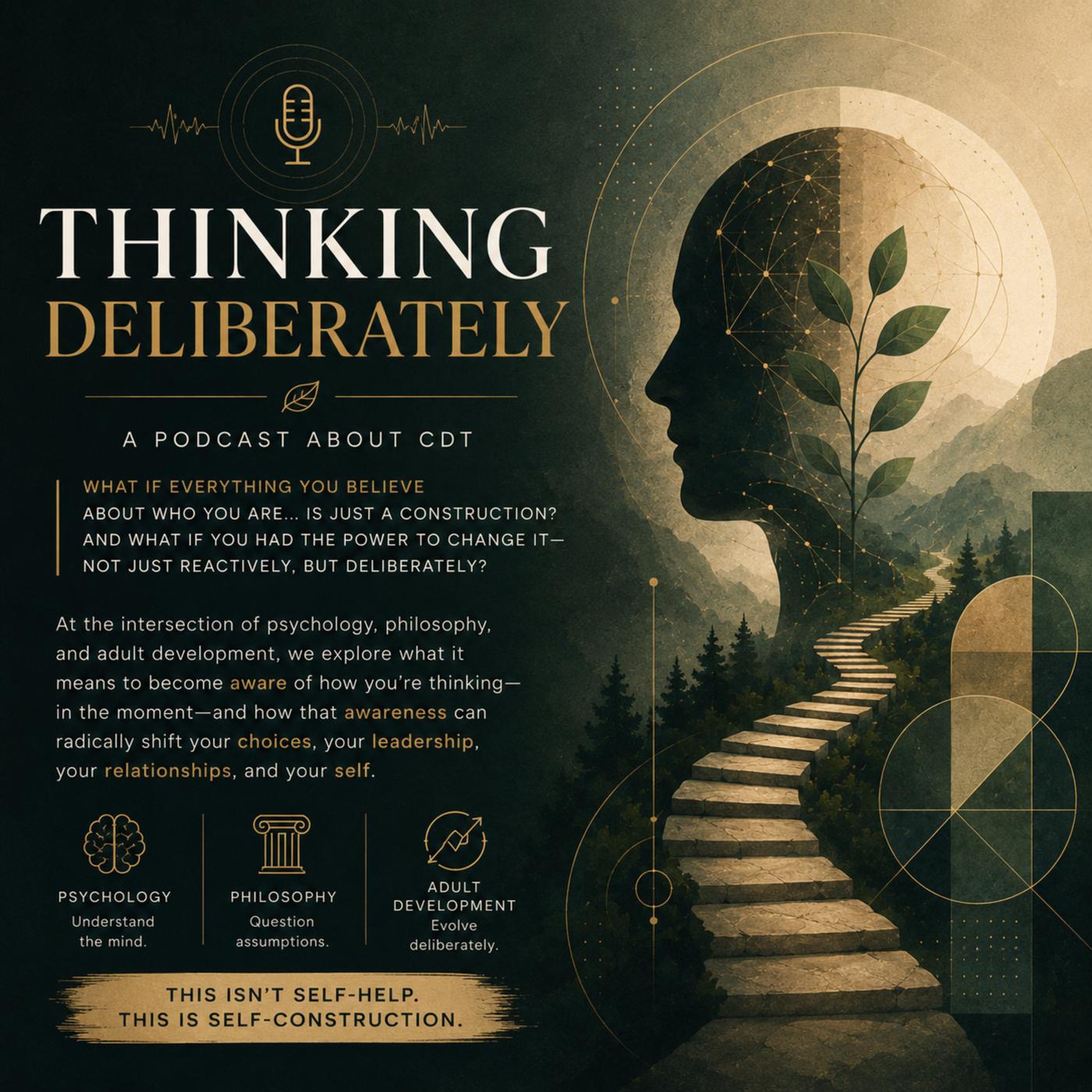
What if everything you believe about who you are… is just a construction?
And what if you had the power to change it, not just reactively, but deliberately?
Thinking Deliberately is a podcast at the intersection of psychology, philosophy, and adult development. Hosted by practitioners and thought leaders in Constructed Development Theory (CDT), we explore what it means to become aware of how you’re thinking — in the moment — and how that awareness can radically shift your choices, your leadership, your relationships, and your self.
This isn’t self-help. This is self-construction.
And what if you had the power to change it, not just reactively, but deliberately?
Thinking Deliberately is a podcast at the intersection of psychology, philosophy, and adult development. Hosted by practitioners and thought leaders in Constructed Development Theory (CDT), we explore what it means to become aware of how you’re thinking — in the moment — and how that awareness can radically shift your choices, your leadership, your relationships, and your self.
This isn’t self-help. This is self-construction.
Värdar:
Uppdateringsfrekvens:
weekly
Genomsnittlig ljudlängd:
18 minutes
Engelsk
Storbritannien
34 avsnitt
sedan 15 juni 2026
episodic
I DENNA PODDSÄNDNING 🔗
SENASTE AVSNITTET 🔗

Today, I'm comparing Constructed Development Theory with Susanne Cook-Greuter's work on ego development, with particular attention to construct awareness.
This is a close comparison because Cook-Greuter already addresses the constructed nature of meaning. CDT has to engage with that directly. Sayin…
SÖK TIDIGARE AVSNITT
Sök efter tidigare avsnitt från Thinking Deliberately - because we don't!.
TIDIGARE AVSNITT 🔗

Welcome back.
This episode compares Constructed Development Theory with Dr Otto Laske's Constructive Developmental Framework, usually shortened to CDF.
Laske is especially interesting because his work gets directly into the structure of thinking. It examines how people make sense of complexity, in…

In this new series, I'm putting Constructed Development Theory into conversation with other accounts of adult development. Today, we're starting with Robert Kegan.
If you know Kegan's work, you'll recognise an immediate connection. What we can examine about our experience is different from what we …

Welcome back to Thinking Deliberately. This is the final episode of our season on tools, models and experiments. Over the previous four episodes, we've explored ways of understanding how people construct their experience and what might help them respond more deliberately. Today I want to bring that…

Today, we bring the ideas of the AQ, TQ and CI's into therapy and coaching through the CAIR model.
The central question is simple enough to say aloud. How are you constructing the thinking that is producing this response, right now? And when you become aware of that construction, what else becomes …

Detecting Thought in Real Time
In the last two episodes, we explored two different dimensions of Constructed Development Theory.
Today, we add a third dimension.
Cognitive Intentions.
Cognitive Intentions ask:
In which direction is attention being organised while the person constructs the situation…

Today, we move to another part of the CDT architecture.
The Thinking Quotient. This one is a bit longer than normal.
And this is where people often become confused.
Because AQ and TQ are related.
But they are not the same thing.
AQ asks:
What is available to awareness?
TQ asks:
How complex is the c…
Today, we begin a new season.
This season is about the practical architecture of Constructed Development Theory.
The tools.
The models.
The assessments.
The experiments.
The things we can actually use to examine how a person is constructing self, context, choice and response.
And the obvious place …
I want to close this Business Unusual season with communication.
But not presentation skills.
Not executive presence.
Not storytelling.
Not how to sound confident while saying very little in a meeting.
I want to talk about ethical communication.
The deeper question is not: “Did the communication wo…
If we want to understand the awareness available across an organisation, what exactly are we looking for?
Can an organisation be aware?
Strictly speaking, no.
An organisation does not have one mind.
It does not wake up in the morning.
It does not possess a single consciousness that can be given an …
Ansvarsfriskrivning: Podcasten och konstverket som är inbäddat på den här sidan är från DrDarrenStevens, som är dess ägares egendom och inte anslutet till eller godkänt av Listen Notes, Inc.
PODCAST SÖKMOTOR
Du kan använda vår webbplats för att söka efter3,825,215podcaster och195,817,643avsnitt efter personer, platser eller ämnen.

I have no special talent. I am only passionately curious, and
I listen to podcasts.
‐ Albert "Llamacorn" Einstein
SÖK TIDIGARE AVSNITT
Sök efter tidigare avsnitt från Thinking Deliberately - because we don't!.
GÖR ANSPRÅK PÅ DENNA PODDSÄNDNING
Why to claim podcasts?
If you are a podcaster, the best way to manage your podcasts on Listen Notes is by claiming your Listen Notes
podcast pages.
It is a great, free way to engage the podcast community and increase the visibility of your podcasts.
After claiming your Listen Notes podcast pages, you will be able to:
✓
Manually refresh the RSS feed to sync up
✓
Get a verified badge (
✓
) alongside with your podcast name on Listen Notes
✓
Post radannonser for sponsorship,
guests, co-hosts,
cross-promotion...
✓
Respond to listener comments on Listen Notes
✓
Use speech-to-text techniques to transcribe your show and
edit transcripts
✓
Improve the presence of your podcasts, e.g., self-service
podcastintervju...
✓
If you share your Listen Notes page and at-mention @ListenNotes
on X (formerly Twitter),
vårt officiella X-konto (tidigare Twitter) will retweet to promote
your show to our followers.
Coming soon:
◯ Self-service promotion on Listen Notes
◯ Track your podcast stats on Listen
Notes, e.g., listens, page
views...
◯ Manage episodes
REDIGERA
Tack för att du hjälper till att hålla databasen över podcaster uppdaterad.
