
ABOUT THIS PODCAST 🔗
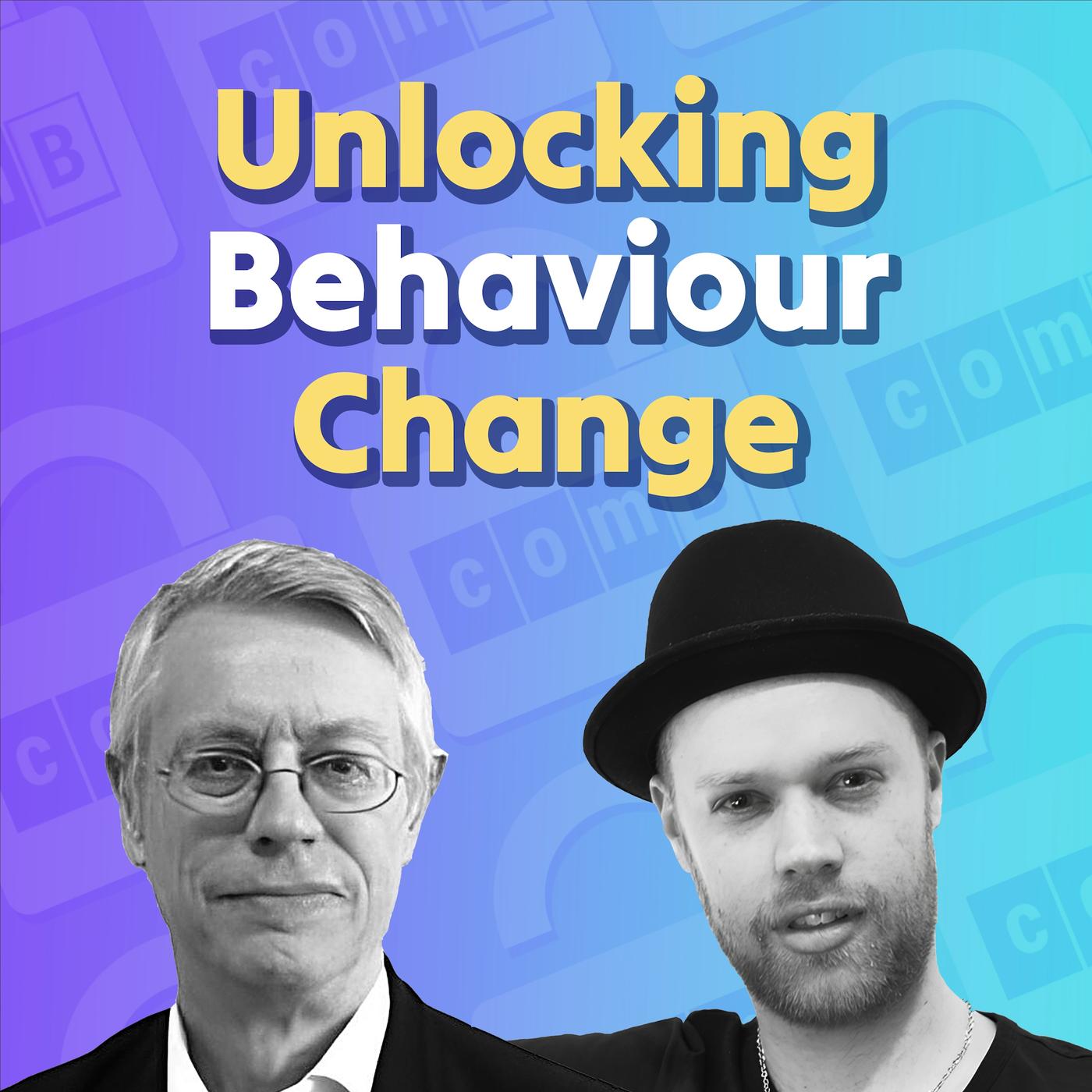
Unlocking Behaviour Change is a podcast delving into psychology and motivation. Join Professor Robert West, a world-leading behavioural scientist, and Jamie West, a writer and musician, as they explore the human mind with practical insights and a touch of humour. Whether you’re into psychology, behaviour science, or just want to understand yourself (and others) a little better, this podcast is for you.
Check out our latest books:
Energise: The Secrets Of Motivation: https://shorturl.at/bbA7y
React: Harness Your Animal Brain: https://shorturl.at/yiFQ9
Sign up to Robert’s Substack: https://robertwest100.substack.com/
Subscribe to the UBC YouTube channel: https://www.youtube.com/@unlockingbehaviourchange
Check out our latest books:
Energise: The Secrets Of Motivation: https://shorturl.at/bbA7y
React: Harness Your Animal Brain: https://shorturl.at/yiFQ9
Sign up to Robert’s Substack: https://robertwest100.substack.com/
Subscribe to the UBC YouTube channel: https://www.youtube.com/@unlockingbehaviourchange
Update frequency:
weekly
Average audio length:
28 minutes
English
United States
72 episodes
since May 22, 2025
episodic
IN THIS PODCAST 🔗
LATEST EPISODE 🔗
Robert has a bone to pick with economic theory . . . In fact, he wants to pick its bones clean and start over with a much better theory for everyone! Join the duo as they discuss what economic theory gets wrong and how it might be put right . . .
Want more? Check out our latest books:
Energis…
SEARCH PAST EPISODES
Search past episodes of Unlocking Behaviour Change.
PREVIOUS EPISODES 🔗
Derisory amounts of money paid for a piece of work called an 'honorarium' seem ok when if they were a 'fee', it would be insulting! Robert and Jamie discuss how we react differently to the same things when they are classified and labelled differently. This includes clinical diagnoses, where receivi…
Robert and Jamie discuss the crucial question of how we classify and label things: one of the most basic things that we do in our mental and social world. But in an infinitely complex universe, putting things into boxes is fraught with difficulties, and classifications lie at the heart of important…
Robert and Jamie pay tribute to Dolly Parton - and Jamie plugs his video on her which can be found here - and then discuss how our intuitions about probability can be seriously misleading - leading to disastrous decisions. Robert explains why decision-makers must understand numerical probability. R…
Robert and Jamie discuss various ways in which we understand probability, including a tendency to 'overchunk' probabilities ('possible', 'likely'), and how these can lead to disastrous decisions.
Want more? Check out our latest books:
Energise: The Secrets Of Motivation: https://shorturl.at/bbA…
Robert makes the bold claim that 'probability' underlies all knowledge and that behavioural scientist should always be thinking about knowledge and claims we make in terms of 'priors' (their judgement of the likelihood that something is true before gathering some evidence) and their 'posterior prob…
Robert and Jamie discuss the ubiquitous phenomenon, illustrated by one of the episodes in The Odyssey, that the first priority of our motivational system is not necessarily our best interests, or even what we most enjoy - it's something else. Because humans kind of know this, we are sometimes willi…
In the second half of a two-parter, Robert explains the limitations of the Theory of Planned Behaviour and how the COM-B model addresses these. The Theory of Planned Behaviour is EXTREMELY widely used and increasingly so despite its age. Among the limitations of the TPB that COM-B addresses are: 1)…
The COM-B model of behaviour was put forward in 2011 as a comprehensive model of behaviour, capturing influences that lay within individuals (capability and motivation) as well as the outside world (opportunity). It has become popular, with some 17,000 citations to the original paper, but nothing l…
Last but not least in our miniseries on decision fails we have 'I didn't ask'. Even when we think we know it all, we should often ask for another opinion or perspective. And we should always reflect on our own limitations and be willing to consult experts for important decisions that require techni…
Disclaimer: The podcast and artwork embedded on this page are from Robert West, which is the property of its owner and not affiliated with or endorsed by Listen Notes, Inc.
PODCAST SEARCH ENGINE
You can use our website to search 3,822,708 podcasts and 195,605,884 episodes by people, places, or topics.

If I have seen further than others, it is by listening to podcasts and standing upon the shoulders of
giants.
‐ Isaac "Llamacorn" Newton
SEARCH PAST EPISODES
Search past episodes of Unlocking Behaviour Change.
CLAIM THIS PODCAST
Why to claim podcasts?
If you are a podcaster, the best way to manage your podcasts on Listen Notes is by claiming your Listen Notes
podcast pages.
It is a great, free way to engage the podcast community and increase the visibility of your podcasts.
After claiming your Listen Notes podcast pages, you will be able to:
✓
Manually refresh the RSS feed to sync up
✓
Get a verified badge (
✓
) alongside with your podcast name on Listen Notes
✓
Post classified ads for sponsorship,
guests, co-hosts,
cross-promotion...
✓
Respond to listener comments on Listen Notes
✓
Use speech-to-text techniques to transcribe your show and
edit transcripts
✓
Improve the presence of your podcasts, e.g., self-service
podcaster interview...
✓
If you share your Listen Notes page and at-mention @ListenNotes
on X (formerly Twitter),
our official X (formerly Twitter) account will retweet to promote
your show to our followers.
Coming soon:
◯ Self-service promotion on Listen Notes
◯ Track your podcast stats on Listen
Notes, e.g., listens, page
views...
◯ Manage episodes
EDIT
Thank you for helping to keep the podcast database up to date.
