
ABOUT THIS PODCAST 🔗
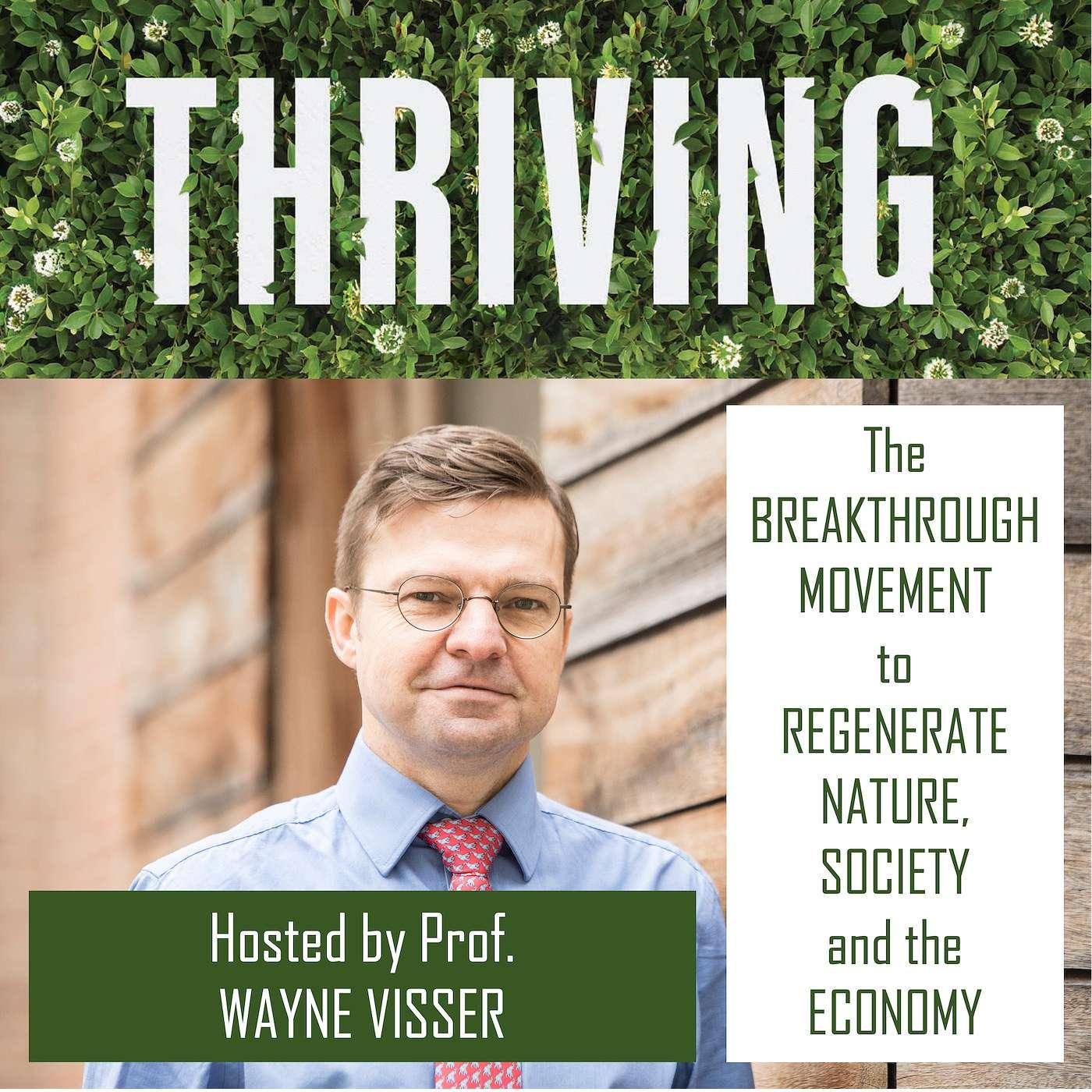
Join me, Prof Wayne Visser, for inspiring conversations with leaders in the breakthrough movement to regenerate nature, society and the economy. Thriving is about going beyond sustainability to a net positive agenda of innovation and regeneration. Each episode is a dialogue with thought leaders and pioneering practitioners, capturing their perspective on the six great transitions to thriving: how to go from degradation to restoration of ecosystems, from depletion to renewal of resources, from disparity to responsibility in communities and workplaces, from disease to revitalisation of health, from disconnection to rewiring through technology, and from disruption to resilience in infrastructure and institutions. We also explore what kind of leadership are needed to create a thriving future, and how organisations can take action to integrate thriving into their strategies, products and services. This is not about false hope or blind optimism, but we actively focus on innovative solutions and positive tipping points for change. The podcast builds on the foundations of my bestselling book "Thriving: The Breakthrough Movement to Regenerate Nature, Society and the Economy." I look forward to having you join the movement for thriving and welcome your suggestions for who I should feature as invited guests on the podcast. Credits: Host: Wayne Visser. Podcast music: Amil Raja
Hosts:
Update frequency:
weekly
Average audio length:
31 minutes
Guest interviews
English
United Kingdom
58 episodes
since June 3, 2022
episodic
LATEST EPISODE 🔗
Episode 12 is based on "Witness" (Epilogue).
Core Theme: Joining the global collective movement for socio-ecological regeneration.
The Six Sixes Matrix: A final synthesis of the keys, breakthroughs, market opportunities, and leadership qualities of thriving [801, Table E.1].
Thriving as a…
SEARCH PAST EPISODES
Search past episodes of Thriving: The Breakthrough Movement.
PREVIOUS EPISODES 🔗
Episode 11 is based on "Leadership" (Chapter 10)
Core Theme: Nurturing the specific characteristics and archetypes required to guide systemic change.
Thriving-Driven Qualities: A breakdown of the six core leader traits: being Systemic, Inclusive, Strategic, Caring, Innovative, and Courage…
Episode 10 is based on "Integration" (Chapter 9).
Core Theme: Embedding thriving and value creation into the core DNA of organizations.
Watermelons to Biogas: Exploring Biogen's anaerobic digestion plant in Cambridge, which processes rotting municipal food waste into clean biogas and…
Episode 9 is based on "Resilience" (Chapter 8).
Core Theme: Preparing infrastructure, economies, and communities to bounce back from systemic shocks.
Stories of Survival: Highlighting Fahrije Hoti and the widows of Krushe e Madhe in Kosovo, who overcame profound tragedy to build Krusha—a …
Episode 8 is based on "Rewiring" (Chapter 7).
Core Theme: Aligning the Fourth Industrial Revolution to serve nature and society.
M-Pesa and M-Kopa: Tracing the rise of the "Silicon Savanna" in Nairobi. M-Pesa's mobile text-based banking brought financial services to million…
Episode 7 is based on "Revitalization" (Chapter 6).
Core Theme: Prioritizing health, vitality, and well-being as the ultimate measures of a successful society.
The Miracle of Andi: A deeply personal story of Wayne Visser’s son, Andi, who suffered a severe heart valve infection and went in…
Episode 6 is based on "Responsibility" (Chapter 5).
Core Theme: Turning disparity into responsibility by making the economy truly inclusive.
The Access Economy: Challenging "global apartheid" by giving marginalized groups fair access to economic opportunities through shared serv…
Episode 5 is based on "Renewal" (Chapter 4).
Core Theme: Redesigning the economy to mimic nature’s zero-waste cycles.
Borrow, Make, Use, Return: Shifting from the linear "take-make-use-lose" model to a circular economy where every output is a nutrient for another process.
Bio-lo…
Episode 4 is based on "Restoration" (Chapter 3).
Core Theme: Moving from the "crime of ecocide" to an economy that actively restores nature.
The Ecoservices Economy: Valuing nature's "invisible" contributions—like water purification and pollination—which are estim…
Based on "Paradox" (Chapter 2)
Core Theme: Recognizing the "forces of fragmentation" that act as triggers for systemic transformation.
The Forces of fragmentation: A look at the six distinct ways our current systems are breaking down: Degradation of ecosystems, Depletion of reso…
Disclaimer: The podcast and artwork embedded on this page are from Wayne Visser, which is the property of its owner and not affiliated with or endorsed by Listen Notes, Inc.
PODCAST SEARCH ENGINE
You can use our website to search 3,825,344 podcasts and 195,854,442 episodes by people, places, or topics.

I have no special talent. I am only passionately curious, and
I listen to podcasts.
‐ Albert "Llamacorn" Einstein
SEARCH PAST EPISODES
Search past episodes of Thriving: The Breakthrough Movement.
CLAIM THIS PODCAST
Why to claim podcasts?
If you are a podcaster, the best way to manage your podcasts on Listen Notes is by claiming your Listen Notes
podcast pages.
It is a great, free way to engage the podcast community and increase the visibility of your podcasts.
After claiming your Listen Notes podcast pages, you will be able to:
✓
Manually refresh the RSS feed to sync up
✓
Get a verified badge (
✓
) alongside with your podcast name on Listen Notes
✓
Post classified ads for sponsorship,
guests, co-hosts,
cross-promotion...
✓
Respond to listener comments on Listen Notes
✓
Use speech-to-text techniques to transcribe your show and
edit transcripts
✓
Improve the presence of your podcasts, e.g., self-service
podcaster interview...
✓
If you share your Listen Notes page and at-mention @ListenNotes
on X (formerly Twitter),
our official X (formerly Twitter) account will retweet to promote
your show to our followers.
Coming soon:
◯ Self-service promotion on Listen Notes
◯ Track your podcast stats on Listen
Notes, e.g., listens, page
views...
◯ Manage episodes
EDIT
Thank you for helping to keep the podcast database up to date.
