ABOUT THIS EPISODE
Guest: Wing Commander Donald Ferguson Fleming, retired, RNZAF, known as Don
Host: Dave Homewood
Recorded: 22nd of January 2026
Released: 26th of September 2026
Duration: 2 hour 37 minutes 27 seconds
Dave Homewood sits down with Don Fleming, who grew up in the wild back blocks of the Whanganui River in the 1930s and early 40s. He got interested in aviation while at New Plymouth Boy’s High School as a boarder. And he was inspired when Squadron Leader Bob McKay flew the country’s first jet, Gloster Meteor NZ6001, over his school.
Don joined the Royal New Zealand Air Force in 1950, hoping to become a pilot, but instead finding himself training as an engineer. After training he was posted to No. 75 Squadron who were still operating de Havilland Mosquitoes, but this did not last long because he swapped his posting with a friend, and he ended up on No. 14 Squadron RNZAF which had just been re-equipped with and were converting onto de Havilland Vampire jets.
Don was on the Advanced Party of No. 14 Squadron when they deployed to Nicosia in Cyprus in October 1952, and he was assigned as the mechanic who looked after pilot Stuart McIntyre’s Vampire. He talks about life on the squadron at Cyprus, and the squadron’s Coronation tour in Africa.
He tells how at the end of his Cyprus tour, a last minute decision to fly to England to meet the RNZAF Handley Page Hastings there and catch it to fly home (instead of waiting for it to reach Cyprus) nearly ended in disaster with him stuck there. But he ended up at Pembroke Dock in Wales where he joined the crew of newly purchased Short Sunderland MR.5 NZ4115, which was being ferried to New Zealand. He tells about how the hull was holed in Egypt and he had to find a way to stop water rushing in. And then further incidents along the trip to New Zealand.
Don was commissioned and spent time as a Transport Officer at RNZAF Shelly Bay. During that time he studied by correspondence for a New Zealand Certificate in Engineering. He passed that and was then sent off by the RNZAF Engineering Branch to England for a post-gradate course at the College at RAF Henlow.
Following the RAF course, Don was posted in as second-in-charge of the Airframe Reconditioning Squadron at No. 1 Repair Depot, RNZAF Base Woodbourne.
He then did a crash course at No. 2 Technical Training School, Wigram, to refresh his avionics knowledge, before being sent to NAS Moffett Field in the USA where he joined the RNZAF team who were learning all about the Lockheed P-3B Orion. They were responsible for receiving the RNZAF’s new fleet of five Orions from Lockheed.
Once the Orion mission was completed, Don was back at Whenuapai and posted to No. 40 Squadron, looking after the Lockheed C-130H Hercules. And then he was back to Wellington, working in Air Department.
After three years at Air Department Don was planning to leave the RNZAF, but instead he found himself posted to London as the Engineer Officer representative. He was involved in overseeing the building of the BAC167 Strikemaster fleet and the Westland Wasps. He was at the launch of the Royal New Zealand Navy’s frigate HMNZS Canterbury and went on its sea trials with the Wasp Flight.
When his London posting ended, Don returned to New Zealand as chief training officer of the RNZAF, looking after all the training and exams. He retired with the rank of Wing Commander in 1976, or 1977.
When he left the RNZAF after more than quarter of a century, he went to work with U.E.B (United Empire Box), and he ended up managing and rescuing a paper bag factory in Wellington. Once he had put that factory back on it’s feet, he was then shifted to manage the Bremworth Carpet Mill. And then he was shifted again to manage Roxburgh Furniture, in Te Atatu.
Don’s next role was heading up the textile and apparel trade training board. And he became trade training officer for the security guard industry.
And then he joined Hawker Pacific as quality control manager and worked there for eleven years, till he retired in 1983.
In retirement Don kept busy, serving for around a decade as a member of the Aeronautical Council of the Royal Aeronautical Society, and Chairman of the Auckland Branch of the RAeS.
He also worked with for years with Geoff Rodliffe in building a replica of Richard Pearse’s Flyer, in association with MOTAT. They even took the aeroplane to England and displayed it with the engine running at Old Warden, and in Cornwall.
Don also talks about working at Buckingham Palace Garden Parties, and working with Governor-General Sir Denis Blundall.
The music at the end of this episode is Wild Flower by Joachim Karud.
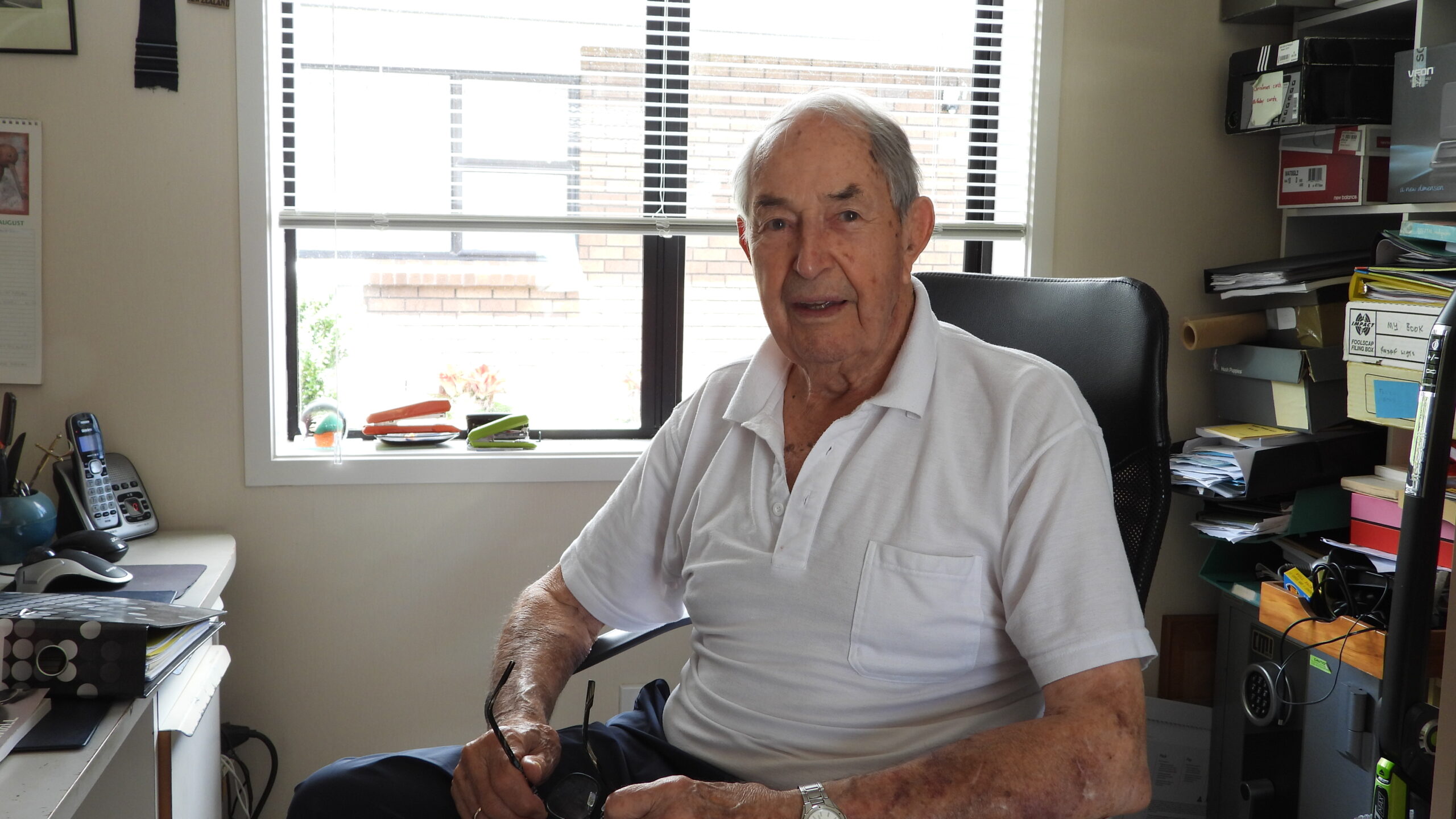
Don Fleming in January 2026