
ABOUT THIS PODCAST 🔗
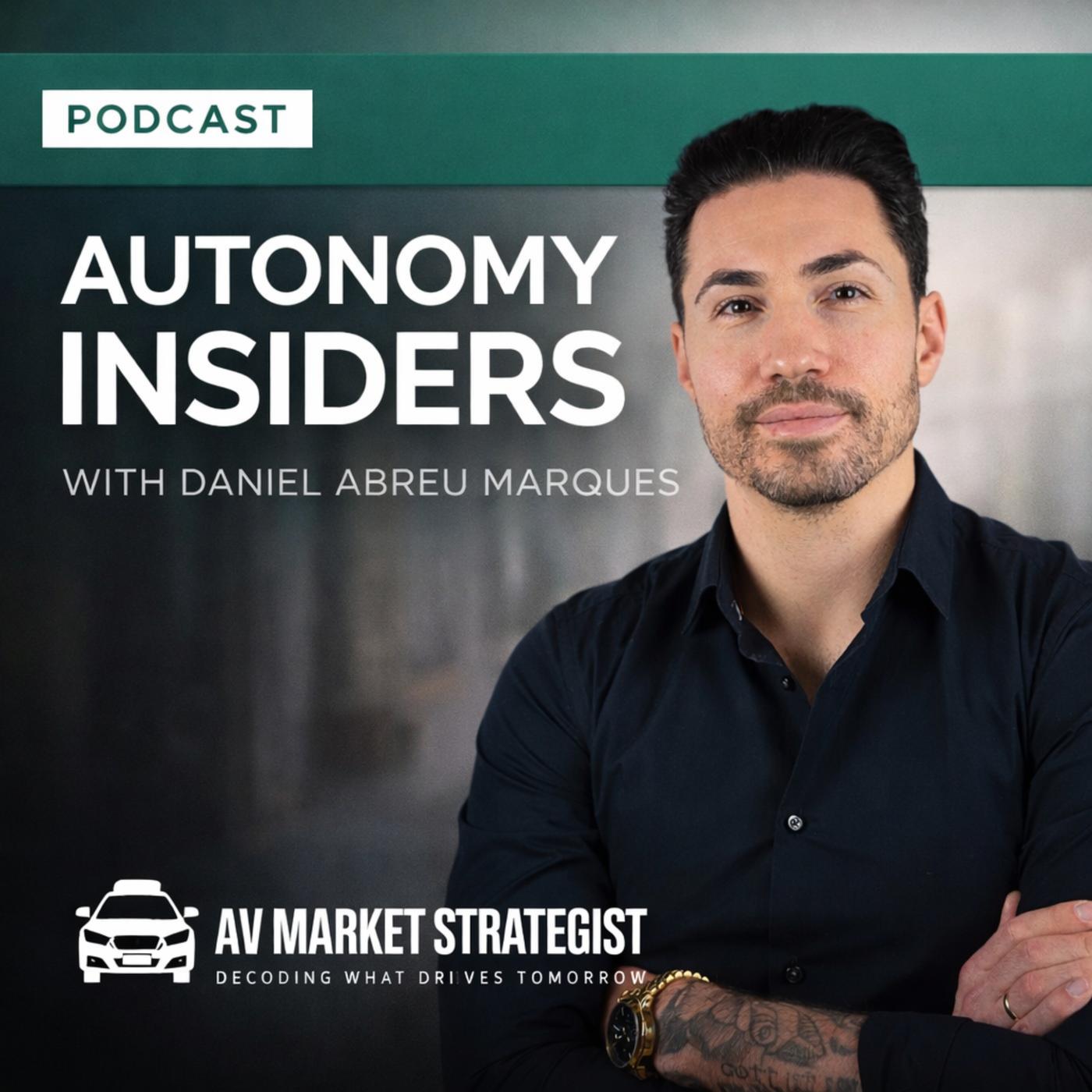
Autonomy Insiders is the weekly podcast for people who need a clear view of autonomous driving, not recycled takes.
Each episode features interviews with leaders across the autonomy ecosystem: robotaxi operators, OEMs, platform players, regulators, and investors.
We go deep on Europe and China, markets that are often under-covered, and we always connect back to the US so you can compare playbooks.
We talk about what changes outcomes: deployment constraints, unit economics, partnership strategy, safety cases, regulation, and the real work of scaling fleets and operations.
You will hear what leaders are optimizing for, where they are stuck, and what they think is coming next.
If you follow autonomous vehicles, this is built for you.
Hosts:
Update frequency:
weekly
Average audio length:
42 minutes
Guest interviews
English
United States
38 episodes
since March 8, 2026
episodic
LATEST EPISODE 🔗
Waymo picked Munich, and Germany wants to become the lead market for autonomous driving. Yet five years after its Level 4 law, no driverless passenger service runs in regular operation.
Christian Hirte is Parliamentary State Secretary to the Federal Minister of Transport and one of the political fa…
SEARCH PAST EPISODES
Search past episodes of Autonomy Insiders.
PREVIOUS EPISODES 🔗
Waymo now pays riders to combine a robotaxi with the bus or train. Is that real integration with public transit, or a smart way to win over transit riders?
Dr. Henriette Cornet has worked on both sides of this question. She led automated mobility at UITP, the global public transport association, co…
Pony AI CEO James Peng on the robotaxi math behind his company: what one car has to earn, who should own it, and how many it takes before the whole company pays for itself.
Dr. James Peng co-founded Pony AI in Silicon Valley in 2016 after years at Google and Baidu. Today the company is listed on Na…
Every robotaxi still has to be charged, cleaned, repaired and financed. Hertz built a separate company to do that work, and it starts with human drivers.
Doria Holbrook is CEO of Oro Mobility, the fleet platform Hertz launched this year to own, operate and orchestrate vehicles for ride-hail and aut…
Robotaxis get the billions. But driverless shuttles on airports and private campuses may scale first, because the owner of the ground can say yes before the law changes.
Taavi Rõivas was Prime Minister of Estonia. Today he chairs Auve Tech, a Tallinn company that designs its own eight-seat shuttle,…
Is Europe hopelessly behind in autonomous driving, or should it skip the race altogether? Lukas Neckermann thinks both camps are wrong.
If the driving software comes from California, China or Israel, what actually stays in Europe? Who earns the money, who employs the people, and who owns the fleets…
Germany wrote the world's first legal framework for driverless commercial service in 2021. Five years later, no operator holds a regular Level 4 approval. Why?
Till Stegemann is a lawyer at Rödl in Berlin. He advises cities, transport operators and companies on autonomous mobility. He is a co-autho…
Southeast Asia should be the last place AV's arrive. Dense, improvised traffic, monsoon rain and some of the cheapest driver labor in any middle-income region. Yet in April 2026, Punggol in northeast Singapore became the first residential neighborhood in Southeast Asia with a public autonomous pass…
London's first robotaxi service runs on the Uber app with a safety driver still behind the wheel. Here is every step a company must clear before the UK lets it take the driver out.
Tym Syrytczyk co-founded the Institute for Driverless Transport (IFDT), an independent UK research body, and writes S…
Europe's first fully driverless commercial robobus runs in France.
beti is a French operator of automated mobility networks, and a spin-off from Bertolami, a family coach business that has moved people around rural France for 75 years. CEO Benjamin Baudet explains the layer of the autonomous drivi…
Disclaimer: The podcast and artwork embedded on this page are from Daniel Abreu Marques, which is the property of its owner and not affiliated with or endorsed by Listen Notes, Inc.
PODCAST SEARCH ENGINE
You can use our website to search 3,838,379 podcasts and 198,151,068 episodes by people, places, or topics.

An investment in knowledge pays the best interest, so I listen to podcasts.
‐ Benjamin "Llamacorn" Franklin
SEARCH PAST EPISODES
Search past episodes of Autonomy Insiders.
CLAIM THIS PODCAST
Why to claim podcasts?
If you are a podcaster, the best way to manage your podcasts on Listen Notes is by claiming your Listen Notes
podcast pages.
It is a great, free way to engage the podcast community and increase the visibility of your podcasts.
After claiming your Listen Notes podcast pages, you will be able to:
✓
Manually refresh the RSS feed to sync up
✓
Get a verified badge (
✓
) alongside with your podcast name on Listen Notes
✓
Post classified ads for sponsorship,
guests, co-hosts,
cross-promotion...
✓
Respond to listener comments on Listen Notes
✓
Use speech-to-text techniques to transcribe your show and
edit transcripts
✓
Improve the presence of your podcasts, e.g., self-service
podcaster interview...
✓
If you share your Listen Notes page and at-mention @ListenNotes
on X (formerly Twitter),
our official X (formerly Twitter) account will retweet to promote
your show to our followers.
Coming soon:
◯ Self-service promotion on Listen Notes
◯ Track your podcast stats on Listen
Notes, e.g., listens, page
views...
◯ Manage episodes
EDIT
Thank you for helping to keep the podcast database up to date.
