


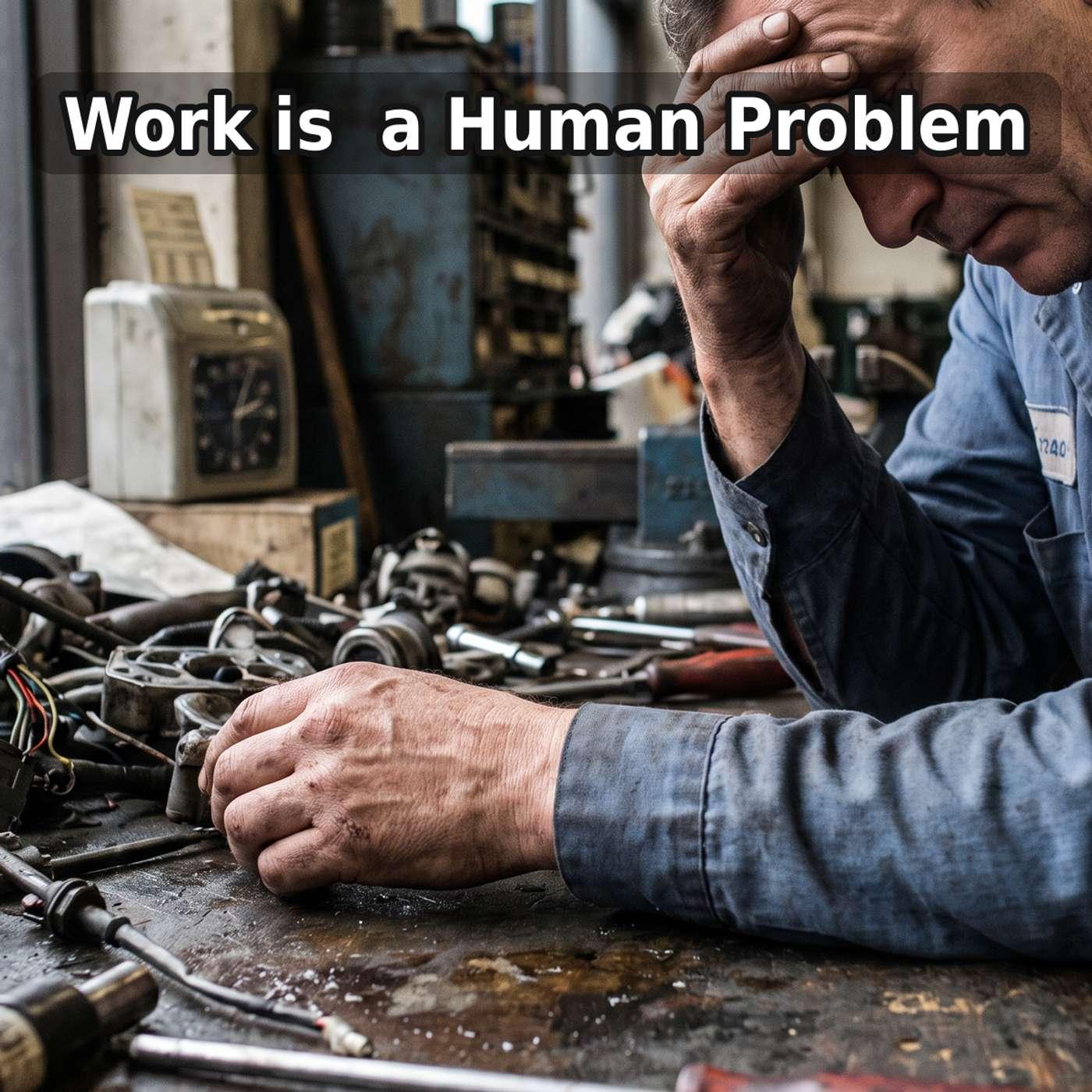
This is Dave 317 work is a human problem.
A fascinating book to read. If you can find a copy of, it was a book created by Studs, Terkel in 1974 called working.
This book was developed through several questions from his Chicago, radio host job.
He moonlighted as an oral historian of sorts, he interviewed over 100 people in a wide variety of occupations, and just let them talk for themselves. He did not ask them the typical things. Like, what do you do for living? He said, asked them things like what does work in here? Do for you. What Circle discovered was that people are doing a lot more than exchanging time for money and these settings, they are actually searching searching for things like meaning dignity, recognition, atomy, usefulness, connection,
When those things are deprived, even well paid work can become absolutely miserable.
I have first-hand experience here. I voluntary, I voluntarily walked away from a high paying job, simply because the work had become miserable. And I, no longer felt that what I was doing mattered.
As a company, we just keep repeating the same failed experiments over and over again. And the improvements and growth that we had accomplished kept getting unraveled.
So you started seeing anything that you built just fall to pieces around you.
Turkle discovered that people really want to establish evidence that they that they actually existed.
Take that away and they will just not talk highly about their jobs.
A top-level executive for a big company, would talk far less enthusiastically than a stone Mason or a carpenter or even a teacher. Why? Well, it was simple, the stone Mason who builds a wall can point to that wall for decades saying that he had built that, he had contributed to the world and that was a monument to his work. Same thing with a carpenter who works on a house or a teacher who helps to develop a young mind. They can point to something that lasts.
Turkle did not take this on as an economic problem. He approached it as a human problem. There is absolutely a psychological relationship with our work boil, it all down to something that we can.
To boil all down to something that can be replaced by machines. Seems like we are missing the point of work entirely.
Interestingly turkle's work is arguably becoming relevant again, because of AI and automation we are once again asking a very turkle like question.
if technology can perform more and more of the tasks, we call work, what part of work were humans, actually valuing and the first place,
I think this is a question of the day. Not, what are we going to do? When AI takes over everything? That's the wrong question. The right question is, how are we going to build anything that actually matters?
A fascinating book to read. If you can find a copy of, it was a book created by Studs, Terkel in 1974 called working.
This book was developed through several questions from his Chicago, radio host job.
He moonlighted as an oral historian of sorts, he interviewed over 100 people in a wide variety of occupations, and just let them talk for themselves. He did not ask them the typical things. Like, what do you do for living? He said, asked them things like what does work in here? Do for you. What Circle discovered was that people are doing a lot more than exchanging time for money and these settings, they are actually searching searching for things like meaning dignity, recognition, atomy, usefulness, connection,
When those things are deprived, even well paid work can become absolutely miserable.
I have first-hand experience here. I voluntary, I voluntarily walked away from a high paying job, simply because the work had become miserable. And I, no longer felt that what I was doing mattered.
As a company, we just keep repeating the same failed experiments over and over again. And the improvements and growth that we had accomplished kept getting unraveled.
So you started seeing anything that you built just fall to pieces around you.
Turkle discovered that people really want to establish evidence that they that they actually existed.
Take that away and they will just not talk highly about their jobs.
A top-level executive for a big company, would talk far less enthusiastically than a stone Mason or a carpenter or even a teacher. Why? Well, it was simple, the stone Mason who builds a wall can point to that wall for decades saying that he had built that, he had contributed to the world and that was a monument to his work. Same thing with a carpenter who works on a house or a teacher who helps to develop a young mind. They can point to something that lasts.
Turkle did not take this on as an economic problem. He approached it as a human problem. There is absolutely a psychological relationship with our work boil, it all down to something that we can.
To boil all down to something that can be replaced by machines. Seems like we are missing the point of work entirely.
Interestingly turkle's work is arguably becoming relevant again, because of AI and automation we are once again asking a very turkle like question.
if technology can perform more and more of the tasks, we call work, what part of work were humans, actually valuing and the first place,
I think this is a question of the day. Not, what are we going to do? When AI takes over everything? That's the wrong question. The right question is, how are we going to build anything that actually matters?
