

이 팟캐스트 소개 🔗
eChineseLearningPod is your go-to podcast for learning Chinese and exploring Chinese culture — anytime, anywhere. Created by professional teachers at eChineseLearning, this show offers practical language tips, real-life conversations, and cultural insights. Whether you're a total beginner, studying for the HSK, preparing for business in China, or learning Chinese for travel, there’s a series for you.
Join us to build confidence, improve fluency, and understand the real China — one episode at a time.
Powered by Firstory Hosting
업데이트 빈도:
semiweekly
평균 오디오 길이:
7 minutes
중국말
대만
에피소드 133 개
2023년 12월 28일부터
episodic
최신 에피소드 🔗

115年地價稅開徵資訊、多元繳稅方式及納稅者權利保護法相關規定,提升民眾對租稅制度與納稅義務之認識。
並藉由宣導如期繳納地價稅的重要性,提醒納稅義務人於期限內完成繳納,以降低逾期繳納所衍生之滯納金及欠稅案件,進而提升整體稅務服務效能與徵收品質
https://fstry.pse.is/9uekkv
—— 以上為 Firstory Podcast 廣告 ——
Every beginner asks this in the first week, and most teachers answer it too quickly: is Mandarin the same as C…
이전 에피소드 🔗

"Chinese" isn't one language — it's a family, and the first time you stand in a Hong Kong street you find out exactly what that means.
In this episode, Jenny and Mark take apart the two biggest members. Mandarin: over nine hundred million native speakers, and the default language of school, gover…

上有老 下有小,更要留意肺炎鏈球菌找上門!
預防流感已成共識,但多得是你不知道的事
你為預防多一步 守護全家健康不讓步!
立即了解肺炎鏈球菌相關資訊
https://fstry.pse.is/9rpvzq
—— 以上為 Firstory Podcast 廣告 ——
Meeting someone in China for the first time feels like walking into a room where everyone else knows the rules — and nobody handed you the sheet.…

Say "ma" and you could be talking about your mother (妈), a horse (马), or scolding someone (骂). Nothing changes but the pitch, which is exactly why Chinese tones are the wall every learner hits.
In this episode, Jenny hands Mark one tongue twister that packs all four tones into a single breath: 妈妈…

Can you clearly pronounce “four” and “ten” in Chinese?
In this episode, we’ll practice one of the most famous Chinese tongue twisters: “四是四,十是十.” You’ll learn how to distinguish the pronunciation of 四 (sì) and 十 (shí), two sounds that can be tricky for Chinese learners, and challenge yourself to s…

How do you say “shut up” in Chinese without sounding too rude?
In this episode, we’ll explore 7 common Chinese phrases that can mean “shut up,” from playful and joking expressions to stronger and more direct ones. You’ll learn when native Chinese speakers use each phrase, how their tones differ, a…

“That’s crazy!”, you say it all the time in English. But in Chinese, there’s not just one way. There’s seven, and each one sounds different in a different situation.
In this episode, Jenny walks Mark through all seven: 太疯狂了 (the safe standard), 太颠了 (Gen-Z internet slang), 太离谱了 (more judgmental), …
Why do Chinese families look at the full moon on 中秋节? Because of three ancient legends, and the lessons they carry.
In this episode, Jenny tells Mark the stories behind the festival:
Chang’e, the goddess who flew to the moon out of love and sacrifice;
Wu Gang, the man who chops an endless osmanthu…

Planning a trip to China? Xiaohongshu and Tripcom can make your journey much easier. 🇨🇳
In this episode, we’ll introduce two useful apps for traveling in China: Xiaohongshu (RedNote) and Tripcom. You’ll learn how to use Xiaohongshu to discover restaurants, attractions, travel tips, and local recomm…
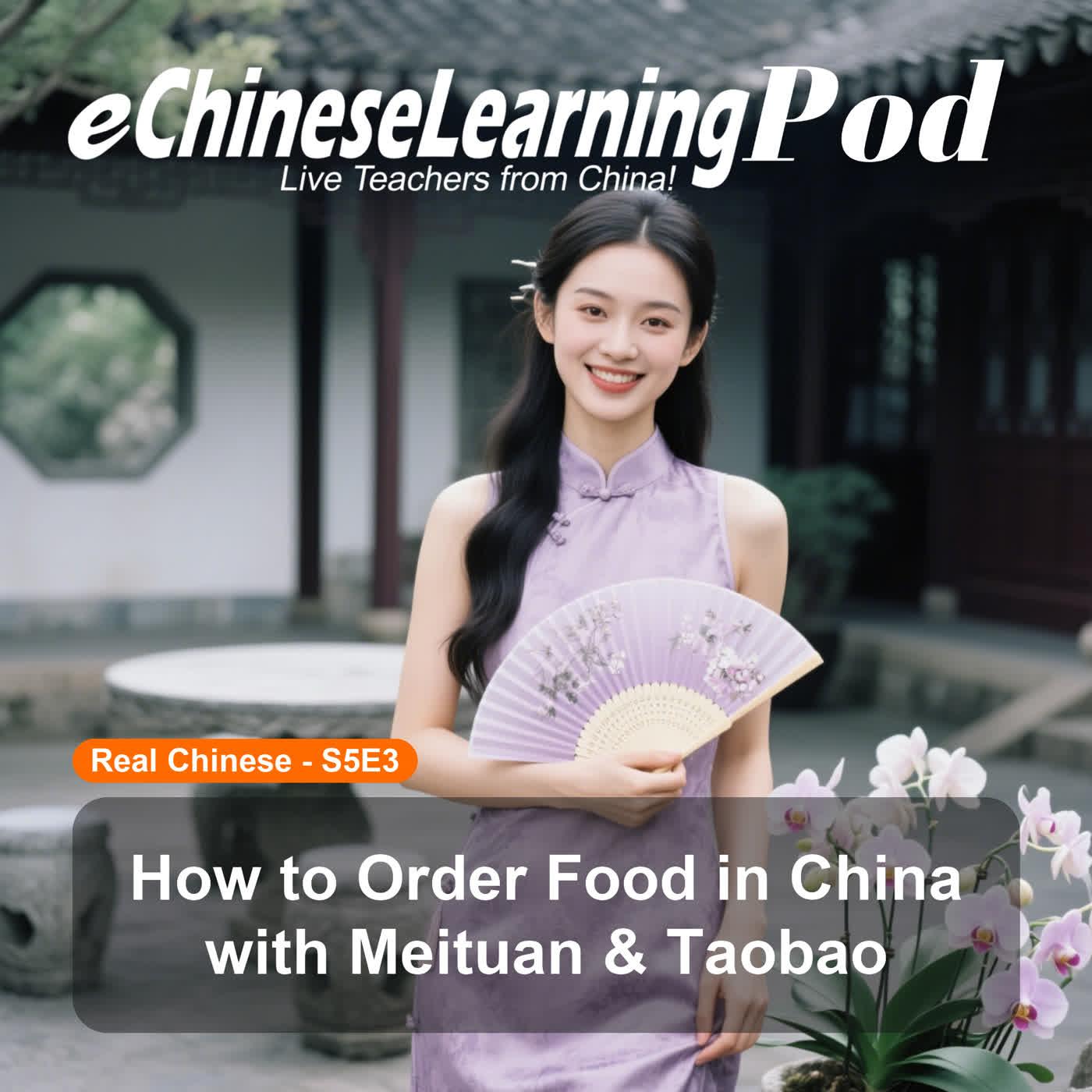
Want to order food in China? 🍜 In this episode, we’ll show you how to use Meituan and Taobao to order takeout, while teaching you the practical Chinese words and phrases you’ll need along the way.
From finding restaurants and choosing dishes to placing your order and checking delivery updates, you’…
면책 조항: 이 페이지에 포함된 팟캐스트와 작품은 eChineseLearningPod에서 가져온 것입니다. 이 팟캐스트는 소유자의 재산이며 Listen Notes, Inc.와 제휴하거나 보증하지 않습니다.
팟캐스트 검색 엔진
당사 웹사이트를 사용하여3,834,224팟캐스트 및197,217,619에피소드를 사람, 장소 또는 주제별로 검색할 수 있습니다.

I have no special talent. I am only passionately curious, and
I listen to podcasts.
‐ Albert "Llamacorn" Einstein
이 팟캐스트 요청하기
Why to claim podcasts?
If you are a podcaster, the best way to manage your podcasts on Listen Notes is by claiming your Listen Notes
podcast pages.
It is a great, free way to engage the podcast community and increase the visibility of your podcasts.
After claiming your Listen Notes podcast pages, you will be able to:
✓
Manually refresh the RSS feed to sync up
✓
Get a verified badge (
✓
) alongside with your podcast name on Listen Notes
✓
Post 분류 광고 for sponsorship,
guests, co-hosts,
cross-promotion...
✓
Respond to listener comments on Listen Notes
✓
Use speech-to-text techniques to transcribe your show and
edit transcripts
✓
Improve the presence of your podcasts, e.g., self-service
팟캐스터 인터뷰...
✓
If you share your Listen Notes page and at-mention @ListenNotes
on X (formerly Twitter),
공식 X(구 Twitter) 계정 will retweet to promote
your show to our followers.
Coming soon:
◯ Self-service promotion on Listen Notes
◯ Track your podcast stats on Listen
Notes, e.g., listens, page
views...
◯ Manage episodes
