

INFORMAZIONI SU QUESTO PODCAST 🔗
Maths on the Move, is the podcast from plus.maths.org. We speak to researchers from the frontiers of mathematical science so you can connect with the maths that shapes and explains our world. Hosted by Plus editors Rachel Thomas and Marianne Freiberger.
Frequenza di aggiornamento:
weekly
Durata media dell'audio:
24 minutes
Interviste agli ospiti
Inglese
Stati Uniti
129 episodi
da 23 Marzo 2022
episodic
AUDIENCE OF THIS PODCAST 🔗
~32.60% of listeners are from Ireland.
🇮🇪
IE
32.60%
🇺🇸
US
29.92%
🇬🇧
GB
13.65%
🇰🇪
KE
5.54%
🇦🇺
AU
2.74%
🇨🇦
CA
2.55%
🇩🇪
DE
2.24%
🇸🇰
SK
1.49%
🇮🇳
IN
1.18%
🇪🇸
ES
0.74%
🇿🇦
ZA
0.56%
🇧🇷
BR
0.56%
🇦🇹
AT
0.49%
🇫🇷
FR
0.49%
🇳🇱
NL
0.43%
🇸🇬
SG
0.37%
🇯🇵
JP
0.37%
🇧🇪
BE
0.31%
🇨🇭
CH
0.31%
🇬🇷
GR
0.31%
🇭🇰
HK
0.31%
🇦🇪
AE
0.31%
🇳🇿
NZ
0.18%
🇳🇴
NO
0.18%
🇷🇴
RO
0.18%
🇲🇽
MX
0.18%
🇺🇦
UA
0.18%
🇹🇼
TW
0.18%
🇮🇱
IL
0.12%
🇸🇪
SE
0.12%
🇩🇰
DK
0.12%
🇹🇷
TR
0.12%
Others
0.97%
* Data source: directly measured on Listen Notes. in tempo reale
ULTIMO EPISODIO 🔗

It feels like we have barely just recovered from this year’s International Congress of Mathematicians, but months of work have already gone into the 2030 ICM! Excitingly for us, it will be happening much closer to home as it will be the first ever multi-country ICM, with the congress taking place i…
CERCA TRA GLI EPISODI PASSATI
Cerca gli episodi passati di Maths on the Move.
EPISODI PRECEDENTI 🔗

While we were at the International Congress of Mathematicians this summer, we were able to speak to one of the invited speakers, Professor Carola-Bibiane Schönlieb, our colleague from the University of Cambridge and long-time Plus collaborator. Carola told us about her fascinating work on inverse p…

There has been a lot of discussion about AI proofs, some of which we have covered earlier in this podcast series. But what actually happens when an AI proof is announced? How much credit should be assigned to human work? How much is hype? We spoke to Henry Bradford, our colleague at the University …

There has been a lot of discussion about AI proofs, some of which we have covered earlier in this podcast series. But what actually happens when an AI proof is announced? How much credit should be assigned to human work? How much is hype? We spoke to Henry Bradford, our colleague at the University …

Recently, Open AI announced that one of their systems had proved one of the hardest maths problems in the world – the Navier-Stokes Millennium Problem, which comes with a million dollar reward. Naturally it has shaken the maths world, but there’s still a lot of confusion about what has actually bee…

Should a life-saving, but expensive, cancer drug be made available on the NHS even though it only benefits very few people? Or should the money be allocated to drugs that lower blood pressure, which help vast swathes of the population? For the final episode of this season, we spoke to Joe Hilton, a…

“He asked me this question because I'm his sister and he loves me.”
Mathematics can often be seen as a solitary endeavour, but as this quote from one of our latest podcast guests show, that is far from the truth. In this episode, we learn how a new proof has developed from one young mathematician…

In this episode, we meet the CEO of one of the most important institutions in mathematics - arXiV. Around since 1991, the website is a publicly accessible home for mathematical research before it is officially published in journals. Around 1,000 articles are published on arXiv every day — it has ho…

What is the potential of artificial intelligence (AI) in scientific research? In this episode, Cambridge Professor James Fergusson talks about some cutting-edge research which addresses this question. James is Director of the Infosys-Cambridge AI Centre, an innovative partnership between traditiona…
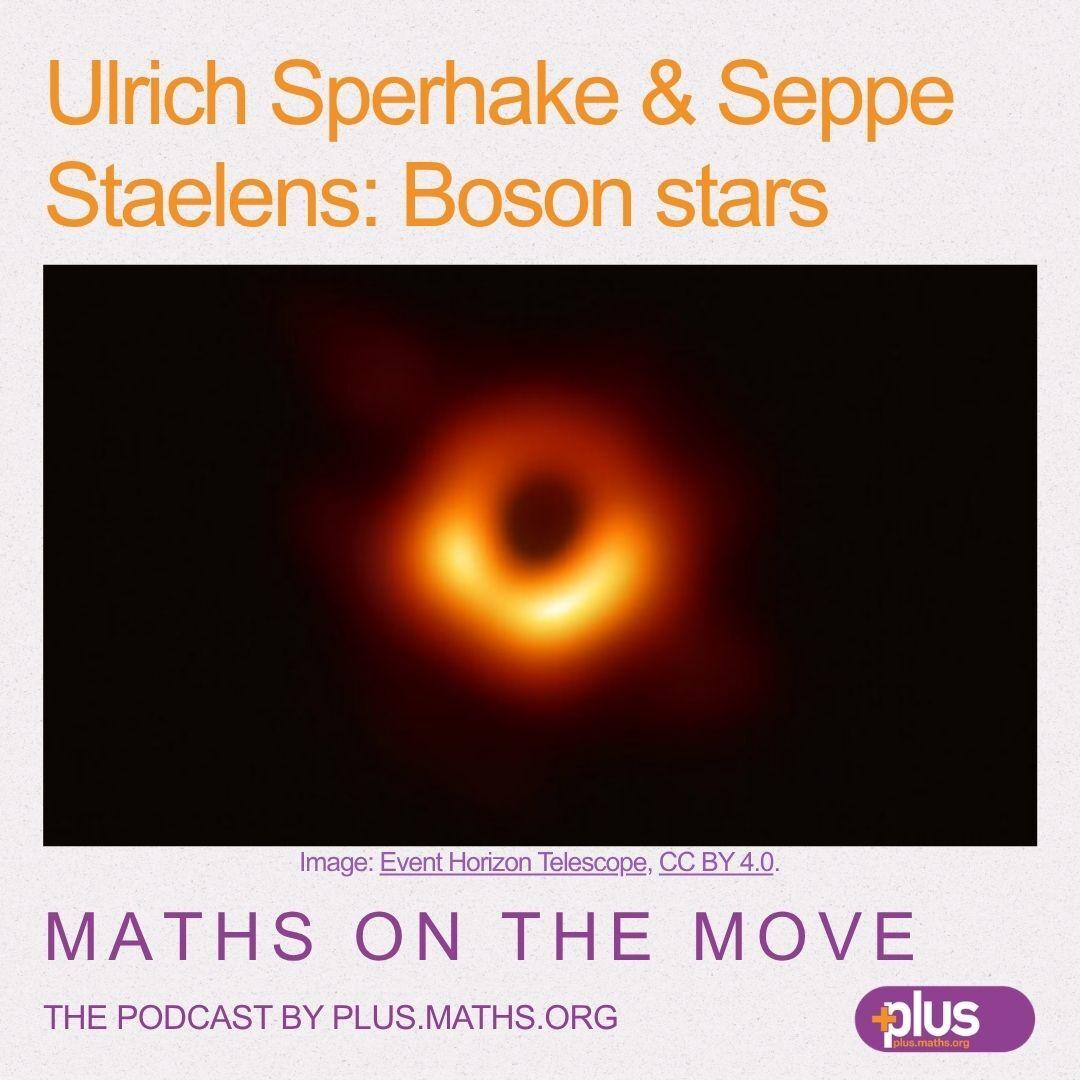
Welcome to the latest episode of Maths on the Move! In this episode we spoke to Cambridge Professor of Theoretical Physics Ulrich Sperhake and his graduate student, Seppe Staelens, about boson stars: hypothetical objects that might be masquerading as black holes.
Our conversation with Ulrich and S…
Dichiarazione di non responsabilità: Il podcast e la grafica incorporati in questa pagina provengono da plus.maths.org, che è di proprietà del suo proprietario e non è affiliato o approvato da Listen Notes, Inc.
MOTORE DI RICERCA PODCAST
Puoi utilizzare il nostro sito Web per cercare podcast3,838,467ed episodi198,177,502per persone, luoghi o argomenti.

If I have seen further than others, it is by listening to podcasts and standing upon the shoulders of
giants.
‐ Isaac "Llamacorn" Newton
CERCA TRA GLI EPISODI PASSATI
Cerca gli episodi passati di Maths on the Move.
RIVENDICA QUESTO PODCAST
Why to claim podcasts?
If you are a podcaster, the best way to manage your podcasts on Listen Notes is by claiming your Listen Notes
podcast pages.
It is a great, free way to engage the podcast community and increase the visibility of your podcasts.
After claiming your Listen Notes podcast pages, you will be able to:
✓
Manually refresh the RSS feed to sync up
✓
Get a verified badge (
✓
) alongside with your podcast name on Listen Notes
✓
Post annunci economici for sponsorship,
guests, co-hosts,
cross-promotion...
✓
Respond to listener comments on Listen Notes
✓
Use speech-to-text techniques to transcribe your show and
edit transcripts
✓
Improve the presence of your podcasts, e.g., self-service
intervista a un podcaster...
✓
If you share your Listen Notes page and at-mention @ListenNotes
on X (formerly Twitter),
il nostro account ufficiale X (in precedenza Twitter) will retweet to promote
your show to our followers.
Coming soon:
◯ Self-service promotion on Listen Notes
◯ Track your podcast stats on Listen
Notes, e.g., listens, page
views...
◯ Manage episodes
MODIFICA
Grazie, ci hai aiutato a mantenere aggiornato il database dei podcast.
