WEBVTT
Jenny Lawson
00:00:00.000 -->
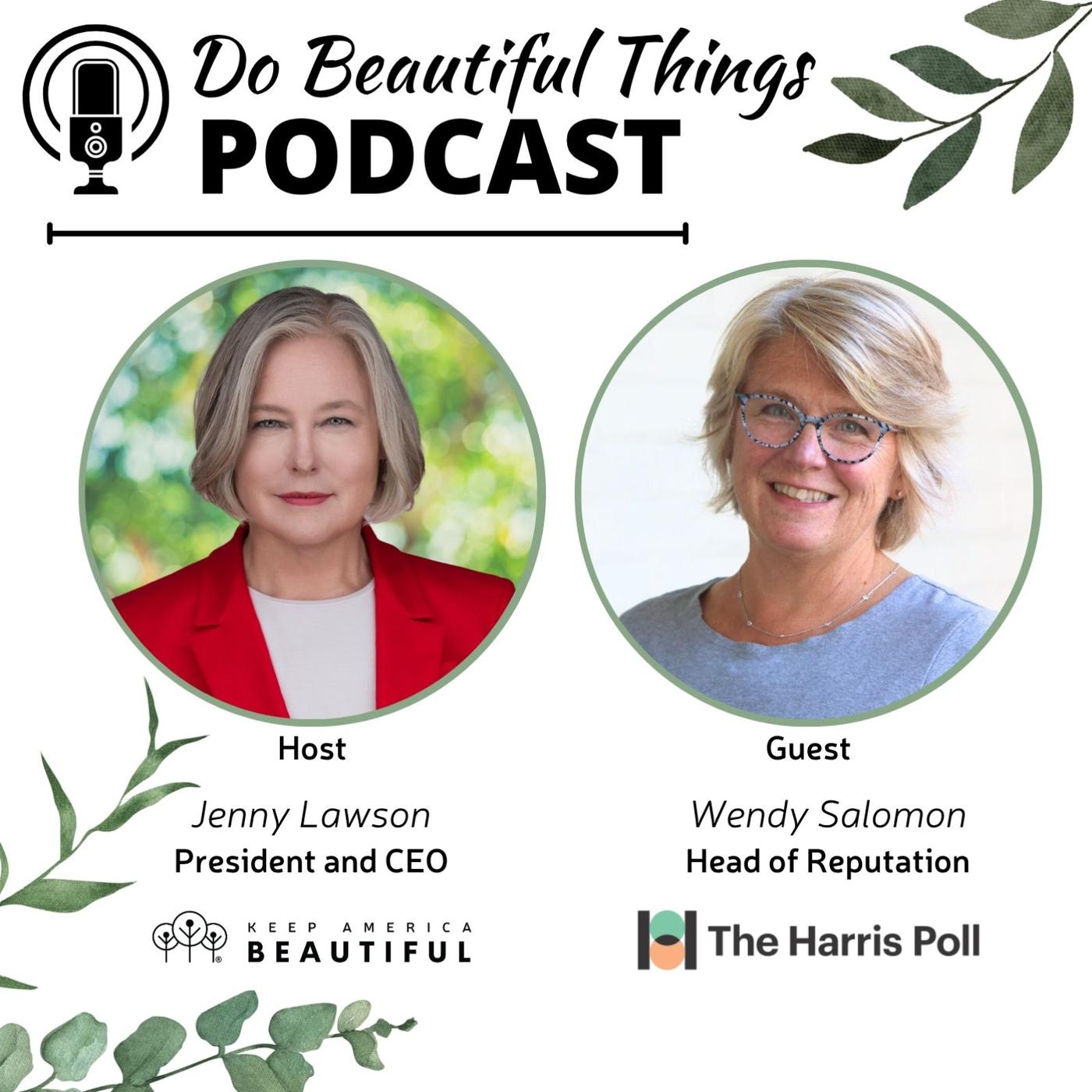
00:00:49.000Welcome to Do Beautiful Things. I'm your host, Jenny Lawson, president and CEO of Keep America Beautiful. On this podcast, we explore all the ways, big or small, that people are stepping up to end litter, rethink recycling, and create cleaner, greener and more beautiful communities. You'll hear from change makers, industry experts, community leaders, and everyday doers who are showing that when we unite to care for the places we love, we can make a real difference. We for each other and for the planet we share. So let's get inspired, let's get connected, and let's do beautiful things. Welcome back to Do Beautiful Things. Today we're continuing our special series on the 2026 Keep America Beautiful national litter study.
Jenny Lawson
00:00:49.000 -->
00:01:45.000We've already covered the hard data with David Scott and the methodology of counting 35 billion pieces of trash with Veronica from HDR. But today we're talking about people get this. 94% of Americans agree that litter is a problem, yet it still plagues our streets, our rivers and our beaches. Why is there such a massive disconnect between how people view the problem and what the numbers tell us? Our guest today is going to help us figure this out. Joining us today is Wendy Solomon, managing director at the Harris Poll where where she leads the reputation and corporate strategy practice. The Harris Poll partnered with us on this groundbreaking research to find out exactly how Americans feel about litter. Wendy, welcome to the show.
Wendy Salomon
00:01:45.000 -->
00:01:47.000Thank you so much. I'm so glad to be here.
Jenny Lawson
00:01:47.000 -->
00:01:56.000Wendy, you've been a guest on the show before, but for all our listeners, let's start with you sharing a little bit about yourself and your role at the Harris Poll.
Wendy Salomon
00:01:56.000 -->
00:02:33.000Sure. So I lead up the corporate strategy and reputation part of the Harris Poll. So we sort of focus at Harris on brand and reputation and of course, thought leadership. And I mean, more and more organizations are looking for data driven platforms. Right. To build their reputation, to help them engage in a way that is agnostic and on issues that matter to them. And basically the work that we're talking about today is actually squarely in what I would say is really unique about Harris, which is, and I've been sort of analyzing this for 30 years or so. But I think what sets us apart is absolutely our curiosity.
Wendy Salomon
00:02:33.000 -->
00:03:11.000Right. And as we talk about people. I loved your intro. We are absolutely committed to understanding what the backdrop of cultural backdrop is. Right. Like to your efforts to accompany to any company's efforts that helps them understand, you know, why do Americans feel the way they feel? Why are they behaving in some ways and on board with some things and not others. Right. And so, so certainly our partnership that we're going to talk about today on this public attitudes piece of the, of the, of the pie is squarely fits in this thought leadership space, this curiosity that, that Harris has and really sort of threading the needle between that cultural context and the issues that matter.
Jenny Lawson
00:03:11.000 -->
00:03:48.000Thank you. And that's why we are delighted to partner with you on this. And I think that, you know, what we know is that litter, the behavior of littering is a behavior element to it. Right. It's how people think and act and respond to their environment is clearly a part of what drives litter and littering numbers. There's infrastructure, there's all sorts of other things. So it's not an exclusive, but so understanding what motivates people, how they see the problem and what's ahead is a really important part of this. So maybe we step back and just start with headlines.
Jenny Lawson
00:03:48.000 -->
00:03:54.000Right. What are the major headlines and key takeaways from the study on how Americans are viewing litter today?
Wendy Salomon
00:03:54.000 -->
00:04:24.000I mean, I think the most important one, and this is literally like stepping back further, maybe even in the question is implying. But like, I think what this study is pointing to is that even against the maelstrom of today. Right, right. And I think we can, we can talk more about that. Right. But the main finding unequivocally says that the work that, that Keep America Beautiful is doing is important. Right. The idea of how topical litter is more topical than I was expecting.
Wendy Salomon
00:04:24.000 -->
00:04:52.000The idea to which the American public says this isn't just something we're talking about, but like this is something that has an appreciable impact on my quality of life. Right. So community beautification is absolutely socially relevant part of the conversation. And even so, a little more so for younger Americans, I think is really important to the story. And people believe it's a major problem. So in truth, they feel like it's not getting any better. And I think we're going to unpack that a little bit too. Right.
Wendy Salomon
00:04:52.000 -->
00:05:20.000Because your physical study proved a little bit of a different story. But the idea that there's something that is so culturally relevant and that is seen as something that actually can impact, you know, our comfort, our security, our housing values. Right. There's unanimous, absolutely non polar, non politically polarized agreement about the negative impacts. And so I think it really just double underscores the work you're doing. And there's a certain meeting of the moment.
Jenny Lawson
00:05:20.000 -->
00:06:20.000I think we're excited to see where that goes, actually. Right. How do we meet the moment and how do we understand, you know, that idea that people don't see the change? How do you help them? I think embrace that change is actually possible, which I think is a challenge for this moment. Right. I think folks are so stuck in that nothing's ever going to get fixed around here mindset that the idea that things can get better and we actually have a solution that's starting to work and has been working is I think, an exciting place to explore with people and how they think about litter. So in that sort of disconnected space, there's a fascinating disconnect in the data, right. 94% of Americans see litter as a national issue, but it drops to 76% of Americans see it as an issue when they're looking in their own communities.
Wendy Salomon
00:06:20.000 -->
00:06:21.000Yeah.
Jenny Lawson
00:06:21.000 -->
00:06:22.000Why do you think that is?
Wendy Salomon
00:06:22.000 -->
00:06:52.000You know, it's interesting because we all sort of came of age with the whole grass is always greener. Right. Like, we're always sort of thinking it's better somewhere else. But you're absolutely right in this, in this instance, when we are in like when we're asked to evaluate that familiar space that is our community. Now granted, still 76% still say it's problem. Right. So, but it's far less than we see it at the national level, but we see that, we see it as worse outside our own communities. And so now when we say think about America, that's a more generalized understanding.
Wendy Salomon
00:06:52.000 -->
00:07:47.000It's more abstract, Right. It's more like what the news tells us, what media tells us, what, you know, maybe some trips we've taken along highways, waterways, beaches, cities, et cetera. Right. So we know that our assessment of America is more wake us up in the middle of night and what are we going to say about that? Whereas our assessment of our communities is far more, I think, grounded in that familiarity. So, so there is something about local and, but, but honestly, Jenny, I think this is also part of a broader trend we're seeing at Harris where like, we know that things that are more community, like the more local something is, the more sheltered they are from some of the concerns and the vitriol we see sort of across our, our nation more broadly. Like, so, you know, we don't trust the media, but our local news guy just, we, we love him to death, Right? Like, we don't like the financial institution, but Joe and Jane and our financial advisors, like, we think they're just fat. Fabulous. Right? So I think the same pattern applies here.
Wendy Salomon
00:07:47.000 -->
00:08:01.000There is something that intimacy with this place where we live, where we know our neighbors and you Know, it's the streets that we travel on, it brings regarding our communities that that helps us be slightly more optimistic, which we could use. I mean, as you said.
Jenny Lawson
00:08:01.000 -->
00:08:20.000Well. Right. And we've got those statistics too. Right. This idea that. That addressing litter and community, even you don't see it as 95% of people seeing it as a problem, 76 still do and that still really matters. And addressing it is refreshing and encouraging to people. Right.
Jenny Lawson
00:08:20.000 -->
00:08:52.000It is a happy solution that people can feel prided ownership of to some extent. Tim, it's interesting as you were talking, the idea that. That 94% of Americans see litter as a national issue seems to me that on some level it's what the news is showing and telling you. Whereas the 76% who thinks their own community has a problem, but maybe not as many as the other is a little bit what you see with your own eyes. What your experience.
Wendy Salomon
00:08:52.000 -->
00:08:56.000It's your experience when you drop your kid off at school. Yeah, totally.
Jenny Lawson
00:08:56.000 -->
00:09:15.000Going a little deeper, 55% of people feel local litter hasn't changed at all in five years. But the data shows a different story. Right. A pretty significant drop in roadway and waterway litter nationwide. Again, is that sort of what you see in your own space versus the national narrative?
Wendy Salomon
00:09:15.000 -->
00:09:55.000I think it's a little bit of that and it's also a little bit of the moment that we're in. So, first of all, before I answer this question, I need to give a huge. It's an analytical gift that you have created this physical, measured, scientific view of litter planning. Plus the perceptual pulling, human element. Like, how cool that we can look at those two things together. Right. That your audit has actually allowed us to have that advantage. So when we think about the perception piece, when we think about what does America think overall separate from litter? If you did a quick tally of negative versus positive news these days, my guess is that we would find that we're all very accustomed to negative news.
Wendy Salomon
00:09:55.000 -->
00:10:23.000Right. We've been living in a time of stacked crisis, be it economic, be it geopolitical, be it like, yes, you're worried about Cl. AI's looming threats. Yes, we're worried about how divided we are. I mean, we are not lacking for challenging situations. And so my sense is that this literally has created a barrier to even the willingness to believe that signs of optimism are real. I really, truly believe that. So there's like this negativity bias that we see.
Wendy Salomon
00:10:23.000 -->
00:10:54.000We sort of inflate it. We think it's more. We don't remember. Our perceptions are Based on these general feelings that, like sort of the news coverage, not necessarily other things. I mean, and I say this because a few months ago, perhaps you remember, there was a moment when, you know, we've been in this long inflation arc, but there was, you know, inflation was going down, unemployment data was heading in the right direction, like that proverbial cost of a dozen eggs. Right. Was leveling off the old cost of the grocery cart story. Stock market was delivering rewards for those who were participating in it.
Wendy Salomon
00:10:54.000 -->
00:11:20.000And so all of the economic metrics were actually. And again, I would equate that to your physical hard facts. Right. Corollary. They were all trending positively. And we did a study of Main Street America, right? This is Applebee's America. This is the, you know, not elite, just average Americans. And in every single case, when we ask, you know, what's the unemployment rate doing? What's the stock market doing? What's the cost of groceries doing? How's inflict.
Wendy Salomon
00:11:20.000 -->
00:11:53.000They predicted, they said it is moving in a negative direction, and in every single case, they were wrong. Right? So we have this sense of your. Like, we haven't worked our optimism muscle in a really, really long time. Right. And so there are times, and this just appears to be one. We're just not that open to good news. And we know that. I mean, as I think about this, what I think would be interesting, and it's nothing I have an answer for, it's more of just a curiosity, is like, we know that literally the cost of eggs, the price of gas are like the trigger costs.
Wendy Salomon
00:11:53.000 -->
00:12:17.000Right. That for Americans indicate a whole host of other things. Whether or not I'm optimistic about them depends on the price of gas. Right. So what is the litter trigger thing? Right. What would be the thing that if the public saw, they would believe the good news? Like, I just wonder if there's something like that. Is it about, you know, vacant lots? Is it about playgrounds? Right. Because we sort of know from our data where people think litter tends to.
Wendy Salomon
00:12:17.000 -->
00:12:26.000To congregate and build up. But I think that's sort of an interesting question, but I think to the question, like, we're not at a moment where we're open to good news and you have good news to tell.
Jenny Lawson
00:12:26.000 -->
00:12:44.000We do have good news to tell. I mean, you know, a 34% reduction in litter is pretty remarkable. I mean, you know, I'm starting to wonder, is, is there a. Is there a vision that. Right. So if litter is down 34% in the last five years. Right. And it's still only 100%.
Jenny Lawson
00:12:44.000 -->
00:12:59.000Some game, right. Can we, in the next tranche of 10 years, get it down another 34% and another 34% in the 10 years after that? And all of a sudden, we have ostensibly managed litter in America.
Wendy Salomon
00:12:59.000 -->
00:13:00.000Right.
Jenny Lawson
00:13:00.000 -->
00:13:29.000Like, it seems so within reach to be able to envision that, but that's going to require people getting involved. And the data shows Americans, 90% overwhelmingly feel a personal responsibility to help reduce litter. Right. So they, they, they do take a personal pride in all of that. Yet many of them, 74%, admit to having littered at cycling. Right. And we all do. Right.
Jenny Lawson
00:13:29.000 -->
00:13:52.000Like I have dropped a doggy bag out of my pocket at some point in my life and, or a gum wrapper. Right. It just, it, it's human nature. I think Sasaki, the CEO at TerraCycle, was on a panel with me and he said, you know, litter is how we learned about history. Right. Is studying people's litter,
Wendy Salomon
00:13:52.000 -->
00:13:54.000literate archeology.
Jenny Lawson
00:13:54.000 -->
00:14:13.000Right. It's the ancient. It's, it's, it's part of the human experience. It's how you manage it and what you do with it that needs to really change. So 90% of people, overwhelming feeling, this personal responsibility, 74% admitted to having littered at some point. So what is that?
Wendy Salomon
00:14:13.000 -->
00:14:15.000How do you thread that needle?
Jenny Lawson
00:14:15.000 -->
00:14:17.000Yeah. What is that behavior all about?
Wendy Salomon
00:14:17.000 -->
00:14:38.000Yeah. So I do think that the 74% is one of the more interesting data points. Right. That three quarters of Americans admitted to having littered in the last year. Right. And it's hard to justify because what we talked about earlier, it's an important issue. It's not benign, it's not just a topical issue. It's not just an issue that people talk about that are sort of inconsequential.
Wendy Salomon
00:14:38.000 -->
00:15:15.000More than 90% of America, Americans, which is like, this is universal. This is like, it would be hard to find somebody who didn't think that litter negatively impacts safety, comfort, quality of life, economic tourism. Right. All that stuff. And so at the end of the day, I think how we think about this sort of twofold, so we all rationalize that a little littering doesn't matter if everything I litter over the course of the whole year doesn't even fill my one pocket. I mean, come on, how bad could it be? Right. And there's Only among those 74% who say they litter, a very, very small portion are what we would call back in the day, litter bugs. Right.
Wendy Salomon
00:15:15.000 -->
00:15:53.000For most, it's a very infrequent thing. Right. And so for this, every once in a while Offender. Right. I think that there's just a sense of how bad could that be? Like, we see similar behavior even with recycling and some of the polling that we've done for you and some of the attitudes that we haven't measured, where it's like, ah, this may or may not be recyclable, but like, how bad could this one thing be in the overall stream? I mean, come on, I'm still overall doing the right thing. So obviously, you know, when you talk about, like, what can we do to make it even have people make it harder to litter than to not litter. Right. Like, I mean, they talk a lot about convenience and where trash cans are and how many steps you have to take and all the things.
Wendy Salomon
00:15:53.000 -->
00:16:34.000So we know that there are some things that could be done. But I also think that part of it here is not just the this almost cavalier relationship we have with small form, infrequent dropping things on the ground. I think that in America, we talk a lot for the past five years or so about behaviors that are being normalized. You would see somebody regularly doing something that had prior, you would have thought is a pretty sketchy thing to do. But when you see it enough, it slowly becomes a behavior that all of a sudden is in those basket of things that it's kind of okay to do. Right. Like we do this here now. Right.
Wendy Salomon
00:16:34.000 -->
00:17:31.000And so what? One thing I thought was really interesting in this work was that we found that 68% of Americans had seen someone litter. Right. So when you think about that normalization, when you think about what it means to walk down a city street and some of the common things you see, you see litter is kind of a common thing. Right. So can it be that it's actually increasingly sensible to think about modest littering in the pantheon of acceptable behavior? So, I mean, I don't know if that's true, but you definitely see something. There is a correlation between that kind of seeing and that commonality, that normalization of lettering. So, like, the Pollyanna and me would be like, well, what other behaviors can we normalize? Right? Like, can we normalize the fact that, like, let's take five more steps and walk to the trash can, you know, let's gather with our neighbors to make a difference. So I think it's really, I thought the normalization, the idea that this is just what we do here, to me feels like something to get underneath.
Jenny Lawson
00:17:31.000 -->
00:18:10.000Yes. And we know from the sort of litter on this. So not the human behavior side directly, but if there's a park with an overflowing trash can and nobody picks it up, there's likely more litter that's going to connect around, collect around there than not. Right. Like if, if parks are not cared for and well tended, they tend to collect more litter than parks that are. So that people see normalized behavior of, oh, they don't pick up litter on this street. So who cares if I drop it to.
Wendy Salomon
00:18:10.000 -->
00:18:14.000Especially if I drop it near the trash can. I mean, that's kind of okay.
Jenny Lawson
00:18:14.000 -->
00:18:26.000Kind of okay, right? Yeah, sure. And so it's just very interesting, right? Like, so it's really important. Even more important than that, the trash cans.
Wendy Salomon
00:18:26.000 -->
00:18:27.000Right.
Jenny Lawson
00:18:27.000 -->
00:19:11.000You know, so what does the community do? What does the individual do? Right. So community needs to make sure those trash cans are emptied on a regular basis so that people understand that the behavior of littering that their peers are not doing it in this town. You don't litter in this town. And that message gets across in the same way. So the role of communities to keep infrastructure going, to be regular in their trash cleanup and all of those things so that you are modeling, even at the municipal level, the cultural norm that you want to establish. Right. So let's talk about the role of corporate responsibility. We heard people say that it's the responsibility of the company to clean up the litter of their products.
Jenny Lawson
00:19:11.000 -->
00:19:17.000What did the public attitude survey say about how Americans view that topic?
Wendy Salomon
00:19:17.000 -->
00:19:31.000You know, I think actually that it was really interesting. So first of all, you know, the main. When we say who's responsible, the greatest enthusiasm, 73% of Americans say, like, by the way, whoever made the mess needs
Jenny Lawson
00:19:31.000 -->
00:19:32.000to pick it up.
Wendy Salomon
00:19:32.000 -->
00:20:05.000Right. So that would hold whether you're an individual, whether you're a corporation. So to the question, where is litter pickup responsibility? It's squarely placed on the entity that littered in the first place. So certainly Americans who hear of a company littering would fully expect that same company to handle that remediation. So that is sort of goes without saying. But I think what I want to do is sort of spin the lens of the role that this could play. Our relationship with business, our being Americans relationship with business sort of ebbs and flows. Right.
Wendy Salomon
00:20:05.000 -->
00:20:49.000Sometimes large and small companies can do no wrong. Usually very often, they can do plenty of wrong, particularly large companies. Right. So we sort of have these different reputational relationships with companies. We're at a moment right now where, if you asked Americans, do companies understand the issues that matter to you? Like, are they sort of in step with you? Do they understand the daily lives of people? Are they focused on the things that are important to you, you've got around, depending on how you ask the question, around 60 or so percent of Americans that say no, they're not. Right. Like so. So the majority of Americans right now feel that companies are out of step and when we look at what is in their quiver to be seen as more in step.
Wendy Salomon
00:20:49.000 -->
00:21:31.000Right. I sort of would posit that this type of litter pickup. Now of course if they're the responsible party, that's sort of a non negotiable. But even otherwise, how can companies engage in your mission, right. In the idea of a cleaner and greener America. For me it feels like there is a, there is a moment right now where this would be good on so many levels, right? Because it is such a, such an important issue now. But when we think about individually responsible individual responsibility, there is a clear civic thread like so we say like 73% say, you know, whoever made the mess cleans it up, company or person or whatever. But nearly as many say it is everybody's responsibility, everybody should play a role.
Wendy Salomon
00:21:31.000 -->
00:22:21.000So for me that is a really civic thread through the data, right? Like, I mean, what does it mean that this is seen as a shared responsibility for everyone? 90% of Americans say it's my personal responsibility to reduce litter. So there is a sense of this like universal stewardship that we all should feel a responsibility for, which I think is a really interesting idea. Like if you like earlier I was talking about how the idea of America sometimes is. So it's sort of unrelatable, it's so big, it's based upon generic assumptions. But what we're saying in this whole line of questioning that the data uncovered in terms of Americans attitudes is that like actually this is super personal. Like everybody has a role. We should all be seeing ourselves as a steward for this nation when it comes to litter, which I think is
Jenny Lawson
00:22:21.000 -->
00:23:23.000amazing, it's really powerful. And it kind of, it gets me back to this sort of peer conversation that we were having just a couple minutes ago, right? Like if it's everyone's responsibility, then the, the visible reput, you know, realization of that. Right. You companies are out in their T shirts and there's lots of infrastructure around their buildings, trash cans and recycling bins and all of that. And they can see people out there, citizens see them out there changing those on daily, weekly, twice a week, whatever basis. Neighbors are on a litter cleanup together or they're walking their dogs with their litter pickers and government is cleaning up the trash and the trash truck comes on time and there's Curbside recycling. All of these things create a virtuous circle where people have a baseline expectation of caring about their communities.
Wendy Salomon
00:23:23.000 -->
00:23:24.000Yes, exactly.
Jenny Lawson
00:23:24.000 -->
00:23:57.000It's fascinating. You know, one of the partnerships that we're working on right now with Niagara is this pilot program called the Love Campaign, which is really sort of spinning the narrative and saying to folks, if you love where you live and reminding people that they do love where they live and help get a connect to what they love, you'll take care of it. Right. And so it, that plays into this too. Right back seeing that everybody has a role to play.
Wendy Salomon
00:23:57.000 -->
00:24:05.000Yeah, you would. You stored things you care about. Right. We've been at this for 250 years in this country. Right.
Jenny Lawson
00:24:05.000 -->
00:24:27.000Some years better than others, but yes, absolutely. In an era of shrinking attention spans, Right. Where we're bombarded by media all day long, how can organizations cut through that digital noise and reach people who say they aren't seeing or hearing any litter prevention messages? They, you know, it.
Wendy Salomon
00:24:27.000 -->
00:24:28.000Yeah.
Jenny Lawson
00:24:28.000 -->
00:24:30.000They're not being encouraged in the right ways.
Wendy Salomon
00:24:30.000 -->
00:24:58.000Yeah. And I mean, we're so around 2/3 of Americans don't recall seeing any ads. Right. For litter prevention. So it is, it is a difficult breakthrough challenge. I think that rather than thinking about the channel, I think the key for breakthrough is the message. Right. So I, my sense is like, yes, this is about litter, but if we stepped back and if we thought about the panacea that the nation needs right now, its connection as a nation.
Wendy Salomon
00:24:58.000 -->
00:25:35.000We have a ton of data at the Harris poll that says we are isolated. Right. We are lonely. If I believe that the lawn signs we all put on our yards in the month of November, like if mine is different from my neighbors, then I actually am 10% more likely to be isolated and lonely. Right. So there's also an intersectionality of this crisis that we're in of like sort of all the angst that we're dealing with. So when I think about the special sauce here, the special sauce is that like 94% of Americans want to join hands with their neighbors and do good in their communities. Right.
Wendy Salomon
00:25:35.000 -->
00:26:08.000And so I say this like we're 30% of Gen Z right now, wishes Snapchat never existed. Many Americans are putting restrictions on their, the amount of technology they use. I mean, if you look at all the new things happening, it's about how it helps us to self regulate. Like, it locks my phone when I've been like, you know, you know, scrolling, et cetera. Right. So we are finding tools to help us find our best selves. Tools to help us be more present with ourselves and with each other. And so, you know, even in, in sort of the work I do with corporate America, we, we want brands to connect us.
Wendy Salomon
00:26:08.000 -->
00:27:52.000We want, we want athleisure stores to close down and become yoga studios at night. We want grocery stores to have upside down pineapple night in lieu of dating apps so we could just stroll around and see who's interested, right? Like, I mean, it's really amazing how this moment is calling organizations and I would put, I would put everybody interested in litter cleanup as well, to bring people together to provide in real life connections. And so, so again, how do we break through it might not be with another way of saying litter is bad, right? It might be by saying knock on your neighbor's door and plan your Saturday morning, right. Have your grab a friend. And rather than a Target run, how about you go to the local school and meet some other neighbors? And, and we know that, I mean there's a lot of data that's sort of going into this recommendation. Like even the work that we did for you when we said, you know what's going to be most motivating to make you leave your house on a Saturday morning, you don't want to go pick up it. I mean, it might be drizzling, right? For heaven's sake. Right? And, and the answer is, is not about like, well, put me on social media and like, you know, whatever it's about, put on a barbecue at the end, right? And let's, and let's gather together, let's split bread, right? So, so I really feel like there's something really compelling in the messaging because the moment, right now Americans need non polarizing reasons to bring us together, right? Things that are human and civic and that are apolitical and that, you know, beating the drum here again, that is universally seen as an important issue that impacts quality of life, right? So it has real, real, you can make a real difference.
Wendy Salomon
00:27:52.000 -->
00:28:09.000And I think your point about like, how do we capture. Yeah. The winds at your back. My gosh, compared to five years ago, 34% less. Like, that's a lot like go, go. Like, how do you. Let's, let's keep that movement going. I think, I think that's the opportunity, right?
Jenny Lawson
00:28:09.000 -->
00:28:52.000We've got to figure out how do you capitalize on such great success when good news is very hard to break through. And it really is. I will say back to the connection point producer will laugh when I say this. So there is a group in Brooklyn called the Pickup Pigeons. They're on Instagram. They're a loose group of friends who organize a cleanup on Friday nights and, and then go celebrate somebody's birthday or go have a beer or go do movies in the park. Right? Like they've integrated this connection, this civic moment to people feel good. Because the big secret about picking up litter, people are like, oh, I don't want to pick up litter.
Jenny Lawson
00:28:52.000 -->
00:28:56.000If you go do it some Saturday, it's a lot of fun, right?
Wendy Salomon
00:28:56.000 -->
00:28:57.000Like, exactly.
Jenny Lawson
00:28:57.000 -->
00:29:16.000And you meet neighbors and you pick up weird things and you have good conversations. Like it's, it's actually really fun. And so the pickup pigeons have capitalized on this to bring their neighbors who they don't all know it's such a transient place together. And I just admire the heck out of what they're trying to do.
Wendy Salomon
00:29:16.000 -->
00:29:18.000Yeah, I love that.
Jenny Lawson
00:29:18.000 -->
00:29:37.000So civic pride is the conversation of the moment. We are now, what, less than 10 days away from the country's 250th birthday. It's a big talking point. Did you notice that sentiment or desire for community unity playing a role in this research?
Wendy Salomon
00:29:37.000 -->
00:30:13.000I mean, I think I noticed that when 84% of people agree on anything, that this has the potential to be community unifying. Right. And that's pretty much the levels that we get of willingness to participate. And it's not just participate to again to improve like beautification, but to participate with others for or that connection. I also think that there is just broadly from the other data that we see, there's interest in across America and like just deescalating how divided we are. Right. Let's have a morning where we don't talk about it, you know, where we have fun and don't talk about it. And if it ends with a nice barbecue, all the, all the better for it.
Wendy Salomon
00:30:13.000 -->
00:30:57.000We know that younger Americans, like more than 7 and 10 want to be part of a cultural moment, right? They want to have these types of experiences. 80% of Gen Z says it's a goal of mine this year to act, to interact more people with more people in the real world. I mean first of all, A, that's sad, right? But B, that's like noteworthy. And so, you know, we see pride, civic pride right now. It came through in this research mostly in the form of like how non polarizing this was, how much agreement there was that this was a human issue and a civic issue. But you know, you, you look at the moment right now, yes, with the 250th, but yet also you see the World cup we are hosting the world right now, and it's not going bad, Right. There's nothing embarrassing happening. Right.
Wendy Salomon
00:30:57.000 -->
00:31:18.000So the. So the idea that, you know, we. I would say that this is a moment of pride for the nation, right. Even if you don't agree with whoever in the White House at the moment, right? This is a moment of pride for the nation. And so. So this desire for community unity, and I think basically it's the same thing. How do you capitalize on this moment? Right? And that. That becomes.
Wendy Salomon
00:31:18.000 -->
00:31:38.000That becomes the challenge because, you know that culturally, like, societally, people want. People want to be with each other. They want to find reasons, and sometimes it's hard. Right. We're using tools to help us not be so tech focused. Right. We want to find reasons where it's easy for us to look up and out, so to say, and do good together and to engage.
Jenny Lawson
00:31:38.000 -->
00:31:44.000Yeah, yeah. I mean, right? The Scots and the Japanese fans. Yes.
Wendy Salomon
00:31:44.000 -->
00:31:47.000I just been running out of beer. I mean, how great is that?
Jenny Lawson
00:31:47.000 -->
00:32:20.000It's so wonderful. Yeah. I had a friend who used to work at Boston Beer there, and I was like, how on earth did you run out of beer? She said, in five locations. But I think the joy that the Scots have brought to all of us, I think it's a good reminder that as a nation, we used to have a lot more fun than we've been having lately, and that there is a way to be kind and civically focused and. And even pick up litter and still have it be a whole heck of a lot of fun.
Wendy Salomon
00:32:20.000 -->
00:32:22.000That's exactly right.
Jenny Lawson
00:32:22.000 -->
00:32:38.000So to wrap things up, Wendy, and this has been great, I think I always leave thinking, oh, I could just pick Wendy's brain forever. What is the single most important thought or insight? Like, what's the thing you want our listeners to take away from our conversation today?
Wendy Salomon
00:32:38.000 -->
00:33:12.000You know, I think it's in the gap between the two, you know, studies that you did, this idea that Americans don't feel like, as a body of work, we see that there is progress, but Americans don't see it when it comes to litter. And that just feels really noteworthy. So we are at a moment where there is good news to tell. Right. We're at a point in time where, by the way, that would be a welcome change. Right? And this is about a topic that materially matters. And so I think it's this, the crux of this, like, untapped well, of positive news. Right.
Wendy Salomon
00:33:12.000 -->
00:33:38.000How do we unleash that? Right. And against the backdrop of the 250th and the world Cup. And how can you take these good vibes and motivate Americans maybe to offset their loneliness? Right. By gathering in communities to drive cleanup. So it's the idea of this untapped. Well, I think of positive news that to me is the most important action item, so to say. Right. Like, how do we keep that going now?
Jenny Lawson
00:33:38.000 -->
00:34:08.000You gave me something to think about all weekend, all through the July 4th America 250 holiday, you know. Right. Like, I'm really going to take this moment as a starting point and not an ending point. Right. Like we're going to reconnect to some core American values here. We're reconnecting through the FIFA experience and how great the fans have been in all the different cities. Let's reconnect to like all the things that are great and to bring that message forward. I right there with you.
Jenny Lawson
00:34:08.000 -->
00:34:14.000So, Wendy Solomon, always an absolute pleasure. Thank you so much for being with us.
Wendy Salomon
00:34:14.000 -->
00:34:16.000Oh, thank you for having me. It was great.
Jenny Lawson
00:34:16.000 -->
00:34:30.000What stood out to me most today is this struggle that we're having between wanting a cleaner country and delivering on that for ourselves and our neighbors.
Wendy Salomon
00:34:30.000 -->
00:34:31.000Right.
Jenny Lawson
00:34:31.000 -->
00:35:06.000Closing the gap isn't something anyone can do with alone. What we heard today is it takes all of us. And that, that isn't a bad thing. It's actually a great thing. It's a way to reconnect with our neighbors, with each other. Who knows, you might even meet a personal new friend or partner. So I want us to take a minute and look at the incredible energy we've seen around America's 250th and the world Cup Cup. It proved that there's an undeniable hunger out there for connection, for shared purpose.
Jenny Lawson
00:35:06.000 -->
00:36:00.000And now the real challenge is channeling that pride into lasting, everyday momentum. The 2026 National Litter Study isn't just a collection of data. It's a tactical roadmap for how we carry that spirit forward, look out for one another and build more beautiful environments from the ground up. To dive into the data and to learn more about the 2026 National Litter Study, visit kab.org thank you so much for listening and as always, take care. Stay inspired and keep doing beautiful things. See you in the next episode.