

WEBVTT
1
00:00:00.100 --> 00:00:12.480
[upbeat music] You're listening to the Contract Heroes Podcast, your one-stop shop for all things contract management. And now here are your hosts, Mark and Pepe.
2
00:00:14.920 --> 00:00:20.800
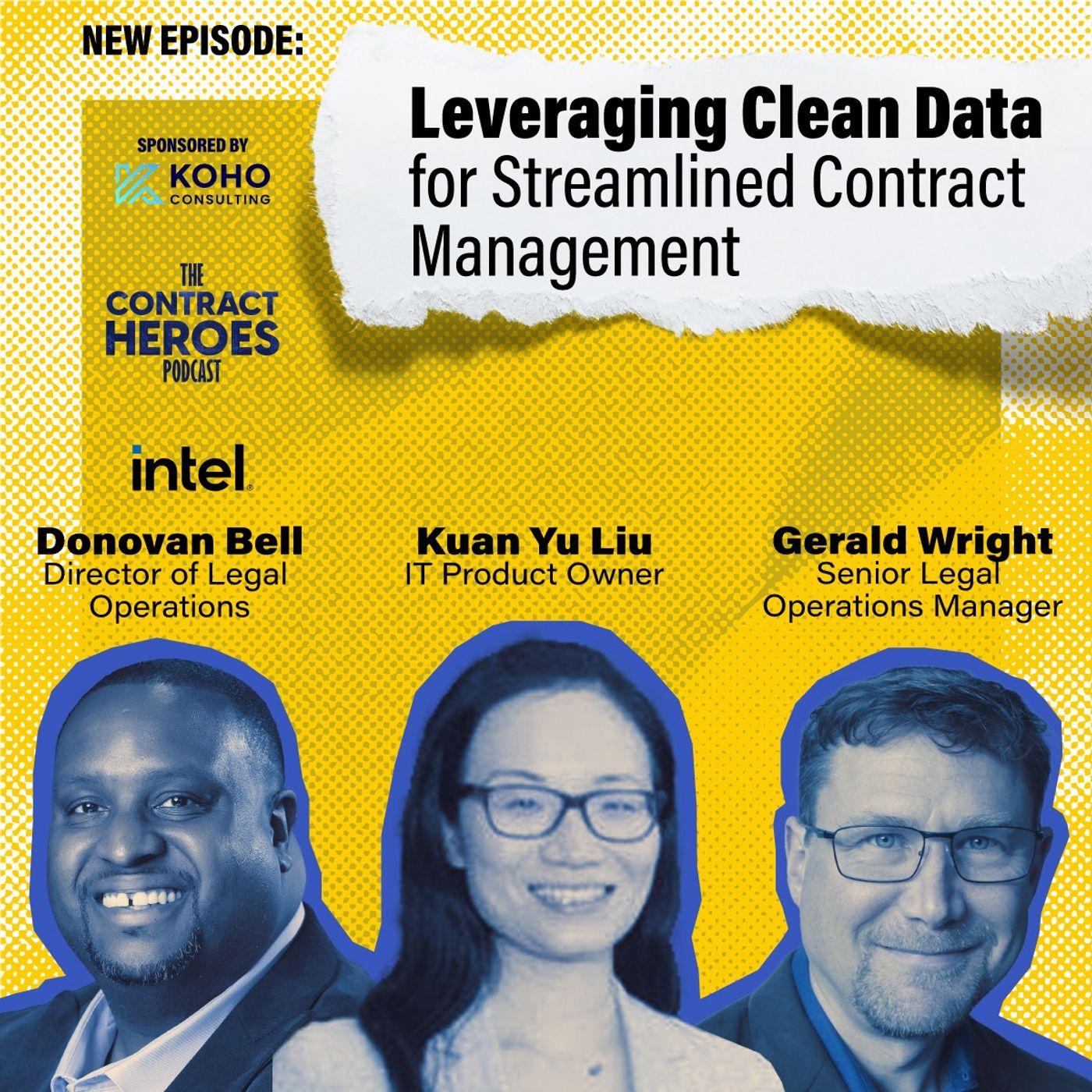
Well, Donovan, Quan, and Gerald, thanks so much for joining us today. You know, we're, we're really excited to have you on the podcast.
3
00:00:20.840 --> 00:00:26.500
And, uh, before I flip things over to, to Pepe, uh, he's gonna give us a little bit more information on what we're gonna be chatting about.
4
00:00:26.760 --> 00:00:36.460
Donovan, maybe you could just give us an understanding of, you know, how the team has gotten to this point where you have implemented a CLM tool and you're actively using it. What is, what has that journey been like?
5
00:00:36.840 --> 00:00:43.320
Yeah, it's been a great journey and one that's built off of learning from history, if you will.
6
00:00:43.700 --> 00:00:52.920
This is our, our second approach, if you will, second time around with our CLM, uh, implementation, and so we've learned a lot. We've gained some of those learnings.
7
00:00:52.960 --> 00:01:04.879
And I think one of the key things about it is we focused on our foundation, foundation being the data. But also a premise of partnership. And so that's why it's, it's such a, uh...
8
00:01:04.900 --> 00:01:14.780
We're fortunate, uh, to be able to speak not just with me, but also, uh, Gerald, who's running our contracts on our team, and Quan, who is our IT partner.
9
00:01:15.280 --> 00:01:25.020
And that cohesive bond between IT and our business op- our global operations aspect is really critical, uh, to the success of what we do.
10
00:01:25.320 --> 00:01:30.920
And so back to your point o- on that, it, it's, it's the foundation is what's of most importance.
11
00:01:31.420 --> 00:01:45.200
And, uh, in a world where a lot of, uh, challenges are being driven on a point by point basis, uh, falling prey to the tyranny of the urgent, if you will, and so here's the one specific, uh, problem that we're trying to face.
12
00:01:45.700 --> 00:01:58.580
Having a firm foundation of understanding what our data is and making a data-centric, uh, mindset approach towards how we solve our challenges when it comes to contracts is, is of utmost importance. Yeah, that's awesome.
13
00:01:58.640 --> 00:02:10.620
So guys, this is going to be our first time that we have three amazing guests on the podcast. So this might be a little bit longer because there's a lot of information, especially from a company like Intel.
14
00:02:10.680 --> 00:02:14.079
I mean, uh, we are very, very honored to have you guys on the show.
15
00:02:14.660 --> 00:02:27.800
And I love that introduction, Donovan, because I think we've been d- discussing this a lot in our previous episode because that foundation, some people like our friend Lucy Bassley like to call it, uh, CLM readiness, right?
16
00:02:27.860 --> 00:02:39.340
Because a lot of the time people just jump straight to technology because they think it's just like a magic wand. Like, "If we hire a CLM, then our problems will be solved." And it's not like that.
17
00:02:39.700 --> 00:02:42.240
You gotta know what do you wanna automate.
18
00:02:42.300 --> 00:02:55.480
You wanna, you want to understand those processes, those templates, those approval workflows, all the homework, the previous work, homework in, uh, before starting an implementation is like, it's of the essence.
19
00:02:55.640 --> 00:03:14.040
Because if you don't have that clear, you'll be only automating broken processes, and you will never see the, the benefits of having a, a, a, a tool that it's, uh, you know, focused to help not just the, the legal team, but also the other commercial departments.
20
00:03:14.120 --> 00:03:26.359
So let's start, Donovan, like you said, there's a lot of, well, right now in the business landscape, like, data-driven businesses is like, uh, right now, like, like, a very buzz word.
21
00:03:26.700 --> 00:03:42.720
And I would like to start our conversations on how can any organization leverage data and metrics to establish a solid foundation for contract management, and what are the key benefits of adopting that, uh, data-driven approach?
22
00:03:42.790 --> 00:03:56.880
And just by the way, this is, maybe Quan and Gerald, if you wanna also jump in, into this question, please feel free to do it. Yeah. A great question there, Pepe. And again, appreciate you and Mark, uh, having us on.
23
00:03:57.320 --> 00:04:09.620
In regards to data-driven metrics and the approach, uh, data is going to be king, uh, in terms of understanding how can we then make a business decision.
24
00:04:09.660 --> 00:04:20.800
The, at the end of the day, uh, the data should produce the ability to make a decision in regards to where you are taking your business and the approach you're going to take with it.
25
00:04:21.180 --> 00:04:32.260
And hence why it's so important to start with the end in mind, of making sure that your, uh, data first is clean and sound, uh, and the approach that you take to get there.
26
00:04:32.360 --> 00:04:41.300
Uh, but ultimately, uh, your data should tell a story, and in that story, it determines, uh, where the velocity of the business goes.
27
00:04:41.640 --> 00:04:52.280
It truly should be a force factor in the decisions that are being made at a senior leadership level. And so again, that, that's, uh, one thing that's really paramount.
28
00:04:53.280 --> 00:05:02.010
I don't know, Gerald and, or Quan, if you guys wanted to add to that or... No, that's fine. You can go to the next. Lo- lots, lots to add, I, I actually, um, but I- [laughs]...
29
00:05:02.040 --> 00:05:11.590
I'll hone in on, on one point, on that data cleanliness piece. In the very beginning, you gotta know what your data looks like just to start, right? You know, a lot of people, we, we made the mistake of,
30
00:05:12.520 --> 00:05:23.740
"Oh, we- we've had, you know, contract system for years, right? So, and our contracts have been placed in that system for years, so let's just move it all into our, a nice new CLM." No.
31
00:05:24.100 --> 00:05:31.940
If you think your data is clean, it's not clean. It's not organized the way you're going to need it to be or want it to be when you move to a CLM solution.
32
00:05:32.620 --> 00:05:38.120
So that has to be a massive part of your project, is to think about your as-is state of your data.
33
00:05:38.720 --> 00:05:52.160
But beyond that, once you fast-forwarded, you know, getting that data clean and organized, our experience was, okay, now that we've done, gone through that time and expense and we've moved it into our CLM, you've gotta have a process in place for keeping it that way.
34
00:05:52.600 --> 00:06:04.940
Because the CLM isn't gonna keep it clean for you, right? So you have to have resources and people and processes established to help mainsure, make sure that that remains clean as well. So it's not a one and done.
35
00:06:04.960 --> 00:06:11.640
It's not set up a CLM and move on to the next project. So a little bit of job security for me there, Donovan, um, and Quan, you too.
36
00:06:11.960 --> 00:06:25.316
So yeah, that da- I just wanna hone in on that data, that data piece, because when you're talking about metrics Your metrics are really on- I know this is a captain obvious statement, but your metrics are really only as good as how clean your data is.
37
00:06:25.356 --> 00:06:40.176
And so, you know, it's so important to, to focus on that piece. Right. And before I turn things to Quan, because we're very interested in how you get that data, right?
38
00:06:40.636 --> 00:06:53.936
So when you were building that foundation, Gerald, like, did you already know what was that data that you needed in order to start the implementations?
39
00:06:54.056 --> 00:07:07.316
Or do you think that was part or, or maybe during the implementation now you knew, okay, maybe this, this kind of data will be, uh, useful for our commercials or procurement or, or the legal de- de- department?
40
00:07:07.376 --> 00:07:19.396
Like, how can you prioritize that data during that foundation stage? Yeah. So for us, um, it was just a matter of sort of analyzing what we had, right?
41
00:07:19.556 --> 00:07:31.436
Looking at what information we did have about our contract records, and it was minimal, um, because we didn't have a CLM system. We had this, a traditional, m- you know, management kind of document management system.
42
00:07:32.376 --> 00:07:36.316
Um, so we had some metadata, but n- not a whole lot.
43
00:07:36.556 --> 00:07:49.966
So we started with just looking at what we had and then, you know, bringing groups of attorneys together and, and analyzing, grouping the, the, the data and analyzing it with the attorneys and saying, "Okay, what's, what's missing," right?
44
00:07:50.026 --> 00:07:53.556
"What would you... What are you not seeing here that would be useful for you?"
45
00:07:53.916 --> 00:08:02.656
And that's what we used to sort of, for our fe- our first CLM solution to sort of establish that, you know, our taxonomy for building that first solution.
46
00:08:03.216 --> 00:08:08.996
At the, at the very ground level, we knew we were gonna grow from there, but we had to get started somewhere.
47
00:08:09.096 --> 00:08:17.076
Um, so that's how we got started, was just like, you know, we're a company that's been around for over 50 years. We had a lot of contract data to look at.
48
00:08:17.116 --> 00:08:26.575
And so we very quickly were able to see trends and get information that the attorneys could look at as well and say, "Okay, you know, let's build from here." That's our experience.
49
00:08:27.256 --> 00:08:31.996
A- and was there maybe a specific department that, you know, or, or types of contracts that you started with?
50
00:08:32.036 --> 00:08:37.156
Was there stuff that, you know, the team knew, "Hey, we, we really wanna make sure that this is the data that we're getting in the system first"?
51
00:08:37.576 --> 00:08:40.265
Uh, sometimes, you know, I mean, typically it's, it's active contracts, right?
52
00:08:40.336 --> 00:08:49.676
But, but was there maybe a large amount of a singular type of contract that you knew that you needed to, to parse those documents to make sure that it, it was in the system and up and running when you, when you went live?
53
00:08:49.796 --> 00:09:00.976
Absolutely. Uh, we, we obviously tried to, uh, we, we left behind our, our agreements that were, have been expired or terminated, and they've been, th- they've been in that status for about a decade or more.
54
00:09:01.176 --> 00:09:06.736
We basically didn't even look at those. We said, "Let's just bring in things that we think people will wanna have access to."
55
00:09:07.476 --> 00:09:19.596
Uh, we still brought over expired records, but, you know, records that, you know, they're not decades old. So that gave us a little bit of a filter and w- allowed us to leave some things behind, not have to worry about.
56
00:09:19.896 --> 00:09:26.916
In terms of sort of like the, you know, like topical, which ones we were focused on, that we didn't really do a filter beyond that.
57
00:09:26.956 --> 00:09:39.636
We said if, if we were managing it in our prior file room, uh, is what we called it, and it was relatively recent or active, we, we were gonna manage it in our new CLM. So we brought it all over at that point.
58
00:09:40.176 --> 00:09:49.496
Just to kinda add to that, too, I think, you know, we talk about it from a perspective of the data, right? And I, I wanna take it up a notch to the metadata aspect of it, right?
59
00:09:49.596 --> 00:09:58.556
So we knew that there were certain categories, certain types, certain, you know, that, that aspect that kind of fed to the taxonomy, as Gerald's alluding to.
60
00:09:58.876 --> 00:10:25.856
That becomes really important because when you have a really strong and flexible and nimble CLM, you almost operate off of a if-you-build-it-they-will-come type philosophy, and the key is, are you able to generate the speed, turnover, efficiencies, and quality that's necessary, uh, to provide the value that the business needs, uh, to be able to, you know, whether it be revenue generation, whether it be risk or cost avoidance, those type of things.
61
00:10:26.326 --> 00:10:40.736
And so it's having the understanding of what's the type of information that we need to make sure we're centered on that gives us the flexibility that when the contract types come in or the different types of contracts, uh, we're able to support it.
62
00:10:41.536 --> 00:10:55.736
Right. I think that's a very smart move. And before I jump to Quan to how you get that data, let me just give you a brief story of one of our previous interviews with, uh, James Donald from Aquor.
63
00:10:55.996 --> 00:11:08.916
He was also at the Clock event, and he told us that right now they are moving from a failed implementation to a new one. One of the main mistakes that they did when the first implementation was,
64
00:11:09.976 --> 00:11:26.756
of course, importing that legacy documents because when they started the implementation part, they just asked somebody, and maybe in the legal team it's like, "Okay, so what kind of information do you want from your contracts?"
65
00:11:27.436 --> 00:11:37.996
And they said, "We want 400 data points for all of our contracts." [laughs] Now, I can see your face, Quan.
66
00:11:38.116 --> 00:11:46.886
So, [laughs] like, can you imagine, like, how long that could take, and especially for a franchise agreement that are, like, over 200, 200 pages? So [laughs]
67
00:11:47.456 --> 00:11:57.466
with that background story, like, Quan, can you tell us a little bit, because I think this is a, like, like, the smarter move, like, starting with an MVP. What are, like, the, uh, main problems right now?
68
00:11:57.716 --> 00:12:13.476
And, uh, so Quan, like, can you tell us a little bit on how do you get that kind of data, and how do you clean it up? Sure. Maybe I can share a little bit our experience, how we build the contract repository, right?
69
00:12:13.496 --> 00:12:22.416
Because that's the container where we store the data and which is gonna give us value and, you know, give us insights for decision-making. But that's the container, right?
70
00:12:22.716 --> 00:12:39.544
So when we started, actually, I would say it's a twofold mission because we look back, you know, to what we have done, right? We know- What do we have already the contract-related data? No matter the format, right?
71
00:12:39.584 --> 00:12:51.704
It could be, uh, you know, in maybe a legacy system. We may have some, you know, uh, documents stored in offline repositories. Uh, it may be spread in different places, right?
72
00:12:52.204 --> 00:13:04.784
Look at what we have, right, and understand those limitations. Okay. Because probably we live with the limitations, and that's how the historical data are captured.
73
00:13:04.824 --> 00:13:14.524
And now the other party's, okay, we look toward the future, right? What's the objective? You know, what's the goal we want to achieve, right?
74
00:13:14.784 --> 00:13:27.184
Knowing that, okay, we are in this transformation journey, we are implementing a CLM, right, what do we want to accomplish? So these two parts are the foundation for our repository design, right?
75
00:13:27.604 --> 00:13:42.474
Because we need to make sure what we design meet our needs, and then it's scalable, right, and it can satisfy, uh, our future growth. But we need to make sure we cannot forget our history, right?
76
00:13:42.524 --> 00:13:51.964
Everything that we have need to be, you know, able to fit into the repository we design. And normally there is a gap we need to close, right?
77
00:13:52.724 --> 00:14:03.164
But the objective, the goal, right, and the future look of repository is very important. And now we talk about, okay, what are the different gaps we need to close, right?
78
00:14:03.384 --> 00:14:19.504
And a very close partnership with our, you know, business partners, in our case, you know, with Jarrow, is crucial because, uh, from the business side, they are the ones that giving us the rules for us to clean up our data, right?
79
00:14:20.104 --> 00:14:34.634
So we know, you know, under which circumstances we may have duplicates, right? We may have redundant information. And also, uh, in some cases, right, uh, we also challenge our business decisions because...
80
00:14:34.664 --> 00:14:49.004
And, and just to the example of the 400 fields, right? From the systems perspective, right, when we are designing something, uh, performance is one of the aspects we really take into consideration, right?
81
00:14:49.084 --> 00:15:03.724
So even though we can have, you know, a very, very detailed business rules, transformation rules, but sometimes we do collaborate with the partners, asking what are those rules necessary, right?
82
00:15:04.204 --> 00:15:11.144
And maybe by implementing those, we may have different, you know, implications, consequences in the system, right?
83
00:15:11.564 --> 00:15:21.804
So it's a probably a, a very, you know, rich conversation understanding the business need, the rules, and the systems capability, right?
84
00:15:21.824 --> 00:15:36.484
So it's like a whole mapping, you know, your historical thing, your new repository, how you align the data, how you align the, the documents, and then, um, and start, you know, doing those data transformation, right?
85
00:15:36.544 --> 00:15:51.124
Of course, we develop scripts, you know, to automate those type of data transformation. And also one thing to take into consideration, and that's, we talk about, uh, it is not you implement and you are done, right?
86
00:15:51.224 --> 00:16:03.204
You need to maintain the data and make sure your data continue to be clean, you know, through years. And so that's why when you are doing this repository design implementation,
87
00:16:04.144 --> 00:16:12.664
take into consideration all the business rules, right? Ideally, you should have those also implemented into the system validation.
88
00:16:13.264 --> 00:16:31.744
So the past mistakes of having, you know, dirty data because we didn't have the ability to control the quality, now those rules, validations are in place in your new system so you make sure you don't run into the data integrity issue anymore, right?
89
00:16:31.824 --> 00:16:42.144
So I think it's a long journey. It's very rich, very interesting, but it's a lot of partnership conversation and negotiation between, you know, both parties. Yeah.
90
00:16:42.204 --> 00:16:47.884
And, and I think, yeah, Connie said a couple of things there, right? The performance, the goals, the rules that we're putting in place.
91
00:16:47.914 --> 00:16:54.744
There's a lot of, of, uh, things that need to be done as part of this groundwork to make sure that the implementation goes smoothly.
92
00:16:54.783 --> 00:17:01.964
And, and I think the first phase of that is, you know, what we would call the scoping process. So I, I'm kinda curious, you know, what did that look like?
93
00:17:02.044 --> 00:17:14.914
What intern- internal teams were involved, and how did you make sure that the, the folks that were really boots on the ground for this, this implementation were all on the same page, and that their goals aligned for that first phase of the implementation?
94
00:17:14.944 --> 00:17:20.944
You know, obviously set the foundation for, for what the, your CLM is going to look like in the future. Yeah. Definitely.
95
00:17:21.064 --> 00:17:28.964
So in our case, actually, it is, it is very important for our system analysts to understand the business knowledge, the business process, right?
96
00:17:29.024 --> 00:17:39.284
Because I think we talk about it is not just the, the implementation of a tool, of a technology, but the business process is actually the foundation, right?
97
00:17:40.064 --> 00:17:52.544
If the business process is not solid, if the business process is not efficient, and you just try to use a tool to mimic a broken business process, it's not gonna give you efficiency, right?
98
00:17:53.184 --> 00:18:02.274
So the first thing we do, actually a lot of, you know, requirement meetings with, with Jarrow, you know, who patiently explained, you know, every business goal.
99
00:18:02.804 --> 00:18:08.124
Because what we are doing is we try to achieve a business growth through this contracting process, right?
100
00:18:08.624 --> 00:18:18.454
And after we have done that, of course, you know, sometimes it is just a huge project, but we need to really identify first MVP, right?
101
00:18:19.004 --> 00:18:33.064
So maybe the question we ask Jarrow always is, "Okay, Jarrow, what's the minimal thing we should have in the system for us to go live?" Means, okay, you are comfortable. We can open it for end users, right?
102
00:18:33.404 --> 00:18:39.984
Maybe it has limited functionality, but Sufficient for us to start collecting data, right?
103
00:18:40.644 --> 00:18:51.624
So I think that's, that's our starting point, and then we may start prioritizing features, functionalities through different phases based on, um, the business value, right?
104
00:18:51.744 --> 00:19:00.604
So it's probably, like, okay, what's the impact? You know, what are the user population we are talking about? Uh, what's the data volume, right?
105
00:19:00.964 --> 00:19:14.924
And based on all these, you know, different aspects, uh, we can make a prioritization call, right? And that's how we start, you know, um, grouping different feature functionalities into different, uh, phases or releases.
106
00:19:15.484 --> 00:19:26.584
I think that's a very special phrase from Gerald. Remember, we prefer progress over perfection. Perfection. Right. Yes. Yes. Absolutely. That partnership is so key.
107
00:19:27.144 --> 00:19:40.744
Our first implementation failed largely because we didn't, uh, partner with, um, our IT organization like we did with our second, second implementation. And so that was the chief reason why we failed.
108
00:19:41.364 --> 00:19:53.564
Uh, we as a legal department, legal operations department, we felt we could do it on our own, right, without bringing in big Intel IT organization, which is a massive organization.
109
00:19:53.604 --> 00:20:05.254
And so we changed our, our mindset, our thinking as we, you know, part- started partnering with our IT organization in a different way, especially from the legal department perspective. And,
110
00:20:06.204 --> 00:20:17.404
you know, I believe that that is one of the chief reasons why we're successful. Why we're, we're heading towards that success in, in our journey on CLM today is because of that partnership.
111
00:20:17.464 --> 00:20:23.504
And Quan, your point about, you know, getting the business requirements and saying, "Okay, what are the minimum viable requirements?"
112
00:20:23.604 --> 00:20:28.684
But what she failed to say was we would give her that, and then she would say, "No, we can pare that back some more."
113
00:20:28.764 --> 00:20:46.644
And she was right every single time, um, because the business w- is always gonna ask for more from the beginning 'cause we, it's a, it's a new toy and, and we s- and when you're looking at CLMs, all the features are, you know, promised to you and you, you feel like you should have those on day one, right?
114
00:20:46.684 --> 00:20:51.744
Like, you buy a video game, you should be able to play the full game on day one, right? Not the case with a CLM.
115
00:20:51.784 --> 00:21:00.124
So, so we, you need, you need your IT partners to help address all of those issues 'cause MVP is so important.
116
00:21:00.164 --> 00:21:14.664
You know, integrations, uh, with other systems in your company, all of that stuff, you know, DocuSign, e-signature, all of those things, you know, as a business person, a business process person, you're thinking that's just table stakes.
117
00:21:14.724 --> 00:21:20.904
That should just be turned on on day one. Well, it's not. It has to be, it has to be established. It has to be set up.
118
00:21:20.924 --> 00:21:30.504
I'm not saying it's impossible, but that's where Quan and her team just, just totally made our m- made our second implementation a success.
119
00:21:31.884 --> 00:21:44.484
And if, and if I could just echo on top of that, there are those who aren't represented, you know, on this call as well, and that's your, you know, the, you know, vendor partner that you may work with.
120
00:21:44.504 --> 00:21:56.524
In some case you may have an implementer or, or whatnot. You have your procurement partner that's helping you drive that. And then you also have, uh, your attorneys and, and business clients and whatnot.
121
00:21:57.284 --> 00:22:08.444
That collaboration and, and work also happens upfront early and often. And so, uh, all of that is, is essential if you wanna succeed.
122
00:22:09.014 --> 00:22:25.104
And so Gerald and Quan rightly highlighted the extreme value of having a strong, um, you know, business-IT partnership going in, uh, because we're all seeking the same thing and charging towards the same goal.
123
00:22:25.424 --> 00:22:34.064
But it's, it's so critical because you don't wanna find out missing parts later in this, in the game, but you wanna know upfront what are the...
124
00:22:34.404 --> 00:22:43.404
So hence you may reach out and get that consultancy, uh, whether it be your CLM of choice or your, those helping you implement. So those are the things that you may not know.
125
00:22:43.444 --> 00:22:49.944
Here's, here's industry experience that I didn't have that's helping us as we're moving, moving into this as well.
126
00:22:50.064 --> 00:23:03.204
So all of those pieces form together like Voltron, if you will, and make the, um [laughs], one strong, uh, uh, one strong, uh, superhero there, so. And don't forget, um, executive sponsorship was also key for us.
127
00:23:03.744 --> 00:23:17.804
You know, our leadership's, um, belief in, you know, our ability to get this done even though we had a pri- past failure was, was hugely, um, important for us. Um, and but for that, we wouldn't be here today.
128
00:23:17.924 --> 00:23:25.744
So, so you absolutely need to, to get that e- executive sponsorship on day one. 100%. Yeah. Yeah, I mean, I think it's important, right?
129
00:23:25.804 --> 00:23:33.364
If you can get the entire team to buy in it, it definitely helps and it, and it's great to hear that the team was f- on the same page for, for, for this project.
130
00:23:33.384 --> 00:23:40.464
And, you know, one thing or one word that or, or phrase that I heard a lot, right, is MVP, right? And my project managers love, love that phrase.
131
00:23:40.664 --> 00:23:53.744
So the same thing is, you know, crawl, walk, run, you know, you gotta start somewhere. I think that's exactly right. And, you know, I'm curious to hear on, on your team's side, was there a dedicated project manager?
132
00:23:53.924 --> 00:24:07.604
Did they have experience with, with legal, um, technologies in the past, or what did that look like? I sort of led as a program manager, and I relied on, heavily on Quan's project manager skills.
133
00:24:08.004 --> 00:24:20.084
So she was our dedicated project manager skilled on the Intel side, and then we relied on our implementer's project management expertise for our implementation as well. That's very interesting.
134
00:24:20.264 --> 00:24:33.940
Well, the other thing about the executives is not just that you build this, this, this project because you get their, uh, their approval. Also- Mike Kevin told us, "You gotta talk to these guys to the podcast."
135
00:24:34.320 --> 00:24:41.540
[laughs] So he was also a, a big sponsor to, to bring you guys to this podcast.
136
00:24:41.660 --> 00:24:51.620
We- he was a guest a couple months ago before the Clock event, and I think that, you know, that's, that's one of the things that I love about these types of associations.
137
00:24:51.740 --> 00:25:03.020
Like, they're, they're promoting all these new, let's say, skills that, as lawyers, you know, like, we don't get that on, on, at law school, you know?
138
00:25:03.440 --> 00:25:08.300
There's no one, may- maybe a few schools right now that they're trying to do something like that.
139
00:25:08.660 --> 00:25:28.900
But I think those type of skills, like legal product management and how can you become more efficient, that's something that you get on the fly, like, when you're starting to face all this type of, of different, um, uh, you know, uh, issues or how you can make the team way, way more efficient.
140
00:25:29.340 --> 00:25:35.120
Just change a little bit on the data, but let's go a little bit back to the basics, right?
141
00:25:35.439 --> 00:25:55.460
So in talking about those processes, like, how, during this foundation stage, did you guys already have, like, all those processes in place, like diagrams on how it works, or you have to make them when you started with this, with this, with this journey on the CLMs?
142
00:25:55.740 --> 00:26:07.180
I mean, with processes, I mean, like, you know, contract lifecycle processes for procurement, for sales, for maybe compliance. Like, how, how did that work on the, on the early beginnings?
143
00:26:07.840 --> 00:26:20.300
Well, for us, it was a lot of me talking and Quan and team recording and our implementer recording, and it ju- we found it to be efficient to just, you know, walk through our processes and say, "Here's how it works today.
144
00:26:20.440 --> 00:26:29.800
Here's what we do," and talk through it and have those conversations recorded. And then the teams would go off and come back and say, "Okay, this is what we've heard.
145
00:26:29.880 --> 00:26:33.440
This is, this is the design and how we want to approach it."
146
00:26:33.880 --> 00:26:48.280
We didn't spend a whole lot of time diagramming, creating complex visios, breaking down the processes because, like I said in the beginning, we're, we're focused initially on our, on our authoring functionality or, excuse me, our repository functionality.
147
00:26:48.780 --> 00:27:00.940
As we speak, driving towards our authoring for the, for the full CLM functionality and, um, of, you know, from request to, uh, assemble to, you know, negotiate, sign files.
148
00:27:00.980 --> 00:27:08.620
So maybe we'll have a follow-up podcast, let you know how that goes. Sure. That, th- yeah, that sounds [laughs] sounds great, Gerald.
149
00:27:08.650 --> 00:27:15.409
And you know, I, I think, I, I kinda wanna go back to a little bit what we were talking about earlier as far as... And, and this too, right? So the, the process.
150
00:27:15.540 --> 00:27:25.020
As, as the team continues to, uh, evolve and you get to more comfortable with what's going on inside the application. Now, of course, of course there's going to be changes that need to be made.
151
00:27:25.029 --> 00:27:29.340
Your processes are going to change and, and it's going to continue and grow and scale with the organization.
152
00:27:29.640 --> 00:27:37.999
Quan, this might be a, a question for you, but how did you handle maybe some of those change requests that were coming from Gerald and his team during the implementation process?
153
00:27:38.260 --> 00:27:44.840
W- was there any things that, Gerald, maybe after you really had an understanding of what the system was capable of, a light bulb went off and you go, "Ooh, you know what?
154
00:27:45.020 --> 00:28:00.000
I actually wanna do that this way instead of the way that we had originally thought about doing it"? I think she blocked me at one point. [laughs] So yeah, that, that really happens a lot, but for good reasons, right?
155
00:28:00.100 --> 00:28:11.160
Uh, because we all want to evolve, and it's a journey, right? It's a progression because probably initially we build something, and then we notice that there is a better way to do things.
156
00:28:11.240 --> 00:28:23.120
So I think what it is very important is we need to make sure what we have in production continue running production without interruption, right? So keep the business running, that's one.
157
00:28:23.920 --> 00:28:43.240
Sometimes, you know, these enhancements or features that actually change the way people work, definitely we need to be very careful, and I think there are two parts, not just the implementation part, you know, from, like, our team, making sure, okay, we have a new design, we have a new concept.
158
00:28:43.400 --> 00:28:56.740
We develop it, you, we configure it, we test it. The other part is the transition change management from the business, that that's also important, but sometimes we just forget about it, right?
159
00:28:57.340 --> 00:29:05.720
If we are doing foundational changes on the process, then we need to make sure what we are proposing makes sense for end users, right?
160
00:29:05.820 --> 00:29:14.600
Because maybe we already part of this world, we feel this is a better approach, but how about our end users, right? Is that really their voice?
161
00:29:15.140 --> 00:29:25.720
So I think constant demo and involving really the real users, you know, to give us early feedbacks to what we plan to build is important, right?
162
00:29:26.260 --> 00:29:38.180
And once we confirm that and we are ready to roll out this new change to the process, uh, I would say communication, you know, trainings, uh, are very crucial.
163
00:29:38.380 --> 00:30:06.920
And, and that's, you know, exactly this partnership IT has with our business unit because we help to make the system, the tool ready, but the rollout, the transition, and change management are, you know, actually, you know, the, the business play an important role because they are the ones that actually talk to the users, get user feedbacks, and then we can really be connected and have these successful rollout.
164
00:30:07.500 --> 00:30:13.370
So I think that's what we have been, you know, trying to do and have been giving us good results. Right.
165
00:30:13.400 --> 00:30:24.480
And I think that's very important, especially when you said that there's, there, there was already a failed implementation because when that things happen, it's like people thinks like, "Not again," [laughs] right?
166
00:30:24.500 --> 00:30:35.440
They gotta learn how to use a different software now. I think that's the EQ part, right? You know what I mean? Like, how can you get them excited about something because they can know about the benefits.
167
00:30:36.020 --> 00:30:50.656
And one follow-up question, Quan, about this is that, of course, all this MVP is, let's say, like, phase one of the implementation, but as the product keep escalating You know, keep scaling.
168
00:30:50.796 --> 00:30:56.576
I mean, of course there are, there are some changes that you need to do. Like, how do you handle that?
169
00:30:56.656 --> 00:31:07.656
Like, do you have any internal admin that is working with those changes, or is it something that you do maybe 50/50 with an external consulting?
170
00:31:07.696 --> 00:31:19.916
Or any recommendation to make those things more efficient to other companies looking to implement a CLM. I think maybe just share our, uh, use case, right? Mm-hmm. We do have a, a team, right?
171
00:31:20.076 --> 00:31:32.636
It's within our IT organization. So we support probably the keep the business running, you know, the KTBR, the maintenance enhancements and also, you know, new features.
172
00:31:33.116 --> 00:31:47.446
But sometimes we have more demand than our capacity, right? So, uh, it comes probably negotiation with the bus- the different business units that have initiatives to do things with the CLM, right?
173
00:31:47.876 --> 00:32:04.716
Sometimes depending on the priority, right, and the criticality of the project, if funding is possible, then we also look into working models to, uh, have, like, implementation, third-party implementation partners to work with us, right?
174
00:32:04.816 --> 00:32:18.576
They can help, um, help us to probably get some of the backlogs, uh, going, right? Maybe specific project, specific implementation for a specific business unit. So I think we are, you know, kind of flexible, right?
175
00:32:18.676 --> 00:32:29.936
We feel, uh, we have a fixed capacity internally, but depending on the demand, we may have some type of burst capacity, you know, uh, taking advantages of third-party implementers.
176
00:32:30.016 --> 00:32:36.436
So I think we have been, you know, experiencing different type of implementation, and I think it's giving us good results.
177
00:32:36.776 --> 00:32:43.736
And not sure, maybe Don or Gerald, you would like to add, you know, to this working model we have been doing. Yeah.
178
00:32:43.816 --> 00:32:59.416
I, I think the key there is being conservative in what your base capacity is and holding to that, and making sure that you have a, a level of budget to handle some of the flex to scale as you need.
179
00:33:00.076 --> 00:33:11.896
I think that's been the real key behind that, which makes it a lot more palatable in how you're able to, uh, adjust. Uh, it also means that at the onset you're not over-engineering.
180
00:33:12.016 --> 00:33:27.956
You're not taking so much time to go live that you've exhausted a ton of funds, money, effort, time and credibility, quite frankly, uh, you know, with your business. Where you're able to show them, "Here are some wins.
181
00:33:28.536 --> 00:33:39.035
Here are some actual, uh, working aspects in how we're leveraging, uh, the CLM in this, in this fashion," uh, to where it again builds that credibility of, "I know you're able to deliver.
182
00:33:39.456 --> 00:33:48.896
I know you're able to be consistent. And so because of that, yes, I'm gonna trust that if you... if I'm on the docket, I'm on the docket and, and it's going to be addressed in a timely fashion."
183
00:33:49.176 --> 00:34:05.756
And that takes, again, relationship, inclusion, uh, in, in the conversation of, "Here's our roadmap, here's where we're going, here are things that we're trying to do," but also the very real, uh, family conversations, if you will, of, "Here's what we're able to do."
184
00:34:05.856 --> 00:34:17.576
Kind of as Gerald and Qu- Gerald has been alluding to, and Quan has been, uh, confirming as well, where sometimes it's those internal conversations where we say, "Yep, let's go aggressive and do all this," and we kind of need the, "Slow down.
185
00:34:17.636 --> 00:34:27.916
Here's what we're actually able to do," and make those adjustments accordingly. But having that in a transparent fashion to where you can drive that across, uh, your business is gonna be key. No, that's great.
186
00:34:27.976 --> 00:34:39.896
And, uh, you know, I, I think my last question is, and this is for everyone, is have, since the implementation and, and you're using the application now, have, are the gears turning at all to, to say, "Hey, here's what we want that next phase to do?"
187
00:34:39.956 --> 00:34:49.976
Is there any must-have, you know, functionality or, uh, use cases that you're thinking about building out next? All the time. [laughs] We picked a solution and it's double-edged sword.
188
00:34:50.005 --> 00:35:01.476
On the one hand it is, it is amazingly flexible. If you can think of it, you can pretty much do it. But that's a good thing. But the bad thing is now you're thinking of everything and you're wanting to do everything.
189
00:35:01.716 --> 00:35:10.596
So to Donovan's point, we have, and Quan's point, we have to prioritize. You know? And something that we're constantly looking for, for improvement.
190
00:35:10.656 --> 00:35:22.376
And, and we're already getting feedback from our, from our users about, you know, "It would be great if we could do this." And I love those conversations because the an- the answer is almost every time yes.
191
00:35:22.716 --> 00:35:33.136
And then not a yes six months from now, a yes as, as soon as I can get Quan to unblock me and talk to me again and help me get it done. So, yes, absolutely, we have a lot of future phases in mind.
192
00:35:33.176 --> 00:35:41.856
Like, as I mentioned, authoring is one of them. And, and we're excited about this is the first time we're mentioning AI, which is amazing for a, a phone call and contracts.
193
00:35:41.936 --> 00:35:54.916
But yeah, bringing, folding in the, the AI components of our CLM, as well as the future of AI for what can be done with, with respect to putting contracts in place as well. That's a future phase I'm very excited about.
194
00:35:55.046 --> 00:36:01.256
In fact, I think we all are. But I'll stop there and Quan, Donovan, you have anything else? I, I think that's great, Gerald.
195
00:36:01.436 --> 00:36:14.236
And, and I think it's just, it's a matter of finding where the greatest value lies and honing in and addressing that, right? That becomes, you know, really critical.
196
00:36:14.456 --> 00:36:22.286
And as you go through, you see all these fun things that you can do. Uh, what's going to yield the greatest value for our company?
197
00:36:22.916 --> 00:36:36.456
Uh, and so knowing what our, being very much aligned to our top level, uh, business strategy, uh, and figuring out, okay, where is our, where is our company heading, and, and what's mul- what's paramount to Intel?
198
00:36:36.596 --> 00:36:47.816
Okay, well, if this is paramount to Intel, how can we be a force multiplier for that? And, uh, providing that, uh, uh, assessment and being able to then go and execute accordingly.
199
00:36:47.896 --> 00:36:59.540
So kind of taking a test-and-learn approach to what you're doing, uh, but also, uh, making sure that you're able to quickly pivot and be nimble To align to where your business strategy is taking you.
200
00:37:00.030 --> 00:37:11.380
And that highlights the point Gerald made earlier of having your executive sponsorship that's saying, "We support you, uh, we're behind you, and also here are the things that we need."
201
00:37:11.440 --> 00:37:19.840
And so we look at that as the imperative piece, and it also makes it an easy conversation because it aligns to our corporate strategy on the things that we're doing.
202
00:37:20.540 --> 00:37:35.000
Uh, maybe one small thing, I think it was mentioned, integration, right? So definitely the integration of the CLM to the rest of the world. You know, the company data is very important, but integration cannot be done
203
00:37:36.060 --> 00:37:44.820
in a very quick way because it is not just to establish integration. What are you gonna do with your historical data, right? Your historical data is not connected.
204
00:37:45.340 --> 00:37:52.040
Now, your system is connected, but you cannot just leave your history disconnected, right? So it's, it's a whole lot of effort.
205
00:37:52.480 --> 00:38:04.440
So definitely in the horizon, uh, we have, uh, different, uh, data domains we plan to establish integration, and also we prioritize, right? What are the most critical domains?
206
00:38:04.640 --> 00:38:14.100
Actually, we have established already integration in two areas. I think our worker data, our department data is, you know, being refreshed constantly.
207
00:38:14.200 --> 00:38:22.960
But we are planning to integrate, for example, to our customer data, supplier data, right? It is not yet done, but we have those in, uh, in the roadmap.
208
00:38:23.040 --> 00:38:34.140
And of course, we will be keep adding more and more integrations so we have this streamlined, you know, data flow, not only within CLM, but across the company. Right. Right, and I, I think that's huge.
209
00:38:34.180 --> 00:38:43.580
And, and the more data that you can connect, the more you're gonna be able to pull from that single source of truth, the, the deeper, uh, those reporting capabilities are going to go. So that's, that's very exciting.
210
00:38:43.940 --> 00:38:54.520
Guys, I, I wanna thank you all for joining us today. This has been a fantastic conversation. So Quan, Donovan, Gerald, thanks so much for, for coming on to, to, uh, to chat with us today. Thanks for having us. Thanks.
211
00:38:54.860 --> 00:39:02.800
Yeah, absolutely. It's been fun. Yeah. Thanks, guys. Thank you, guys. Awesome. Yeah, thank you. Well, thank you so much, and thanks everybody for listening to another episode of Contract Heroes.
212
00:39:02.820 --> 00:39:13.060
This episode of the Contract Heroes is sponsored by COHO Consulting. COHO helps organizations of all shapes and sizes find, implement, and manage their chosen CLM tool.
213
00:39:14.060 --> 00:39:23.449
Whether your project is buy or sell side led, COHO can help you navigate the waters of the CLM space to make sure that you're getting a product that's going to fit like a glove for years to come.
214
00:39:24.100 --> 00:39:33.880
If you'd like to learn more about COHO, visit their website at C-O-H-O consulting dot com. [outro music]
