

À PROPOS DE CET ÉPISODE

Host Damien Filiatrault talks with Justin Gelinas, Chief Business Officer at TAHO Labs, about the hidden inefficiencies behind AI infrastructure and why the industry may need to get more from the hardware it already has.
Justin explains how TAHO is building low-level software that breaks large workloads into smaller jobs and distributes them across available processors. The goal is to keep GPUs and other resources working more effectively, reduce idle capacity, and support different types of hardware within the same environment.
The conversation also explores Wirth’s law and Jevons paradox: why faster hardware does not always produce faster software, and why lowering the cost of compute may increase overall demand rather than reduce it. Damien and Justin connect these ideas to AI development, infrastructure costs, energy constraints, and the future of software engineering.
Justin also shares why TAHO uses AI tools extensively for documentation and operational work, but less for its core code. When engineers are inventing techniques without established examples, coding agents can quickly reach their limits or introduce unnecessary technical debt.
For developers, technology leaders, and anyone interested in the economics of AI, this episode offers a closer look at what is happening beneath the application layer—and why efficiency may become one of the industry’s most important challenges.
What you’ll learn
- What Wirth’s law and Jevons paradox reveal about software and compute
- Why cheaper, more efficient AI may create more demand
- Where AI coding tools struggle with genuinely new technical problems
- How TAHO divides and distributes large workloads
- Why interoperability across different hardware providers matters
- Why many compute environments use only a fraction of their available capacity
- How energy and infrastructure constraints are affecting AI growth
- Why improving compute efficiency can reduce costs and create room for innovation
Memorable sound bites
“Software gets slower more rapidly than hardware becomes faster.”
“When we can produce more value at a fraction of the cost, that creates opportunities.”
“When you are inventing a genuinely new technique, AI can reach a brick wall quickly.”
“Those constraints make efficiency unavoidable.”
“Innovation and efficiency can reinforce each other.”
Links
Get 20% off your first month with Scalable Path: https://www.scalablepath.com/commit
Commit & Push Website: https://www.commit-push.com/
Scalable Path Website: https://www.scalablepath.com/
Anglais
États-Unis
TRANSCRIPTION 🔗
Are you the producer of this podcast?
Add a podcast transcript
Need Audio-to-Text?
Transcribe with Listen411 in Just 60 Seconds
RECHERCHER LES ÉPISODES PASSÉS
Rechercher les épisodes précédents de Commit & Push.
AUTRES ÉPISODES DANS CE PODCAST

Host Damien Filiatrault welcomes Killian Valkhof—long-time web-dev, educator, and solo founder of Polypane, the “browser made for developers.” They trace Polypane’s journey from a scrappy side-project to a profitable, one-person SaaS, and unpack the power—and quirks—of building tools for developers…

"Don’t hire the brilliant jerk." That’s just one of the hard truths Zach Goldberg, CTO of Gruntwork and author of The Startup CTO’s Handbook, drops in this episode of Commit & Push.
Zach joins Damien to talk about the mistakes most new CTOs make, why developer productivity is wildly misundersto…
Welcome to Commit & Push, where we talk about how great software really gets built. I'm Damian Filiatro, your host and founder of Scalable Path. Each episode, we'll explore the decisions, tradeoffs, and strategies that shape successful digital products. You'll hear from developers, founders, an…
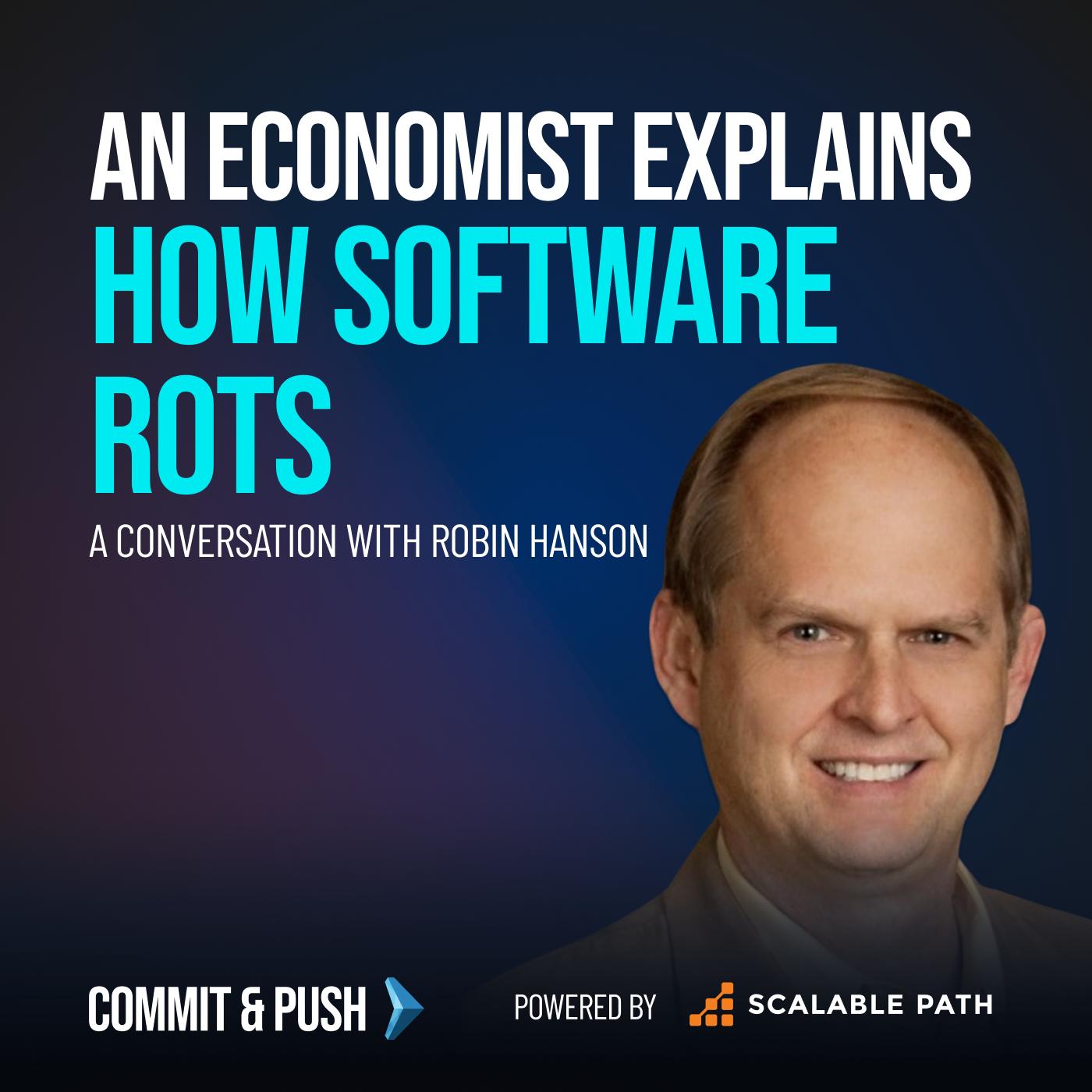
In this episode, host Damien Filiatrault sits down with Robin Hanson—associate professor of economics at George Mason University, former AI researcher at Lockheed & NASA, and author of The Age of EM—to explore what happens when the worlds of software engineering and economics collide.
What you’…

Most AI projects fail. Some never ship. Others ship and implode. So what’s going wrong?In this episode of Commit & Push, Damien sits down with Dan Saffer - Associate Director of Outreach at Carnegie Mellon’s Human-Computer Interaction Institute and author of Microinteractions - to dig into the …
Avertissement: Le podcast et les illustrations intégrés sur cette page proviennent de Scalable Path, qui est la propriété de son propriétaire et n'est ni affilié ni approuvé par Listen Notes, Inc.
MODIFIER
Merci de nous avoir aidé à tenir la base de données de podcasts à jour.
