
À PROPOS DE CET ÉPISODE
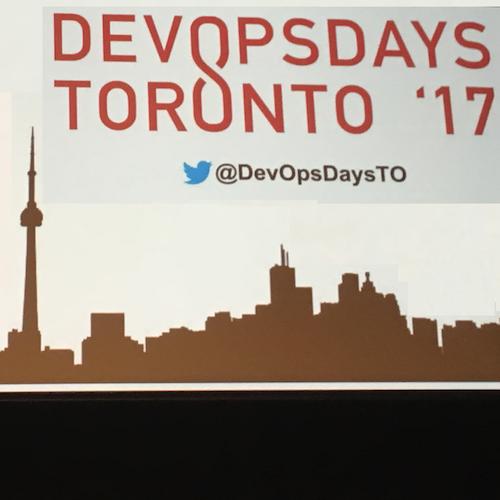
Bridget records live at devopsdays Toronto with local organizer Amy Mansell, who is on a podcast for the first time, and three speakers. Aaron Aldrich, a DevOps consultant and community builder at Cage Data in Connecticut, spoke on managing fires and is also organizing devopsdays Hartford, so Aaron is "secretly here for reconnaissance and stealing ideas from other organizers." Arthur Maltson and Roderick Randolph, both at Capital One, co-gave a talk on deep work and structuring a DevOps team. Roderick leads the DevOps practice for Capital One Canada, in what Roderick calls a software studio in North York. The recording ended early, because the batteries in the Tascam recorder ran out about ten minutes before the end.
Organizing a First devopsdaysBridget notes the overlap between ops people and conference organizers, and asks Amy how the organizing team recruited a newcomer. Amy met Steve Pereira, one of the organizers, at a DevOps Toronto meetup about a year earlier, and asked a million questions about the role before saying yes. The appeal was a grassroots event in many cities, and Amy does community building in the day job. Planning one is "a full-time job in and of itself." Amy's pro tip is to talk a lot on Slack, and Amy admits the team may be annoyed by the number of direct messages.
Steve was too sick to attend, which became a test of the team. Amy says the organizers kept information in the group email and group chat, even for things needed from one person, and held regular meetings and kept shared files. When Steve said Steve couldn't make it, "there was almost just like a playlist that you could go through and check off." Amy adds that the alumni organizers were welcoming, which made the onboarding feel comfortable.
Foreground, Background, and Deep WorkBridget asks Roderick and Arthur how they balance interrupt-driven work against heads-down work. Roderick says to be unafraid to say you need time to focus, pointing to research that "every time you're interrupted, it takes 25 minutes to get back to what you were trying to do earlier." The model from the talk splits a team in two: a foreground group handles the firefighting while a background group works on preventing fires.
Bridget wonders what happens when everyone who understands Project X is in the background. Arthur says that if only one person can answer a question, that's the problem to begin with, and the team is still working on spreading the knowledge. Arthur hopes to reach a "pair programming or pair opsing model." Bridget pushes back that deep contemplation and conversation are hard to combine, noting that Pivotal is a big fan of pairing. Arthur agrees that foreground pairs can learn from each other, then separate when someone needs contemplation, though the team isn't there yet.
On onboarding, Roderick says the team timeboxed the model for a month, and it worked well enough to keep iterating, and that being senior doesn't remove the chance to learn from other groups, which is one reason Capital One sponsors the event. Arthur credits Piyush Chugh, a former colleague now at Capital One Canada, with creating the foreground and background idea, and says Arthur took the credit at first.
Incident Commanders and BackupsBridget asks Aaron what happens if the incident commander is a single point of failure. Aaron says the odds are low while an incident is active, but the best practice is to have someone who can step in, and adds that "best practices is a great word we all like to throw around and then pretend they're not real when we actually put them in place." Aaron says onboarding people to the incident process is about leadership setting the tone: being deliberate, and not letting someone work past capacity when they say they're fine, instead saying "I really need you to go home and get rest." The talk came from an incident that went well, and Aaron wanted to capture why, since the company culture side of incident response seemed more important than individual tooling.
Bridget says ops culture spends a lot of time on what broke and less on what went well, and asks Amy how events handle that. Amy says that on the day of an event, feedback is nearly instantaneous: are people smiling, talking, on time, did everyone eat lunch on time?
Keeping Questions in PublicArthur says the challenge is redirecting conversations that would happen in private chat into a group chat where others can see them, since another engineer who has seen an answer before can give it when the one expert isn't there. Aaron says the team Slack has shifted from private to public messages, in part by reinforcing "default to the public channel," and by copying and pasting private messages to the public channel. Bridget adds that safety matters: if asking a question gets people laughed at, they'll ask in private. Arthur says senior people can use that privilege to show that even someone senior doesn't know everything.
Bridget chats with devopsdays Toronto local organizer Amy Mansell & speakers Roderick Randolph, Arthur Maltson, and Aaron Aldrich.
Roderick & Arthur Aaron Community & Event StuffIf you have an upcoming conference you would like to see promoted on ADO, you can fill out the handy form at arresteddevops.com/conf
Upcoming conferences- Velocity San Jose - discount code "ADO2017" gives 20% off for Gold, Silver, and Bronze passes.