
Algunos audios de este pódcast pueden estar dañados.
Maybe this podcast has a new rss feed?
ACERCA DE ESTE PODCAST 🔗
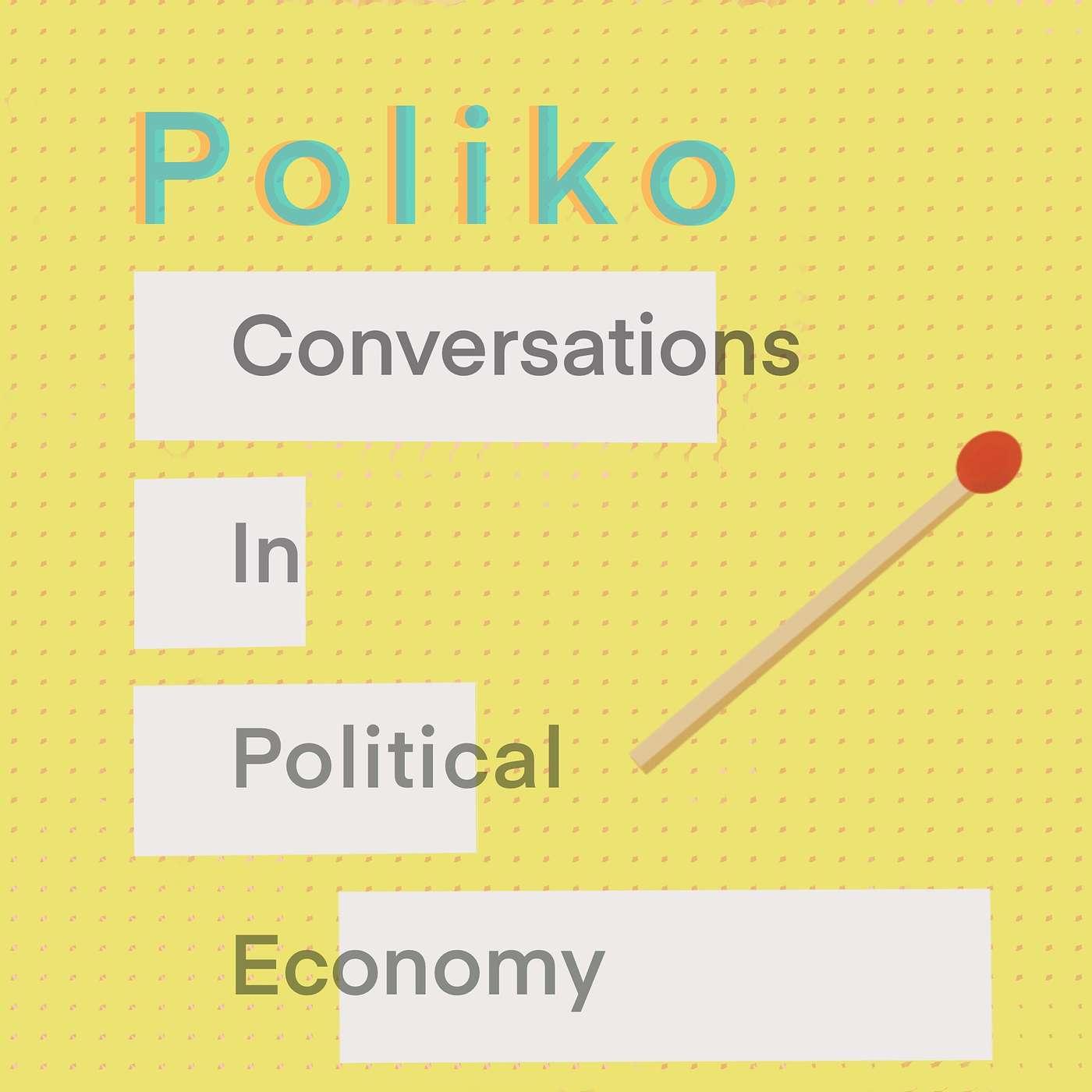
Poliko is a platform for the dissemination of exciting new theoretical and empirical research in political economy. It focuses on the interactions between political and economic institutions, ideas and behaviors but isn't limited to any particular discipline, methodology or theoretical tradition. This is a space to open up and share those longer academic discussions which usually take place around a dinner table.
Frecuencia de actualización:
monthly
Duración media del audio:
49 minutes
Inglés
Estados Unidos
11 episodios
desde 11 de marzo de 2021
episodic
AUDIENCE OF THIS PODCAST 🔗
~67.68% of listeners are from United States.
🇺🇸
US
67.68%
🇬🇧
GB
6.90%
🇳🇱
NL
5.11%
🇩🇪
DE
3.20%
🇨🇦
CA
2.78%
🇧🇪
BE
1.60%
🇳🇴
NO
1.22%
🇿🇦
ZA
0.91%
🇨🇭
CH
0.83%
🇫🇷
FR
0.83%
🇦🇺
AU
0.80%
🇵🇹
PT
0.80%
🇦🇹
AT
0.76%
🇪🇸
ES
0.61%
🇯🇵
JP
0.57%
🇮🇳
IN
0.49%
🇲🇽
MX
0.38%
🇨🇿
CZ
0.38%
🇮🇪
IE
0.26%
🇩🇰
DK
0.22%
🇮🇹
IT
0.22%
🇫🇮
FI
0.19%
🇧🇩
BD
0.19%
🇷🇴
RO
0.19%
🇭🇺
HU
0.19%
🇸🇪
SE
0.19%
🇦🇷
AR
0.15%
🇨🇴
CO
0.15%
🇲🇾
MY
0.15%
🇳🇿
NZ
0.15%
🇸🇦
SA
0.11%
🇹🇷
TR
0.11%
🇸🇮
SI
0.11%
🇸🇨
SC
0.11%
🇧🇷
BR
0.11%
Others
1.35%
* Data source: directly measured on Listen Notes. en tiempo real
ÚLTIMO EPISODIO 🔗
Today’s episode is the first part of a conversation with Nicolas Pons-Vignon who played an instrumental role in setting up Aporde, the African Programme on Rethinking Development Economics, a unique training programme teaching heterodox development economics in South Africa. In this episode, we exp…
BUSCAR EPISODIOS ANTERIORES
Buscar episodios anteriores de Poliko.
EPISODIOS ANTERIORES 🔗
In today’s episode, I’m talking with Ayşe Zarakol from Cambridge University about the crisis of the Liberal International Order (LIO). Ayşe's work explores the contradictions of the LIO as a hierarchical order premised on the notions of freedom, rationality and equal participation: she examine…
In this episode, I invited Jennifer Bair and Benjamin Selwyn to share their insights on the World Bank’s 2020 World Development Report. The WDR is the World Bank’s flagship publication, which aims at defining a hegemonic framework for thinking about development. In 2020, the WDR was entitled “Trad…
In today’s episode, we examine the interdependence between urban displacements, surplus populations and surplus capital in Susanne Soederberg’s recent book “Urban Displacements. Governing Surplus and Survival in Global Capitalism” published in late 2020 with Routledge. We explore the links between…
Today I am joined with Thomas Marois from the School of Oriental and African Studies to discuss the backdrop to his latest book "Public Banks. Decarbonisation, Definancialisation and Democratisation" which is coming out with Cambridge University Press in May 2021. Critical social scienti…
Pritish Behuria from the University of Manchester has a long expertise in studying industrial policy and comparative developmental trajectories in Sub-Saharan Africa. In today’s episode, we first talk about the broader context of a supposedly post-neoliberal developmental framework where industrial…
Today I’m talking with Jathan Sadowski from Monash University about the economic and political dimensions of digital capitalism. An emerging consensus sees digital data, its extraction and the concentration of Big Tech as signalling a dramatic shift towards a new age of “digital feudalism”: The sto…
I am talking today with Zoltán Ginelli, a Hungarian critical geographer whose research repositions the semi-peripheral experience of Hungarian modernization in a global context, by studying the many points of connections linking peoples, ideas, expertise, institutions and political utopias in Hunga…
Today I am talking about China’s engagement in Central Asia with Niva Yau Tsz Yan from the OSCE Academy in Bishkek, Kyrgyzstan. A region often overlooked by Western media and academic research, Central Asia plays a central role in China's Belt and Road Initiative. Niva clarifies the relations…
State capitalism is today a label often applied to China, Russia or the Arab Gulf as a model threatening to displace Western liberal conceptions of insulated markets driven by fair competition and minimal state interventions. In this episode, I'm asking Ilias Alami from Maastricht University…
Descargo de responsabilidad: El podcast y el arte incluidos en esta página son de David Karas, que es propiedad de su propietario y no está afiliado ni respaldado por Listen Notes, Inc.
MOTOR DE BÚSQUEDA DE PODCAST
Puede utilizar nuestro sitio web para buscar podcasts de3,829,722y episodios de196,544,161por personas, lugares o temas.

If I have seen further than others, it is by listening to podcasts and standing upon the shoulders of
giants.
‐ Isaac "Llamacorn" Newton
BUSCAR EPISODIOS ANTERIORES
Buscar episodios anteriores de Poliko.
RECLAMAR ESTE PODCAST
Why to claim podcasts?
If you are a podcaster, the best way to manage your podcasts on Listen Notes is by claiming your Listen Notes
podcast pages.
It is a great, free way to engage the podcast community and increase the visibility of your podcasts.
After claiming your Listen Notes podcast pages, you will be able to:
✓
Manually refresh the RSS feed to sync up
✓
Get a verified badge (
✓
) alongside with your podcast name on Listen Notes
✓
Post anuncios clasificados for sponsorship,
guests, co-hosts,
cross-promotion...
✓
Respond to listener comments on Listen Notes
✓
Use speech-to-text techniques to transcribe your show and
edit transcripts
✓
Improve the presence of your podcasts, e.g., self-service
entrevista con podcaster...
✓
If you share your Listen Notes page and at-mention @ListenNotes
on X (formerly Twitter),
nuestra cuenta oficial de X (antes Twitter) will retweet to promote
your show to our followers.
Coming soon:
◯ Self-service promotion on Listen Notes
◯ Track your podcast stats on Listen
Notes, e.g., listens, page
views...
◯ Manage episodes
EDITAR
Gracias por ayudar a mantener actualizada la base de datos de podcasts.
