
關於這一集
Good empirical safety research is heavily bottlenecked on thinking more clearly. This post shares a few frames and tips I found useful, illustrated with concrete examples.
I spent the better part of 2026 in empirical AI safety research apprenticeships. I was mentored by Alex Turner and Alex Cloud as part of MATS 9 Team Shard, where my collaborator and I worked on finetuning-based misalignment auditing. I then interned at Redwood Research, managed by Aryan Bhatt, where I worked on sabotage capability evaluations.
These thoughts are indebted to my mentors, collaborators, friends, and colleagues, but they are not direct reflections of their views.
Thank you to Alex Cloud, Alex Turner, Aryan Bhatt, Jeremy Huff, and especially to Keshav Shenoy for feedback on the piece.
Better models of the problem speed up empirical iteration
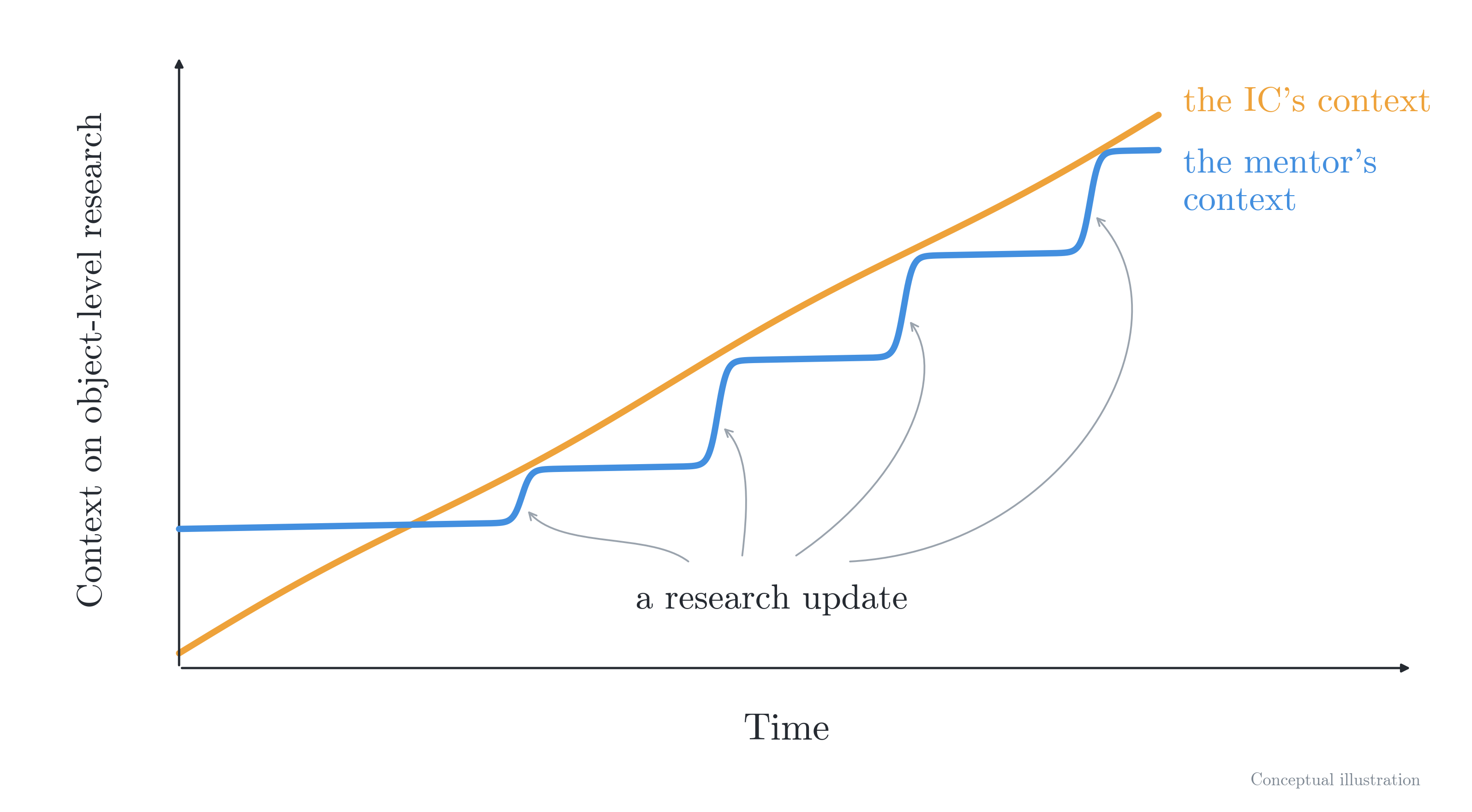
Fast iteration is one of the key virtues of an empirical safety researcher. At first, I didn't find it obvious what that meant or how I should get better at this skill. I imagined a sprinter, doing one looped motion at a far quicker pace than everyone else. I now think that's the wrong mental picture, and going fast is more like being an efficient grappler–agile, strategic [...]
---
Outline:
(01:00) Better models of the problem speed up empirical iteration
(02:26) Develop predictive models and update them
(04:05) Update with uncertainty in mind
(05:51) Predict senior researchers' research takes
(07:34) Use metacognitive strategies to make predicting and updating habitual
[... 9 more sections]
---
First published:
October 12th, 2026
Source:
https://www.lesswrong.com/posts/Q4rcvgjbgjTwmn8Xa/research-lessons-i-learned-at-mats-and-redwood
---
Narrated by TYPE III AUDIO.
---
Images from the article:
Apple Podcasts and Spotify do not show images in the episode description. Try Pocket Casts, or another podcast app.
Apple Podcasts and Spotify do not show images in the episode description. Try Pocket Casts, or another podcast app.
英語
美國
逐字稿 🔗
Are you the producer of this podcast?
Add a podcast transcript
Need Audio-to-Text?
Transcribe with Listen411 in Just 60 Seconds
本 Podcast 中的其他單集

Authors: Axel Højmark*, Ezra Newman* (*Equal contribution) While reviewing transcripts from standard behavioral evaluations of GLM-5.3, we noticed that the model occasionally reasons, unprompted, about how its actions will shape future models. It appears to consider that its outputs might be used f…
TL;DR: Increasingly when you interact with frontier models, your prompt doesn't only contain the words on the page, but also a lot of what you've ever publicly written online. This is not intended to be a scary post. And I'm not going to suggest that you self-censor (and honestly, by…
I think “On Social Reality in China” makes many accurate observations, but I find the comparison fundamentally uneven. There are already many interesting comments there, but they’re too scattered, so I’m starting a separate post to respond in a more systematic and comprehensive way. The most critic…
It's fortunate that I was the first one to wake up on 8/1. The past week had been one where sleep was rare. The next year loomed large — I was dreading college applications. The stress woke me up bright and early at 5:14 am, a little less than an hour after the messages were sent. I started of…
What would it take to get assurance that we have actually explained a neuron? Certainly, it would be a good sign if neuron activations looked like they had a consistent pattern, and a bad sign if they looked like a random jumble of unrelated concepts. Nick Cammarata's recent post makes an impo…
免責聲明: 本頁面嵌入的 Podcast 和封面圖片來自 LessWrong,歸其所有者所有,與 Listen Notes, Inc. 無關聯,也未獲得 Listen Notes, Inc. 背書。