WEBVTT
00:00:08.800 -->
00:00:16.079Welcome to Academia on the Line, a podcast where a couple of mathematicians talk about what's going on in higher education.
00:00:16.239 -->
00:00:17.120We're your hosts.
00:00:17.199 -->
00:00:18.079I'm Joel Fish.
00:00:18.399 -->
00:00:19.760And I'm Karina Kurto.
00:00:20.079 -->
00:00:21.920And what are we talking about today, Karina?
00:00:22.719 -->
00:00:26.480Well, I think we're talking about the crazy week last week.
00:00:26.719 -->
00:00:28.879Yeah, it's been really crazy.
00:00:29.760 -->
00:00:38.079Uh yeah, so I don't I don't know where to begin, but I think the first thing that I heard about was related to the twin primes conjecture.
00:00:38.320 -->
00:00:38.799Oh, right.
00:00:39.200 -->
00:00:42.799It's a crazy week in math and math and AI in particular.
00:00:43.280 -->
00:00:46.320Um so okay, the twin primes conjecture.
00:00:46.399 -->
00:00:55.439I don't know if you remember that one, but that's the one that says there are infinitely mares many pairs of primes that have a gap of just two apart, three and five, five and seven, eleven, thirteen.
00:00:55.679 -->
00:00:58.719So that was it's been an open conjecture for a very long time.
00:00:58.960 -->
00:01:22.640And um, I think the backstory is that, you know, in like 2013, something like 13 years ago, there was a mathematician, Yi Tang Zhang, um, who was actually like a lecturer at the time at University of New Hampshire, who made a big progress where he was able to prove that there are infinitely many pairs that are um a finite amount apart, right?
00:01:23.120 -->
00:01:24.799Finite amount, but it was a big number, right?
00:01:24.879 -->
00:01:26.640Like Yeah, it wasn't two.
00:01:26.799 -->
00:01:29.439It was like I think it was like 70 million.
00:01:29.519 -->
00:01:29.760I don't know.
00:01:30.159 -->
00:01:30.959In the millions, it's great.
00:01:31.280 -->
00:01:32.239Like millions, right?
00:01:32.640 -->
00:01:34.400Um, but it was finite, right?
00:01:34.480 -->
00:01:41.439So there's some finite number, and you can guarantee infinitely many pairs that um are within that kind of gap.
00:01:41.680 -->
00:01:45.599And then uh, you know, I think that was improved quickly.
00:01:45.760 -->
00:01:56.879Um, so he had the big breakthrough ideas, but like other other mathematicians um quickly improved it and got it all the way down to like 246, I think was the magic number.
00:01:56.959 -->
00:02:01.519So infinitely many pairs, um, less than 246 apart.
00:02:01.680 -->
00:02:05.760Um in uh that was maybe like in 2014.
00:02:05.920 -->
00:02:06.079Yep.
00:02:06.239 -->
00:02:09.199So that was the state of the art until the best you could do.
00:02:09.439 -->
00:02:11.199Yeah, until like a month ago.
00:02:11.919 -->
00:02:15.120Until a month ago, and then uh or two weeks ago or something.
00:02:15.680 -->
00:02:20.960And that's when, although this problem had had been picked up recently, I think uh Julia what's her last name?
00:02:21.280 -->
00:02:22.080Stadleman.
00:02:22.400 -->
00:02:23.120Stadlman, right.
00:02:23.199 -->
00:02:26.960So Julia Stadelman was uh had been working on this problem, I think, for a fair amount.
00:02:27.039 -->
00:02:39.199I think in 2023 she'd made a lot of progress in developing some machinery, and then I guess she uses that machinery to improve the bound, and any sort of improvement was considered by the field, I think, a a major result.
00:02:39.439 -->
00:02:50.080And so um she releases this in, I think it's August 31st, and then sort of quickly shows, okay, here's how it would work, and then gets the number from 246 down to 240, I think.
00:02:50.240 -->
00:02:58.080But everyone's really impressed because of the seeing the new machinery work and making some serious progress on this problem uh after none for at least 10 years.
00:02:58.400 -->
00:02:58.639Right.
00:02:58.719 -->
00:03:04.159And I think she even says in her paper that she's kind of it seems like she's a little bit in a rush to get it out.
00:03:04.319 -->
00:03:15.919Yeah, and she even says that she believes these techniques, these new techniques she's developed can be used to improve the bound further, but she doesn't have time or resources to do that.
00:03:16.000 -->
00:03:20.639So she just does the improvement to 240, which is kind of the easier part.
00:03:20.879 -->
00:03:22.080Yeah, which is really cool.
00:03:22.159 -->
00:03:33.120And uh for me, I I when I started looking into this, at least a little bit, because this is definitely not my field, the the important thing, the thing that that people care about is the technology used to improve the bound.
00:03:33.199 -->
00:03:36.879So if you develop new technology to improve the bound, that's great.
00:03:37.039 -->
00:03:40.560If you use that same technology to improve the bound further, that's good.
00:03:40.719 -->
00:03:47.840But like most people in the field, I think, care about the technology used, which I think uh is what uh uh uh which is why Julia's work was so great, I think.
00:03:48.159 -->
00:03:49.919Well let's yeah, let's hope that's true.
00:03:50.560 -->
00:03:51.039Indeed.
00:03:51.680 -->
00:03:54.479Because in fact, uh, yeah, so so what happened?
00:03:54.560 -->
00:04:02.719I mean, the the reason this came to my attention, and I think your attention was actually not because of the preprint on August 31st, but actually September 3rd.
00:04:02.960 -->
00:04:15.199So September 3rd, which is now like a little over a week ago, um axiom math uh improved the bound to 212, just like a few days after she posted her preprint.
00:04:15.280 -->
00:04:19.439They go from 240 down to 212 um using her techniques.
00:04:19.680 -->
00:04:22.240And they were able to do this really quickly.
00:04:22.480 -->
00:04:29.199Um and I think I don't know, they had previously formalized it, formalized the 46 bound.
00:04:29.360 -->
00:04:29.759What was that?
00:04:29.920 -->
00:04:36.480Yeah, the 246 they that's the thing about Axiom Math is they're not, I don't know to what extent they're interested in proving theorems directly.
00:04:36.560 -->
00:04:44.000I think their main focus is lean formalization, although I think they're interested in doing other things besides just lean, but I I thought that's what their focus was.
00:04:44.399 -->
00:04:51.120Um so yeah, they did a lean formalization of the 246 bound and they released that on August 17, I think.
00:04:51.199 -->
00:04:56.079And then yeah, September 3 they said, hey, we reduced it from 240 to to 212.
00:04:56.240 -->
00:05:03.759And then I think a couple of hours later, uh, OpenAI said, uh, actually, yeah, we've got the bound down to 186 now.
00:05:03.839 -->
00:05:09.600Uh so really, really rapid development there from uh from multiple sources, which was pretty cool.
00:05:09.920 -->
00:05:13.040Yeah, I mean, pretty cool or pretty alarming.
00:05:13.120 -->
00:05:19.439If you I don't know, I mean it I I think I think some of us were thinking, okay, from Julia's perspective, so she's a postdoc.
00:05:19.519 -->
00:05:19.680Yeah.
00:05:19.839 -->
00:05:21.360She doesn't have a 10-year track job.
00:05:21.600 -->
00:05:22.319She's young, right?
00:05:22.399 -->
00:05:35.600She's a young, brilliant mathematician, and had, you know, spent all this time developing these new methods, and I think, you know, really didn't have the time or resources to actually see her methods to their full extent.
00:05:35.759 -->
00:05:36.560Um, I don't know.
00:05:36.639 -->
00:05:38.160So that's Yeah, no, that's definitely true.
00:05:38.240 -->
00:05:56.079There was a uh a decent number of folks who were kind of concerned about uh just the way mathematicians work, and we're trying to be very open about our results, and uh and then the possibility of kind of releasing results or tools and then kind of getting scooped using your own work by um you know by by other organizations.
00:05:56.560 -->
00:06:00.959I mean, I think yeah, once you publish, it's one thing, but I think she would have waited longer to publish.
00:06:01.120 -->
00:06:06.000She she sort of had been told maybe open AI is working on this or there's pressure, right?
00:06:06.079 -->
00:06:06.240Yeah.
00:06:06.399 -->
00:06:22.800And so she actually, I think, felt pressured to publish quickly to at least get you know get her name on the tools because they weren't um that paper from uh from August 31st hadn't been out yet, but like who knows what what the AI companies know.
00:06:23.439 -->
00:06:24.319Yeah, yeah.
00:06:24.480 -->
00:06:36.240Well, this was the first of a number of incidents that came to light over the past couple of weeks, which were simultaneously interesting, exciting, and um, well, a bit concerning.
00:06:36.319 -->
00:06:42.319Um, but this particular one ended up being dwarfed by a much, much bigger announcement just a couple of days later.
00:06:42.800 -->
00:06:45.839Yes, you must be talking about the Navier Stokes news.
00:06:46.000 -->
00:06:46.240Yeah.
00:06:46.480 -->
00:06:52.560That was the the bombshell news um that prompted us to do this episode.
00:06:52.879 -->
00:07:04.160Um so okay, so Navier Stokes, just for you know, for people who don't know, so they're so Navier Stokes equations are partial differential equations describing uh fluid dynamics.
00:07:04.319 -->
00:07:07.360Okay, so they are they are being solved all the time, right?
00:07:07.439 -->
00:07:14.720So they're being solved to describe um uh water flow and atmospheric flow and all these kinds of things.
00:07:15.040 -->
00:07:15.439Right, right.
00:07:15.519 -->
00:07:25.120So the I mean you mean like these these equations appear like all over the place in the real world, uh, you know, in real world models, and so they get numerical solutions all the time.
00:07:25.199 -->
00:07:26.160Like this is a very common thing.
00:07:27.360 -->
00:07:27.920Yeah, okay, yeah.
00:07:28.240 -->
00:07:34.639But there was a question, but the but so so it's not that you know they hadn't been solved, but there is a millennium problem.
00:07:34.879 -->
00:07:35.279That's right.
00:07:35.600 -->
00:07:41.519These millennium problems, there are like seven of them, they have a million dollars attached to them, and they were set out like around 2,000.
00:07:41.839 -->
00:07:44.079Um very famous open math problems.
00:07:44.240 -->
00:07:55.920And one of them was on Navier Stokes, and the problem was um, or is to uh decide whether or not these equations would have solutions that naturally kind of blew up.
00:07:56.000 -->
00:08:13.439So even if you started with sort of reasonable, smooth initial conditions, like your initial configuration of water or whatever it was was reasonable, if the equations themselves, as you evolve forward in time, could lead to some kind of singular behavior blow up, is what they call it.
00:08:14.000 -->
00:08:20.720Um so that's uh anyway, that's that's about as much as I know about this, because this is not my field.
00:08:20.879 -->
00:08:32.559Um, but the point is like to show the existence of such a solution or to prove that it doesn't exist, that there is like nice smoothness no matter what, um, was one of these millennium problems.
00:08:32.720 -->
00:08:32.879Right.
00:08:33.120 -->
00:08:40.720And so, you know, million-dollar prize if you can solve it, but it's also meant to sort of spur a lot of research in this field and understand PDEs better.
00:08:40.879 -->
00:08:41.200Yep.
00:08:41.440 -->
00:08:44.080So, okay, so that was that's sort of the backstory.
00:08:44.320 -->
00:08:56.240But okay, so the big thing that happened uh Monday night, Labor Day, is uh Tristan Buckmaster, uh, a math professor at NYU.
00:08:56.559 -->
00:09:10.879He and his collaborator, Levin Alpoge, who actually works for Anthropic, they posted three preprints that day, and then Tristan posted the statement, like a two-page statement, um, kind of saying a couple of things.
00:09:11.039 -->
00:09:22.559First, uh regretting that the papers are a bit of a mess, that they didn't have time to uh clean them up, although they have they do have like lean verification for their results.
00:09:23.120 -->
00:09:36.720Um but also basically saying uh OpenAI um had you know wanted to, you know, sort of alleging that open AI was trying to scoop them in some way or Right, right.
00:09:36.960 -->
00:09:46.159Probably worth mentioning that uh Tristan and Levant had been working as a team, I think, on Navier Stokes for about the past, I don't know, year or so, I think.
00:09:46.639 -->
00:09:59.200And uh the preprints that they released by any uh normal standard uh would have been considered pretty major progress towards uh ultimately or eventually solving the uh the Millennium problem.
00:09:59.759 -->
00:10:11.200But then Tristan also releases this statement, and he does a number of things in the statement, um, one of which being to detail this meeting he's just had with uh some representatives from OpenAI.
00:10:11.440 -->
00:10:23.840Um I think the story is that both sides realize that they're each going to make a major announcement about progress on Navier Stokes, and so they're trying to figure out, okay, what has the other side done and and how and uh uh etc.
00:10:24.320 -->
00:10:43.679Um but what Tristan details from that meeting uh well is really very concerning, um, both in terms of the behavior of OpenAI representatives, um, but also in terms of how OpenAI got to their Navier Stokes results, whatever those might be.
00:10:43.919 -->
00:10:56.960This happens, uh, and then the next day OpenAI makes their actual announcement, which is that they have solved the Navier Stokes millennium problem, and their proof has been lean verified.
00:10:57.200 -->
00:11:06.240Yeah, so and and and also kind of contesting some of the details about the personal interaction that had happened um between Buckmaster and OpenAI.
00:11:06.399 -->
00:11:21.679But I think, I mean, the other thing, so so Tristan's statement um says a couple of things, and among uh, you know, in addition to detailing these really weird interactions with open AI that feel, you know, I think to most people in the math community pretty strange.
00:11:22.159 -->
00:11:40.559Um the the suggestion is that so even though Tristan was working with Livon Alpage, who um is an employee at Anthropic, Tristan himself had been using open AI models, like he like a paid version, like he was paying maybe the$200 a month paying for open AI models.
00:11:40.720 -->
00:12:04.480And his major concern, and he had actually asked them about this in the meeting and did not get a satisfactory answer, was whether that the open AI had been able to use you know the unpublished work that they were feeding in, you know, to to Chad GPT or whatever, um, as training for the model that then went up went on to scoop them.
00:12:04.720 -->
00:12:06.559So that's sort of the question.
00:12:06.720 -->
00:12:13.039Like this was definitely a concern that that Tristan had, who was very, very concerned, and I think a lot of people uh would be as well.
00:12:13.200 -->
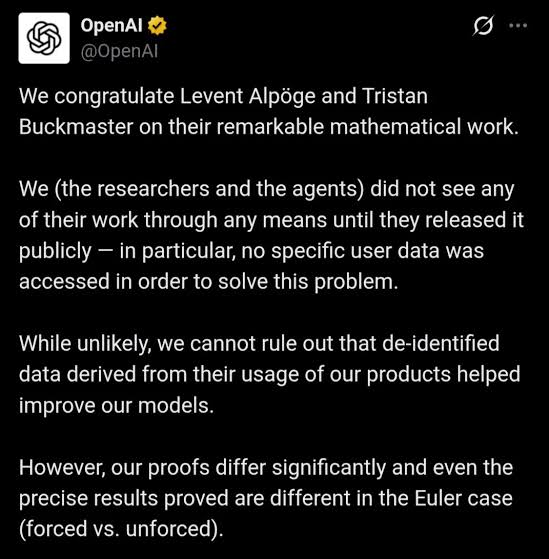
00:12:18.080And uh, you know, OpenAI's initial statement didn't really tamp things down that much.
00:12:18.320 -->
00:12:30.159It included the line, uh, while so this is what OpenAI says said, um, while unlikely, we cannot rule out that de-identified data derived from their usage of our products helped improve the models.
00:12:30.240 -->
00:12:34.639So they're kind of saying, like, um maybe Maybe we trained on your work.
00:12:34.799 -->
00:12:37.759Yeah, maybe we trained on your unpublished work, we're not sure.
00:12:38.159 -->
00:12:40.480They've since removed that, by the way.
00:12:40.879 -->
00:12:41.600Yeah, they have.
00:12:41.679 -->
00:12:47.360So now and now they have a much more definitive statement saying, no, we categorically deny that this was that this was possible.
00:12:47.440 -->
00:12:58.240But um But yeah, but for uh for that past week though, a lot of people were really, really concerned about well, wait a second, like is it the case that open AI is training on our data or not?
00:12:58.480 -->
00:13:01.679Training on our conversations or our partial our partial work?
00:13:01.840 -->
00:13:03.039Like there was a lot of concerns.
00:13:03.120 -->
00:13:04.240I think there still are some floating around.
00:13:04.559 -->
00:13:12.879I think that's the I mean that's the big question that was raised, I think that alarmed a lot of mathematicians, particularly ones who are maybe using um these AI tools.
00:13:13.120 -->
00:13:19.120Because when you are working on something, right, and you're not ready to publish, you assume it's private, right?
00:13:19.200 -->
00:13:37.519You you you're sort of feeding maybe your um laTech files or you're prompting the the LLM in various directions, but you assume that's all private and you assume that like it's still your work that's not getting immediately assimilated into the training data, at least until you publish it.
00:13:37.679 -->
00:13:39.039But we're not so sure anymore.
00:13:39.120 -->
00:13:41.519And so that you know, this is the kind of thing.
00:13:42.799 -->
00:13:51.919So I think that the the the best takeaway that I had from all of this, it's still, you know, conspiracy theorists or might be concerned that there was still some theft, I guess.
00:13:52.000 -->
00:13:58.879Um, but uh I think if you're if you are concerned about this, there is a setting that says uh do not train on my data.
00:13:58.960 -->
00:14:02.799Uh at least in OpenAI, I think Anthropic has something uh something similar.
00:14:02.960 -->
00:14:07.120And if you are concerned, I highly suggest you go to your settings and set it to something you'd be happier with.
00:14:07.360 -->
00:14:11.120Yeah, I don't know that I would call them conspiracy theorists of people who are concerned.
00:14:11.360 -->
00:14:20.480I think it's a legitimate concern, and I think uh I think that may be a little too trusting to think you can just you know put the right setting and you're safe.
00:14:20.559 -->
00:14:21.600I'm not sure that's true.
00:14:21.840 -->
00:14:22.159Fair enough.
00:14:22.399 -->
00:14:23.200But we can disagree with that.
00:14:23.519 -->
00:14:23.759Fair enough.
00:14:23.840 -->
00:14:27.600Like yeah, it's it's an open question about mathematicians about whether or not this is possible.
00:14:27.919 -->
00:14:29.679Um so okay, so here's the crazy thing.
00:14:29.759 -->
00:14:34.720So this all happened, um, this big kind of blow up in the math community.
00:14:35.039 -->
00:14:35.840Pun intended.
00:14:35.919 -->
00:14:37.360The pun is always intended.
00:14:37.759 -->
00:14:44.720Um but uh and then you know, that was like Tuesday after Labor Day, went night, Tuesday morning.
00:14:44.879 -->
00:14:47.519I started getting texts about it Tuesday morning when I woke up.
00:14:47.600 -->
00:14:50.720I think that's the day it spread, and then OpenAI made their announcement.
00:14:50.879 -->
00:14:55.600And then by Wednesday, there were new things simmering that other people brought up.
00:14:55.759 -->
00:15:07.039A lot of people had read Tristan's statement, and all of a sudden there were then questions about two other results that were at least two other results that had come out via AI over the summer.
00:15:07.200 -->
00:15:11.840Um yeah, not quite as big as Millennium Problems, but still very large problems, right?
00:15:14.080 -->
00:15:16.720So I guess there was the the Jacobian conjecture.
00:15:16.799 -->
00:15:17.039Yeah.
00:15:17.279 -->
00:15:23.840Um this was this one came out, uh I think this was kind of one shot by Levant, I think, during the World Cup final.
00:15:24.240 -->
00:15:30.000Um, but there were definitely some uh some I guess semi-al allegations about this.
00:15:30.159 -->
00:15:41.919I think Yeah, so this is the one that I remember this because there was a tweet the day, you know, so the World Cup final was kind of a sad day for me as an Argentina fan.
00:15:42.159 -->
00:15:48.159Um but then this this this tweet came out from Levant saying, yeah, I saw the Jacobian conjecture.
00:15:48.240 -->
00:16:05.279And that one was really striking because it's a counterexample saying the picture is not true, and the counterexample is basically just a set of three polynomials and three variables, um degree seven, so it does fit on a tweet, and you can actually check the counterexample yourself.
00:16:05.440 -->
00:16:14.159Like I actually sat down with my you know with my teenage son, and we're like, let's take some partial derivatives and compute a determinant, and we could actually you could check it by hand.
00:16:14.240 -->
00:16:18.240So it's like one of those once you have the counterexample, like it's easy to check.
00:16:18.399 -->
00:16:21.039Um so it was obviously true.
00:16:21.279 -->
00:16:43.360Yeah um, but yeah, but then after you know, on Wednesday, September 9th, like as this uh OpenAI Navier Stokes news is going down, um, it's it starts circulating um another paper by a team that had actually been working on developing theory that addresses the Jacobian conjecture.
00:16:43.519 -->
00:16:43.759Right.
00:16:44.000 -->
00:16:53.279And uh their preprint had actually been posted on September 4th before all of this stuff happened, but then was circulating um after.
00:16:53.679 -->
00:17:12.640Uh you know, and and and they have a whole section at the end with AI comments, and one was an AI disclosure that they actually did not use AI, right, but they said that there had been an earlier version of their preprint kind of hanging online, sort of technically publicly accessible, but maybe not intended to be.
00:17:12.720 -->
00:17:44.480So some you know, maybe they'd post it's like a personal website, personal website, and maybe posted without a without a uh a public link, so like no one could actually like find it if they were just searching, but maybe so they were worried because the style of the counterexample is actually very, very similar to what would come out of their work, and so they actually were questioning whether that had managed to get into the training data for um, I guess in this case, anthropics model, um, which allowed Levant to find the counterexample.
00:17:44.640 -->
00:17:44.960Yep.
00:17:45.279 -->
00:17:51.119Yeah, I think it's I mean it's interesting, it's it's less of a you know ethical or contract violation type thing.
00:17:51.200 -->
00:17:56.319I mean, if you accidentally leave it out there and someone can find it, but it's kind of a it's a new world that we're living in.
00:17:56.400 -->
00:18:12.319If if anything that you might leave out can be sort of scraped up and incorporated, I think a lot of people are gonna get uh a lot of mathematicians are gonna be worried about security and and privacy of their information uh and be less forthcoming to share stuff, I think, which would not not be so good.
00:18:12.480 -->
00:18:21.440Um and then um right, but this uh then this also wasn't the only case of something a little bit strange and and some concerns going on.
00:18:21.599 -->
00:18:32.079The it we found out, I think, on I think we found out on September 9th that there was a potential issue with uh the non-Sophic Groups uh uh paper as well, right?
00:18:32.319 -->
00:18:32.480Right.
00:18:32.640 -->
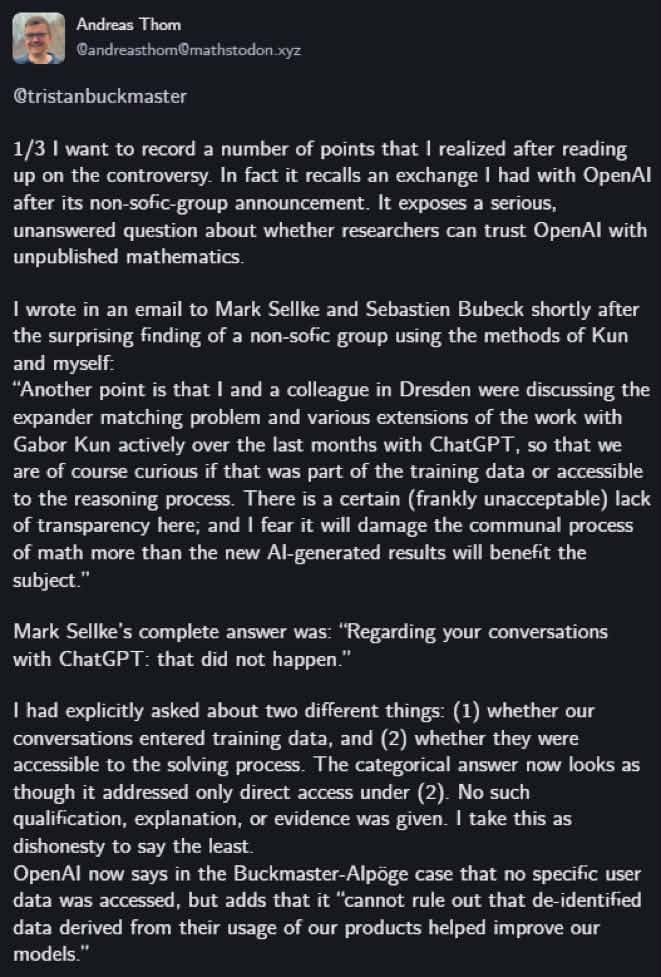
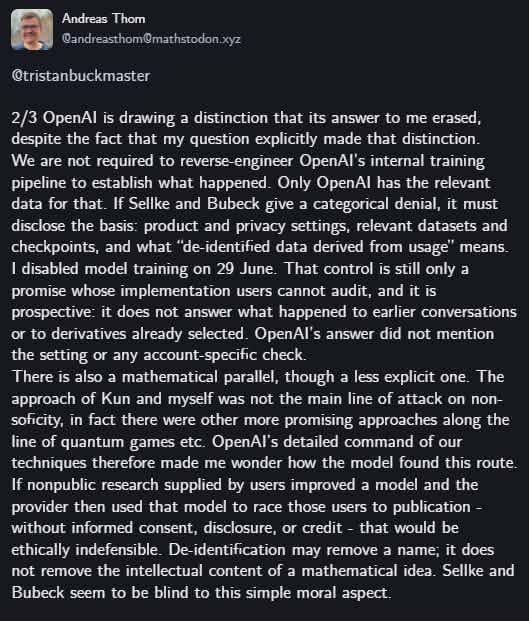
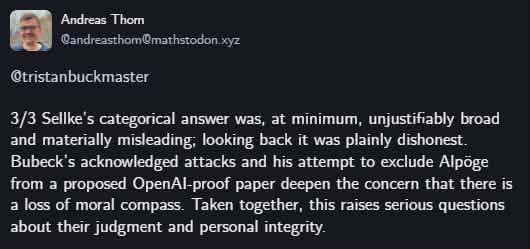
00:18:51.279So that result too, there was like I maybe a tweet by Andreas Tom, um sort of alleging like that work is also it's also suspicious whether uh people using uh open AI tools, right, might have inadvertently been training open AI to scoop them.
00:18:52.160 -->
00:19:00.559Yes, uh Yeah, I think their concern was that uh some of their work, yeah, definitely that some of their work might have been scooped up into uh into training data.
00:19:00.720 -->
00:19:15.519Um uh I don't think there was anything necessarily uh nothing necessarily inappropriate, but but nevertheless there was something kind of I think about the result that was obtained that that made it seem a little bit maybe unlikely that it would have been found independently.
00:19:15.680 -->
00:19:17.200I can't remember why they were concerned about this.
00:19:17.519 -->
00:19:23.200I think the concern was that the they were really close actually to finding um to the result.
00:19:23.440 -->
00:19:25.119Like they're and it was the case.
00:19:25.200 -->
00:19:34.480I mean, even when it came out in real time, uh I have math friends who were like, oh, I sort of was at a workshop that they were discussing this, and like the community was close, right?
00:19:34.720 -->
00:19:54.319And so like in all of these cases, whether it's Navier Stokes or Jacobian Conjecture or the non-Sopic groups, or some of the other problems in the 10 problems that open AI solved, they had another post over the summer, like 10 open problems, like all of these cases, it feels like the community was close to an answer or too close to solving the problem.
00:19:54.559 -->
00:20:19.200Some people were even using AI tools as part of that, and so there's a a fear that in fact, you know, this is what the LLMs are really good at, instead of like doing that lot of stuff when the ideas are already there, when they're close, like and they're and they're maybe, I think, may perhaps inappropriately absorbing knowledge um into the training that is not yet published.
00:20:19.519 -->
00:20:20.000Yeah, yeah.
00:20:20.240 -->
00:20:24.640So that feels that's not the same as absorbing published knowledge, right?
00:20:24.720 -->
00:20:26.079That's supposed to be public, right?
00:20:26.160 -->
00:20:30.000That's sort of the private workings of mathematicians, is that getting absorbed in?
00:20:30.079 -->
00:20:31.440That's the that's the big question.
00:20:31.599 -->
00:20:32.400So Yep.
00:20:32.640 -->
00:20:37.119And I think you know, uh lots of folks are uh mathematicians, I think, care about this a lot.
00:20:37.359 -->
00:20:40.640Just to point out on the other on the other side, though, right?
00:20:40.720 -->
00:21:00.640If you're an AI company and you want to demonstrate how capable your models are, rather than working on random problems where you don't know if there's any progress, like if your only goal is to is to is to hit that proof before anyone else does, the natural thing to do is to look for problems in the field which look like they're about to be published and then target those.
00:21:00.880 -->
00:21:14.000Even if you're being completely honest, those are the problems that you want to target because then you know that like a proof is going to be possible, as opposed to working on any other problem where you don't know if this is possible or not, so you might be wasting your time, your money, your tokens.
00:21:14.160 -->
00:21:21.119So it's it could be, these could just be good targeting on the behalf of the AI company.
00:21:21.359 -->
00:21:24.799On the other hand, with the Millennium problems, you have to imagine they're just targeting them all.
00:21:24.880 -->
00:21:26.319They're only seven, you know.
00:21:26.480 -->
00:21:28.799So that's well, you know, that's true.
00:21:29.039 -->
00:21:38.240Although the funny thing, the funny thing about the Navier Stokes problem, right, was that uh apparently they had spent a little bit of money working on all the uh millennium problems, OpenAI did.
00:21:38.319 -->
00:21:41.279They spent some money on these problems, didn't make any progress.
00:21:41.440 -->
00:21:58.640Then they heard that uh that Levant and Tristan were about to they're getting close with something, and over the course of like seven, eight, nine days, they're just like, let's dump, I think they estimated it on the order of ten or twenty million dollars worth of compute at trying to solve this particular problem, and they were able to succeed.
00:21:58.720 -->
00:21:59.279It was just crazy.
00:22:00.240 -->
00:22:10.880This crazy intense run, 88 hours, I think they said, and then another another chunk of time and tokens for the lean verification, which we should actually do an episode on this lean stuff, right?
00:22:10.960 -->
00:22:12.240But that's the point.
00:22:12.319 -->
00:22:36.000Because one of the reasons anybody trusts these proofs, which are really, I mean, the AI proofs are super long and allegedly very poorly written, but like the reason is because of this lean verification, which is a sort of a different um ingredient in this whole process, which is like a sort of a way to verify that uh a statement is true uh rigorously, but it's not easy to read and understand.
00:22:36.319 -->
00:22:36.559Right.
00:22:36.640 -->
00:22:40.400But that's also kind of a new phenomenon, right?
00:22:40.480 -->
00:22:44.240That there's an increasing number of proofs that are getting these sort of lean certificates.
00:22:44.319 -->
00:22:45.359So we really should talk to them.
00:22:45.759 -->
00:22:50.160Okay, but first I think we really need to talk to an expert about Navier Stokes.
00:22:50.240 -->
00:22:52.240I want to hear more details about it.
00:22:52.400 -->
00:22:53.920Yes, we we definitely should.
00:22:54.000 -->
00:22:56.079Uh that's uh that's a good idea.
00:22:56.400 -->
00:23:02.640Um so we I actually have one of my colleagues here at Brown in the math department, Javier Gomez Serrano.
00:23:03.039 -->
00:23:07.279Uh so I know he's been working on Navier Stokes um with AI.
00:23:07.519 -->
00:23:08.319Yeah, with AI.
00:23:08.400 -->
00:23:10.640I think he has a collaboration with Deep Mind.
00:23:10.720 -->
00:23:15.599Um so uh he actually gave a talk at Harvard last Friday.
00:23:15.759 -->
00:23:22.480They invited him out to come explain what the hell happened uh with all this Navier Stokes news.
00:23:22.640 -->
00:23:29.279Um and so I uh I reached out to him after that, and I think he's gonna come and talk to us.
00:23:29.440 -->
00:23:30.799Um that's fantastic.
00:23:30.960 -->
00:23:31.440Yeah.
00:23:31.759 -->
00:23:35.200All right, well, let's uh let's see what uh let's see what Javier has to say then.
00:23:35.440 -->
00:23:36.000All right.
00:23:38.640 -->
00:23:39.279Welcome.
00:23:39.359 -->
00:23:47.279Uh our guest today is Javier Gomez Serrano, and he is actually a colleague of mine here at Brown in the pure math department.
00:23:47.359 -->
00:23:52.480Uh I'm an applied math, so funny enough, we've never, I think, actually met in person.
00:23:52.799 -->
00:23:58.400Um I guess you were, you know, I've only been here a couple of years and and you were on sabbatical last year, maybe.
00:23:58.480 -->
00:24:00.240Is that you said?
00:24:00.480 -->
00:24:10.160Um but anyway, now is the is as good a time as ever because there's uh lots of relevant stuff in the news about Navier Stokes and things that Javier has been working on.
00:24:10.319 -->
00:24:16.799So uh we're delighted to have you here to to talk to us and and fill us in on what is going on.
00:24:17.200 -->
00:24:24.400Yeah, it'd be great if you could give a little background on yourself and uh your work and how you came to start working on the Navier Stokes problem.
00:24:24.799 -->
00:24:25.039Right.
00:24:25.279 -->
00:24:43.359So yeah, so so I I did my PhD in 2013 in in mathematical fluid mechanics in let's say what is now known as traditional or or pen and paper um PDE, um, but with a strong uh computational component.
00:24:43.519 -->
00:24:52.799So so I was doing uh I was one of the first ones doing computer-assisted proofs uh in the context of uh of PDE.
00:24:52.880 -->
00:25:07.039So a little bit somewhere beyond numerical simulations, like in some kind of intermediate world um beyond classical simulation or numerical simulation, and let's say old school uh traditional uh PDE.
00:25:07.200 -->
00:25:11.119So that's sort of like how I grew up and what I was doing.
00:25:11.599 -->
00:25:19.839So I'm kind of curious though, if you if you were using um you know AI uh in your work to some uh reasonable extent, roughly when did you start uh doing that?
00:25:20.319 -->
00:25:29.200I started uh in the context of math, I was one of the first ones to use AI in some capacity um back in 2021.
00:25:29.279 -->
00:25:30.799Um 2021.
00:25:31.039 -->
00:25:31.359Okay.
00:25:32.400 -->
00:25:34.799So that's well, it depends who you ask.
00:25:34.960 -->
00:25:39.759Uh I mean for the physicists and for the engineers, this is extremely late.
00:25:39.920 -->
00:25:43.279Uh for the mathematicians, it's probably very early.
00:25:43.440 -->
00:25:51.680Uh yeah, back then, and and even now, I uh I talked a lot to to physicists who were already doing this kind of uh this kind of stuff.
00:25:51.839 -->
00:26:05.759So initially it was uh done to do better, faster, stronger uh numerical simulations and to like use for discovery of of new solutions of certain PD.
00:26:06.000 -->
00:26:18.000And then slowly the natural kind of path was going in through more agentic AI, uh LLMs, and so on, up until now, where I basically use it every day, all day.
00:26:18.400 -->
00:26:28.640So that so in the pre-LLM phase, right, when you talk about either the computer-assisted proofs you were doing earlier or you know, uh using AI in 2021, what did that look like?
00:26:28.799 -->
00:26:31.440That I assume that was not with large language models.
00:26:31.839 -->
00:26:32.559No, no, no.
00:26:33.359 -->
00:26:33.920Think about now.
00:26:34.079 -->
00:26:39.839That is that more like deep learning or um did you call it machine learning or that's right.
00:26:39.920 -->
00:26:58.319So so the AI, which is these days kind of a very kind of blanket word uh for a lot of things, uh, it was mostly like deep learning and uh physics in for neural networks uh and that kind of stuff, which if you look at the models, they're not they're not so big actually, they're fairly small.
00:26:58.480 -->
00:27:09.680Um so that was sort of the context uh for like the broad AI or or or I don't know or machine learning, however you you want to call it, that I was doing in in 2021.
00:27:09.839 -->
00:27:32.000Uh and the the computer-assisted stuff, it was more like old school like CPU kind of computation, but more like interval arithmetics and sort of uh doing guaranteed bounds, or in some communities this is known as like uncertainty quantification in order to arm with those kind of bounds, uh prove a mathematically rigorous theorem afterwards.
00:27:32.240 -->
00:27:44.000Um and then when when did you start really using what we now would consider, you know, I don't know, large language models or AI, or there's also another thing that you've been involved with, Alpha Evolve.
00:27:44.640 -->
00:27:45.039That's right.
00:27:45.200 -->
00:27:49.759So Alpha Evolve, uh, well, let me decouple the two statements.
00:27:50.000 -->
00:27:54.960So I started using mainstream LLMs.
00:27:55.519 -->
00:27:59.680Well, maybe maybe this is even uh easier to state in the following way.
00:27:59.839 -->
00:28:10.640I think I bought my first$200 LLM subscription uh at around uh October 2025, roughly, roughly around that.
00:28:11.200 -->
00:28:12.240Oh, less than a year ago.
00:28:12.880 -->
00:28:13.59911 months ago.
00:28:13.839 -->
00:28:14.000Okay.
00:28:14.240 -->
00:28:20.880Uh and I bought my first LLM subscription at around September 2024.
00:28:21.680 -->
00:28:23.680Okay, a year before that, two years ago.
00:28:24.400 -->
00:28:36.160Uh so that's let's say for the uh frontier LLMs, let's say the paid versions of the open uh of the open models out there.
00:28:36.960 -->
00:28:48.079Uh and then concerning Alpha Evolve, which is also LLM-based to some extent, it's more like uh um a genetic optimization of like an agentique framework.
00:28:48.240 -->
00:28:58.559Um we started working on this uh in January 2025, and we posted the paper around in the fall.
00:28:58.720 -->
00:29:07.759Well, there are two papers, but uh the math paper, uh we posted it around uh October or November uh 2025.
00:29:07.839 -->
00:29:14.000And the paper just got accepted about two months ago, and it's completely obsolete.
00:29:15.920 -->
00:29:16.559Wow, yeah.
00:29:18.160 -->
00:29:21.279And that's a and that alpha evolve, can you say a little more about that?
00:29:21.440 -->
00:29:22.640Because that's that's different.
00:29:22.799 -->
00:29:29.039I think that's different from what people have been hearing um in terms of you know other LLM usage.
00:29:29.440 -->
00:29:30.000That's right.
00:29:30.160 -->
00:29:37.200So so the point is that LLMs back then, let's say in January 2025, they were okay, but they were not great.
00:29:37.440 -->
00:29:54.160So so what we what we did uh was to develop a framework where uh so think of think of this uh model or think of this um program as some kind of black box optimization.
00:29:54.319 -->
00:29:57.279Uh and this is geared, let's say, to solve a math problem.
00:29:57.519 -->
00:30:08.160So the idea was that if you and think of a math problem that is it it is recasted in as an optimization problem over something.
00:30:08.240 -->
00:30:27.759And and this, for example, could be find a given configuration of points that satisfies the best constraints, or find the function that satisfies something, for example, that it's a solution of something, uh, or find uh the best um constant in some inequality.
00:30:27.920 -->
00:30:44.000Uh like it doesn't need to be uh like a number, but it could be like an object, or for example, find the uh the the this uh the way to put spheres or the way to pack spheres in a way to maximize the volume, uh things like that.
00:30:44.079 -->
00:30:47.279So these are the kind of problems that we were working on.
00:30:47.519 -->
00:30:58.559And uh the idea is that instead of trying to solve directly, like as what I don't know, let's say modern LLMs would do, like, okay, solve or help me solve problem X.
00:30:58.960 -->
00:31:04.960Uh then what we were trying is uh help me write the code to solve problem X.
00:31:05.039 -->
00:31:14.480So we recasted everything in the landscape of like finding a code that produced a candidate or uh or find the S constant and whatnot.
00:31:14.559 -->
00:31:38.079Uh and then in that landscape, uh there is so what we did was like to keep a genetic algorithm, so to have a population of codes that solve the problem at a certain uh with a certain score, um, and then introduce mutations uh among uh these codes to generate better codes that solve the problem better.
00:31:38.160 -->
00:31:41.599Uh so those mutations were introduced by query an LLM.
00:31:41.680 -->
00:31:43.759This is where the LLM comes into play.
00:31:44.000 -->
00:31:48.000Um and and and so this is kind of the optimization.
00:31:48.079 -->
00:32:05.359So there is a genetic uh optimization algorithm overall, every element of this population is a code, uh, and we sort of run this this optimization produce this optimization procedure to get better and better codes that uh that solve the problem.
00:32:05.519 -->
00:32:17.519So by doing that, and this is what we uh wrote down in the Alpha Evolve paper, uh, we were able to operate at a very large scale, which back then was like quite impressive.
00:32:17.680 -->
00:32:21.920We were doing about a problem every other day, roughly.
00:32:22.160 -->
00:32:34.160Um, again, in modern, like this is like all 2025 kind of science, which by now is obliterated by by what one can do, but back then it was like fairly impressive to us.
00:32:34.240 -->
00:32:43.680So we were able to say something, maybe not solve, but to say something and to try to make a serious attempt on 67 problems uh in about four months.
00:32:43.839 -->
00:32:52.160So and what kind of problems were they PDE problems or sphere packing problems or we tried to be broad, so oh I should say so.
00:32:52.240 -->
00:32:58.319This is a collaboration with uh Terenstou, uh Bogdan Gorgiev and uh Adam Wagner.
00:32:58.400 -->
00:33:02.559Uh so two engineers from DeepMind and Terry from UCLA.
00:33:02.720 -->
00:33:04.000And we tried to be broad.
00:33:04.079 -->
00:33:16.640Uh again, there are maybe small biases given our backgrounds, uh, but we tried to be broad as tackling problems from analysis, from geometry, a little bit from algebra, uh, from uh from probability.
00:33:16.799 -->
00:33:28.400We we were trying to be as broad as we could when it comes to the selection of problems to understand really from combinatorics, from number theory, I don't know, to understand the technology.
00:33:28.559 -->
00:33:43.519Our our point or our motivation back then was to sort of throw everything at it and see what stuck and what didn't, and in a way to understand what problems could like for what problems this kind of method could be better.
00:33:43.920 -->
00:33:56.319But this is, I mean, this is a little bit different from your I mean if your background is in um you know classical or you know pen and paper uh uh PDE as opposed to numerical PDE, this seems like a bit of a sidestep, maybe.
00:33:57.279 -->
00:33:59.519Well, I mean, back then it was clear to me.
00:33:59.839 -->
00:34:03.359I guess what I want to say is like you you did come back to Navier Stokes, right?
00:34:03.440 -->
00:34:06.240Which is very clearly, you know, PDE again, I guess.
00:34:06.319 -->
00:34:09.440So I I'm just wondering what your path was to get to Navier Stokes.
00:34:09.679 -->
00:34:15.519Oh, do Navier no no, this was ongoing as I was uh working on Navier Stokes.
00:34:15.840 -->
00:34:16.159I see.
00:34:16.320 -->
00:34:17.039Okay, okay.
00:34:17.280 -->
00:34:17.679Uh-huh.
00:34:17.760 -->
00:34:18.480So you had like a lot of people.
00:34:18.639 -->
00:34:34.159So this so I I had two collaborations with uh DeepMind, this is one of them, and then there is the other collaboration, which is even earlier than that, it's started in 2022 uh on trying to solve uh the Navier Stokes problem.
00:34:34.559 -->
00:34:34.880Okay.
00:34:35.679 -->
00:34:36.000Okay.
00:34:36.559 -->
00:34:38.880But but these are like two kind of separate projects.
00:34:39.039 -->
00:35:13.679The the point is that by 2025, at least to me, it was clear that the uh impacts from LLMs were like was going to be massive, and people were starting to see little bits and little glimpses of like LLM sort of suggestions or LLM uh kind of improvements, uh, even on like research papers where people were starting to acknowledge that they uh that they used LLMs and somehow it came with a crazy idea to solve lemma 4.2 that somehow simplified the proof.
00:35:13.760 -->
00:35:16.880Like nothing extremely big, but a little bit here and there.
00:35:17.039 -->
00:35:28.960So that kind of prompted me to to sort of well get involved and try it as much as I could and uh and and sort of investigate what was going on and what could actually be done.
00:35:29.440 -->
00:35:33.599So that was a broader just like let's see how much math we can do with these tools.
00:35:33.920 -->
00:35:40.880But then the earlier collaboration which was happening in parallel with DeepMind um was focused on Navier Stokes.
00:35:41.119 -->
00:35:41.360Correct.
00:35:41.760 -->
00:35:43.760Can you tell us a little bit about that?
00:35:44.239 -->
00:35:57.920Yeah, so our approach back then was to understand uh finite time singularities by constructing uh uh a self-similar solution to to Navier Stokes.
00:35:58.000 -->
00:36:18.559So a self-similar solution is a solution of the PDE uh that that is particular in the sense that um that if you rescale properly time and space at a given rate, which is part of the problem, uh then you converge to to some other profile in these rescale variables.
00:36:18.719 -->
00:36:31.599So think of a, for example, think of a wave that kind of it stretches at a certain scale, but if you zoom in precisely uh at the right rate, then and you rescale, you renormalize variable.
00:36:31.679 -->
00:36:35.360I think in in physics, many people call this like a renormalized solution.
00:36:35.519 -->
00:36:47.679So if you renormalize in the proper way, uh then what you get is that this converges to like a steady solution of some other PV uh that that depends on these parameters and so on.
00:36:47.840 -->
00:37:09.840So the idea was to construct such a thing which is not guaranteed to exist, uh, and then okay, with a lot of uh uh work and and and pain to sort of transform this object which typically has infinite energy into something that you could cut off and cook up like a more localized uh scenario of the blowup.
00:37:10.000 -->
00:37:11.920So that was the strategy.
00:37:12.480 -->
00:37:30.159So the idea is this sorry, I just want to this the self-similar solution would be a a solution somehow to Navier Stokes or some related PDE that then you would start from that as your your sort of starting ingredient and then massage it somehow so that it would become a blow-up solution?
00:37:31.039 -->
00:37:32.079Well, yes and no.
00:37:32.239 -->
00:37:37.360Uh so so so these solutions by design they blow up.
00:37:37.679 -->
00:37:42.079So but the problem is that typically these subsimilar solutions do not have finite energy.
00:37:42.159 -->
00:37:47.039So it would not be like a good solution uh as an initial condition.
00:37:47.679 -->
00:38:09.679But if we can perturb it in a way that we make it like finite energy, and then the far field doesn't have too much influence and we can control it, uh then the idea is to find a finite energy solution close to this uh self-similar solution that blows up in a way that the blow-up is so strong that it drags the finite energy solution with it.
00:38:09.920 -->
00:38:14.400So so that's that's kind of the way it is uh set up.
00:38:14.559 -->
00:38:26.239And people have been successful in constructing these things for a variety of equations, um but not yet uh for for Navy Stokes or for even for Euler uh at that point.
00:38:26.400 -->
00:38:34.880But that was sort of the underlying uh the underlying idea and the underlying plan as to how to go towards uh towards the blow-up.
00:38:35.519 -->
00:38:39.280I'm kind of wondering when did you start working on this?
00:38:39.440 -->
00:38:44.719Um and there's also a number of problems, like when we're talking about the Navier-Stokes equation.
00:38:44.800 -->
00:38:56.400I mean, sometimes folks want to talk about the two-dimensional, sometimes it's three-dimensional, sometimes it's Euler equation, sometimes it's um it's it's Navier-Stokes, sometimes it's um uh there's forcing, sometimes there's not forcing.
00:38:56.480 -->
00:39:02.320So there's a variety uh there's a large variety of kind of options there for people to um to choose from.
00:39:02.639 -->
00:39:10.800And uh my sense, right, because this comes back to the millennium problem, which uh has uh uh which has a couple of different directions that you could go.
00:39:11.119 -->
00:39:26.480Um, and I'm not connected to this field at all, but my my vague sense, right, I thought was that uh a lot of folks kind of thought that uh blow up wouldn't occur, that like uh if you have smooth starting conditions, maybe no forcing, that the expectation was that no singularities would form.
00:39:26.639 -->
00:39:31.760But it does sound like your research is coming at it from the approach of like, hey, let's try to find some blow-up.
00:39:32.159 -->
00:39:37.760And I'm I'm wondering to what extent were you like zagging when everyone else was zigging or whatever, right?
00:39:37.840 -->
00:39:41.440Like, how much are you doing something very different, or was this a very natural thing to do?
00:39:41.840 -->
00:39:45.440Okay, so so uh okay, this has many questions.
00:39:45.679 -->
00:39:46.639Yeah, I know, sorry.
00:39:46.960 -->
00:39:48.480No, no, that's that's fine.
00:39:48.639 -->
00:39:53.519So so the first question is whether the community believed uh whether there was blow-up or not.
00:39:53.760 -->
00:40:06.000Um this is funny because uh so you're right in the sense that for a while, especially when the problem was written down in the 90s, uh, people thought that the answer should be global existence.
00:40:06.159 -->
00:40:31.039Uh but then over time there were uh improv and also based potentially, I guess, by the fact that the simulations were difficult and they were scarce and people put a lot of effort and nobody had seemed to find kind of a convincing uh mechanism, even numerically, uh, for for the solutions to uh for the blow-up solutions to be seen, let's say on a computer.
00:40:31.280 -->
00:40:40.960Okay, now fast forward um about 15 years or so, and the first examples of uh success in the direction of blow up started to happen.
00:40:41.039 -->
00:40:58.719So there were papers that could prove finite time blow up for, let's say, for Euler, and I'll comment the differences between Euler and Navier stocks uh by, for example, bending the geometry a little bit, and instead of working on the full space, uh working on the interior of a sea in the interior of a cylinder.
00:40:58.800 -->
00:40:59.760So that was one thing.
00:40:59.920 -->
00:41:11.599It's not solving the clay problem or even uh uh the the condition on the Euler equation, but it is a strong indicator uh about maybe there is a blow up, then other people.
00:41:11.760 -->
00:41:16.239So so that's the work of uh uh Luo and How and then Chen and How.
00:41:16.480 -->
00:41:18.880Um and then what year what year are we talking about?
00:41:18.960 -->
00:41:24.719I mean, because you said uh for the numerics 13-14, for the proof 22-23.
00:41:25.039 -->
00:41:36.159Okay, so you would say around then, around 2013, 2014, there started to be a change in I don't know, the intuition or the opinion about which way the problem would would go.
00:41:36.480 -->
00:41:36.800Correct.
00:41:37.280 -->
00:41:37.519Correct.
00:41:37.599 -->
00:41:46.639And then there are results in 19, 20, 21, uh where you don't bend the geometry, but you bend a little bit the regularity of the initial data.
00:41:46.880 -->
00:41:55.039So you allow instead of very smooth initial data, you allow less smooth, but not horribly smooth, let's say.
00:41:55.280 -->
00:42:02.719So uh so you allow, for example, data that is C1 alpha, um as opposed to, I don't know, L infinity.
00:42:02.960 -->
00:42:06.079If you are L infinity, then you can do crazy things.
00:42:06.239 -->
00:42:15.280Um, but uh but if you are more restricted, but not quite like at the level of the statement, uh then you can still do, and and that was surprising.
00:42:15.519 -->
00:42:15.840I see.
00:42:15.920 -->
00:42:20.320So if you just broke the smoothness a little bit, but not too much, you could get blown up.
00:42:20.719 -->
00:42:21.119Exactly.
00:42:21.280 -->
00:42:36.559So people based on this like new evidence, people including myself, uh started to feel that well, maybe we just didn't find it because we, I don't know, it's difficult, it it is very unstable, we are incompetent, uh, you know, a variety of reasons.
00:42:36.880 -->
00:42:52.239Um so so that's kind of what led me to believe, also paired with the fact that new techniques from the, let's say, from the pen and paper world had happened and had been successful in other uh in other PDE, broadly from this kind of general area.
00:42:52.400 -->
00:42:57.360So there was more technology uh to understand this, uh more pen and paper technology to understand.
00:42:57.679 -->
00:42:58.639More pen and paper technology.
00:42:58.800 -->
00:43:03.920I think that's an important point because I think that's gotten a little bit lost in the public discourse.
00:43:04.079 -->
00:43:12.239I mean, in the news, it's like, you know, AI has solved a problem mathematicians couldn't solve for hundreds of years, as though it were done from scratch, right?
00:43:12.320 -->
00:43:14.000But there are a lot of new ingredients.
00:43:14.480 -->
00:43:38.159And also what drew me in as well was there was also uh computational technology, and this is like coming from this uh machine learning sort of point of view, uh, where we had been successful in finding for other equations or for uh let's say Euler with uh boundary, uh self-similar solutions that people hadn't found before.
00:43:38.320 -->
00:43:48.880So we were kind of optimistic uh about that approach, potentially leading ultimately to to a blow up of either Euler or Navier stocks.
00:43:48.960 -->
00:43:53.440Now let me go back to the distinction between Euler and Navier stocks and 2D, 3D and so on and so forth.
00:43:53.679 -->
00:43:59.760Yeah, and we while you do that, could we would you mind reviewing just like uh in broad strokes the statement of the problem?
00:44:00.159 -->
00:44:01.519Yes, yes, yes, exactly.
00:44:01.679 -->
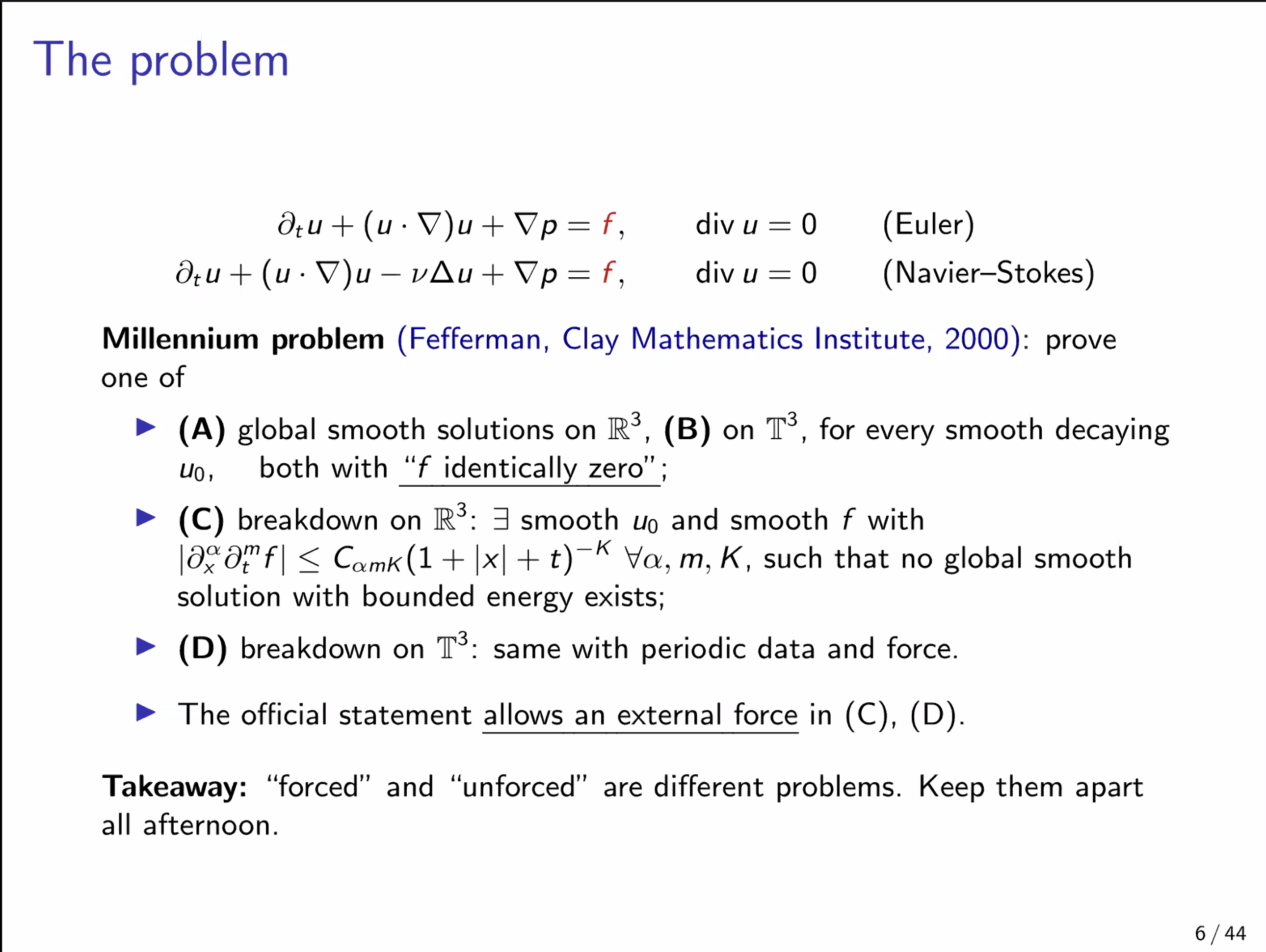
00:44:06.800So so the statement uh the statement says the following, like the clay problem says the following.
00:44:07.519 -->
00:44:14.880Given the incompressible uh 3D Navier-Stock equations, and and there are first that there are several options.
00:44:14.960 -->
00:44:25.119So the first option is whether to uh to set them in either in T C in the three-dimensional torus or in R3 in the whole uh Euclidean space.
00:44:25.360 -->
00:44:39.280Um given an initial data, let's say a smooth initial data uh of the of that PDE, either uh the following two alternatives uh can happen.
00:44:39.519 -->
00:44:49.119One, uh for any initial data, um the solution stays smooth for all time, or for any smooth initial for any smooth initial data.
00:44:49.360 -->
00:44:53.840For any smooth initial data, uh the solution stays smooth for all time.
00:44:54.000 -->
00:45:10.719Uh or two, um for there exists at least one uh smooth initial data for which the problem, and I will be slightly more specific in a minute what the problem means, develops a finite time singularity, namely leaves that uh smooth space.
00:45:10.880 -->
00:45:22.320Yeah, understood as in the velocity or the vorticity or the pressure uh will become, or their derivatives uh will become infinite infinite time.
00:45:22.559 -->
00:45:28.400Let's not get into like the really sort of deep uh I don't know, space uh definitions and so on.
00:45:28.559 -->
00:45:30.719So just big, just big, can I just pause it?
00:45:30.800 -->
00:45:34.079Just big picture for people who don't know much about Navier Stokes, right?
00:45:34.159 -->
00:45:37.920That I mean that would be like you know, your water waves or whatever.
00:45:38.559 -->
00:45:38.960Exactly.
00:45:39.280 -->
00:46:08.559So Navier Stokes comes and Euler come from uh Newton's laws when you apply uh when you write down what is f equals uh Ma for the velocity of a particle, uh let's say in in a fluid, uh and then the Euler equations don't uh take into account uh the effects due to viscosity, uh and the Navel-Stokes equations take into account the those effects.
00:46:08.719 -->
00:46:13.280Now, if you're why are they different and why are they similar?
00:46:13.440 -->
00:46:26.079Uh so so the only difference is actually just one little term in the equation uh that has, if we let's say if we neglect, if we normalize viscosity, that is just simply the Laplacian of U.
00:46:26.480 -->
00:46:31.199Uh so that's the only thing, the only difference between one set of equations and the other.
00:46:31.360 -->
00:46:43.840Now, this Laplacian of U in general, it will act uh by smoothing the velocity, meaning that it will it will go against, if you want to develop a finite singularity, it will go against you.
00:46:44.000 -->
00:46:53.760So it will try if you start with something that is somewhat trying to be rough or where a curvature uh is trying to uh get bigger and bigger, then this term will go against it.
00:46:54.079 -->
00:47:03.360Okay, so that's so it's so it's it's pretty obvious then for anybody who starts looking at the equations that it's gonna be harder to find blow-up in Navier Stokes than it is in Euler.
00:47:03.760 -->
00:47:04.239Correct.
00:47:04.480 -->
00:47:04.719Okay.
00:47:04.960 -->
00:47:05.360Correct.
00:47:05.519 -->
00:47:18.239So so this is why Euler was understood as the middle ground where you would remove that technical difficulty from the Laplacian, but still retain all the difficulties, for example, from the non-linear structure.
00:47:19.599 -->
00:47:23.119So so so now in 2D everything is understood.
00:47:23.280 -->
00:47:27.360Uh and in 3D, up until last week, everything was open.
00:47:27.679 -->
00:47:31.039So that's so so can you review the 2D results for us?
00:47:31.199 -->
00:47:35.119Everything was understood, meaning meaning there is global existence in both cases.
00:47:35.519 -->
00:47:41.920So so smooth initial data stays smooth in both equations with and without forcing.
00:47:42.079 -->
00:47:44.079We should we'll ask about forcing in a minute.
00:47:44.239 -->
00:47:44.559Yeah.
00:47:44.719 -->
00:47:45.119Yes.
00:47:45.440 -->
00:47:47.280Okay, so 2D is smooth.
00:47:47.519 -->
00:47:47.760Yes.
00:47:48.000 -->
00:47:49.199And 3D is open.
00:47:49.360 -->
00:47:54.960And does anybody think about it in or well, sorry, was open 10 days ago or whatever.
00:47:55.360 -->
00:48:07.519Um and just before we get into the 3D, which I think is the central problem, like does anybody think about higher dimensions, or is that is it really a 2D, 3D maybe, but it felt a little bit artificial.
00:48:07.760 -->
00:48:11.199Like 3D was genuinely difficult.
00:48:11.440 -->
00:48:18.639So people were thinking there are some papers uh about higher dimensions, but um, but they feel a bit artificial.
00:48:18.800 -->
00:48:26.960So uh so the real thing, the real sort of difference between 2D and the rest is essentially 3D.
00:48:27.199 -->
00:48:28.239So okay.
00:48:28.400 -->
00:48:40.559So so well, I don't know what everyone was doing, but I think the most uh serious attempts were trying to uh because 3D has like the problem in 3D has a very different structure than in 2D.
00:48:40.639 -->
00:48:48.960Uh and then it's not like you cannot really extrapolate easily because the equations have or more terms depending on how you write it.
00:48:49.119 -->
00:48:52.960Um so and and those are technically quite different.
00:48:53.280 -->
00:49:00.320So so people were I would say the majority of people were thinking in in 3D, let's say.
00:49:00.639 -->
00:49:04.800And was the 2D case known before the millennium problem was written?
00:49:05.039 -->
00:49:05.280Yes.
00:49:05.519 -->
00:49:07.519Okay, and was that the inspiration for it then?
00:49:07.599 -->
00:49:10.159So in 3D was it was it, you don't know.
00:49:11.679 -->
00:49:13.119I didn't write the statement.
00:49:13.199 -->
00:49:16.559So this you know, in 2000, was it written in 2000?
00:49:16.800 -->
00:49:32.000Was that the I think shortly before, I think it was probably 1999, but it appeared as part of the um millennium clay problem list um and you were like a teenager or something at that time.
00:49:32.639 -->
00:49:32.960Okay.
00:49:33.280 -->
00:49:36.639So uh people and I'm not responsible for the problem.
00:49:36.800 -->
00:49:39.039You're not responsible for the writing of the problem.
00:49:39.280 -->
00:49:40.480Um but okay.
00:49:40.639 -->
00:49:47.840But I mean that yeah, I guess the thing that struck me with the problem is that if you answer in the affirmative, it's for the unforced case.
00:49:48.079 -->
00:49:53.440But if you uh show the counterexample or the blow-up, uh forcing is allowed.
00:49:53.519 -->
00:49:56.559So it's not like the two possibilities cover everything, right?
00:49:56.639 -->
00:49:57.840They're not that's true.
00:49:58.079 -->
00:50:02.159I think, well, here's my guess, but I again I don't know.
00:50:02.320 -->
00:50:12.559Uh I think it may have to do with the fact that um back then people thought that the answer would be um global existence.
00:50:13.039 -->
00:50:19.840So so maybe just a way to balance out things, um, but I'm I'm not entirely sure.
00:50:19.920 -->
00:50:30.079Yeah, and in fact, if you had asked me, let's say a year ago, I would have sworn that the force wouldn't have mattered and be very wrong.
00:50:30.320 -->
00:50:35.039But uh because the force needs to be very smooth, so you cannot allow just any force.
00:50:35.119 -->
00:50:48.559Um just say for a moment, just for you know people who are um so so the equation, it's some partial differential equation, and there's an equals to zero in the equation in the non-force case, right?
00:50:48.800 -->
00:50:56.159But in the force case, there's some term there, so that's there's some kind of I don't know, forcing of the system from the outside, right?
00:50:56.719 -->
00:51:02.000And can I sorry if if I could uh I'm always sort of curious about this um stupid question.
00:51:02.159 -->
00:51:06.880Um, but the forcing can depend upon what what can the force depend on?
00:51:07.039 -->
00:51:10.800Like usually it's like a really any any position, time, everything.
00:51:11.039 -->
00:51:11.280Right.
00:51:11.360 -->
00:51:12.880Yeah, including the solution itself.
00:51:13.360 -->
00:51:15.519It can be a complicated, including the solution itself.
00:51:15.840 -->
00:51:16.719Including the solution itself.
00:51:16.960 -->
00:51:17.119Yeah.
00:51:17.360 -->
00:51:18.559Ah, okay.
00:51:19.199 -->
00:51:29.440But I think yeah, and then my understanding, well, we'll we'll get into this, but my understanding is the the forcing term was actually very delicately fine-tuned um in the counter.
00:51:30.400 -->
00:51:30.639Yeah.
00:51:30.960 -->
00:51:31.519Yes.
00:51:31.920 -->
00:51:41.039Yeah, so the forcing, um the forcing is as long as it is smooth, the forcing is allowed to uh to be anything.
00:51:42.079 -->
00:51:51.679So in particular, uh, and this sounds a bit tautological, uh your favorite function is a solution to the force Navier stocks problem.
00:51:52.239 -->
00:51:58.400Because all you have to do is you substitute into the equation, whatever it gives you, you move it to the other side, and that's your force.
00:51:59.760 -->
00:52:03.840And and then your favorite function solves Navier stocks.
00:52:04.159 -->
00:52:05.280So far, so good.
00:52:05.360 -->
00:52:12.800Now the difficult part is that you need to construct at the same time your favorite function that blows up and a force that doesn't.
00:52:12.960 -->
00:52:13.519That doesn't.
00:52:13.760 -->
00:52:17.679So it's not just as simple as it looks, but um right.
00:52:18.400 -->
00:52:20.400Okay, so that okay, from the outside, right?
00:52:20.480 -->
00:52:29.599It feels like allowing the forcing term um see I mean, I you know, I don't know what the consensus is, but that feels kind of artificial, actually.
00:52:29.760 -->
00:52:32.800It's not really the natural Navier Stokes, right?
00:52:32.880 -->
00:52:36.000I mean, um I mean, I don't know.
00:52:36.719 -->
00:52:40.880But the way the problem was it seems, it seems okay.
00:52:40.960 -->
00:52:45.679It seems like Charlie Pfefferman, I guess he's the one who wrote up the millennium this millennium problem, right?
00:52:45.760 -->
00:52:51.280I think the idea, you know, maybe he thought it was gonna be um the answer was gonna be in the affirmative, right?
00:52:51.360 -->
00:52:57.199There wasn't gonna be a counterexample, but so then he gave more leeway for finding the counterexample for finding the blow-up.
00:52:57.440 -->
00:53:01.440I don't know if that's the if that's but I don't know what was going through.
00:53:03.199 -->
00:53:09.360Well, on the other hand, there are solutions now uh to the enforced problem for Euler.
00:53:09.679 -->
00:53:10.960For Euler, yeah.
00:53:11.360 -->
00:53:13.519Okay, but not for Navier Stokes.
00:53:13.760 -->
00:53:14.719Not for Navier Stokes.
00:53:14.960 -->
00:53:16.320Not for Navier Stokes.
00:53:16.559 -->
00:53:26.000So so it's still so this is my other question, is like, okay, so technically maybe the millennium problem has been solved after people check, right?
00:53:26.320 -->
00:53:36.880But um there isn't really a counterexample yet to the smoothness conjecture for Navier Stokes.
00:53:37.280 -->
00:53:37.760Unforced.
00:53:38.079 -->
00:53:38.400Unforced.
00:53:38.639 -->
00:53:39.280Unforced.
00:53:39.679 -->
00:53:40.639Unforced, right?
00:53:41.039 -->
00:53:42.239I agree with the statement.
00:53:42.320 -->
00:53:42.559Yes.
00:53:42.719 -->
00:53:45.840For forced Navier Stokes, that is this is the right one.
00:53:46.239 -->
00:53:48.239This is the new result from OpenAI, yeah.
00:53:48.639 -->
00:53:59.679But for unforced, but it's okay, but you could still it could still be true that the unforced Navier Stokes um satisfies the smoothness conjecture.
00:54:00.159 -->
00:54:01.599In principle, yes.
00:54:01.840 -->
00:54:04.559Uh given all the overwhelming evidence.
00:54:04.639 -->
00:54:15.519Um I find it difficult to believe, but but again, you know, uh until I see it, then uh then this is still this is still an open question.
00:54:15.679 -->
00:54:29.440But but given the overwhelming evidence on the side of like the blow up, um then that would really mean that the forcing changes a lot of the equations, uh, which I think it does.
00:54:29.760 -->
00:54:36.480Um to the extent of changing the character from global existence to blow up, that would be surprising.
00:54:37.199 -->
00:54:44.719Okay, so you think that that if you can do it with blow up, if you can do it with forcing, that you'll be able to do it without forcing.
00:54:44.960 -->
00:54:45.519Most likely.
00:54:45.920 -->
00:54:46.719That's your feeling.
00:54:47.039 -->
00:54:49.519If I were to bet, then you were to bet.
00:54:49.920 -->
00:54:50.239Okay.
00:54:51.440 -->
00:54:52.400Are you betting?
00:54:54.239 -->
00:54:56.800No, right now I well, it depends.
00:54:56.880 -->
00:55:07.840No, if I you know, if I post on Twitter whether OpenAI can solve it as a challenge, then maybe close and see if they'll beat you.
00:55:08.000 -->
00:55:12.079Um the community is still digesting the open AI solution.
00:55:12.159 -->
00:55:14.239I think that's uh I think that's is that a correct statement?
00:55:14.320 -->
00:55:14.480Yeah.
00:55:14.960 -->
00:55:15.519I think so, yeah.
00:55:15.599 -->
00:55:16.320I agree with that.
00:55:16.639 -->
00:55:21.679And then I'm kind of wondering I'm kind of wondering how the community moves from here.
00:55:21.840 -->
00:55:26.960For instance, I it seems like the unforced problem is still an interesting question to solve.
00:55:27.119 -->
00:55:34.800And with all the evidence, as you said, now we sort of think that uh one ought to be able to construct uh something where the um you know vorticity blows up.
00:55:34.880 -->
00:55:41.280Uh uh and at the same time, um you know, OpenAI kind of smashed out this problem.
00:55:41.760 -->
00:55:57.360So is is there I guess I'm wondering how much interest is there from the community to kind of work on the problem to push forward to find that next to find a blow-up uh for the uh for the unforced problem in this case.
00:55:57.760 -->
00:55:59.840I think that is that is certainly interest.
00:56:00.159 -->
00:56:07.840Um I also think it will come after the digestion of both solutions, not just the Navier stocks, but also the Euler solution.
00:56:08.000 -->
00:56:11.679Because uh I think the forced Navier stocks and the unforced Euler.
00:56:11.920 -->
00:56:16.079That's those are uh so then maybe there are things that are trans.
00:56:16.480 -->
00:56:24.480I mean, nobody knows because as far as I know, well, I mean I've tried to read it and I made an effort to read the papers.
00:56:24.639 -->
00:56:27.519The papers are not very well written.
00:56:27.760 -->
00:56:31.360Yes, I think I have used the word incomprehensible in the past.
00:56:31.599 -->
00:56:35.760Uh people have they're very difficult to read.
00:56:35.840 -->
00:56:38.960They're not written for mathematicians, they're written by an LLM.
00:56:39.519 -->
00:56:47.679So so that that is tough for, let's say, even for the specialists to understand what is going on.
00:56:47.840 -->
00:56:52.800Um I think once the proof of both results, and and both are written horribly.
00:56:53.119 -->
00:56:55.519And so just to pause there for a second, right?
00:56:55.920 -->
00:57:02.480So so no human has really checked this, but it's believed to be true because of the lean certificate.
00:57:02.800 -->
00:57:03.119Correct.
00:57:03.280 -->
00:57:03.920Yes.
00:57:04.239 -->
00:57:09.840Uh yeah, so no, well, a few humans have made attempts, including myself.
00:57:10.000 -->
00:57:14.320I think there is some degree of understanding of how the proof works.
00:57:14.559 -->
00:57:17.760I don't think anyone has had time to go line by line.
00:57:17.920 -->
00:57:20.320Uh, it's 166 pages.
00:57:20.480 -->
00:57:24.880Um, so it's and it's uh again not terribly informative.
00:57:25.119 -->
00:57:39.280Uh, but because of the existence of the lean certificate, then the consensus is that uh it is it is correct, unless something, I don't know, extremely fishy or or something like that happens, which is highly unlikely.
00:57:39.440 -->
00:57:46.639But I haven't read the lean code myself, so I uh I don't want to stamp like 100% sort of like correctness.
00:57:47.039 -->
00:58:11.760But given that the statement is um drawn from some database of statements that have of famous problems that have been checked by many experts, and that the whole proof like compiles and there are no sorries and and everything checks out, uh then it is with a very, very high probability uh the proof is correct.
00:58:12.000 -->
00:58:24.559So that's what the community, because of that, the community believes that or at least I believe that with an extremely high probability everything checks out and everything is is okay.
00:58:25.199 -->
00:58:28.159Um so that's concerning the correctness of the solution.
00:58:28.880 -->
00:58:38.159Can I ask, um, so you know, uh we don't have to talk about the drama sort of too much, but there was a a statement that came out um by like Tristan, I think, right?
00:58:38.320 -->
00:58:45.840I'm wondering, was that was I can't remember, was there a preprint that was available from them and then something came out by AI?
00:58:46.159 -->
00:58:49.599Or did they say we worked on this and we've been scooped by AI?
00:58:49.760 -->
00:58:54.320I'm just like we're talking a lot about AI and stuff that happened a couple years ago.
00:58:54.400 -->
00:59:04.239Like, if it's the case that there was other stuff that other solutions that kind of came out um or have been completed, I kind of don't want to skip over those and pretend they don't exist.
00:59:04.559 -->
00:59:23.119So there is work of um Levant Alpog and uh uh uh Tristan Bachmaster on the morning, no, sorry, on the night of them last Monday, uh they released uh three preprints uh solving and this is prior to the OpenAI release.
00:59:23.199 -->
00:59:23.760Yeah, yeah, yeah.
00:59:24.960 -->
00:59:44.000Solving uh a finite time uh blow up for forced uh IPM uh which is another model, um Businesque and uh and Euler, all three of them forced, um and that's that's what they uh that's what they released.
00:59:44.079 -->
00:59:56.079Uh and then on Tuesday morning, I guess, or Tuesday somewhere uh throughout the day, uh OpenAI released their uh their their manuscript.
00:59:57.280 -->
01:00:04.079So that that's what happened like on uh Monday, but there was no claim about Navier Stokes.
01:00:05.199 -->
01:00:06.079That was a week ago.
01:00:07.119 -->
01:00:08.000That was a week ago, yes.
01:00:08.159 -->
01:00:09.760Yeah, less than a week ago.
01:00:10.480 -->
01:00:16.880And then OpenAI did um force Navier Stokes, and then they have did they have something on Euler as well?
01:00:17.119 -->
01:00:20.480Yes, they have unforced Euler, unforced Navier Stokes.
01:00:21.039 -->
01:00:23.280So that's that's kind of the the timeline.
01:00:23.840 -->
01:00:25.440So both are a step beyond.
01:00:25.840 -->
01:00:27.280I mean both are yeah.
01:00:28.639 -->
01:00:39.840Yeah, I I guess I'm wondering when we're talking about what are the next steps, suppose the the the field is interested in in working on the Navier Stokes unforced problem and we need to digest what's out there.
01:00:40.000 -->
01:00:47.840It's more unfortunately maybe more about digesting what OpenAI did than what uh what Tristan and Levant did.
01:00:47.920 -->
01:00:52.000Is that is that correct, or do we think that there's some interesting stuff in there that's maybe different?
01:00:52.159 -->
01:00:52.800I don't know.
01:00:54.400 -->
01:01:25.599It's hard to say because uh I mean it takes a long, but I think all of the papers contain interesting ideas, and it's good to sort of I mean it's certainly healthy to kind of uh go through all of them, digest all of them, and in fact, uh I think Tristan and Levan said that uh they sort of rushed the papers and they were not like written in the best, or at least some of them they were not written in the best in the best way.
01:01:25.760 -->
01:01:41.920So it will still take time to kind of rewrite everything and digest everything and maybe I don't know, do another iteration uh of the construction or the uh the way sort of things work and and and so on.
01:01:42.079 -->
01:01:45.360So that's I think that's going to be priority number one.
01:01:45.519 -->
01:01:57.119And then once the dust settles and the ideas are understood, uh then people can see whether, like in which direction this kind of stuff uh takes them.
01:01:57.519 -->
01:02:00.320Are you hopeful all about about improvements?
01:02:00.400 -->
01:02:04.480Uh like once the the AI proofs and techniques are digested?
01:02:04.639 -->
01:02:13.679Like sometimes this happens where AI comes up with some really weird kind of solution, and then when humans actually finally understand what's going on, they're like, oh, you did this extra long path here.
01:02:13.760 -->
01:02:16.239We can actually do something much simpler or much stronger.
01:02:16.400 -->
01:02:20.000Um is there is there hope that there's that that's forthcoming?
01:02:20.400 -->
01:02:20.960Maybe.
01:02:21.119 -->
01:02:26.000Um, but it could also go the other way, as in, oh, this construction is quite interesting.
01:02:26.159 -->
01:02:28.559How about to apply to this other problem?
01:02:28.719 -->
01:02:30.079Or maybe a combination of both.
01:02:30.159 -->
01:02:38.800Like with now with this construction and all that we know from this other field or problem and whatever, we can combine them and do an even harder one.
01:02:38.960 -->
01:02:41.039So I think it could go either way.
01:02:41.280 -->
01:02:56.400That the construction is simplified, that the construction opens like new doors, or that the construction plus other things solves new problems, or even uh kind of comes up with new new questions and and so on.
01:02:56.800 -->
01:03:01.039So so related to this, I wanted to ask um, I guess, two questions.
01:03:01.199 -->
01:03:05.280So one is, you know, how from what you know so far, right?
01:03:05.360 -->
01:03:11.280I realize it's only been it's been less than a week, but like how original does the open AI solution seem?
01:03:11.360 -->
01:03:17.360Like, is it a really new idea that um you know you hadn't seen before, hadn't thought of before?
01:03:17.760 -->
01:03:31.760The Euler paper draws heavily on prior work, including the work of uh Córdoba, Martinez Feroa, and also uh Alpoch and Bachmaster.
01:03:32.159 -->
01:03:43.920Uh the Navir Stokes construction, uh at least to my knowledge and what all the ideas that I had uh so far, the construction looks new to me.
01:03:44.079 -->
01:03:48.880But but again, this is related to kind of my understanding and my experience and my ideas.
01:03:49.119 -->
01:03:57.199Maybe other people had thought about this before, or this kind of uh object or this kind of strategy uh had been more clear.
01:03:57.280 -->
01:04:02.639But to me, this was like something that I had for sure never thought before.
01:04:02.960 -->
01:04:04.320Okay, so wait, so we need to.
01:04:04.400 -->
01:04:14.079So just to give a small uh a small description, the way they construct something is that instead of so before we were talking about self-similar.
01:04:14.239 -->
01:04:33.039So so the way they construct it is that they have two very different self-similar solutions, one focalized in some little neighborhood of the origin, and another one sort of localized in the in the far field close to infinity, and then they somehow manage to find a way to glue them in a good way.
01:04:33.119 -->
01:04:35.840And and this kind of happens in in the middle.
01:04:36.000 -->
01:04:53.440So that in the context of these type of equations is something combined with other features of of the self-similar construction, like a two-scale, like all these combinations of things, is something that I certainly hadn't thought about before.
01:04:53.840 -->
01:05:02.159Okay, so when you see the open AI solution to unforced Euler, that looks like a continuation of the research that was being done.
01:05:02.320 -->
01:05:02.400Right.
01:05:02.719 -->
01:05:15.360The pen and paper work of their names again, Cordova and Martinez and uh and also the you know the AI assisted work of Buckmaster and and Alphoge.
01:05:15.679 -->
01:05:21.360But the for but you're saying the forced Navier Stokes, that really, at least to your eye, looks new.
01:05:21.440 -->
01:05:23.280Like the idea there's an idea for the solution.
01:05:23.679 -->
01:05:24.000Yes.
01:05:24.239 -->
01:05:38.400And do you have a okay, so my other like sort of related question was do you have a sense as to why as to why OpenAI was able to do the unforced Euler case, but not unforced Navier Stokes yet?
01:05:38.719 -->
01:05:41.199I think it's a matter of difficulty, most likely.
01:05:41.440 -->
01:05:45.519Um but but I don't know, I could be wrong.
01:05:45.760 -->
01:05:52.880Um my guess is that these problems may be in increasing order of difficulty.
01:05:53.360 -->
01:05:56.960Uh but again, this is a kind of a wild guess.
01:05:57.199 -->
01:05:59.760I think it's also their motivation.
01:06:00.719 -->
01:06:02.159Uh, most likely.
01:06:02.400 -->
01:06:09.599Uh it's likely that their motivation is the claim to have solved uh clay problem.
01:06:09.920 -->
01:06:18.079But whether it is exactly whether it is the forced version or the enforced version is probably less relevant uh for them.
01:06:18.239 -->
01:06:20.800But again, I am not entirely sure.
01:06:20.960 -->
01:06:30.079But that would be my guess as to what type of science matters to the I mean not just OpenAI, but but all the big AI tech companies.
01:06:31.119 -->
01:06:44.960Where yeah, like now, for better or for worse, a lot of science is um uh is explained uh on a tweet, uh which is very important.
01:06:46.000 -->
01:06:52.880Um but I think that's the kind of way AI companies and AI motivations sort of uh work for.
01:06:53.679 -->
01:06:56.639I liked your in your Harvard talk that you gave on Friday.
01:06:56.719 -->
01:07:00.960I liked your your first slide, like uh message to the AI companies.
01:07:01.119 -->
01:07:05.760Uh we will try to link that talk in our episode notes um so people can see it.
01:07:06.000 -->
01:07:08.159I hope they can see it and they can do something about it.
01:07:08.320 -->
01:07:20.239I mean many things it should it it should be free to them, like free as in no effort, no uh in terms of like time and money, and it would help the math community tremendously.
01:07:21.599 -->
01:07:21.920Yeah.
01:07:22.639 -->
01:07:32.960So uh just to maybe uh to take a step back a little bit, uh so uh I was watching uh a video you you had posted um uh on Navier Stokes from March, I think.
01:07:33.039 -->
01:07:33.280Yes.
01:07:33.599 -->
01:07:44.159And one of the things that I noticed that was kind of interesting in there was you said, look, this is uh it's kind of a hot topic right now, and you were encouraging people to to work on this uh uh this particular problem.
01:07:44.639 -->
01:07:48.320Um and uh uh which you know which is great.
01:07:48.559 -->
01:07:52.559And you know, now here we are where we've gotten uh we've gotten to where we are.
01:07:53.119 -->
01:08:03.039And I'm kind of wondering, I I don't know, I'm wondering how many people were working on Navier Stokes heavily, primarily, maybe say in the past, what is it, six months?
01:08:03.440 -->
01:08:14.960And then relatedly, do we think that as a consequence of OpenAI's results that there's going to be more interest in this family of problems um or less interest?
01:08:15.039 -->
01:08:19.039Or I don't know, is there do you have any sense of the field of like where do we go from here?
01:08:20.479 -->
01:08:24.560Um This is an interesting question.
01:08:24.720 -->
01:08:26.159I uh I don't know.
01:08:26.319 -->
01:08:31.119Uh and the answer may depend on what the big tech companies want to do to some extent.
01:08:31.439 -->
01:08:37.279Like if there is the sense that they will just uh bulldoze everything, then probably people are going to be afraid.
01:08:37.840 -->
01:08:51.760But at the same time it is exciting because many things have been produced and and it's it's well the amount at which uh uh new knowledge or interesting knowledge is generated is is pretty high.
01:08:51.840 -->
01:09:00.640So these kind of two forces, like the force of discovery versus the force of fear, uh they are kind of uh pushing each other.
01:09:00.880 -->
01:09:11.520And and um, you know, maybe it depends on like whether people are young versus more senior and they are more stable and they can take more risks and this and this kind of thing.
01:09:11.680 -->
01:09:31.920Uh from the level of the community, I mean uh from the level of let's say the mathematical fluids community, Navier Stokes is not it's not the end of the story, in the sense that there are many uh many questions that are still left to be done, and I think could benefit from uh understanding uh, for example, this construction.
01:09:32.159 -->
01:09:41.199Like there are many other equations in uh in PDE, uh broadly understood, that maybe such a construction is is helpful, I don't know.
01:09:41.520 -->
01:09:57.039Or or the or the other constructions, like the construction for uh unforced uh Euler, these sort of like forced forced problems, or even more importantly, how to remove the force or how to um yeah, smooth out the force and so on.
01:09:57.119 -->
01:10:09.199So all of these are not really intrinsic to fluids, but um but it could have like a bigger impact in the broader field of uh uh of PDE.
01:10:09.279 -->
01:10:10.319So it is exciting.
01:10:10.479 -->
01:10:21.520I would say that it is exciting and risky, and it depends a lot on the risk tolerance of the people whether to enter uh or not uh into the field.
01:10:21.600 -->
01:10:24.880But but this is sort of the way I would I would see it.
01:10:24.960 -->
01:10:32.399But by no means the uh amount of problems or the world of problems uh finishes here.
01:10:33.039 -->
01:10:56.399Okay, so related to this, I wanted to ask you about this idea that's been articulated um by Terence Tao, and maybe in this, there's a letter that's been circulating that 25 Fields Medalists have signed, um, sort of cautioning that uh the way in which AI is being used to solve problems might not be the most productive um avenue for the math community, right?
01:10:56.479 -->
01:11:13.039And so I think if I summarize correctly, the idea is that you know, if you can kind of teleport to the answer instead of having people spend time pursuing different directions, dead ends, that um you don't get as much mileage out of the efforts to solve the problem.
01:11:13.279 -->
01:11:16.479Mileage in the sense of like mathematical understanding.
01:11:16.800 -->
01:11:21.279Yeah, the failed attempts, just filling out the landscape of mathematical knowledge.
01:11:21.359 -->
01:11:28.399Um, maybe you're not you're not gonna make as much progress ironically by getting to the answer of one of these problems more quickly.
01:11:28.640 -->
01:11:29.920You know, what are your thoughts on that?
01:11:30.000 -->
01:11:37.279Because like you, you know, the flip side is well, seeing the answer, right, can inspire um also progress, right?
01:11:37.439 -->
01:11:41.920And and and going and you know, maybe applying similar ideas in other contexts.
01:11:42.000 -->
01:11:43.840So what is your sense on the other thing?
01:11:44.319 -->
01:11:52.399So so so I think well, one thing that um that somehow people miss is that like LLMs also make mistakes and also make failed attempts.
01:11:52.479 -->
01:11:54.800They just do it at an incredibly faster pace.
01:11:54.960 -->
01:12:03.680So so we could also learn if like, I don't know, especially if OpenAI released their logs, uh, we could also see what they tried and failed.
01:12:03.760 -->
01:12:07.039And this would be pretty interesting to know.
01:12:07.279 -->
01:12:18.000Um so so for example, in the Alpha Evolve, like circling back, we also release our the problems at which we failed and where the system like just didn't produce a good solution.
01:12:18.239 -->
01:12:31.680So so that's one thing that nobody does, but I think it would be uh helpful uh to understand to have a more complete picture as to what worked and what didn't work, even if it is at this supersonic speed.
01:12:31.920 -->
01:12:41.520Um and then the other one is that uh yes, I agree that that this is uh it may be counterproductive uh in the long run.
01:12:42.159 -->
01:13:03.039The problem with this um is that at the same time, uh sort of this new technology is coexisting with an old incentive system, so and especially for young people where productivity is rewarded in terms of quantity or quality or a combination of both.
01:13:03.279 -->
01:13:16.319So it's hard for them to sort of let's say go slow whenever they are raising a lot of other people that for for being the first.
01:13:16.640 -->
01:13:23.520So so the this mismatch is at least part of the problem to to like in my opinion.
01:13:23.680 -->
01:13:35.439Uh and until we don't operate with like the same rules, then it's going to be difficult to sort of like just tell, especially young people, that they need to slow down.
01:13:35.520 -->
01:13:37.920I I I don't think this is fair to them.
01:13:38.159 -->
01:13:41.359Um so so that's kind of part of the problem.
01:13:42.000 -->
01:13:53.439I think if OpenAI were to rewrite the proof in a more digestible way, we would all uh learn a lot more from the construction, even if it is done by AI.
01:13:53.520 -->
01:14:12.479So so there are a lot of things that could be easily improved, and we would still keep the AI technology, but we will learn a lot more than what we are right now if we put more effort into the digestion, if we put more effort into the exposition, uh if we put more effort into the communication in more than 140 characters.
01:14:12.720 -->
01:14:16.960So that's uh that's kind of my my take on this.
01:14:17.600 -->
01:14:25.359Overall, uh my impression, right, is that um you're pretty pro you know using LLMs or uh uh in research, right?
01:14:25.439 -->
01:14:45.359I mean you've been doing this for a while, so you know it's this this seems um um something that you uh support, but it does sound like you can kind of see, at least in the broader community and even in the narrow fluids uh community, that there can, you know, maybe there's a mismatch or maybe there's there's definitely some trade-offs and some some different terms that need to be kind of balanced out um in the community.
01:14:45.520 -->
01:15:03.439But I'm kind of wondering, let's let's imagine for a second that uh that uh you know OpenAI and Anthropic were we're going to listen to you very closely and and use your suggestions to sort of say, okay, how do we how do we improve uh how do we do this a bit better, or what would be better for the community?
01:15:03.600 -->
01:15:10.560So if if if you could tell them anything and they they would actually listen and implement, um uh what would you recommend?
01:15:10.880 -->
01:15:26.319Yeah, like more digestive, uh more more digested arguments, better writing, more communication with the mathematicians, um better uh like the problem with that is that I think it's coming from a mismatching goals.
01:15:26.560 -->
01:15:36.640Like their goal is to maximize profit or evaluation, and the goal of the mathematicians is not even production but understanding.
01:15:36.800 -->
01:15:42.960So these two goals need to be aligned somehow, and uh and that's difficult sometimes.
01:15:43.199 -->
01:16:01.520Um, so so that would be part of it, like to really have an open communication as to what everyone's needs are and and come up with a way that we can all benefit from the technology because the technology is not going to disappear, the technology is going nowhere.
01:16:01.680 -->
01:16:05.039So we need to learn to live with the technology.
01:16:05.199 -->
01:16:21.359This is a reality, and um and then the way for, let's say, for the mathematicians to live with that is to learn how to use it, so get maybe better access or more access or more uh information about it.
01:16:21.439 -->
01:16:24.640And this is also on the side of the math community itself.
01:16:24.800 -->
01:16:36.720They they need to uh listen more and sort of be more proactive and and sort of be able to understand what is going on and and maybe be open about it.
01:16:36.880 -->
01:16:53.279Uh and on the big AI companies to disclose more, to um allow certain access of uh of the models and to really talk about like not just the positive results but also the negative results.
01:16:53.439 -->
01:16:56.319So I think that would be a very good starting point.
01:16:56.960 -->
01:17:02.399I think it'd be really interesting to get a list of problems that AI companies have worked on and couldn't make any progress.
01:17:02.800 -->
01:17:03.920Yes, that's very fast.
01:17:04.239 -->
01:17:21.439No, no, no, that that that would be great, and and I don't think they're going to uh release that, but but you keep hearing this, and and it is very natural to think that like they were successful in in one problem, but they probably were unsuccessful in 99 more.
01:17:21.760 -->
01:17:29.439Um so I agree that would be very interesting to know what when it failed, why it failed, or how it failed.
01:17:29.600 -->
01:17:29.840Yeah.
01:17:30.239 -->
01:17:33.279Do you do you think um so here's a question.
01:17:33.359 -->
01:17:38.720I mean, do you think AI companies are gonna continue investing in this in doing math research?
01:17:38.880 -->
01:17:50.399Because on the one hand, you know, it's it's been successful, um, but maybe, you know, now that there's a millennium problem, that's another notch in the belt or whatever, um, maybe that's enough.
01:17:50.720 -->
01:17:57.119And there's no longer a need to prove, you know, we can do research mathematics and they'll move on.
01:17:57.520 -->
01:18:00.880I think ultimately this is this is an economic question.
01:18:01.039 -->
01:18:04.479Uh, whether this is profitable in some capacity.
01:18:04.720 -->
01:18:10.640I think after the IPO, uh probably things could change.
01:18:10.960 -->
01:18:26.960Um so so maybe that question will be more answered after after they after the IPO, and maybe they could go on other directions, I don't know, like CS or or other sciences or or something like that.
01:18:27.279 -->
01:18:45.119I mean at some well it's hard to tell, no, because if the cost of the models keeps dropping down, uh and these things, you know, maybe proving Navier stocks is$20 million today, but in six months maybe it's$20.
01:18:46.000 -->
01:18:49.600So it's unclear.
01:18:49.840 -->
01:18:51.520Um for how long?
01:18:51.680 -->
01:19:06.000I mean, the there will be like no these two curves, like sort of cost versus importance or impact or whatever, and then whenever these two things meet, uh then math will stop being uh a priority for for AI companies.
01:19:06.159 -->
01:19:08.479So so I'm not sure if we are there yet.
01:19:08.720 -->
01:19:18.399Um I think probably a better point to judge uh maybe after or or yeah, after the IPO's launch.
01:19:19.359 -->
01:19:26.319I'm curious, do you think I don't know how rapidly the uh the price drops on uh these sorts of things?
01:19:26.399 -->
01:19:30.880Uh$20 million to$20 in six months seems a little steep, but uh uh but who knows.
01:19:31.039 -->
01:20:04.560Uh if the cost does stay, let's say, even modestly high, though, um uh I'm I'm kind of wondering, do you think that there's any inter there would be any interest from say open AI to pair with mathematicians and sort of say, you know, you can use our services off hours, for instance, for for these products, you know, for some period of time and maybe a joint venture, or uh I don't know, or if maybe maybe it's is it always going to be the case that it's like open AI versus you know university math professors and they're just completely sort of split?
01:20:04.720 -->
01:20:06.479You know, no insights on that one?
01:20:06.800 -->
01:20:21.199Uh I mean I think we are still valuable in the sense that math mathematicians could uh develop training data for like long thinking on a difficult question.
01:20:21.359 -->
01:20:23.680I don't know how much of that is needed now.
01:20:23.920 -->
01:20:24.960They need it.
01:20:25.199 -->
01:20:28.239I don't know if they already have enough or or whatever.
01:20:28.319 -->
01:20:30.560I don't know how the latest models have been trained.
01:20:30.880 -->
01:20:48.159But but that could give an opportunity for maybe partnering, or maybe whenever their resources are like overnight or on the weekend or something like that, where they're not using them, um maybe that could lead to interesting things.
01:20:48.319 -->
01:20:58.000Um I think developing things for maybe for education could be something useful, beneficial, and cheap on the Open AI side.
01:20:58.239 -->
01:21:02.000Um so that angle could be explored.
01:21:02.159 -->
01:21:10.880Um, another, I don't know, tools for um, let's say math journals or or or other uh venues like that.
01:21:11.039 -->
01:21:21.279I think there is still some kind of let's say low effort, high impact or high benefit that could still benefit a lot of the community.
01:21:21.359 -->
01:21:23.600I'm thinking mostly about education here.
01:21:24.960 -->
01:21:29.279I think, I mean, I think for the AI companies, I imagine there there's a couple of incentives.
01:21:29.359 -->
01:21:32.239I mean, one is you know, as a way of showing off the product, right?
01:21:32.319 -->
01:21:39.920Like if we can solve these hard math problems, then clearly, you know, this is some kind of you know high-level intelligence that we've developed.
01:21:40.079 -->
01:21:47.760But the other um aspect is in using math as a benchmark, right, to improve the products.
01:21:48.159 -->
01:21:48.319Right.
01:21:48.479 -->
01:21:57.760I think that a lot of people believe that this has been a good way to improve um the performances by by tackling these problems and training on math and so on.
01:21:58.079 -->
01:22:05.920So, you know, they might still be interested in math as a way of continuing to improve the product.
01:22:06.479 -->
01:22:15.359But but again, I don't know, and things in this space move so quickly that six months from now it's really like the future.
01:22:15.600 -->
01:22:18.239So who knows?
01:22:19.039 -->
01:22:24.479So yeah, so things are uh are definitely moving uh very rapidly, which is uh which is interesting.
01:22:24.640 -->
01:22:30.800I'm not sure if you have any um currently if you have any graduate students or uh or postdocs or if you have sort of a group there.
01:22:31.279 -->
01:22:40.560Um I'm kind of wondering what are you recommending them, say for instance, or other students that are you know interested in in fluids in general.
01:22:40.720 -->
01:22:44.079Um what kind of recommendations do you have for using AI?
01:22:44.479 -->
01:23:05.840I mean to be cute, my my students have been using AI since I've been, in the sense that I exposed them uh to the latest technologies just for to develop skills, to develop understanding, to know what they're talking about, and to see, I don't know, a technology that would be important or so, I thought back then.
01:23:06.079 -->
01:23:29.760Um so my recommendation in this like new uh landscape of mathematics is to be very curious, to have a high risk tolerance, which I know it doesn't sound great, but at the same time um to live in the excitement and to sort of have patience and don't despair and and adapt.
01:23:30.159 -->
01:23:36.239So try to adapt to the very uh fast moving sort of pace.
01:23:36.399 -->
01:23:56.319I I know this doesn't sound um I don't know, terribly encouraging in some way, but um but but it's a new way and it's like uh it's a new way of doing math, it's a new way of living through through that where they're going to undergo a lot of uh let's say emotions.
01:23:56.479 -->
01:23:58.079Uh but it doesn't need to be bad.
01:23:58.159 -->
01:24:16.960It's it's just a new way of of doing mathematics, and they need to be prepared for that, and they need to um like certainly use in some capacity and a hundred percent understand uh sort of this technology because that's as I said, I don't think it's going anywhere.
01:24:17.439 -->
01:24:43.840And you think you have a good balance if you have um like one of the things I don't have any graduate students, but um one thing I would be kind of worried about is this uh balance between the student kind of wants to get to the answer quickly because you know being first is really important, and so then there's an over-reliance on use of AI to do anything, everything, some things, and you're not building the skills that we're used to building sort of slowly over the time.
01:24:44.000 -->
01:24:48.800I I don't know if you've seen this problem at all or if you have ideas on how to recommend a balance.
01:24:49.119 -->
01:24:49.760Yes and no.
01:24:49.920 -->
01:24:58.960So my students are old enough, uh, and the postdocs even more, that they were trained, let's say, in the non-AI days.
01:24:59.199 -->
01:25:12.079So they do have this critical thinking skill and sort of this banging their head against the wall for months because they can't get to solve the problem and that kind of thing.
01:25:12.159 -->
01:25:20.720So I'm not worried about the over-reliance, uh, just because my students are very good and they come from the pre-AI era.
01:25:21.119 -->
01:25:24.960Uh for the new students, um, I don't know.
01:25:25.199 -->
01:25:27.920Then then that's that's another thing to think about.
01:25:28.079 -->
01:25:32.479But at least my current students and postdocs, they have been trained in the old days.
01:25:32.800 -->
01:25:42.399So I know that they will not like just blindly accept anything that is presented in front of them and they will be uh critical.
01:25:42.560 -->
01:25:59.039Yes, this is certainly something that it's important, certainly something that I uh ask them to uh to have and to and to use, which is uh um critical thinking of whatever AI says or suggests, uh and so on.
01:26:00.560 -->
01:26:10.640I I I think my concern um is that not so I mean, I do think a lot of students naturally are gravitating towards using these tools, and that is gonna happen.
01:26:10.800 -->
01:26:14.399I mean, I mean, maybe in applied math they're more open-minded about it than in pure math.
01:26:14.479 -->
01:26:14.800I don't know.
01:26:14.880 -->
01:26:21.039We may have uh department differences, but um I, you know, so I'm not sort of worried about that.
01:26:21.199 -->
01:26:25.840I think there is a lot of curiosity and there is a lot of um desire to use these tools.
01:26:26.000 -->
01:26:32.079I think what I worry about um is the loss of the pen and paper technology, right?
01:26:32.239 -->
01:26:45.680The loss of passing that along, you know, and I think it's important to, you know, be open to new tools, but preserve um a little bit that that culture of the pen and paper as well, you know, and not lose that.
01:26:46.000 -->
01:26:46.479Yeah, yeah.
01:26:46.560 -->
01:26:51.600No, I mean it's not like black or white in the sense that there is some balance to that.
01:26:51.840 -->
01:26:58.720And as I said, these pen and paper tools, all my students come from like a time where that's the only thing they had.
01:26:58.880 -->
01:27:08.960So I'm not worried about them when it comes to the new batch of students, then uh the new batch of students, yeah, then then I'll think about it.
01:27:09.119 -->
01:27:14.640But uh but as of now I'm not concerned about like let's say my current students.
01:27:14.720 -->
01:27:23.840But but but I I agree with you, and this is a difficult balance to strike uh when it comes to like the new generations and and so on.
01:27:26.319 -->
01:27:32.159All right, well, we've been going on actually well over an hour, so yeah, we should probably wrap things up.
01:27:32.399 -->
01:27:34.159Um but thank you so much.
01:27:34.479 -->
01:27:35.439Yes, thank you very much.
01:27:36.239 -->
01:27:38.640Um yeah, this was really, really interesting.
01:27:38.800 -->
01:27:42.720Um Yeah, and if you come up with anything else or whatever, just let me know.
01:27:43.039 -->
01:27:46.479I should buy you a cup of coffee at least as a thank you.
01:27:54.880 -->
01:27:57.680Thanks for listening to Academia on the line.
01:27:57.920 -->
01:28:00.720Today's guest was Javier Gomez Sorano.
01:28:01.119 -->
01:28:18.079Javier is a mathematics professor at Brown University, and his research interests lie in the boundary between machine learning, analysis, partial differential equations, fluid mechanics, spectral geometry, numerical computation, and rigorous computer assistant groups.
01:28:18.399 -->
01:28:20.560Javier is the winner of the Ramon E.
01:28:20.800 -->
01:28:32.880Moore Prize, the MRA Prize, the Antonio Ambrosetti Medal, the Antonio Baillo Prize, the Vicente Ocean Prize, and the Princeton Junior Faculty Teaching Award.
01:28:34.880 -->
01:28:41.279The theme of is Ophelia's Blues by Jason Shaw from Audionautics.com.
01:28:41.359 -->
01:28:44.960And it's used under a Creative Commons attribution license.
01:28:45.279 -->
01:28:48.319Thanks for listening, and we hope to catch you on the line.