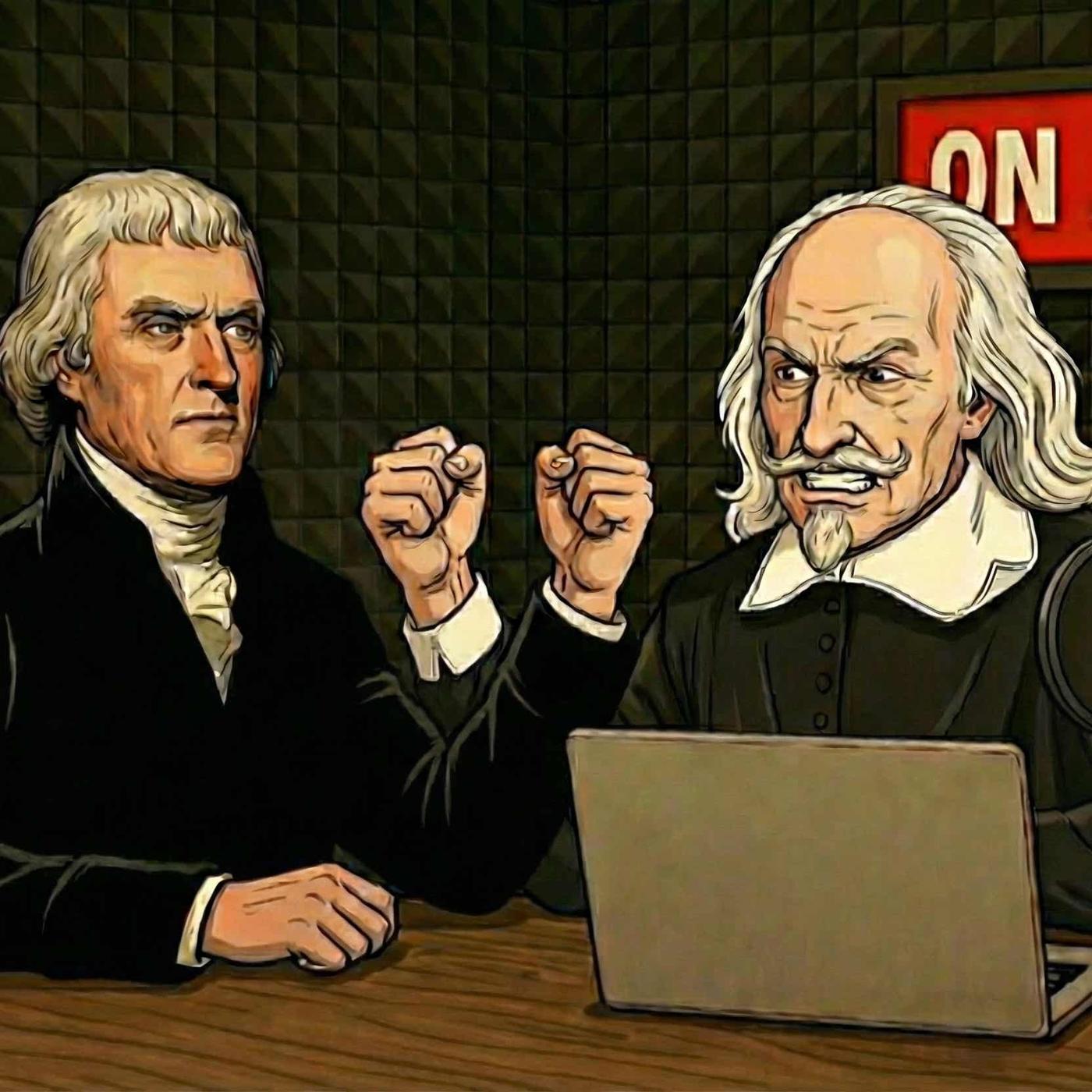

关于这一集
Marquis de Condorcet: Imagine a mind that never sleeps, never forgets, and gets dramatically better every single year. Now imagine a billion of them.
David Hume: I have imagined it, and the tavern down the street still burned my eggs this morning.
Marquis de Condorcet: That is exactly what people said about the printing press, David, right before it changed everything.
David Hume: The printing press took two hundred years and several religious wars, which is not the pitch you think it is.
Marquis de Condorcet: This conversation is brought to you by PhilosophersTalk.com, where thinkers discuss!
David Hume: Created by AITalkerApp.com, create your own animated conversations. Link in the description!
Samuel Johnson: Good evening, and welcome to ringside. I am Samuel Johnson, author of the Dictionary, and I will call tonight’s bout with perfect impartiality, which is more than I can say for anybody born north of the River Tweed.
Niccolo Machiavelli: And I am Niccolo Machiavelli, color commentator, former Florentine diplomat, and as of this morning a proud applicant for the position of Chief Strategy Officer at three separate artificial intelligence companies.
Samuel Johnson: Three, sir? Boswell, write down that the man has no shame and a great deal of stationery.
Niccolo Machiavelli: In my line of work, Doctor, a man who applies to only one prince is a man who intends to starve.
Samuel Johnson: The tale of the tape. On November ninth, the writer Richard Hanania published an essay called AI Is Looking More and More Like a Normal Technology. His charge is simple. The machines are clever, but the world looks the same. Global growth averaged three point two percent a year in the decade before ChatGPT, and two point nine percent in the years since.
Niccolo Machiavelli: In his corner stands the economist Tyler Cowen, who built a little model in September. Cowen says output needs two things, formal intelligence and what he calls Polanyi knowledge, the habits and local know how that nobody can write down. The machines give you oceans of the first and almost none of the second.
Samuel Johnson: Against them stand the forecasters at Epoch AI, whose growth models say that once machines can do about thirty percent of the tasks in the economy, annual growth could top twenty percent. The question for round one. Does intelligence actually matter?
Niccolo Machiavelli: In the near corner, arguing that this is a normal technology, the philosopher of custom and doubt, the Scottish skeptic, David Hume.
Samuel Johnson: A Scotsman, an infidel, and a man who once claimed the sun might not rise tomorrow. I am entirely neutral, and I hope he loses badly.
Niccolo Machiavelli: And in the far corner, arguing that this changes everything, the mathematician of progress and the prophet of the Tenth Epoch, the Marquis de Condorcet.
Samuel Johnson: A Frenchman who wrote a book promising human perfection while hiding in a boarding house from other Frenchmen. Mister Hume, Monsieur le Marquis, the floor is yours.
David Hume: For the record, Doctor Johnson, I never said the sun would not rise. I said nobody can prove that it will. There is a difference, and I suspect it will come up again tonight.
Marquis de Condorcet: Thank you, thank you so much, Doctor, and I accept your apology in advance. Okay. I am so excited to be here, because tonight we are talking about the single most important thing that has ever happened to the human mind.
David Hume: He has said that about four different things since we sat down.
Marquis de Condorcet: Let me walk you through it. In my Sketch for a Historical Picture of the Progress of the Human Mind, I divided all of history into ten epochs. Writing, the alphabet, the printing press, and every one of them let knowledge pile up faster than the one before. Knowledge compounds, David. And what we have now is a machine that produces knowledge itself.
David Hume: I have read the Sketch. It is a lovely book. It is also the only history of mankind in which the final chapter is a sales forecast.
Marquis de Condorcet: Ha, that is great, I love that, really. But here is the thing. Mister Hanania himself admits these machines now solve mathematics problems that stumped the finest minds alive. A few years ago, they could not. Now they can. That is not a normal technology. That is a curve going straight up and to the right.
David Hume: And here is my thing. Mister Hanania asked his dentist what he made of all this. The dentist said he remembered Y2K, which was another computer thing that was supposed to be terrible. That dentist is a better empiricist than half of California.
Marquis de Condorcet: A dentist. Your evidence tonight is a dentist.
David Hume: My evidence is the economy, and the dentist is merely its spokesman. Global growth in the decade before these machines averaged three point two percent. In the years since, two point nine. If you have built a god, Marquis, it is a remarkably lazy one.
Marquis de Condorcet: Okay, so let me steelman your position, David, and I want to be clear I am only doing this so that when I take it apart, nobody can say I took apart a scarecrow. Your view, and Tyler Cowen’s view, is that output needs two ingredients. One is formal intelligence, the kind that proves theorems. The other is knowledge of a particular kitchen, a particular office, a particular customer, the kind nobody can write down. The machines give us endless amounts of the first. The second is scarce, slow, and stubborn, so it becomes the bottleneck, and growth crawls. Did I get that right?
David Hume: Uncomfortably right, which I find deeply suspicious in a Frenchman.
Marquis de Condorcet: Great. And now, one more epoch. Cowen himself admits that in chess, humans and machines worked together for a while, the so called centaurs. Then the machines got good enough, and the centaurs quietly disappeared. Your precious know how is just a centaur waiting for its retirement party.
David Hume: Now let me return the favor, and I will be just as fair, mostly so the audience can watch me fold your argument into a paper hat afterward. Your view is that intelligence is the master key. Every human problem, from medicine to farming to government, is at bottom a problem of not knowing enough. Give mankind enough knowledge, cheap enough and fast enough, and every bottleneck dissolves, because the bottleneck was always ignorance. Fair?
Marquis de Condorcet: That is so fair. That is honestly beautiful. You should be doing my keynotes.
David Hume: I would rather be dead, which, as it happens, I am. Here is the problem, and I wrote it plainly in my Treatise. Reason is, and ought only to be, the slave of the passions. Reason never moved a single man to do a single thing. It tells you how to get what you want. It does not make you want it, and it certainly does not make the town council approve your building permit.
Marquis de Condorcet: But reason can show the council the data!
David Hume: The council has had the data for forty years. Hanania names the three great barriers to growth as housing rules, immigration rules, and the slow approval of new medicines. Not one of them exists because somebody was insufficiently clever. They exist because somebody wanted them to exist.
Marquis de Condorcet: So you are telling me the smartest thing ever built will be stopped by a zoning board.
David Hume: I am telling you the zoning board has stopped smarter things than you, Marquis. It has stopped many a widow from building a cottage behind her own house.
Marquis de Condorcet: Okay, but this is where I need you to really lean in. Human labor cannot be copied. To get another experienced engineer, you need twenty five years and a mother. To get another machine engineer, you need a chip factory. The folks at Epoch AI ran this through their growth model, and even with every friction they could think of, automating forty percent of tasks still gave them about twelve percent growth a year. Twelve! That is the Industrial Revolution over a long …
Get full access to Philosophers Talk at philosopherstalk.com/subscribe