

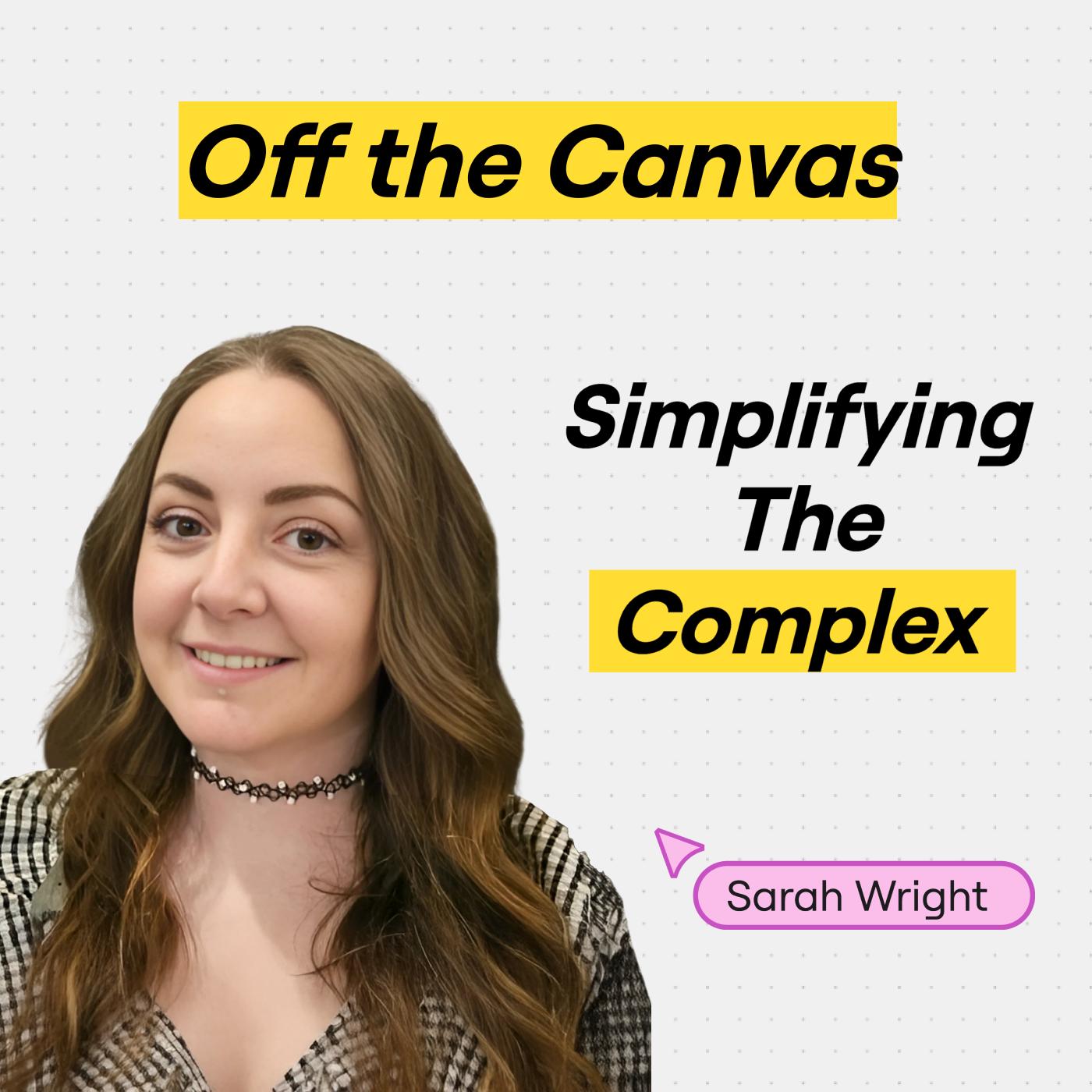
Lee: Hello and welcome back to Off the Canvas. This episode is about simplicity, not the aesthetic kind, not making things look clean, the hard kind, the kind that only comes after you've fully understood the mess underneath. Before a single pixel gets placed, there's a whole world of complexity a designer has to make sense of. Systems, orchestration layers, technology barriers, competing stakeholders, and the expectation that all that disappears completely by the time it reaches the person using the app. Most designers want to skip to the fun creative bit. Today's guests will tell you exactly why that's the wrong move. And my guest is Sarah Wright, a UX designer with experience designing apps at scale. Most recently at Virgin Media 02, where she's worked across multiple apps, built a design system from scratch and navigated some of the most complex stakeholder landscapes you can imagine. Sarah recently took her thinking onto the stage at Belfast Design, speaking publicly about this very topic. She's just launched a new venture Indie creative and I met Sarah at canvas 26 in London and this is a conversation I've been looking forward to ever since we sat down and came up with the idea at this very podcast Sarah, welcome to Off the Canvas.
Sarah: Thank you, thanks for having me.
Lee: No, it's great to see you again. So I've been following you on LinkedIn. Not that it's talking too much on there, but you've been coming on my feed a little bit. And you've been very busy over the last few months. So you've obviously launched Indie Creative. You've been on the road in your camper van. I've seen you and your dog as well, Indie. And you was at Canvas 26. You spoke at Belfast Design. And you've been busy creating your own stickers as well, which I was quite jealous of.
Sarah: Yeah.
Lee: So how's all that been? A busy few months.
Sarah: yeah, three months living in my camper van, starting my business was an experience I don't think many people can probably say that they've had. It's been really exciting, really challenging and actually just really good to slow down actually. know, working really busy constantly in the more corporate world with Virgina Media 02, you know. hammering out design systems and kind of dealing with stakeholder challenges, know, all those things kind of really, I spent the past sort of, four or five years in that world and yeah, I feel like now I'm finally doing it my way. I'm of getting used to the idea that I can kind of log on as and when I need to and build my client base from there. But yeah, it's been really exciting and yeah, I got home from Belfast and immediately wanted to create the actual stickers that I've been creating in Miro. So that was a little bit of a hyper focus that I had. for a few days where I was like bashing out a load of stickers so if you want some I'll create some next time we see each other.
Lee: Definitely, think maybe, yeah, I've done jokes sometimes because my laptop screen is just full of stickers. But yeah, I've still got the ones from Canvas, actually. I've not had to take them out, took them out the seal yet, the kind of just saving them. But no, it's been great to see your journey from afar there as well. And I know you mentioned there a lot of experience you've had in that kind of corporate world. I'm sure we'll get into that during the conversation, which would be great. But I think, yeah, before we do get started, can you just kind of... Just introduce a little bit more about yourself to our listeners, of tell us maybe kind of the things that you're doing day to day, how maybe that has changed since you've got into this freelance world.
Sarah: Yeah, absolutely. So before, you know, I worked on the three core apps for Virgia Media 02, I was the design lead. So I led a team of kind of interchangeable across time, but between three to five designers. And really we had to build sort of from the ground up. because we had multiple apps owned by lots of different companies and we were trying to bring it all in-house into a React Native build. And of course there was a need to innovate and kind of bring design systems closer into one space. And you know, long story short, we built three apps. MyVirgin Media, MyO2 and Priority. We brought them all into a complete system of variables. It was originally Token Studio, so we kind of made that migration as well. So worked with the team to kind of create that. And yeah, essentially trying to build new experiences off the basis of old technology and trying to bring it up to date with, you know, the modern world and the modern expectations of Virgin Media 02. And yeah, very much day to day was, you know, lots of video calls with the team, lots of workshops, lots of kind of involved in strategic decisions and, you know, making big bold decisions with a lot of the leadership there. That's now completely different. I'm now asking around if anybody needs any work. I have some clients lined up and if anything, I've had a huge learning curve. And Miro has really helped actually in helping me start my business because I'm not very good at writing contracts. I'm not very good at knowing what insurance terms mean and you know, all these layers of things that you need to do when you get started. So now my day to day really is, you know, kind of getting to grips with what it means to have your own business, how to get started. what insurance you need, what funding you need, having enough money to kind of get off the ground. I had to buy myself a new laptop because it was a bit old and decrepit, I wouldn't really do anything on Miro and it was a bit sluggish. I definitely couldn't do anything on Figma. And yeah, so very much now is building. different types of experiences and looking at things beyond apps, beyond that kind of experience, but taking everything I've learned over the years and being able to channel that into new things and new parts of different types of businesses, know. and into the web again. You know, it's been a while since I've been working on web experiences, but I definitely know how to simplify a lot of things. So hopefully it'll all come to the same conclusion, I think.
Lee: No, yeah, it's a big transition there, isn't it, from that world on your own there and that is building at scale isn't it across three different I guess like different apps there that need to connect and you mentioning around how you then making sure that you can build it so it's all interconnected because as designers sometimes I guess early on in career you've got that tunnel vision into I'm working on this part but they're not understanding the impacts across that I think one question that was coming to mind then was around you talked about leading that with people there and a team, whereas now maybe you're more individual. What was it like there being like a lead designer, like, guess, leading into the leadership angle and the delegation and the strategic angle. And then how's that changed as you come on your own and you kind of, you're on this like mini team of one.
Sarah: So leadership is... really hard, it's a lot more difficult than I think people realize. I've spoken to some people that are still at Virgin Media too and we've been kind of, I've been mentoring slightly, talking about how it's been going for them. And it really is tricky because you've got to bring everybody into the room, you've got to bring everybody together and you've got to have that level of ownership that everybody is proud of, everybody wants to be part of that ownership. The key thing for me was making sure that we were all building this design system. I didn't want to build it myself, I didn't want to task it to one person because we're all trying to develop ideas into, you know, shaping it into usable experiences. components are reusable, tokens are reusable. So there's absolutely no reason to have three separate design systems for three different apps when you can reuse that, especially when in the actual technology itself, the developers, they're reusing and repurposing the same information. They're not gonna recreate the exact same card or button or component there. So really it was getting everybody involved and My team will laugh when they hear this, but I used to try and do a little... sort of workshop together with them in a museum and that would be our little collaboration space where we would do a task. We would go and you know maybe do some ethnographic research and we would go and watch some people and see how they navigate museums and then we would take it to the office and start to design something you know just completely out of context out of the telecommunications world and you know and see how we kind of function together as a group and see how other people contribute to different things and leaning into those people's strengths. That was really key is bringing everybody together, having, you know, probably a lot of banter. We're always a bit averse to, you know, being quite professional most of the time, but get a bunch of designers together and there's usually some really good creative thinking. And so, you know, that was a really big part of what we did, even though we were mostly remote, we were one of the most connected teams. in the business and I think it really showed in the collaboration that we were achieving. And now, it's back to your original question, now it really is a team of one. At the moment I'm relying on myself to be able to do everything, you know, and then going out and seeking out guidance from lots of different avenues. And it's very confusing my world at the moment but... if anything, the AI in Miro has been quite helpful to keep me on track and know where I need to go next and generate, okay, I need to think about this insurance, is it covering me for the right things? Do I need anything like doing my own desk research here and finding out how do I put a contract together? Being able to put a draft together, think about the things that I might not have thought about being a little bit new into this space. So now my team of sort of to sort of six people has now come down to one. So everything that I do now is going to be trying to bounce off my own thinking off myself by using AI in the context of what I've already filtered into it really.
Lee: Yeah, it's really interesting shift. think I've definitely seen kind of that shift myself, but in kind of the worlds that I've been working in. I think when you mentioned about that shared ownership, that shared purpose and that for a team to own something. And then I guess you have that connection that a team has and, you if you're coming out working together and in the day to day, you know, you need to have some times to be able to have that banter or have that bit of fun as well as actually the professionalism and. I really like that idea that you had around, you know, just going and solving a problem outside of the context of the world that you're normally in. I'm definitely going to steal that one because, no, I think sometimes, yeah, they get too focused, you know, we're here to solve problems and problems can exist in lots of different forms, can't they?
Sarah: Yeah, absolutely.
Lee: Great. Let's get into the subject matter then. So simplifying the complex, breaking that down. So I know in your talk, I've seen some of your slides around you saying having to fully engage with complexity before you can really start to simplify it. So what does that mean in practice?
Sarah: So when I ran the talk in Belfast, I had a few slides, a few engagement slides. that I actually asked them, you what aspects do they actually struggle with the most in terms of this main topic? And of course, you know, I had to like set questions, but the key one that was coming through was digesting complex systems, followed by understanding everyone's goals and then how to be seen and heard. So what that meant to me really was that Complexity is a top priority here. We need to get into the understanding of it in detail and I think in my experience and the way that that's run before is it's usually ended up being the you kind of given a task, you kind of figure out some of the things along the way. You design something that you think that will work, but it doesn't have all of the complexity of the background in there. And so you have to really engage with the complexity, you know, get to know, you know, what are the layers in the backend systems doing? What does this SDK actually do? And what parameters do I have to play with? What does the API pull in, terms of of data points, what can we actually use here and understanding those to a more deeper level than surface, they're gonna be your opportunities there to find your unhappy paths, find error messages or some of these things that you don't necessarily get on top of straight away. And I think that is like the... not only the top priority but it was the first thing that I even thought to speak about in terms of simplifying the complex because if you don't understand it how are you going to be able to simplify it? You need to get in the weeds with it. You need to really understand and talk and communicate with the people who do understand it. You know, your solution architects, the people, the backend developers that are looking at this day to day, get to understand it and get to the root of how it works because then you can design most effectively.
Lee: Yeah, so I guess that curiosity of asking good questions and building those strong relationships across disciplines, because I've seen it sometimes where, you know, you can go into an office or an environment where there is those disciplines, you just kind of sit together about trying to mix those up and get integrated and, like I say, making friends in solution design and engineering and finding out about and sharing both ways, I guess, like sharing about design as well so you can work together. something that kind of popped into my head there was around maybe, you know, as we start learning about design and we talk about like the design process, maybe even go back to the double diamond and stuff like that. And we talk this process, but then actually when we get thrown into an organization, it doesn't necessarily work like that with kind of time constraints or complexities. how do you see like maybe like junior designers coming into the field? Do you think they struggle a little bit? more at beginning and they maybe need that experience of being their eyes open to these kind of complex systems that have to work together and how's that, have you seen that in you when you was at time at maybe Virgin or two, how did that play across the team in the different levels and experience there?
Sarah: Yeah, I think... You know, for juniors, it's really tricky because they want to do well for their product or, you know, their team in general. So they want to be able to say yes to everything. So when they're given the information, oftentimes they will just go ahead and design. You know, they might sort of skip a few steps. They might be, you know, kind of going straight to the UI. They might be using the design system because it's already there. You know, it really is. And I've definitely been there. not just as a junior, I've been there at every stage, you know, where I kind of, you know, I want to get to a really nice point with this work and this is how it's going to look and I'm going to talk about it to stakeholders and everybody's going to be happy. But the reality is that, you know, even in that realm, even if you do understand the complexities, you have to be willing and ready to have pushback or somebody who's developing it or maybe your QA engineer that looks at things and goes, hang on, we haven't thought about this error or, we haven't thought about this situation. And, you you're not always going to get it right the first time. And I think especially for juniors, they hopefully can learn from it and adapt and they can take that into their next piece of work or, you know, they can think back on it and reflect. But I've definitely been a victim to it myself. I've definitely left it. to probably a bit too last minute to understand the complex systems. But I think really it's one of those things that you learn and adapt and you realize, I did make that mistake. learn from it, kind of note it down, give yourself that like key feedback as a designer and then review it again you know and see what could I have done differently, how could I approached it, who could I have asked for the advice and shape your learnings from that and be ready to push back and say, I can't do this until I have more detail or I don't have everything to hand to be able to get it to where we need to. And that was something that I really tried my best to teach the designers was push back and say, no, I don't have, you know, the details. can't get started. So once we have a bit more information, then I can get going and I can design to the best of that ability. I've even actually had designers doing that legwork themselves. They've been the ones going and seeking out that information, maybe from third parties or, you know, from other areas that own that API or, you know, something. And they've actually gone and understood it, digested it, created a diagram, and then explained it to their stakeholders before they've even got to the design stage. So everybody's capable. It's just having the confidence to... to make those strides and yeah, confidence comes definitely with time.
Lee: No, it does. I've definitely been there myself. Like you said, think design is very subjective, isn't it? You can solve a problem in many different ways. And like you said, being able to feedback, push back yourself or even be ready to be challenged by other stakeholders as well. And trying to work towards that common goal and common solution together. There's some really key points in there. I think before you mentioned about maybe solutionizing too quickly going into Maybe the UI, you maybe this is a, I guess it's the common trend across the industry about UX versus UI. You've seen them in job titles, chains over, over years. You've seen people who quite, I always see like, you know, like matrix where everyone's got strengths across different design areas. I think UX and UI is probably one that gets brought out a bit, especially when you've got like design systems or brand teams within organizations. How do you see that? Like that step of like people maybe jumping in. too early to design, especially when we've got design systems available that we can quickly start creating kind of solutions very, very quickly. How's that come across? Is there anything in your workflow that you do as a process to make sure you're taking the right steps? has that come up in like mentorship conversations
Sarah: Yeah, it's a really tricky one because especially as a strategic level designer, you're expected to present work to stakeholders at a high fidelity. So stakeholders want to see how it's going to look at the end, how it's probably going to function. And just, you know, they want to see an idea of where it's going. And it's a hard balance. to really go down that route because then if it doesn't then look like that in the end, are they gonna know, are they gonna notice, you kind of have that internal struggle. But it is impactful, it's really huge because even if you are reusing design systems and you're using those components to get you through your ideation, that could just be your process of elimination. That could just be your way of working to say, maybe we could do this with the design system first. But it doesn't always ring true and it doesn't always. end up in that direction and I'm a firm believer in sketching you know I have post-it notes everywhere I have like a whiteboard that I, you know, draft things on. have paper everywhere, you know, you can't see it but everything beyond the screen here is pretty much just chaos and sticky notes and things where I've written things down because it's quite visceral and you can sort of almost feel it. It's a bit more tangible. So I do truly still believe that people sketching wireframes is still one of the most powerful ways of figuring out some of your you know, right down to micro interactions, you might think that, this is the type of thing that I need to do, but then when you think more on it, because you've done the action, you've been integrated with the thinking. you actually feel more part of that. So there is definitely room for every avenue. You can go into high fidelity. And of course now we have the added layer of AI and AI prototyping. you're creating something that looks like a finished article. And that's sometimes helpful. and sometimes really unhelpful. And I think it's just being able to distinguish what that is in your team. know, does it need to be seen and viewed as that's the finished product? And ultimately it's always going to come down to your user research. It's always going to be, you know, we need to figure out how this works, how it operates. Is it going to make sense to our users? And I think the difference between UX and UI as well is always this kind of push and pull. If you design for... the UI, like the analogy I always think about is like plumbing. You know, the UX is the kind of plumbing behind the scenes. You don't see the plumbing, but what you do see is the tap and the water coming through the tap. So the tap is the UI and you see the water come through. That's the action, but you don't see the plumbing behind it. And if you don't have the correct plumbing, you're to have problems, right? With your tap. I mean, it's a super simple way of thinking about it, but... you know, if you haven't spent the time figuring out the sort of logistics behind it, you know, your UI is gonna, you know, fall flat on its face. It's not, it's not gonna really mean anything. It's not gonna be usable. And those are the kind of key aspects that you need to kind of watch out for.
Lee: there's some really, really good bits in there, really resonated with the framing aspects of the taps and the plumbing behind it as well. I guess if we talk about, you mentioned at the beginning about kind of building these design systems from scratch in house and can you just talk about what that experience was like? Maybe, I know we've talked about kind of growing and lessons learned as a designer. Could you pull out many bits around? Things that went well and you enjoyed and then maybe a few bits of like lessons learned are things that you would kind of potentially do differently
Sarah: I would do so much differently. Now that I know what I know. And sometimes you just don't know what you don't know. And that's okay, right? And that's part of growing as a person. But I think building a design system, know, pretty much from scratch, you know, there was a lot to deal with there. There was a lot of scope, a lot of, you know, expectations. There was a lot of... stakeholder politics, there was a lot of technical constraints that we just kind of back and forth around, you know, and trying to keep designers on track as well, you know, there's kind of so many layers, I think, within my experience and I think... You one, one aspect is, you want to keep your stakeholders happy. You want to be making progress. You want to show that things are getting, getting done. you know, what can you take to them that shows them and showcases the team's abilities and your abilities and how do you kind of showcase then what you're going to achieve in the long term. But the long term is so unknown. It's, it's really, really hard to know exactly. where you're going to go. And as well, know, things happen. Businesses change their minds, know, stakeholders change positions. So sometimes you have to be ready and willing to let things go a little bit. That's definitely a huge one for me. And even leaving the business was a hard one for somebody who's like owned that world for a while. You know, and I think There's kind of this this key experiences that you can really shape and help people understand, you know, in a stakeholder meeting. But it's trying to then make sure that you're like we said before, understanding the complexities of how that then works for the users. So it's kind of defining a whole strategic design to your stakeholders and then having the actual work. They're like two separate areas of your workload. you know and a lot of my experience was trying to work with a wider net of stakeholders so we adopted lots of other types of stakeholders from like a commercial area and you know third party agencies that were kind of working on designs in tandem with the designs that we were working on and trying to get everybody on the same page is really, hard when that net gets wider and wider and there's more and more people involved. And I think what, like despite my best efforts, sometimes you just have to know when to let things go and kind of. get used to the idea that you can't own absolutely everything in the app world. Like for me, was learning that actually we can do our best, we can showcase our best, we can try and give our best understanding through the room and who you're speaking to. But. everybody's got their own goals. And if there's one thing I would do differently, I would revisit those people's goals and I would kind of go through and see how they match to what we were trying to achieve and how they were trying to achieve in tandem with other people's goals. you know, especially in big corporate world, there's so many OKRs flying around and, you know, so many people are trying to do the same kind of project and it's ever so slightly different to this other team and that team's basically doing the same work and nobody's talking to each other. So what I've found in my experience is at least bringing the designers together because they're really good at collaboration, they're really good at kind of talking through their work and being passionate about their work because they're there and doing it right. So I think bringing people together that was... That was definitely on the cards to try and do more of that. And I think if the designers at least can kind of get together and bring the best thinking together, you should at least kind of get somewhere with that. But yeah, and the other thing that I kind of learned is, it's a bit of a hot topic, maybe. Not every UX designer is an app designer. And that sounds really harsh, but you know, and I wasn't an app designer when I started there. I was pretty much a web and graphic sort of designer. So that was my background. And, you know, I learned to simplify the UI, I learned, you know, how to strip back to basics. things like that. yeah, it's a bit of a tricky one to say out loud, but you know, it's just my experience as I navigated different designers and tried to pull in the best team to get the job done really.
Lee: No, some really good key takeaways there. I think that you mentioned around this kind of like there's a communication layer across this and this is guess where it goes into different skills as a designer. I guess you call them as like softer skills don't where we've got the design craft, but then you've got to be able to communicate that back. And they also that influence that you have then on other people around how that lands as well. think the app designer comment as well. I think I've definitely seen that in teams that I've worked in where there was the app and then the web experiences and a lot of people did have experience within the web and no experience in app design and you could see the fundamental flaws within that and then when we got people who had that definitely specialised in that area he'd kind of then did kind of creating this ownership as the app designer for that particular piece of work and it was really important for them to have the experience in that space so I definitely do resonate with that as well.
Sarah: Yeah.
Lee: let's move on to I guess you mentioned there about like simplifying design so and being able to remove things from the interface So I guess that's a real craft as a designer to be able to decide kind of what to take out and how to make it simple and intuitive And it's easy when you've got all these stakeholders coming in saying I want this here I want that there you need to put this information especially guess if you've worked in compliance and all the information and C's and C's that you've got to put in spaces. So how do you navigate that as a designer around the craft of removing things and creating these kind of simple experiences, especially on, I guess, as an app and a mobile device when you've got such little screen space to kind of navigate.
Sarah: Yeah, well actually the... the event that I spoke at Belfast, I literally asked the group to get their phones out and open their phone to the last app that they had open. And I asked them, okay, how many headings can you see in this app? And, you know, asked them to speak out and there was, you know, a couple of people that said, yeah, about two, maybe three, not many at all. All right, okay. And now how many icons can you see in that app? And it was, you know, a much larger number, you know, kind of seven, ten, like, you know, was literally the UI was targeted towards iconography, it was targeted towards visual aid, it was, you know, very much that kind of world and ultimately it's... it's easy to say, right, I need to chunk all this information. I need like a bunch of headers. I need to be able to make this really usable. But actually, like my kind of strategy would be, okay. If you remove a bunch of things, is it still usable? Can you still get around? Can you still navigate? Can you still find the thing you're trying to look for? And of course, you you need to do the rounds of user testing. You need to, you know, check in with, with your, you know, your user base. need to do some A B testing and you need to be able to see, okay, what makes this usable? Is it the navigation? Is it the way that it navigates? Is there something that I can. remove very easily. And really the proximity of the task you're trying to complete, is it near the thing that you're trying to do? Has it kind of flowed nicely? Has it gone through and done the thing that you're expecting it to do? you know, it's kind of removing is so easy to say, but then adding lots of capabilities to an app. you know, it's very easy to do. I was actually setting up a new broadband provider at home and the journey was not. comfortable. And you know, it's realizing, okay, this is why and being almost kind of being the user in that moment gives you the opportunity to think, that's why it's a frustration is because something doesn't resonate in my information architecture, the way I'm thinking of how this is structured and what it relates to, you know, does that, is there a bit of a disconnect? Is there something that I can tie a bit better? and use less jargon. Like you don't need
Lee: You
Sarah: to use a bunch of jargon and we've always been taught this as UX designers and you know content design is really key but really do you need to say you know the really big body of text of like jargon heavy wording or do you need to just say I need to set up my broadband really simply. That's a lot of what I found. In terms of trying to simplify is, you know, I had designers adding headers, creating sections, doing all this stuff, but actually you could strip a bunch of that away and just create, you know, bit more of a... easier experience of flow of information rather than the traditional way of designing for web, which you'd have sections, you'd have a whole navigational area, massive information architecture there, and being able to strip that down a lot more simply. And I think to your other point around... like stakeholders adding complexity. You know, it's just challenging them and saying, okay, well, what makes this more useful for our users? And what is the business metric that we're trying to achieve? Like, why is this important to the business? Because oftentimes, you know, that is like a business level decision. And to the compliance part, I very much fought tooth and nail to avoid having terms and conditions on the homepage of the Virgia Media app. Yeah, if they were gonna put it anywhere, it's gonna be hidden somewhere in an overlay. Please leave my app alone. I don't need your technical legal jargon that nobody really understands anyway.
Lee: No, it's still I've worked on finance, car finance journeys in the past. that was, I think we, I think we, took that approach where we kind of collaborated with compliance and tried to make it a more collaborative effort to try and get around some of these difficult kind of conversations around where this information should live in the, in the
Sarah: Yeah.
Lee: UI. No, there's some, some really good, good points there around being able to kind of simplify journeys. You talked about kind of, guess, simplicity and then usability. Are they the kind of similar things? Is it a simple UI versus a usable UI? Are they one of the same thing? How would you kind of describe that?
Sarah: always. Simplicity doesn't necessarily always mean good design so if it's stripped back too far then probably you would lose some of your usability. course you've got to think about accessibility as well. That's always at the forefront of everything that we do as designers, but it's trying to make sure that we're not only relying on icons because you probably find in WCAG that... accessibility rules for web, know, state that you can't just use iconography to describe the interaction. So, you know, oftentimes you do have to try and make some affordances to make sure that, yes, it is still usable. So it really is that balancing act. And I think that's where it becomes the most difficult because you want to be able to strip everything away, but you don't want to take away the intent for each user. don't want to lose sight of actually is something findable. And ultimately, you know, to that point, it should be a really strong information architecture in the first place. That should be your basis for the entirety of how you structure things. That's where I started with. Virgia Media 02 apps was okay, what is the information architecture first? And then go from there, what are we trying to solve? And then really it's testing and iterating with your designers, getting stakeholder feedback on what they think, but also challenging that in the user research and then seeing what your users actually prefer. Do they prefer lots of information? Is it going to be more useful upfront? I mean, the problem you sort of have, especially with apps, is users often think that everything should be on the homepage. They don't actually mean that, they say that, but what they mean is is that they should be able to navigate very easily from the homepage. That's the key.
Lee: Yeah, I think it's making me think of like Steve Krugges is it don't make me think I remember reading that years ago was when I started getting into
Sarah: Thank
Lee: this and like every little piece of information's extra cognitive load on the user but you know, sometimes they need this information But how do you bring that in kind of piecemeal? But I guess what I'm hearing from the conversation is that the relationships with stakeholders is is key during kind of these these projects and working with stakeholders I guess if there was one tip maybe you was if you was mentoring a designer And they were struggling because a stakeholder was trying to add more stuff into the app and they were quite strong, maybe senior and very opinionated. Have you got any tips around? I know you shared quite a bit already, but how you would maybe try and navigate some of those conversations to help support them on that journey.
Sarah: Absolutely. think the key one is understanding their goal. So why do they want to embed this new feature or this new thing in, you know, why are they being strong about it? Is it a business need? Is it just a personal goal that they want to achieve, you know, something impactful in the business and really have that stakeholder interview, you know, and, interview them in that way that really gets to the understanding of why this needs to happen and actually advise, like try and think strategically, try and think a bit broader than the small area that say the designer at question is responsible for and is it going to bring actual value in that one location or could it be somewhere else? Could it be in a different area? Could it be a different journey? Does it need to happen? What value does it bring to both the business and the user because of course you know we have to think about the business outcome as we're doing this work. And I think ultimately, usually when stakeholders, when you remove something and the stakeholders say, put it back, usually because like they have this anxiety that taking it away has lost value and that you're not going to get that value back into what you've removed potentially. I definitely think that, you know, there is that temptation to allow the strong voice in the room to have their say, but understanding them and getting to the root of why is going to be way more impactful for being able to deliver the right thing at the right time.
Lee: some really useful advice there. No, thanks, Sarah. I think just before we kind of close out, I guess we can talk about Miro because I think we're both very fanatics of our Miro. So let's, yeah,
Sarah: my god.
Lee: let's let's have a little segment on that before we wrap up. So I guess Miro is a space you've been using it probably for quite a long time. I guess you mentioned around some of the new AI features. Is there some of those? I guess if you cash your mind back is there some of the stuff that's available today that you've that you think wow I could have used that in my time before and what would how would it have been valuable for for some of this Some of this journey around kind of navigating some of these complex spaces
Sarah: do I, I have a list as long as my arm. Cause I was thinking about this in advance and I, in my talk, I kind of went through, okay, how would Miro have actually, how would the tools that are available now helped me? And I think this is probably gonna be the basis for how I work going forward as well. And there's so many and. It's really interesting that you mentioned AI because my go-to at the moment for sense checking things is the AI sidekick. And I've built my own custom sidekicks with my own tone of voice, with my own like personality, with my own information that I want it to know. That's its like context. And then I... I basically use it to make sure that it reviews my work. It looks through, okay, you might have missed, you know, X, Y, Z. You might want to think about talking to your stakeholders about this thing. And actually you need to use a test because I can't give you enough information. And that's how I've trained my model or one of my models. I've got a few. And that essentially gives you... the sense of you're getting on the right track or I feel that I'm on the right track when I use my sidekicks. And I think that's something that somebody who's a little bit unsure sometimes on am I making the right decision that actually helps me just solidify. Yep. I know that I've got this. I know that I can make this decision and this is the reasoning and that will help me get me from A to B. There's quite a few related to kind of my key topics in my talk as well, where the understanding the complex, what we talked about earlier, like having diagramming and being able to use the context of maybe the systems that exist and bringing them into the diagramming tool in Miro, either by manual kind of creation or AI. Understanding your back-end system and having everybody come together on the board and collaborate on that system and talk about that system and try and understand each piece of that diagram is really a place where you can have that direct... communication with those solution architects, with those backend developers, anybody who is the expert on those areas, bringing it all together. Maybe you could create a flow, where you've had a bunch of context, you've created this diagram and then you start to query, okay, how do we then even think about the user interface here? What does this actually look like? And... run workshops with your stakeholders on, what is it that you need and want and bring them onto the board and collaborate, especially on those things we were just talking about where, you you're trying to do stakeholder interviews or you're trying to understand their goals and their needs, the business needs, bring it all into one place. And that suddenly becomes the context of your project or your product or whatever it is that you're working on to then deliver the the output that you need to deliver and do the kind of the work alongside the tasks that you have at hand. You know, and I think I know what I said earlier about sketching as well for your ideation. stakeholders don't necessarily feel confident sketching. I've noticed over the years where they feel a bit apprehensive about, you know, what they're going to do, like a crazy eight, and then they're going to sit there and overthink it and only do like one design. You know, so actually getting the context of the board and bringing it into a prototype live on the board with the understanding that this is just... This is just the ideas that they have and they want to be able to communicate it to a designer who can then translate it into the right thing. That's something that I've talked about with a few people and it's still, it's this understanding that stakeholders want to help you. They want to give you... the design upfront, they wanna kind of draw it out for you what they've got in their mind and being able to bring that to life into the board could be helping you into your ideation session. And then there's also other aspects of AI that a lot of people are very scared. And I know we've talked about how there's this real aversion to using AI, but. It's trying to think about it in terms of how can you use it to collaborate better with your team? How can you use it to simplify some of the things that actually have given you a headache for the past week, trying to understand the complex systems, those diagrams. How can you then summarize that? What can I then achieve as a designer to be able to understand it, digest it and translate that into the right experiences for your users? But yeah, like I said, I've got a list as long as my arm is of things that I could have done differently with the use of AI tools.
Lee: No, I mean, it's amazing how these tools keep on keep on progressing and we can go back and think about how we might do differently or how we might learn to adapt our approach for the future as well. I think it really picks up on some key elements there. I think you kind of nailed it with the more collaborative approach that it's enabling, whether that's a collaborative approach, even just one to one where you've got something that can sense check, but it's personal and authentic to how you want to. kind of have your tone of voice or the things that it should, how it should act. And you're able to control that, which is really nice. But then also bringing all stakeholders and teams together on a canvas where you can kind of create these artifacts that you can have those discussions. And I think I've seen a lot of kind of maybe product managers bringing kind of visuals for your lovable or all sorts of these AI tools in kind of like PRD documents upfront. you kind of get in a sense of And it can be quite high fidelity as well, but you get in that sense of this is like a visual brief of what they want to try and do. But I think being able to bring that on a central space where you can collaborate, you can talk about what's the prompt that you fed in to get this. What was your rationale to why you got to this solution? And I guess those are the good conversations that you want to understand. And I think as you said earlier, it's asking those questions and being curious, isn't it?
Sarah: Absolutely, and I think with stakeholders, making them believe that they came up with the idea is usually the best way of getting a good buy in. I mean, how many times I've tried to try and shape a workshop or shape a conversation with a stakeholder that draws them into the actual thinking, and then as soon as they think that it was their idea. absolutely they're going to want to do that solution because they think it was their idea and they've got the actual influence then to see it through to its completion. I mean, bringing everybody on the board, yeah, actually using their ideas and using them, you know, most effectively is going to be most impactful, especially from a business politics perspective.
Lee: No, yeah, another great point about that. I guess using that influence. think the best, the best is experiences that I've seen built have always been like diverse perspectives coming together and getting the best of everybody's knowledge and expertise, whether that would be a designer or maybe a content designer and architects around how it's built or even the product manager driving it that way. I think, yeah, it all needs to get fed in, doesn't it? To a central place. That's been a really good conversation. Eye opening again. think there's lots of core takeaways there. You talked about when you approach these complex systems, there's lots of key tips around how you might approach that, how you might communicate across stakeholder groups as well. And yeah, there's a lot to consider. No, thanks for sharing that knowledge of those journeys that you've been on as well. Even from that, you know, that leading design angle into the actual person doing the craft as well. No thanks about that before. guess before we kind of close out, how can people find out a little bit more about you and your work and what you're up to?
Sarah: Yeah, so I'm on LinkedIn a lot. I'm posting on there. That's kind of my go-to channel. I've just been so busy trying to start my business that I still don't even have a website and I've got clients knocking on my door. So as and when I get my website up, you'll be the first to know. But yeah, I mean, I'm now doing this kind of work solo. This is indie creative, so. take a little look at what I do there. But follow me directly on LinkedIn, that's the best place to get me.
Lee: Awesome. I know we've had the chat as well. If anyone's in the Northwest, we've got Nata above me there. So I think you're looking at getting involved in NataCon as well,
Sarah: Absolutely.
Lee: how we might bring Miro into that space. So hopefully some listeners are based in the Northwest, who might be able to meet us in Manchester in November.
Sarah: Absolutely.
Lee: Cool. Well, thanks for joining us. That brings us to the end of our fourth episode of Flying By With Ease. But no, thanks for listening and thank you again to Sarah for joining us. Don't forget to like, subscribe and follow us wherever you're tuning in from and look out for future episodes where we'll be meeting more people from the Miro community. So yeah, bye for now and see you next time.
Lee Jeffery: Thank you for listening to Off the Canvas, the podcast dedicated to the passionate, curious and deeply skilled people at the heart of the Miro community. Please like, share and follow us to stay updated on future episodes and join us again soon for more insightful conversations with the community.
