

WEBVTT
00:00:14.279 --> 00:00:47.024
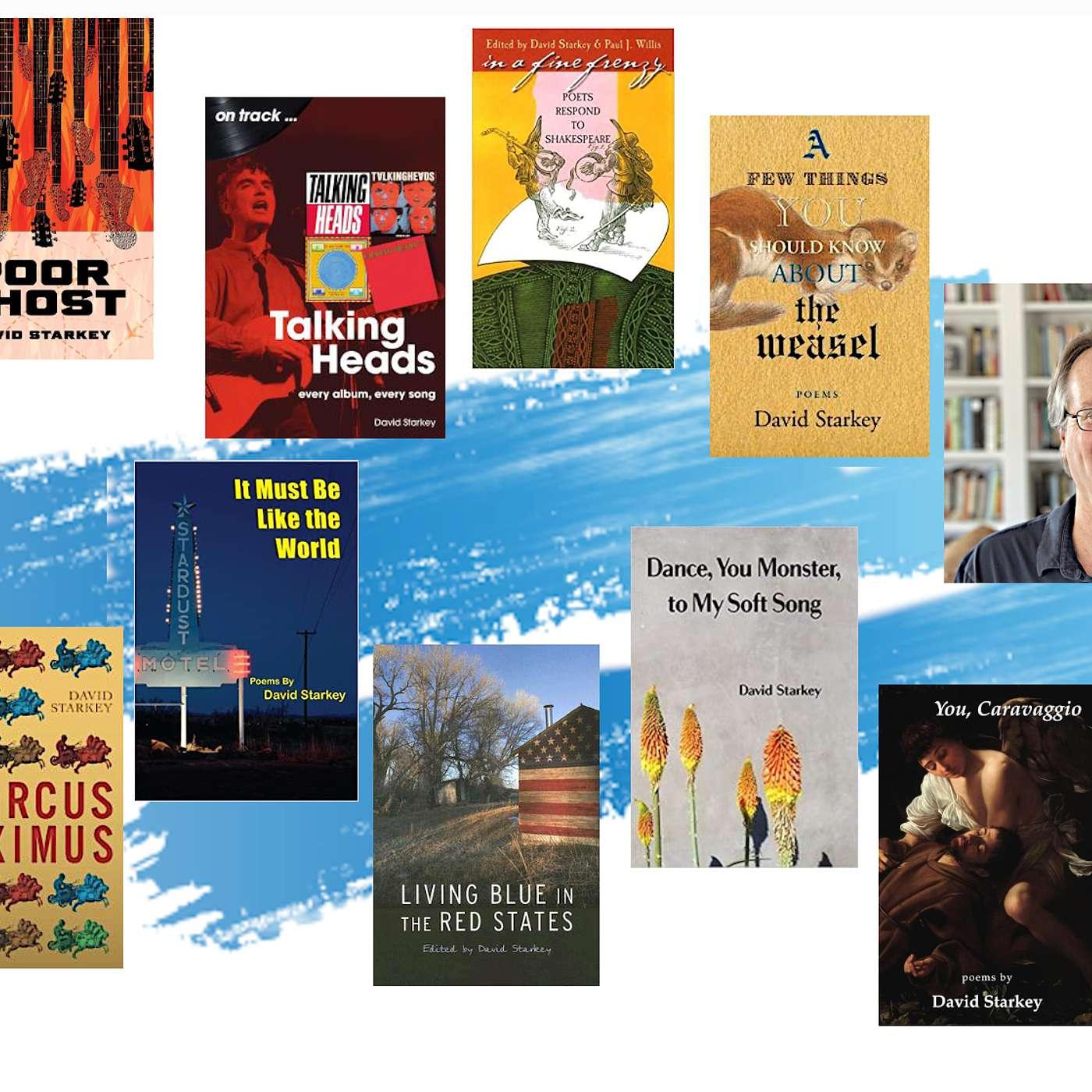
Hello. Welcome to Dust Jackets: Conversations with authors. We speak with authors across many genres, about their books, their creative process, and how they manage it all. I'm Maggie Lynch, and today I'm interviewing David Starkey. Let me read his bio from his website. David Starkey served as Santa Barbara's 2009 to 2011 Poet Laureate. He is founding director of the creative writing program at Santa Barbara City College, and the publisher and co-editor of gunpowder press.
00:00:47.685 --> 00:01:16.694
Over the past 30 years, he's published 11 full length collections of poetry with small presses and more than 500 Poems in literary journals such as American Scholar, Georgia Review, Prairie Schooner, and Southern Review. As an educator, he's written and edited a number of books, most recently, Hello Writer and Creative Writing for Genres in Brief, the fourth edition. Both are published by Bedford St Martin's in 2021.
00:01:17.534 --> 00:01:30.135
David is also a founding editor of The California Review of Books and the host of Santa Barbara's online Creative Community. He's a very busy guy.
00:01:24.015 --> 00:01:30.135
David, welcome to the podcast.
00:01:30.180 --> 00:01:32.219
Well, thank you for having me, Maggie. I appreciate it.
00:01:32.219 --> 00:01:55.484
Thank you so much for making the time for us. So that's quite a bio. I'd have to say I'm impressed, particularly with your poetry collections and the number of publications and literary journals. I've met a lot of poets in my life, but none have as many publications as you do. Would it be correct to assume that poetry is your primary genre?
00:01:56.620 --> 00:02:30.085
Yeah, I think I that's true most of the time. I feel like when I get off on another project, that I'm that other kind of writer. So for instance, I just finished writing a book about Bruce Springsteen. So for about five months I was a music journalist, primarily, and I have a novel that's just come out. And so for the months that it took me to write that I was a novelist, but I think, yeah, my default setting as a writer is probably as a poet.
00:02:32.004 --> 00:03:02.590
Well, so I'm going to ask you, you know, recently, some of my folks, my fans, who watch this show have asked me to ask more questions around what type of reading ihas influenced you in the past. So can you tell me, is there a particular book or couple of books that stick in your mind that may have influenced you as a child, as an adult, and do they have any relationship at all to what you write today.
00:03:02.780 --> 00:04:01.669
Yeah, you know, I think as an adult, the group of books that's most interested or most influenced me is probably the Collected Poems of Seamus Heaney. And by collected, I mean it's a little set of 11, 12, 13 books. I was lucky enough as several Santa Barbara poet laureates and I went to Ireland a few years back, and we were lucky enough to read at the Seamus Heaney center in Bellaghy Northern Ireland. And on the shelf in their gift shop was this book, you know, this little collection. And I had read the knee, but I hadn't devoured him in that way. So that was, I don't know, maybe that was about eight years ago, that really, I think, influenced my poetry a lot in the time since then, as a child.
00:04:01.060 --> 00:04:07.060
I was kind of a whoever or whatever was available reader.
00:04:07.060 --> 00:04:42.384
So I spent my summers. My parents were public school teachers in Sacramento, California, but their parents lived in in Beaumont, Texas and Lake Charles, Louisiana, and we would go back there for most of the summer, every summer, from the time I was a little child till the time I graduated from high school, and I read whatever happened to be on the shelves of my grandparents. So it could be James Bond or, you know, I read Endymion by Keats in long poem.
00:04:37.045 --> 00:05:04.029
Struggled through it. I read Thomas Mann's The Magic Mountain, which is something that most 14 year old boys don't read. So, you know, whatever I could kind of get my hands on, because reading was the only thing when I was growing up outside of my regular school life. I just I read what I could.
00:05:04.870 --> 00:05:51.879
Well, those certainly are pretty big tomes to be reading as a child or a teenager. So I can kind of see how that would influence you, especially with the poetry. You know, the language and the rhythms and I imagine are very great. I didn't read poetry much as a child. As a teenager I did because they were very deep to me, but as a child I wasn't really into that. So right now, things that are contemporary, is there anything that you particularly as an author or poet, that you're always looking for their next work, or are you just kind of, whatever you feel like is what you're going to pick up tomorrow, the next day.
00:05:51.839 --> 00:06:43.410
You know, with with my friend BrianTanguay, I'm the co editor of The California Review of Books, as you mentioned. And so we, you know, we'll get a lot of different things. So most recently, over the last week, I reviewed a biography of John Prine, the great singer songwriter, and I reviewed a biography of Christopher Marlowe, the Elizabethan dramatist. Then I also reviewed a book of interviews with New York School poets like John Ashbery and Kenneth Koch and people like that. So I don't know. Whatever, whatever lands on my desk that looks interesting to me. I'll sit down and read it, probably give it a review.
00:06:44.250 --> 00:06:48.569
I had forgotten already that you were a reviewer, so you are reading a lot,
00:06:48.930 --> 00:07:12.615
Yeah, yeah. And, you know, when I was younger, when I started a book, I was committed to it, you know. I think that's how I was able to read those books when I was a youth. But now as a reviewer, and I have stacks and stacks of books, if, if I'm not into it by the first 20 or 30 or 40 pages, then off to Planned Parenthood bookseller.
00:07:14.475 --> 00:07:30.720
Oh, okay, well, that's something to understand, yeah, and, I think the same thing works If you're trying to get traditional contracts. The people who are reading your book from the slush pile, it's kind of like You better catch me pretty quickly, within 50 pages, I would say.
00:07:30.000 --> 00:08:16.649
Well, you know, and I think it's interesting, since we're both also writers, how do you get those reviews? I think, you know, you can get a review on social media from a friend or a book influencer that you you pay, but it's hard to get a it's hard to get a serious reviewer to look at a book of serious writing. And so, you know, we reviewers get pitched all the time by people, by agents, by the marketing folks at the big publishers, by the writers themselves. And it's hit and miss. You know, you never know when that one idea is really going to resonate with a reviewer, just as you don't know when it's going to resonate with an editor or an agent,
00:08:17.199 --> 00:08:31.839
Right exactly, and the reviews that you're doing, I know so many review places now charge money, right? Sometimes as little as $50 and sometimes as much as $500 and something.
00:08:32.139 --> 00:08:35.860
So where you review is that a charge thing or...
00:08:35.860 --> 00:08:39.565
Absolutely not?
00:08:35.860 --> 00:08:53.845
No. In fact, I just was having a beer with my co editor a couple days ago, and we were talking about what horrible business people we were, because all we get out of it is free books, you know, which any reviewer gets.
00:08:54.264 --> 00:09:03.429
But it also gives us a lot of power, because, you know, you're not paying us $500 to review your book, we wouldn't take it.
00:09:04.269 --> 00:09:24.610
And so therefore, we don't have to, if we don't like your book, we're not gonna review it. And I think we're probably a kind of getting to be a pretty rare bird right now in that we just are looking for what we think are the best books that we want to pass on to our readers, the readers of California Review of Books.
00:09:24.960 --> 00:09:35.759
Yeah, about the only other place I can think of is Midwest book reviews. You can still get a free review, but if you pay them the $50 you're guaranteed to get one.
00:09:37.320 --> 00:09:41.820
Otherwise, you know, it could be two years later before they get to you.
00:09:41.379 --> 00:10:11.038
And you know, even, I think even when you're paying, I think, like with Kirkus, as you mentioned, it's really expensiv. But if they are true to their word, that doesn't guarantee you a good review, you know, you could get allowed to review, and then I think you have the option of not publishing it. Um, but you know you're, I think if you're paying$500 and you know you're going to get a great review, that seems pretty sleazy to me.
00:10:11.000 --> 00:10:13.580
Yeah, no, I think Kirkus is true to their word.
00:10:13.879 --> 00:10:25.639
I've seen some bad reviews, or what I would consider bad because they're like three out of five stars, right? After you've paid 500 some dollars, that's not what you want in the year.
00:10:27.940 --> 00:10:48.625
So because you are both a novelist and a nonfiction person and a poet, I wonder, did you set out to be a specific type of writer, like a poet, and then branch out to to novels and non fiction. Or did it just kind of happen based on whatever was influencing you?
00:10:49.620 --> 00:11:03.720
Well, when I, you know, like I was saying I read a lot as a kid, and I think that sort of makes you want to be a writer, because you admire the people who are who are producing the books that you're reading.
00:10:58.740 --> 00:12:20.460
And so my grandfather had given me an old Smith Corona typewriter, and when I was in high school, I just started typing on it. And the things that mostly came out were little short stories. And so when I went to UC Davis, I was an English major with a creative writing emphasis, and it was fiction. It was my emphasis there, and then I somehow wound up at UCLA getting a master's degree in literature, and my roommate encouraged me to write poetry. Somehow I wrote a poem about Danny Bonaduce of the Partridge Family, with the line, did you ever learn to play that bass guitar? And my my friend thought that was hilarious. You should write some more poems. So I think that's kind of been my way of writing, is that I have a dark humor, kind of running through everything but there's also a sense of sadness and loss, you know, even in a subject matter like that. It's this child actor who was a phony, even as he was pretending to be something else, you know.
00:12:15.134 --> 00:12:25.799
And so I think that's what you see that, if you were to read across my pretty broad, you know, body of work.
00:12:27.059 --> 00:12:34.860
Is that a kind of calling card for you, that even if it's dark or sad, that you have balanced it with some humor?
00:12:35.279 --> 00:12:51.945
I think so, and vice versa too. You know, even something, that if something seems purely silly, I probably would avoid it. But if there's some humor lined with sadness, then that would probably, you know, my radar would be, ah, that sounds that sounds interesting.
00:12:51.945 --> 00:13:17.009
I think it takes a talented person to do both of those things well. So, one of the other things my listeners really love to hear about is your creative process, your inspirations. Like, you know, where do you write? Is there just one spot, or is it wherever you are? And do you continuously work on one project at a time?
00:13:13.409 --> 00:13:18.629
Or do you go back and forth between multiple projects?
00:13:19.620 --> 00:14:23.789
Yeah, you know, I like to kind of write around until I zero in on something that I really want to do, you know? So that's what makes poetry so great. It doesn't take that long to write the draft of a short lyric poem. But I do, I will start to think, Okay, this is what I'm working on now and then, when I do that, then I tend to just push everything aside. You can ask my wife in the other room, like everything just I get kind of obsessed with the work until I finish it. So, yeah, I work at my computer, I do take notes in a little notebook, especially when I'm out and about traveling, or when I know that I'm I'm going to write about something. I do try and take handwritten notes, but mostly I write in silence in, you know, my study, a little corner of the room, and that's where most of what happens.
00:14:25.110 --> 00:14:29.835
Did you say, you write primarily in a notebook or on your computer?
00:14:29.894 --> 00:14:40.335
Yeah, only taking notes. I only take notes by hand. My handwriting is pretty bad, so frequently I can't read that. I have to make stuff up.
00:14:41.715 --> 00:14:54.720
It'd be a bad reporter, like doctor handwriting? Well, I hear you about obsessiveness. I can get that way myself, particularly when I'm past the halfway part.
00:14:55.740 --> 00:15:04.500
You know my husband will peek his head in and say, Are you eating? I say No, not right now.
00:14:58.799 --> 00:15:05.460
No, it's like, see you tomorrow morning. No, you're right.
00:15:05.539 --> 00:15:12.019
And I think that is something about that halfway point where you can say, I'm on the downhill slope, you know?
00:15:12.500 --> 00:15:14.899
And I, you know, I got to keep going,
00:15:14.000 --> 00:15:45.664
Right? Yeah, I don't want to lose it. That's kind of the way that I feel. So both of your novels are about musicians, and though it appears that they're very different in terms of the themes and the genre, and you also have a nonfiction book about a musician group. So my first question is, are you a musician yourself? And what interests you about creating music and sharing peeks into the lives of musicians?
00:15:46.259 --> 00:16:49.470
Yeah, yeah. I mean, I've been playing in bands since I was in high school, and I still play in a couple bands now at age 63. So I put in plenty of decades of work doing that. I mean, I think that the creative process of making music, writing songs, popular songs, is not unlike you know what we do when we're writing a novel or writing poems or essays, but when you're working with other people, there's just that dynamic of competition and collaboration. And I think the way, in most bands, those two things are always kind of in a tension that makes for a dramatic situation. So yeah, I wrote a book about the Talking Heads, and there was a ton of conflict there, because David Byrne was writing nearly all the music and the lyrics, but the rest of the band wanted to have credit. So they were kind of always just, you know, on edge.
00:16:49.889 --> 00:17:09.734
So I've just finished this book about Bruce Springsteen, and, you know, he calls himself the boss for a reason. He calls all the shots so there's less tension, although, clearly, you know, people have been kind of hurt and dissatisfied along the way, as he's sort of, you know, moved in his own directions.
00:17:10.440 --> 00:17:17.460
Yeah? So it sounds like you, whether you're writing fiction or nonfiction, that you're also doing a lot of research.
00:17:18.079 --> 00:17:21.980
Yeah, I think so.
00:17:18.079 --> 00:18:19.009
I mean, the the two novels I've written, one of them is about a band, a kind of pretty famous band, that crashes into someone's backyard, and that backyard just happens to look exactly like my backyard. That made it really easy to write, because I could imagine, you know, where the plane was and what the people were doing. And then I have a bunch of fans kind of swarming over the place over the course of a couple months because they want to commemorate the band. And then my second novel is about these two kind of washed up folk rock musicians who tour Japan because one of their songs becomes a part of a commercial for Honda. And that is based on my own travels in Japan. My son lives there, and I've visited, I guess, eight or nine times over the last 10 years. So I have a pretty good sense of that, at least enough to write a novel where two, you know, Americans are wandering around the country.
00:18:20.390 --> 00:18:43.355
I can't even imagine how crazy that is, because, in my experience, it's such a homogenous culture with, you know, really kind of well set ideas about how you interact with people, and Americans tend to be kind of all over the place and definitely feeling that they're the superior.
00:18:44.259 --> 00:19:29.769
You know, it's also a culture that embraces idiosyncrasies. So, you know, there's like, there's a cult for just about everything. I mean, use the word cult loosely, but you know, the people who dress up like Elvis and dance in the streets of Tokyo or whatever genre of music. So the first rock band in Japan that sang in Japanese was actually a folk rock band. So that, that was a nice little piece of information I dug up along the way. So this is my first, it's just a fish out of water story, which are one of my favorite types of stories, is to see people kind of trying to navigate a world that they're not super familiar with.
00:19:30.680 --> 00:19:37.759
I agree. I love fish out of water. I think a lot of authors do, because that's how they feel themselves.
00:19:39.220 --> 00:19:39.880
You're right.
00:19:39.220 --> 00:19:39.880
Yeah.
00:19:43.559 --> 00:20:05.865
So many writers, even if they're writing cross genres, you know, or what appears to be very different genre types of books, they tend to have, at some point, kind of an overriding theme that becomes a part of every book, whether they planned it that way or not.
00:20:01.140 --> 00:20:08.805
Is that the case with you? Or do you work completely unique? No crossovers?
00:20:08.759 --> 00:21:00.292
No. I think there's crossovers. I mean, I think I've always been interested in what it's like when people are close to death, you know. My own parents both passed away in the last few years, and that just being there, you know, when my dad was taking his last breath, I think that's there's something really powerful about that. And so I think, even when I was in my 20s, I was writing about people who were dying or had died. But I was, I think I was often really don't. So you were saying because you had two novels, and looking at it kind of at a canted angle. Maybe a little bit of that dark humor that we were talking about earlier, and that's probably still in there somewhere. I'm not somebody who's only writing about death, but they're in both my novels.
00:21:00.366 --> 00:21:07.740
There is a significant death, you know, in each one. So I guess that is something that carries over.
00:21:24.994 --> 00:21:28.355
the one about Japan is the most recent one. Is that correct?
00:21:28.359 --> 00:21:29.740
Just, just out this month.
00:21:29.720 --> 00:21:35.578
Yeah, okay. And are all your books in paperback?
00:21:35.701 --> 00:21:40.339
Hard book, ebook, audiobook, you know?
00:21:40.000 --> 00:21:56.980
Yeah. I mean, most of my I would say the, well, definitely the novels and the nonfiction I've written is available, you know, as an ebook and paper copies, hardback and paperback. The books of poetry are generally just a paperback.
00:21:56.980 --> 00:22:29.230
You know that they're not usually in a digital form. I am going to do the recording for my two novels. I got the go ahead to do that, so I just need to find a quiet place in the house to sit down and read through everything. But I'm looking forward to that. I, you know, I think a lot of people do listen to audio books now that don't read paper, you know, or even digital books, so I'm looking forward to having that in my arsenal.
00:22:30.559 --> 00:22:44.119
Well, I'm really happy you're reading your books yourself, just because I think that a lot of listeners love hearing the author read unless, of course, they're really lousy.
00:22:44.779 --> 00:23:11.825
A lousy reader. I can't imagine that you are just in talking to you, but I think they like it because they figure that the author knows where to put the emphasis, and the author knows what the rhythm was, whether it's a poem or a line of description, and it's just so much more rich that way when they listen. So I wish you the very best. That is an onerous process.
00:23:12.484 --> 00:23:17.750
Yeah, it is. I mean, I wish Brad Pitt was going to be doing the reading instead.
00:23:20.869 --> 00:23:35.329
Yeah, it can be. I have not narrated anything myself. I keep telling myself I'm going to, but it's hard to find the time. You know you're talking, sometimes 10 to 15, hours.
00:23:35.329 --> 00:23:35.930
For sure, yeah.
00:23:35.930 --> 00:23:39.994
So it's, but I wish you the very best for that.
00:23:40.055 --> 00:23:40.954
I appreciate that.
00:23:40.954 --> 00:23:50.734
So what are you working on next? I know you have something just out, but do you have another project you're planning to get into soon?
00:23:50.960 --> 00:24:39.109
Yeah, so I actually had finished, just before I wrote that Bruce Springsteen book I had been working on, a novel where Elvis Presley is elected president in 1968 and Robert Kennedy Sr is not assassinated, and he becomes Elvis' vice president. And then Elvis turns out to be a really horrible president. So the first part of the book is getting Elvis elected. And the first part is Elvis kind of destroying America. And that sounds familiar. And then, yeah, and then I have a kind of surprise ending.
00:24:40.250 --> 00:25:15.095
Wow, that's, I want to read that, yeah, because that's so unique, and I can see how it might have some parallels in our political situation, just because when people are living in an environment where everyone's waiting on them and listening to them and doing whatever they say, sometimes they don't have the practice at situations where there's disagreement.
00:25:15.214 --> 00:25:39.740
And Elvis was used to getting his own way. I mean, in my novel Sam Phillips, you know his manager who took 50% of everything that he earned, is pushed out of the way pretty early in the novel. So Elvis suddenly has this power that he's never had before, and it turns out that he's not great at handling it.
00:25:40.220 --> 00:25:45.740
Yeah. Wow. I'm sure there's going to be humor as well.
00:25:45.740 --> 00:25:50.464
Oh yeah, yeah.
00:25:50.299 --> 00:25:58.279
Well, that's just amazing. So, um, where can people find your books? Is it just at your publisher, or are they distributed?
00:25:58.400 --> 00:26:21.724
Well, I mean, you know, they're wherever you buy books, I think kind of around the world. I think my publishers have been pretty good about making sure that it's not just on Amazon. You know that wherever you buy books? So, yeah, you know, occasionally I'll toss up in a local bookstore, but mostly, I think people buy my work online?
00:26:22.500 --> 00:26:36.839
Yeah, I think that's true, pretty much. But speaking of tossing up in a bookstore or somewhere else, you know, are there any events or places you plan to be, let's say over the next couple months?
00:26:34.079 --> 00:26:44.279
Should people listening to this say hey, Should you, you know, if you said San Francisco, for example, people who are from there might want to show up.
00:26:45.019 --> 00:26:57.140
Well, if people are in the central coast of California, I'll be launching my book at Chaucer's Bookstore on September the 28th at 3pm.
00:26:51.440 --> 00:27:17.585
That's a Sunday, and they're one of the finest local bookstores certainly in California, probably in the country. It's a magnificent place. I'm really excited. And then I will be at the Louisiana Book Festival on the first of November, along with a lot of other writers. And I'm still kind of just, you know, looking around for places.
00:27:17.585 --> 00:27:29.345
So if somebody watches or listens to your podcast and says, Oh, I want to meet David Starkey, just head on over to my website. davidstarkey.net and shoot me a line and I'll be
00:27:29.000 --> 00:27:32.420
Oh, that's great.
00:27:29.000 --> 00:27:29.585
Well, maybe someone from Japan there.
00:27:32.420 --> 00:27:53.585
will say that. So, and just to remind my listeners, you know, I always put in the show notes your website information and contact information and anything like that, so they they'll know how to get your website as sometimes spelling becomes a problem with different names.
00:27:53.585 --> 00:28:29.750
Well, I really thank you for being my guest today, David. And a reminder to all my listeners is, you know, share this podcast with other people you think would be interested. It sounds like David is the kind of author that has both some deep things happening in his books, but also humor. And I know a lot of you asked for humor, so this is your chance to read someone and check the show notes to be sure that you can contact him if you want to. Or just check out his website, because he has a whole lot of other books besides the ones that we've been discussing.
00:28:30.650 --> 00:28:37.789
This has been dust jackets conversation with authors. Our guest today was David Starkey.
00:28:33.829 --> 00:28:44.734
You can get more Dust Jacket author interviews on your favorite podcast app. Please check back on past interviews and stay tuned for new ones.
00:28:45.095 --> 00:28:45.815
Thank you.
