


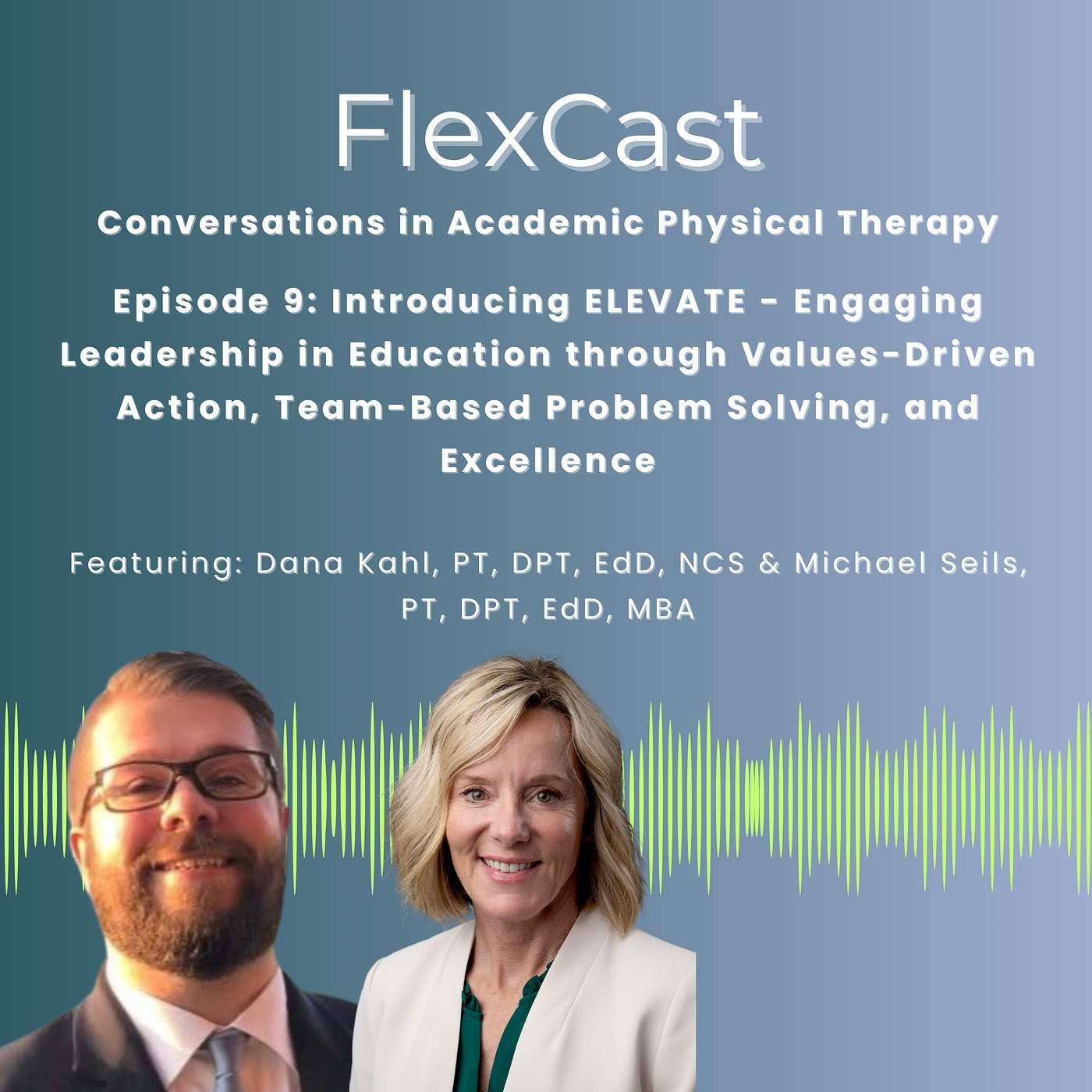
WEBVTT
00:00:00.400 --> 00:00:02.799
Welcome to another episode of FlexCast.
00:00:03.040 --> 00:00:13.039
Today we're talking about something that affects every physical therapy program, whether you're a faculty member, department chair, clinical educator, or administrator, leadership.
00:00:13.279 --> 00:00:15.519
But not leadership in the traditional sense.
00:00:15.759 --> 00:00:25.920
We're talking about the kind of leadership that helps teams navigate change, solve complex problems, improve programs, and ultimately strengthen physical therapy education.
00:00:26.239 --> 00:00:40.159
That's exactly why ACAP developed the engaging leadership in education through values-driven action, team-based problem solving, and excellence course, or Elevate, to solve real-life issues with a team of mentors.
00:00:40.399 --> 00:00:46.640
Today we're joined by the faculty who helped create this exciting new leadership experience, and we're so excited to talk to them.
00:00:46.880 --> 00:00:47.600
Welcome, Drs.
00:00:47.840 --> 00:00:49.920
Dana Cale and Michael Siles.
00:00:50.159 --> 00:00:51.039
Thank you.
00:00:51.520 --> 00:00:52.159
Thank you so much.
00:00:52.399 --> 00:00:53.119
Glad to be here.
00:00:53.439 --> 00:00:55.119
Oh, we're happy to have you here.
00:00:55.280 --> 00:00:59.200
So I want to start off with something fun to help the audience get to know you better.
00:00:59.439 --> 00:01:03.520
What was the best or worst leadership advice you've ever received?
00:01:03.840 --> 00:01:05.760
All right, I'm going to start with this one.
00:01:06.000 --> 00:01:10.239
I remember having a mentor say leaders lose the right to complain.
00:01:10.400 --> 00:01:12.719
And honestly, at first, I did not like that.
00:01:12.879 --> 00:01:18.879
I thought, wait, does that mean leaders have to pretend everything is fine or never challenge the status quo?
00:01:19.280 --> 00:01:21.519
But over time, I realized that's not what it meant at all.
00:01:21.680 --> 00:01:28.159
It meant that as a leader, you have a responsibility to move beyond identifying problems towards creating solutions.
00:01:28.319 --> 00:01:37.040
Leaders absolutely need to understand problems, probably more so than anybody else, but they also have a responsibility to be part of the solution.
00:01:37.200 --> 00:01:44.640
They ask better questions, bring together different perspectives, and help teams move from talking about problems to solving them.
00:01:44.799 --> 00:01:47.599
That's really the philosophy behind Elevate.
00:01:47.760 --> 00:01:55.200
A leader is anyone in the position that can look at the problem deeply, bring people together, and help move the conversation forward.
00:01:55.359 --> 00:01:59.040
That advice completely changed how I thought about leadership.
00:01:59.280 --> 00:02:06.799
And just to add on that, I think one of the most memorable uh pieces of advice was from my mentor, Christian Menti, when I was in a home healthcare leadership role.
00:02:06.879 --> 00:02:11.680
Um, as I overtook a rehab team, PTOT speech, social work, I was really trying to do everything.
00:02:11.759 --> 00:02:18.800
I was scheduling, looking at authorizations, intake, and he really mentioned to me that what I was doing was admirable, but not sustainable.
00:02:18.960 --> 00:02:21.199
I was really burning myself out and trying to do everything.
00:02:21.280 --> 00:02:25.280
And ultimately, he recommended I need to develop proxies in place.
00:02:25.360 --> 00:02:32.319
I needed to kind of set up the team leadership and really kind of understand what's going on, but then also be able to incorporate the entire team.
00:02:32.479 --> 00:02:41.120
And ultimately, I think of I want to be able to set up processes so that way thousands of decisions can be made down the road, and we need to have the right process and the team members in place to be successful.
00:02:41.520 --> 00:02:47.039
And what I love both about both of your stories is that it's not just okay, leadership is the person at the top.
00:02:47.199 --> 00:02:52.319
Leadership really involves everybody and it's about processes, it's about being able to work together.
00:02:52.479 --> 00:02:53.520
So I love that.
00:02:53.759 --> 00:02:57.520
So with that said, let's start with what this new programming is all about.
00:02:57.680 --> 00:03:02.240
Can you tell us more about who it's for and why it's so unique in this profession?
00:03:02.879 --> 00:03:03.520
Absolutely.
00:03:03.680 --> 00:03:13.599
Now, when I think of Elevate, I want you to think it's a team-based leadership problem-solving experience for physical therapy educators in any role and in any career stage.
00:03:13.759 --> 00:03:19.919
Ultimately, individuals who want to create meaningful change in their programs, you can tend as an individual or in a team.
00:03:20.159 --> 00:03:24.800
What makes it unique is that you're developing leadership skills while working on a real institutional challenge.
00:03:25.039 --> 00:03:33.280
So whether that's curriculum, accreditation preparedness, student success initiatives, et cetera, you're working on that strategically throughout the process.
00:03:33.439 --> 00:03:45.680
And what we use are tools such as the ACAP Leadership Compass, which is really a gold mine of information for leadership development, concepts from the ideal team player, and we use a creative problem-solving framework to really help identify that problem.
00:03:45.919 --> 00:04:00.800
Additionally, what's very unique is we're gonna leverage artificial intelligence, including retrieval augmented generation or RAG, which I'll talk about more, but really utilizing technology to help teams explore ideas, organize information, and make better data-informed decisions using trusted program-specific resources.
00:04:00.960 --> 00:04:10.240
So ultimately, individuals are gonna leave with a stronger sense of team, practice problem solving, and they'll have a better understanding of AI technologies and how to move their project forward.
00:04:10.479 --> 00:04:21.839
And I love that because a lot of what I see in teams breaking down in different associations and in different kind of like education um environments is the lack of communication and the lack of working together.
00:04:22.000 --> 00:04:25.040
So I love that you're able to couple all of these different things.
00:04:25.120 --> 00:04:30.879
And honestly, some of the um institution's biggest problems is not facing AI and data head on.
00:04:30.959 --> 00:04:33.519
So I'm glad that you're also able to incorporate that.
00:04:33.759 --> 00:04:44.079
Now, with that said, um, I know data and AI are definitely one of them, but if we looked back on the profession 10 years ago, how has leadership and physical therapy education changed?
00:04:44.240 --> 00:04:47.759
And how should leadership development evolve to match those realities?
00:04:48.000 --> 00:04:49.199
That's a great question.
00:04:49.360 --> 00:04:52.319
Um, I've been a physical therapist for more than 30 years.
00:04:52.399 --> 00:04:54.720
So I'm going to think back to my own career.
00:04:54.800 --> 00:05:01.199
Um, I started as a clinician, then moved into academia, and then eventually found myself in leadership roles.
00:05:01.279 --> 00:05:11.680
And along the way, I learned a lot about patient care and then about teaching and research, but really very little about leading teams or solving complex problems with others.
00:05:11.920 --> 00:05:26.399
We often assume that a strong clinician or a strong educator will naturally become strong leaders, but leadership requires a different skill set, building effective teams, navigating conflict, managing change, and finding solutions together.
00:05:26.639 --> 00:05:30.000
And leadership in academic programs is increasingly distributed.
00:05:30.079 --> 00:05:38.399
It's not about deans and program directors, it's course coordinators, committee chairs, clinical educators, assessment leaders, and then faculty at all levels.
00:05:38.639 --> 00:05:40.560
We all have the opportunity to lead.
00:05:40.639 --> 00:05:44.079
And much of that leadership happens through teamwork and problem solving.
00:05:44.319 --> 00:05:49.439
And just to add on that, kind of thinking, kind of moving forward, our challenges are more complex than ever.
00:05:49.600 --> 00:05:53.600
Healthcare, technology, accreditation standards are evolving quickly.
00:05:53.759 --> 00:05:55.839
Faculty are balancing more demands than ever.
00:05:56.000 --> 00:06:01.839
They may be involved in recruitment, marketing, um, in addition to supporting a student that is having challenges.
00:06:02.000 --> 00:06:04.399
So these aren't problems that one person can solve alone.
00:06:04.480 --> 00:06:09.279
That's why Elevate emphasizes teamwork, complex problem solving, and embracing technology.
00:06:09.439 --> 00:06:17.759
I recently worked with my research team on a J-O-P-T-E paper on using AI for accreditation, and we're going to bring some of those key concepts directly into Elevate.
00:06:17.920 --> 00:06:26.800
Participants will learn how to use AI to explore ideas, support problem solving, along with retrieval log generation, retrieval log meta generation to work with their program-specific information.
00:06:27.040 --> 00:06:37.439
The goal isn't to replace good leadership with technology, it's to give teams tools to think differently, make better decisions, and solve problems by using technology, which can ultimately make it more efficient.
00:06:37.680 --> 00:06:44.000
And Michael, that's such a great point because we need to remember that working with technology doesn't mean that it's replacing us.
00:06:44.160 --> 00:06:50.160
There always needs to be a human in the room and they will never take away kind of like that humanity of it, right?
00:06:50.240 --> 00:06:51.680
Especially with leadership.
00:06:51.839 --> 00:06:59.040
Now, I know we've already kind of delved into this quite a few times already in this conversation, but I'm going to bring it back so that we can dive a little deeper.
00:06:59.279 --> 00:07:02.560
Can we talk a little bit more about what makes Elevate unique?
00:07:02.879 --> 00:07:03.600
Absolutely.
00:07:03.839 --> 00:07:12.560
And prior to diving into that question, I do want to acknowledge the Academy of Education's Fellowship in Higher Educational Leadership, or the Fellowship.
00:07:12.800 --> 00:07:15.360
I completed the fellowship in 2019.
00:07:15.439 --> 00:07:20.560
It was called ELIBEN, and it literally changed the trajectory of my academic career.
00:07:20.800 --> 00:07:21.120
Dr.
00:07:21.199 --> 00:07:27.519
Teresa Brown, the fellowship program director, she's my core supervisor and she's also one of my closest mentors.
00:07:27.759 --> 00:07:36.560
It's an outstanding, comprehensive program that prepares current and aspiring program directors with the knowledge and skills needed to lead a PT program.
00:07:37.040 --> 00:07:38.800
But Elevate is different.
00:07:38.879 --> 00:07:46.319
It's designed for academic PT educators at any career stage with a focus on team-based problem solving wherever you are.
00:07:46.639 --> 00:07:59.600
You're going to bring a real institutional challenge and use the ACAP Leadership Compass and creative problem solving to elevate your leadership to help build high-performing teams and move towards that challenge towards action.
00:07:59.839 --> 00:08:01.120
Thank you for sharing that, Dana.
00:08:01.360 --> 00:08:04.720
And really, the fellowship is really an outstanding program.
00:08:04.959 --> 00:08:12.639
And ACAP is so proud to support that work through our grant, which helps expand access to this value, valuable leadership development program.
00:08:13.199 --> 00:08:14.879
So thank you for clarifying that.
00:08:15.120 --> 00:08:19.759
Now, one thing that stands out is that this isn't designed just for individuals, though.
00:08:19.839 --> 00:08:23.199
It's designed for faculty teams, which I've heard that over and over.
00:08:23.439 --> 00:08:25.920
So why did ACAP decide to go down this path?
00:08:26.160 --> 00:08:28.240
Yeah, I think it comes down to a simple reality.
00:08:28.480 --> 00:08:33.039
Very few meaningful changes in academia or anywhere happen because of one individual.
00:08:33.200 --> 00:08:35.519
They happen because teams work together effectively.
00:08:35.759 --> 00:08:40.080
I want you to think right now of how many committees you've served on over the past several years.
00:08:40.320 --> 00:08:41.440
You've had those experiences.
00:08:41.600 --> 00:08:45.279
You have great, wonderful ideas during a faculty retreat or a committee meeting.
00:08:45.440 --> 00:08:48.720
Everyone leaves energized, and six months later, nothing has happened.
00:08:48.879 --> 00:08:51.039
Or you're, oh my gosh, should we revisit that?
00:08:51.120 --> 00:08:52.720
And you're thinking about it a year later.
00:08:52.879 --> 00:08:54.080
The ideas weren't bad.
00:08:54.240 --> 00:08:58.879
Ultimately, the challenge was how do we go from ideas to implementation and strategic planning?
00:08:59.039 --> 00:09:00.960
And that's what we want you to really leave with this.
00:09:01.120 --> 00:09:03.440
It's coming with a systemic problem.
00:09:03.519 --> 00:09:08.480
And then you're going to be working on it strategically over a year and then presenting your progress and achieving and making success.
00:09:08.559 --> 00:09:12.000
So I we don't want it to be one of those courses where you leave with great ideas and then forget about it.
00:09:12.080 --> 00:09:13.759
It's going to be active and ongoing.
00:09:14.000 --> 00:09:21.519
Yeah, Mike, as a program director, I've been in plenty of retreats where we leave with a whiteboard board full of great ideas.
00:09:21.679 --> 00:09:24.080
The hard part is turning those ideas into action.
00:09:24.240 --> 00:09:26.639
And like you said, that's really where Elevate comes in.
00:09:26.799 --> 00:09:36.480
We help teams develop a common way of working, clarifying roles, making decisions, identifying roadblocks, and creating accountability so things actually move forward.
00:09:36.639 --> 00:09:39.600
We also emphasize that leadership happens at every level.
00:09:40.159 --> 00:09:46.720
Whether you're leading a committee, coordinating a course, or working on a strategic initiative, you have an opportunity to influence change.
00:09:46.879 --> 00:09:51.679
And once you bring different perspectives together with a structured process, you really get better decisions.
00:09:51.840 --> 00:09:58.960
Elevate is really about helping teams move from good ideas to meaningful action and really sustaining that momentum.
00:09:59.200 --> 00:10:04.080
So, Dane, I want to go back to a point that you just said, which is leadership happens at every level.
00:10:04.320 --> 00:10:12.240
So sometimes people hear the word leadership and immediately think, well, I'm not a chair or a dean, but Elevate is for so many different roles.
00:10:12.399 --> 00:10:14.159
So can you go into that a little bit further?
00:10:14.480 --> 00:10:14.960
Absolutely.
00:10:15.120 --> 00:10:20.240
Um, I think one of the biggest misconceptions about leadership is that you need a formal title to be a leader.
00:10:20.399 --> 00:10:27.279
Um, yes, I was a home health care leader of 25, 30 clinicians, but I'm not a chair or dean currently, but I lead every day.
00:10:27.440 --> 00:10:37.759
If you're leading a course, you're serving on a committee, you're mentoring a colleague or student, you're helping with a strategic initiative, you're already influencing your program, and that's leadership, and that can happen from any level.
00:10:37.919 --> 00:10:41.279
So one of the things we emphasize and elevate is leading from where you are.
00:10:41.440 --> 00:10:44.399
You don't have to wait for a formal leadership role to make an impact.
00:10:44.559 --> 00:10:47.200
Some of the best changes start with people on the front lines.
00:10:47.279 --> 00:10:50.639
They see an opportunity, they bring others together, and they move an idea forward.
00:10:50.799 --> 00:10:53.759
That's why this is really designed for educators at any career stage.
00:10:53.919 --> 00:10:59.279
Individuals that started started past year to maybe individuals with many, many years of experience.
00:10:59.519 --> 00:11:05.519
Ultimately, we want anybody to feel comfortable coming to this to this course and feeling that they can make an impact and make progress on their problem.
00:11:05.759 --> 00:11:12.320
I streate that because we need to start developing leaders even much earlier than they actually get the leadership role.
00:11:12.399 --> 00:11:16.879
Because by the time that they're in that leadership role, that is not the time to start developing them as leaders.
00:11:17.039 --> 00:11:24.000
This needs to be done way before, and then it really creates that wonderful succession plan and that pathway for leadership.
00:11:24.159 --> 00:11:25.519
So I love that.
00:11:25.759 --> 00:11:33.600
Um, elephants curriculum spends a lot of time talking about things like emotional intelligence, conflict, communication, and team dynamics.
00:11:33.759 --> 00:11:41.279
In fact, ACAPS Leadership Compass is woven throughout the course, covering areas, like you said, strategic planning, managing conflict, and much more.
00:11:41.679 --> 00:11:47.200
Can you go a little bit deeper into why those skills are so important, particularly for a leadership course?
00:11:47.600 --> 00:11:48.480
Absolutely.
00:11:48.639 --> 00:11:57.200
Um, we sometimes call those soft skills, but I'm actually challenged that term because, in my experience, they're some of the hardest skills to develop.
00:11:57.279 --> 00:11:58.720
They're not really soft at all.
00:11:58.799 --> 00:12:02.639
Um, and they're often the difference between success and failure, aren't they?
00:12:02.879 --> 00:12:05.840
Think about the challenges we face in PT education.
00:12:06.000 --> 00:12:15.360
We have difficult conversations about curricular changes, about accreditation, assessment, student success, faculty workload, limited resources.
00:12:15.600 --> 00:12:22.080
Those conversations involve people with different experiences, different priorities, and sometimes very different opinions.
00:12:22.399 --> 00:12:27.200
If a team doesn't have trust or psychological safety, people stop sharing ideas.
00:12:27.360 --> 00:12:29.120
The team really breaks down.
00:12:29.279 --> 00:12:33.759
They hold back concerns, or maybe only the loudest voices are heard.
00:12:33.919 --> 00:12:38.879
That's when teams can miss opportunities or make decisions without fully understanding the issues.
00:12:39.120 --> 00:12:44.240
And ultimately, when I think of think of the most successful teams you've ever worked on, or maybe some unsuccessful teams.
00:12:44.480 --> 00:12:49.440
The successful teams are the ones where we're we're comfortable having uncomfortable conversations.
00:12:49.600 --> 00:12:51.919
We can respectfully challenge each other's ideas.
00:12:52.080 --> 00:12:54.320
Healthy disagreement can lead to better ideas.
00:12:54.480 --> 00:12:57.600
We don't want individuals that are saying the exact same thing all over the time.
00:12:57.759 --> 00:13:01.279
We want to have different ideas and we want to work through those issues together.
00:13:01.360 --> 00:13:04.960
Um, and that's why we really thread the ACAP Leadership Compass so much into this.
00:13:05.120 --> 00:13:15.600
The leadership compass has recently been revised and it includes research articles, videos, webinars, courses, and there's going to be specific components on conflict management, change management, team dynamics.
00:13:15.840 --> 00:13:22.000
It's important that we cover all of those areas to give participants the chance to practice those skills while working on the real challenge.
00:13:22.159 --> 00:13:29.519
At the end of the day, the good problem solving comes down to trust, open communication, having different perspectives, and having a team committed to work to forward together.
00:13:29.600 --> 00:13:32.960
And the leadership compass gives us really a framework to help move that forward.
00:13:33.200 --> 00:13:43.919
I could probably talk about that all day because the the teams that I have seen that kind of fall apart are the ones that are conflict avoidant or that don't know or refuse to have difficult conversations.
00:13:44.080 --> 00:13:51.279
And because of that, there are so much more miscommunication that happens that a really great team can just dissolve because of that.
00:13:51.440 --> 00:13:52.399
So I love that.
00:13:52.559 --> 00:13:56.879
Um, and I love what you said because really you do have to get comfortable with being uncomfortable.
00:13:56.960 --> 00:13:59.840
And I think that's definitely a soft skill.
00:13:59.919 --> 00:14:00.720
That should be a hard skill.
00:14:00.799 --> 00:14:02.320
I'm gonna take what Dana said.
00:14:02.559 --> 00:14:08.240
So Elevate is also unique in its approach to an implementation of leadership of mentorship.
00:14:08.399 --> 00:14:09.759
Why is this so important?
00:14:11.120 --> 00:14:15.440
Well, leadership development doesn't end when the in-person program ends.
00:14:15.600 --> 00:14:22.320
Once we have the day together, um, it will continue throughout the whole year of the whole experience of Elevate.
00:14:22.559 --> 00:14:29.440
The mentorship is built into Elevate, both during that on-site time and then through mentor check-ins throughout the year.
00:14:29.759 --> 00:14:38.080
Mentors will provide accountability, coaching, and be a thought partner as teams navigate those challenges as they move their projects forward.
00:14:38.320 --> 00:14:46.240
Participants also learn from educators across the country, sharing perspectives and approaches to common challenges that we all have in PT education.
00:14:46.399 --> 00:14:56.159
You'll leave Elevate with a stronger team, greater confidence, meaningful progress on a real challenge, and a network of colleagues and mentors to support you for the whole year.
00:14:56.480 --> 00:15:06.240
And just to add on to that, in conjunction with the mentorship, you are gonna be in a room with individuals having challenges that are very similar throughout the course in person.
00:15:06.320 --> 00:15:09.919
You're gonna be sharing input and ideas and feedback to one another.
00:15:10.080 --> 00:15:12.240
You're not in this alone, you're in this together.
00:15:12.399 --> 00:15:18.000
So the mentorship as well as the colleagues in the course really are threaded throughout the entire experience.
00:15:18.159 --> 00:15:23.519
So that way your the culmination of it is gonna be presenting your major project and your in your process.
00:15:23.679 --> 00:15:27.840
And um, I think just the mentorship and the the collegiality between that is is important.
00:15:28.080 --> 00:15:38.240
That's so important because even as an executive director, I have my own community of other executive directors that are going through similar, you know, problems or similar growth issues and whatnot.
00:15:38.320 --> 00:15:53.679
And it really is so important to have a community of fellow leaders that are going through things that are similar because sometimes you can get siloed and thinking that your problems are only yours, but you'd be surprised how many other places are going through very similar issues and they can give you advice and help you grow.
00:15:53.840 --> 00:15:54.720
So I love that.
00:15:54.879 --> 00:16:03.919
And with that said, I did want to say that Elevate will have its own dedicated community in our flex communities where current participants and alumni can share advice and ideas.
00:16:04.080 --> 00:16:10.960
So for that, visit www.community.acapt.org to browse the flex community.
00:16:11.679 --> 00:16:18.159
So you already talked about this a little bit, but in Elevate, participants are working on something that matters to their own institution.
00:16:18.559 --> 00:16:23.440
To help our future participants, what kinds of projects do you hope teams bring to this course?
00:16:24.320 --> 00:16:32.960
Yeah, we really encourage teams or individuals to bring a real project that matters to their program, something that aligns with their mission, their vision, their goals, their strategic plan.
00:16:33.120 --> 00:16:34.080
That could be anything.
00:16:34.240 --> 00:16:43.519
That could that could be a curricular revamp, uh, maybe student success initiatives, accreditation and prep preparedness, faculty development, maybe specific outcomes.
00:16:43.600 --> 00:16:46.559
You're looking at PTGQ outcomes, you're looking at NPT outcomes.
00:16:46.720 --> 00:16:49.919
It could be a marketing initiative where you're looking for student enrollment.
00:16:50.080 --> 00:16:51.519
It could be something completely different.
00:16:51.679 --> 00:16:54.080
Ultimately, the project becomes a vehicle for learning.
00:16:54.240 --> 00:16:58.720
Teams are going to apply the leadership teamwork and problem-solving skills directly to something they're already working on.
00:16:58.879 --> 00:17:01.759
It's not just something extra, it's something that's important to them.
00:17:01.919 --> 00:17:04.400
That way they're kind of working on it throughout the process.
00:17:04.640 --> 00:17:12.480
I mean, there really is no better investment than investing in your teams and the ability for your teams to work on these, you know, problems and projects together.
00:17:12.559 --> 00:17:13.440
I love that.
00:17:13.759 --> 00:17:20.480
So, with that said, I'll ask both of you when participants finish Elevate next year, what do you hope they'll say about the experience?
00:17:20.720 --> 00:17:27.039
Yeah, I think ultimately it's very common that somebody leaves a course with great ideas and struggles to turn into action.
00:17:27.200 --> 00:17:30.160
I hope the first thing they say is, we actually did it.
00:17:30.400 --> 00:17:34.480
We didn't just talk about our project, we made meaningful changes in progress.
00:17:34.640 --> 00:17:36.799
I want Elevate to feel different.
00:17:37.039 --> 00:17:44.160
Participants should feel that they leave with the framework to not only solve this specific problem, but they can apply these concepts to all of their future problems.
00:17:44.319 --> 00:17:47.599
They have tools, they have resources, and a plan they can actually use.
00:17:47.759 --> 00:17:53.599
My hope is that they can finish the experience thinking, hey, not only did I learn something, I made progress, I have a process of use moving forward.
00:17:53.680 --> 00:17:55.599
And honestly, I wish I took this earlier.
00:17:55.680 --> 00:17:57.039
I'd recommend this to my colleagues.
00:17:57.279 --> 00:17:58.079
I love that, Mike.
00:17:58.160 --> 00:18:06.400
And I also hope that they discover that leadership isn't about knowing all the answers or having the loudest voice or the highest title.
00:18:06.559 --> 00:18:11.359
It's really about bringing together different ways of thinking to make excellent decisions.
00:18:11.599 --> 00:18:15.279
And finally, I hope they leave equipped with a ton of resources.
00:18:15.519 --> 00:18:17.200
We are all lifelong learners.
00:18:17.279 --> 00:18:27.440
And throughout the program, we're going to introduce them to outstanding books, frameworks, and resources that are in the leadership compass that they can continue exploring with their teams and individually.
00:18:27.680 --> 00:18:30.559
My hope is that Elevate isn't the end of their leadership journey.
00:18:30.640 --> 00:18:36.240
It's just the beginning of a new way of thinking about leadership, teamwork, and solving complex problems.
00:18:36.480 --> 00:18:39.680
Michael, Dana, it's been such a pleasure having you.
00:18:39.839 --> 00:18:44.000
I mean, you can just feel the passion from the screen.
00:18:44.319 --> 00:18:49.359
I am so excited about this course and I love all of the things that you've said in this podcast.
00:18:49.440 --> 00:18:50.559
So thank you.
00:18:50.880 --> 00:19:00.400
So, in closing, Elevate helps participants become stronger collaborators, communicators, problem solvers, and teammates who can lead meaningful change together.
00:19:00.640 --> 00:19:07.119
Because stronger leaders create stronger programs and ultimately better outcomes for students and for the profession as a whole.
00:19:07.359 --> 00:19:11.920
So, again, thank you so much for joining us today and for sharing the vision behind Elevate.
00:19:12.160 --> 00:19:13.359
Thank you so much for having us.
00:19:13.440 --> 00:19:15.519
It was an absolute pleasure and really looking forward to it.
00:19:15.759 --> 00:19:17.200
Such a pleasure chatting with you.
00:19:17.359 --> 00:19:18.480
Thank you so much.
00:19:18.799 --> 00:19:19.359
Of course.
00:19:19.519 --> 00:19:25.359
And if you like to learn more about Elevate, visit the ACAP website for program details and registration information.
00:19:25.599 --> 00:19:28.319
Until next time, thanks for listening to the FlexCast.
