

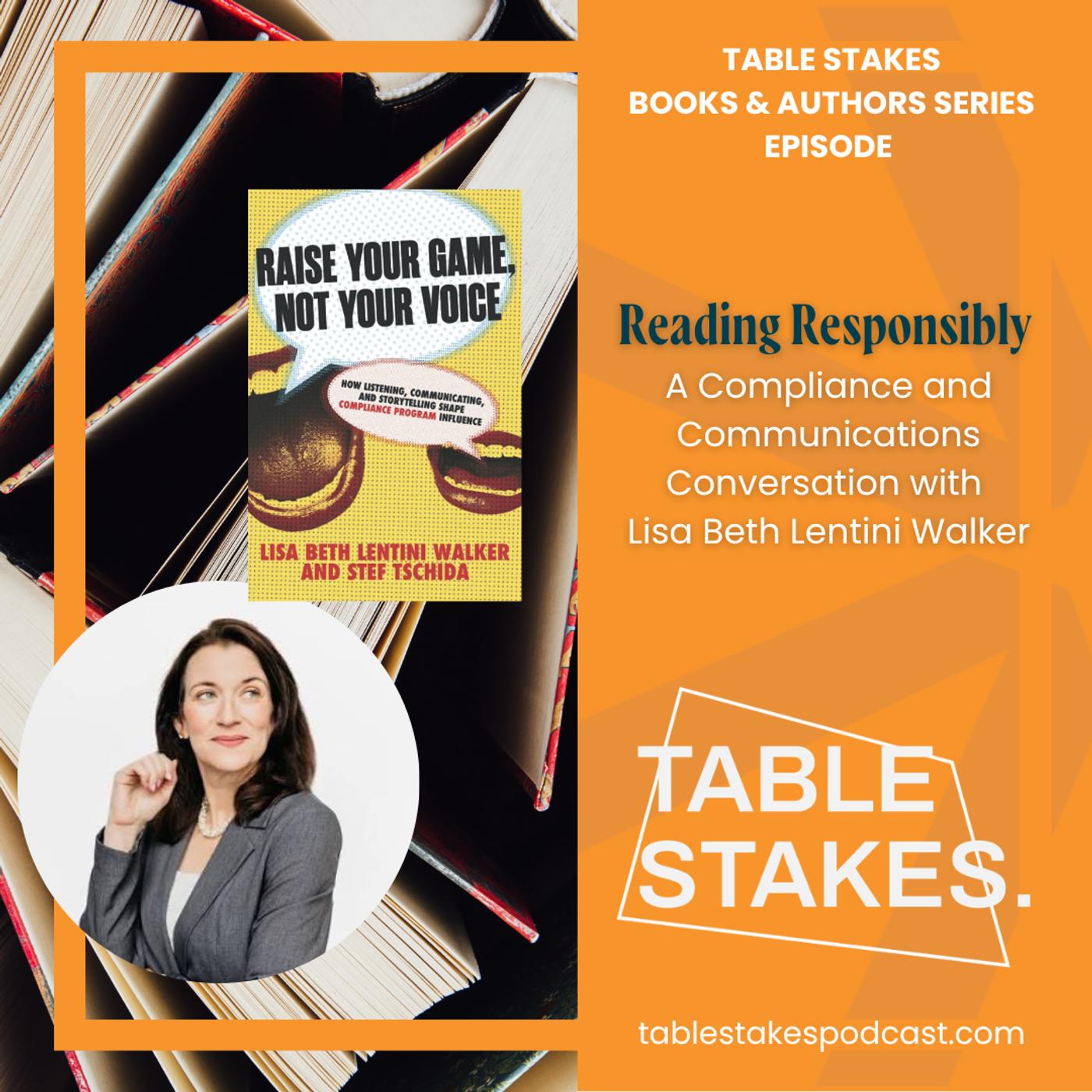
Marcy Twete: My guest today is one of my favorite people to think out loud with. Lisa Beth Lentini Walker is the CEO and founder of Lumen Worldwide Endeavors, a compliance leader whose career runs all the way from the SEC to the C-suite. And she's the co-author of Raise Your Game, Not Your Voice. She's also the first person we've had back on Table Stakes as a guest. So you know it's going to be a great discussion where we hit the ground running. Here's my conversation with Lisa Beth. Welcome to Table Stakes. Hi, Lisa Beth. I'm so excited to have you back on the podcast.
Lisa Beth Lentini Walker: I am so excited to be here, Marcy. This is just one of those delightful moments that we get to share together. And ⁓ I'm so impressed with everything you've been doing and with the podcast that I am delighted to be back.
Marcy Twete: ⁓ so glad. And you're the first person that we have on this author series that's also been on this podcast before. So it's fun to like revisit with people who have ⁓ who have been with us before. I think the last time you were here, you were here with Steph, who was your co-writer on this book. and that was so great. And I I I know she's kind of moved on to different things, but ⁓ excited to have you here. But You know, I by way of introduction, I kind of want to start with your thread of leadership because ⁓ the book is so fantastic. Raise your game, not your voice, love it. But you've had this very fun career path. Began at the SEC, corporate finance and enforcement. You are also a certified health and wellness coach. ⁓ you have this wonderful business Lumen. You also are an assistant or associate general counsel in internally at a company. So I'd love to hear you just kind of talk for our listeners about your career path and the kind of thread from the SEC to your leadership today. you know, it's all been grounded in ethics and and compliance and would love to just hear you kind of riff on on your career path for people who maybe don't know you.
Lisa Beth Lentini Walker: Yeah, you know, my career path has always been one where I wanted to work at a job where I could always look myself in the mirror and think, you know, I've done something today that is making a difference. And I've done something today that I'm proud of. And as long as those two things were true, I felt like I was on the right path for what made me filled with joy and able to live my life in the way that I wanted to live my life.
Marcy Twete: Mm-hmm.
Lisa Beth Lentini Walker: So ⁓ it started with ⁓ going to the SEC. I had gotten a law degree and an MBA, and I wanted to know more about the law than the business people and more about business than the lawyers. And ⁓ I I decided to go to the SEC because I thought it was a great place to learn about how capital markets function and what is prized and rewarded, and how we tell stories about the trajectories of companies. And so I decided to go to the SEC. And at the time, so many people were like, what are you doing? What are you thinking? You could be making buku bucks in the consulting firms. And mind you, this was at the time, like right literally right before Enron hit and WorldCom. And everything changed. And so like now it looks prescient. But at the time,
Marcy Twete: Mm-hmm.
Lisa Beth Lentini Walker: ⁓ I was taking this job that wasn't highly compensated, but I felt good about what I was doing and I felt like I was making a difference. And so from there, ⁓ my career just went in different directions in terms of like I wanted to see what it would be like in-house with a public company. Then I decided I wanted to see what it would be like in a private company that was having significant regulatory issues. Then I said, let's try something a little more highly regulated.
Marcy Twete: Mm-hmm.
Lisa Beth Lentini Walker: And everywhere along the way, my goal has always been to build people on my teams who would do great things in the world and to also build structures that let stand the test of time. Even when times change radically, I wanted to leave behind a legacy of development and also of change making. So I feel like I've gotten to do that. And I got the
Marcy Twete: Mm.
Lisa Beth Lentini Walker: certification, the National Board ⁓ Health and Wellness Certification, because I saw trauma amongst compliance practitioners and amongst lawyers. So lawyers in general have very, very high rates of depression, anxiety, addiction, etc. And so I said, how can I know more so that I can help people around me and help myself before I get to a point of crisis?
Marcy Twete: Mm.
Lisa Beth Lentini Walker: And so the the red the thread that goes through all of this is am I living my life in a way that I think brings light and joy to others? And can I feel good about the change that I'm making? And I think that's where honestly a lot of the work that you and the listeners of the podcast do have in common, right? You all are making change that positively impact other people and society. And you have to be able to look at yourself in the mirror each day saying, I did something that is making the world a better place.
Marcy Twete: That's awesome. Have I'm curious, have you seen the movie Equity?
Lisa Beth Lentini Walker: I haven't.
Marcy Twete: It c you you should watch this. It came out, I wanna say 10 years ago. and it's ⁓ Anna Gunn and Alicia Reiner, the two actresses, and one of them is they were law school ⁓ students together, and now they're in these big and one of them works for the SEC and one of them works in a big corporation. It's kind of the like tension between the two of them. ⁓ but I'm picturing you as like. The SEC investigator of this movie, which is so, so fun. Highly recommend. ⁓ it's one of my like consistent plain movies. I always have it on my ⁓ iPad. So yes, it's great. It's great. ⁓ it'll be close to home for you. so for listeners who didn't catch the first conversation, let's kind of give a primer on the book. So the title is Raise Your Game, Not Your Voice.
Lisa Beth Lentini Walker: Is definitely going on my list.
Marcy Twete: Tell us what that means and kind of the problem that you and Steph were trying to come at when you were writing the book.
Lisa Beth Lentini Walker: So we decided to write this book because we thought we had found something that was unique, which is at the end of the day, communications and compliance professionals and lawyers don't always see eye to eye, right? We are coming at things from very different vantage points. And
Marcy Twete: Mm-hmm.
Lisa Beth Lentini Walker: The beauty that Steph and I found together was that if we could leverage the strengths of each other and really listen deeply to understand, we came up with a much superior messaging strategy and approach to working with humans because we're all working with humans, right? Humans are messy. I say that I have a job because people keep peopling. you know, the reality is. We are all in this world together and we all need to learn how to work together really well and listen really well. So Raise Your Game was what we learned together about how to get messages across to the messy humans that we all are in this planet with. and it really focused on active listening, storytelling, getting to like the root causes and the base of those
Marcy Twete: Mm.
Lisa Beth Lentini Walker: statements and needs that people are articulating so that you can build influence, so that you can have enhanced credibility, so that your program, which we all know is good and grounded on great ideas and things like that, can move forward because it's not the loudest voice in the room ⁓ that really has all the interesting things to say. It's making sure that you can do what you're set out, what you're setting out to do. ⁓ and that is in most cases, you know, something that is values-based and aligned to where an organization either wants to go or is heading or or imagines itself to be heading. it's all about that change making and finding ways to get through the messy middles.
Marcy Twete: Yeah. And the argument underneath it all, and I'm probably oversimplifying, right, is that compliance fails not because the rules are wrong, but because no one communicates them in the right way. ⁓ and it's interesting to me. I was I was talking to someone yesterday about sort of ethics and morals inside an organization. And the example I used, and it's not mine, it's actually have you ever seen all these ⁓ Second City in Chicago has like a compliance. ⁓ arm. Have you have you ever worked with them? They're so funny, right? And one of one of their really funny videos is a guy trying to buy a dirt bike for a customer, right? Like for a customer's kid. Like, I'm just gonna buy this guy's kid a dirt bike, right? And I was talking to somebody about it yesterday and was like, the joke is that you're gonna buy a dirt bike to close the deal, but the dirt bike isn't the first thing. It's the 15th thing, right? Like first there's a bottle of wine, and first there's a
Lisa Beth Lentini Walker: Yes. I love them.
Marcy Twete: There's this kind of thing that crosses the line, right? And so again, it's like you're
Lisa Beth Lentini Walker: there's this kind of thing that gets close to the line, right? Like it's Beyonce tickets, but you're there. So it's not really like a gift because you were there.
Marcy Twete: Okay. Right. So how important, you know, is that is is it really the storytelling and the listening to and really the communicating to let people know there's rules and audits and all of this for the reason? Is that why that sort of partnership really works?
Lisa Beth Lentini Walker: Yeah, I think ⁓ historically people thought that if there was a rule that you just tell people what the rule is and they'd follow it. But that is not how human beings work, right? Everybody can know that you shouldn't, you know, do something that's terrible for your body, whether that's like taking drugs or, you know, take your poison. ⁓ that doesn't stop people from doing it though. There's a reason why people are.
Marcy Twete: Mm-hmm. Yeah. Yeah.
Lisa Beth Lentini Walker: you know, addicted to things and people make choices that maybe aren't the greatest. ⁓ and and and there's a whole, you know, mind science behind all of it. ⁓ but for a very long time, compliance took the approach that if you tell people the rules, they'll follow them. If you tell people, you know, what to do, because people love to be told what to do. Everybody says, you know, just tell me what to do and I'll do it. ⁓ said no one ever. ⁓ But ⁓ you know, there was this concept that if you just, you know, explained what it was, everybody would be rational about it and just fall in line. And that's not the reality. The reality is we can tell people, you know, what the what the rules are, but there's so many permutations of how this can be, you know, perverted and and and and everything else that you really need to create a consistent drum beat and connect with people on an emotional level with the why.
Marcy Twete: Yeah.
Lisa Beth Lentini Walker: It's not enough that you say do this. It's creating something that really resonates in that storytelling with them so that they'll know what to do because there's a deeper why behind it and they are connected with that deeper why. Most people don't want to be quote unquote bad, right? They they want to do things that that are good.
Marcy Twete: Right.
Lisa Beth Lentini Walker: ⁓ there's always a small segment of the population that is, you know, kind of on that psychopathic ⁓ you know, strain, but the but it's not the majority. Thank goodness, at least not yet. so like the reality is when you tell people what to do, there are certain segments of the population that'll say, nope, I'm not gonna do that because you just told me what to do, and I'm not gonna let you tell me what to do. There's other segments that will misinterpret it. And then there are other people who are very, very good intentioned. but just are poor executors on whatever you've asked them to do and they don't think beyond the black and white of what you've given them, which is not sufficient in a very gray world. So it's really kind of teaching people how to implement values rather than just putting them up on a wall and saying what they are, which is frankly never sufficient.
Marcy Twete: Is right. It's, you know, it's interesting. I my husband worked for years at Walgreens, and I use them as an example a lot because I I I think they had both an incredibly strong CEO in Greg Wasson for many years. And they also had there was a time at Walgreens where every single team member got a magnet of their they actually didn't call them values, and now I can't remember the name they used for it, but they're like. Core, I think it core four kind of things that was in everything. And they started every single meeting by talking about the core four values. And it was to the point where people joked about it and it got boring, but it was so ingrained in who they are. And I've heard that too. There was years and years 50 years ago, Johnson and Johnson had the same thing and then let it go at some point. And what happens, right? Like what happens after that? That cultural drumbeat of we start every meeting with this. We remind you of this at every all hands. We talk about how the values work internally. We examine, like I always think, you know, I worked for a long time in in manufacturing and there's this thing in health and safety called a near miss, right? I've always wished that we had near misses in our space that we like, because in health and safety, they actually like put them up on the wall and go, here's what happened that was a near miss and here's how we're gonna solve for it. Like
Lisa Beth Lentini Walker: Yeah.
Marcy Twete: Here's the thing where so-and-so accident maybe almost bought Beyonce tickets, right? Like whatever that was. Like it would be interesting to look at.
Lisa Beth Lentini Walker: Yeah. A lot of places do do things like that in the compliance and ethics space. Like we were asked for gold bars to be presents for, you know, Chinese New Year. And we decided maybe that wasn't a great idea because, but like these are examples that come up and a lot of times in more evolved, you know, compliance and ethics programs, you will see those near misses. They don't really call them near misses usually, but there's like, you know.
Marcy Twete: Mm-hmm.
Lisa Beth Lentini Walker: ⁓ you know, ethical moments or values in action, like those are the kind of the pseudonyms for those near misses. ⁓ but they're they're fascinating.
Marcy Twete: We had one we had one once, I won't say ⁓ say where who ⁓ where a manager tried to buy ⁓ branded hunting knives for all their customers. And we were like and actually they it was a good well, it was actually a good example of the system working because the person who caught it was the person ⁓ who saw the expense report. And because it never got a marketing didn't get asked, right?
Lisa Beth Lentini Walker: Interesting choices.
Marcy Twete: Compliance certainly didn't get asked. ESG certainly didn't get asked. And the expense report, I remember the guy walking down and I my office was across the way from the compliance person. And they talked to both of us at the same time. We're like, Do you know that this guy bought knives? Like, what do we do? And it's like, Okay, this is working. We'll stop this, right? But same cut gold bars. I love that too.
Lisa Beth Lentini Walker: Yeah, I mean, and honestly, like expense professionals oftentimes are the people that are overlooked in terms of training, but they're the ones that see a lot of things that are happening. And that's why you have to have like a whole company system to communicate. But this what what goes deeper than this is. those values and how they form the bedrock of everything that a company is doing. And there's a lot of overlap there on the ESG space as well, because ESG is typically driven by deep seated values. And that's another manifestation of those values.
Marcy Twete: Yeah, absolutely. So it's been a few years since the book came out. ⁓ I'm curious, do you hear from compliance professionals? What do they tell you that the book got right? Are there things that you would write differently today? Obviously, we are in a weird world in this moment ⁓ of of ethics in our larger world right now that's really gray and kind of yucky. So what do you hear today from people when they read the book now, or what do you wish you had written differently?
Lisa Beth Lentini Walker: You know what? I love the book so much. Steph and I worked on it for such a long time, it felt like, although it was only really 18 months. but I feel like the book got a lot of things right. And I feel like the world has changed a little bit. So I think we've
Marcy Twete: Yeah.
Lisa Beth Lentini Walker: Could definitely update it right now for some of the means by which people are gathering information, particularly the strong impact of social media. But also like AI is coming on strong and it is the Wild West in many, many respects. So there I think is going to be a lot of work ahead around how values manifest in an AI-driven world.
Marcy Twete: Mm. Mm-hmm. Well, you could write a whole new book about AI ethics and communication just on its own, ⁓ because that it it's hitting everybody, right?
Lisa Beth Lentini Walker: Yeah, and it's it's it's all over the place. It's in how you show up to work, it's in how organizations are staffing, it's in the energy use around it. There's just so much. And I think we are at a period of time where there is going to be massive transformation over the next couple of years. ⁓ And whether that turns out to be for the good or not is going to largely hinge on how we continue to keep values in focus and how we continue to live out you know, the corporate world and also our personal lives.
Marcy Twete: Yes. Yeah. I had ⁓ Trista Harris on the podcast recently who wrote the book Future Good. ⁓ she's a sort of futurist in the community and and ⁓ nonprofit space. And you know, everybody's kind of doom and gloom about AI. And she said, if we do this right, we could be five years from Utopia. And I was like, I love you. Please, please let's go that path instead of the the others. Yeah.
Lisa Beth Lentini Walker: I think I think we I think we have to be optimistic about it. I mean, ⁓ although I also am an eternal optimist. So I'm I'm the person who would see a field of manure and I'd be like, there's gotta be a pony here. so where's my pony?
Marcy Twete: I love that about you.
Lisa Beth Lentini Walker: ⁓ but you know, I think that there is so much promise alongside the peril. You have to be aware that the peril exists to be mindful about it. But I will tell you, there is so much promise. And I think that there will be much more access in ways that are meaningful for lots of different people in the future. ⁓ so I think it'll be fantastic to see how it all turns out. But it requires each of us to continue to show up and do things that make the world a better place and have positive impact. So that's why we're here.
Marcy Twete: Yeah. We hope. We hope. So I want to talk to you about language because I've always been so mad that you guys on your side of the house get to pick the ethics word. You get to be ethics and compliance, and we have to be this like very annoying thing called ESG or sustainability or corporate responsibility. And I've always felt like ethics is the better word. And I wish that we got to own it. Right. So I'm interested in your take on. On language and kind of how how you speak about not just the field of ethics and compliance, but when you're talking to leaders about running values-driven companies that are inherently good and not bad, right? Do they understand ethics? Like, does that word really ring true still? Because I feel like that's when you're sitting in front of a CEO, if you say, you know, how how do you think you're doing in terms of corporate responsibility? They might not answer, but it's like, do you run an ethical company? Do you run a a company that is moral and makes good choices? Then maybe they get it, but tell me if I'm wrong on that. If I'm like, can ethics just be the word that solves it all for us?
Lisa Beth Lentini Walker: I think I think that there's been a lot of pushback against ethics because it is so tied into morality. ⁓ and and and frankly, some like religious structures. And so what I hear a lot more is values-driven decision making as opposed to ethics, because ethics is broader than just what the law permits. And there's been a decoupling in some places from compliance and ethics, because ethics is focused more on values.
Marcy Twete: Hm.
Lisa Beth Lentini Walker: Compliance is focused more on what's the bare minimum that you need to meet. ⁓ so I, you know, it has been a very frothy couple of years, is what I would call it. ⁓ and I don't think ethics answers everything because there's been pushback even in ethics. A lot of programs are changing their names to, you know, instead of having a code of ethics, it's a code of conduct. Integrity.
Marcy Twete: Mm-hmm. Integrity is out there, right? Integrity is a big move. Yeah.
Lisa Beth Lentini Walker: I think that one's going to become a lightning rod at some point in time too, because it's so tied to that morality element. so I, you know, like I said, it has been a very frothy time. I do not think that ethics solves it. I also think that ESG has gotten such a a loaded rap. and there's no perfect language yet. But I'm I think that if we work together really hard, we might come up with something pretty good.
Marcy Twete: Hmm. ⁓ yeah. I know, right? And it's it's interesting because I've I I have long thought I often just use sustainability because I think it's the bigger catch all on our side of the house, right? But similar to compliance, like what a low bar to sustain. What a low bar to comply, right? Just to do exactly what you legally are required to do or exactly what you needed to do in order to keep living, right? Like if you as a human are sustaining, you're in kind of a
Lisa Beth Lentini Walker: Right.
Marcy Twete: crappy position, right? And so it's like, how do we get a higher bar here? Like
Lisa Beth Lentini Walker: It's it does remind me a little bit of ⁓ you know, advanced studies in navel gazing. ⁓ you know, it just it is it is not exactly what you want to put on the top of the resume ⁓ to just sustain at the end of the day.
Marcy Twete: Okay. Right, how you doing? I'm sustaining, I'm complying, you know. It's a little Yeah. Mm hmm. Yeah.
Lisa Beth Lentini Walker: Right. Exactly. It's not it's not uplifting. It's not aspirational. ⁓ it may be realistic, but it's not where we'd like to see things go over the long term to like really have the world that we would like to see.
Marcy Twete: Yeah. Well, it's funny. I also, my ⁓ he's now nine, but last year my eight-year-old nephew got an award in school for responsibility. And my mother-in-law was really annoyed about it. Like she was like, responsibility? Like, don't you think he has towering strengths outside of being responsible? And I was like, Okay, first of all, he's eight and they needed to give everybody an award, right? Like second of all, I work every day to make people more responsible. So maybe it's good. But it is, it's like we have all these, you know. It's not as flashy as as some of the marketing people get to be.
Lisa Beth Lentini Walker: And it never will be, but you know what? ⁓ it is something that makes a profound difference. And there is virtue in that, and there is virtue in being that sound, you know, navigator of the world and helping an organization that works very hard to put out marketing and to do all these things be able to live its best life and have positive impact on others. So
Marcy Twete: So when you think about, you know, you've been on both sides, enforcement and building programs from the inside. So there's moral language and risk language, right? Would you rather have an employee or a leader say, is this the right thing to do, or is this within the rules? Or both, right? What where do you hope the rubber actually meets the road on the difference between morality or responsibility and like true risk?
Lisa Beth Lentini Walker: Yeah, so I will say risk tolerance can vary dramatically from leader to leader, even within the same company. Right. I always want them to ask, is this legal? Like let's put that as the minimum bare floor. but I also want to them to ask the question, is it right for the organization and is it right for me as a leader? So I think that there's like a multi-pronged set of questions.
Marcy Twete: Yeah. Mm-hmm. Mm-hmm.
Lisa Beth Lentini Walker: and like leaders need to ultimately know how they align within the organization. And the organization has its own structures to drive risk-based decision making. I'm never gonna be a person who says we should eliminate risk. No, that's not that's that's that's wild. Like you you need risk to be functional, right? We take risks every day. I step into the bathroom and every morning. It's the scariest part of the day because that's where most accidents happen in homes. ⁓ but but
Marcy Twete: Right.
Lisa Beth Lentini Walker: Right. We are making risk decisions every moment that we continue to exist. So just like us, organizations need to take risks. And that's part of, you know, the entire process. You also want to be mindful that there are risks that are existential and those should be considered very, very carefully.
Marcy Twete: Yeah. Mm-hmm. Mm-hmm. That's interesting. I love thinking about that. And I don't hear a lot of corporations say what is the existential risk here? And I think we've pushed on the ESG side, we've pushed risk to do climate risk, to do social risk, but it is this like internalities and externalities. And then what is the existential risk? Like, what are you risking in terms of the entire your first of all entire organization and then go up a level?
Lisa Beth Lentini Walker: Slack correction time.
Marcy Twete: society, community, all of that kind of stuff as well.
Lisa Beth Lentini Walker: Right. But but you're also looking at it from society within the country that you're in, potentially, or the community that you're in, as well as global. Like, you know, there's layer upon layer upon layer of considerations in there for those risks. And, you know, is it something that really is a make it or break it for this company at this particular time or for this society at this particular time?
Marcy Twete: Yeah, absolutely. I'm interested. ⁓ do you feel like so we've had this, I think for many years, this, you know, constant kind of I want to work an ESG ⁓ thing that comes from young people coming out of this this work. And, you know, I think there's been a lot of coverage in the world about, you know, number of people going to law school versus number of jobs and all of that. Do you feel like people are, you know, how are people drawn to the compliance profession? I'm curious, sort of, what you think the future is for these roles inside of corporations. I think, you know, we just saw this last week, ⁓ everybody's up in arms because Starbucks announced that they were eliminating their chief sustainability officer role, which you could say is the sky is falling. I actually think it's because they've gotten a lot of it right and they've put the things that the CSO used to do in the right places. And they don't necessarily need that leader anymore. And, you know, we there's a lot of that. But I'm I'm curious sort of what the future of like compliance teams inside organizations. Has that changed in recent years?
Lisa Beth Lentini Walker: I I think it's in the process of changing, to be honest with you. And I think I think actually even for lawyers just in general, the role of lawyers and how lawyers are used is going to be changing dramatically. A lot of things like contract reviews or, you know, compliance with, you know, third party ⁓ you know, disclosures and things like that, a lot of that ha is going to be and is being automated.
Marcy Twete: Mm.
Lisa Beth Lentini Walker: That doesn't mean that there isn't a need for the types of jobs that do like the checks and the on-site audits and everything, but the nature of the work is shifting. And that shouldn't be scary. It should be exciting for a whole host of reasons. We can crunch larger sets of data, we can understand more at our fingertips, and there's going to be a need. For different types of accountability and different types of jobs than we have seen historically. So where you used to have a lot of analysts doing different things very manually, you're probably going to leverage technology a little bit differently. And you're going to need to have people actually moving and traveling and meeting in person and doing different things in ways that we haven't seen historically. So again, this is It is a time that I would consider to be very frothy. It is a time where I think responsibilities are going to be shifted around. And at the end of the day, you know, in my consulting practice, I like to say I'm a little bit like Mary Poppins. When you need me, I'm there. And when you don't, I make myself go away. Because our job isn't to create permanent dependency. Our job is to educate, enable, and create better outcomes. Right. It would be wonderful to be in a world someday where everything, compliance and ethics and ESG, was so ingrained that we didn't have to call it something different. We're not there yet. And I think it'll probably be, you know, decades until we do get there. But the goal isn't to keep it a separate function. Silos don't work long term. They're great when you're standing something up. They're great when you need to start developing a real muscle, but the goal is to get everybody muscly, right? Like it's like it's like having a gym and having people come and learn how to use their bodies. Like at the end of the day, you want people to be able to use their bodies all the time. So they don't necessarily even need a gym because they're running outside and doing all these different things.
Marcy Twete: Yeah. Yeah. And I think it's the, you know, I had this conversation with Trista as well, is like, where are the pieces that when AI picks up some of this that we can human the hell out of things? Like where do the where is the human touch so awesome and helpful? And I think that's where we can where superpower will come in for people who are in these fields of, you know, the data we can handle, the number crunching AI can do, and that's fine, but where's the human? That is still needs to be there and we have to touch it in that way.
Lisa Beth Lentini Walker: And and that's where I think the the future holds a lot of promise. Like AI is really great at data and it's really great at certain things. It is terrible at nuance, it is terrible at discernment, it is terrible. I mean, it is it's trained to try to please you. ⁓ and so like it doesn't actually do the same connectedness and emotional, you know, outreach that. humans do. And so I think the next 10 years is going to be about really showing our humanity and making the human in the system integral to outcomes.
Marcy Twete: Yeah, absolutely. So wrapping up, what I always ask everybody is besides your own, what are your must reads? What have you loved in terms of books in business or for you ethics and compliance? What should everybody in this space have on their shelf?
Lisa Beth Lentini Walker: So ⁓ there are so many wonderful books ⁓ in compliance and ethics. It would be hard for me to mention all of them. One of my dear friends, Mary Shirley, is always a good read. She has a couple of books out. ⁓ She also has done a lot in women's leadership within compliance and ethics, which I am a huge fan of. ⁓
Marcy Twete: Okay.
Lisa Beth Lentini Walker: I would also say that I am spending a lot of time just doing right now, ⁓ really embracing the technology. And I have been using my own personal instance of Claude to redesign my house, come up with menus. I've done, you know, created a skill that's a personal trainer. So right now I am getting my hands dirty and everything to understand because I have to be able to understand in order to be able to enable what I think is coming next. So I've been doing a lot of pleasure reading. ⁓ my gosh, it's so good. I can send you my skills that I put in there. It's fantastic. And I also so I also did something I have a a child that has
Marcy Twete: I love Claude as your personal trainer. I need that. ⁓ please do
Lisa Beth Lentini Walker: ⁓ a lot of allergies. And so I put all the allergies and all the ingredients that we can use. And then my favorite chef and it came up with five. And I said, I have ⁓ one pound of ⁓ turkey meat, what's for dinner? And it came up with five recipes that were all great, that had the right palate kind of like flavors that I like. It was amazing.
Marcy Twete: I love it. ⁓ so fun. That's the perfect use for Claude. I always call him my boyfriend Claude. ⁓ like he's so fantastic. ⁓ yeah, it's great. Well, Lisa Beth, this has been fantastic. Thank you so much for coming on the podcast. I know our listeners are gonna get so much out of this, and hopefully we'll pick up your book if they haven't already. ⁓ and and continue to read and learn more about the ethics and compliance space. So thank you so much for joining us.
Lisa Beth Lentini Walker: Thank you for having me.
