

00:00:00:00 - 00:00:39:08
Unknown
Welcome to Aztec Caste, sponsored by the Arizona Technology Council with your hosts, Steve Zylstra and Eric Miller. Aztec Cast is dedicated to covering innovation and technology in Arizona and beyond. Aztec Cast invites leading experts to have real conversations about what is happening in the tech sector across the state of Arizona, from innovative startups to regional news companies and emerging technologies.
00:00:39:09 - 00:00:53:02
Unknown
Aztec Cast covers the critical issues and economic trends propelling the state's growing tech ecosystem.
00:00:53:02 - 00:01:21:01
Unknown
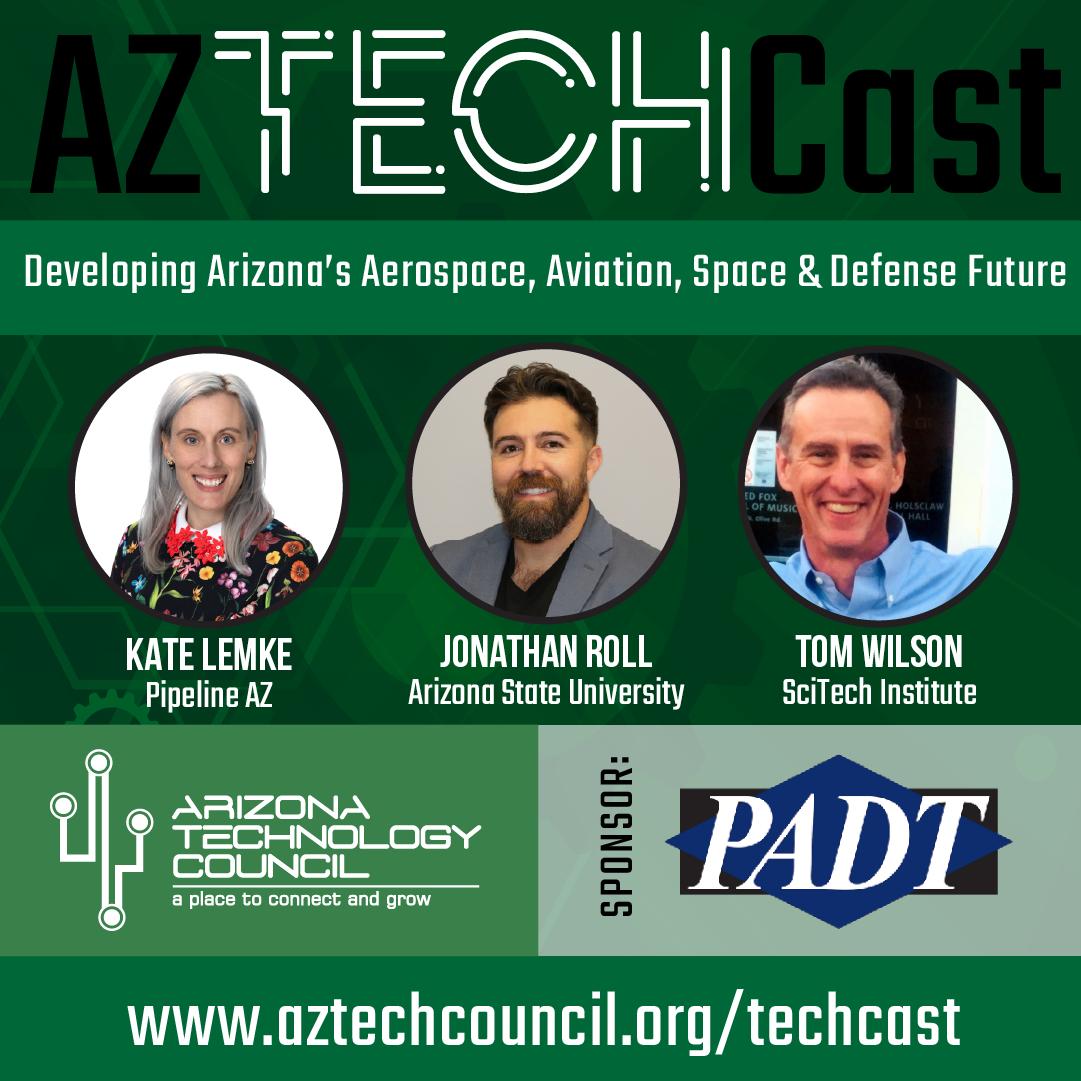
Welcome to Arizona Technology Council's Aztec cast. I'm Erik Miller, principal and co-founder of. And today I'm joined by my co-host, council president and CEO Steve Zylstra. Aztec Cast is dedicated to covering innovation and technology in Arizona, beyond and beyond. Bringing together industry experts for real conversations about the trends, challenges and breakthroughs shaping our state's tech ecosystems. Today, we're joined by three outstanding guests who will share more about themselves shortly.
00:01:21:02 - 00:01:52:01
Unknown
Kate Lemke from pipeline AC. Jonathan Rolle from ASU and co-chair of the council's aerospace, aviation, Space and Defense Committee. And Tom Wilson from the SciTech Institute. Together, we'll discuss the dynamic landscape of Arizona's aerospace aviation, defense and space sectors. How the growth in these industries have increased the demand for skilled local workforces. And in fact, in this episode of Aztec Cast, we're going to focus in on the collaborative effort underway to build a future ready ASU talent pipeline.
00:01:52:02 - 00:02:14:10
Unknown
From launching the ASD industry hub to developing innovative tools like skills, maps and career pathways. These experts share how they're bridging the gap between education industry and how employers can play a crucial role in shaping the next generation of Arizona's high tech workforce. But before we dive in, Steve, can you tell our listeners a little bit about the Tech Council?
00:02:14:11 - 00:02:37:07
Unknown
Yeah. Thank you Eric. I'm Steve Zylstra, president and CEO of the Arizona Tech Council and the Sci Tech Institute. A little bit about the Tech Council. We're a trade association for science and technology based organizations. We're a statewide entity where we have offices in both Phoenix and Tucson. We do public policy advocacy at the local, state, and federal level.
00:02:37:09 - 00:03:02:13
Unknown
We do around 100 events, annually. We have all kinds of publications, newsletter magazine, two podcasts and, we negotiate lower cost products and services for our members. We run an association health plan with Blue Cross Blue Shield of Arizona. We run a 401 K program with empower, and we even have discounts on tuition at our, local universities.
00:03:02:13 - 00:03:22:13
Unknown
So full service trade association for science at technology companies. Great. Well thanks, Steve. Let's go ahead and get started with getting to know our guest and and well, instead of trying to read a long, boring biography, we're going to make you guys introduce yourselves. And I'll go alphabetical. So we'll start with cake. Hi there. I am Kate Lemke.
00:03:22:13 - 00:03:49:15
Unknown
I'm our senior director of strategic initiatives at Pipeline Connects, and we are a local Arizona nonprofit that powers the state's career navigation systems. That includes pipeline, AC, pipeline College and My Future AC. Our mission is really to make career exploration more accessible, aligned, and actionable so students and job seekers can discover real career pathways and employers can connect with talent earlier in the pipeline.
00:03:49:15 - 00:04:16:05
Unknown
So we play a unique role in connecting labor market data and player demand and career pathways to the platforms that Arizona students, educators and families already use. So one of the most important things we do is really put real time labor market information into the hands of educators, students and parents and caregivers. So everyone supporting a learner has the tools to understand what careers are in demand and how to get there.
00:04:16:06 - 00:04:46:13
Unknown
So in ASD, we've led the efforts, analyze hiring trends, interpret student engagement from our My Future platform like career favoriting and highlighting high demand pathways that often fly under the radar. So we're really proud to sponsor with Arizona Technology Council leadership, through the sub a workforce subcommittee that's led by Jonathan and Aaron, and the Tech Council has been a strong partner in our previous work, including the development of Arizona's cybersecurity hub.
00:04:46:13 - 00:05:07:15
Unknown
So we're excited to continue building this work alongside partners across the state. Excellent. Very good. Yeah, I can't wait to get more into that. Jonathan, why don't you do the same? Let us know what you you wear a lot of different hats. Let's hear about them. A lot of different hats. No, no literal hat today. Sometimes I'll have a cowboy hat on since we live here in Arizona.
00:05:08:00 - 00:05:35:03
Unknown
You know, my my two main, roles are, are at ASU. So Arizona State University. First and foremost, I'm a project manager and research analyst at what we call the New Space initiative. That's technically the Space Technology and Science Initiative. So we're part of sort of the R&D wing of Arizona State University, and we're specifically, a group that's, sort of funded with what we call trip funding from the state.
00:05:35:05 - 00:05:59:05
Unknown
So that's, I believe it's a tech research innovation fund. Essentially, our job is to enable, the assets at the university to connect with strategic partners in the state and beyond. A lot of times that looks like partnering with industry. So that keeps me pretty busy trying to, match some of the faculty expertise we have, with, companies and different government opportunity awards, throughout the year.
00:05:59:05 - 00:06:20:03
Unknown
So that's the first that's the first hat. The other hat is kind of adjacent to that. We have some strategic space projects that are coming down the pipeline at ASU. And, one of them has to do with the space engineering lab, more to come in the near future publicly about that. But, we're setting that effort up, to be able to engage with, with industry partners and, and build cool things and send them to outer space.
00:06:20:04 - 00:06:41:12
Unknown
Okay, cool. Well, I guess I should mention, although I already was given a lead in, about, two thirds of a year ago now, in December 2024, we stood up this this working committee within the Arizona Tech Council. That's the ASD committee, aerospace, aviation, space and defense. And, I'm the co-chair of of that effort, kicking things off here this inaugural year.
00:06:41:14 - 00:07:09:11
Unknown
So more to come about that, I'm sure. Yeah. Yeah, definitely. And we'll finish up with Tom. Well, Thanks, Eric. It's great to be here and it's great to join all of you today. And I'm looking forward to getting into the conversation. So I am the workforce development and post-secondary because, post-secondary education coordinator for SciTech Institute, and I am a, former Stem ecosystem hub coordinator for Side Tech, been with side tech for about three years now.
00:07:09:13 - 00:07:31:14
Unknown
And SciTech Institute is the nonprofit partner organization for the Arizona Tech Council that promotes Stem education for all. And we do that in a variety of ways, including those Stem ecosystems I was referring to. We have the Sci Tech Festival, which is statewide and, takes place in over 80 of the 90 different towns, cities across Arizona.
00:07:31:15 - 00:07:58:02
Unknown
We have our innovative chief science officer program, which is actually international in scope as well. And these days, I do a lot of work that's associated with connecting education to workforce through the skills mapping, which we'll get into a little bit more later. And, I'm proud to say just last week, team and I finished putting together a prototype for long duration energy storage, a career map with educational pathway from middle school onward.
00:07:58:03 - 00:08:19:06
Unknown
And so, again, excited to be here today. Very cool. Yeah. Very, very. Yeah. Poignant. And today's, changing market. It's, very, very important for people to look at, you know, what you thought you do when you were a junior in high school. And what's the options are as a senior? Can change rapidly with, the way technology is evolving these days.
00:08:19:06 - 00:08:50:00
Unknown
So it's really, really important. But you guys are doing Steve, do you want to go ahead and kick off the first question? I think I think you were kind of involved with this as well. So, yeah. Jonathan, let's start with you and talk about the the committee. We launched this, last year after the aerospace, aviation, Defense and Manufacturing Conference, where I sort of did a call out to the community that, a lot of complaints that the industry operates in silos.
00:08:50:01 - 00:09:18:08
Unknown
There are workforce issues. And, so my shout out was, let's do something about it. And, you and Darren stepped up. You want to talk about that process, that journey? Absolutely. Right. Darren Long, I should mention who's the other co-chair. Yeah. Yeah. So we, you know, this journey started, in many senses long even before, you know, Steve, I think formally asked Darren and I to, to take charge on the effort.
00:09:18:08 - 00:09:41:10
Unknown
Like you pointed out, Steve, coming out of the, aerospace, aviation, Defense and Manufacturing Conference last summer, there was a clear need for a town square of sorts of stakeholders in the state of Arizona. Both a need. But then also, clearly, it seemed like some excitement, for there to be one for one to materialize. And so I think that was sort of the heartbeat of, of this effort from the get go.
00:09:41:11 - 00:10:16:02
Unknown
You know, maybe to put it in more formal language, to sort of position Arizona as a global hub of aerospace excellence, if we could be that ambitious. Right. And we should be. But you know what? What that means is, is that, you know, when we stood up the committee knowing a part of the Tech council, we thought we would have if we did this correctly, we'd have the opportunity to bring in stakeholders from, industry, from other, sort of applicable nonprofits, from government, and from all the major academic institutions or organizations in the state.
00:10:16:02 - 00:10:45:12
Unknown
And if if you're daring enough to get that group together of stakeholders, we need to do we need to have some some clear objectives in mind. Right. We need to use that that time. Well, and so, yep, we essentially are some of our main objectives I'll share without getting to granular, is trying to help accelerate innovation in technology, some policy advocacy and a roadmap development, clearly supporting the RDM conference again when it rolls around each July.
00:10:45:12 - 00:11:07:14
Unknown
We just, I think, knocked this one out of the park earlier this month. But then, sort of all I'll put at the top of that list of objectives, workforce development and really trying to stitch together the, the signals and the demand and the output here for the state. Yeah, the, the the aerospace, aviation, Defense and Manufacturing Conference as a complement to the work of the committee.
00:11:07:14 - 00:11:28:01
Unknown
And, I'm happy to report we had over 350 attendees and 32, exhibitors, a record by far. So there's growing enthusiasm for this sector. I might add that as one of our keynote speakers, we had an Army general, which may be expected to a few folks, but, I think he kind of lit up the room.
00:11:28:01 - 00:11:52:11
Unknown
So that was one of the better. All the speakers are great, but to hear from the guy literally on the front line of, what's going on with our defense was quite a special time. Yeah. So Kate, we've been working together with, Pipeline AG for many, many years. As you inferred earlier, we helped set up, or maybe it was there.
00:11:52:12 - 00:12:20:00
Unknown
We helped set up a cyber IT hub, a number of years ago. And this is sort of the next, major step, in collaboration for us. And that is to really create an aerospace, aviation space and defense hub. You want to talk a little bit about what a hub is. Yeah. Glad to talk about what it is and kind of like what our vision is behind it and how we got to the conversation of developing hub.
00:12:20:00 - 00:12:44:05
Unknown
And it really started with a simple question of how do we help Arizona students really see themselves in ASD and really understand how to get into that career. What are the steps that they need to take? So, especially within this industry where there are jobs, where there are high wage and high opportunity roles, we knew the demand was there, and we really heard it from employers across the state.
00:12:44:06 - 00:13:15:03
Unknown
But students weren't seeing those careers. And educators don't always have the tools or clarity to help guide those students. So Tech Council, you guys recognized the gap and stepped into lead. And so through the work of the subcommittee, brought together all of these partners. So what we have been seeing, and our vision for the hub is to really build that bridge, where we see there student curiosity, where students in my future as our favorite in roles like aircraft mechanic or aerospace engineer.
00:13:15:04 - 00:13:36:07
Unknown
But there's really no clear bridge between interest and action. And that's what we are. Facilitate with an industry hub. So that industry hub is building that bridge to make the careers visible, break them down into real, tangible next steps, and ensure that students, educators, and caregivers all have the tools that they need to use to move from awareness to opportunity.
00:13:36:07 - 00:14:00:06
Unknown
So it's really about pathways, and that starts in middle school and evolve into real post-secondary and workforce outcomes. So I'll ask one more question and then I'll turn it back to you. Eric. So f Tom, the SciTech Institute, we've been working for quite some time now on, as you referred to earlier, these skills maps. Can you, educate our audience about what those are?
00:14:00:06 - 00:14:33:13
Unknown
And then as we get into the discussion, we'll talk about how that's applicable to the sector. Yeah. Be happy to. So the skills maps that we've been putting together, one way we're viewing it is kind of like a Rosetta Stone for, common language that can connect education to workforce. So, we have been looking across the nation at various, similar skills related initiatives through, national CTE programs, for example, like advanced CTE.
00:14:33:15 - 00:15:03:03
Unknown
Portrait of a graduate and, and variety of others. And what we found is common elements among the core and emerging skills that they have described in each. And so what we've done is distill those down into a common vocabulary, and those are core and emerging skills that you might see focused in the K-12 space. And what we've done with the skills maps we're doing is expanded on that, so that now we're adding sector based industry, sector based skills that are common across all the different divisions of that industry.
00:15:03:06 - 00:15:32:14
Unknown
And then an outer ring that goes into each one of those domains, or clusters within that industry that show the unique skills for that. The idea here is to take those two educators as well as to workforce and be able to have a common vocabulary. So ideally, now you may have a job applicant that has just graduated from school and they're speaking the same language in that job interview as that employer that's sitting across from the very good, you know, having having two children.
00:15:32:14 - 00:15:54:00
Unknown
They just graduated from college, one in in a tech related space. What you just said, that was really important. Getting the employers to notice you requires a certain amount of free, you know, knowledge before you get to the interview so that you stand out as somebody that's not just I want a job, but you actually understand the industry.
00:15:54:00 - 00:16:16:08
Unknown
I mean, that, yeah. He learned that firsthand. So, yes, it's really true. You know, one of the things that we've kind of touched on a couple times here is, you know, silos and not silos. And and, Kate, when you your introduction, you talked about how you interface with other organizations. I think it's really important to really talk a little bit more about how this hub interfaces with.
00:16:16:08 - 00:16:38:08
Unknown
It's not it's not we're the only way to do this, right. It's it's working with other people to to be a force multiplier. So what are those other organizations and how do you work with them. Yeah. So great question. You know, what we've seen across Arizona is a lot of great work. There are education programs that are preparing talent partnerships that are really gaining traction and and real commitment.
00:16:38:08 - 00:17:04:07
Unknown
I mean, we have top notch industry programs across all of our statewide programs to community college and post-secondary. And what we really try to do is amplify all of those efforts, and create those connections to expand access, improve and ment. And that really drives long term workforce outcomes for from middle school and high school programs, where we have partners like center for the Future of Arizona and J.
00:17:04:10 - 00:17:28:11
Unknown
And all of these tremendous partners that are activating curriculum in the classroom, we can help amplify that work and get information into educators hands that's based in real labor market demand, which is the number one thing that we both hear from our educators in the classroom is we have two staff that are deployed across all Arizona, onboarding, education, educators into my future AC at no cost.
00:17:28:14 - 00:17:50:11
Unknown
Let me hear that from our partners, is that educators just don't have that labor market information. Yeah. Yeah, definitely. So go ahead. Go ahead there. Yeah I kind of along that line is from an employer's perspective, there are bottlenecks to hiring locally. Right. And and Steve, you can probably answer this as well since a lot of those employers talk to you about it.
00:17:50:12 - 00:18:13:00
Unknown
But what what is it that one of the one of those bottlenecks that keep them from finding local talent and hiring here locally, and how do we kind of fix that? I don't know, maybe start with Jonathan on that and work our way around. Well, you know, so I, I work at a pretty large university and a lot of people graduating with technical degrees.
00:18:13:00 - 00:18:46:04
Unknown
Yes. Right, right. And which is a phenomenal thing. Right. And, you know, part of the nature of, of my role at that university is, is trying to bridge gaps in general between right, the resources and the talent coming out here, and then into the wider domain. And so whenever I go to, to space conferences, whether in state, or, in our neighboring states, I often hear, you know, on stage voiced this sort of, nation frustration, or lingering frustration where all the educational organizations go, we have all this talent.
00:18:46:06 - 00:19:09:07
Unknown
And, you know, if we can only find them jobs, that they're qualified, they're ready to go, right? They can spout off whatever, you know, whatever their institution's number is for Asus, it's pretty big. We have a very big engineering school with a lot of talented students. But then, you know, that's in one breath and the next breath is out of industry folks going like, I'm hiring and I can't find, you know, any folks to the right folks.
00:19:09:08 - 00:19:32:07
Unknown
Right. So, so, while I'm, well, I'm not a sort of an expert on exactly what characterizes that gap. Well, I would say for sure is that, what we want to make sure we're doing, as you know, educators is not just the skill set, that they're, you know, working through a curriculum on, to be, effective in the workforce, but also hands on experience.
00:19:32:07 - 00:19:50:00
Unknown
Right. That's what we hear over and over again from industry partners. Is that a good engineer is one thing, but an engineer that when you know they want at the job, they can build stuff. They can do stuff, they can function with efficacy. That's what we want to prepare them for. So however we characterize that exact gap needs to be solved.
00:19:50:02 - 00:20:16:09
Unknown
Yeah, yeah it's there. Tom, you have any thoughts on that. What what those barriers are. Yeah, I, I have like, Jonathan, I am a, former professor at the University of Arizona, so he's current faculty and former faculty from the University of Arizona. And, I was an academic advisor, environmental science degree in sustainable plant systems for many years and also curriculum developer and at the university.
00:20:16:09 - 00:20:41:12
Unknown
And I don't think it's just the university I went to. But across the nation, there is a disconnect between curriculum and curriculum development, student and student learning outcomes, and their respective career services center. Those career services centers are getting input from employers. So that's their job networking at the University of Arizona, network of over 500 employers across the country.
00:20:41:13 - 00:21:10:09
Unknown
Why aren't faculty members approaching the Career Services Center in building out the curriculum and building out the observable, measurable student learning outcomes that could be aligned with that? The flip side of that, too, I will say, is this is education is partially responsible. But I would say also that industry is partially responsible as well, in the sense that there could be more work based learning, opportunities for students, internships, for example.
00:21:10:10 - 00:21:32:13
Unknown
That in particularly and a lot of the tech sectors, there might be an issue where, high school students aren't allowed to work in those industries, for example, being able to give more opportunities along those lines so that students are in the classroom, but they're also in the workplace early on. That's a great way. And anything to add to that?
00:21:32:14 - 00:22:00:07
Unknown
Yeah, I think our perspective is a little bit different, but it aligns with what I'm getting from you all. But you know, what we consistently hear from employers and educators is, one of the biggest barriers is awareness and visibility. These careers in this industry are often hidden in plain sight. Students don't really grow up, hearing about wire harness assembly or calibration techs or machinists, even though those are, you know, great, stable, well-paying, high demand jobs in Arizona.
00:22:00:07 - 00:22:18:13
Unknown
They're just not part of the mainstream conversation in schools or families. So for us, if students can't see them, they can't plan for them. And if educators don't have access to the right information or tools, it's hard for them to guide students towards those opportunities. So that's really why we're we're building the SD hub to make those roles visible and reachable.
00:22:18:13 - 00:22:47:06
Unknown
Earlier in the journey. Dale, is that I'm, are you far enough into it to be able to share what, you're finding the gaps are particularly in this particular sector. I know you've done some polling and surveying and so on. Can you speak to that? Yeah. Some of the data that we've gathered so far, we've seen really strong interest from students, especially in aerospace engineering, aircraft mechanics and other space related roles.
00:22:47:06 - 00:23:20:03
Unknown
But the careers most employers urgently need to fill, like electromechanical assemblers, CNC machines, and calibration techs. Students just aren't seeing those. And that's not part of their their awareness. So our data for that student engagement really comes from my future AG, which is our middle school and high school platform. And that's really based on how students explore those pathways, can favorite those careers, learn about a day in the life that really gives us unique insight into what's catching their attention and even what's not on their radar.
00:23:20:04 - 00:23:44:08
Unknown
And so one major reason, for that gap is that we don't have a dedicated aerospace aviation space defense hub, in our statewide career navigation system. So they can't see those roles clearly within the context of this industry. And that's why we're working to change that and really surface those career pathways so students can understand what the local training programs are in their community.
00:23:44:10 - 00:24:24:15
Unknown
And Tom, the work that you're doing around, the skills mapping, any early signs of what the gaps are in this particular sector at this point, we haven't had a lot of, validation or verification, from industry. And that's something where we are really looking to do. But, we have been aligning our skills maps with, the federal, what you call Onet codes, which are job classification codes, and also, CTE, CIP codes, which are basically a code aligned with curriculum for career technical education.
00:24:25:00 - 00:24:45:10
Unknown
And so by creating all of that alignment, we are hoping to follow up with both educators and the employers to make sure that they're all aligned, that are given skills maps, in good shape. What I will say, though, is for the data mining that we've been using for putting together those skills maps. We have been using national scale data sets, which includes from Onet.
00:24:45:10 - 00:25:09:06
Unknown
Like asked Competency Model clearinghouse, a variety of other data sources to be able to build that out. One other challenge we do have is there are there can be variations among different employers, within the same industry with what they are calling skills. And so an example of that is that you may have say, in advanced manufacturing or something.
00:25:09:06 - 00:25:32:03
Unknown
You may have two employers and they're advertising for the same job position, but those job postings look very different from each other in terms of the skills that they're looking for. So that is a challenge that we do want to overcome. But we have been gaining a lot of, traction, from industry and from the CTE programs and from educators, to, for example, the Arizona Department of Education.
00:25:32:03 - 00:25:56:08
Unknown
So we're optimistic in the near future will be able to put that together. Yeah. Yeah. That's so yeah, I mean, I'm guilty of it, right? I'm thinking engineers, engineers, engineers. Right. And that's that's not necessarily where the need is or it's not just the only place the need is. And we do talk about some of these technician skills, but what about the other professions, I mean HR people and business people and things like that.
00:25:56:11 - 00:26:24:01
Unknown
What does that look like and how are we addressing those other people that support the rest of the organization? That's a great question. That's kind of why we insist. I mean, we understand that, you know, industry evolves quickly and students don't understand the variety of options that are available to them in a sector, you know, industry evolves quickly, but our education systems, they are often under resourced when it comes to keeping up.
00:26:24:01 - 00:26:57:06
Unknown
So from prospective long term roles to short term needs, there's a time horizon mismatch. So some careers require some long term planning and credentialing. And that ideally starts in middle or high school. And others have, you know, some of those fast track opportunities that could lead to employment within, you know, 12 to 18 months of graduation. So students and also the adults supporting them, they really need help understanding both of those paths, both paths, and where their interests and strengths might align.
00:26:57:07 - 00:27:14:01
Unknown
Yeah. So Jonathan, were you going to say something. Go ahead. Well yeah I was going to, I was going to add to that, you know, that I think I'll if I'm hearing you correctly, Eric, you know a lot of the supporting positions say it. I'll use an example. Right. You know so and I function mostly in the space domain.
00:27:14:05 - 00:27:32:01
Unknown
So if you, if you're going to be a lawyer, you know, at. Yeah, at a, at a, at a space company at, you know, local say Paragon or something like that down in Tucson. What you really need to be is a good lawyer. And because you're probably not going to be rehashing the outer Space treaty, you know, in international, you know, buildings over in Europe.
00:27:32:01 - 00:28:02:05
Unknown
So, so the reason I bring that up as an example is I think that there's, an immense opportunity. And, we should definitely focus on, making sure that folks that have those skills, can move laterally horizontally into the aerospace domain that may not know that their skills apply, but they're already sort of trained. Right. When I hear, you know, Lisa morse of Virgin Galactic talking about, you know, types of folks, she'd, she'd want to hire, a lot of times it sounds like it's folks moving laterally from other industries that could apply into aerospace.
00:28:02:06 - 00:28:21:11
Unknown
And, while it's absolutely important, the work that we're doing with, Thomas and Caitlin in the committee looking through, you know, the beginning of the pipeline, there's some folks that could move over laterally. So, I think that's also a question of competitiveness, right. Of what? You know, what what the benefits package is going to look like if you're moving from Silicon Valley to aerospace.
00:28:21:11 - 00:28:52:09
Unknown
But maybe that's another conversation. Yeah. I want I wanted to ask you sort of a topical question that's happening in real time. That has to do with post-secondary education. There's a mood, there's sort of an anti-science mood in America right now. There's an anti university mood in Arizona. And because of all the economic instability that's going on with tariffs and other things, companies tend to hunker down.
00:28:52:11 - 00:29:24:03
Unknown
And, when they hunker down, they stop hiring until they know what the future might hold. How is this impacting? ASU and particularly the programs that you're involved in at ASU? Yeah, it's a question. It's, at top of mind, right, for a lot of universities, nationwide, especially ASU, because ASU, has been, I think, blessed enough to, to build up quite, research and development, sort of a portfolio.
00:29:24:04 - 00:29:44:09
Unknown
You know, I work with folks from all across the university and, whether it's, Stem education programs coming out of NASA, and that that are more on the along the lines of what is, is, is, you know, working with as far as early pipeline or actual funding awards. It seems like right now we're we're in a special time.
00:29:44:10 - 00:30:20:04
Unknown
You know, I think any administration that comes into power has the prerogative to, to focus where they want. And, you know, the different branches of government, there's mechanisms for for folks to hash out exactly what we think our priorities are. But science has long been a priority for for universities, for this nation. You know, I think the president of the university that I'm at, you know, has always, really championed a lot of the, the thinkers, the Vannevar Bush, type folks, of times past that championed, science and technology development as sort of the bedrock of, the strength of a modern civilization.
00:30:20:06 - 00:30:42:05
Unknown
So, to get back to sort of the personal side of it, I meet with faculty all the time that, you know, maybe our slightly changing the award, channels that they're going after, space specifically, we're looking at more space technology, award opportunities than space science. So, so, so the winds have shifted a little bit.
00:30:42:06 - 00:31:16:01
Unknown
And I think at the macro level, the universities are all all of us are navigating how to deal with that as just the the bigger the large pie, has changed its shape. But I would say and I'll end on an optimistic note there, I think there's still a lot of, things that, if you look at the Congress's reaction to the budget, about space science and NASA specifically, or, you know, for those that have long functioned more in the human space flight side of things, there actually may be a bump in, you know, the, the domains in which you can, you can sort of apply your,
00:31:16:04 - 00:31:37:11
Unknown
your expertise. So I think, I'm always an optimist about the future. And, I think it's just a challenge that we need to, to overcome. And I'll finish with this. While the government, expenditures may change, I think, coming from my office at ASU, I can't speak for the rest of the university. We are very anxious to, to maybe look at new novel partnerships with industry.
00:31:37:11 - 00:32:08:04
Unknown
Right. ASU did a space mission with the United Arab Emirates, in conjunction with UC Boulder. And, you know, that was that was a novel approach. So, maybe our funding partnerships look different moving forward. And that's the new normal. Thank you for that. Even more important earlier conversation about making sure students who graduate from these programs are ready to have that dialog and understand the options, when they enter the workforce.
00:32:08:06 - 00:32:28:05
Unknown
Eric. Yeah, I kind of wanted to dig in a little bit more into that because, one of the problems we have in Arizona and you all know this, is that a lot of these companies aren't headquartered here, right? So we don't know that they're they, you know, employ thousands of people and thousands and hundreds of different kinds of job categories.
00:32:28:06 - 00:32:48:09
Unknown
How do you reach out or how do we do a better job? How are you now and how do we do a better job of reaching out to these large, especially defenses is is, by the nature of their business, quiet, but not only economically important, but extremely important for the safety and the future of our country, that we have a strong defense.
00:32:48:09 - 00:33:05:00
Unknown
And that's a major technical pivoting going on in that sector. So so how do how do you, as people working with the hub and trying to help people find jobs in this space, create a relationship with these companies that aren't necessarily headquartered here.
00:33:05:01 - 00:33:27:05
Unknown
I'll throw that out to you ever. Yeah, I can I can jump in and I'll start there because that's kind of part one of your one of your hats. Right? Yeah. Yeah. So, so beyond partnering with industry, you know, at ASU, alongside UVA, I believe is a space com, partner. So Space com and Space Force both have these university consortiums.
00:33:27:06 - 00:33:44:07
Unknown
And the reason I'm kind of going there with it is, what they do is they draw together small to medium sized businesses, from across the country and also academic partners and researchers, and bring them into events like the summit, New Mexico, which was back in June. Or follow up events at the National Space Symposium.
00:33:44:07 - 00:34:04:09
Unknown
And so, you know, being there in person with folks that are outside the state or perhaps headquartered outside the state, but they have a presence in your state. We get to make those direct connections. So me and my colleagues at New Space, but also, throw out their different units at ASU, Thunderbird School, Fulton School of Engineering, the Interplanetary Initiative.
00:34:04:12 - 00:34:28:11
Unknown
We're all folks that, our interlocutors from the university out to these groups. And a lot of times we we only really foster those relationships when we're there in person. Space force has provided a lot of opportunities for that. Yeah. Okay. What about your organization? I mean, how do you build those relationships and keep them strong? Yeah, it's just something we have to do every time we build a new industry hub in each industry is a little bit different.
00:34:28:11 - 00:34:57:14
Unknown
And we're very grateful for the partnership of everyone here today. But we're a lot of those introductions have come from, so that's one main way to, you know, look at our partners and where they're convening industry already, and where government is really convenient industry across Arizona. There's a lot of traction for that currently. We also look to all of our education partners, who are the employers that you have direct, you know, contracts with to get your students placed in, in those internships and job opportunities.
00:34:57:14 - 00:35:17:08
Unknown
So help us identify who we should be talking to. The summit that we participated in, from Tech council, you know, last at the beginning of July was a great opportunity. Those 32 employers, we got connections with every single one of them. And some of them were thinking about early career exploration and some were not.
00:35:17:08 - 00:35:41:11
Unknown
And we're very open to that conversation of how do we amplify these efforts here in Arizona. So through these personal connections, through education partners, we we want to talk to everyone that, you know, what are your workforce initiatives? And if it's not early career exploration and should you be thinking about it? But there's a lot of other things that we do at Pipeline Connects that really support that student continuum all the way up to post-secondary and workforce.
00:35:41:12 - 00:36:29:11
Unknown
So cool. And then, of course, as high tech institute, you do a lot of work bringing, education and companies together. I mean, what have you learned about building those relationships and keeping them strong? So it really comes down to trust. And in that comes from transparency and the ability to build capacity. And so if I take a step back and I look at ecosystems, the ecosystem approach that SciTech has, the idea of ecosystem is that you're sharing resources among a variety of different participants in the ecosystem, whether it's a natural ecosystem or a community ecosystem, where you have education, community and classroom educators, you have other community based organizations, you have
00:36:29:11 - 00:36:53:04
Unknown
government, you have industry all working together and sharing resource and coming together in a way that's noncompetitive, but a way that is openly collaborative. And so a great example of that is the tech councils after five tech mixers. So it's an informal way you get a lot of business done. You know, and, and you know, it's just really an informal environment.
00:36:53:06 - 00:37:31:09
Unknown
I've actually adopted that, approach for Stem ecosystem, where I have community and classroom educators come together. I would love to have those two combine after five tech mixers and the community classroom educators are in the same room. So, the idea here say is, you're somebody's about to enter workforce now you've got champions, from all different directions, whether it's your, after school programs, CTE programs, robotics clubs, whether it is other community organizations, whether it is internship opportunities that you have, and then, of course, the classroom itself.
00:37:31:11 - 00:38:05:09
Unknown
So you bring all those together. You can create a symbiotic relationship that can really help all participants, come together and build out that workforce. So Kate and Tom, even before our working together on this ASD hub that we're talking about today, pipeline connects and the SciTech Institute have been working together for some time. Can you talk about, either of you or both of you talk about that partnership and, you know, what important things that that's led to as a consequence?
00:38:05:10 - 00:38:29:01
Unknown
Kate, you want to start? Yeah. So, we've been grateful to partner with, with psi tech for, for many, many years and currently working on another Department of Labor grant initiative, really focusing on afterschool programs and out of school time training providers to gain access to what are the skills needed for, high demand industry across Arizona.
00:38:29:01 - 00:39:02:12
Unknown
So we really tried to take the work that that PSI tech is doing and make sure that we can scale it into classrooms that are already using my future ag and community based organizations and nonprofits that are trying to support students across Arizona. So, you know, as we think about the aerospace hub, how we can use the work that that psi tech is leading, to really understand what those skills are to help make sure that not only that is aligned for education and employers, but students that are just starting to think about that.
00:39:03:00 - 00:39:42:05
Unknown
Our our system is really based on skills matching. So students need to understand what the skills they have and where those gaps are and what are the training that they would need to pursue to fill those gaps. Sam, you want to add to that? Sure. And, from my end to I have been working inside tech has been working quite a bit with, pipeline AC as well as the, center Future of Arizona and variety of other, similar aligned organizations in, in terms of sharing resources and I'll give you an example, so early on building up the skills maps and then, sharing them out with pipeline AC to get their
00:39:42:05 - 00:40:07:06
Unknown
perspective. And we've had some great feedback from them and helping us refine, how these are put together. Also aligning what the resources we have to offer to complement the resources that pipeline has to offer, because the last thing we want to do is compete. Horizon. See, floats all boats. And so if we're able to build capacity by working together, it's going to send a unified message to the students.
00:40:07:06 - 00:40:25:05
Unknown
It's going to be more powerful, the coalition of resources that we have to offer, they complement each other. And, it's going to be more effective in connecting education to workforce data. Yeah. I want to dig into a little bit about this idea of skills, because it's come up again and again and again. It seems really, really important.
00:40:25:05 - 00:40:48:03
Unknown
And I'm thinking about my own, job posting. And yeah, that's what I do, is we sit down and we list these are the capabilities experiences that we need for this position, whether technical or not. Maybe a good place to start is to is it's time to really kind of dig into what is this map, the skills map that you guys do, what is what does that really look like.
00:40:48:04 - 00:41:19:01
Unknown
So the the skills map that we've been referring to, it is a vocabulary, if you will, that starts from kindergarten, actually even pre-kindergarten, the core and emerging skills through instruction, through the educational experience, you know, however early someone experiences that those skills are, broadly speaking, the ability to work with others, the ability to have introspection, to understand yourself.
00:41:19:02 - 00:41:39:11
Unknown
And, you know, we're all going through a lot of changes as we're growing older. And so the idea of these core and emerging skills to help in terms of how we function in society, how we function with others, do we work well in groups? And do we are we self-aware and or do we have the ability to adapt and evolve over time?
00:41:39:13 - 00:42:01:00
Unknown
And then if you take those core and emerging skills, which are the center of the skills maps and add on to those the workforce skills. So we're layering on the skills that could be in a given industry, those common skills. And then the final ring would be the unique skills associated with each one of those industries. That's basically the function of the skill map.
00:42:01:01 - 00:42:34:07
Unknown
I do want to touch on something that Jonathan pointed out, which I think is really important too. We talk about skilling and we talk about upskilling, and we talk about reskilling. So somebody in workforce could move laterally in a different division in their industry. For example, bringing those same skills. One key thing that I think doesn't get, included in the conversations enough is that you might have somebody in one industry and they have all the skills they need to be applied in another industry.
00:42:34:08 - 00:42:56:00
Unknown
It's just that the tasks are different. The tasks, their daily tasks, their weekly tasks, these kinds of things, are different. And the skills that they bring to accomplish those tasks may be used in different combinations. So I say this with the idea that just because you're, have a career in one industry doesn't mean that you're in a dead end.
00:42:56:01 - 00:43:19:07
Unknown
There's a lot of opportunities out there. And it might be in, an industry or division workforce that you might not even anticipate, you know, go ahead there. Yeah. I think I think it's really key to emphasize that. And it's a two way street to. So I mean, my company basically is built on the idea that aerospace technology can be applied to any industry, right?
00:43:19:07 - 00:43:41:02
Unknown
That skill set that you have to develop to build jet engines or rockets or airplanes, can be used for medical devices or dog toys, even. And, yeah, I think it's really important. I love that and thinking that from a skills standpoint, that's great. Steve. You know, I have a question that's either for all of you or any of you.
00:43:41:03 - 00:44:14:10
Unknown
You know, when we created the aerospace, aviation, Space and Defense Committee, we combined all those industries because there's so much overlap between those industries. Some of the things that are just referred to suggest. But there are also differences between those sectors. And I'm wondering, particularly in the work that you're doing, Kay, the work you're doing, how do we differentiate those skills between those different aspects of the broader industry?
00:44:14:11 - 00:44:29:15
Unknown
And, Jonathan, you were there when we decided to combine them all. Any thoughts you might have on that would be useful as well? Who wants to go first?
00:44:30:00 - 00:45:00:09
Unknown
All right. I'm going to pick someone that. There you go. All right. Okay. I can jump in here. Yeah, yeah. So, you know, thoughts on this? Yeah. It gets a little bit tricky with that crossover, because we want students to see that connection and see that overlap. But we also want to see that distinction. And I think one way that we're thinking about how we can get that information that really separates these clusters within the sector is how we can bring additional like video content for students.
00:45:00:09 - 00:45:25:11
Unknown
Students love to see these day in the life videos, and we have partnered with PBS Arizona to produce the day in the life videos, where we really spotlight real people working in real roles, highlighting real skills. And I think that's one way that we can bring that to students. So they can really start to see themselves in that industry and start to see where that differentiation is, and what the opportunities are that they just might not be aware of.
00:45:25:11 - 00:45:52:04
Unknown
And also thinking about with the launch of the the aerospace Aviation Space Defense Hub, we're working along with center for the Future of Arizona and other partners within the community to develop many lessons that we can directly get into educators hands. So many lessons. Think of a quarterly lesson for an educator that does not have the time and resources to really understand what the skills are specific to this industry.
00:45:52:08 - 00:46:15:02
Unknown
So having an entire lesson like let's say this is one, you know, specific skill that's relevant to this role, we can give them content that is specific to that role, and then they can start to use that in classrooms all across Arizona. And I just think about, you know, if you're working in the space industry, everything has to be so-called space hardened, right?
00:46:15:02 - 00:46:50:03
Unknown
So require some special skills in that, in that realm, if you're working in aviation, it's all about safety, right? It's all about human safety. So special skills in that area as well. Tom, anything to add to that in terms of well differentiated when you're doing these skill maps between these sort of sectors within a sector. Yeah, we we've been referring to them as domains or, or clusters within that to get more specific and among the different industry sectors, those numbers of divisions may vary.
00:46:50:03 - 00:47:11:05
Unknown
But the idea is to we develop skills maps that are specific to each of those domains or skills clusters, within the industry. And so now we have highlighted the unique skills among those. And then you drill deeper into the next ring towards the middle. Those are the common skills among industry. And so I'll give you an example of that.
00:47:11:05 - 00:47:45:07
Unknown
So a big common skill set across all different industries is communication, for example, technical communication. So if you are in the domain, say that's associated with environmental compliance, for example, the kinds of communication that you're participating in, whether it's writing technical reports, it's environmental impact statements, environmental assessments, for example, might be different then if you are in, for example, the manufacturing, domain of that sector.
00:47:45:08 - 00:48:14:11
Unknown
So now the reports that you're writing may be instruction plans for a proper processes for manufacturing. So communication is common among this in a variety, you know, all sectors. But the manifestations of those different forms of communication are different. A really good point. Very good point. Yeah. So, why why is it so important that the employers are involved in this discussion?
00:48:14:11 - 00:48:46:00
Unknown
I think, Kate, you discuss that earlier. Any other thoughts? You know, they're always hard to get to the table. Right? And that's one of the reasons we've created this committee. And we've really become a convener, if you will. And we've been very lucky to have a lot of the big companies like Honeywell and Raytheon and Boeing and Virgin Galactic and Viasat and companies like that in the room, and then a lot of small businesses that tend to be suppliers for the bigger firms.
00:48:46:01 - 00:48:52:07
Unknown
But why is it so critical to have that voice in the room?
00:48:52:08 - 00:49:15:00
Unknown
There's, from my perspective, there's a couple a couple of different important reasons. One is say somebody's about to enter workforce, being able to have the opportunities to set foot in that industry, to be able to have a day in the life or longer where they're accomplishing the skills or acquiring the skills and accomplishing the tasks associated with that.
00:49:15:00 - 00:49:38:11
Unknown
So there's that work based learning component. Implicit in that is the idea of building a mentorship, opportunity, for example, where you have somebody in workforce is now mentoring somebody maybe about to enter workforce. Another component of that is not just the student but also the educator. I would love to see more opportunities for educators to go into workforce.
00:49:38:12 - 00:49:58:08
Unknown
There was a program at the University of Arizona College of Education called the Teachers in Industry program, and it was a summer stipend. Given to teachers that worked in local industries here in Pima County through the summer. And then they would set foot in the classroom and build out, and their curriculum would be infused with that experience.
00:49:58:09 - 00:50:21:14
Unknown
So now they are speaking the language of employers are using that language in the classroom. They're added building out the syllabi that include that language. All of that is really dependent on by and from the industries. That is sometimes an abyss, right? That, teachers have never had, never set foot in a manufacturing facility or an aerospace company.
00:50:21:14 - 00:50:53:04
Unknown
And it's, it's a gap that's very difficult to close. But, internships and day in a life and, teacher, you know, teacher at work kind of thing. All helpful. Can I ask a follow up question to that? And this is for each of you. How can we get industry leaders, more involved and learn more, about your individual efforts and, you know, how do we engage them?
00:50:53:06 - 00:51:18:14
Unknown
Okay, let's start with you. Yeah. So, I mean, what's a path look like for our audience? Yeah. So we really can't do our work without an industry. Plain and simple. Like, our entire strategy is built around employee aligning. Employer needs to what? What student demand is. And that only works if employers helped shape it. So there's a number of ways that industry leaders can help, you know, to get involved.
00:51:18:14 - 00:52:02:10
Unknown
And we welcome both strategic input financial partnership. Introductions. Convenings. So we're actively looking for sponsors to help build and sustain this work. You know, that can be whether it's sponsoring the overall ESD hub, sponsoring a specific career pathway, or one of those PBS produced day in the life videos that, in support from employers, ensures that students are getting the most relevant information and high quality, industry aligned career content so that can come in in a variety of ways by participating in the subcommittee and validating the roles with the information that we need to get in front of students, sharing with us what your hiring needs are for the next year, because we know that
00:52:02:10 - 00:52:24:12
Unknown
we need to start inspiring the future workforce today, and really helping us align with what your current workforce efforts are. We have a lot of different ways that employers are engaging in classrooms, but don't necessarily have ways to track success or measure that, and we can help support that. So if you want to get involved or want to learn more, you can can connect with me.
00:52:24:12 - 00:52:49:00
Unknown
I know we're going to be sharing our contact information. Or I would say engage through the through the subcommittee. There's a variety of ways. And Tom, how do other industry participants get more engaged with SciTech tech in general and specifically in the skills mapping area? It's, building relationships. So part of it is just getting us into the room together.
00:52:49:00 - 00:53:17:02
Unknown
But another big part of this is having, as Kate referred to a longer term relationship where we are through building a partnership with industries, and we're going through this iterative process of creating and validating, these and assessing, these skill maps and responding in a timely fashion to industry feedback. So and then they see building trust.
00:53:17:04 - 00:53:41:05
Unknown
They see that we are, helping them and we're helping them hire locally. And we are responsive to their needs. Very good. Eric, are Jonathan, do you want to add anything to that before we move on? Yeah, I was I was going to address one small thing and that's, you know, we have had so far in this in this inaugural year with this ASD committee, right, which will be linked to the ASD hub.
00:53:41:07 - 00:54:07:05
Unknown
We've had some incredible champions that have stepped forward from, from industry and from all the educational institutions across the state. Right. All five universities represented the major community college groups. You know, I on and on. But, I you know what we've realized, I think Darren Long, you know, my my co-chair, is that the, the decision makers that end up coming to our meetings?
00:54:07:07 - 00:54:25:02
Unknown
You know, a lot of times if they're at a big organization, they're sort of guiding a ship that's big enough where they might not be, the exact person who will have the time and the nuance to engage with Kate, Tom and I as we move this effort forward. And so not that their input is important, but we need to have the three of us here.
00:54:25:04 - 00:54:51:12
Unknown
We need to, I think, make an extra concerted effort to reach out to those those workforce professionals at the companies who really have a clear idea of where the target is for the for each each business venture and what it's going to need the universities and the community college to, to to deliver. Right. Because at the end of the day, all these these educational organizations, we are organizations that are in service, in service to our communities and and service to to the state industry.
00:54:51:12 - 00:55:09:03
Unknown
So, show us where the target is. But we need to we need to contact where the those H.R leaders at the companies. I think great, great. We could talk a lot more about this thing. We're just kind of scratching the surface. And we're just talking about one sector, in the ASD sector. But we do have to wrap it up.
00:55:09:03 - 00:55:37:09
Unknown
So I want to give everybody a chance to, you know, summarize the work you're doing, make a pitch, you know, what what how can other people make a positive impact? We'll go ahead and start with you, Tom. And then Kate, and then Jonathan. Well, I love the work that I do. You know, I, you know, when I was working at the University of Arizona, I could see that not just at the University, but across our education system as a whole.
00:55:37:10 - 00:55:55:15
Unknown
There's a lot of challenges to overcome in terms of connecting education to workforce. And I love the work that I do now because it's offering a, concrete opportunity for me to address those gaps and to work with great people like Kate and Jonathan. I'm really excited because I learn something new every day with the work that I'm doing.
00:55:56:00 - 00:56:22:10
Unknown
I'm also excited all the new opportunities we have out there for skills mapping in all kinds of different sectors, even just within the aerospace, aviation, defense manufacturing sector alone. So I think there's a lot of opportunities for there, for that. And I also think that there's a lot of opportunities to build more capacity. We're just getting started with this particular component of skills mapping, but it's already gaining a lot of traction, and I'm just grateful to be part of it.
00:56:22:11 - 00:56:43:11
Unknown
Great, great. Kate. Yeah. Going along with the theme of opportunities, or it's interesting that any time that I talk to a president or CEO or HR or workforce development team, they're like, gosh, I wish I had this when I was, you know, this young I know I might be in a different career every that is the common response.
00:56:43:11 - 00:57:19:15
Unknown
And you feel that and that that is something we're creating real change. We want to, you know, inspire students. And we can't do this without industry. So if you see value in that and providing a more connective, effective system for preparing the workforce, we invite you to be part of it. I think Tom really hit on it before creating that trust that we are building this together, to represent our state of Arizona at a national level, that we are leading this the sector so can be a part of it, connect with our team and really plug it in so we can build something that has real lasting value.
00:57:20:00 - 00:57:51:04
Unknown
Awesome, awesome. Very true Jonathan. Yeah, super excited about this first year for the committee and our, our, what I'll consider are first and foremost pilot project in year one here with Kate and Tom. You know, from my perspective, both, trying to lead some of the efforts of the committee and then, our engagement from from ASU, I guess, what I'm most excited about is I'm, I'd like to consider myself a systems level thinker or a systems type thinker.
00:57:51:06 - 00:58:10:03
Unknown
Now, full disclosure, I'm not a systems engineer. And actually, Tom, thank you for the belief in me, but I'm not actually faculty. I'm staff, so I want but I haven't gone through the six years of PhD work, so I won't claim that. But but the systems level thinking I'm considering here is almost more of a project management style, right?
00:58:10:04 - 00:58:35:08
Unknown
Of, you know, all of us probably here on this podcast, Steve and Eric included are interlocutors of some sort. So when you're an interlocutor, it means you're usually excited about a number of different things. But also it's kind of incumbent on you to, to, to connect the dots. And so that's what I see my role, as in the committee and what I'm most excited about, and happy to be alongside some, some real stellar, talent, doing the same next to me.
00:58:35:09 - 00:59:04:12
Unknown
Excellent. Steve, any parting thoughts before I read the, Yeah. Yes. Well, first of all, thank you all for your, input today. Their feedback, your comments, your dialog. It was extraordinary. We really appreciate it. And the work that you're doing is so important to this sector and to the state of Arizona. And I couldn't leave without, suggesting that this is a day of celebration of a particularly for someone who's a space commissioner.
00:59:04:13 - 00:59:30:14
Unknown
And this is the anniversary of NASA, saying signed into law by, Eisenhower in 1958. And, very important to the point you made earlier, Jonathan, the Congress is stepping up and saying, no, NASA needs the funding, the, more funding that the administration has thought was appropriate. So very important to the future of our, our place in space.
00:59:30:14 - 00:59:59:13
Unknown
And, so a day to celebrate. Yeah, I totally agree. And and and my, my party thought to all of you is, sometimes when we get into the skills of the nation, the project management and all that and that building relationships, we forget, you know, one kid who might not have had a career in this area. You know, for me, what I love about being involved in this thing is when I see I drive by a middle school on my way to school, and I see kids wearing NASA t shirts, right.
00:59:59:14 - 01:00:22:07
Unknown
I just think it's wonderful. And I think, you know, somebody that may have gone in a totally different career path runs into your program, has a teacher that's part of your program. It changes their life to where they're going to be driving a spacecraft around Mars someday, or they're going to be, hiring people or training people that are going to go to Mars or deep space probes or communication satellites.
01:00:22:07 - 01:00:39:13
Unknown
You know, we we turn on the internet, it goes flick. You know, I was on the internet on the plane the other day. There's there's thousands of engineers and technicians and non-technical people that make all that happen. And, you know, if if kids can find a career path in that, that, it's just a it's good work. I guess it's my point.
01:00:39:15 - 01:00:57:06
Unknown
So thank you for doing it. It changes lives in a good way. So I want to thank, you I thank all of our speakers for their expertise and time today. Today's easy tech task was brought to you by PDT. PDT is a southwest leading provider of engineering products and services for companies that design or manufacture physical products.
01:00:57:07 - 01:01:20:14
Unknown
Our team of 75 engineers, sales professionals, administrators and technicians is proud to be an an elite Ansys channel partner. Now part of synopsis and PTT is also a channel partner with Stratasys and EOS for 3D printing and flow for systems level thermal simulation. Our engineers also provide product design, simulation and 3D printing as a service. So for over 30 years now at PTT, we make innovation work and I will sneak in here at the end.
01:01:20:14 - 01:01:43:01
Unknown
An invite to all of you on this call and those listening to the call, to come to our nerd tober fest. That's our annual open house in October on the 21st. Please, look it up at, PDT. Inc.com slash in our tober fest. It's a big, gathering of everybody in many industries, including aerospace and, and an opportunity to meet folks who are maybe hiring or are looking to help people hire.
01:01:43:01 - 01:02:05:06
Unknown
So, definitely come out for that on the 21st. So if you are interested in being a podcast participant or sponsor for the council's Aztec cast, contact marketing at Aztec council.org to learn more about opportunities to further position you as a tech expert, influencer and innovator. So until next time, I'm Eric Miller and I want to thank all of you for joining us for the AC Tech Cast.
01:02:05:06 - 01:02:37:03
Unknown
Thank you for joining us for this episode of The Aztec Caste. With the Arizona Technology Council, featuring leading tech and business experts who help influence and shape our great state and the industries they serve. Hey. Steve.
Unknown
Welcome to Aztec Caste, sponsored by the Arizona Technology Council with your hosts, Steve Zylstra and Eric Miller. Aztec Cast is dedicated to covering innovation and technology in Arizona and beyond. Aztec Cast invites leading experts to have real conversations about what is happening in the tech sector across the state of Arizona, from innovative startups to regional news companies and emerging technologies.
00:00:39:09 - 00:00:53:02
Unknown
Aztec Cast covers the critical issues and economic trends propelling the state's growing tech ecosystem.
00:00:53:02 - 00:01:21:01
Unknown
Welcome to Arizona Technology Council's Aztec cast. I'm Erik Miller, principal and co-founder of. And today I'm joined by my co-host, council president and CEO Steve Zylstra. Aztec Cast is dedicated to covering innovation and technology in Arizona, beyond and beyond. Bringing together industry experts for real conversations about the trends, challenges and breakthroughs shaping our state's tech ecosystems. Today, we're joined by three outstanding guests who will share more about themselves shortly.
00:01:21:02 - 00:01:52:01
Unknown
Kate Lemke from pipeline AC. Jonathan Rolle from ASU and co-chair of the council's aerospace, aviation, Space and Defense Committee. And Tom Wilson from the SciTech Institute. Together, we'll discuss the dynamic landscape of Arizona's aerospace aviation, defense and space sectors. How the growth in these industries have increased the demand for skilled local workforces. And in fact, in this episode of Aztec Cast, we're going to focus in on the collaborative effort underway to build a future ready ASU talent pipeline.
00:01:52:02 - 00:02:14:10
Unknown
From launching the ASD industry hub to developing innovative tools like skills, maps and career pathways. These experts share how they're bridging the gap between education industry and how employers can play a crucial role in shaping the next generation of Arizona's high tech workforce. But before we dive in, Steve, can you tell our listeners a little bit about the Tech Council?
00:02:14:11 - 00:02:37:07
Unknown
Yeah. Thank you Eric. I'm Steve Zylstra, president and CEO of the Arizona Tech Council and the Sci Tech Institute. A little bit about the Tech Council. We're a trade association for science and technology based organizations. We're a statewide entity where we have offices in both Phoenix and Tucson. We do public policy advocacy at the local, state, and federal level.
00:02:37:09 - 00:03:02:13
Unknown
We do around 100 events, annually. We have all kinds of publications, newsletter magazine, two podcasts and, we negotiate lower cost products and services for our members. We run an association health plan with Blue Cross Blue Shield of Arizona. We run a 401 K program with empower, and we even have discounts on tuition at our, local universities.
00:03:02:13 - 00:03:22:13
Unknown
So full service trade association for science at technology companies. Great. Well thanks, Steve. Let's go ahead and get started with getting to know our guest and and well, instead of trying to read a long, boring biography, we're going to make you guys introduce yourselves. And I'll go alphabetical. So we'll start with cake. Hi there. I am Kate Lemke.
00:03:22:13 - 00:03:49:15
Unknown
I'm our senior director of strategic initiatives at Pipeline Connects, and we are a local Arizona nonprofit that powers the state's career navigation systems. That includes pipeline, AC, pipeline College and My Future AC. Our mission is really to make career exploration more accessible, aligned, and actionable so students and job seekers can discover real career pathways and employers can connect with talent earlier in the pipeline.
00:03:49:15 - 00:04:16:05
Unknown
So we play a unique role in connecting labor market data and player demand and career pathways to the platforms that Arizona students, educators and families already use. So one of the most important things we do is really put real time labor market information into the hands of educators, students and parents and caregivers. So everyone supporting a learner has the tools to understand what careers are in demand and how to get there.
00:04:16:06 - 00:04:46:13
Unknown
So in ASD, we've led the efforts, analyze hiring trends, interpret student engagement from our My Future platform like career favoriting and highlighting high demand pathways that often fly under the radar. So we're really proud to sponsor with Arizona Technology Council leadership, through the sub a workforce subcommittee that's led by Jonathan and Aaron, and the Tech Council has been a strong partner in our previous work, including the development of Arizona's cybersecurity hub.
00:04:46:13 - 00:05:07:15
Unknown
So we're excited to continue building this work alongside partners across the state. Excellent. Very good. Yeah, I can't wait to get more into that. Jonathan, why don't you do the same? Let us know what you you wear a lot of different hats. Let's hear about them. A lot of different hats. No, no literal hat today. Sometimes I'll have a cowboy hat on since we live here in Arizona.
00:05:08:00 - 00:05:35:03
Unknown
You know, my my two main, roles are, are at ASU. So Arizona State University. First and foremost, I'm a project manager and research analyst at what we call the New Space initiative. That's technically the Space Technology and Science Initiative. So we're part of sort of the R&D wing of Arizona State University, and we're specifically, a group that's, sort of funded with what we call trip funding from the state.
00:05:35:05 - 00:05:59:05
Unknown
So that's, I believe it's a tech research innovation fund. Essentially, our job is to enable, the assets at the university to connect with strategic partners in the state and beyond. A lot of times that looks like partnering with industry. So that keeps me pretty busy trying to, match some of the faculty expertise we have, with, companies and different government opportunity awards, throughout the year.
00:05:59:05 - 00:06:20:03
Unknown
So that's the first that's the first hat. The other hat is kind of adjacent to that. We have some strategic space projects that are coming down the pipeline at ASU. And, one of them has to do with the space engineering lab, more to come in the near future publicly about that. But, we're setting that effort up, to be able to engage with, with industry partners and, and build cool things and send them to outer space.
00:06:20:04 - 00:06:41:12
Unknown
Okay, cool. Well, I guess I should mention, although I already was given a lead in, about, two thirds of a year ago now, in December 2024, we stood up this this working committee within the Arizona Tech Council. That's the ASD committee, aerospace, aviation, space and defense. And, I'm the co-chair of of that effort, kicking things off here this inaugural year.
00:06:41:14 - 00:07:09:11
Unknown
So more to come about that, I'm sure. Yeah. Yeah, definitely. And we'll finish up with Tom. Well, Thanks, Eric. It's great to be here and it's great to join all of you today. And I'm looking forward to getting into the conversation. So I am the workforce development and post-secondary because, post-secondary education coordinator for SciTech Institute, and I am a, former Stem ecosystem hub coordinator for Side Tech, been with side tech for about three years now.
00:07:09:13 - 00:07:31:14
Unknown
And SciTech Institute is the nonprofit partner organization for the Arizona Tech Council that promotes Stem education for all. And we do that in a variety of ways, including those Stem ecosystems I was referring to. We have the Sci Tech Festival, which is statewide and, takes place in over 80 of the 90 different towns, cities across Arizona.
00:07:31:15 - 00:07:58:02
Unknown
We have our innovative chief science officer program, which is actually international in scope as well. And these days, I do a lot of work that's associated with connecting education to workforce through the skills mapping, which we'll get into a little bit more later. And, I'm proud to say just last week, team and I finished putting together a prototype for long duration energy storage, a career map with educational pathway from middle school onward.
00:07:58:03 - 00:08:19:06
Unknown
And so, again, excited to be here today. Very cool. Yeah. Very, very. Yeah. Poignant. And today's, changing market. It's, very, very important for people to look at, you know, what you thought you do when you were a junior in high school. And what's the options are as a senior? Can change rapidly with, the way technology is evolving these days.
00:08:19:06 - 00:08:50:00
Unknown
So it's really, really important. But you guys are doing Steve, do you want to go ahead and kick off the first question? I think I think you were kind of involved with this as well. So, yeah. Jonathan, let's start with you and talk about the the committee. We launched this, last year after the aerospace, aviation, Defense and Manufacturing Conference, where I sort of did a call out to the community that, a lot of complaints that the industry operates in silos.
00:08:50:01 - 00:09:18:08
Unknown
There are workforce issues. And, so my shout out was, let's do something about it. And, you and Darren stepped up. You want to talk about that process, that journey? Absolutely. Right. Darren Long, I should mention who's the other co-chair. Yeah. Yeah. So we, you know, this journey started, in many senses long even before, you know, Steve, I think formally asked Darren and I to, to take charge on the effort.
00:09:18:08 - 00:09:41:10
Unknown
Like you pointed out, Steve, coming out of the, aerospace, aviation, Defense and Manufacturing Conference last summer, there was a clear need for a town square of sorts of stakeholders in the state of Arizona. Both a need. But then also, clearly, it seemed like some excitement, for there to be one for one to materialize. And so I think that was sort of the heartbeat of, of this effort from the get go.
00:09:41:11 - 00:10:16:02
Unknown
You know, maybe to put it in more formal language, to sort of position Arizona as a global hub of aerospace excellence, if we could be that ambitious. Right. And we should be. But you know what? What that means is, is that, you know, when we stood up the committee knowing a part of the Tech council, we thought we would have if we did this correctly, we'd have the opportunity to bring in stakeholders from, industry, from other, sort of applicable nonprofits, from government, and from all the major academic institutions or organizations in the state.
00:10:16:02 - 00:10:45:12
Unknown
And if if you're daring enough to get that group together of stakeholders, we need to do we need to have some some clear objectives in mind. Right. We need to use that that time. Well, and so, yep, we essentially are some of our main objectives I'll share without getting to granular, is trying to help accelerate innovation in technology, some policy advocacy and a roadmap development, clearly supporting the RDM conference again when it rolls around each July.
00:10:45:12 - 00:11:07:14
Unknown
We just, I think, knocked this one out of the park earlier this month. But then, sort of all I'll put at the top of that list of objectives, workforce development and really trying to stitch together the, the signals and the demand and the output here for the state. Yeah, the, the the aerospace, aviation, Defense and Manufacturing Conference as a complement to the work of the committee.
00:11:07:14 - 00:11:28:01
Unknown
And, I'm happy to report we had over 350 attendees and 32, exhibitors, a record by far. So there's growing enthusiasm for this sector. I might add that as one of our keynote speakers, we had an Army general, which may be expected to a few folks, but, I think he kind of lit up the room.
00:11:28:01 - 00:11:52:11
Unknown
So that was one of the better. All the speakers are great, but to hear from the guy literally on the front line of, what's going on with our defense was quite a special time. Yeah. So Kate, we've been working together with, Pipeline AG for many, many years. As you inferred earlier, we helped set up, or maybe it was there.
00:11:52:12 - 00:12:20:00
Unknown
We helped set up a cyber IT hub, a number of years ago. And this is sort of the next, major step, in collaboration for us. And that is to really create an aerospace, aviation space and defense hub. You want to talk a little bit about what a hub is. Yeah. Glad to talk about what it is and kind of like what our vision is behind it and how we got to the conversation of developing hub.
00:12:20:00 - 00:12:44:05
Unknown
And it really started with a simple question of how do we help Arizona students really see themselves in ASD and really understand how to get into that career. What are the steps that they need to take? So, especially within this industry where there are jobs, where there are high wage and high opportunity roles, we knew the demand was there, and we really heard it from employers across the state.
00:12:44:06 - 00:13:15:03
Unknown
But students weren't seeing those careers. And educators don't always have the tools or clarity to help guide those students. So Tech Council, you guys recognized the gap and stepped into lead. And so through the work of the subcommittee, brought together all of these partners. So what we have been seeing, and our vision for the hub is to really build that bridge, where we see there student curiosity, where students in my future as our favorite in roles like aircraft mechanic or aerospace engineer.
00:13:15:04 - 00:13:36:07
Unknown
But there's really no clear bridge between interest and action. And that's what we are. Facilitate with an industry hub. So that industry hub is building that bridge to make the careers visible, break them down into real, tangible next steps, and ensure that students, educators, and caregivers all have the tools that they need to use to move from awareness to opportunity.
00:13:36:07 - 00:14:00:06
Unknown
So it's really about pathways, and that starts in middle school and evolve into real post-secondary and workforce outcomes. So I'll ask one more question and then I'll turn it back to you. Eric. So f Tom, the SciTech Institute, we've been working for quite some time now on, as you referred to earlier, these skills maps. Can you, educate our audience about what those are?
00:14:00:06 - 00:14:33:13
Unknown
And then as we get into the discussion, we'll talk about how that's applicable to the sector. Yeah. Be happy to. So the skills maps that we've been putting together, one way we're viewing it is kind of like a Rosetta Stone for, common language that can connect education to workforce. So, we have been looking across the nation at various, similar skills related initiatives through, national CTE programs, for example, like advanced CTE.
00:14:33:15 - 00:15:03:03
Unknown
Portrait of a graduate and, and variety of others. And what we found is common elements among the core and emerging skills that they have described in each. And so what we've done is distill those down into a common vocabulary, and those are core and emerging skills that you might see focused in the K-12 space. And what we've done with the skills maps we're doing is expanded on that, so that now we're adding sector based industry, sector based skills that are common across all the different divisions of that industry.
00:15:03:06 - 00:15:32:14
Unknown
And then an outer ring that goes into each one of those domains, or clusters within that industry that show the unique skills for that. The idea here is to take those two educators as well as to workforce and be able to have a common vocabulary. So ideally, now you may have a job applicant that has just graduated from school and they're speaking the same language in that job interview as that employer that's sitting across from the very good, you know, having having two children.
00:15:32:14 - 00:15:54:00
Unknown
They just graduated from college, one in in a tech related space. What you just said, that was really important. Getting the employers to notice you requires a certain amount of free, you know, knowledge before you get to the interview so that you stand out as somebody that's not just I want a job, but you actually understand the industry.
00:15:54:00 - 00:16:16:08
Unknown
I mean, that, yeah. He learned that firsthand. So, yes, it's really true. You know, one of the things that we've kind of touched on a couple times here is, you know, silos and not silos. And and, Kate, when you your introduction, you talked about how you interface with other organizations. I think it's really important to really talk a little bit more about how this hub interfaces with.
00:16:16:08 - 00:16:38:08
Unknown
It's not it's not we're the only way to do this, right. It's it's working with other people to to be a force multiplier. So what are those other organizations and how do you work with them. Yeah. So great question. You know, what we've seen across Arizona is a lot of great work. There are education programs that are preparing talent partnerships that are really gaining traction and and real commitment.
00:16:38:08 - 00:17:04:07
Unknown
I mean, we have top notch industry programs across all of our statewide programs to community college and post-secondary. And what we really try to do is amplify all of those efforts, and create those connections to expand access, improve and ment. And that really drives long term workforce outcomes for from middle school and high school programs, where we have partners like center for the Future of Arizona and J.
00:17:04:10 - 00:17:28:11
Unknown
And all of these tremendous partners that are activating curriculum in the classroom, we can help amplify that work and get information into educators hands that's based in real labor market demand, which is the number one thing that we both hear from our educators in the classroom is we have two staff that are deployed across all Arizona, onboarding, education, educators into my future AC at no cost.
00:17:28:14 - 00:17:50:11
Unknown
Let me hear that from our partners, is that educators just don't have that labor market information. Yeah. Yeah, definitely. So go ahead. Go ahead there. Yeah I kind of along that line is from an employer's perspective, there are bottlenecks to hiring locally. Right. And and Steve, you can probably answer this as well since a lot of those employers talk to you about it.
00:17:50:12 - 00:18:13:00
Unknown
But what what is it that one of the one of those bottlenecks that keep them from finding local talent and hiring here locally, and how do we kind of fix that? I don't know, maybe start with Jonathan on that and work our way around. Well, you know, so I, I work at a pretty large university and a lot of people graduating with technical degrees.
00:18:13:00 - 00:18:46:04
Unknown
Yes. Right, right. And which is a phenomenal thing. Right. And, you know, part of the nature of, of my role at that university is, is trying to bridge gaps in general between right, the resources and the talent coming out here, and then into the wider domain. And so whenever I go to, to space conferences, whether in state, or, in our neighboring states, I often hear, you know, on stage voiced this sort of, nation frustration, or lingering frustration where all the educational organizations go, we have all this talent.
00:18:46:06 - 00:19:09:07
Unknown
And, you know, if we can only find them jobs, that they're qualified, they're ready to go, right? They can spout off whatever, you know, whatever their institution's number is for Asus, it's pretty big. We have a very big engineering school with a lot of talented students. But then, you know, that's in one breath and the next breath is out of industry folks going like, I'm hiring and I can't find, you know, any folks to the right folks.
00:19:09:08 - 00:19:32:07
Unknown
Right. So, so, while I'm, well, I'm not a sort of an expert on exactly what characterizes that gap. Well, I would say for sure is that, what we want to make sure we're doing, as you know, educators is not just the skill set, that they're, you know, working through a curriculum on, to be, effective in the workforce, but also hands on experience.
00:19:32:07 - 00:19:50:00
Unknown
Right. That's what we hear over and over again from industry partners. Is that a good engineer is one thing, but an engineer that when you know they want at the job, they can build stuff. They can do stuff, they can function with efficacy. That's what we want to prepare them for. So however we characterize that exact gap needs to be solved.
00:19:50:02 - 00:20:16:09
Unknown
Yeah, yeah it's there. Tom, you have any thoughts on that. What what those barriers are. Yeah, I, I have like, Jonathan, I am a, former professor at the University of Arizona, so he's current faculty and former faculty from the University of Arizona. And, I was an academic advisor, environmental science degree in sustainable plant systems for many years and also curriculum developer and at the university.
00:20:16:09 - 00:20:41:12
Unknown
And I don't think it's just the university I went to. But across the nation, there is a disconnect between curriculum and curriculum development, student and student learning outcomes, and their respective career services center. Those career services centers are getting input from employers. So that's their job networking at the University of Arizona, network of over 500 employers across the country.
00:20:41:13 - 00:21:10:09
Unknown
Why aren't faculty members approaching the Career Services Center in building out the curriculum and building out the observable, measurable student learning outcomes that could be aligned with that? The flip side of that, too, I will say, is this is education is partially responsible. But I would say also that industry is partially responsible as well, in the sense that there could be more work based learning, opportunities for students, internships, for example.
00:21:10:10 - 00:21:32:13
Unknown
That in particularly and a lot of the tech sectors, there might be an issue where, high school students aren't allowed to work in those industries, for example, being able to give more opportunities along those lines so that students are in the classroom, but they're also in the workplace early on. That's a great way. And anything to add to that?
00:21:32:14 - 00:22:00:07
Unknown
Yeah, I think our perspective is a little bit different, but it aligns with what I'm getting from you all. But you know, what we consistently hear from employers and educators is, one of the biggest barriers is awareness and visibility. These careers in this industry are often hidden in plain sight. Students don't really grow up, hearing about wire harness assembly or calibration techs or machinists, even though those are, you know, great, stable, well-paying, high demand jobs in Arizona.
00:22:00:07 - 00:22:18:13
Unknown
They're just not part of the mainstream conversation in schools or families. So for us, if students can't see them, they can't plan for them. And if educators don't have access to the right information or tools, it's hard for them to guide students towards those opportunities. So that's really why we're we're building the SD hub to make those roles visible and reachable.
00:22:18:13 - 00:22:47:06
Unknown
Earlier in the journey. Dale, is that I'm, are you far enough into it to be able to share what, you're finding the gaps are particularly in this particular sector. I know you've done some polling and surveying and so on. Can you speak to that? Yeah. Some of the data that we've gathered so far, we've seen really strong interest from students, especially in aerospace engineering, aircraft mechanics and other space related roles.
00:22:47:06 - 00:23:20:03
Unknown
But the careers most employers urgently need to fill, like electromechanical assemblers, CNC machines, and calibration techs. Students just aren't seeing those. And that's not part of their their awareness. So our data for that student engagement really comes from my future AG, which is our middle school and high school platform. And that's really based on how students explore those pathways, can favorite those careers, learn about a day in the life that really gives us unique insight into what's catching their attention and even what's not on their radar.
00:23:20:04 - 00:23:44:08
Unknown
And so one major reason, for that gap is that we don't have a dedicated aerospace aviation space defense hub, in our statewide career navigation system. So they can't see those roles clearly within the context of this industry. And that's why we're working to change that and really surface those career pathways so students can understand what the local training programs are in their community.
00:23:44:10 - 00:24:24:15
Unknown
And Tom, the work that you're doing around, the skills mapping, any early signs of what the gaps are in this particular sector at this point, we haven't had a lot of, validation or verification, from industry. And that's something where we are really looking to do. But, we have been aligning our skills maps with, the federal, what you call Onet codes, which are job classification codes, and also, CTE, CIP codes, which are basically a code aligned with curriculum for career technical education.
00:24:25:00 - 00:24:45:10
Unknown
And so by creating all of that alignment, we are hoping to follow up with both educators and the employers to make sure that they're all aligned, that are given skills maps, in good shape. What I will say, though, is for the data mining that we've been using for putting together those skills maps. We have been using national scale data sets, which includes from Onet.
00:24:45:10 - 00:25:09:06
Unknown
Like asked Competency Model clearinghouse, a variety of other data sources to be able to build that out. One other challenge we do have is there are there can be variations among different employers, within the same industry with what they are calling skills. And so an example of that is that you may have say, in advanced manufacturing or something.
00:25:09:06 - 00:25:32:03
Unknown
You may have two employers and they're advertising for the same job position, but those job postings look very different from each other in terms of the skills that they're looking for. So that is a challenge that we do want to overcome. But we have been gaining a lot of, traction, from industry and from the CTE programs and from educators, to, for example, the Arizona Department of Education.
00:25:32:03 - 00:25:56:08
Unknown
So we're optimistic in the near future will be able to put that together. Yeah. Yeah. That's so yeah, I mean, I'm guilty of it, right? I'm thinking engineers, engineers, engineers. Right. And that's that's not necessarily where the need is or it's not just the only place the need is. And we do talk about some of these technician skills, but what about the other professions, I mean HR people and business people and things like that.
00:25:56:11 - 00:26:24:01
Unknown
What does that look like and how are we addressing those other people that support the rest of the organization? That's a great question. That's kind of why we insist. I mean, we understand that, you know, industry evolves quickly and students don't understand the variety of options that are available to them in a sector, you know, industry evolves quickly, but our education systems, they are often under resourced when it comes to keeping up.
00:26:24:01 - 00:26:57:06
Unknown
So from prospective long term roles to short term needs, there's a time horizon mismatch. So some careers require some long term planning and credentialing. And that ideally starts in middle or high school. And others have, you know, some of those fast track opportunities that could lead to employment within, you know, 12 to 18 months of graduation. So students and also the adults supporting them, they really need help understanding both of those paths, both paths, and where their interests and strengths might align.
00:26:57:07 - 00:27:14:01
Unknown
Yeah. So Jonathan, were you going to say something. Go ahead. Well yeah I was going to, I was going to add to that, you know, that I think I'll if I'm hearing you correctly, Eric, you know a lot of the supporting positions say it. I'll use an example. Right. You know so and I function mostly in the space domain.
00:27:14:05 - 00:27:32:01
Unknown
So if you, if you're going to be a lawyer, you know, at. Yeah, at a, at a, at a space company at, you know, local say Paragon or something like that down in Tucson. What you really need to be is a good lawyer. And because you're probably not going to be rehashing the outer Space treaty, you know, in international, you know, buildings over in Europe.
00:27:32:01 - 00:28:02:05
Unknown
So, so the reason I bring that up as an example is I think that there's, an immense opportunity. And, we should definitely focus on, making sure that folks that have those skills, can move laterally horizontally into the aerospace domain that may not know that their skills apply, but they're already sort of trained. Right. When I hear, you know, Lisa morse of Virgin Galactic talking about, you know, types of folks, she'd, she'd want to hire, a lot of times it sounds like it's folks moving laterally from other industries that could apply into aerospace.
00:28:02:06 - 00:28:21:11
Unknown
And, while it's absolutely important, the work that we're doing with, Thomas and Caitlin in the committee looking through, you know, the beginning of the pipeline, there's some folks that could move over laterally. So, I think that's also a question of competitiveness, right. Of what? You know, what what the benefits package is going to look like if you're moving from Silicon Valley to aerospace.
00:28:21:11 - 00:28:52:09
Unknown
But maybe that's another conversation. Yeah. I want I wanted to ask you sort of a topical question that's happening in real time. That has to do with post-secondary education. There's a mood, there's sort of an anti-science mood in America right now. There's an anti university mood in Arizona. And because of all the economic instability that's going on with tariffs and other things, companies tend to hunker down.
00:28:52:11 - 00:29:24:03
Unknown
And, when they hunker down, they stop hiring until they know what the future might hold. How is this impacting? ASU and particularly the programs that you're involved in at ASU? Yeah, it's a question. It's, at top of mind, right, for a lot of universities, nationwide, especially ASU, because ASU, has been, I think, blessed enough to, to build up quite, research and development, sort of a portfolio.
00:29:24:04 - 00:29:44:09
Unknown
You know, I work with folks from all across the university and, whether it's, Stem education programs coming out of NASA, and that that are more on the along the lines of what is, is, is, you know, working with as far as early pipeline or actual funding awards. It seems like right now we're we're in a special time.
00:29:44:10 - 00:30:20:04
Unknown
You know, I think any administration that comes into power has the prerogative to, to focus where they want. And, you know, the different branches of government, there's mechanisms for for folks to hash out exactly what we think our priorities are. But science has long been a priority for for universities, for this nation. You know, I think the president of the university that I'm at, you know, has always, really championed a lot of the, the thinkers, the Vannevar Bush, type folks, of times past that championed, science and technology development as sort of the bedrock of, the strength of a modern civilization.
00:30:20:06 - 00:30:42:05
Unknown
So, to get back to sort of the personal side of it, I meet with faculty all the time that, you know, maybe our slightly changing the award, channels that they're going after, space specifically, we're looking at more space technology, award opportunities than space science. So, so, so the winds have shifted a little bit.
00:30:42:06 - 00:31:16:01
Unknown
And I think at the macro level, the universities are all all of us are navigating how to deal with that as just the the bigger the large pie, has changed its shape. But I would say and I'll end on an optimistic note there, I think there's still a lot of, things that, if you look at the Congress's reaction to the budget, about space science and NASA specifically, or, you know, for those that have long functioned more in the human space flight side of things, there actually may be a bump in, you know, the, the domains in which you can, you can sort of apply your,
00:31:16:04 - 00:31:37:11
Unknown
your expertise. So I think, I'm always an optimist about the future. And, I think it's just a challenge that we need to, to overcome. And I'll finish with this. While the government, expenditures may change, I think, coming from my office at ASU, I can't speak for the rest of the university. We are very anxious to, to maybe look at new novel partnerships with industry.
00:31:37:11 - 00:32:08:04
Unknown
Right. ASU did a space mission with the United Arab Emirates, in conjunction with UC Boulder. And, you know, that was that was a novel approach. So, maybe our funding partnerships look different moving forward. And that's the new normal. Thank you for that. Even more important earlier conversation about making sure students who graduate from these programs are ready to have that dialog and understand the options, when they enter the workforce.
00:32:08:06 - 00:32:28:05
Unknown
Eric. Yeah, I kind of wanted to dig in a little bit more into that because, one of the problems we have in Arizona and you all know this, is that a lot of these companies aren't headquartered here, right? So we don't know that they're they, you know, employ thousands of people and thousands and hundreds of different kinds of job categories.
00:32:28:06 - 00:32:48:09
Unknown
How do you reach out or how do we do a better job? How are you now and how do we do a better job of reaching out to these large, especially defenses is is, by the nature of their business, quiet, but not only economically important, but extremely important for the safety and the future of our country, that we have a strong defense.
00:32:48:09 - 00:33:05:00
Unknown
And that's a major technical pivoting going on in that sector. So so how do how do you, as people working with the hub and trying to help people find jobs in this space, create a relationship with these companies that aren't necessarily headquartered here.
00:33:05:01 - 00:33:27:05
Unknown
I'll throw that out to you ever. Yeah, I can I can jump in and I'll start there because that's kind of part one of your one of your hats. Right? Yeah. Yeah. So, so beyond partnering with industry, you know, at ASU, alongside UVA, I believe is a space com, partner. So Space com and Space Force both have these university consortiums.
00:33:27:06 - 00:33:44:07
Unknown
And the reason I'm kind of going there with it is, what they do is they draw together small to medium sized businesses, from across the country and also academic partners and researchers, and bring them into events like the summit, New Mexico, which was back in June. Or follow up events at the National Space Symposium.
00:33:44:07 - 00:34:04:09
Unknown
And so, you know, being there in person with folks that are outside the state or perhaps headquartered outside the state, but they have a presence in your state. We get to make those direct connections. So me and my colleagues at New Space, but also, throw out their different units at ASU, Thunderbird School, Fulton School of Engineering, the Interplanetary Initiative.
00:34:04:12 - 00:34:28:11
Unknown
We're all folks that, our interlocutors from the university out to these groups. And a lot of times we we only really foster those relationships when we're there in person. Space force has provided a lot of opportunities for that. Yeah. Okay. What about your organization? I mean, how do you build those relationships and keep them strong? Yeah, it's just something we have to do every time we build a new industry hub in each industry is a little bit different.
00:34:28:11 - 00:34:57:14
Unknown
And we're very grateful for the partnership of everyone here today. But we're a lot of those introductions have come from, so that's one main way to, you know, look at our partners and where they're convening industry already, and where government is really convenient industry across Arizona. There's a lot of traction for that currently. We also look to all of our education partners, who are the employers that you have direct, you know, contracts with to get your students placed in, in those internships and job opportunities.
00:34:57:14 - 00:35:17:08
Unknown
So help us identify who we should be talking to. The summit that we participated in, from Tech council, you know, last at the beginning of July was a great opportunity. Those 32 employers, we got connections with every single one of them. And some of them were thinking about early career exploration and some were not.
00:35:17:08 - 00:35:41:11
Unknown
And we're very open to that conversation of how do we amplify these efforts here in Arizona. So through these personal connections, through education partners, we we want to talk to everyone that, you know, what are your workforce initiatives? And if it's not early career exploration and should you be thinking about it? But there's a lot of other things that we do at Pipeline Connects that really support that student continuum all the way up to post-secondary and workforce.
00:35:41:12 - 00:36:29:11
Unknown
So cool. And then, of course, as high tech institute, you do a lot of work bringing, education and companies together. I mean, what have you learned about building those relationships and keeping them strong? So it really comes down to trust. And in that comes from transparency and the ability to build capacity. And so if I take a step back and I look at ecosystems, the ecosystem approach that SciTech has, the idea of ecosystem is that you're sharing resources among a variety of different participants in the ecosystem, whether it's a natural ecosystem or a community ecosystem, where you have education, community and classroom educators, you have other community based organizations, you have
00:36:29:11 - 00:36:53:04
Unknown
government, you have industry all working together and sharing resource and coming together in a way that's noncompetitive, but a way that is openly collaborative. And so a great example of that is the tech councils after five tech mixers. So it's an informal way you get a lot of business done. You know, and, and you know, it's just really an informal environment.
00:36:53:06 - 00:37:31:09
Unknown
I've actually adopted that, approach for Stem ecosystem, where I have community and classroom educators come together. I would love to have those two combine after five tech mixers and the community classroom educators are in the same room. So, the idea here say is, you're somebody's about to enter workforce now you've got champions, from all different directions, whether it's your, after school programs, CTE programs, robotics clubs, whether it is other community organizations, whether it is internship opportunities that you have, and then, of course, the classroom itself.
00:37:31:11 - 00:38:05:09
Unknown
So you bring all those together. You can create a symbiotic relationship that can really help all participants, come together and build out that workforce. So Kate and Tom, even before our working together on this ASD hub that we're talking about today, pipeline connects and the SciTech Institute have been working together for some time. Can you talk about, either of you or both of you talk about that partnership and, you know, what important things that that's led to as a consequence?
00:38:05:10 - 00:38:29:01
Unknown
Kate, you want to start? Yeah. So, we've been grateful to partner with, with psi tech for, for many, many years and currently working on another Department of Labor grant initiative, really focusing on afterschool programs and out of school time training providers to gain access to what are the skills needed for, high demand industry across Arizona.
00:38:29:01 - 00:39:02:12
Unknown
So we really tried to take the work that that PSI tech is doing and make sure that we can scale it into classrooms that are already using my future ag and community based organizations and nonprofits that are trying to support students across Arizona. So, you know, as we think about the aerospace hub, how we can use the work that that psi tech is leading, to really understand what those skills are to help make sure that not only that is aligned for education and employers, but students that are just starting to think about that.
00:39:03:00 - 00:39:42:05
Unknown
Our our system is really based on skills matching. So students need to understand what the skills they have and where those gaps are and what are the training that they would need to pursue to fill those gaps. Sam, you want to add to that? Sure. And, from my end to I have been working inside tech has been working quite a bit with, pipeline AC as well as the, center Future of Arizona and variety of other, similar aligned organizations in, in terms of sharing resources and I'll give you an example, so early on building up the skills maps and then, sharing them out with pipeline AC to get their
00:39:42:05 - 00:40:07:06
Unknown
perspective. And we've had some great feedback from them and helping us refine, how these are put together. Also aligning what the resources we have to offer to complement the resources that pipeline has to offer, because the last thing we want to do is compete. Horizon. See, floats all boats. And so if we're able to build capacity by working together, it's going to send a unified message to the students.
00:40:07:06 - 00:40:25:05
Unknown
It's going to be more powerful, the coalition of resources that we have to offer, they complement each other. And, it's going to be more effective in connecting education to workforce data. Yeah. I want to dig into a little bit about this idea of skills, because it's come up again and again and again. It seems really, really important.
00:40:25:05 - 00:40:48:03
Unknown
And I'm thinking about my own, job posting. And yeah, that's what I do, is we sit down and we list these are the capabilities experiences that we need for this position, whether technical or not. Maybe a good place to start is to is it's time to really kind of dig into what is this map, the skills map that you guys do, what is what does that really look like.
00:40:48:04 - 00:41:19:01
Unknown
So the the skills map that we've been referring to, it is a vocabulary, if you will, that starts from kindergarten, actually even pre-kindergarten, the core and emerging skills through instruction, through the educational experience, you know, however early someone experiences that those skills are, broadly speaking, the ability to work with others, the ability to have introspection, to understand yourself.
00:41:19:02 - 00:41:39:11
Unknown
And, you know, we're all going through a lot of changes as we're growing older. And so the idea of these core and emerging skills to help in terms of how we function in society, how we function with others, do we work well in groups? And do we are we self-aware and or do we have the ability to adapt and evolve over time?
00:41:39:13 - 00:42:01:00
Unknown
And then if you take those core and emerging skills, which are the center of the skills maps and add on to those the workforce skills. So we're layering on the skills that could be in a given industry, those common skills. And then the final ring would be the unique skills associated with each one of those industries. That's basically the function of the skill map.
00:42:01:01 - 00:42:34:07
Unknown
I do want to touch on something that Jonathan pointed out, which I think is really important too. We talk about skilling and we talk about upskilling, and we talk about reskilling. So somebody in workforce could move laterally in a different division in their industry. For example, bringing those same skills. One key thing that I think doesn't get, included in the conversations enough is that you might have somebody in one industry and they have all the skills they need to be applied in another industry.
00:42:34:08 - 00:42:56:00
Unknown
It's just that the tasks are different. The tasks, their daily tasks, their weekly tasks, these kinds of things, are different. And the skills that they bring to accomplish those tasks may be used in different combinations. So I say this with the idea that just because you're, have a career in one industry doesn't mean that you're in a dead end.
00:42:56:01 - 00:43:19:07
Unknown
There's a lot of opportunities out there. And it might be in, an industry or division workforce that you might not even anticipate, you know, go ahead there. Yeah. I think I think it's really key to emphasize that. And it's a two way street to. So I mean, my company basically is built on the idea that aerospace technology can be applied to any industry, right?
00:43:19:07 - 00:43:41:02
Unknown
That skill set that you have to develop to build jet engines or rockets or airplanes, can be used for medical devices or dog toys, even. And, yeah, I think it's really important. I love that and thinking that from a skills standpoint, that's great. Steve. You know, I have a question that's either for all of you or any of you.
00:43:41:03 - 00:44:14:10
Unknown
You know, when we created the aerospace, aviation, Space and Defense Committee, we combined all those industries because there's so much overlap between those industries. Some of the things that are just referred to suggest. But there are also differences between those sectors. And I'm wondering, particularly in the work that you're doing, Kay, the work you're doing, how do we differentiate those skills between those different aspects of the broader industry?
00:44:14:11 - 00:44:29:15
Unknown
And, Jonathan, you were there when we decided to combine them all. Any thoughts you might have on that would be useful as well? Who wants to go first?
00:44:30:00 - 00:45:00:09
Unknown
All right. I'm going to pick someone that. There you go. All right. Okay. I can jump in here. Yeah, yeah. So, you know, thoughts on this? Yeah. It gets a little bit tricky with that crossover, because we want students to see that connection and see that overlap. But we also want to see that distinction. And I think one way that we're thinking about how we can get that information that really separates these clusters within the sector is how we can bring additional like video content for students.
00:45:00:09 - 00:45:25:11
Unknown
Students love to see these day in the life videos, and we have partnered with PBS Arizona to produce the day in the life videos, where we really spotlight real people working in real roles, highlighting real skills. And I think that's one way that we can bring that to students. So they can really start to see themselves in that industry and start to see where that differentiation is, and what the opportunities are that they just might not be aware of.
00:45:25:11 - 00:45:52:04
Unknown
And also thinking about with the launch of the the aerospace Aviation Space Defense Hub, we're working along with center for the Future of Arizona and other partners within the community to develop many lessons that we can directly get into educators hands. So many lessons. Think of a quarterly lesson for an educator that does not have the time and resources to really understand what the skills are specific to this industry.
00:45:52:08 - 00:46:15:02
Unknown
So having an entire lesson like let's say this is one, you know, specific skill that's relevant to this role, we can give them content that is specific to that role, and then they can start to use that in classrooms all across Arizona. And I just think about, you know, if you're working in the space industry, everything has to be so-called space hardened, right?
00:46:15:02 - 00:46:50:03
Unknown
So require some special skills in that, in that realm, if you're working in aviation, it's all about safety, right? It's all about human safety. So special skills in that area as well. Tom, anything to add to that in terms of well differentiated when you're doing these skill maps between these sort of sectors within a sector. Yeah, we we've been referring to them as domains or, or clusters within that to get more specific and among the different industry sectors, those numbers of divisions may vary.
00:46:50:03 - 00:47:11:05
Unknown
But the idea is to we develop skills maps that are specific to each of those domains or skills clusters, within the industry. And so now we have highlighted the unique skills among those. And then you drill deeper into the next ring towards the middle. Those are the common skills among industry. And so I'll give you an example of that.
00:47:11:05 - 00:47:45:07
Unknown
So a big common skill set across all different industries is communication, for example, technical communication. So if you are in the domain, say that's associated with environmental compliance, for example, the kinds of communication that you're participating in, whether it's writing technical reports, it's environmental impact statements, environmental assessments, for example, might be different then if you are in, for example, the manufacturing, domain of that sector.
00:47:45:08 - 00:48:14:11
Unknown
So now the reports that you're writing may be instruction plans for a proper processes for manufacturing. So communication is common among this in a variety, you know, all sectors. But the manifestations of those different forms of communication are different. A really good point. Very good point. Yeah. So, why why is it so important that the employers are involved in this discussion?
00:48:14:11 - 00:48:46:00
Unknown
I think, Kate, you discuss that earlier. Any other thoughts? You know, they're always hard to get to the table. Right? And that's one of the reasons we've created this committee. And we've really become a convener, if you will. And we've been very lucky to have a lot of the big companies like Honeywell and Raytheon and Boeing and Virgin Galactic and Viasat and companies like that in the room, and then a lot of small businesses that tend to be suppliers for the bigger firms.
00:48:46:01 - 00:48:52:07
Unknown
But why is it so critical to have that voice in the room?
00:48:52:08 - 00:49:15:00
Unknown
There's, from my perspective, there's a couple a couple of different important reasons. One is say somebody's about to enter workforce, being able to have the opportunities to set foot in that industry, to be able to have a day in the life or longer where they're accomplishing the skills or acquiring the skills and accomplishing the tasks associated with that.
00:49:15:00 - 00:49:38:11
Unknown
So there's that work based learning component. Implicit in that is the idea of building a mentorship, opportunity, for example, where you have somebody in workforce is now mentoring somebody maybe about to enter workforce. Another component of that is not just the student but also the educator. I would love to see more opportunities for educators to go into workforce.
00:49:38:12 - 00:49:58:08
Unknown
There was a program at the University of Arizona College of Education called the Teachers in Industry program, and it was a summer stipend. Given to teachers that worked in local industries here in Pima County through the summer. And then they would set foot in the classroom and build out, and their curriculum would be infused with that experience.
00:49:58:09 - 00:50:21:14
Unknown
So now they are speaking the language of employers are using that language in the classroom. They're added building out the syllabi that include that language. All of that is really dependent on by and from the industries. That is sometimes an abyss, right? That, teachers have never had, never set foot in a manufacturing facility or an aerospace company.
00:50:21:14 - 00:50:53:04
Unknown
And it's, it's a gap that's very difficult to close. But, internships and day in a life and, teacher, you know, teacher at work kind of thing. All helpful. Can I ask a follow up question to that? And this is for each of you. How can we get industry leaders, more involved and learn more, about your individual efforts and, you know, how do we engage them?
00:50:53:06 - 00:51:18:14
Unknown
Okay, let's start with you. Yeah. So, I mean, what's a path look like for our audience? Yeah. So we really can't do our work without an industry. Plain and simple. Like, our entire strategy is built around employee aligning. Employer needs to what? What student demand is. And that only works if employers helped shape it. So there's a number of ways that industry leaders can help, you know, to get involved.
00:51:18:14 - 00:52:02:10
Unknown
And we welcome both strategic input financial partnership. Introductions. Convenings. So we're actively looking for sponsors to help build and sustain this work. You know, that can be whether it's sponsoring the overall ESD hub, sponsoring a specific career pathway, or one of those PBS produced day in the life videos that, in support from employers, ensures that students are getting the most relevant information and high quality, industry aligned career content so that can come in in a variety of ways by participating in the subcommittee and validating the roles with the information that we need to get in front of students, sharing with us what your hiring needs are for the next year, because we know that
00:52:02:10 - 00:52:24:12
Unknown
we need to start inspiring the future workforce today, and really helping us align with what your current workforce efforts are. We have a lot of different ways that employers are engaging in classrooms, but don't necessarily have ways to track success or measure that, and we can help support that. So if you want to get involved or want to learn more, you can can connect with me.
00:52:24:12 - 00:52:49:00
Unknown
I know we're going to be sharing our contact information. Or I would say engage through the through the subcommittee. There's a variety of ways. And Tom, how do other industry participants get more engaged with SciTech tech in general and specifically in the skills mapping area? It's, building relationships. So part of it is just getting us into the room together.
00:52:49:00 - 00:53:17:02
Unknown
But another big part of this is having, as Kate referred to a longer term relationship where we are through building a partnership with industries, and we're going through this iterative process of creating and validating, these and assessing, these skill maps and responding in a timely fashion to industry feedback. So and then they see building trust.
00:53:17:04 - 00:53:41:05
Unknown
They see that we are, helping them and we're helping them hire locally. And we are responsive to their needs. Very good. Eric, are Jonathan, do you want to add anything to that before we move on? Yeah, I was I was going to address one small thing and that's, you know, we have had so far in this in this inaugural year with this ASD committee, right, which will be linked to the ASD hub.
00:53:41:07 - 00:54:07:05
Unknown
We've had some incredible champions that have stepped forward from, from industry and from all the educational institutions across the state. Right. All five universities represented the major community college groups. You know, I on and on. But, I you know what we've realized, I think Darren Long, you know, my my co-chair, is that the, the decision makers that end up coming to our meetings?
00:54:07:07 - 00:54:25:02
Unknown
You know, a lot of times if they're at a big organization, they're sort of guiding a ship that's big enough where they might not be, the exact person who will have the time and the nuance to engage with Kate, Tom and I as we move this effort forward. And so not that their input is important, but we need to have the three of us here.
00:54:25:04 - 00:54:51:12
Unknown
We need to, I think, make an extra concerted effort to reach out to those those workforce professionals at the companies who really have a clear idea of where the target is for the for each each business venture and what it's going to need the universities and the community college to, to to deliver. Right. Because at the end of the day, all these these educational organizations, we are organizations that are in service, in service to our communities and and service to to the state industry.
00:54:51:12 - 00:55:09:03
Unknown
So, show us where the target is. But we need to we need to contact where the those H.R leaders at the companies. I think great, great. We could talk a lot more about this thing. We're just kind of scratching the surface. And we're just talking about one sector, in the ASD sector. But we do have to wrap it up.
00:55:09:03 - 00:55:37:09
Unknown
So I want to give everybody a chance to, you know, summarize the work you're doing, make a pitch, you know, what what how can other people make a positive impact? We'll go ahead and start with you, Tom. And then Kate, and then Jonathan. Well, I love the work that I do. You know, I, you know, when I was working at the University of Arizona, I could see that not just at the University, but across our education system as a whole.
00:55:37:10 - 00:55:55:15
Unknown
There's a lot of challenges to overcome in terms of connecting education to workforce. And I love the work that I do now because it's offering a, concrete opportunity for me to address those gaps and to work with great people like Kate and Jonathan. I'm really excited because I learn something new every day with the work that I'm doing.
00:55:56:00 - 00:56:22:10
Unknown
I'm also excited all the new opportunities we have out there for skills mapping in all kinds of different sectors, even just within the aerospace, aviation, defense manufacturing sector alone. So I think there's a lot of opportunities for there, for that. And I also think that there's a lot of opportunities to build more capacity. We're just getting started with this particular component of skills mapping, but it's already gaining a lot of traction, and I'm just grateful to be part of it.
00:56:22:11 - 00:56:43:11
Unknown
Great, great. Kate. Yeah. Going along with the theme of opportunities, or it's interesting that any time that I talk to a president or CEO or HR or workforce development team, they're like, gosh, I wish I had this when I was, you know, this young I know I might be in a different career every that is the common response.
00:56:43:11 - 00:57:19:15
Unknown
And you feel that and that that is something we're creating real change. We want to, you know, inspire students. And we can't do this without industry. So if you see value in that and providing a more connective, effective system for preparing the workforce, we invite you to be part of it. I think Tom really hit on it before creating that trust that we are building this together, to represent our state of Arizona at a national level, that we are leading this the sector so can be a part of it, connect with our team and really plug it in so we can build something that has real lasting value.
00:57:20:00 - 00:57:51:04
Unknown
Awesome, awesome. Very true Jonathan. Yeah, super excited about this first year for the committee and our, our, what I'll consider are first and foremost pilot project in year one here with Kate and Tom. You know, from my perspective, both, trying to lead some of the efforts of the committee and then, our engagement from from ASU, I guess, what I'm most excited about is I'm, I'd like to consider myself a systems level thinker or a systems type thinker.
00:57:51:06 - 00:58:10:03
Unknown
Now, full disclosure, I'm not a systems engineer. And actually, Tom, thank you for the belief in me, but I'm not actually faculty. I'm staff, so I want but I haven't gone through the six years of PhD work, so I won't claim that. But but the systems level thinking I'm considering here is almost more of a project management style, right?
00:58:10:04 - 00:58:35:08
Unknown
Of, you know, all of us probably here on this podcast, Steve and Eric included are interlocutors of some sort. So when you're an interlocutor, it means you're usually excited about a number of different things. But also it's kind of incumbent on you to, to, to connect the dots. And so that's what I see my role, as in the committee and what I'm most excited about, and happy to be alongside some, some real stellar, talent, doing the same next to me.
00:58:35:09 - 00:59:04:12
Unknown
Excellent. Steve, any parting thoughts before I read the, Yeah. Yes. Well, first of all, thank you all for your, input today. Their feedback, your comments, your dialog. It was extraordinary. We really appreciate it. And the work that you're doing is so important to this sector and to the state of Arizona. And I couldn't leave without, suggesting that this is a day of celebration of a particularly for someone who's a space commissioner.
00:59:04:13 - 00:59:30:14
Unknown
And this is the anniversary of NASA, saying signed into law by, Eisenhower in 1958. And, very important to the point you made earlier, Jonathan, the Congress is stepping up and saying, no, NASA needs the funding, the, more funding that the administration has thought was appropriate. So very important to the future of our, our place in space.
00:59:30:14 - 00:59:59:13
Unknown
And, so a day to celebrate. Yeah, I totally agree. And and and my, my party thought to all of you is, sometimes when we get into the skills of the nation, the project management and all that and that building relationships, we forget, you know, one kid who might not have had a career in this area. You know, for me, what I love about being involved in this thing is when I see I drive by a middle school on my way to school, and I see kids wearing NASA t shirts, right.
00:59:59:14 - 01:00:22:07
Unknown
I just think it's wonderful. And I think, you know, somebody that may have gone in a totally different career path runs into your program, has a teacher that's part of your program. It changes their life to where they're going to be driving a spacecraft around Mars someday, or they're going to be, hiring people or training people that are going to go to Mars or deep space probes or communication satellites.
01:00:22:07 - 01:00:39:13
Unknown
You know, we we turn on the internet, it goes flick. You know, I was on the internet on the plane the other day. There's there's thousands of engineers and technicians and non-technical people that make all that happen. And, you know, if if kids can find a career path in that, that, it's just a it's good work. I guess it's my point.
01:00:39:15 - 01:00:57:06
Unknown
So thank you for doing it. It changes lives in a good way. So I want to thank, you I thank all of our speakers for their expertise and time today. Today's easy tech task was brought to you by PDT. PDT is a southwest leading provider of engineering products and services for companies that design or manufacture physical products.
01:00:57:07 - 01:01:20:14
Unknown
Our team of 75 engineers, sales professionals, administrators and technicians is proud to be an an elite Ansys channel partner. Now part of synopsis and PTT is also a channel partner with Stratasys and EOS for 3D printing and flow for systems level thermal simulation. Our engineers also provide product design, simulation and 3D printing as a service. So for over 30 years now at PTT, we make innovation work and I will sneak in here at the end.
01:01:20:14 - 01:01:43:01
Unknown
An invite to all of you on this call and those listening to the call, to come to our nerd tober fest. That's our annual open house in October on the 21st. Please, look it up at, PDT. Inc.com slash in our tober fest. It's a big, gathering of everybody in many industries, including aerospace and, and an opportunity to meet folks who are maybe hiring or are looking to help people hire.
01:01:43:01 - 01:02:05:06
Unknown
So, definitely come out for that on the 21st. So if you are interested in being a podcast participant or sponsor for the council's Aztec cast, contact marketing at Aztec council.org to learn more about opportunities to further position you as a tech expert, influencer and innovator. So until next time, I'm Eric Miller and I want to thank all of you for joining us for the AC Tech Cast.
01:02:05:06 - 01:02:37:03
Unknown
Thank you for joining us for this episode of The Aztec Caste. With the Arizona Technology Council, featuring leading tech and business experts who help influence and shape our great state and the industries they serve. Hey. Steve.
