

Ep 7: Go for New from TableFlips Industries Toy Division, the Game Design Magic 8 Ball! Can't quite figure out what new mechanism to add to your bloated design? Let fate decide. Okay, I just need one more game mechanic to add to my four-hour dudes on a map game design to make it truly epic. Let's ask the game design magic eight ball.
In-Person: New from TableFlips Industries Toy Division, the Game Design Magic 8 Ball. Can't quite figure out what new mechanism to add to your bloated design? Let fate decide. Okay, I just need one more game mechanic to add to my four-hour dudes on a map game design to make it truly epic. Let's ask the game design magic eight ball. I'll just give this a shake
Ep 7: Just give this a shake and
In-Person: and it says Deck Building!
Ep 7: it says. Deck building! Game Design Magic 8 Ball, that's perfect! The Game Design Magic 8 Ball knows what is best. Just trust it! Alright, how do I finish this worker placement game design with something new and unusual? I'll ask the Game Design Magic 8 ball.
In-Person: Game Design Magic 8 Ball, that's perfect. The Game Design Magic 8 ball knows what is best. Just trust it. Alright, how do I finish this worker placement game design with something new and unusual? I'll ask the game design magic eight ball. I'll just shake this and
Ep 7: Shake this and
In-Person: feed your workers every
Ep 7: Make your workers around.
In-Person: round. yeah, well, if the Game Design Magic 8 Ball says it makes sense, who am I to fight fate? The Game Design Magic 8-ball is now available in new designs. The Game Design Magic 1 Ball, autographed by Matt Leacock, and the abstract, awkward, and unbalanceable Game Design Magic 7 Ball, Martin Wallace Edition. Layaway only. Get them at your favorite game store today.
Ep 7: The Game Design Magic 8 Ball says it makes sense. Who am I to fight fate? The Game Design Magic 8 Ball is now available in new designs. The Game Design Magic 1 Ball, autographed by Matt Leacock. And the abstract, awkward, and unbalanced Game Design Magic 7 Ball, Martin Wallace edition. Lay away only. Get them at your favorite game store today. Welcome to TableFlips by two grown men who own more dime bags than drug dealers. On this week's episode, we're gonna be talking about games that we have played this week. Travis is gonna be calling an interesting game that kind of pains me a little bit. Then
In-Person: Welcome to Table Flips by two grown men who own more dime bags than drug dealers. On this week's episode, we're gonna be talking about games that we have played this week. Travis is gonna be calling an interesting game that kind of feeds me a little bit. Then we're going to be flipping some tables,
Ep 7: we're gonna be flipping some tables. Followed by our featured review Ostia. Are we really trading in that area of the map again, Travis? my goodness. But to begin with,
In-Person: followed by our feature review Ostia. Are we really training in that area of the map again, Travis? my goodness. But to begin with,
Ep 7: Night at the Zoo by Thomas Hullock by Capstone Games. In this game, each player has their own board made up of a five by five square. And in the middle of this is your zoo.
In-Person: Night at the Zoo by Thomas Pollock by Capstone Games. In this game, each player has their own board made up of a 5x5 square. And in the middle of this is your zoo.
Ep 7: Through drafting tiles and placing tiles, you activate actions where you can move animals on your board closer to your zoo. At the end of the game, you score the animals that you got to your zoo. The base game comes with six different animals, and each game you randomly select three of them. Each animal is unique on how they move and how they score. For example, the sloth, Travis, is gonna score 18 points if you get the sloth to the zoo.
In-Person: Through drafting tiles and placing tiles, you activate actions where you can move animals on your board closer to your zoo. At the end of the game, you score the animals that you've got to use. The base game comes with six different animals. In each game, you randomly select three of them. Each animal is unique on how they move and how they score. For example, the sloth, Travis, is going to score 18 points if you get the sloth to the zoo.
Ep 7: That's a lot of points for an animal. But every time you move them, they fall asleep, and then you have to lay the sloth down, and before they move again, you have to wake them back up. Snakes, on the other hand, they're gonna score a lot less points, but they're only gonna move in one direction, and then it takes another move action to turn them to go in a different direction. This is one of Thomas's lighter games compared to Seti and Galileo, yet it still has some.
In-Person: That's a lot of points from. But every time you move them, they fall asleep, and then you have to lay the slot down, and before they move again, you have to wake them back up. Snakes, on the other hand, they're gonna score a lot less points, but they are only gonna move in one direction, and then it takes another move action to turn them to go in a different direction. This is one of Thomas' lighter games compared to SETI and Galileo, yet it still has some crunch for hobby gamers.
Ep 7: Crunch for hobby gamers. I'll say I'm not gonna cull this game just yet. I wanna play it more, but you might hear about it on a future episode. This game thrives on its different types of animals, and I would say that the expansion might be a must if you really like this game. Otherwise, replayability might be lacking. The components and the artwork, they're great, the meeple tokens are cute, it's gonna play well at
In-Person: Well Sam, I'm not gonna call this game just yet. I want to play it more, but you might hear about it on a future episode. This game thrives on its different types of animals, and I would say that the expansion might be a must if you really like this game. Otherwise, replayability might be lacking. The components and the artwork, they're great. The maple tokens are cute. it's gonna play well at
Ep 7: All player counts, even solo. But Travis,
In-Person: all player accounts, even solo.
Ep 7: I really need your help here. It was it was okay. Nothing really excited me, nothing really hooked me. Why is that? Yeah, Thomas Polic has not been a designer.
In-Person: I really need your help here. It was it was okay. Nothing really excited really hooked me. Why is that? Yeah, Thomas Holick has not been a designer that I've been wanting to follow. I mean I do like Galileo Galilei quite a bit, but overall I'm kind of finding his designs problematic. and that thought I'll come up again when we talk about Teagarden
Ep 7: and thought will come up again when we talk about C drive.
In-Person: here in a few minutes. I almost brought SETI up in our discussion on last episode of entropy and game design. because that is a game that is has very interesting card play. some of the most interesting card play I've seen in the game in a long time. and then the mid-game revelation of Alien Reese is really exciting.
Ep 7: brought the SETI up in our discussion on last episode of entropy and game design. So that is a game that is very interesting car play. Some of the most interesting card play I've seen in the game in a long time. And then the mid-game revelation of alien release is really exciting.
In-Person: but I found the game just to be kind of bloated, and it has some design decisions I just find strange, like the most egregious of which is the in-game score track.
Ep 7: But I found game just to be kind of floated and it has some design decisions I just find strange. Like the most egregious of which is the in-game score track, rewarding first choice of upgraded in-game scoring. It basically forces the player to play a certain way. I was actually when we were playing this game, I didn't even know it was Tomash Lodek. until I looked at the box halfway through the game, and I surprised that you know he had designed this with all those other games.
In-Person: rewarding first choice of upgraded endgame scoring. It basically forces the player to play a certain way. I was actually when we were playing this game, I didn't even know it was Tomas Holek until I looked at the box halfway through the game and I was surprised that you know he had designed this with all those other games.
Ep 7: As far as the gameplay, it's somewhat reminiscent of a game that I really like called Karuba.
In-Person: as far as the gameplay it's somewhat reminiscent of a game that I really like called Karuba from Haba. which I don't know how what you call it. It's it's a call and place game. Basically, you have a stack of tiles with numbers on them, and somebody will draw one
Ep 7: Which I don't know what you call it. It's a call and place game. Basically, you have a stack of tiles with numbers on them, and somebody will draw one.
In-Person: and call that number for everybody to place. and Karuba is a much simpler game than Knight of the Zoo, but I think in that simplicity there's a little bit of power. I think what troubles me about Tomash Holk's designs is I find them very uneven.
Ep 7: is a much simpler game than Nine of the Zoo, but I think in that simplicity there's a little bit of power. I think what troubles me about Tumaswala's designs is that I find them very uneven. So it's kind hard to tell what swim lane they're in.
In-Person: So it's kind of hard to tell what swim lane they're in.
Ep 7: And some of that could be production, sure. I think this game wanted to be a family game, but it's too complex in certain ways. I don't think it functions as a family game. And then for gamers, it kind of has this weird draft mechanic that doesn't seem really balanced. so and speaking of the game design being a bit up filter, I don't like when games have a draw pile or a bag that
In-Person: And some of that could be production, sure. but I think this game wanted to be a family game, but it's too complex in certain ways. I don't think it functions as a family game. And then for gamers, it kind of has this weird draft mechanic that doesn't seem really balanced. so, and speaking of the game design being a bit off-kilter, I don't like when games have a draw pile or a bag that they have abilities on them that are only good at the beginning of the game, so nobody wants them at the end of the game or at the end of the game when they don't do you any good. Like after you get so many binoculars, you don't need binoculars anymore. But there's so many on the tiles, on the spaces on your board. It's just a lot of weird unevenness in this game. Yeah.
Ep 7: They have abilities on them that are only good at the beginning of the game, so nobody wants them at the of the game, or at the end of game, and they don't do you any good. Like after you get so many binoculars, you don't need binoculars anymore. But there's so many on the tiles and the spaces on your board. There's just a lot of weird unevenness in this game. Yeah, I completely hear what you're saying there. the the game kind of needs to grow as you're playing it. And depending on what tiles are gonna come out at certain times, can really change up the game in a good or or bad way. It all depends. But that's so interesting that you compare this game, Night at the Zoo, to Karaba, which is a Haba game. Karuba, sorry, which is a Haba game, which I'm excited to play now after you're talking about it. But that's yeah, Haba, that's that's that's family oriented. Night at the zoo, you're right, it
In-Person: game Night at the Zoo to Karaba, which is a Haba game. It's Karuba. Karuba, sorry. It's a Haba game, which I'm excited to play now after you're talking about it. But that's yeah Haba that's that's that's family oriented. Night at the zoo you're right it
Ep 7: wants to be really family oriented. I don't know if I would
In-Person: wants to be really family oriented. I don't know if I would
Ep 7: teach this to my kids or not, because there is some complexity to it and there's some crunch to it. But I definitely want to play it some more. And that was Night at the Zoo by Thomas Holland.
In-Person: Teach to my kids or not, because there is some complexity to it, there's some crunch to it, but I definitely want to play it some more. And that was at the Zoo by Thomas Holek. Okay, so let's move on to Tea Garden by Tomash Holeck, released in the US by Capstone
Ep 7: Okay, so let's move on to T-Garn by Tomoshwolek, released in the US by Capstone.
In-Person: Games in 2025. I don't want to spend all our time hating on Tomash Holeck, because I appreciate the intricacy.
Ep 7: I appreciate the intricacy in the designs that he's releasing. but Team Garden is another game work for me very well. I mean it looks pretty, Travis. It really looks pretty.
In-Person: in the designs that he's releasing. but Tea Garden is another game that didn't work for me very well. I mean it looks pretty bad. It's definitely pretty, that's for sure. in this game the players embody owners of tea gardens in the Yunnan region of China, establishing new tea gardens in different regions, harvesting green tea of different quality, and fermenting the leaves and as the main engine to acquire things in the game.
Ep 7: In game, the players embody owners of tea gardens in the Yunnan region of China, establishing new tea gardens in different regions, harvesting green tea of different quality, and fermenting the leaves as the main engine to acquire things in the game. This is ostensibly a deck-building game, so you have a starter deck of 11 cards that you row and cull throughout the game. And these cards have teapots of different colors and secondary actions in the center.
In-Person: this is ostensibly a deck building game. So you have a starter deck of eleven cards that you will grow and call throughout the game. And these cards have teapots of different colors and secondary actions in the center. the teapots are used as kind of a currency for acquiring better cards, while the secondary actions provide bonuses in different areas as you work towards endgame scoring.
Ep 7: The teapots are used as kind of a currency for acquiring better cards, while the secondary actions provide bonuses in different areas as you work towards a game scoring. What's kind of nice about this game is it's an open action selection game, so there are five different actions, main actions you can take. The first thing you generally do during your turn is play a stack of cards with power values in the upper left that denote the strength of the action that you want to take that turn.
In-Person: Kind of nice about this game is it's an open action selection game. So there are five different actions, main actions you can take. The first thing you generally do during your turn is play a stacked set of cards with power values in the upper left that denote the strength of the action that you want to take that turn. Because you have three or four actions that you're going to take in a round, but you start each round with only four cards in your hand. So you have to find ways to acquire new cards.
Ep 7: Like this system a lot because you have three or four actions that you're going to take in the round, but you start each round with only four cards in your hand. So you have to find ways to acquire new cards, and you have to sort of meter how you play those cards out so you can make sure you can take all the actions during the turn. main actions are either collect a card, if you can afford
In-Person: And you have to sort of meter the w how you play those cards out so you can make sure you can take all the actions during a given turn. the main actions are either collect a card if you can afford it, in tea leaves and teapots, and the cards go directly to your hand. So that's good. So now you have power for the remainder of that round playing actions. You can build a new tea garden, which will provide you tea at the end of a round.
Ep 7: in tea leaves and teapots and the cards go directly to your hand. So that's good, so now you have power for the remainder of that round playing actions. You can build a new tea garden, which will provide you tea at the end of round. you can sell tea to the caravan, which is a display of random cards from the deck, that'll be taken and rotated and out. you can harvest tea, which is always done at the end of a round, so it's kind of not one of the
In-Person: you can sell tea to the caravan, which is a display of random cards from a deck that'll be taken and rotate in and out. you can harvest tea, which is all s always done at the end of a round, so it's kind of not one of the
Ep 7: actions most often taken, but sometimes you need tea on your board so you can harness tea again. And then finally you can ferment your tea, which some actions in the game require preventing tea leaves.
In-Person: actions most often taken, but sometimes you need tea on your board, so you'll harvest tea again. And then finally you can ferment your tea, which some actions in the game require fermented tea leaves. The problems I have in this game start with your initial hand, which I feel is very important to your game outlook. Some of these cards have secondary actions and some don't. If you get a hand void of those secondary actions as your first hand, you're at a major disadvantage. You might say, Well, the cards that don't have secondary actions have teapots on them, but those secondary action bonuses are not only immediate bonuses, but are major parts of the end game scoring.
Ep 7: game start with your initial hand, which I feel is very important to your game outlook. Some of these cards have secondary actions and some don't. You get a hand void with those secondary actions as your first hand, you're at a major disadvantage. You might say, well the cards that don't have secondary actions have T pods on them, but those secondary action bonuses are not only immediate bonuses but are major parts of the end scoring. So you don't start off with like No, you draw
In-Person: No, you draw randomly from your eleven card deck. So you'll have four cards that are different. In the game I played, all of the cards of the secondary actions were at the bottom of my deck. So it took me two full rounds to get down into some of those cards.
Ep 7: So you'll have four cards that are different. In the game I played, all the cards that had secondary actions were at the bottom of my deck. Uh-huh. So it took me two full rounds to get down to some of those cards. But everyone has the same starting 11 cards. Yeah. But it depends what you're gonna draw at the beginning. Exactly. Okay. I think this it could have been handled better by fixing all players' first four cards or allowing players to choose their first four cards, knowing that
In-Person: Yeah. But it depends what you're gonna draw at the beginning. Exactly. I think this it could have been handled better by fixing all players' first four cards or allowing players to choose their first four cards, knowing that they'll have to draw the others on later turns, 'cause you have to make it through your entire deck before you reshuffle.
Ep 7: 'cause you have to make it through your entire deck before you reshuffle. That variant will come out next month. Yeah, exactly. also the the Caravan deck and the Emperor decks have various scoring opportunities on them, but they're not all equal. So you can benefit from a new card reveal. Moving up the Emperor track is almost imperative and everybody's singular focus for most part. play the game with the card mechanic is a great puzzle, but it feels such an
In-Person: Yeah, exactly. also the the caravan deck and the emperor decks have various scoring opportunities on them, but they're not all equal. so you can benefit from a new card reveal. Moving up the emperor track is almost imperative, and everybody's singular focus for the most part. the play of the game with the card mechanic is a great puzzle, but it fuels such an
Ep 7: uneven and overall not very exciting experience.
In-Person: uneven and overall not very exciting experience.
Ep 7: For all the modularity of setting the board up, I really didn't feel like an impact of the game at all. I I played that game again we feel exactly the same way as when I played the first time. That's frustrating. So I this is another one where I I just think that some midway Euro game designers just rarely pass the 85% rule with me. It's
In-Person: For all the modularity of setting the board up, I really didn't feel like it impacted the game at all. Like I if I played that game again, it would feel exactly the same way as when I played the first time. So I this is another one where I I just think that some midweight Euro game designers just rarely pass the 85% rule with me. It's kind of this idea that
Ep 7: kind of this idea that most games I play I feel have a good core eighty-five percent, even if I end up not liking it. But that last fifteen percent, how do you fill that with the mechanics that kinda bring everything together? And I feel like with Tomos Foleck's designs that he just relies on very simple and not so exciting tropes to fill that fifteen percent and
In-Person: Most games I play I feel have a good core eighty five percent, even if I end up not liking it. But that last fifteen percent, how do you fill that with the mechanics that kinda bring everything together? And I feel like with Tomash Holeck's designs that he just relies on very simple and not so exciting tropes to fill that fifteen percent and
Ep 7: It's kinda like having a card deck where you just flip cards off of it and you spin stuff to take the card. It's just very boring and very unbalanced. so there could have just been something better in some of these places. that's Tea Garden by Tuman Schwoller and Capstone Games.
In-Person: It's kinda like having a card deck where you just flip cards off of it and then you spin stuff to take the card. It's just very boring and very unbalanced. so there could have just been something better in some of these places. that's Tea Garden by Tomash Holick and Capstone Games.
Ep 7: Now, Travis, another one of his games and again I I think it's one of his games that I like the most is SETI. I've only played it a few times, but I'm also excited about trying it with the expansion because I think it's gonna fix a few of the issues
In-Person: Next year the issue.
Ep 7: that I had with SETI. So I'm excited about that and I hate that an expansion might fix some of the issues for me, but it's one of his most interesting designs that he's had so far for me. Yeah.
In-Person: Yeah, I I I really like the card play. but there's just some things in that game that just they baffle me. The the the the rewarding of end game scoring to whoever is ahead on the points track is just doubling down. If there's no thought there. It's not like revive where
Ep 7: It's not like revive where by taking in game points you're sacrificing something else in the game. Everything you're working towards in SETI is going after getting points and discovering the aliens. So there's no reason to reward those people with even more points. The other thing that doesn't work for me is the searching. Yeah. Some weird area majority mechanic there that never
In-Person: By taking in game points, you're sacrificing something else in the game. Everything you're working towards in SETI is going after getting points and discovering the aliens. So there's no reason to reward those people with even more points. The other thing that doesn't work for me is the searching. Yes. This is some weird area majority mechanic there that never really works or amounts to anything.
Ep 7: That was my least favorite part about the game, and I think they might have done something with the expansion. But I also think it's kind of like the Terraforming Mars expansion where you had the prologue where it kind of sets you up a little bit more so the game's a little faster. And I think that game really needed something like that, so I'm excited.
In-Person: Yeah, we'll see. Next up is Salt Fjord by Christian Amundsen in I Lives Vensen, produced by Porta Games. Now this is a reimplementation of Sandy.
Ep 7: next up is Soulfire by Christian Amundsen in I Left Zenson, produced by Orde Gaines. Now, this is a re-implementation of Santa Maria, a much prettier version, even if someone thinks it looks a little too busy. At least this one tries to have some artistic flair to it. In this game, you run a fishing village in northern Norway. The game lasts three rounds, and each round
In-Person: Even if someone thinks it looks a little too busy, at least this one tries to have some artistic flair to it. In this game, you run a fishing village in northern Norway. The game lasts three rounds, and each round
Ep 7: you'll be drafting dice to activate actions on your
In-Person: You'll be drafting dice to activate actions on your
Ep 7: personal player board. Every time you grab a die, you activate a column or a row, and for every house in that row or column, you take a corresponding action. You might send your boat out to fish, build more houses in your village, which will give you more actions to activate in the future. You might trade goods or develop your tech and go up one of four tech tracks. This game was it was trickier than I expected. I played Santa Maria once years ago with you Travis and
In-Person: personal player board. Every time you grab a die, you activate a column or a row, and for every house in that row or column, you take a corresponding action. You might send your boat up to fish, build more houses in your village, which will give you more actions to activate in the future. You might trade goods or develop your tech and go one of four tech tracks. This game was it was trickier than I expected. I played Santa Maria once years ago with Utravis,
Ep 7: And I remembered loving this dice drafting and activating whole rows or columns. I forgot how important it was to keep building buildings on your player board, or you won't have that many actions to activate in later turns. Definitely happened to me when I played Salt Fjord. the fishing action is it's a fun luck element where you're going up the fjord
In-Person: and I remembered loving this dice drafting and activating whole rows or columns. I forgot how important it was to keep building buildings on your playboard, or you won't have that many actions to activate in later turns. Definitely happens to be when I played salt fjord. the fishing action. It's a fun luck element where you're going up the Fiord every time and then grabbing a fishing top.
Ep 7: every time and then grabbing a fishing time. If you upgraded that action, then great, you can grab from a better stack and so forth. You might end up getting some fish, which are resources in the game, or lobster or squid, which are just points. It's a fun luck element that doesn't give big swings in the game that would make or break it. The way the game handles resources to me, I think it's pretty nifty. You have your own resource board with wooden cubes.
In-Person: If you upgraded that action, then great, you grab from a better stack and so forth. You might end up getting some fish which are resources in the game, or lobster or squid, which are just points. It's a fun luck element that doesn't get big swings in the game that would make or break it. The way the game handles resources to me, I think it's pretty nifty. You have your own resource board with wooden cubes.
Ep 7: I know it sounds very exciting.
In-Person: I know it sounds very exciting.
Ep 7: I I thought it was. You can upgrade your resources from fish to wood, don't question it too much, or wood and paper all the way up to the top, which is gold. You can also downgrade resources as needed or sell every resource for a certain amount of fish. It's a fun little resource track with wooden cubes.
In-Person: I thought it was. You can upgrade your resources from fish to wood, don't question it too much, or wood and paper all the way up to the top, which is gold. You can also downgrade resources as needed or sell every resource for a certain amount of fish. It's a fun little resource track with wooden cues.
Ep 7: So you can get in game points depending on what track you go up to the top. You get points for trading and shipping, but ultimately it's all about the fish and converting them to points to win the game. Yeah, I haven't played so long.
In-Person: in my page. So you can get in game points depending on what track you go up to the top, you get points for trading and shipping, but ultimately it's all about the fish and converting them to points to win the game. Yeah, I haven't played Salt Fjord, but I am a big fan of its design predecessor, Santa Maria, which is also from A Porta in twenty seventeen. I guess games with the theme of European colonization and subjugation of native peoples just doesn't have the same cachet that it used to. I I will say f the graphic design for Salt Fjord is very, very busy. And Salt Santa Maria was
Ep 7: I guess games with the theme of European colonization and subjugation of native peoples just doesn't have the same cachet that it used to. we'll say the graphic design for Salt Fjord is very, very busy. Yes. Santa Maria was
In-Person: very, very bland, but sometimes bland is good.
Ep 7: Yes, it is a lot busier, I will say that. And in the game that I played, I came in dead last. But I enjoyed it and I definitely want to play it again. You really need to build up your village so you can have actions for the future, or you're gonna get stuck with nothing to do, and it's all your fault. No one to blame but yourself. And once you master this, you can add in kind of like the advanced game, which adds a wagon that you can move on your player board that interacts with the dying.
In-Person: to do and it's all your fault. No one to blame but yourself. And once you master this, you can add in kind of like the advanced game which adds a wagon that you can move on your player board that interacts with the die.
Ep 7: I haven't tried it yet, but it looks intriguing. There's nothing amazing here, but I believe it's a solid dice drafter with good components and fun. Yes, fun artwork even though it's a little busy.
In-Person: I haven't tried it yet, but it looks intriguing. There's nothing amazing here, but I believe it's a solid die scrapter with good components. And fun. Yes, fun artwork, even though it's a little busy. Yeah. I I've been keeping an eye on this, thinking that at some point I would upgrade from Santa
Ep 7: I I've been keeping an eye on this, thinking that at some point I would upgrade from Sam.
In-Person: Maria to to Salt Fjord. I think the reason I didn't upgrade to the new version is from reading about the new additions for Salt Fjord, they seem to make the decisions in the game system less interesting and sort of took you away from the tableau building and dice drafting. It seems from what you said and what I've read is that the mechanics were added.
Ep 7: Self keyword. I think the reason I didn't upgrade to the new version is from reading about the new additions for self keyword, they seem to make the decisions in the game system less interesting. It sort of took you away from the tableau building and dice drafting. It seems from what you said and what I've read is that the mechanics were added to make the design more open. Like they've added
In-Person: make the design more open. Like they've added a larger fourth tile design. Which I think sounds kinda like a step back. I I understand it makes some of the options of San Maria a little bit more interesting, like when you complete rows and columns you get bonuses, or the the fishing that you mentioned, or using the workers instead of coins. but I think ultimately I'm gonna keep my San Maria with the expansions. I don't really want the game to be more open.
Ep 7: Design. Definitely. Which I think sounds kinda like a step back. I I understand it makes some of the options to San Maria a little bit more interesting, like when you complete rows and columns, you get bonuses the fishing that you mentioned, or using the workers instead of coins. but I think ultimately I'm gonna keep my San Maria with the expansions. I don't really want the game to be more open and I like how minimalistic the art is to assist.
In-Person: And I like how minimalistic the art is to assist
Ep 7: in playing it. can kind of focus really work in that system. So I'm sticking with Sam
In-Person: in playing it. And so you can kind of focus on those mechanics that really work in that system. So I'm sticking with Sambria.
Ep 7: Maria. And I think one day I might get you to play my copy just so you can see a a a little better artwork.
In-Person: that was Salt Fjord by Christian Amundsen and Ilive Svenson.
Ep 7: Now it's time to purify our game collection.
In-Person: Yeah.
Ep 7: Every now and then we have to get a little dirty and clear off the shelf. Travis, what are you calling for us this week? Well, it might pain you to hear it, but my call of the week is Tekenu, Obelisk of the Sun, from Borden Dice, designed by Taniela Ticini and David Turzi, released in 2020. Ugh. I want to start out by saying I don't hate this game.
In-Person: Well, it might pain you to hear it, but my call of the week is Takenu, Obelisk of the Sun, from Borden Dice designed by Taniela Toshini and David Turtsy, and released in 2020. I want to start out by saying I don't hate this game. I like dice drafting games, and the dice drafting in this game is very fascinating. So it features this idea of rotating dice dates based on the casting shadow of the obelisk. Where certain dice are in the dark.
Ep 7: I like dice rafting games, and the dice drafting in this game is very fascinating. So it features this idea of rotating dice states based on the casting shadow of the obelisk. Where certain dice are in the dark and become forbidden, some are shaded and are tainted, some are sunny and are considered pure. The dice drafting fuels you to participate in these six different mini-games, which it overall the mechanic is
In-Person: And become forbidden. Some are shaded and are tainted, some are sunny and are considered pure. the dice drafting fuels you to participate in these six different mini games, which i overall the mechanic is
Ep 7: Is neat, but the mini games I think are a little complicated in places without really being very satisfying. And I also felt there were some playability issues, mostly with the iconography and the text on the cards is very small.
In-Person: is neat, but the mini games I think are a little complicated in places without really being very satisfying. And I also felt there were some playability issues, mostly with the iconography and the text on the cards was very small.
Ep 7: Overall, I think the biggest thing for me, and likely a general theme with my future calls, is that other games in this two series are just better. And so I felt I feel that there's no reason to return to it.
In-Person: overall, I think the biggest thing for me, and likely a general theme with my future calls, is that other games in this two series are just better. And so I ful I feel that there's no reason to return to it. I'm trying to find ways to eliminate redundancy in my game collection. and this series, in my mind, is best represented by Teoti Wakan and Taletum. And Zolkin, I guess, even though it's not a nice forward game, I guess it's the first in this.
Ep 7: Trying to find ways to eliminate redundancy in my game collection. and this series in my mind is best represented by Toyote Wacan and Toledo. Hands open, I guess, even though it's not a dice forward game. I guess it's the first in this T-series, but I think those are the the three games that I feel are the best in that series. And so it'll be hard to unseat those. If I were to see Tekan being played, I mean I would play, but
In-Person: T series, but I think those are the the three games that I feel are the best in that series. And so it'll be hard to unseat those. If I were to see Takenu being played, I mean I would play, but I would always be thinking that I'd rather just play Toledo instead, really. a old T games.
Ep 7: I would always be thinking that I'd rather just play Toledo instead. the good old T games. Yeah, there's some that are good and some that are great and some that just might be bad. And I think you're right that this game i it's not a bad game, but it's not the best of the T games. I enjoyed my play Takinu and I loved the balancing act of the light and forbidden die. I thought that was a very interesting mechanic you don't see often. But I loved your assessment on how the mini games were just not satisfying enough. For such a chunky game. Now, I'm gonna say this wrong. Teetawahakan, I feel, plays a little quick so close. It plays a little quicker and it uses the dice
In-Person: such a chunky game. Now I'm gonna say this wrong. Tea to Waka Con. I feel it plays You were so close. So close. It plays a little quicker and it uses the
Ep 7: in a very interesting fashion of having them age throughout play. Plus the table presence. it's beautiful. I love building that pyramid, and I really want to get that game back to the table.
In-Person: Throughout play. Plus the table presence. it's beautiful. I love building that pyramid, and I really want to get that game back to the table. And you get me excited about Toledo. I haven't played that T game yet, so I'm hoping to try that soon.
Ep 7: and you got me excited about Toledo. I haven't played that T game yet, so I'm hoping to try that soon. so that was Travis's Call of the Week
In-Person: So that was
Ep 7: That was Tekenu, Obelisk.
In-Person: That was Takenu, Obelisk of the Sun. And now it's time for table flips
Ep 7: Table flips with Now, if there's one thing I don't particularly love about this hobby, something this little hobby perpetuates, even if it's probably just the nature of the beast, it's
In-Person: It's even if it's probably just the nature of the beast, it's
Ep 7: FOMO. FOMO can be a slippery slope, and that slope can lead straight into, well, let's name it, addiction. Now, if you haven't been bitten by the board gaming bug, the idea of being addicted to a board game.
In-Person: Slippery slope and that slope can lead straight into, well, let's name it, addiction. Now, if you haven't been bitten by the board gaming bug, the idea of being addicted to a board game
Ep 7: might sound a little ridiculous. I mean, come on, we're talking about cardboard, wooden cubes, tiny plastic people, and enough rule books to qualify as light reading for a small library.
In-Person: might sound a little ridiculous. I mean, come on, we're talking about cardboard, wooden cubes, tiny plastic people, and enough rule books to qualify as light reading for a small library.
Ep 7: How bad could it possibly be being addicted to board games? Well, pretty bad, actually. And honestly, this isn't unique to board gaming. It can happen to any hobby, but our particular corner of the hobby has a few ingredients that make
In-Person: How bad can it possibly be being addicted to board games? Well, pretty bad actually. And honestly, this isn't unique to board gaming. It can happen to any hobby, but our particular corner of the hobby has a few ingredients that make
Ep 7: FOMO especially potent.
In-Person: FOMO especially potent.
Ep 7: Platforms like Kickstarter and GameFound can be fantastic. They give designers opportunities, allow publishers to take risks, and let us back games that might never exist otherwise. That's good stuff. But they can also open the door to the dreaded buy it now or regret it forever mentality. You know the feeling? This is the only campaign,
In-Person: Platforms like Kickstarter and GameFound can be fantastic. They give designers opportunities, allow publishers to take risks, and let us back games that might never exist otherwise. That's good stuff. But they can also open the door to the dreaded buy it now or regret it forever mentality. You know the feeling? This is the only campaign.
Ep 7: this is the only chance to get the deluxe version.
In-Person: This is the only chance to get the deluxe version.
Ep 7: You'll never see this expansion again. Only 17 minutes left. And suddenly you're sitting there at two in the morning rationalizing why spending $247 on a game about medieval turnip farming is actually a financially responsible decision. Because if you don't buy it now, you might miss out. And that fear can push people to spend more than they can afford or more than they should. The difference with our
In-Person: You'll never see this expansion again. Only 17 minutes left. And suddenly you're sitting there at two in the morning rationalizing why spending $247 on a game about medieval turnip farming is actually a financially responsible decision. Because if you don't buy it now, you might miss out. And that fear can push people to spend more than they can afford or more than they should. The difference with Our hobby is that we're often dealing with
Ep 7: hobby is that we're often dealing with Physical objects. Board games aren't usually files you can download with the click of a button and access forever. They are tangible products produced in limited quantities, stored in warehouses, shipped around the world and eventually sometimes disappear into the midst. Not everyone who wants a particular game will be able to get it. Maybe it's too expensive. Maybe they live somewhere the game isn't distributed. Maybe they discovered
In-Person: physical objects. Orb games aren't usually files you can download with the click of a button and access forever. They are tangible products produced in limited quantities, stored in warehouses, shipped around the world, and eventually sometimes disappear into the mint. Not everyone who wants a particular game will be able to get it. Maybe it's too expensive. Maybe they live somewhere the game isn't distributed. Maybe they do. Discovered it five years too late,
Ep 7: it five years too late. Or maybe the publisher printed approximately 12 copies because apparently they had other things to do. Scarcity is a real part of this hobby because the board gaming hobby is both incredibly niche and incredibly vast, kind of an oxymoron. Of course there are people who push back against this. Some board game content creators will tell you that if a game is good enough, it will eventually be
In-Person: or maybe the publisher printed approximately 12 copies because apparently they had other things to do. Scarcity is a real part of this hobby because the board gaming hobby is both incredibly niche and incredibly vast, kind of an oxymoron. Of course, there are people who push back against this. Some board game content creators will tell you that if a game is good enough, it will eventually be.
Ep 7: reprinted.
In-Person: Reprinted.
Ep 7: Maybe. I hope they're right, but I don't completely buy it all the time. Yeah, will all good games be reprinted? Who's to say a game is good? for instance, Micorinos is being reprinted.
In-Person: Maybe. I hope they're but I don't completely buy it all the time. Yeah, I will all good games be reprinted? Who's to say a game is good? for instance, Micarinos is being reprinted with a Kickstarter. I like that game, although I played the original iteration so much I no longer own it. I feel it is a forgotten area control game that's fast name because of how much it distills the essence of that.
Ep 7: feel is a forgotten area control game and is fast game because of how much it distills the essence of that area control to a 45 minute fight. Which I think I would appreciate much more now being in you know this time and place. It allows me also to introduce the game to you noobs who have no idea it even existed. But it certainly isn't everybody's cup of tea. And BGG or rating suggested is just an okay game. But it's being reprinted anyway.
In-Person: area control to a forty five minute fight. which I think I would appreciate much more now being in you know this time and place. It allows me also to introduce the game to you noobs who have no idea it even existed. It certainly isn't everybody's cup of tea. And BGG's rating suggested is just an okay game. But it's being reprinted anyway. so I guess the best answer to will all good games be reprinted is most likely, I think.
Ep 7: so I guess the best answer to all good games be reprinted is most likely, I think. but it may not be reprinted in the way you want it to be. With crowdfunding, gamers are always put into a tough spot. I always opt for early adoption, knowing that I'll probably be screwed for that at some point down the line. games are meant to be played, and so I'll play a whole game until it has more shelfware than fresh linen finish.
In-Person: but it may not be reprinted in the way you want it to be. With crowdfunding, gamers are always put into a tough spot. I always opt for early adoption, knowing that I'll probably be screwed for that at some point down the line. games are meant to be played, and so I'll play an old game until it has more shelfware than freshly and finish.
Ep 7: There are games I would absolutely love to play that are now just difficult to find, unless I'm willing to sacrifice an arm, a leg, and possibly my firstborn to the aftermarket gods. And I'm not here to condemn publishers for using Kickstarter or GameFound. I'm not here to say
In-Person: Kickstarter or game five. I'm not here to say
Ep 7: every board game needs to be permanently available on a shelf somewhere. That obviously is not realistic, Travis. I also
In-Person: Obviously is not realistic, Travis. I also
Ep 7: Don't believe we can completely remove FOMO from this hobby. It's going to be a part of the marketing machine. There will always be limited editions, exclusive promos, campaign-only expansions, deluxe components, and some beautifully rendered advertisement whispering, you'll never get another chance.
In-Person: don't believe we can completely remove FOMO from this hobby. It's going to be a part of the marketing machine. There will always be limited editions, exclusive promos, campaign only expansions, deluxe components in some beautifully rendered advertisement, whispering, you'll never get another chance. Something wants us to adopt this collectible market outlook. But when push comes to shove, games are only moderately collectible. You could buy in for that $300 Kickstarter game and think it is flippable, but it's a risky premise. First of all, true hobby board gamers are notoriously cheap people. I frequently run into people who
Ep 7: Push comes to show, games are only moderately collectible. You could buy in for that $300 Kickstarter game and think of this flippable, but it's a risky premise. First of all, true hobby board gamers are notoriously cheap people. So true. I frequently run into people when
In-Person: When selling games that will make decisions against their own self-interest to save two dollars. It certainly isn't true that the value of all game goes up either,
Ep 7: selling games that will make decisions against their own self-interest to save two dollars. It certainly isn't true that the value of all games goes up.
In-Person: or that all out-of-print games increase in value. The manifestation of that is you have established companies choosing to offer Kickstarter limited and exclusive add-ons, games that don't hit retail, or games that are on Kickstarter once and you never see them again until they're updated with a corrected rule set.
Ep 7: Or that all out-of-print games increase in value. The manifestation of that is you have established companies choosing to offer Kickstarter Limited and exclusive add-ons, games that don't hit retail, games that are Kickstarter once and you never see them again until you're updated with a corrected rule set. I mean overall, as a hobby gamer, you have to do this sort of double sift of crowdfunding. You have to first figure out what is going to be not going to be good or what will possibly be vaporware.
In-Person: I mean overall as a hobby gamer you have to do this sort of double sift of crowdfunding. You have to first figure out what is going to be not going to be good or what'll possibly be vaporware and then sift through the good stuff to find a comfortable early adopter buying situation. I think to be a hobby board gamer is somewhat exhausting.
Ep 7: And then sift through the good stuff to find a comfortable early adopter buying situation. I think to be a hobby board behavior is somewhat exhausting. Yes, very true. But there is something I do
In-Person: Yes, very true. But there is something I do
Ep 7: want to call out, There is a dark rabbit hole here, and it's very easy to fall into. We can become so obsessed with the games that the hobby stops being a hobby and starts well just becoming a problem. We can buy outside our budget.
In-Person: so obsessed with the games that the hobby stops being a hobby and starts smoke just becoming a problem. We can buy outside our budget,
Ep 7: We can chase every new release. We can convince ourselves that the next game is the one that will finally complete
In-Person: we can chase every new release. We can convince ourselves that the next game is the one that will finally eat the collection because apparently the other 146 games weren't quite enough. We can let the hobby consume our time, our money, our attention, and eventually interfere with our responsibilities and our relationships. And that's where I think we need to stop. Just take a breath and remember something important.
Ep 7: the collection because apparently the other one hundred forty six games weren't quite enough. We can let the hobby consume our time, our money, our attention, and eventually interfere with our responsibilities and our relationships. And that's where I think we need to stop. Just take a breath and remember something important. This hobby is.
In-Person: This comedy,
Ep 7: Well, it's supposed to enrich our lives, not enslave them. Board gaming should bring us happiness, it should give us an escape, it should create memories, it should give us time with our friends and family, it should provide a little self-care, a little laughter, a little friendly competition, and maybe the occasional opportunity to discover that someone you love is apparently willing to end a 20-year friendship over sheep.
In-Person: well, it's supposed to enrich our lives, not enslave them. Wargaming should bring us happiness, it should give us an escape, it should create memories, it should give us time with our friends and family, it should provide a little self-care, a little laughter, a little friendly competition, and maybe the occasional opportunity to discover that someone you love is apparently willing to end a 20-year friendship over chi.
Ep 7: But that escape should ultimately
In-Person: But that escape should ultimately
Ep 7: Make us better equipped to return to our lives, not help us avoid them. Let this hobby energize us. Let it strengthen our relationships. Let it give us joy. Let it be something that we look forward to, not something that you feel controlled by.
In-Person: make us better equipped to return to our lives, not help us avoid them. Let this hobby energize us, let it strengthen our relationships, let it give us joy, let it be something that we look forward to, not something that you feel controlled by.
Ep 7: Because addiction is real, and I know that personally. I have my own history with it, and that is exactly why I am flipping the table today. Not
In-Person: addiction is real and I know that personally. I have my own history with it and that is exactly why I am flipping the table today. Not out of anger, not out of annoyance, out of love. I love this hobby. I love the community. And I want us to be able to enjoy it for what it should be. A source of joy, connection, creativity, laughter, and escape.
Ep 7: out of anger, not out of annoyance, out of love. I love this hobby. I love the community, and I want us to be able to enjoy it for what it should be: a source of joy, connection, creativity, laughter, and escape. So let's be aware of that rabbit hole. Let's recognize the FOMO for what it is. Let's remember that missing a game is not the end of the world. Sometimes you don't need the Kickstarter exclusive. Sometimes you don't need that deluxe addition. And sometimes you don't even need another
In-Person: So let's be aware of that rabbit hole. Let's recognize the FOMO for what it is. Let's remember that missing game is not the end of the world. Sometimes you don't need the Kickstarter exclusive. Sometimes you don't need that deluxe addition, and sometimes you don't even need a Another game. And yes, I realize the irony of saying that in a hobby where I have voluntarily accumulated enough cardboard to concern structural engineers. But that's the point. We own the hobby. The hobby shouldn't own us.
Ep 7: game. And yes, I realize the irony of saying that in a hobby where I have voluntarily accumulated enough cardboard to concern structural engineers. But that's the point. We own the hobby. The hobby shouldn't own us. So play the games, enjoy the games, buy the games you can't afford, pass on the ones you can't, and if you miss one, well there will always be another game. There is always another game. Let this hobby bring you joy, the kind of joy that energizes you
In-Person: So play the games, enjoy the games, buy the games you can't afford, pass on the ones you can't. And if you miss one, well, there will always be another game. There is always another game. Let this hobby bring you joy, the kind of joy that energizes you.
Ep 7: to go out and live your whole life. Table flipped.
In-Person: you to go out and live your whole life. Table limits. Are you done? Finally I'm done.
Ep 7: Finally I'm done.
In-Person: Did you did you take your pills today? I think I need to go take more.
Ep 7: I think I need to go take more. now on to our featured review.
In-Person: now on to our featured review. This is Oskia by Totsuko Chuo and released by Uchibakoya in 2022 and re-released as the Mariner edition.
Ep 7: Deslin Mariner edition in the US by Crafty Games in twenty twenty six.
In-Person: In the US by Crafty Games in twenty twenty six.
Ep 7: In OSTIA, you're taking the role of a merchant fleet owner in the second century.
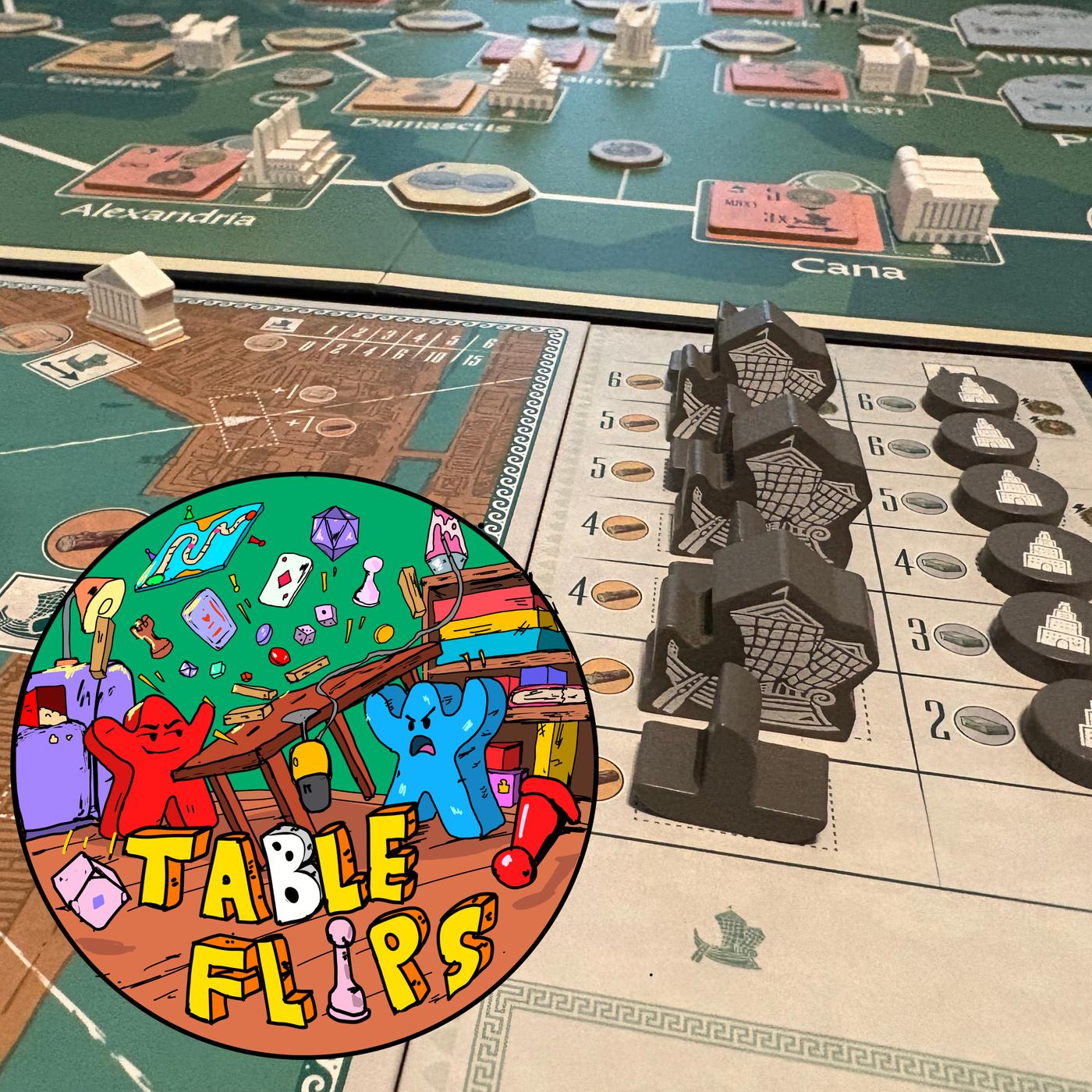
In-Person: In Ostia, you are taking the role of a merchant fleet owner in the second century at the time of Emperor Trajan, expanding your sphere of business in a very abstract way. This game has been so hyped as a modern classic that I and others spent much of our time this year eagerly awaiting the English print of this game. This is a Rondell game and will inspire many comparisons to other Rondell games, most notably Trajan by Stefan Feld, and Crusaders Thy Will Be Done.
Ep 7: Expanding your sphere of business in a very abstract way. This game has been so hyped as a modern classic that I and others spent much of our time this year eagerly awaiting the English print of this game. This is a Rondell game and will inspire many comparisons to other Rondell games, most notably Trajan by Stephon Bell, and Crusaders that will be done. And even perhaps the Matter Hurts Rondell games. Many of you are familiar with those old things. If you're not familiar with the Rondell or
In-Person: And even perhaps the Matt Gertz Rondell games, if any of you are familiar with those old things. if you're not familiar with the Rondell or Moncala type game, in Ostia you have a player board with an action circle on it that is your harbor. And your harbor is broken up into six congruent segments, each representing a resource and an action. in Moncala type games,
Ep 7: Type game. In OSGL you have a player board with an action circle on it that is your harbor. And your harbor is broken up into six congruent segments, each representing a resource and an action. In Moncolot type games, you pick up your action points, in this case ships, from one segment, and count
In-Person: You pick up your action points, in this case ships, from one segment, and count clockwise, dropping a token in each segment until you reach the last one. For Ostia, this represents the first innovation and deviation from that formula. Because you will produce resources based on the number of player pieces in the segment that you chose, and then you'll take the action of the area in the segment you end in. all this piece groping fuels a shared game board.
Ep 7: Dropping a token in each segment until you reach the last one. For Ostia, this represents the first innovation and deviation from Because you will produce resources based on the number of player pieces in the segment that you chose, and then you'll take the action of the area in the segment you ended. All of this piece groping fuels a shared game board featuring sailing routes and cities on it.
In-Person: Featuring sailing routes and cities on it. Yes, in the Mediterranean. So your main actions are building ships, moving ships, building structures and cities you have ships in, trading resources and completing contracts, and buying in game scoring opportunities with gold. I think the most interesting mechanic here is that when you build a Corbita, which is your basic ship.
Ep 7: Yes, and that's ready. So your main actions are building ships, moving ships, building structures and cities you have ships in, trading resources and completing contracts, and buying endgame scoring opportunities with them. think the most interesting mechanic here is that when you build a Corbeda, which is your basic ship, it
In-Person: It goes on your player board where it makes your harbor action stronger.
Ep 7: goes on your player board where it makes your harbor action stronger.
In-Person: When you build a ponto, which is an upgraded ship, it goes on your player board, it counts as double for production of resources, but it replaces a Corbita, which then enters the main board at the origin in Ostia. So now you can explore a different trade route
Ep 7: When you build a ponto, which is an upgraded ship, it goes on your player board, it counts as double for production of resources, but it replaces a Corbita, which then enters the main board at the origin in Ostia. you can trade route with different bonuses.
In-Person: with different bonuses.
Ep 7: that's interesting. I never thought, Travis, of looking at a Munkala type game as a Rondell, and I guess you're right that it is a type of Rondell mechanic. and so I love how the boats you grab from one area produces stuff from that area, and then those resources go on that slice of the Mankala board. That was very interesting to me. That was something I haven't seen before, and I love how you have to map this out for your future turns. So by taking an action,
In-Person: Future terms. So by taking an action
Ep 7: I'm already trying to set up for my future action. That was a beautiful mechanic. Also love
In-Person: Future action. That was a beautiful mechanic. Also love
Ep 7: How you need to choose which route you're going to go down. I think there's four routes, is that correct, Travis?
In-Person: how you need to choose which route you're going to go down. I think there's four routes, is that correct, Travis? Yeah, and one of them forks I think in the two. So it might be might be five, I don't like no, I don't remember. So you really just have to study each river and the different forks along the way. You need to understand each end game scoring.
Ep 7: yes. So you really just have to study each river and the different ports along the way. You need to understand each endgame scoring and the end of each river to make the best choices just throughout the whole game.
In-Person: in the end of each river to make the best choices just throughout the whole game.
Ep 7: In some areas you're truly just racing your opponent to get there first, and in other areas it doesn't matter and you want to take your time, stop at different ports, make sure you build certain buildings. Now I know
In-Person: In some areas, you're truly just racing your opponent to get their first. And in other areas, it doesn't matter. You want to take your time, stop at different ports, make sure you build certain buildings. Now, I know when we review a worker placement game, we're not going to compare it to all other worker placement games. But when you have a Moncala game mechanic and you see it so rarely, then you have to compare them to other Moncala games.
Ep 7: When we review a worker placement game, we're not gonna compare it to all other worker placement games, but when you have a Moncala game mechanic and you see it so rarely, then then you have to compare them to other Moncala games. So other games have this mechanic and they're completely different games, like Trajan. I think Trajan and Ostia are two separate games that just share a core mechanic.
In-Person: So other games have this mechanic and they're completely different games like Trajan. I think Trajan and Ostia are two separate games that just share a core mechanic.
Ep 7: Trajan, you know, it's a fun game. It's a big game divided up into four or five mini games with the Makala mechanic at its core. Now, Crusaders, thy will be done, that's a different story. I believe that's very, very similar to Ostia. You aren't going down rivers,
In-Person: Trajan, you know, it's a fun game, it's a big game divided up into four or five mini-games with the Makala mechanic at its core. Now, Crusaders that will be done, that's a different story. I believe that's very, very similar to Ostia. You aren't going downriver. But you're racing across the map to fight certain armies and build buildings, and that's just very similar to Ostia. I mean, Crusaders is a fun game, it's best at three or four players,
Ep 7: but you're racing across a map to fight certain armies and build buildings, and and that's just very similar to Ostia to me. Crusaders is a fun game, it's best at three or four players. So you can have that pressure of racing across the map. Again, similar to Ostia. In Crusaders, I feel like it's a little easier to get things done. You can almost always do what you want to do while in Ostia. It takes a little bit more planning. And then when I played
In-Person: so you can have that pressure of racing across the map. Again, similar to Ostia. In Crusaders, I feel like it's a little easier to get things done. You can almost always do what you want to do while in Ostia. It takes a little bit more planning, and then when I Played Ostia, my initial impressions was that it was going to be a Crusaders killer for me. But then it made me just want to play Crusaders again. And Travis, this is tough for me. I I like them both,
Ep 7: Ostia, my initial impressions was that it was gonna be a Crusaders killer for me. But then it made me just want to play Crusaders again. And and Travis, this is tough for me. I I like them both. But for different reasons. I love the set and setting for Crusaders. The artwork is fun and exciting. The gameplay just flows beautifully, almost too easily. You're off to battle and it's fast and furious. Now, Ostia, the production, yeah, it's amazing. There's a lot to take in and study when you look at the map and how you're gonna play the game.
In-Person: but for different reasons. I love the set and setting for Crusaders. The artwork is fun and exciting. The gameplay just flows beautifully, almost too easily. You're off to battle and it's fast and furious. Now, Ostia. The production, yeah, it's amazing. There's a lot to take in and study when you look at the map and how you're gonna play the game.
Ep 7: You you want to lay back and take it all in and examine how the different ports and the in game scoring are gonna help or hurt you.
In-Person: You you want to lay back and take it all in and examine how the different ports and the in-game scoring are gonna help or hurt you.
Ep 7: D does that make sense, Travis? The they're like the same game, but one's fast and furious and one's just a little bit more methodical. Yeah.
In-Person: Does that make sense, Charles? They're like the same game, but one's faster furious and one's just a little bit more methodical. Yeah, I think I agree with that. As I said in my call of the week, I'm trying to reduce redundancy in the games I own. I own Trajan, I own Crusaders, and now I own Ostia. And I'm evaluating if these are redundant and which ones I like. I think what separates Ostia from the others is that that monkala is a true puzzle.
Ep 7: Separates Ostia from the others is that that Moncala is a true puzzle. In Crusaders and Trajan, the the Moncala is just a means to an end. Sure, you can fail at planning how to use it effectively in those games, but that penalty is just so much steeper in Ostia. You can truly leave yourself with a disaster on that border. Yes, you can. I like I like that puzzle. On the other hand, there are a few things I'm not so sure about.
In-Person: In Crusaders and Trajan, the the Mankala is just a means to an end. Sure, you can fail at planning how to use it effectively in those games, but that penalty is just so much deeper in Ostia. you can truly leave yourself with a disaster on that board. I like I like that puzzle. on the other hand, there are a few things I'm not so sure about in Ostia, and I just need to play a few more times
Ep 7: And I just need to play a few more times.
In-Person: to determine their impact.
Ep 7: First, I don't think the compensation for not going first is as valuable as going first. based on the modular setup, there's likely to be a good early path to set yourself up, and going first just seems like a great advantage. I know you draft your starting buildings, starting city tiles, in reverse turn order, but it just doesn't seem like enough of a
In-Person: First, I don't think the compensation for not going first is as valuable as going first. based on the modular setup, there's likely to be a good early path to set yourself up, and going first just seems like a great advantage. I know you draft your starting buildings, starting city tiles, in reverse turn order, but it just doesn't seem like enough of a advantage for going last to
Ep 7: advantage for going last to compensate for the first player advantage. Also you don't necessarily specialize in the unit. Everything, everybody's trying to do everything optimally. The things you're doing are very simple, they're very abstract. You're turning in food for contracts. It's a very simple exchange. There aren't really any trade-offs. You want to play all your buildings, you want to play all your ships, you want to trade effectively.
In-Person: Compensate for the first player advantage. Also, you don't necessarily specialize in anything in the game. Everything everybody's trying to do everything optimally. The things you're doing are very simple. They're very abstract. You're turning in food for contracts. It's a very simple exchange. There aren't really any trade-offs. You want to play all your buildings. You want to play all your ships. You want to trade effectively. None of that is in itself terribly exciting. It's
Ep 7: None of that is in itself terribly exciting. It's kind of one of the most rote optimization puzzle games, and it's pretty dry as a bone. I think that will turn many people off. Last is that the goal cards can be easily missed. They just sort of sit there, and if you don't think about it, I mean they're available to buy, and they're huge amounts of points.
In-Person: kind of one of the most rote optimization puzzle games and it's pretty dry as a bone. I think that will turn many people off. last is that the goal cards can be easily missed. they they just sort of sit there and if you don't think about it, I mean they're available to buy and they're huge amounts of points.
Ep 7: I think what really buggy about them is they're always the same. So they're always the same end game goals. And Travis,
In-Person: I think what really bugs me about them is they're always the same. So they're always the same end game goals.
Ep 7: I completely forgot about them when I played my first game. and I think so did the other player. Right at the very end of the game, we both looked up and we're like, crap. And that was our bad. That wasn't the game's fault right there. But I didn't know that there were only five in game cards. They don't switch them out. Yeah, there's there's no random.
In-Person: Yeah, there's there's no randomization there at all.
Ep 7: Yeah, so that's frustrating. That's something that they could have easily added to to make the game a little bit more replayable. And I know the in game scoring for each city route, those are interchangeable, is that correct? Yeah, that's correct. And then all the ports and all the building areas, those are kind of mixed up and just thrown out too, right? Yeah.
In-Person: they could have easily added to to make the game a little bit more replayable. And I know the in game scoring for each route, those are interchangeable. Is that correct? Yeah, that's correct. And then all the ports and all the building areas, those are kind of mixed up and just thrown out too, right? Yeah, w the modularity is is definitely there. And you really have
Ep 7: You really have
In-Person: to evaluate that board when you start the game. I
Ep 7: Intents.
In-Person: think that's a lot more interesting than what you get in Crusaders. As it just seems like that board could just be set up any different way and
Ep 7: So in any different way.
In-Person: you would just go do what you want to do. It's very open world. and Ostia, you really need to play the optimization game and pick the right path at the right time to to make the most of that game. So I do like that puzzle. I'm just not totally s sold on some of the
Ep 7: shit you really need to play the optimization game and pick the right path at the right time to to make the most of that game. So I do like that puzzle. I'm just not totally s sold on some of the
In-Person: I don't know the lesser items that
Ep 7: Certain items, especially as dry and abstract as the game is. how to really think about it.
In-Person: Especially as dry and abstract as the game is, have to really think about it.
Ep 7: And I I think you're right, Travis. For me, it's definitely a well-designed game that I enjoyed. It flowed well, it had good crunch, but in the end nothing kind of stood out, nothing grabbed me, and that seems to be the theme for
In-Person: Yeah.
Ep 7: me on this episode. There's just too much out there these days to just grab another game with a similar mechanic.
In-Person: There's just too much hot there these days to just grab another game with a similar mechanic
Ep 7: For no big reason. I think I might just stick with Crusaders because I already have thirty other games about trading in the Mediterranean.
In-Person: for no big reason. I think I might just stick with Crusaders because I already have thirty other games about trading in the Mediterranean. Only thirty?
Ep 7: three? That was just so funny to me when we pulled out the game, I don't know why it just didn't hit me that we're in the Mediterranean again, trading with ships. Especially since you think
In-Person: Yeah, especially since you think all those trade routes are rivers.
Ep 7: What are they again?
In-Person: I have no idea. I think they're just trade routes generally. The board doesn't even look like any sort of
Ep 7: I think they're just trade routes generally. The board doesn't even look like any sort of
In-Person: map. It's just a very, very odd production design, I think. I think you think it's very beautiful. I think the the screen printed buildings, those look great. It makes the game look great. But other than that, the production design I'm kinda like meh.
Ep 7: I do think it's very beautiful. I think the the screen printed buildings, those look great, makes the game look great. But other than that, the production design I'm kinda like, meh. And the trays the trays were nice, but I I felt like they were a little tight in putting the pieces back in. You kind of had to be very, very particular with little bitty fingers and almost tweezers to get those buildings into the right area.
In-Person: Yeah, that was the real game, I think. It's a dexterity game.
Ep 7: There you go. It's a dexterity game. I like that. I like that. And that's our review of Ostia by Tsukocho and I guess Crafty Games.
In-Person: Totsukachu and I guess crafty games if you're in the US.
Ep 7: And thanks for joining us on TableFlips. Now get out there and play some more games. Bye.
In-Person: Bye.
