


BU BÖLÜM HAKKINDA
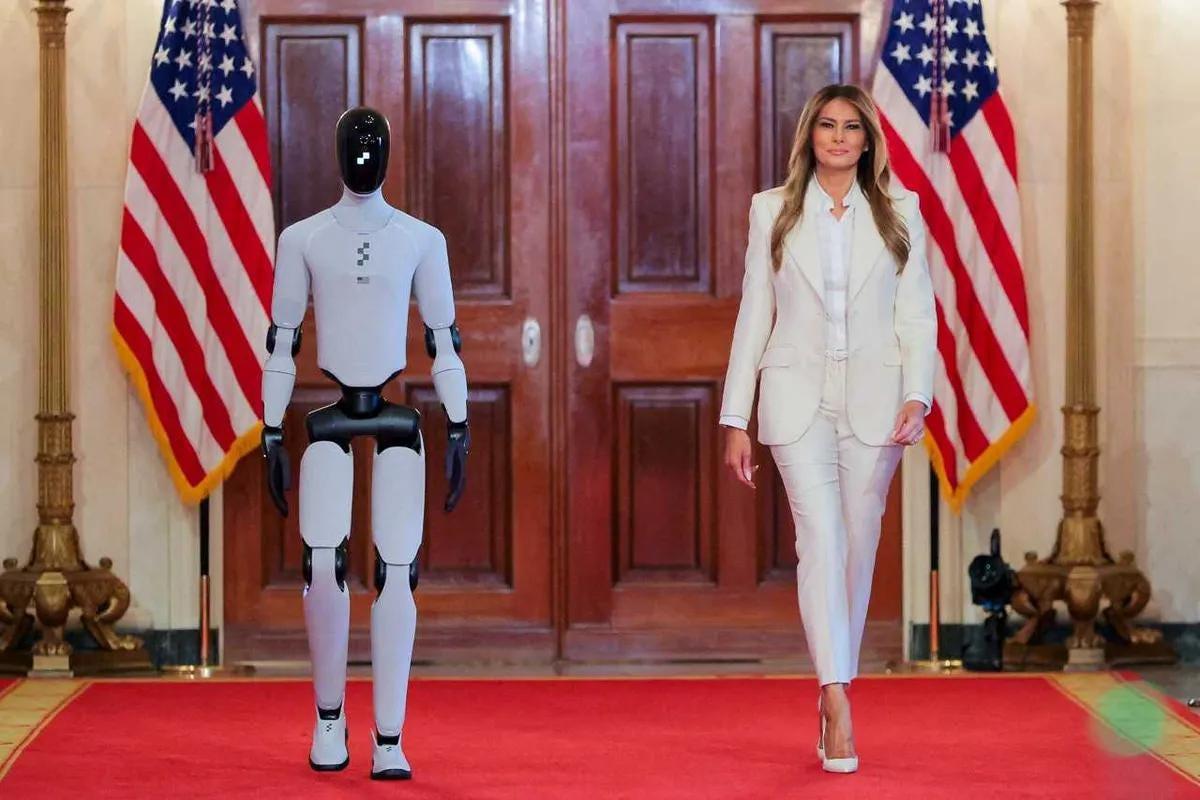
U.S. first lady Melania Trump walks next to a humanoid robot as she hosts a roundtable event on the second day of the inaugural Fostering the Future Together Global Coalition Summit, at the White House in Washington, D.C., U.S., March 25, 2026. REUTERS/Kylie Cooper
Congress Is Not Powerless Before AI. Its Leaders Are Choosing Delay.
The Decision Belongs to the People Holding the Gavel
Raw Story reports that Republican lawmakers dismissed or questioned warnings from AI insiders while arguing that broad federal guardrails could entrench dominant companies or weaken the United States against China. The immediate political fact is simpler than the article’s doomsday framing: Republicans controlled the Senate, Ted Cruz chaired the Commerce Committee, and Speaker Mike Johnson sent House members home until after the November 2026 election.
These officials were not spectators waiting for Silicon Valley to resolve a technical dispute. They held the institutional power to convene hearings, demand evidence, draft narrow safeguards, and keep Congress working. Their skepticism may shape whether any of that happens.
Help fuel the work. Independent analysis doesn’t fund itself:☕ Buy us a coffee
Cruz acknowledged “catastrophic risks,” including nuclear and biological dangers, while warning that “overzealous Washington bureaucrats” could cripple innovation. That is not ignorance of the alleged hazard. It is an explicit ordering of priorities: avoid burdens on the industry first, address catastrophic risk without empowering regulators too much.
Skepticism Is Not a Regulatory Program
Republicans quoted in the report raised a legitimate problem. Large companies can support regulation that favors incumbents and blocks smaller competitors. Democrats such as Rep. Sara Jacobs also recognized that danger, arguing that Congress should protect new entrants and open-weight models rather than write rules solely for established firms.
But identifying regulatory capture does not justify regulatory surrender. It requires legislation designed against capture.
Sen. Rick Scott said companies asking to be regulated may simply want protection from competition. Sen. Ron Johnson called the warnings “fear-mongering.” Sen. Bernie Moreno said companies unable to control their products should stop making them. Yet none of those positions, as presented by Raw Story, establishes a mechanism that would make companies stop. Telling executives to behave responsibly while resisting enforceable restraints leaves the decision with the executives.
That is the central evasion. The lawmakers describe corporate power accurately, then preserve it.
China Is the All-Purpose Permission Slip
Cruz and Sen. Ted Budd invoked competition with China as a reason not to slow AI development. Moreno warned that federal control could turn American AI into something resembling the system depicted in 1984. These arguments convert every proposed restraint into either economic capitulation or state domination before its actual terms are considered.
Raw Story does not supply a specific bill whose provisions can be tested against those claims. That matters. “Guardrails” can mean disclosure rules, safety testing, liability, restrictions on dangerous capabilities, or a licensing system that entrenches the largest firms. Treating all of them as one bureaucratic threat prevents scrutiny of the choices Congress could actually make.
The China argument also conceals who receives freedom under the proposed arrangement. It is not the public, which would have little control over systems deployed at scale. It is the companies building them.
The Reporting Overplays Belief and Understates Choice
Raw Story frames Republicans as somehow trusting AI while distrusting AI companies. The quoted lawmakers demonstrate something more coherent and more political: they distrust corporate warnings but still prefer limited government intervention.
That distinction matters because “trust” makes the conflict sound psychological. The relevant issue is institutional choice. Officials can doubt executives’ motives and still require independent testing, disclosure, or protections against nuclear and biological misuse. Cruz himself said meaningful protections were needed. The unresolved question is whether his committee will produce them.
The article also leans heavily on extreme predictions from industry figures. Former Anthropic researcher Jacob Coxon reportedly warned in September 2026 that AI could kill everyone by the end of the decade, while Anthropic alignment lead Evan Hubinger reportedly placed the chance above 10 percent within ten years. Those are attributed assessments, not established probabilities. Congress need not accept them as forecasts to investigate the underlying capabilities and impose targeted safeguards.
Absence Is a Policy
Rep. Veronica Escobar told Raw Story that closed-door briefings were creating urgency among lawmakers, then criticized Johnson for sending the House home. Whatever the Speaker’s reason for changing the schedule, the consequence described in the report is concrete: members were dispersed during a period when some believed sustained work could support bipartisan action.
Delay is especially favorable to a fast-moving industry. Products develop, infrastructure expands, money is invested, and commercial practices harden while Congress debates whether acting would itself be dangerous. By the time lawmakers return, yesterday’s voluntary experiment may have become tomorrow’s entrenched market.
The companies retain agency too. Moreno’s criticism of firms warning about products they continue to develop and monetize identifies a real contradiction. But Congress cannot answer that contradiction by handing the same firms continued discretion. If lawmakers believe the warnings are self-serving, independent oversight becomes more necessary, not less.
The System Rewards Paralysis
The larger pattern is not that one party believes in machines and the other believes in regulation. It is that concentrated private power and partisan competition give officeholders multiple excuses for inaction: regulation might help incumbents, China might gain ground, agencies might overreach, and corporate warnings might be marketing.
Each concern can be valid. Together, without legislation, they form a permission structure for doing nothing.
That arrangement distributes responsibility downward and outward—to executives, engineers, bureaucrats, foreign rivals, and future Congresses—while elected leaders keep the authority. The error is systemic because paralysis carries no procedural label. No one has to vote for unmanaged risk. Committee chairs can decline to advance safeguards, leaders can empty the chamber, and lawmakers can call that absence of decision a defense of innovation.
It is still a decision.
Thanks to Raw Story
Source: ‘I’m not buying it’: Republicans scoff at apocalyptic AI warnings as blatant money grab
Systemic Error is a reader-supported publication. To receive new posts and support my work, consider becoming a free or paid subscriber.
We warned them.We told them.We shouted from the rooftops.We plead.We begged.They didn’t listen.Now, we all will suffer.Y’all know what to do, right?VOTE BLUE! 💙Vote as if your life — nay, our country — depend on it.Because, this time, and every time, it does.
This is a public episode. If you'd like to discuss this with other subscribers or get access to bonus episodes, visit paulstsmith.substack.com/subscribe


