
BU BÖLÜM HAKKINDA
Abstract
We introduce Natural Language Autoencoders (NLAs), an unsupervised method for generating natural language explanations of LLM activations. An NLA consists of two LLM modules: an activation verbalizer (AV) that maps an activation to a text description and an activation reconstructor (AR) that maps the description back to an activation. We jointly train the AV and AR with reinforcement learning to reconstruct residual stream activations. Although we optimize for activation reconstruction, the resulting NLA explanations read as plausible interpretations of model internals that, according to our quantitative evaluations, grow more informative over training.
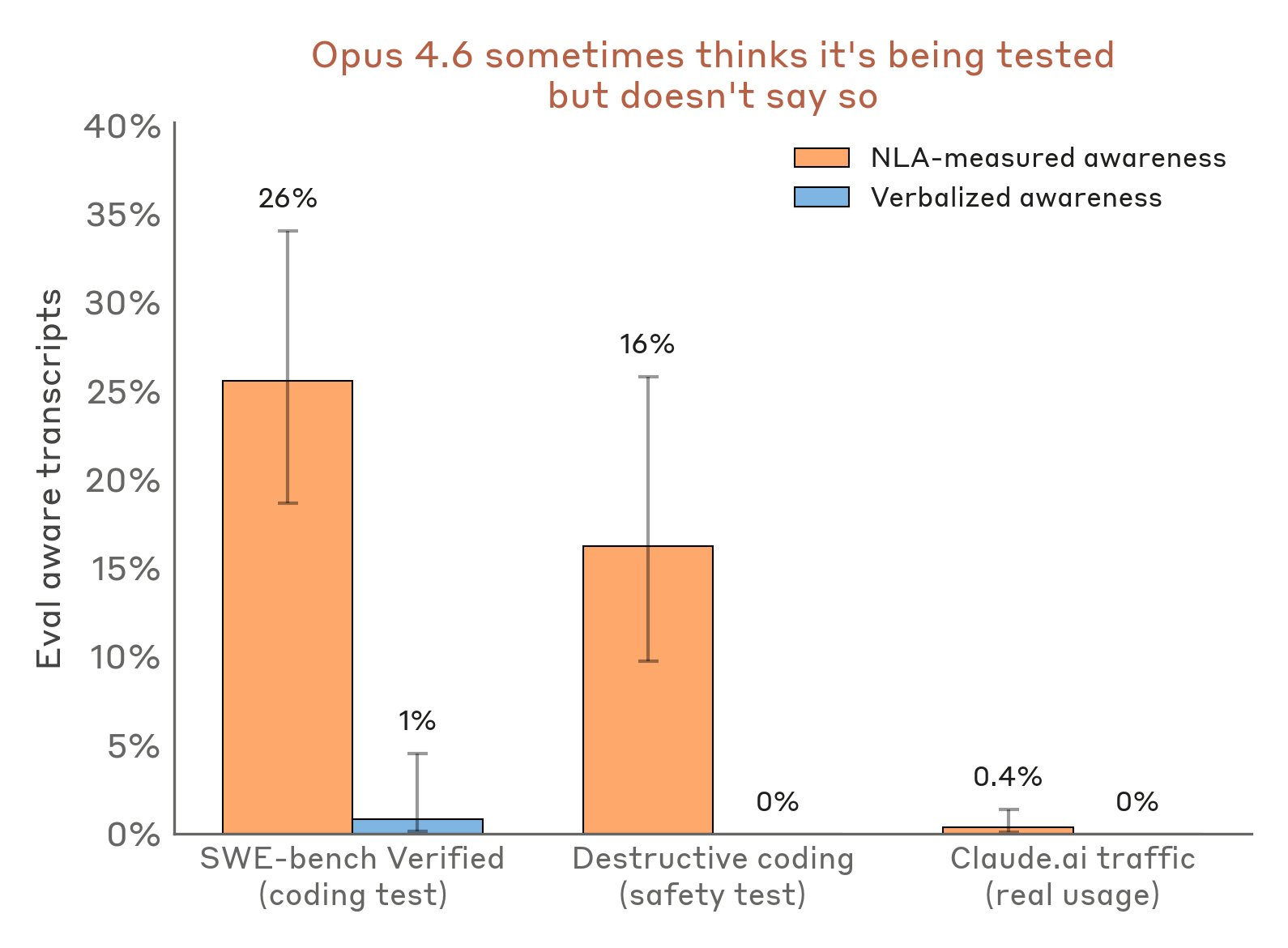
We apply NLAs to model auditing. During our pre-deployment audit of Claude Opus 4.6, NLAs helped diagnose safety-relevant behaviors and surfaced unverbalized evaluation awareness—cases where Claude believed, but did not say, that it was being evaluated. We present these audit findings as case studies and corroborate them using independent methods. On an automated auditing benchmark requiring end-to-end investigation of an intentionally-misaligned model, NLA-equipped agents outperform baselines and can succeed even without access to the misaligned model's training data.
NLAs offer a convenient interface for interpretability, with expressive natural language explanations that we can directly read. To support further work, we release training code and trained NLAs [...]
---
Outline:
(00:15) Abstract
[... 6 more sections]
---
First published:
May 7th, 2026
Source:
https://www.lesswrong.com/posts/oeYesesaxjzMAktCM/natural-language-autoencoders-produce-unsupervised
---
Narrated by TYPE III AUDIO.
---
We introduce Natural Language Autoencoders (NLAs), an unsupervised method for generating natural language explanations of LLM activations. An NLA consists of two LLM modules: an activation verbalizer (AV) that maps an activation to a text description and an activation reconstructor (AR) that maps the description back to an activation. We jointly train the AV and AR with reinforcement learning to reconstruct residual stream activations. Although we optimize for activation reconstruction, the resulting NLA explanations read as plausible interpretations of model internals that, according to our quantitative evaluations, grow more informative over training.
We apply NLAs to model auditing. During our pre-deployment audit of Claude Opus 4.6, NLAs helped diagnose safety-relevant behaviors and surfaced unverbalized evaluation awareness—cases where Claude believed, but did not say, that it was being evaluated. We present these audit findings as case studies and corroborate them using independent methods. On an automated auditing benchmark requiring end-to-end investigation of an intentionally-misaligned model, NLA-equipped agents outperform baselines and can succeed even without access to the misaligned model's training data.
NLAs offer a convenient interface for interpretability, with expressive natural language explanations that we can directly read. To support further work, we release training code and trained NLAs [...]
---
Outline:
(00:15) Abstract
[... 6 more sections]
---
First published:
May 7th, 2026
Source:
https://www.lesswrong.com/posts/oeYesesaxjzMAktCM/natural-language-autoencoders-produce-unsupervised
---
Narrated by TYPE III AUDIO.
---
ingilizce
Amerika Birleşik Devletleri
TRANSKRİPT 🔗
Are you the producer of this podcast?
Add a podcast transcript
Need Audio-to-Text?
Transcribe with Listen411 in Just 60 Seconds
SON BÖLÜMLERİ ARA
LessWrong (Curated & Popular) için geçmiş bölümleri ara.
BU PODCAST'IN DİĞER BÖLÜMLERİ

Note: As with any research done in a couple of days, this is all very tentative. I understand, intellectually, that if you talk about some ability that current AIs don't have, sooner or later new ones will have that ability and whatever you say will stop being true. I just didn't expect i…
This is a link post. METR recently estimated that Anthropic is now making AI progress about twice as fast as its historical rate (they would not be surprised by anything from 1.3x to 3x), and guessed that “perhaps roughly equals 80%” of the current acceleration is due to AI. If they’re right, that …
Science is caught between Law and Chaos. On the side of Law:
Things should make explicit sense to your deliberate reasoning ("system-two"). If you just have a "vibe" about how things work, that's bad. Measure everything. Use numbers whenever possible. You want things to b…
How do you get a friend to leave an abusive relationship? If you talk to people who work at women's shelters, they will tell you, but there is something resigned about the way they do it: they know that it's too difficult an ask. Those who can do it reliably are often people who are unluc…
Audio note: this post contains a lot of mathematical notation. We narrate the simpler formulas and flag the complex ones, so you may want the original text to hand. Heavily inspired by a conversation with Keshav Srinivasan and Richard Ngo during MATS 10.0. The week ahead of you is packed. This is…
Feragatname: Bu sayfaya yerleştirilmiş podcast ve sanat eserleri, sahibinin mülkiyetinde olan ve Listen Notes, Inc.'e bağlı olmayan veya tarafından onaylanmayan LessWrong'e aittir.
DÜZENLE
Podcast veritabanını güncel tutmaya yardımcı olduğunuz için teşekkür ederiz.