

Speaker:
00:00:00
There are so many CMOs I've talked to who say, I wish I had known X before
Speaker:
00:00:04
taking my role, or I wish I had been told the real truth about Y way earlier.
Speaker:
00:00:10
And there are, meanwhile, so many CEOs and investors who are
Speaker:
00:00:14
unhappy with the performance or the tenure of their last CMO.
Speaker:
00:00:18
What if we had better tools to reduce risk on both sides?
Speaker:
00:00:22
This season is the sixth season of The Get.
Speaker:
00:00:25
We are going to focus on the race to reduce risk when it comes to a
Speaker:
00:00:29
match between a company and a CMO.
Speaker:
00:00:31
How can you find out what you need to find out before saying yes, so that
Speaker:
00:00:36
you can move forward wholeheartedly?
Speaker:
00:00:38
This need to mitigate risk, it's always been the case, of course,
Speaker:
00:00:42
it's always been important, but it just feels more pressing lately.
Speaker:
00:00:45
If we haven't met yet, welcome!
Speaker:
00:00:48
I'm your host, Erica Seidel.
Speaker:
00:00:50
I spend my days recruiting CMOs and VPs of marketing in B2B SaaS.
Speaker:
00:00:55
My tagline is, I place the make- money marketing leaders,
Speaker:
00:00:59
not the make-it-pretty ones.
Speaker:
00:01:00
With my role, I have a front row seat to the trends, tribulations, and triumphs of
Speaker:
00:01:05
today's top marketing leaders in B2B SaaS.
Speaker:
00:01:08
And now with The Get, you do, too.
Speaker:
00:01:11
The Get is designed to drive smart decisions around recruiting and
Speaker:
00:01:14
leadership in B2B SaaS marketing.
Speaker:
00:01:17
Today, let's look at what the best CMOs find out before saying yes to a job.
Speaker:
00:01:23
If you're hiring, it's going to help you to be ready for the information that
Speaker:
00:01:26
some of your top candidates will ask for.
Speaker:
00:01:29
And, you'll see what they see as risky so that you can
Speaker:
00:01:31
position your role effectively.
Speaker:
00:01:33
If you're looking to get hired, it will help you use the limited time in the
Speaker:
00:01:37
recruiting process to your best advantage.
Speaker:
00:01:40
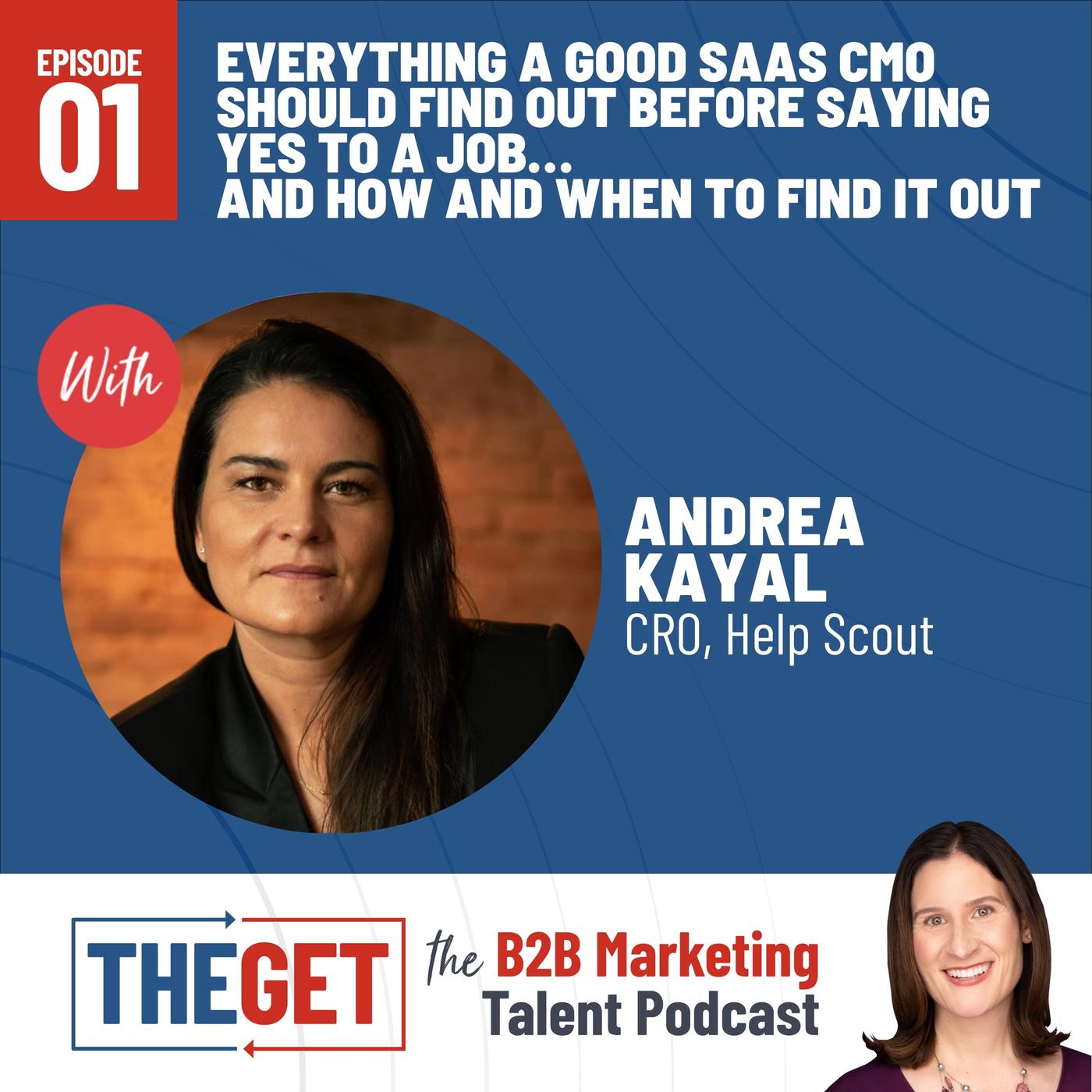
You'll hear from me, and then I'll bring on my guest, Andrea Kayal.
Speaker:
00:01:44
She will share her perspective as a CMO and now a CRO.
Speaker:
00:01:48
I'm also really excited to talk with her about something controversial - whether
Speaker:
00:01:52
it's a risk for CMOs to report to CROs.
Speaker:
00:01:55
So let's get started.
Speaker:
00:01:57
During the recruiting processes that you'll see, time and access
Speaker:
00:02:02
in general are so limited.
Speaker:
00:02:04
In an interview, time is really especially precious.
Speaker:
00:02:07
The best candidates will plan ahead and know what they're going to be looking
Speaker:
00:02:10
for and in roughly what sequence.
Speaker:
00:02:13
They'll have an idea of what to ask about directly in an interview with the CEO,
Speaker:
00:02:17
and what to ask for in other meetings.
Speaker:
00:02:19
And they'll know where they need to become a sleuth to find out things on their own.
Speaker:
00:02:23
I often ask candidates what their top three criteria are for accepting a job?
Speaker:
00:02:28
They talk about different things.
Speaker:
00:02:30
Information about the health of the business, the product, the marketing
Speaker:
00:02:33
impact so far, the culture, the upside opportunity, the relationships with the
Speaker:
00:02:38
investors, a lot of different things.
Speaker:
00:02:40
But one thing's for sure, the best candidates are very
Speaker:
00:02:43
intentional about their criteria.
Speaker:
00:02:46
Here's just a smattering of some of the best questions I've
Speaker:
00:02:49
heard CMO candidates ask lately.
Speaker:
00:02:52
One is, how long did it take to get to the number of customers the company has now?
Speaker:
00:02:57
How do you know you have product market fit?
Speaker:
00:02:59
What competitors worry you the most?
Speaker:
00:03:02
What is the organization's view on marketing?
Speaker:
00:03:04
It's definition of marketing?
Speaker:
00:03:06
What's working well with marketing and what's not?
Speaker:
00:03:09
What are the funnel metrics?
Speaker:
00:03:10
What are you measuring in general with marketing?
Speaker:
00:03:13
What is your retention rate?
Speaker:
00:03:15
What was a question that came up at the last board meeting that
Speaker:
00:03:18
marketing struggled to answer?
Speaker:
00:03:20
What does the sales cycle look like in terms of timing and
Speaker:
00:03:24
in terms of pipeline coverage?
Speaker:
00:03:26
What's the relationship with investors like?
Speaker:
00:03:28
What does the cap table look like?
Speaker:
00:03:30
And also culture questions.
Speaker:
00:03:32
Some of these questions I coach people to ask actually, and they include
Speaker:
00:03:35
things like what would happen here that doesn't happen somewhere else?
Speaker:
00:03:39
Or what surprised you about the culture when you joined?
Speaker:
00:03:43
And what do you value to the detriment of other things?
Speaker:
00:03:47
When a candidate asks questions, they're really demonstrating their altitude,
Speaker:
00:03:51
and with that, they're signaling how they are likely to tackle the role.
Speaker:
00:03:55
Now, let's go beyond questions to other things that good CMO candidates do.
Speaker:
00:04:00
They provide something to react to - some slides, perhaps, that talk about the
Speaker:
00:04:05
structure of their role, what is in scope, what's not, how they measure things.
Speaker:
00:04:09
And in this way, they're taking control of the interview.
Speaker:
00:04:12
It helps them to educate the CEO, especially if the CEO is somebody who
Speaker:
00:04:17
doesn't understand marketing too well.
Speaker:
00:04:20
They ask for product demos.
Speaker:
00:04:22
Usually these are product marketing people, people who have come up through
Speaker:
00:04:25
the product marketing ranks that do this.
Speaker:
00:04:27
But this could be a great way to see the product in action.
Speaker:
00:04:30
They get backdoor references on the hiring leader.
Speaker:
00:04:33
One CEO client I had, he proactively, actually, offered references of
Speaker:
00:04:37
people who had worked with him before to talk to candidates.
Speaker:
00:04:41
They ask for an in-person meeting.
Speaker:
00:04:43
On the hiring side, this can actually help you close a deal because if a candidate
Speaker:
00:04:47
is in multiple recruiting processes, they can feel more of a kinship to
Speaker:
00:04:51
the company that they meet in person.
Speaker:
00:04:54
Of course, some people have different perspectives on this.
Speaker:
00:04:57
I have a client who said she cared more about her CMO connecting via Zoom since
Speaker:
00:05:02
that was going to be 90 percent of the way he would be interacting with people.
Speaker:
00:05:07
Another thing that people do is they ask to talk to investors.
Speaker:
00:05:10
They ask to talk to customers or they just go ahead and do it.
Speaker:
00:05:13
And, of course, they tap the recruiter for their knowledge and guidance.
Speaker:
00:05:16
There's a whole art to that that we could talk about another time.
Speaker:
00:05:20
And I think the gold standard for de-risking from a candidate
Speaker:
00:05:23
side is to start fractionally.
Speaker:
00:05:25
Gold standard on both sides actually.
Speaker:
00:05:27
It's a great way to try before you buy.
Speaker:
00:05:29
It's just not always practical to do.
Speaker:
00:05:32
So of course, there's a lot to find out.
Speaker:
00:05:34
The trick here, if you're the candidate, is to not seem like you
Speaker:
00:05:37
have an endless array of questions.
Speaker:
00:05:40
Otherwise, it looks like you're sort of expensive to work with
Speaker:
00:05:43
and can't make a decision.
Speaker:
00:05:44
So again, an art to this.
Speaker:
00:05:47
So the net is, there's lots of things to de risk for both parties,
Speaker:
00:05:51
and there's a compressed time frame in recruiting, as we know.
Speaker:
00:05:54
And it takes intentionality and some finesse to manage the process the best.
Speaker:
00:06:00
In the end, both sides will also always be making a leap.
Speaker:
00:06:05
Now, let's bring on another perspective on this topic.
Speaker:
00:06:08
So andrea i'm really excited to welcome you to The Get.
Speaker:
00:06:11
I am excited to talk with you about this topic of kind of everything a SaaS CMO
Speaker:
00:06:16
should know before they say yes To a job and how they should find that out.
Speaker:
00:06:21
The reason I picked you as a person to talk to was I remember
Speaker:
00:06:26
I was taking this Pavilion class.
Speaker:
00:06:27
I think it was a CMO school and you did a session and it was great.
Speaker:
00:06:31
And you said, "I have a whole worksheet that I fill out
Speaker:
00:06:34
before I say yes to a job."
Speaker:
00:06:36
And I thought that was so cool.
Speaker:
00:06:38
I thought, oh, I want to see her worksheet.
Speaker:
00:06:39
I want to, I want to hear more about this.
Speaker:
00:06:42
And so I am thrilled to have you.
Speaker:
00:06:44
Just so our guests know, you have been a CMO multiple times,
Speaker:
00:06:48
and a CRO multiple times.
Speaker:
00:06:50
Now you're a CRO at Help Scout.
Speaker:
00:06:52
So this is going to be great.
Speaker:
00:06:53
We're going to talk about the whole, you know, CMO versus CRO.
Speaker:
00:06:56
And marketing leaders reporting to CROs.
Speaker:
00:06:58
But also, you know, this topic of what to find out before saying yes to, to a role.
Speaker:
00:07:04
I think it's really cool that you were on the board of Help
Speaker:
00:07:08
Scout before you became CRO.
Speaker:
00:07:12
It's like the ultimate try before you buy.
Speaker:
00:07:14
So, let's first talk about being a CRO.
Speaker:
00:07:18
You're a CRO, you've been a CMO, and this whole theme is about reducing risk.
Speaker:
00:07:23
So I'll just come out and say it.
Speaker:
00:07:24
Some CMOs, VPs of Marketing, whatever, they recoil, they would like puke
Speaker:
00:07:30
at the idea of reporting to a CRO.
Speaker:
00:07:33
Yet, this is kind of a trend that you know, that we see in SaaS.
Speaker:
00:07:37
And so I'm wondering, what do you see as the benefits of it?
Speaker:
00:07:40
You know, how do you react to somebody who says too much risk,
Speaker:
00:07:44
you know, if I report to a CRO, I'm just going to become a lead factory.
Speaker:
00:07:48
I'm going to become nothing more.
Speaker:
00:07:50
What do you say?
Speaker:
00:07:50
And what's the pitch for a CMO to work for CRO?
Speaker:
00:07:53
And, and If you have time to also talk about this, like when should a CEO
Speaker:
00:07:58
consider having marketing report to the CRO rather than the CEO directly?
Speaker:
00:08:02
Actually, I'll start there, Erica, because I think that's primarily one of
Speaker:
00:08:06
the things to, I don't know, evaluate prior to you taking a role as a CMO
Speaker:
00:08:11
to reporting into the CRO is why does the CRO exist in the first place?
Speaker:
00:08:15
And what has the CRO aligned with the CEO on as the value that
Speaker:
00:08:18
they're going to drive or the leverage they're going to give them?
Speaker:
00:08:21
In that, you know, in that particular company, because every company is nuanced.
Speaker:
00:08:25
So, I would say first, the benefit of a CRO in an organization, at least as far
Speaker:
00:08:30
as my experience has kind of illuminated is that what I noticed the CEO doing
Speaker:
00:08:35
frequently was kind of like going to his C-level counterparts by function
Speaker:
00:08:39
and, you know, asking for numbers.
Speaker:
00:08:40
Or we were like reporting up you know, particularly siloed metrics.
Speaker:
00:08:45
And it wasn't that I didn't have great sales and marketing alignment with my
Speaker:
00:08:48
sales peer or great sales and customer success alignment with my CCO peer.
Speaker:
00:08:53
We were aligned, but that there was no one deliberator of the actual
Speaker:
00:08:57
singular number that the CEO cares about was like, is our revenue on track?
Speaker:
00:09:01
So there's new revenue, which is usually what the sales and marketing
Speaker:
00:09:05
leaders are responsible for, primarily.
Speaker:
00:09:07
And then there's like the retained revenue, which the CCO is responsible for.
Speaker:
00:09:11
And so, in that way, if you have three very senior people reporting on these
Speaker:
00:09:15
things, I felt like there was always like a gap in the strategy around
Speaker:
00:09:20
where to put resources because sales and marketing efficiency is one of the
Speaker:
00:09:24
things that like help your valuation.
Speaker:
00:09:26
I said, well, one person should probably be the deciding capital
Speaker:
00:09:29
allocator among all the teams in terms of like where the money is
Speaker:
00:09:32
best spent to generate the revenue.
Speaker:
00:09:33
So I think that's the value of the CRO.
Speaker:
00:09:36
Now, if I'm a CMO and I'm thinking like, okay, can I make an impact
Speaker:
00:09:40
here under a CRO who's responsible for the revenue strategy?
Speaker:
00:09:44
I would say this is a great opportunity to come in and partner with what the
Speaker:
00:09:48
leader that has the responsibility to the CEO for that one revenue strategy
Speaker:
00:09:53
versus like three competing viewpoints on like what markets we should go after.
Speaker:
00:09:58
You should be evaluating, obviously your relationship with the CRO
Speaker:
00:10:01
and where their strengths are, but usually, and this is the trend I'm
Speaker:
00:10:04
hoping to bork, it's a sales leader.
Speaker:
00:10:08
And in my opinion, hiring a CMO to support the revenue leader is like critical
Speaker:
00:10:12
because they don't have that skill set.
Speaker:
00:10:14
And in my opinion, not to discredit my, my sales counterparts, marketing is
Speaker:
00:10:19
sort of like the more multi-dimensional-
Speaker:
00:10:22
Yeah.
Speaker:
00:10:23
-harder, if you will?
Speaker:
00:10:24
Like role to solve for because there's content marketing, product
Speaker:
00:10:27
marketing, brand marketing, creative, design, PR, like demand gen, events.
Speaker:
00:10:33
There's like twelve disciplines to marketing and there's
Speaker:
00:10:36
like one dimension to sales.
Speaker:
00:10:37
And so like, if I'm a CRO, now my background is marketing.
Speaker:
00:10:41
I have a great VP of Marketing because I still need all that stuff done.
Speaker:
00:10:45
But I still really want a strong marketing leader because it's
Speaker:
00:10:48
such a hard thing to wield.
Speaker:
00:10:50
So, I can stay focused on the sales side of the organization and
Speaker:
00:10:54
my sales leaders and a strong VP of Marketing or CMO is capable of running
Speaker:
00:10:59
point on all the marketing stuff.
Speaker:
00:11:00
But ultimately my job is to take all that information and
Speaker:
00:11:03
then go to the CEO with it.
Speaker:
00:11:05
Mm hmm.
Speaker:
00:11:05
And I think when I talk to people, I'm starting to ask them, you know, I've got
Speaker:
00:11:09
these people come to me, "I'm looking for a job, I'm looking for a job."
Speaker:
00:11:11
And one of the qualifying questions I ask them is, are you okay working for a CRO?
Speaker:
00:11:15
Because this is a bit of a trend.
Speaker:
00:11:17
I just want to know, are you, you know, allergic to it a priori?
Speaker:
00:11:20
And what I'm starting to hear is, "Oh, it depends on the CRO."
Speaker:
00:11:24
And I think if it's somebody like you, who's come from marketing,
Speaker:
00:11:26
that's very different than somebody who was a sales leader yesterday and
Speaker:
00:11:30
only has led, you know, five person sales team or something like that.
Speaker:
00:11:34
Exactly.
Speaker:
00:11:35
There, there's a lot of, I think the apprehension marketers have is to
Speaker:
00:11:38
report into a sales leader who really doesn't get marketing at all and can't
Speaker:
00:11:41
appreciate the value or the impact.
Speaker:
00:11:43
And that would be a red flag.
Speaker:
00:11:45
So that's why I think there's a, there's a nuanced answer there.
Speaker:
00:11:48
Where just like, it depends truly because the person is a big factor in that.
Speaker:
00:11:53
So I'd love to see more marketing leaders move over to CRO because I
Speaker:
00:11:56
do think that like, there's no reason that that shouldn't be the case.
Speaker:
00:11:59
Like a revenue strategy isn't only able to be determined by
Speaker:
00:12:02
somebody who grew up in sales.
Speaker:
00:12:04
In a lot of cases, I think even like, you know, Latane from 6sense, she had
Speaker:
00:12:07
called herself like a Chief Market Officer at one point because, knowing the
Speaker:
00:12:11
market and how to read the business and where to go is the job, not necessarily
Speaker:
00:12:16
like, oh, I'm here just to drive leads.
Speaker:
00:12:18
Mm hmm.
Speaker:
00:12:18
Like I said, it's a more, it's a deeper job than just, you know, that one thing.
Speaker:
00:12:24
Interesting.
Speaker:
00:12:25
Yeah.
Speaker:
00:12:26
God, I could talk to you about that topic all day long, but let's,
Speaker:
00:12:28
let's focus on other aspects of, of this, you know, risk management.
Speaker:
00:12:32
So, no matter where the marketing leadership role reports, what do
Speaker:
00:12:36
you see as like the top two or three things for a CMO, Head of Marketing,
Speaker:
00:12:41
whatever it's called, to find out before saying yes to that role?
Speaker:
00:12:44
Like, is it this whole worksheet of, you know, thirty things, or do you
Speaker:
00:12:47
have a couple, you know, top, you know, the Andrea Kayal top things?
Speaker:
00:12:50
Yeah, I have a very, very top.
Speaker:
00:12:52
It like eclipses the others by probably, by a very large margin which is gross
Speaker:
00:12:58
retention and that gross retention is a signal to me of product market fit.
Speaker:
00:13:05
Certainly like, you know, you could get this, you could cut different segments of
Speaker:
00:13:09
those sales so that the gross retention of maybe smaller customers is crappy
Speaker:
00:13:13
and larger ones is really great or whatever, however you want to cut it.
Speaker:
00:13:15
But you really want to get an understanding of whether or not the
Speaker:
00:13:17
ideal customer for that business is retaining with their dollars.
Speaker:
00:13:22
There's a logo retention and then there's a dollar retention.
Speaker:
00:13:25
I would look at gross retention , gross retention of absolute logos.
Speaker:
00:13:28
The dollar amount is important, but if you bring on a company, you want
Speaker:
00:13:32
to see that the company is able to retain that segment at about 90%.
Speaker:
00:13:36
90% is like a healthy number, I would say, for some small companies who
Speaker:
00:13:41
are focused on small business, like maybe that number is around 80% just
Speaker:
00:13:44
because naturally small businesses go out of business sooner than others.
Speaker:
00:13:47
But let's just say like your medium to enterprise size
Speaker:
00:13:50
company, you want it to be at 90%.
Speaker:
00:13:52
And the reason this is so important for a marketer assessing a job is because
Speaker:
00:13:57
for all commercial teams, I would say sales, marketing, and let's just say
Speaker:
00:14:00
customer success, if the gross retention is suffering below 90%, that is a problem
Speaker:
00:14:05
that the product team needs to solve.
Speaker:
00:14:06
And the VCs and the CEO, very apprehensive to spend more at the top
Speaker:
00:14:11
of the funnel generating more leads and more pipeline and more revenue if
Speaker:
00:14:16
they know it's leaking out the bottom.
Speaker:
00:14:18
So that's definitely the question I would ask, you know, that's
Speaker:
00:14:21
far and away the most important.
Speaker:
00:14:23
The second thing to look at, if I were a marketing leader joining an organization
Speaker:
00:14:29
is probably the close rate percentage.
Speaker:
00:14:33
Because the worse the sales team is at closing deals, the harder the job is
Speaker:
00:14:39
for the marketing leaders because you are covering what their quotas are.
Speaker:
00:14:45
So if their close rate is 25%, then you need to be covering, you know, you
Speaker:
00:14:50
need 4x the pipeline to cover that.
Speaker:
00:14:53
If they close at 20%, just five points less, you need five times
Speaker:
00:14:57
the pipeline to cover that.
Speaker:
00:14:58
And what happens is, as that close rate changes, the budget you need to support
Speaker:
00:15:03
that organization also needs to increase.
Speaker:
00:15:06
And sometimes that's not clear to the company that it's not, it's nothing
Speaker:
00:15:09
that I can do to solve for this.
Speaker:
00:15:11
Every time the close rate goes down, the budget for the
Speaker:
00:15:14
marketing team needs to go up.
Speaker:
00:15:15
So, you know, those are probably like, I think the top two
Speaker:
00:15:18
that I would be digging into.
Speaker:
00:15:19
That's great.
Speaker:
00:15:20
All right.
Speaker:
00:15:21
And, you know, and I find as I talk to marketing leaders, I
Speaker:
00:15:25
always ask, you know, what are your criteria for saying yes to a job?
Speaker:
00:15:28
And many have a kind of structure for it.
Speaker:
00:15:30
You know, I, I like yours as, as very, you know, quantitative metrics.
Speaker:
00:15:34
Sometimes people are talking about, oh, I love culture and good people
Speaker:
00:15:37
and good product and, and, you know , good market, big tam, et cetera.
Speaker:
00:15:40
There's a lot of different things.
Speaker:
00:15:42
So everybody has their process of due diligence.
Speaker:
00:15:44
And what, what tips do you have for, for a CMO to do that process of due diligence?
Speaker:
00:15:50
And how do you, I am very curious, curious about how you balance
Speaker:
00:15:54
efficiency and thoroughness?
Speaker:
00:15:55
Because if you ask every single last question, you know, you're going to
Speaker:
00:16:00
exhaust the CEO and the whole team and the recruiter and everything.
Speaker:
00:16:04
Yeah, and so I think the, you mentioned this at the beginning, there is a list of
Speaker:
00:16:07
questions that I have, which are basically written in the order of importance to me.
Speaker:
00:16:14
And at the very top of the list is this gross retention, like
Speaker:
00:16:17
the customer health metrics.
Speaker:
00:16:19
The second is people.
Speaker:
00:16:20
I do mention this because like your relationship either with
Speaker:
00:16:23
the CRO or the CEO is everything, mostly just for your mental health.
Speaker:
00:16:26
It has nothing to do with how smart they are, but like, can
Speaker:
00:16:30
you wake up every day and get motivated to work with this person?
Speaker:
00:16:32
Very important.
Speaker:
00:16:33
And I check Glassdoor for that.
Speaker:
00:16:35
Glassdoor is...
Speaker:
00:16:36
mixed reviews on Glassdoor.
Speaker:
00:16:37
'cause people just like, you know, really like complain about what the
Speaker:
00:16:39
issues are in their, their roles.
Speaker:
00:16:41
But you do, you can pick out trends.
Speaker:
00:16:44
Something's constantly coming up with the CEO or the CRO, you know, you
Speaker:
00:16:47
kind of need to investigate that.
Speaker:
00:16:48
So I would say, you don't want to exhaust the other side in the process.
Speaker:
00:16:53
But one of them, one of the asks I had when I joined Teampay was
Speaker:
00:16:56
basically, I put the questions in a spreadsheet and I just said, hey,
Speaker:
00:16:59
can I work with the CFO on this?
Speaker:
00:17:01
Mostly because they're a thought partner to you just as much as the CEO is.
Speaker:
00:17:05
At Help Scout, it's a CFO, the CEO, and myself, and we manage
Speaker:
00:17:09
the different business units.
Speaker:
00:17:10
I manage the commercial.
Speaker:
00:17:11
Nick, the CEO, manages the product and engineering organization, and
Speaker:
00:17:15
Shawna manages the business functions.
Speaker:
00:17:16
That's, like, FP and legal, et cetera.
Speaker:
00:17:18
And so working with someone like a CFO or COO upon, like, even even joining
Speaker:
00:17:25
the, the company shows you like what that relationship would be like.
Speaker:
00:17:29
So, I did send the whole list over.
Speaker:
00:17:32
And I did say like, this is part of my diligence.
Speaker:
00:17:35
I think it's important.
Speaker:
00:17:36
The article I have, it just says interview companies with the same
Speaker:
00:17:39
rigor they're using to interview you.
Speaker:
00:17:41
And frankly, that spreadsheet is very well received in the, let's just
Speaker:
00:17:44
call it dozen times I've had to kind of like run a process in my career.
Speaker:
00:17:49
When I've used it, it shows the company that you have a very good
Speaker:
00:17:53
handle on the things that are going to make you successful in the role
Speaker:
00:17:55
and they're very appreciative of that.
Speaker:
00:17:58
Because they too don't want to hire somebody who isn't a fit.
Speaker:
00:18:02
And one other thing I'll mention, like, I'm saying this, knowing that
Speaker:
00:18:05
sometimes you just need to take a job because you need one and like, that's,
Speaker:
00:18:09
you know, certainly understandable.
Speaker:
00:18:10
But in the event that you have the opportunity to evaluate a job, I
Speaker:
00:18:14
would say, don't be shy in you know, going to the mat with all
Speaker:
00:18:17
the questions that you have.
Speaker:
00:18:19
Yeah, that's great.
Speaker:
00:18:20
And I think that gets to this point of, you know, you talked about the Chief
Speaker:
00:18:23
Market Officier, which I think is great.
Speaker:
00:18:24
But I also think a way of thinking about the CMO role as
Speaker:
00:18:27
Chief Marketing Education Officer.
Speaker:
00:18:29
Within a company, you know, they're educating about what the role is, and
Speaker:
00:18:33
a lot of companies, you know, the CEO is just not a marketing expert, and the
Speaker:
00:18:38
investors are not marketing experts.
Speaker:
00:18:39
And so part of the process of them doing the recruiting is them learning from CMOs.
Speaker:
00:18:45
And so if a CMO just shows up and says, okay, okay, let me answer
Speaker:
00:18:48
your questions, those questions might not be the right ones.
Speaker:
00:18:51
It's like, you're almost kind of guiding the interview process, you know, with
Speaker:
00:18:55
your framework of, of what you want to fill in and figure out for yourself.
Speaker:
00:19:00
You said it exactly right.
Speaker:
00:19:02
It's like, well, they're going to interview you and
Speaker:
00:19:05
they have a set of questions.
Speaker:
00:19:06
Like, are you more of a brand marketer or a, you know, a performance marketer?
Speaker:
00:19:11
Right?
Speaker:
00:19:11
Like you, you come up in one of those two paths, generally.
Speaker:
00:19:14
Either you grew up writing comms for product marketing or content
Speaker:
00:19:16
marketing or your performance marketer.
Speaker:
00:19:18
Like, are you good at figuring out which ads you need to run
Speaker:
00:19:21
and those kinds of things.
Speaker:
00:19:22
But so they have questions for you.
Speaker:
00:19:24
They are looking for a type.
Speaker:
00:19:25
But you need to be looking for the company where your type is going to most benefit
Speaker:
00:19:31
them and that's how you become successful.
Speaker:
00:19:32
So like if you don't run a process and you get there and you find out
Speaker:
00:19:37
that they have ten reps and only five of them are getting over 50% of quota.
Speaker:
00:19:44
You've already joined an organization where you know the uphill battle
Speaker:
00:19:47
will be on performance marketing.
Speaker:
00:19:49
Again, it's just really like a give and take there, but I, I highly
Speaker:
00:19:52
recommend really scrutinizing the business before you say yes.
Speaker:
00:19:56
Yeah, I love that.
Speaker:
00:19:56
And we'll include a link to your article on LinkedIn.
Speaker:
00:19:59
Yeah, in the show notes.
Speaker:
00:20:00
Cause I think that'll be, that'll be great.
Speaker:
00:20:02
So, you have this worksheet and, and you've shared it before.
Speaker:
00:20:06
Have you ever in any of your roles that you've been in, seen a CEO bristle about,
Speaker:
00:20:13
you know, over a particular question?
Speaker:
00:20:15
Or, you know, has that person ever said like, "Oh, you know, you're asking
Speaker:
00:20:18
this, ooh, that's a little sensitive?"
Speaker:
00:20:20
You know, it's like a partnership and, and you're saying, look, I'm
Speaker:
00:20:24
going to give you everything I have in this company, everything I have
Speaker:
00:20:27
to like make this company successful.
Speaker:
00:20:30
I need you to show me where I can best give you leverage to do the
Speaker:
00:20:34
thing it is you're asking me for.
Speaker:
00:20:36
And if you're telling, and so the bristle question usually
Speaker:
00:20:40
comes around gross retention.
Speaker:
00:20:42
It's the first one.
Speaker:
00:20:42
It's the most annoying because for CEOs, because that's their baby.
Speaker:
00:20:46
They can't stand that somebody isn't loving their baby, right?
Speaker:
00:20:50
And thinking it's cute and like wanting to use it all the time.
Speaker:
00:20:53
And, you know, so gross retention usually reveals kind of where there might be
Speaker:
00:20:57
some, I don't know, weakness in, you know, in, in the product market fit.
Speaker:
00:21:02
But I think approaching it in the way I just mentioned, which is like,
Speaker:
00:21:05
I don't care what the answers are, but if your gross retention is 75%,
Speaker:
00:21:11
hire me in a year when you fix that.
Speaker:
00:21:15
Because I'm going to say, we're going to need to do all this stuff to grow.
Speaker:
00:21:18
And you're going to be like, wait, that money needs to go to the R&D team.
Speaker:
00:21:21
And I'm going to be like, well then why are you paying me?
Speaker:
00:21:23
You know?
Speaker:
00:21:25
At my level, like at, again, not necessarily me, but like at a C level, C
Speaker:
00:21:31
levels have to be giving the CEO leverage.
Speaker:
00:21:34
They have to be able to offload stuff to you that they just cannot do on their own.
Speaker:
00:21:39
And you have to be able to level that up and show impact.
Speaker:
00:21:42
And if they can't simply just reveal to you where those problems are?
Speaker:
00:21:46
Red flag.
Speaker:
00:21:47
You have to be evaluating that as an input to your decision making process.
Speaker:
00:21:52
Yeah, yeah.
Speaker:
00:21:53
I love that.
Speaker:
00:21:54
And certainly , as part of this, you're not just throwing a spreadsheet at
Speaker:
00:21:58
them and saying, "Fill this out."
Speaker:
00:21:59
You know, there's, there's a certain amount of talking about why you're asking.
Speaker:
00:22:05
And I, I think that's, you know, you have to do that artfully in an interview.
Speaker:
00:22:10
It's certainly an art.
Speaker:
00:22:11
But I think, yeah, I think the why you're asking, and like, you know,
Speaker:
00:22:15
you sign an NDA anyway, it's not why, cause you're like going to go run to
Speaker:
00:22:18
a competitor and take another job.
Speaker:
00:22:19
It's like, you know if we agree that my job is to give you leverage because you
Speaker:
00:22:23
need help in these areas, like, let's just, let's talk about what those are.
Speaker:
00:22:26
The spreadsheet is really just an assessment to make sure that the things
Speaker:
00:22:30
that I have been successful in doing in the past, I will be able to apply here.
Speaker:
00:22:35
If, for example, this is a enterprise level issue, right?
Speaker:
00:22:42
Like they're, they're having high, or let's say high churn on the S and B side.
Speaker:
00:22:46
They want to go after enterprise, but my experience is not aligned to that.
Speaker:
00:22:50
Like we need to know that now, you know?
Speaker:
00:22:52
So to your point, and about the theme of your podcasts, like it's just
Speaker:
00:22:56
de-risking on both sides is to make sure that you feel confident to ask the
Speaker:
00:23:01
questions prior to going into the role.
Speaker:
00:23:03
Great, great.
Speaker:
00:23:04
I know we're getting towards the end.
Speaker:
00:23:06
I have two final questions for you.
Speaker:
00:23:08
One is, just going back to this whole CMO, CRO thing, because I know people
Speaker:
00:23:14
might say, Oh, I listened to Andrea and I see what she's saying about
Speaker:
00:23:20
one CRO, you know, kind of being over the whole like growth number and the
Speaker:
00:23:26
whole, you know, like the number.
Speaker:
00:23:28
I wonder if those people would say, but I really like reporting to a CEO because
Speaker:
00:23:33
marketing is not just more, you know, it's communications and it's, you know,
Speaker:
00:23:37
employment marketing and everything.
Speaker:
00:23:38
And I need to be able to really have a view, not just to sales
Speaker:
00:23:43
and customer success, but also product and finance, et cetera.
Speaker:
00:23:46
Also a great path, you know?
Speaker:
00:23:49
I think if you're a CMO, the message is feel encouraged to move
Speaker:
00:23:53
into CRO because you're capable.
Speaker:
00:23:54
You have all of the tools to do that.
Speaker:
00:23:57
And you probably have a little, actually more of, a wider lens than
Speaker:
00:24:02
maybe some of your sales counterparts to be very successful in the role.
Speaker:
00:24:06
You know, like to help drive that strategy.
Speaker:
00:24:08
So as a CRO, I think CMOs make a great person for that.
Speaker:
00:24:12
And I think when the CEO has one person very helpful to him.
Speaker:
00:24:15
However, in the event that in that organization, there's, you know, a sales
Speaker:
00:24:20
leader, really just responsible for new business, and you're, you're one
Speaker:
00:24:23
input to that, which is to help generate pipeline, but there's all this other
Speaker:
00:24:26
stuff you really do need to connect with the CEO on, like brand positioning, et
Speaker:
00:24:30
cetera, then absolutely I still think it's great to report into the CEO.
Speaker:
00:24:35
I would just want to make sure that you check in with the CEO to make sure
Speaker:
00:24:38
that they're still getting leverage from having the roles separated.
Speaker:
00:24:42
Yeah, yeah.
Speaker:
00:24:43
Okay.
Speaker:
00:24:43
Thank you for clarifying that.
Speaker:
00:24:45
And my final, final question for you is now that you're in a different
Speaker:
00:24:49
role and you hire, you know, you have a VP of Marketing reporting to you.
Speaker:
00:24:54
Do you have a favorite interview question that you ask marketing
Speaker:
00:24:58
leaders when you're interviewing them?
Speaker:
00:25:01
Like what do you do in your free time?
Speaker:
00:25:03
I actually don't ask work- I ask, like, I think, like, I want to make sure
Speaker:
00:25:07
that the VP of Marketing has a track record of success and doing the role.
Speaker:
00:25:11
So that's kind of like table stakes.
Speaker:
00:25:12
So I'm asking a bunch of questions to make sure that they're generally going
Speaker:
00:25:16
to be a fit for the needs we have.
Speaker:
00:25:18
But I just want to know that this person is nice and kind and compassionate
Speaker:
00:25:22
and like, you know, really cares about the work they're doing.
Speaker:
00:25:25
So passion, curiosity, and grit.
Speaker:
00:25:27
I think some of the, what do you do in your free time?
Speaker:
00:25:29
Again, there's no evaluation or judgment about what that thing is.
Speaker:
00:25:32
Say like, you know, do you like to read books or something else?
Speaker:
00:25:35
The non work questions help me just better understand who they are as an individual.
Speaker:
00:25:39
And if they bring an animal onto the interview, even better.
Speaker:
00:25:43
We, I love people who bring their pets, you know, into
Speaker:
00:25:47
meetings and things like this.
Speaker:
00:25:48
I mean, it's sort of like a silly answer, but truly I am hiring for
Speaker:
00:25:51
the whole person and not just, you know, a machine who maybe got lucky
Speaker:
00:25:57
on a ride with some company where they have that on their resume.
Speaker:
00:26:00
Truly it's about the, I don't want to say the softer skills.
Speaker:
00:26:04
I don't think we're allowed to use that anymore because they're not like soft.
Speaker:
00:26:07
They're still very important skills.
Speaker:
00:26:09
They're just the, the compassionate skills are really where I think
Speaker:
00:26:13
I ask more of my questions.
Speaker:
00:26:15
That's great.
Speaker:
00:26:16
Well, thank you so much.
Speaker:
00:26:17
This has been great chatting with you, Andrea.
Speaker:
00:26:20
You too, Erica.
Speaker:
00:26:20
Thanks for having me.
Speaker:
00:26:21
That was Andrea Kayal, CRO at Help Scout and former CMO.
Speaker:
00:26:26
Now, think about what questions are most key for you to address when
Speaker:
00:26:30
you're in a recruiting process.
Speaker:
00:26:32
And how can you reduce risk as efficiently as possible?
Speaker:
00:26:35
Next time on The Get, you'll hear more from me and from another guest.
Speaker:
00:26:39
Don't miss it.
Speaker:
00:26:41
Thanks for listening to The Get.
Speaker:
00:26:42
I'm your host, Erica Seidel.
Speaker:
00:26:44
The Get is here to drive smart decisions around recruiting and
Speaker:
00:26:47
leadership in B2B SaaS marketing.
Speaker:
00:26:50
We explore the trends, tribulations, and triumphs of today's top
Speaker:
00:26:53
marketing leaders in B2B SaaS.
Speaker:
00:26:55
If you liked this episode, please share it.
Speaker:
00:26:57
For more about The Get, visit thegetpodcast.com.
Speaker:
00:27:01
And to learn more about my executive search practice, which focuses on
Speaker:
00:27:04
recruiting the make-money marketing leaders rather than the make-it-pretty
Speaker:
00:27:08
ones, follow me on LinkedIn or visit theconnectivegood.com.
Speaker:
00:27:12
The Get is produced by Evo Terra of Simpler Media Productions.
