


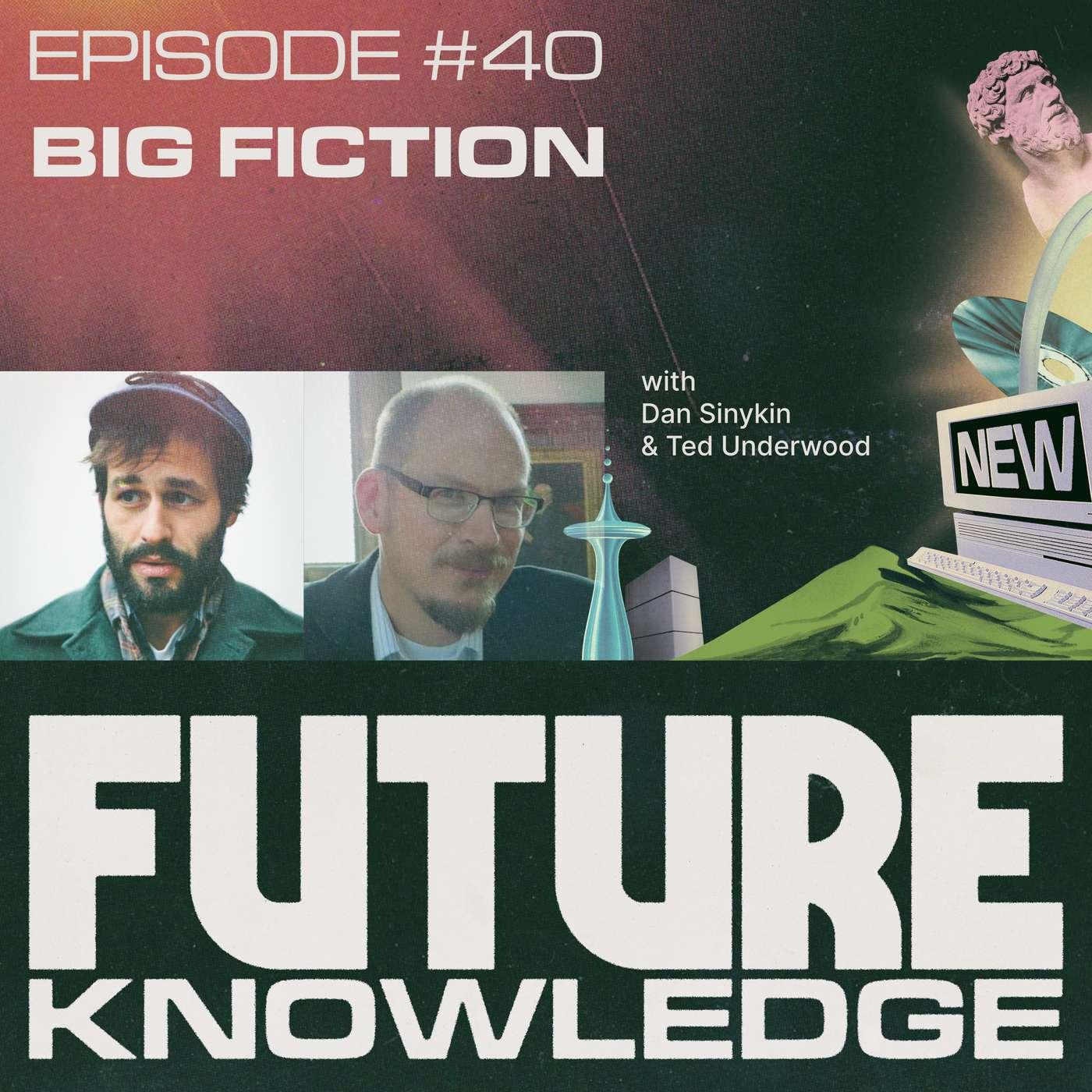
[00:00:14] Chris Freeland: In the heyday of publishing, editors from dozens of thriving publishing houses mingled with literary giants over jazz tunes or discussed art with cultural icons, all while shaping the literary landscape. Fast-forward to today. There are five major publishing houses built by endless mergers and acquisitions, and everyone's chasing the next major blockbuster.
[00:00:35] It all leaves us to ask the question: what has conglomeration actually done to the publishing industry and, most importantly, to books? Hi, everyone. I'm Chris Freeland. I'm a librarian at the Internet Archive. I wanna welcome you to today's book talk. In Big Fiction, author and Emory University professor Dan Sinykin explores how changes in the publishing industry have affected fiction, literary form, and what it means to be an author.
[00:01:00] Joining Dan for today's conversation will be Ted Underwood, a professor in the School of Information Sciences at the University of Illinois Urbana-Champaign. As we get started here today, I'd like to welcome Brewster Kahle, the Internet Archive's founder and digital librarian.
[00:01:16] Brewster Kahle: Hello from Vancouver, where we're seeing actually a lot of the small publishers crushed out of business and not having any mechanism really of participating in the digital e-book world, or much less the booksellers, because it's controlled by very few large platforms.
[00:01:32] Are we going to see a sort of Netflix of books where things can be blinked on and off based on licensing deals at the end of the month and then the books just go away and they're not allowed to be in any library? This is the sort of thing that we're seeing within the library world and heavily impact.
[00:01:49] So I'm very excited about this book and this scholarship around the effects of what happens when you have only a few large publisher platforms controlling what it is we read and what it is we know as a society. So thank you very much for coming and speaking here at the Internet Archive.
[00:02:11] Chris Freeland: Thanks, Brewster.
[00:02:12] Now I'd like to welcome Dave Hansen. Dave is the executive director of Authors Alliance, and Dave's gonna help provide a little more background for today's conversation
[00:02:21] Dave Hansen: Hi. Thank you, Chris, and thanks, Brewster. I'm really happy to be here again today. I'd like to make a couple of introductions. First, to our moderator, Ted Underwood.
[00:02:31] So Ted Underwood is a professor in the School of Information Sciences and also holds an appointment with the Department of English in the College of Liberal Arts and Sciences at the University of Illinois. After writing two books that describe 18th and 19th century literature using familiar critical methods, he turned to new opportunities created by large digital libraries.
[00:02:53] And since that time, his research has explored literary patterns that have become visible across long timelines when we consider hundreds of thousands of books at once. And he's kind of low-key famous among, I think, the digital humanities and text data mining crowd, and so really a treat to have him here today.
[00:03:11] So Ted will be moderating today, and we are going to hear first from Dan Sinykin, Assistant Professor of English with a courtesy appointment in Quantitative Theory and Methods from Emory University. In addition to Big Fiction, he's the author of American Literature and the Long Downturn: Neoliberal Apocalypse by Oxford University Press, published in 2020.
[00:03:36] And his writing has appeared all over. He's in The New York Times, Washington Post, the Los Angeles Review of Books, and elsewhere. And he is also co-founder and co-editor of the Post45 Data Collective, which peer reviews and houses post-1945 literary and cultural data on an open access website. It's a really cool resource.
[00:03:57] So with that, I am going to turn it over to Ted and Dan, and we're gonna have a really good book talk
[00:04:06] Dan Sinykin: All right. It is wonderful to be here. I am so grateful for the opportunity from the Internet Archive and from Authors Alliance. So I'm gonna begin just by saying a few words about Big Fiction and a few notes specific to this occasion.
[00:04:23] So Big Fiction is a history of what I call the conglomerate era in publishing, with special attention, as the title suggests, to fiction. Now, the publishing industry looks radically different today than it did sixty or seventy years ago. If you ported back to the 1950s, you would find a collection of smallish independent publishers.
[00:04:46] Back then, Random House had something like two hundred employees total. Today, Penguin Random House has about ten thousand employees. Now, most of those publishers back in the 1950s were run by the founders or the heirs of the founders. They were usually family businesses. Uh, and so they were run, for the most part, by book people.
[00:05:08] And book people were notoriously not terribly efficient. They were not the most effective business people. Beginning in the 1960s, large conglomerates started to consolidate the industry. They began to acquire publishers, and the velocity of this consolidation increased in the late 1970s and continued onward in subsequent decades until, by the early twenty-first century, there were just the big six conglomerates that had consolidated something like eighty percent of trade publishing.
[00:05:42] That was reduced to five in 2013 when Penguin and Random House merged. What I do in Big Fiction is I tell the story of what all of this consolidation has meant for fiction. Now, a couple notes. There was some small amount of data gathering and computational analysis that undergirds Big Fiction. I would have done more if it had been easier to acquire and study texts under copyright prior to 2021 when I did most of the work, a project that Dave Hansen and Authors Alliance have been hard at work on from one particular angle, and I'm grateful to them for that.
[00:06:19] And as Dave was saying, my interlocutor Ted is definitely low-key famous in this world. He's arguably the leading practitioner of computational literary studies, period. Now, there have been a few interesting developments in the publishing industry in just the last few years, essentially since I finished writing the book, and I just wanna note a few things about those at the outset.
[00:06:42] The Department of Justice, the US Department of Justice, sued to block Penguin Random House from acquiring Simon & Schuster on antitrust grounds, and they won that case, possibly suggesting that we are reaching some sort of limit to consolidating the industry at this point. So instead, KKR, a private equity firm maybe most well-known for bankrupting, uh, uh, Toys 'R' Us, came in and acquired Simon & Schuster.
[00:07:11] And the entrance of private equity into the publishing industry is a new development that everyone is watching. But arguably the biggest development of the 21st century is the explosion of born digital fiction. A vast amount of literature is now self-published through digital platforms like Kindle Direct Publishing, or is contributed to fan fiction sites like Archive of Our Own, or written through Wattpad, a social networking fiction writing site with tens of millions of monthly users.
[00:07:45] And each of these platforms, KDP, Archive of Our Own, and Wattpad, are different and important in substantive ways. This whole universe of internet fiction exists mostly in parallel to traditional publishing, and there are only at this point relatively few transmissions between. Now, the last thing I'll say is just a, a note about AI, which is certainly on everyone's minds in publishing today for many different reasons, actually.
[00:08:11] There's one about questions about the fair use of literature as used by AI companies in the training data to train their models. There's also already a lot of authors, especially in the KDP world, self-published writers already collaborating with AI to write fiction. And finally, within publishing, the big conglomerate publishing houses, they're looking at AI as a way to increase the efficiency and productivity of their workforce.
[00:08:40] So I'm aware that already there is... uh, Penguin Random House has PRHGPT as of recently, which I imagine they're gonna be using in-house to try to speed up things like copywriting on covers. So if you start to see some hallucinations on the covers of books from Penguin Random House, you might know the source.
[00:08:59] But okay, that's enough from me just kind of to get started. So I'm gonna say let's get into it.
[00:09:04] Ted Underwood: Thanks, Dan, and congratulations on this book, which is a real pleasure to read in, in lots of ways. And, you know, I've got, uh, several questions for you. I'm gonna start with sort of the big picture. If you could give us your sense, there's so many different ways of telling this story, the story of conglomeration and consolidation in publishing.
[00:09:23] And when we even use the word conglomeration, that tends to suggest an angle on it where we're looking at the producers, at the publishing houses, the corporate structures that organized them. And there is one way that that story can be told where that's central. I think you start off the story by saying, well, corporations need to grow, they need to demonstrate growth, and one way they can do that is by acquiring other corporations But there are also other ways of telling the story that are woven through this volume, 'cause it's a story with multiple facets.
[00:09:55] And for instance, one could focus on readers. You know, are they distracted by television, and is that cutting into the mass market part of the publishing industry? Or on the other hand, is it just the growth of readership that, you know, sort of inevitably leads to gigantism in publishing? Or be- beyond publishing and, and reading, there's the other part of it, which is publicity and distribution.
[00:10:17] And at moments you talk about the rise of the book tour and the publicity campaign, uh, as well as sort of a factor in the The new scale of publishing. So I'm not necessarily asking you to choose between these, but if, you know, if you wanted to weave these into a story about the reason for conglomeration, how would you do that?
[00:10:38] Dan Sinykin: So this whole interlocking set of pieces, and, like, the big sort of upheaval, it really... a lot of what we see today is a result of things that happened structurally at a number of different layers, from the people who own the publishing companies, to changes in how literary agents work, to how distribution was revolutionized by a company called Ingram, to the rise of chain bookstores.
[00:11:03] And a lot of this was happening in the late 1970s and the 1980s, and a lot of the impulse for it happening at that moment is because of what was going on at a very high level economically. So the 1950s and 1960s were this incredible period, one of the greatest periods of capitalist growth in the United States, but also then anywhere in the history of capitalism.
[00:11:27] And that meant that there were all these new readers, all this good time. There was just, like, expansive growth happening in books then. And in the 1970s, we had stagflation, so books are starting to cost more, wages are stagnating, people have less money to buy books. But these new conglomerates are now beholden to shareholder value and need to figure out how to institute growth, and one way they figure out how to do that is to take advantage of something that's happening by Ingram, which makes it possible to distribute trade paperbacks and hardbacks all over the country in a mass cultural way, and those are then able to be sold at new chain bookstores that are emerging in suburban shopping malls in the form of Waldenbooks and B.
[00:12:11] Dalton. And all of this creates the conditions out of which you can see changes in the kind of books that get published. So, for example, fantasy was not a genre in the way we understand it today until it was able to take advantage of exactly all those developments that I just named. There was a canny editor working in a new imprint called Del Rey, and he saw that if you took Lord of the Rings and made a really derivative, formulaic versions of it, you could turn fantasy into a genre that 12-year-olds like me in 1995 would go to the shopping mall with my mom, and we'd stop into Waldenbooks, and I'd see the Piers An- Anthony Xanth series, and I'd grab them and read them.
[00:12:56] So this is a big part of why I wrote the story. I was like, "Why did I pull Xanth off the bookshelf in 1995?" The answer is all of these developments that were interlocking, and really that moment from, like, the mid-'70s to the mid-'80s was kind of the major moment of upheaval.
[00:13:11] Ted Underwood: Fascinating. Thanks. That highlights what you think is the sort of the crucial transformation with lots of other things going on.
[00:13:17] But beyond the story of conglomeration, I would say in some ways, you know, that, that's on the title, that's on the front cover, but in some ways this is a bigger story because y- it's not just the story of the conglomerates themselves, but also of other niches in the publishing industry, the nonprofits, the independents who don't go, you know, publicly owned, and how their particular role in the market also shapes what they decide to do and the kind of fiction that they decide to publish.
[00:13:46] You could say that, you know, it's a story of conglomeration, but also at moments you hint it's more broadly trying to get us to sort of stop thinking just about individual authors of books and think about the sort of collective economic and institutional system that produces books and produces particular niches in the marketplace.
[00:14:07] And yet, here's the contradiction I wanna set up for you or wanna invite you to explain. I don't think I've ever read a literary history that is more focused on individuals than this one. At the same time as like, you know, in a sense it's about big institutional and economic forces. In fact, every page of this book has an individual story on it, uh, you know, vivid individual stories.
[00:14:30] I just looked up, you know, Bennett Cerf in the index, and I, I saw Bennett Cerf, sexism, exclamation point, of, and the, the story is so dramatic that it really needs that exclamation point. But there are also positive stories, just a lot of different individuals. Why did you decide to tell the story so much as a story about individual people given the kind of story it is?
[00:14:53] Dan Sinykin: Yes. So in my mind, you've put your finger on the great drama of big fiction, which is the drama of the individual and the system, and how these two are always in a sort of agonistic battle through publishing. And, you know, there's one particular kind of individual that tends to get elevated and focused on to the exclusion of the vast majority of the others, and that is the figure of the author.
[00:15:25] So the figure of the author, we fetishize the figure of the author in this country, and there's deep historical roots, lots of reasons why we do this. We love the fantasy of the solitary author drawing from the creativity of their imagination to deliver works of genius from their minds to ours. That's often what we go to bookstores and pull books off the bookshelf and to buy when we're buying the commodity of the book is that experience, that fantasy of authorship.
[00:15:55] That's why publishers emblazon the covers of their books with the name of the author, but hide the publisher in, in a way that's a little harder to find. But the problem with this vision is that if you start to pay attention to how books are made, you, uh, you start to see a, a very different picture. And now I'm hardly the first person to burst this bubble.
[00:16:15] I mean, I think you and I, Ted, share something like a structuralist or even post-structuralist conception of ideation and authorship, how cognition works. But I'm coming at it from a very, like, specific angle of the nitty-gritty of publishing. And so I posit something in this book that I call conglomerate Authorship, which I offer as an alternative to the romance of the singular genius.
[00:16:41] And so on one end, you know, there are many books that are sold to us as solo author that are actually just blatantly industrial productions. So like the Hardy Boys and Nancy Drew were actually written by what's called the Stratemeyer Syndicate, but all packaged under a single fake name. Or the vastly popular mid-century mystery writer, Erle Stanley Gardner, who created Perry Mason, had a fiction factory on his California ranch.
[00:17:04] But I argue in the book that even major figures like Joan Didion or Cormac McCarthy or Toni Morrison are themselves part of this conglomerate authorship, this collective authorship. Now, the reason, and this, this includes a bureaucratic assemblage, this conglomerate authorship is the effect or the output of a bureaucratic assemblage of agents, editors, marketers, wholesalers, book buyers, and more.
[00:17:25] And these are all the individuals who populate the pages of the book. And so one of the things I'm doing is try to show how this disseminated, distributed collection of characters all, like decisions that they're making under the particular constraints of systems is producing part of a feedback loop that works its way all the way back to the author and all the way out to the reader through any various numbers of mediated steps that affects the very actual words that appear on the page that we read.
[00:17:59] Ted Underwood: Right. So you talk about sometimes as not just the, you know, author's name on the title page, but you're one to foreground the people who are hidden in the colophon or, you know, the publisher's mark, and very small, but there's a lot of people in that. And yet I wanna sort of press you a little bit more on the decisions you make in the way to tell the story, because you could foreground publishers, you could tell this as a story of publishing houses, and the agents would really be the corporations.
[00:18:29] But that is not the way the story is told. These are people who at one day in 1990, you know, stood up, and what is sort of your motivation for telling it in such a dramatic way?
[00:18:40] Dan Sinykin: Yeah, there are several. It's, you know, tactical in one is that I was aiming with this book for it to hopefully attract readers outside of the academy.
[00:18:51] First was looking at people in New York publishing and hoping they would read it, but really I wrote it so that hopefully anyone who enjoys fiction might find the backstory interesting. And to make that story compelling and dramatic, I kept finding all these stories compelling, dramatic people. And so it, that way it's a way to hopefully keep people turning The pages.
[00:19:11] So that's one. Another is that as I studied for this book, the more that I found... The more I found that literary history and what we understand of it is full of contingencies. It's not a deterministic story. Just because conglomeration can appear in retrospect like this one gradually proceeding deterministic monster going onward and growing, there's always the idiosyncrasies of individual people making decisions change literary history.
[00:19:38] I mean, a great example of that is how W.W. Norton... There's a whole chapter dedicated to W.W. Norton, the last main chapter of the book. It's about independence. The way it has escaped conglomeration is just the guy, William Warder Norton, died young. His wife sold the company to its employees. It became employee-owned, and then it teamed up with a Cornell University professor and a M.H.
[00:20:01] Abrams, who created the Norton Anthology, and that spawned this whole series of books that became incredibly profitable for W.W. Norton. All of this meant that decades later, as an employee-owned company with a strong college division that financed it extremely well, it could do things on the trade side starting in the 1990s that no one else could do.
[00:20:21] It could continue to reject and rebuff conglomerate people who wanted to buy it, and then it had enough Success from the college side that it could do weird things. So there were-- they hired an editor named Jerry Howard, and Jerry Howard could get away with bringing in a guy who his books didn't look like anyone would be interested in them, named Chuck Palahniuk publish a book called Fight Club.
[00:20:42] Or they could publish Patrick O'Brian, who had been tried twice before in the United States and failed twice before in the United States. And in nineteen ninety, they could try Master and Commander, you know, massive success. But that wouldn't have happened in the conglomerates. They wouldn't have tried it after two fails.
[00:20:57] But by going down to the level of the individual, you're able to see, make sense of in ways that you wouldn't if you had just narrated it from the top level abstraction.
[00:21:06] Ted Underwood: There are interesting exceptions and countercurrents and individual people who make a difference. One of the interesting sort of echoes of this is the role of autofiction in the story, which in some ways is a fictional version of the foregrounding of individuals that we've been talking about and the way you tell the story.
[00:21:30] But it has complicated implications, and it's hard to sort of figure out quite what the relationship of autofiction foregrounding the person of the writer, maybe as a character in the story, implicitly or explicitly, what relation that has to conglomeration. And I think there may be a couple different ways of telling that you explore, and that may both be true, but I'm kind of inviting you to explore them.
[00:21:53] At one moment, I think you quote maybe Joe Moran as saying, "The new demands for publicity", you know, these publicity campaigns, author photos. Autofiction is in a way a reflection of that new conglomerate scale publicity industry that was making authors into kind of mini celebrities. So kind of an echo of the corporate pressures on fiction.
[00:22:15] But there are other moments where you say, like, autofiction is authors kind of trying to claw back some agency from this massive system and foreground an older version of authorial power. So can it be both of those things? How do you see the story of autofiction?
[00:22:33] Dan Sinykin: Yeah. I mean, it is what, you know, academics might sometimes call overdetermined, which is just to say that there's a lot of reasons why it works, and they're coming from different directions.
[00:22:43] And some of them, yes, as you say, are intention. So there's that shibboleth, write what you know, and writers are often always, you know, drawing consciously or unconsciously at some level from their life. And when... And as writing has become increasingly professionalized in the last several decades, increasingly reliant on marketing and publicity, exactly as you say, this fact that an author is becoming part of the promotion, is becoming a brand unto themself, is becoming more and more involved with the bureaucratic publishing environment, it becomes something that gets folded into the writing.
[00:23:18] And an argument I make across the book is this isn't only the case in autofiction, that there's a kind of almost science fiction in this conglomerate authorship, ways in which allegories of conglomeration make their way into books. And autofiction is kind of the most explicit version of how that happens.
[00:23:34] And in the explicitness, that's part of authors taking some autonomy back, taking some control back. Mm. Making themselves the agent, the protagonist, the one who is doing the actions, who is, you know, in... When Ben Lerner writes in 10/04 about his relationship with his agent and the deal they made to sell the book that we are reading, he's getting a chance to voice his own concerns.
[00:23:59] He's getting a chance to voice his own ambivalences. And in that way, he's taking control back. But for his publisher, for FSG, by making Ben the central character of 10/04, it's also putting him even more front and center as the brand, more front and center as a sort of marketing occasion, and hiding further the bureaucratic publishing machine which is informing the elements of publishing.
[00:24:23] So on the one hand, for the conglomerate, autofiction allows them to kind of still foreground the author, and the author gets to claw back some agency. It's a win-win
[00:24:36] Ted Underwood: Yeah. Authors can sort of seize what's being done and use that for their own personal brand and agency.
[00:24:42] Dan Sinykin: Exactly.
[00:24:44] Ted Underwood: I wanna talk a little bit about the role that other media have and are increasingly having, other media ranging from television to sort of fanfic on the internet.
[00:24:55] But I think one maybe a bridge to that would be to talk a little bit about this phenomenon of literary genre fiction, which is the boundaries blurring between what we think of as literary trade publishing and the sort of high end of trade, and then, you know, noir, detective, science fiction. Colson Whitehead, you say, I think at one point is sort of the king of literary genre, but there are many, many other examples, and it might extend even down into things we don't think of as genre fiction but that might be, that written by, you know, say Toni Morrison or someone.
[00:25:28] What role... This is speculation on my part, but could part of that story be television eating into the mass market side and sort of- genre fiction being pushed toward literature as much as literature wanting to, the literary authors reaching out to use the genre tropes? What story would you tell about it?
[00:25:47] Dan Sinykin: Yeah, no, I, I think there's no question. And actually, there's a great book that just came out in the last few weeks by a great scholar of publishing named Evan Briar called Novel Competition, and he really tells that story about what the emergence of television and other forms of mass culture did to fiction and novels, and how novelists responded.
[00:26:08] And undoubtedly, the competition from television shaped some of the drive to make literary fiction more popularly accessible through the use of genre. One thing that I found sort of late in the writing of this book was that the terms genre fiction and literary fiction didn't actually even have circulation.
[00:26:29] I mean, this was Andrew Goldstone published a great article on this very recently about how genre fiction as a term only emerged in the 1970s, and literary fiction postdates that. Literary fiction only emerges in the 1980s. And the argument that I make is that literary fiction emerged in that specific moment as a, it's a, it's another genre, and it's a form of- Mm
[00:26:51] of commercialization. It's a way on the market to distinguish literary fiction from genre fiction only after genre fiction came. I mean, we had specific genres. We had mystery, we had Western, we had romance. But to think of them all as a specific kind of thing together that we call genre, in the '50s and '60s, mass market publishers were publishing all of these together.
[00:27:11] There weren't these distinctions. These distinctions are part of the process that I described of that moment of the mid-'70s, late '70s, when conglomeration intensified in a world of stagflation and publishers were starting to think about, how can we make novels more effective and replicable mass culture items?
[00:27:31] And that's when genre fiction became this reified category. It was really hard to publish literary fiction then in the late '70s and early '80s until this enterprising editor named Gary Fisketjon at Random House started Vintage Contemporaries, which had these... And big part of that series in 1984 when they launched was these covers.
[00:27:51] The cover of Big Fiction is an homage to the covers of Vintage Contemporaries. And they published Jay McInerney, who was a friend of Gary Fisketjon's from college, Bright Lights, Big City Massive hit. They published it as a paperback first for a lot of reasons that I could go into, but that was not done at the time.
[00:28:09] And by doing that, they resuscitated this thing that was now called literary fiction.
[00:28:14] Chris Freeland: Hmm.
[00:28:15] Dan Sinykin: Um, and very quickly, this thing called literary fiction needed to figure out other ways in order to be profitable at conglomerate houses, and one of the first geniuses to figure out how to do that was Cormac McCarthy, who changed his whole strategy of publishing with All the Pretty Horses in 1992, which is like a Louis L'Amour Western in a Cormac McCarthy voice, which is unlike anything he had done before.
[00:28:38] There's a whole story to tell there too, but enough for now.
[00:28:41] Ted Underwood: Thanks. That's fascinating, and thanks for the lead to novel competition, among other things. Let's move a little bit toward the, the present and sort of what's happening and what might happen. One of the interesting things in your conclusion is you acknowledge a lot of contemporary trends that people have framed as sort of challenging the dominant publishing model.
[00:29:05] And I mean fanfic, self-publishing, and Amazon's sort of alliance with the self-publishing ecosystem, social media, and we could also gesture at, you know, the older sorts of competition, like from television and film, but also especially audiobooks. Audiobooks have been booming. You acknowledge all of that But at the same time, you end up saying it's still the conglomerate era.
[00:29:29] And the way you put it, I think, is interesting. It's not that these things aren't happening necessarily, but that the conglomerate publishers don't really care. And from their perspective, these forces are not-- they don't loom large. Am I presenting that right? And, and do you think that's still true? Do you think that will continue to be true even if we add in new media, new f- like interactive forms of fanfic mediated by artificial intelligence?
[00:30:00] Will that still be sort of not something that conglomerates need to care about?
[00:30:05] Dan Sinykin: So I would say y- there's some yes and some no there. I would say in terms of thinking about the born digital writing stuff at Wattpad, at AO3, at KDP, largely the conglomerate mainstream traditional publishing largely doesn't care except when you have a Colleen Hoover or an E.L.
[00:30:23] James or an Andy Weir, something kind of pop through and they're like, "We can pull them into our sphere and make a bunch of money on that." And so, you know, people are paying attention. I suspect they're increasingly paying attention to what's happening in those spheres in order just to pluck, you know?
[00:30:39] And, uh, in terms of audiobooks though, a way that the conglomerate publishers have made a great deal of money in the twenty-first century is by-- so subsidiary rights is a major form of how publishers earn money, which is rights beyond the original publication of the book in print. And audiobooks has been a huge source of profits for the last fifteen years and continues to grow at a rapid pace, and this has been a huge boon for publishers and has helped keep them in the black.
[00:31:06] So they've really leaned into kind of audio rights, and they've also leaned into foreign rights and trying to expand the market for US-based books in, say, China or India or places around the world. That's another place where they've been looking for profits. But yeah, the sort of born digital stuff, like one of the things that's gonna be really interesting to watch in the coming years is whether or not these two Currently, largely parallel universes figure out ways to merge.
[00:31:35] Something like Wattpad is already trying to come in as a competitor. You know, you've got an interesting situation in terms of this question of conglomerate authorship that I talk about where, you know, I'm saying cognition happens in the mainstream publishing books through all these distributed forces.
[00:31:50] But if you actually look at something like Wattpad or Archive of Our Own, it becomes suddenly much more literal. Archive of Our Own, a fan fiction site, you've got these people creating these genres as a kind of comments. Like, no one's claiming this sort of copyright of authorship on it, and then you get these scandals when people do try to take something from a-- Archive of Our Own and bring it over and claim it under their own copyright, and you-- I mean, there's incredible piece on kind of wolf erotica genre, the Omegaverse, different from Alexandra Alter in The New York Times, about one of the scandals when this happens, when something that was truly the creation, a genre, a whole set of tropes, a whole set of conventions created in the commons.
[00:32:33] And Wattpad is like, you know, created with constant feedback from readership, but then you've got this situation where those kind of become privatized. And this is a question-- like, a way that, like, thinking about how authorship is changing in the platform age is something that I think is really fascinating.
[00:32:52] Ted Underwood: Thanks. That's-- Yeah, that's a fascinating story. Can I ask you to comment on sort of related to this, the effect of other media? Well, there's this thesis out there, option aesthetics. J.D. Porter, Laura McGrath, and Xander Manshell sort of argue that authors are now kind of writing for Film producers, because ultimately they can make a lot of money if their book is optioned.
[00:33:15] And so that, that shapes the way novels are written now. Um, how, how important is that in this picture? That, and are the conglomerates aware of that? Does that, is it a problem for them? Is it a plus for them?
[00:33:28] Dan Sinykin: Yeah, so this fits into this idea that sociologists talk about as anticipatory socialization. So my kind of theory of the author is that they unconsciously or consciously have this sense of all of these forces that are gonna help make them a success, and that gets built into the way they design their books.
[00:33:47] And as you say, like, one of the kind of the biggest lotteries you can enter into as an author is for getting optioned for film and TV. Now, that's a whole other... Like, it gets really complicated. So many books are optioned and then never pays off, but, you know, the author maybe already collected their check.
[00:34:04] And yeah, that piece does a good job of trying to suggest some of the ways that that is shaping how people are designing books. Like, if you're designing a book to get taken up by TV, there needs to be a possibility of seriality built into the form of the writing itself. How are you gonna do that? What's important?
[00:34:22] How can you have a kind of cast of characters that could double over into TV- Mm-hmm ... um, specifically? And so yes, I mean, I don't know how widespread. And there's also a difference between the people who are aiming... You know, there's, we still live in a world of a broad distinction between popularity and prestige, and there's all the folks who are really gunning for the big money who are gonna be trying to work with a literary agent and go to a conglomerate.
[00:34:50] But there's also, like, a thriving sphere of small non-profits like New York Review Books or Transit, Deep Vellum, Graywolf, Coffee House On and on and on and on and on. And here folks are avoiding perhaps some of those more profit-driven motives that affect the form of their work.
[00:35:08] Ted Underwood: Fascinating. Although I guess was Erasure originally Graywolf, and then that, that did just get made into a movie, but maybe that's not as, as-
[00:35:16] Dan Sinykin: That's a complicated story too.
[00:35:18] I mean, that's a fascinating story. I mean, that required... You know, Percival Everett's a writer who's huge. I mean, his, one of the biggest books of the year in 2024 is James, his rewriting of Huckleberry Finn- Yeah ... published with Doubleday for at minimum $500,000 advance, maybe a lot more than that. But here is a guy who's been writing in the trenches for three and a half decades.
[00:35:40] His first books were published, uh, in the '80s with big commercial presses, but they failed, and he would've been done, but he went to Graywolf, which was then a quite small, in the early mid-'90s, a small nonprofit, and he teamed up with Fiona McCrae, who was a new editor there, and she became his champion. So she published book after book of his at this small press.
[00:36:01] Didn't sell a lot of copies. Erasure actually weirdly was published, uh, one outlier published by University of New England Press during those years. Oh,
[00:36:08] Dave Hansen: oh.
[00:36:08] Dan Sinykin: Then was later reissued by Graywolf. But he was not writing books that would be celebrated or published or would work with conglomerate presses for decades, and only in the last few years after building a following, building critical, like, celebration was he able to write the book The Trees that made him a finalist for the Booker.
[00:36:28] Fiona McCrae finally retires. He can take all of his cultural capital he built over decades and kind of put it into this advance in Doubleday, which is his first one not for Graywolf in three decades other than Erasure. So anyway, and then Cord Jefferson picking up Erasure as its own idiosyncratic story.
[00:36:45] So the contingencies, the contingencies.
[00:36:47] Ted Underwood: Yeah. Again, individuals have their own stories.
[00:36:52] Dave Hansen: So I promised you an AI question. I told you we always get an AI question, and you got a little bit into it. But there was one about the idea of a Penguin Random House GPT or something like that, right? Is interesting.
[00:37:05] And so the question is do you think conglomerates are really against AI? We've seen a lot of public kind of posturing, particularly around copyright. Or is it just AI that they can't control?
[00:37:15] Dan Sinykin: Oh, it's just AI that they can't control, absolutely. You know, I mean, the new... So Penguin Random House, which is the world's largest trade publisher, they had to pay $200 million to Simon & Schuster after their failed bid, and so they had to cut their global CEO and their US CEO both got fired.
[00:37:33] The new CEO at Penguin Random House revealed in an interview that he's, like, all in for AI insofar as it can help rationalize, make more efficient the work that they do at the house. So I think these Big Five conglomerates, their CEOs, their job is find whatever mechanisms you can. When you're in a business of books, of culture that is not In and of itself designed to constantly grow every quarter, then you gotta get creative and always think about where am I gonna find that little edge?
[00:38:07] And AI is right now the place that everyone in C-suites across America are looking to find that edge, and the heads of the Big Five are no different.
[00:38:15] Dave Hansen: So another one that hadn't occurred to me at all reading the book that I think is really interesting is whether you have an opinion on the relative disinterest, particularly among the, the large conglomerates in short fiction, given, you know, in other areas of entertainment media, short formats are amongst the most popular and I think becoming even more popular now.
[00:38:36] Dan Sinykin: Yeah, that's a really interesting question. On the one hand, short stories have a terrible reputation. Books of short stories, like there's... You know, I would look at memos and stuff from back in the '90s being like, "Whatever it is, even if it's short stories, just like slap the name novel on the top of it so that it'll actually sell."
[00:38:54] And that's often the case. People, agents are often trying to work with writers to take... How can they take their MFA short story collections and kind of mold it into something that looks like a novel for commercial reasons. But the other piece of that is that novellas are having something like a renaissance, and both in big trade publishing, but it also, you, you can see it kind of everywhere, also in academic publishing.
[00:39:17] There's this, this sort of fondness for fast short books, books that are, you know, run 70, 80 pages, maybe up to 110 pages. Absolutely because of what Anna Kornbluh, another critic, calls in a recent book this desire for immediacy, this sense that the kind of a push... She really worries that there's this push towards simplification, reduction, immediate gratification, and that this is part of the motive behind this desire for books in that kind of 70 to 110-page novella range that for that reason might be seeing something like a moment.
[00:39:54] Dave Hansen: That's really interesting. The effect of the rise of digital platforms as kind of the dominant means of distribution and kind of along with that, some of these other sort of leverage buyout companies that have dominated the space, like Overdrive. What is their effect on what's being written now?
[00:40:13] Dan Sinykin: Yeah, that is a really good question.
[00:40:17] There was a good piece a few years ago by Nick Levy, I think, in Journal Post 45, thinking about how, you know, if you're able to write on a platform, suddenly it makes the idea of seriality make a lot more sense. So in some ways, what we're seeing is a return to the kind of 19th century, like the triple decker 19th century Victorian novel.
[00:40:41] There was the compilation of Charles Dickens writing monthly segments over and over and over again. If you're writing for something like Wattpad or if you're writing on KDP, it can make a lot more business sense or just aesthetic sense, formal sense to write in installations rather than to just like envision one kind of enclosed volume where the story begins and ends.
[00:41:05] So that's what I see as maybe the most obvious, like aesthetic formal shift that occurs when you kind of break the technology of the book onto the digital platform.
[00:41:17] Dave Hansen: So I, I think I mentioned last time we talked, one of my favorite parts of the book was this extensive glossary of publishing figures that you include.
[00:41:26] And so this is sort of a fun question, but you have a lot of kind of crazy characters that are highlighted throughout the book. Who was the most interesting to you?
[00:41:36] Dan Sinykin: Oh, man. It's such a hard question. But I was really delighted to find this guy named Jim Sitter. So he's not a name people know, and I found him in a really weird way.
[00:41:50] I was doing an event at Washington University in St. Louis. Professor there put me in touch with one of their students who was doing a undergrad thesis on gentrification and nonprofit publishers in Minneapolis, and she had been talking to this guy. She's like, "You should talk to this guy. Here's his email.
[00:42:05] His name's Jim Sitter." I got in touch with this guy. He's in Minnesota. He was the architect of nonprofit publishing in the United States. Like, he was the one. He pulled Graywolf Press to the Twin Cities from Washington State. He pulled Coffee House Press, which had been called Toothpaste, up from Iowa City, and he was their sort of consultant who worked with them and Milkweed Editions, um, to figure out what it would look like to become nonprofits.
[00:42:31] He was strategizing at dinners with Toni Morrison and the head of the Walker Art Center, then when they were both on the National Endowment for Arts kind of council. And this guy eventually went to New York City and, like, got these massive grants to allow it to become a nat- nationwide movement. And now the guy's not working in that business anymore.
[00:42:50] He's still hanging out in Minneapolis, and he's sitting. He's got an incredible mind, and he's a talker, and he's just, like, got all these stories. And so I got in touch with him, and we just did interview after interview where he would tell me in incredible detail these stories about running into Alan Kornblum, the founder of Coffee House Press, and how they first met and what that e- e- exchange was like and what Alan Kornblum was like in his, you know, garage working on a Platen press doing letterpress in the middle of the night listening to baseball.
[00:43:18] So, you know, I, he's just got endless stories out of Jim Sitter. And after the book was done and it was about to get published, I went up to Minnesota to meet him in person, and he took me into this, like, old school, the Monte Carlo in the Warehouse District in Minnesota. Everyone knew him there. And we got this little room, and he brought this kind of lost and found, or the kind of show and tell of all these documents he'd had from over the years and spread them out over a couple tables while we're having martinis in, at, at 2:00 in the afternoon. So it was incredible
[00:43:49] Dave Hansen: That does sound like a fun one. Well, and I guess my comment on that as I was reading the book was thinking like, how much do we lose from having such levels of consolidation where, like, the individual personality role is in some ways diminished compared to publishing as it was?
[00:44:06] Dan Sinykin: I mean, I read a Substack post a couple days ago saying, you know, a report from someone in the industry who said, "You know, when I was acquiring one debut book, it needed to be read at a, at a conglomerate house. It needed to be read by 16 people before we could acquire it." And if you need 16 people to look at a book and agree to acquire it, you know, you're gonna reduce the risk to a sort of institutional common sense.
[00:44:30] And it might be, like, an extreme case, but nevertheless, you know, the kind of aesthetic risk you can take at a conglomerate publishing house is reduced by any number of sort of built-in mechanisms to kind of increase predictability and profit and decrease risk.
[00:44:44] Dave Hansen: Yeah. No, I mean, it makes sense. They're trying to operate a big business.
[00:44:48] Thank you both. This was such an incredible talk. I really appreciate you doing this.
[00:44:54] Chris Freeland: And for thank yous, and a thank you to Dan and Ted for such a great conversation today, to Dave Hansen and Authors Alliance for co-hosting the session. Thank you all, everyone. Have a great day.
[00:45:05] thanks for joining us on this journey into the future of knowledge. Be sure to follow the show. New episodes, drop every other Wednesday with bold ideas, fresh insights, and the voices shaping tomorrow.
