

Chantelle Lewis: Hey, come sit by the fire with me. If you were here last time, welcome back. And if you're new, welcome to the campfire. There's no shame here, only curiosity. So today we're talking about why your brain sometimes reacts like everything is a fucking bear. And I have possibly the perfect story to explain this one. Unfortunately, it is at my expense. So let's get into it. Have you ever had to pee while you're out fishing? Because this is something they don't put in the tourism commercials. They show you the beautiful lake, the sunrise, the fish jumping. They don't show somebody crawling into the bushes at seven o'clock in the morning trying not to piss themselves. Hell no. So, early morning fishing trip, coffee's done its job and damned I had to go for a pee that is. We pull up along the shoreline, I climb out of the boat, head into the bushes, find myself a nice private spot, you know, one without any poison ivy or any of that kind of stuff. Get all situated and I'm just about to pee and snap. Branch. Branch breaks in the bush. And then a shuffle, shuffle. It's a little ways away, but I can hear something moving around and it sounds big. Let me tell you, those pants came up so fucking fast, I don't even remember doing it. I think my nervous system actually dressed me. Then I took off. Full sprint. Right back to the boat. I swear I launched myself into that thing from like ten feet away. I'm pushing us off the shoreline, my heart's pounding, the adrenaline's going. I look behind me because clearly there is going to be a goddamn giant big old black bear coming out of the bush. However, out of the bushes waddles a fat squirrel. I mean, this this little chunky little bastard was just looking for snacks. He wasn't chasing me. He wasn't threatening me. In fact, it was like Alvin's overweight little cousin. He was probably just wondering why some half-dressed lunatic just launched themselves into a boat. Once my heart returned from somewhere near my throat, I started laughing. And so did the other person in the boat because my brain hadn't waited to find out actually what had made the noise. It heard the snap, it heard the noise, and it went bare immediately. And that, well, that's what we're talking about today. So remember last episode I introduced the living forest? Well, today you're meeting somebody who spends a lot of time up in the Force Watchtower. I call them Frank. Frank isn't literally a part of your brain, but ⁓ it's a name that we're going to give a part of your brain. It's our campfire character for understanding some of the brain's protective threat detection systems. The amygdala is part of that story, along with other interconnected brain regions, but we're gonna call the alarm happy bastard Frank because it's easier to remember, and Frank has one job. That's to keep your ass alive. And Frank takes that job very fucking seriously. Frank doesn't care that you have a presentation at nine, doesn't care that you're trying to communicate calmly with your spouse. Frank doesn't care that the thing in the bushes is just a squirrel. If it's potential danger, alarm. And then here's the really cool part. Your brain isn't simply waiting for the world to happen and then calmly deciding what everything means. It's actually constantly using incoming information alongside past experiences to make predictions. So when I heard that branch snap, My brain had incomplete information. All it knew was that something moved, I'm in the bush, there could be bears, bears exist. And apparently, that was enough for my Frank to go, we're fucked, run. Now. So from a survival perspective, that makes sense. If our ancestors heard something in the bushes and spent 20 minutes debating what species it might be. Some of them would have definitely become lunch. It's often safer for a protective system to generate a false alarm than to miss a genuine threat. But the problem is that most of today's bears aren't actually bears. So your boss says, Can I talk to you? Bear. Your spouse says, We need to talk, big fucking bear. Your teenager sends a text that just says, K. Apparently That's bear. Someone doesn't respond to your text for a little while. Or you make a mistake, or someone's tone changes in a in a conversation, or you walk into a room and people suddenly stop talking. Well, Frank is up in that watchtower with binoculars saying, I don't like this shit. But thankfully, Frank isn't working alone. We also have what we call the forest guide. Again, this isn't one literal book. brain structure sitting in your head wearing hiking boots. The guide is our way of talking about the systems that help us pause, evaluate information, plan, regulate impulses, consider the context, and make more deliberate decisions, including the important functions associated with the prefrontal brain networks. I know a lot of big words in that one. So Frank hears snap, noise in the bush, and screams BAM But then the guide is trying to go, could we maybe look before we launch ourselves ten feet into a fishing boat? Cause that seems dangerous too. The problem is when our stress response gets really fired up, some of those higher order thinking abilities can become harder to access effectively. Which is why have you ever been in an argument and said the dumbest fucking thing imaginable? Then three hours later you're in the shower and suddenly you've got the perfect response. Like where the fuck was that earlier? Your guide finally got a word in. Past experiences matter too. Your brain learns patterns. That's where our hiking trails metaphor becomes useful. Imagine walking the same trail through the woods every day, and eventually you don't have to think that much about where you're going. The trail becomes familiar and it's so much easier. Well, brains do something similar with frequently repeated patterns of thinking and also of feeling and behaving. And that can be incredibly useful until the old trail starts taking you somewhere you no longer want to go. So let me give you an example. We're gonna call this person Mike. ⁓ again this is a story you know I have permission to share, however, we have changed the names and a bit of the info. So anyway, Mike's a husband, a dad, a Hard worker, works construction, loves the family. And Mike came in saying, So apparently I have an anger problem. So I asked, Do you think you have an anger problem? And the response was nope. According to Mike, everybody else just pissed him off. So you know what? Fair enough. So instead of arguing about whether Mike was angry, we just got curious about it. So Mike grew up in a home where moods actually really mattered. Let's be honest, in all of our homes and all of our lives, moods do matter. Some days dad came through the door and everything was fine. Other days, not so much. So as a kid, Mike learned to pay attention. How hard did the truck door slam? What did dad's footsteps sound like? What was the tone of the voice he was using? Was everybody quiet? Little Mike became incredibly good at reading the room. Why? Because it helped him predict what might happen next. That wasn't a weakness, it was an adaptation. Frank got really fucking good up in Mike's watchtower. Fast forward decades, Mike has a different home, different relationship, different life. So one evening his wife says to him, We need to talk. All she wants to do is she just wants to talk about the budget and talk about the fact that groceries are getting more expensive. That's it. There's nobody threatening anybody. You know, nothing big is actually happening. But Mike's body reacts before he has fully worked through what is happening, and his jaw tightens, his heart rate changes, his muscles tense up, and he becomes very defensive. And suddenly he's snapping at her. His wife responds, and now he's louder. And five minutes later, Mike is sitting there out in his truck thinking, why the fuck do I do this? Because inside of Mike's brain, Frank had found an old trail. Conflict had historically meant prepare yourself. The problem wasn't that Mike's brain was defective, the protective response made sense in the context in the context where it developed. It wasn't just particularly useful anymore. And this is the part that I really want you to hear. Understanding this and understanding that, you know, the brain was looking at old pathways doesn't excuse Mike's behavior. Right? His wife still deserves to be treated respectfully. Mike is still responsible for what Mike does. Understanding gives Mike somewhere to intervene, somewhere to start. Instead of saying to himself, I'm just an asshole, and repeating the behaviors, we can ask, What happened right before Frank in the brain sounded the alarm? And that gives us an actionable behavior to go on. And this is where neuroplasticity becomes so important. Old trails can be strong, but we can practice new ones. Mike can notice the jaw tightening, pause, feel his feet, take a slower breath, ask for a minute before continuing the conversation, and come back to it. He can listen, actually find out what she wants to talk about, and it gives him the opportunity to respond differently. And every time he practices that, he's giving his nervous system another experience. It's no longer the idea that conflict equals catastrophe, but instead conflict can happen and I can stay present again and again and again. And that's how the new trail starts to become easier to walk. It takes practice and it takes time, but it is possible. Neuroplasticity is amazing. So here's today's trail marker. The next time you feel a big reaction beginning, don't immediately tell yourself to calm the fuck down, and don't shame yourself for having it. Instead pause, look around, and ask, is this actually a bear or might it be a squirrel? Maybe it is a bear, maybe it is something, maybe there is real danger that's existing, and we want the protective systems capable of responding when we genuinely need them. But sometimes it's just discomfort, uncertainty, an old association. Or it might be a tone that we recognize from the past or a difficult conversation we don't really want to have, but we need to. Or it could just be a fat squirrel looking for breakfast. Simply noticing the difference gives our guide a chance to join the conversation. It gives our prefrontal cortex, which is the guide, the ability to weigh in on what's happening. I mean, let's be honest, sometimes if we all just took and paused and ⁓ had one moment breathe. Shit wouldn't hit the fan as much. We'd actually be able to get through stuff and we wouldn't be so fucking stressed out in today's world, like when an email comes through or notification on your phone instead of just freaking. If you took a minute, took a deep breath, read it, and actually tried to identify why you're reacting the way you're reacting, we might be able to respond a little bit easier. Anyways, so if Frank the Amygdala loses their shit this week. Don't hate Frank. Frank's doing the job that the watchtower learned to do. Instead, get curious. What did Frank notice? What old trail did your brain find? And what does the guide the prefrontal cortex, know about what's happening right now? What does it actually identify? Can it see if it's actually a danger? What new trail do I want to practice? That's roots in real life. It's not perfection. It's awareness, regulation, choice, repetition. So take a deep breath, unclench jaw, let your shoulders soften and drop down from your ears. Feel your feet underneath you and notice you're here. Remember you are not broken. You are becoming. Every challenge you've faced, every lesson you've learned, and every step you've taken has shaped the person you are today. So keep tending to your roots, because everything that grows above the surface begins below it. There is beauty in the struggle, there is wisdom in uncertainty, there is growth in discomfort, and there is always a little magic waiting to be found in the mess. Because that, my friends, is the messy magic of being human. So thanks for sitting by the fire with me. And remember, before you launch yourself ten feet into a fishing boat with your hat, your pants half done up, maybe check for squirrels. I'll see you around the fire. Have a good day. Until next time.
OM DETTA AVSNITT
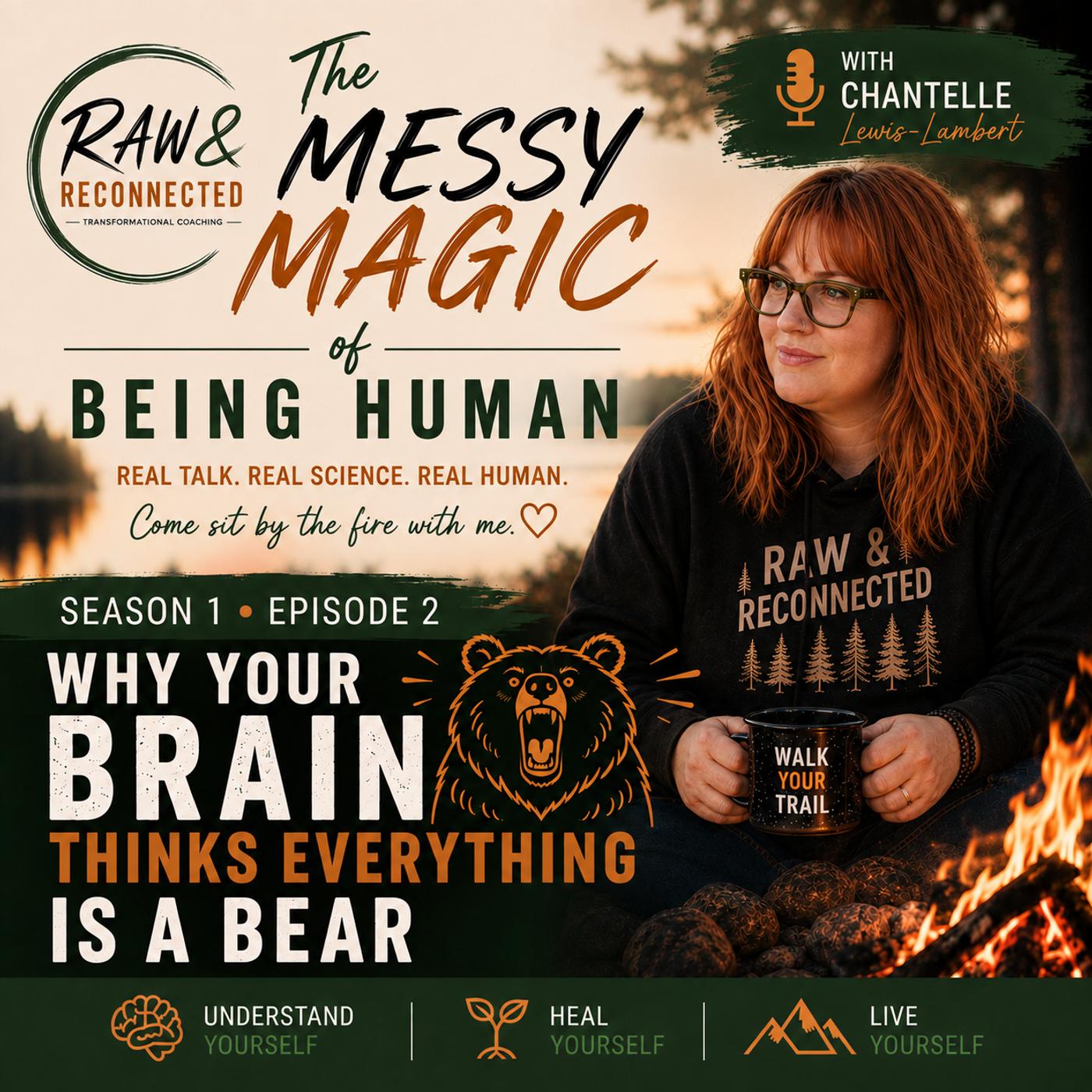
The conversation explores the brain's protective threat detection systems, using the metaphor of a forest and its inhabitants. It delves into the roles of 'Frank' (the amygdala) and the 'forest guide' (the prefrontal cortex) in managing reactions to perceived threats and old patterns of thinking.
Takeaways
- Protective threat detection systems can generate false alarms in response to perceived danger.
- Neuroplasticity allows for the creation of new thought patterns and responses to perceived threats.
Chapters
Engelsk
Kanada
tydligt innehåll
UTSKRIFT 🔗
SÖK TIDIGARE AVSNITT
Sök efter tidigare avsnitt från Raw & Reconnected.
Ansvarsfriskrivning: Podcasten och konstverket som är inbäddat på den här sidan är från Chantelle Lewis-Lambert, som är dess ägares egendom och inte anslutet till eller godkänt av Listen Notes, Inc.
REDIGERA
Tack för att du hjälper till att hålla databasen över podcaster uppdaterad.
