

ОБ ЭТОМ ЭПИЗОДЕ
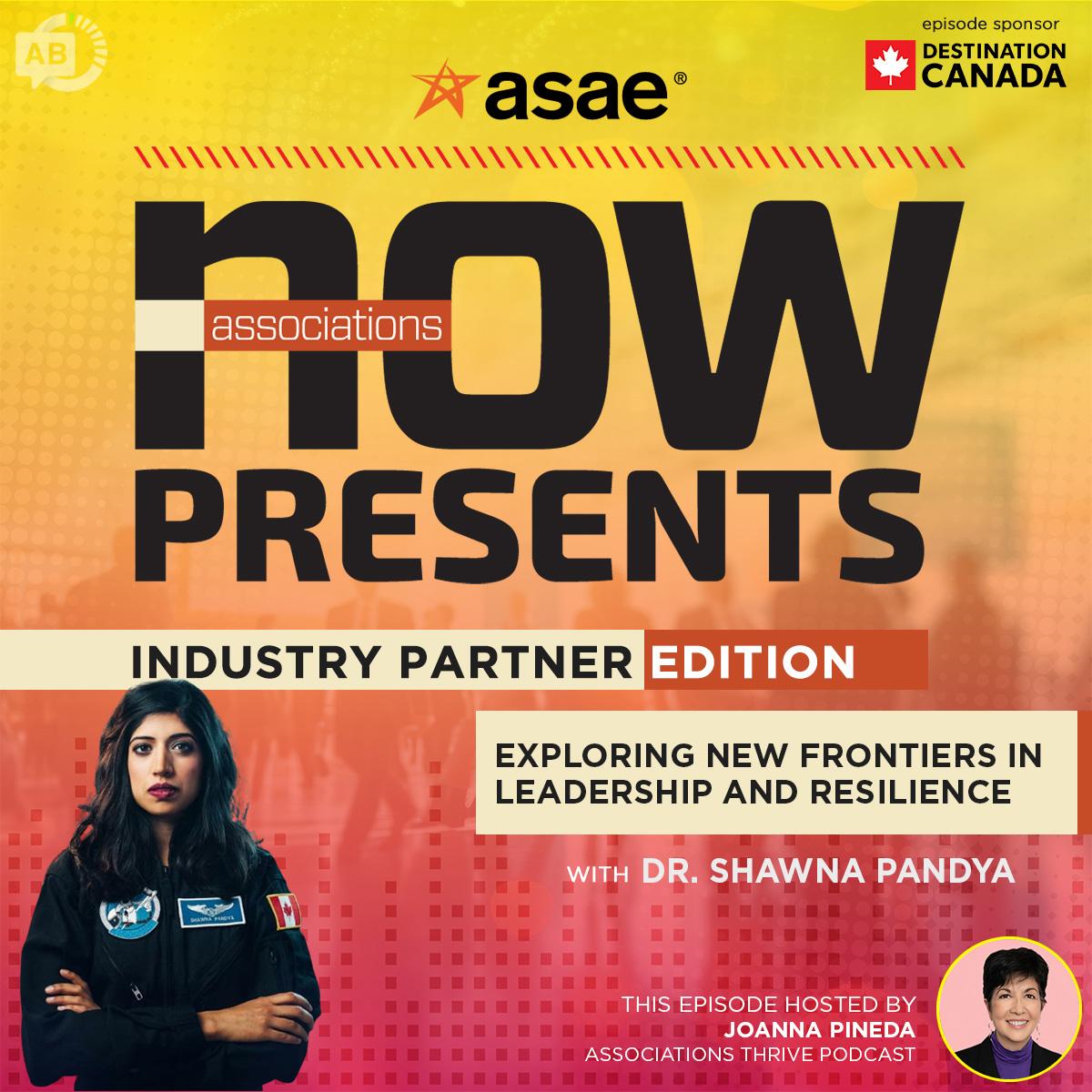
In this episode of Associations NOW Presents: Industry Partner Edition, recorded live at ASAE’s Annual Meeting & Exposition in Indianapolis, guest host Joanna Pineda of the Associations Thrive podcast welcomes Dr. Shawna Pandya, Canada’s first named commercial female astronaut, who is preparing to fly with Virgin Galactic. Dr. Pandya explores how commercial human spaceflight is creating new pathways to space and shares how her background as a physician informs her work in space medicine, focused on keeping people healthy and performing at their best in extreme environments. She also discusses her experiences as an aquanaut on NEPTUNE saturation missions in the Florida Keys and how underwater environments can help researchers study crew dynamics and test technologies for space. Dr. Pandya highlights research priorities ranging from neuroscience and women’s health to health technology and physical sciences, reflects on the role of leadership and resilience throughout her career, and looks ahead to the next generation of commercial spaceflight.
Check out the video podcast here:
This episode is sponsored by Destination Canada.
Associations NOW Presents is produced by Association Briefings.
Transcript
Joanna Pineda: [00:00:00] Welcome to this episode of Associations NOW Presents: Industry Partner Series, an original podcast series from the American Society of Association Executives. I'm Joanna Pineda, CEO and chief troublemaker at Matrix Group International, and we're recording here in Indianapolis during ASAE's Annual Meeting & Exposition.
This episode is sponsored by Destination Canada. And today, we are so excited to welcome Dr. Shawna Pandya, Canada's first named commercial female astronaut. Dr. Pandya, welcome to the show.
Dr. Shawna Pandya: Thank you so much for having me here. It's just wonderful to be here.
Joanna Pineda: Dr. Pandya, what does it mean to be a, I wanna make sure I get this right, a named commercial female astronaut?
Dr. Shawna Pandya: Yeah, that's a great question. So once upon a time, the only path to get to space was to be an agency astronaut, so being a Canadian Space [00:01:00] Agency astronaut, being a NASA astronaut. And now I often like to say that this is the best possible time to be alive in human space flight because there are multiple paths to space.
So you can be a commercial astronaut. You can be an agency astronaut. You can be an agency astronaut who retires and works with a commercial company as one of their astronauts. So when we talk about commercial astronauts, we mean an astronaut who's going to space with a company like SpaceX–in my case Virgin Galactic–Blue Origin, Axiom, Vast. And so the path of how to get to space and who gets to go to space is changing. So in Canada, we've had a number of commercial astronauts, including William Shatner, probably the most famous one. Makes sense. But there've been no females so far. So for women astronauts, we've had Dr.Roberta Bondar and Julie Payette, who have flown with the Canadian Space Agency, Jenni Sidey-Gibbons, who will soon fly with the Canadian Space Agency, and on the commercial side, I have the honor and privilege of being the first named commercial female astronaut.
Joanna Pineda: That is just amazing. [00:02:00] Congratulations.
Dr. Shawna Pandya: Thank you. It still feels like I'm processing the information.
Joanna Pineda: Yeah. I'm curious, when you were a little girl, what did you want to be?
Dr. Shawna Pandya: I definitely wanted to be an astronaut, and so I think this is where the story of where representation matters. It does. I was a kid growing up in the '90s, and I got to watch Canada's first female astronaut go to space.
I heard of Dr. Roberta Bondar and her space flight, and I thought, "Canadian women can do that. I want to do that. I'm a Canadian woman, so if I want to do that, I should just follow Dr. Bondar's path." And so she's a neuroscientist, a physician, and an astronaut, so I thought, "Okay, that's what I'll do. There's no question about it.
I'll go study neuroscience, medicine, and then go be an astronaut."
Joanna Pineda: Oh, so you were trying to follow her path.
Dr. Shawna Pandya: From the very start, like when I was 15, I knew that I was going go do a neuroscience degree. There was no- nothing else I was gonna apply to, and so that became the blueprint for me, and then I took a few detours along the way.
I did my master's degree in space studies at the International Space [00:03:00] University, and that's where I learned that space medicine is this whole field dedicated to keeping astronauts alive and healthy in space, and this was prior to my getting into medical school. And so this really shaped my path and trajectory coming to medical school.
And so these days I like to say every part of my life is either space medicine or space medicine.
Joanna Pineda: Okay, so help me out a little bit. So I think about astronauts as being former military, former Air Force, but you're taking the physician astronaut route. Yeah. Talk to me about this.
Dr. Shawna Pandya: Yeah, and that's a really good question.
And so when we look at the history of where human space flight came from, it wasn't a journey of science and exploration. It was a political showdown between the Soviet Union and the Americans. And so of course they were going to have military pilots, and in those days, females were barred from applying to that position.
So of course it was gonna be military test pilots who were male. And then as we moved out of the Cold War era into one [00:04:00] of cooperation, and even the USSR and the USA at that time did collaborate in space. There's a very famous Apollo-Soyuz test project in the 1970s wherein the commanders of the Apollo and the Soyuz docked together and shook hands across space and time.
Joanna Pineda: Amazing.
Dr. Shawna Pandya: That was widely viewed as a very diplomatic beginning of a detente and a thawing of relations in the Cold War. And so then that's what ushered in the next era of space exploration, and we saw the Skylab and the Mir and the shuttle eras, and now it's the International Space Station era. So this is one of science, discovery, collaboration, cooperation, and today the ISS is supported by five key partners, the USA- Right
Europe, Canada, Japan, and Russia. And now, in addition to being in the ISS era, we're also ushering ourselves forward into simultaneous multiple new eras. So that includes commercial space stations in low Earth orbit. That is [00:05:00] happening. Commercial human space flight, so astronauts like myself. And then also exploration of class missions, and we saw the first of that with the Artemis II mission earlier this year.
So there's a whole lot happening, and so this is what I mean when I say it's the best possible time to be alive in human space flight.
Joanna Pineda: So it sounds like commercial space flight combined with government-sponsored space flight has really opened up just vast new possibilities.
Dr. Shawna Pandya: Absolutely. There's a whole new world out there, and it's not that we're living in separate silos where it's just agency or just commercial space.
We see a very close partnership between commercial and agency space flights. So for example, SpaceX is the provider for NASA, for the Canadian Space Agency to the International Space Station. We see companies like Axiom, like Fast, partner with NASA to take private astronauts to the International Space Station.
So it really is this whole new pathway towards space.
Joanna Pineda: So Dr. Pandya- You're an [00:06:00] aquanaut and an astronaut.
Dr. Shawna Pandya: Yes.
Joanna Pineda: So talk to me about why you're an aquanaut, and what is that, and what's the training to be both an aquanaut and an astronaut?
Dr. Shawna Pandya: Happily. And yes, I get this question a lot. What is an aquanaut?
Why are you an aquanaut? How does that inform your space work? And so I think the easiest way to paint this picture is when I was on my first aquanaut mission, my commander, he had this amazing shirt, and the caption was, "Same, but different." That was the caption, "Same, but different." And the image was this aquanaut underwater doing work at the bottom of the sea, and their umbilical with their life support and their air is snaked up.
And then it turned into the umbilical and air supply of an astronaut up in space. Ah. And so the same but different pertains to this idea of working in what we call an ICE environment, so an isolated, confined, extreme environment. And so the definition of an aquanaut is someone who lives at saturation, so [00:07:00] an increased pressure, which you will be at if you're underwater.
And once you're in that environment for more than 24 hours, all the gas bubbles that are gonna dissolve into your body will have dissolved, so now you have unlimited bottom time. So you just live and work there for as long as you need until it's time to surface, and then you'll surface at a set rate. So that's the definition of an aquanaut.
And actually, the space agencies themselves pioneered this tradition of sending their astronauts to live and work underwater. And the idea was that they would build their crew dynamics, have their crews get used to working in this closed, confined space. They would do science that would inform human space flight.
They would test technologies that might be used in space. And so that was the beginning of it. And so I was lucky enough to do a civilian aquanaut mission in the Florida Keys. I've done it twice now. I've lived and worked and done science underwater for a total of 11 nights [00:08:00] and 10 days with an amazing crew.
So two Canadians, three Americans, and these were the NEPTUNE missions. So everything in space, exploration and medicine is an acronym. Our mission is another acronym, NEPTUNE, which stands for Nautical Experiments in Physiology, Technology and Underwater Exploration. And so that was the-
Joanna Pineda: Nice acronym there.
Dr. Shawna Pandya: Yeah. We really worked on the team name. And it really was a lesson in learning to be a good crewmate, a good teammate, being able to live in this confined environment. But when you do it with the right crew, it ends up feeling like something you don't want to leave at all. Your crew becomes like your family, and I still talk to my fellow aquanauts every day.
Joanna Pineda: Wow. I wanna go back to the science a little bit and the medicine, and I've got a question here for you. In addition to all of these wonderful things that you're doing, you're director of IIAS's Space Medicine Group and chief instructor for IIAS's Operational Space Medicine course. So are you a physician to astronauts or a physician doing [00:09:00] research in space?
Dr. Shawna Pandya: All of the above. Yeah.
Joanna Pineda: Okay.
Dr. Shawna Pandya: Yeah. And the International Institute for Astronautical Sciences is, as you've said, where I do my research, where I teach space medicine, and it's the institute with which I'll be flying to space. And so to just back it up a little bit, I often get funny looks or I get asked, "What is space medicine?
Why do those two terms belong- Right ... in a sense together?" And my one-line answer to that is that space is trying to kill you. And so spa- the space environment is a little bit different in that there are a number of hazards that we have to think about in space that we take for granted being here in this podcast environment where we have gravity.
Up in space, you don't have gravity. It's increased radiation. There's that isolation and confinement which can affect behavioral health performance and mental health. When you go to a destination like the moon, there's lunar dust. There's altered day and night cycles which can impact your sleep and performance.
So there's a lot. So space medicine is a little bit different from traditional medicine in that you're not trying to cure disease. You're actually [00:10:00] trying to take high-performing individuals and keep them healthy and keep them performing well. And so- I first discovered this field when I did my master's degree at the International Space University.
As part of that master's degree, I interned at the European Astronaut Center with their crew medical support office, and this is when I really learned that people make entire careers out of space medicine, out of keeping astronauts surviving and thriving in the space flight environment. So these days at AAIS I hold a number of titles and portfolios, and one of them is space medicine, so I direct the space medicine group, as you say, and we've done a number of s- medical research in, in parabolic flight, zero G, sub-orbital space flight, and orbital space flight.
So different space flight environments. I teach space medicine as the chief instructor, and then I'm also a research astronaut, as we've talked about. We'll be flying to space with Virgin Galacticto do some cool research in space.
Joanna Pineda: It's really interesting, 'cause when you just explained it as at the bottom of the ocean. It's an ice [00:11:00] environment, and in space it's an ice environment. I guess they're very similar conditions.
Dr. Shawna Pandya: That's exactly it.
Joanna Pineda: Pressure, it could kill you.
Dr. Shawna Pandya: Yep.
Joanna Pineda: You have to maintain oxygen.
Dr. Shawna Pandya: Yep, all of it.
Joanna Pineda: Let's take a quick break for a word from our episode sponsor, Destination Canada.
Ad Read: From fresh perspectives to bold breakthroughs, Canada brings people together to imagine what's possible.
It's where visionary leaders like Dr. Shawna Pandya show how curiosity, collaboration, and openness can turn complex challenges into meaningful change. In Canada, business events connect you with world-leading expertise, inspiring destinations, and fresh perspectives that spark ideas, strengthen partnerships, and create lasting impact.
Learn more about why Canada is the natural choice for your next business event at businesseventscanada.ca. [00:12:00] So what's the number one health issue that you're trying to address or research?
Dr. Shawna Pandya: So we have a number of research priorities for our upcoming mission. With my background in medicine, a number of them are biomedical priorities, so those include neuroscience, health technology that can both help astronauts in space flight, but also help our most in need environments and resource limited environments back on Earth.
It also includes women's health, and then finally, physical sciences and building on some of the science results we had from our institute's first space flight.
Joanna Pineda: All right, so you got a lot that you're going to be researching while you're in space.
Dr. Shawna Pandya: Yeah. We've been really lucky in that we have a whole plethora of science payloads that may come with us.
We're definitely furthering the science and what we've learned from our first mission, and now we've also partnered with some of the leading organizations around the world. We held a global call for science in these priority areas shortly after our flight was announced, and so [00:13:00] we've already down selected once, and now we're going through further down selects.
And then we're also pioneering our own research in women's health as well. Um,
Joanna Pineda: Dr. Pandya, you are doing a walk and talk session during the ASAE annual conference. So tell us about that. I think it's coming up.
Dr. Shawna Pandya: Yeah, it's coming up tomorrow for those who are in attendance at ASAE 2026, and this actually brings us back to Earth because we've talked about a lot that may not pertain to everyone's daily life.
We've been talking about space medicine, we've been talking about austere environments, and tomorrow what I'm going to be talking about is people, legacy, pushing the limits and perspectives. And then how my experiences in space and space flight come back to the day-to-day lives of association leaders and what association leaders can learn about creating impact, working with their communities, and learning to leave a legacy as not just leaders, but stewards.
Joanna Pineda: Wow. I'm signed up for it. Amazing. So I'm [00:14:00] looking forward to it. And let me go back to this podcast. So this podcast is sponsored by Destination Canada. Has being Canadian influenced or guided your career as an astronaut and aquanaut?
Dr. Shawna Pandya: Absolutely. So when I think of what it means to be a Canadian astronaut, so my path is a little bit different.
No Canadian woman has flown commercial yet. But taking the bigger picture and zooming out a little bit, I still abide by what I've learned from the role models who've gone before me. I started out wanting to be a Canadian astronaut, and when I was younger, it was the only path towards becoming an astronaut was through the Canadian Space Agency.
And so I closely followed the careers of all of the Canadian astronauts, everyone from Roberta Bondar to Chris Hadfield, and now Jeremy Hansen with the Artemis II mission. And every single one of Canada's astronauts has left very big shoes to fill. They've blazed trails. They [00:15:00] performed at a level of excellence that has set a new bar.
And so for me, that's what I grew up believing in. And so my hope is for anyone who wants to follow my career is that this further raises the bar of what it means to be a Canadian on the international and maybe even off earth stage- Yeah ... and to set the standard of what it means to lead with excellence, to be a good teammate, to leave an impact, and to do so with quiet confidence.
Joanna Pineda: Is there a Canadian trait that you think has really helped your career?
Dr. Shawna Pandya: Yeah, I think it's not just one trait, but I think it's just this willingness to embrace adversity. There's this term in positive psychology that we call salutogenesis. And so what that means is instead of viewing an adverse or harsh or extreme environment as something that might harm you, it's an opportunity to grow and to rise to the occasion.
And being Canadian, having grown up in Edmonton, you only need to experience a minus 40 [00:16:00] winter once to know that is the perfect- That's an
Joanna Pineda: extreme environment ...
Dr. Shawna Pandya: That is an extreme environment. You don't even need to pay to go anywhere exotic because it's right in your own backyard. And so that resilience, that adversity can breed resilience.
Ah. And it can also breed this idea of embracing salutogenesis, embracing this idea of rising to the occasion, using adversity as an opportunity to bl- make ourselves better and develop our character.
Joanna Pineda: Sell me on going to Edmonton.
Dr. Shawna Pandya: Oh my gosh, Edmonton. There's so much to do- Ah ... and to see there. The restaurant scene has become something else over the past two decades.
Every time I turn around, there's something amazing to try there. Whether you're talking, regardless of the time of year, you wanna visit in the winter, there's winter sports, there's skiing. Yeah. In the summers, there's the river valley, there's the greenery, there's the Muttart Conservatory. And of course, I would be remiss if I didn't mention West Edmonton Mall.
So- Ah ... I had a friend I hadn't seen in 17 years who visited last week, and he did not know about the mall. [00:17:00] And for anyone who has not experienced West Edmonton Mall, it's one of the world's largest malls.
Joanna Pineda: Oh.
Dr. Shawna Pandya: For a while, it was the world's largest mall. Sometimes it changes depending on who's adding a new addition to a new level or phase to their mall.
But there's Ice Palace, there's a mini golfing, there's go-karting, there's an indoor water park, there's an indoor amusement park, there's a hotel, and there's over 800 shops. So, you know, this is a fixture. It's if you're gonna visit Edmonton, you have to make time to see West Edmonton. All right.
Joanna Pineda: I've had the opportunity to visit many cities in Canada, from the West Coast to the East Coast, and so I think Canada's just a wonderful place to hold a meeting as well as vacation.
Dr. Shawna Pandya: Absolutely. Fully agree.
Joanna Pineda: Is there a specific Canadian dish that you would recommend or that we must try if we go to Canada?
Dr. Shawna Pandya: Oh my gosh, there are so many, and I think it actually ends up being a little bit regional. Mm-hmm. Now, I know Canadians are known for everything from poutine.
Joanna Pineda: Yes.
Dr. Shawna Pandya: Um, so for me, I actually just love to [00:18:00] experience what the city I'm visiting has to offer.
But if you're in Edmonton, what I love about the downtown scene is that the restaurant scene is really hot. Some of the, there's amazing brand new cuisine that are cropping up all the time. And so I'd say more than- championing any one dish. I think it's whatever you want, you will find, and you'll find at quality in Edmonton.
Joanna Pineda: Yeah. I have found whenever I've been to Canada that you're absolutely right. Somehow it's the melting pot also- Yeah ... of the different cultures- Yeah ... in Canada that makes every city unique.
Dr. Shawna Pandya: Yeah, absolutely. So it's really funny. For anyone who follows me online, they'll know that I have certain staples of what I eat when I travel, and I travel so much.
It ends up being this predictable repertoire. But recently it's also included Thai food, and so I recently just experienced one of the best Thai restaurants I have in Edmonton. And whatever you want, whether it's Thai food, pizza, Indian food, you'll find it, and you'll find it [00:19:00] at an exceptional level in Cana- in Edmonton.
Joanna Pineda: Hey, let's get back to being an astronaut and an aqua- and an aquanaut. What would you say to someone who's interested in this? They look at you and they say, "Ah, I want to be like Dr. Bandya." What's the path? What's the training?
Dr. Shawna Pandya: Yeah, I think growing up and not having any path before me, so there was no path towards becoming a commercial astronaut when I was younger, that those entities didn't even exist.
And now being Canada's first named commercial female astronaut, it is making and paving the way as I go. And so what I would say to anyone who's trying to blaze trails in an area that may be lesser known, don't let anyone stop you. Set your goals.
Joanna Pineda: Love that.
Dr. Shawna Pandya: Work really hard. It costs nothing to become the hardest working person in the room.
Yeah. And pick out what you love and then make space for yourself.
Joanna Pineda: I love that. Yeah. Is there a myth about being an astronaut that you wish [00:20:00] you could just dispel?
Dr. Shawna Pandya: Yeah, I think, I think that a- any time that anyone thinks that y- you're an astronaut, it's that you're in zero G all the time, and certainly I've flown zero G in parabolic flight.
Some of you know what this is, the Vomit Comet. I've done 18 of these flights. I highly recommend them. They're super fun. But it's not that I'm doing that every day. There's a lot of discipline. There's a lot of embracing the long game. I've been doing this, I've been working with my research institute for 11 plus years now.
There's a lot of meetings. There's a lot of documentation. There's a lot of documentation around safety, around ethics when you're doing human research, around science reviews. So you really have to love every single minute of it. But, you know- If you can love every step of the journey, you're gonna be living the dream, and I'm lucky enough to be doing it with an amazing team and an amazing crew.
Joanna Pineda: So when do you fly? When do you go into space?
Dr. Shawna Pandya: That's a great question. So I will be flying with Virgin Galactic, and right now I am waiting on Virgin to build us a new spaceship. So they [00:21:00] retired their previous spaceship, the Unity class of spacecraft, in 2024 to make way for their new Delta class of spaceship.
Oh. So that is currently, it's finished the manufacturing and assembly phase. It is currently in the integration and testing phase. So they have a few more internal tests to go through, and then they will proceed to their first science flights without people, and then finally start flying people. So that current timeline is early 2027, so.
Joanna Pineda: That is so soon.
Dr. Shawna Pandya: It is very soon. So if I'm back here next year, you may, I may have been a flown astronaut by that time.
Joanna Pineda: Wow. All right. So how do we stay in touch with you? How do we follow you so that we can follow the journey and hear about the training and what you're eating and where you're visiting?
Dr. Shawna Pandya: Yeah. I'm very online. So you can find me on most social media platforms at Shawna Pandya, S-H-A-W-N-A P-A-N-D-Y-A. I'm on LinkedIn, I'm on Instagram, and you can also find me online at shawnapandya.com.
Joanna Pineda: Dr. Pandya, this has been [00:22:00] an honor for me. Congratulations and good luck and stay safe.
Dr. Shawna Pandya: Thank you so much for having me.
It's been a pleasure.
Joanna Pineda: Thanks to everyone for listening to this episode of Associations NOW Presents: Industry Partner Series. Please make sure to join us each month as we explore topics relevant to association professionals, discuss the challenges and opportunities in the field today, and highlight the significant impact associations have on the economy, the US, and the world.
We want to give a big thanks to our episode sponsor, Destination Canada, and be sure to subscribe to our other podcast on Apple, Spotify, or wherever you listen to your favorite podcasts.