

SOBRE ESTE EPISÓDIO
REUTERS/Callaghan O’Hare
The $5,000 Mirage
A Campaign Promise Without a Policy
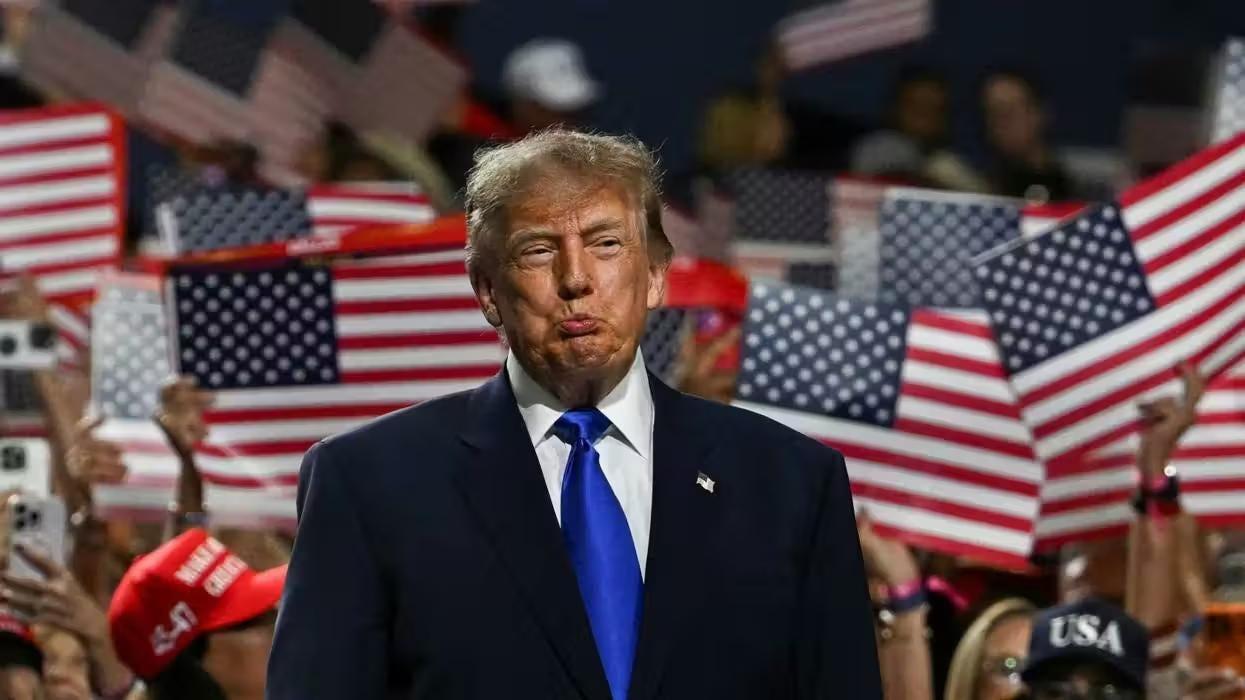
Donald Trump told Republican convention-goers that every adult citizen would receive $5,000 if Republicans retained Congress. The estimated cost is roughly $1 trillion. Republican senators then acknowledged that they had seen no legislation, funding mechanism, eligibility rules, or even advance notice of the proposal.
That is enough context. The important fact is not that the plan appears fiscally implausible. It is that the president announced a vast public expenditure as an electoral inducement before his own party had produced anything resembling a policy.
Help fuel the work. Independent analysis doesn’t fund itself:☕ Buy us a coffee
The Power Is in the Promise
Trump holds the institutional power here. He commands the presidency, dominates the Republican Party, and can use a national platform to turn an improvised pledge into the party’s campaign message. Senators James Lankford and Steven Daines may profess confusion, but their confusion does not dilute his agency. It demonstrates how little the legislative branch matters inside this arrangement.
JD Vance’s attempt to narrow eligibility after the announcement is equally revealing. He was not explaining an established proposal. He was retrofitting details onto a presidential promise already released into the electorate. The policy apparatus follows the spectacle, trying to make yesterday’s applause line look like tomorrow’s legislation.
Confusion Is Political Cover
The senators’ responses frame the problem as uncertainty: they have not seen the mechanics, do not know who qualifies, and cannot identify the funding source. That language is convenient. It treats the president’s choice to announce an unformed trillion-dollar benefit as a technical mystery instead of a deliberate campaign tactic.
Trump specified the political condition clearly enough: elect Republicans, receive money. The vagueness concerns delivery, not intent.
Calling the payment a “dividend” adds another layer of misdirection. A dividend ordinarily distributes surplus value. As Rand Paul noted, the federal government is running deficits. The label borrows the language of ownership and profit to disguise what would, under the facts presented, be debt-financed spending tied rhetorically to an election result.
Fiscal Principle, Selectively Activated
The Republican senators quoted object primarily through debt and inflation. Those are legitimate policy concerns: borrowing roughly $1 trillion could affect interest rates, prices, and federal finances. But their posture also lets them avoid the more immediate abuse embedded in the pitch.
They criticize the cost while soft-pedaling the transaction being offered to voters. Lankford invokes the Inflation Reduction Act. Daines invokes the national debt. Cassidy invokes personal finances. Each shifts attention toward familiar fiscal doctrine, where disagreement can remain safely procedural.
The sharper issue is presidential power being used to advertise a personal cash benefit contingent on partisan victory. Whether Congress would ever approve it is almost beside the point. The promise performs its political work before a single bill exists.
Senators as Cleanup Crew
These lawmakers are not powerless spectators. Republican senators possess legislative authority, public platforms, and the capacity to reject the premise outright. Instead, they “dump cold water,” express doubts, and predict that the idea may not come to fruition.
That is institutional cowardice in cautious language. They distance themselves from the proposal’s arithmetic without confronting the leader who made it. Their objections preserve an escape route: if the promise disappears, they were prudent; if Trump insists, they never mounted a direct challenge.
The article’s framing also weakens the story by centering whether skeptical senators think the plan is workable. That makes them appear to be referees evaluating somebody else’s proposal. They are members of the governing party whose electoral leader just attached a four-figure payment promise to congressional victory. Their evasiveness is part of the event, not a reassuring counterweight to it.
Government Reduced to a Campaign Giveaway
The larger pattern is government by personalized transaction. Public money is presented not as the product of legislation, taxation, eligibility standards, and competing priorities, but as a reward dispensed by a leader after voters deliver the desired partisan outcome.
The promise does not need to survive contact with Congress to be useful. It only needs to create expectation, loyalty, and a conveniently blameable cast of saboteurs when the check fails to arrive.
That is the systemic error: executive spectacle sets the terms, legislators pretend the absence of details is the central problem, and institutional power is converted into campaign theater. The policy may be imaginary. The manipulation is already functioning.
Thanks to Alter Net
Source: Top Republican senators dump cold water on Trump’s expensive midterm bribe
Systemic Error is a reader-supported publication. To receive new posts and support my work, consider becoming a free or paid subscriber.
We warned them.We told them.We shouted from the rooftops.We plead.We begged.They didn’t listen.Now, we all will suffer.Y’all know what to do, right?VOTE BLUE! 💙Vote as if your life — nay, our country — depend on it.Because, this time, and every time, it does.
This is a public episode. If you'd like to discuss this with other subscribers or get access to bonus episodes, visit paulstsmith.substack.com/subscribe


