
SOBRE ESTE EPISÓDIO
Central bank digital currencies (CBDCs) are increasingly being talked about in the press with announcements of initiatives from different central banks working on CBDCs coming out left right and centre. Few however are as forward thinking and embracing a collaborative approach as the Bank for International Settlements (BIS). For this podcast we are joined by Daniel Eidan, Adviser and Solution Architect at the Bank for International Settlements (BIS) in the Innovation Hub where he builds technology solutions for the central banking community with a special focus on blockchain and CBDC. He will share with us some of the exciting work his team are doing for driving CBDC forward.
What is blockchain?
Blockchain and DLT is often referred to as Web 3.0 whilst the internet of today is Web 2.0.
Web 2.0 enables to globally connect communications protocol whilst blockchain and Web 3.0 isn’t just about putting communication protocols digitally but to store value digitally. What blockchain enables is to execute computations between different members and keep a record of state. Essentially as Daniel mentions we can encapsulate value. Value can be cryptocurrencies, central bank digital currencies, contracts and many other forms of value. This wasn’t something possible in the Web 2.0 because the fundamentals weren’t there.
What are CBDCs?
To fully understand what CBDCs, central bank digital currency, are you first need to understand what is a currency. Money and currency in general have three attributes:
* They are a unit of account
* A store of value
* A medium of exchange
What central bank digital currencies do is that they digitise those three attributes.
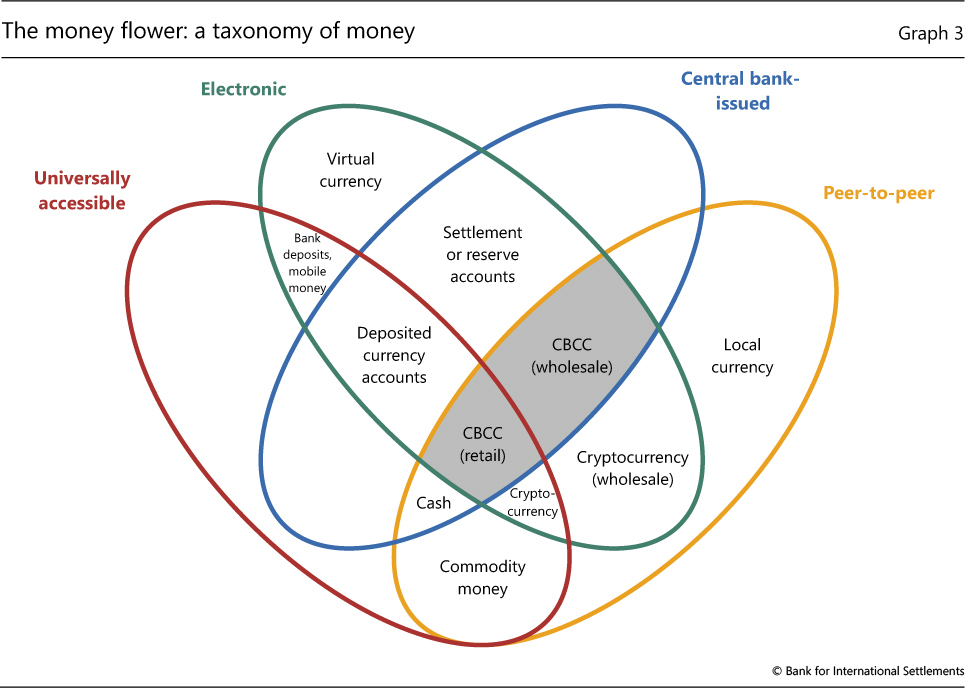
To explain how this happens Daniel uses the “money flower” approach which looks at its four different attributes:
* Is it universally accessible?
* Is it electronic?
* Is it issued by a central bank?
* Is it moved around in a peer to peer way?
A retail form of CBDC will have all four of the money flower attributes. It will be universally accessible, it will be electronic, it will be issued by a central bank and contain central bank liability, and it will transact in a peer to peer way.
What is important to recognise is that most of the retail monetary base is not central bank money, it’s commercial bank money. For example, when you deposit money at you bank it is likely that a large part of your fiat currency is with a claim against your commercial bank. Then through a set of mechanisms that claim is insured by potentially a central bank or a federal institution.
The only claim that retail can have against a central bank is in the form of cash. Cash of course is a tiny percentage of the total amount of money individuals have. What CBDC does is takes that cash liability, in a retail context, to exist in a digital context in a way that’s accessible to anyone.
The question is what happens to individuals who do not have a smart device, or electricity, or WIFI? In addition, how is universal accessibility attained to individuals with disability issues or are elderly? There are a number of technical solutions that can help to lower this barrier but it is one that is a challenge in terms of the last mile for reaching ubiquitous CBDC.
In the case of wholesale, the case for CBDCs is to broaden the base of digital currency from tier one institutions that are regulated domestically to fintechs, startups and perhaps banks in other jurisdictions. So, it's really extending the promise and the capabili...
What is blockchain?
Blockchain and DLT is often referred to as Web 3.0 whilst the internet of today is Web 2.0.
Web 2.0 enables to globally connect communications protocol whilst blockchain and Web 3.0 isn’t just about putting communication protocols digitally but to store value digitally. What blockchain enables is to execute computations between different members and keep a record of state. Essentially as Daniel mentions we can encapsulate value. Value can be cryptocurrencies, central bank digital currencies, contracts and many other forms of value. This wasn’t something possible in the Web 2.0 because the fundamentals weren’t there.
What are CBDCs?
To fully understand what CBDCs, central bank digital currency, are you first need to understand what is a currency. Money and currency in general have three attributes:
* They are a unit of account
* A store of value
* A medium of exchange
What central bank digital currencies do is that they digitise those three attributes.
To explain how this happens Daniel uses the “money flower” approach which looks at its four different attributes:
* Is it universally accessible?
* Is it electronic?
* Is it issued by a central bank?
* Is it moved around in a peer to peer way?
A retail form of CBDC will have all four of the money flower attributes. It will be universally accessible, it will be electronic, it will be issued by a central bank and contain central bank liability, and it will transact in a peer to peer way.
What is important to recognise is that most of the retail monetary base is not central bank money, it’s commercial bank money. For example, when you deposit money at you bank it is likely that a large part of your fiat currency is with a claim against your commercial bank. Then through a set of mechanisms that claim is insured by potentially a central bank or a federal institution.
The only claim that retail can have against a central bank is in the form of cash. Cash of course is a tiny percentage of the total amount of money individuals have. What CBDC does is takes that cash liability, in a retail context, to exist in a digital context in a way that’s accessible to anyone.
The question is what happens to individuals who do not have a smart device, or electricity, or WIFI? In addition, how is universal accessibility attained to individuals with disability issues or are elderly? There are a number of technical solutions that can help to lower this barrier but it is one that is a challenge in terms of the last mile for reaching ubiquitous CBDC.
In the case of wholesale, the case for CBDCs is to broaden the base of digital currency from tier one institutions that are regulated domestically to fintechs, startups and perhaps banks in other jurisdictions. So, it's really extending the promise and the capabili...
Inglês
Reino Unido
TRANSCRIÇÃO 🔗
Are you the producer of this podcast?
Add a podcast transcript
Need Audio-to-Text?
Transcribe with Listen411 in Just 60 Seconds
PESQUISAR EPISÓDIOS PASSADOS
Pesquisar episódios anteriores de Insureblocks.
OUTROS EPISÓDIOS NESTE PODCAST
In January 2020, 12 global pharmaceutical companies and 17 public and private entities; including technical, legal, regulatory, academia, research organisations and patient representative organisations, got together to form PharmaLedger, the pharmaceutical blockchain consortium.
Joining us for thi…
Leandro Nunes, Vice President, Product Development and Innovation at Mastercard, joins us to share how he leveraged Mastercard’s DNA in scalability, payment automation and governance. We also discuss the important of a data governance model and his top tips for building scalable blockchain solution…
Jim Nasr, is the CEO of Acoer, a software development company whose vision, and work is all about building useful, usable, real time technologies that are fundamentally targeted at the healthcare industry. Jim was the former chief software architect at the Centre for Disease Control and Prevention …
IDunion is a new European decentralised identity management platform that is promising to bring user centric digital identity with privacy at its core. In this podcast we had Adrian Doerk – Product manager at Lissi and communication & Public relations at IDunion, walk us through IDunion.
…
Alisa DiCaprio, is the Head of Trade and Supply Chain at R3 and also facilitates a lot of R3’s research. Whilst the concept of governance is familiar to many in the business community it has proven to be quite a challenge to blockchain business networks. In this podcast we discuss with Alisa, her l…
Aviso: O podcast e a arte incorporada nesta página são de Walid Al Saqqaf - Blockchain insurance, que é propriedade de seu proprietário e não é afiliado ou endossado por Listen Notes, Inc.
EDITAR
Obrigado por ajudar a manter a base de dados dos podcasts atualizada.