

WEBVTT
00:00:00.000 --> 00:00:27.859
We're advocating more employers to take on, which is challenging today because they simply don't have to. This is not part of compliancy data, right that many large orgs have to measure how many by gender, ethnicity, race status, job level, all of those segments that they are required to measure caregiving is not required to measure today. So that is also something we're trying to push forward. Did
00:00:27.570 --> 00:00:35.939
you know that in 2020 there were 53 million caregivers in the United States?
00:00:31.379 --> 00:00:57.600
And by 2025 this number is expected to grow to 62 point 5,000,073% of these caregivers also have a job. They are called Working caregivers, and they are invisible because they don't talk about their caregiving challenges. Working caregivers, the invisible employees, is a podcast that will show you how to support working caregivers.
00:00:57.960 --> 00:01:08.250
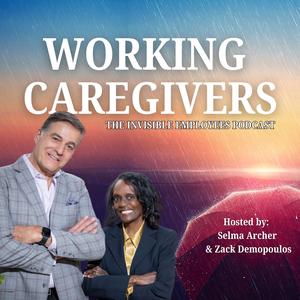
Join Selma Archer and Zach Demopoulos on the working caregivers, the invisible employees podcast, as they show you how to support working caregivers.
00:01:13.560 --> 00:01:20.599
Hello everyone, and welcome to our podcast, working caregivers, the invisible employees. I'm Selma Archer,
00:01:20.780 --> 00:01:22.459
I'm Zach Dimopoulos,
00:01:22.640 --> 00:01:29.180
and we are so excited to have our special guest today, Sarah Johal, welcome Sarah.
00:01:29.299 --> 00:01:32.840
Thank you both so much for having me. It's such a privilege to join you.
00:01:33.140 --> 00:01:46.540
Well, we're looking forward to hearing more about what you're doing in the caregiver space, but before we get there, we'd like to start out with an icebreaker. So could you share with us an interesting fact about the area that you live in?
00:01:46.840 --> 00:01:54.640
Yes, I love that question. So my family and I reside in an East Bay City near Oakland called Castro Valley.
00:01:54.879 --> 00:02:40.520
And for those that don't know about this area, just shortly post World War Two, this area used to be nothing but chicken farms and horse ranches. Our home was built probably around 1947 and we actually found through neighbors on our Avenue street that we live on that in that time area, the neighborhood kids used to use our street as a soapbox derby race. Street that was the place to have soapbox Derby races between the 40s and 50s. All of the kids would come on our particular street because it's the perfect ramp. You start at the hill, you can still see the Bay Area, water right at the top of the hill, and it just slowly coasts down through the neighborhood.
00:02:40.939 --> 00:02:47.439
That is so cool. Who's an artist? Is it Rockwell? Who's I just had a Rockwell painting in my room, and
00:02:47.439 --> 00:02:48.580
Rockwell, absolutely. That
00:02:48.580 --> 00:02:50.259
was amazing.
00:02:48.580 --> 00:02:50.259
That was awesome. How
00:02:50.259 --> 00:02:51.159
fun
00:02:51.219 --> 00:03:03.599
they have since put in speed buns, because we're in an area close to the elementary schools in our neighborhood, so I don't know if we could get by doing those same races today, but it sure would be fun to try
00:03:03.900 --> 00:03:16.020
absolutely well, let's get on and talk a little bit about your wonderful company, care sprint. Could you just share with our audience a little bit about the company and why you decided to create it
00:03:16.979 --> 00:04:20.899
absolutely a care sprint is a national grassroots, 501, c3, nonprofit we launched just a few short months ago in January, really to serve to change the systems level impact that caregiving is happening within our workforce. We are very much motivated by the fact that today, the US sits in last place when it comes to work, life quality and family care. So when we say last place, Oxfam came out with a report about two years ago ranking America 38 out of 38 peer nations in the world when it comes to family care. So the good news is there's only one way to go but up and care sprint is here to do that, and we're taking this approach by centering What do caregivers need, working families in our workforce, and employers play a pivotal role in this space. And we know employers, business leaders, people, leaders, they need help in this space as well.
00:04:20.899 --> 00:04:28.040
So we're here to serve as an open marketplace where they can sprint into action for their working families. That's fantastic.
00:04:28.040 --> 00:04:32.000
I was going to ask you how you came up with the name, but you just told us, yes,
00:04:32.300 --> 00:05:01.259
my background is primarily in tech, or it has been for several years, and all of the different mechanisms and processes of sprint planning and sprint processes. How do you expedite change in a thoughtful but quick manner so that very much influenced. How can we take some of those practices and apply it using software, using technology, using the internet and open information? Into expedite. So
00:05:01.259 --> 00:05:03.959
basically, right now, we're not even in the race.
00:05:03.959 --> 00:05:06.839
We're not sprinting, we're on the sidelines. Very
00:05:06.839 --> 00:05:10.800
much so, very much so. But we're here to change that in quick fashion.
00:05:11.100 --> 00:05:33.920
You've got an amazing website. It's clean, it's simple. I encourage all our listeners to check it out. And speaking of our listeners, we have leaders, HR, leaders, managers, employers, listening in and your tagline right there at the very top, helping leaders sprint into action with care.
00:05:34.339 --> 00:05:40.839
What's one thing that you want our listeners to take away from meeting Sarah and going to the care sprint website,
00:05:41.139 --> 00:06:31.819
there's a huge opportunity for anyone to get involved. And I mean, anyone, it doesn't matter if you are an executive sitting in the C suite to a mid manager trying to grow your team and your career at the same time, or maybe you're a young professional just starting to think about where do you want to head and how are you going to build a family in that process of building your career? So no matter where you're at in that journey, caresprint has a place for you to start just thinking about these challenges that are impacting everyone in this country, even if you're not a caregiver. This is impacting your quality of life, the opportunities that we have to better support our families and communities. So I think that's one piece, is that everyone is welcome and open to be part of this. Solve with us.
00:06:28.519 --> 00:06:49.660
Collaboration is one of our key values, and it's going to take all of us to think about this at that systems level. The second thing to take away from this as well is to think about what you all made a wonderful point in the book you two co authored that we have in our care sprint library, as our
00:06:49.660 --> 00:06:54.100
guests are always plugging our booksella, I love that it's
00:06:54.100 --> 00:07:09.779
a wonderful, wonderful read, and can't thank you all enough for writing it and featuring some of the work that is really pushing the point of visibility with unpaid caregivers in our workforce.
00:07:05.819 --> 00:07:17.220
Right? We know as of next year, there's going to be over 60 million Americans who are caring for somebody, whether it's their own kids or children families.
00:07:17.399 --> 00:07:57.220
Maybe it's taking their sister to her chemo appointments. Maybe they're like me, where I'm in the sandwich Gen taking care of my family while working and taking care of our aging parents as well too. So really thinking about there's many of us here, but none of us are visible when it comes to data in our workforce. And that was such a shocking stat that I took away building out our care sprint story and solutions was, how is this still possible today, with all of the data that we have, we have very little visibility when it comes to caregiving in our workforce. I
00:07:57.220 --> 00:08:19.680
appreciate you bringing up data Selma and I do talk about that in our book and how important it is. And we also have those conversations with many others who come to us and ask us, How do we start? And it does start with data really. You know, good data. But if I could just follow up question, one of the reasons someone I wrote that book is to increase awareness and empathy, even for those readers that are not caregivers.
00:08:19.680 --> 00:08:35.480
And you said it, Sarah, you said, even if you're not a caregiver, we've got value for you on your site. How would somebody even find your site if they're not a caregiver, and how would they even consider getting on your site? Do you have any tips there?
00:08:35.779 --> 00:09:59.919
That's a great question. We are limited in our early phase right now of trying to get the word out, and we're very much leaning on our own community circles, our partner networks and ecosystems. And you can find us almost on every social channel, and that's where we're most active today. So you can find us on LinkedIn, Instagram, Twitter, x, we're often posting about these themes and topics and conversations, as well as cheering on our own partners in our space as well to level and lift them up along the way too. But yes, we are just early in our journey of trying to really get the word out. So thank you. You all are helping with that journey too, and really trying to make sure that we're connecting with people leaders at large, to really start thinking about these intersectional topics. Our Open Library, for example, is one great resource. So every month, we are curating reads like your book, where people can learn about this space. Learning and Development has always been a huge factor in my own career growth, all of the great managers I've had in my life have very much been supportive in that learning development space. And that's one place where, if you are a new manager, managing people on your team, most likely you already have caregivers on your team. That is, I'm sure, a shared a.
00:10:00.000 --> 00:10:41.919
Awareness challenge, right is most people leaders have this perception gap of how many of us are truly caring for others, that time equates, on average, to having an additional 1.5 full time jobs in your average week on top of your existing full time job, and most of them are having such difficulties and challenges just navigating that can they feel safe to bring up that part of their identity in the workplace as well, we often talk about our leaders parenting out loud so others can feel that they can bring up those moments that matter themselves. Well,
00:10:41.980 --> 00:10:57.700
we noticed Sarah on your website, which is phenomenal. As Zach said earlier, it's just so great. You have a couple articles. The newest one, I think, is 2024 that's the bare minimum from employers is hurting families.
00:10:57.879 --> 00:11:21.799
So we really encourage our listeners to take a look at that article. It's very powerful. And the other one we actually referenced in our book. So thank you for that, and that one is called supporting employee caregivers starts with better data. So if you could just give us maybe one or two quick points that you would like the audience to walk away with from that particular article,
00:11:22.039 --> 00:11:33.200
absolutely. Thank you for spotlighting those efforts and co authors. Shout out to my colleague Amy Henderson, who co wrote that HBR article with me a few years ago.
00:11:33.500 --> 00:12:46.120
That takeaway is still part of our key advocacy at caresprint today, and that is again encouraging employers to think about the missing data when it comes to having a full picture and visibility into their talent and their workforce. Again, this is, to me, the biggest segment that is missing from our workforce data. If you think about the commitments that large companies organizations are making to equity in the workforce, shrinking or closing the gender pay gap, we know that motherhood and caregiving is hugely intersectional to the impact whether they're going to be successful in their career or not. So that particular piece of data is what we're advocating more employers to take on, which is challenging today because they simply don't have to. This is not part of compliancy data, right? That many large orgs have to measure how many by gender, ethnicity, race status, job level, all of those segments that they are required to measure, caregiving is not required to measure today, so that is also something we're trying to push forward.
00:12:46.659 --> 00:13:01.559
I remember working for a company where the model was, if it's not measured, it doesn't get done. So that's kind of the situation here. But we're hoping that all of us, working together, will make a dent in that we'll get it to where it needs to be well, that's
00:13:01.559 --> 00:13:23.539
so true. We've never been more optimistic, even though that might be radical in its own right in these days. But I certainly am. I've never been more optimistic about the momentum and the seismic shifts that we are seeing in how we as a culture, are really starting to care about care, and that's a fantastic place to be. What do
00:13:23.539 --> 00:13:29.120
you think's going to take for us to move from what was that 38th set?
00:13:25.159 --> 00:13:50.799
38th bottom place? I mean, that's right, I don't know about you, but that doesn't feel good at all. What do you think it's going to take to move us up a few notches? And before you answer that, I just want you to know that Selma and I were talking about a great article that we're going to highlight in the future of hewart Packard enterprises. Shout out to them.
00:13:45.519 --> 00:14:14.159
Their CPO Chief People Officer was interviewed, and she shared six months paid leave for new parents, but she also discussed the need for other parts of the life cycle as well, right? So that is earth shaking, and I think, you know, hats off to you. HPE, you're that's a competitive advantage, right?
00:14:09.840 --> 00:14:25.879
So, so we know the we know that's going to help us move from the bottom up. But do you have anything off top of mind that that's going to help us get off that bottoms ranking at least put us in the middle of the pack, maybe yes,
00:14:26.240 --> 00:15:05.340
somewhere in the upward trajectory. Well, I think you just said that the magic phrase, which is competitive edge, that's the opportunity for leaders to see what care can do and how a caring culture within their organization can truly transform productivity, retention, loyalty, all of these true business costs that our American companies are losing billions every year because we're still not centering care at the end of the day. So that's. It the competitive edge is when you think about six months. That sounds radical.
00:15:05.460 --> 00:15:35.480
It's not. In the global lens, six months is the average amount from a world health perspective, of the time that they need to recover bond and come back strong as ever. So we're starting to point that direction, and many kudos to the companies that are starting to grow and expand those types of benefits and policies. But it also shouldn't just be dependent on a private employer, right?
00:15:31.279 --> 00:15:56.559
We're also seeing more public sectors expand this access to paid family leave, but we are still one of the only nations without it. So I think that's on the business side. We think about competitive edge. On the policy side, it's paid family leave and sick time. We have to answer that as a nation if we are going to be competitive at the global level at all.
00:15:56.620 --> 00:16:09.960
If you were sitting in front of a CEO who asked you, what one thing should I do first right now to help me move away from that number 38 what would you suggest I
00:16:09.960 --> 00:16:31.460
would start it with asking, do they know who their caregiving talent is? Do they have a sound understanding on paper, by the numbers, by the demographics. If the answer is no, that's a wonderful place to start, and we're helping partners sort how to do that with expert led best practices.
00:16:31.580 --> 00:16:58.720
There are many people that have been studying this longer than we have that care sprint. And we're going to bring in those types of existing solutions and help leaders understand they don't have to start from scratch either. We're asking them to use existing measurement frameworks, existing tools that they're already trying to understand the demographics of their talent segments, and that's where we want to help bridge that gap in understanding.
00:16:59.200 --> 00:17:20.220
I just one other thing before we close up, Sarah, you know, I can't help but noticing you're such a young person and and your your advocacy is respected and admired. And Selma and I were already in love with you when we read the work that you did in the Harvard Business Review, and we've really gotten to know you since then. I'm just impressed.
00:17:20.220 --> 00:17:33.019
I gotta be honest. Yeah, what is, what's and I know you're a mother and all that, but, but there's got to be more to this story. I mean, what is it that's just driving you to do all this work at such a young age? Well,
00:17:33.019 --> 00:18:17.940
thank you. My daughter, who's going into middle school, doesn't think I'm young, but I will take that for the win this week, but it's, I think it goes back to really being moved by my own parents work ethic, and seeing their experiences as caregivers. You know, when my younger sister and I were little, my parents were doing their best to work full time, and at the same time they were taking care of our both our grandparents, who lived with us, they were both dying of cancer, terminal care to the very end, and my mother saw it through and becoming a parent many years later, I asked her, How did you get through all of that? Right?
00:18:13.440 --> 00:18:25.700
That had to be tremendously taxing and hard and emotionally hard. And she said two things that always resonated with me.
00:18:22.099 --> 00:18:50.619
She said she had an understanding, flexible team at work, and a boss who got it, even though the boss themselves weren't experiencing that same journey as us, but it was leading with empathy. It was going back to say we got you. We trust you. You've always been loyal to us, and so those lessons that even she experienced has always stayed through with my career journey.
00:18:51.099 --> 00:19:04.019
So I think it's a tribute back to that, and of course, becoming a parent myself that that is earth shattering, and all of the types of perspectives of wanting to leave this world in a better place for them, tremendous
00:19:04.019 --> 00:19:16.380
gratitude for the work you're doing. Sarah and Selma and I are just so, so honored and excited to to get to know you even more. Thank you for the work you're doing on behalf of all the working caregivers out there,
00:19:16.680 --> 00:19:19.559
and congratulations on the launch of your company.
00:19:19.619 --> 00:19:30.319
Oh, well, thank you. It takes a village and a team like great partners like yourselves. We have a phenomenal Board Advisory behind us, and a partner ecosystem like no other.
00:19:30.319 --> 00:19:38.960
So we're just getting started, and we're tremendously excited about where this nation is heading. Like we said, there's only a way, one way to go, and that's up.
00:19:39.079 --> 00:19:49.119
And we keep talking about your website, and I just wanted also mention if you could share, could share, if people want to learn more about policy, you've got some great updates in there. Can you just share a little bit more about that? So
00:19:49.119 --> 00:20:05.039
we have a few open solutions. You can find us@caresprint.org and one of our solutions is an employer care marketplace. So if employers benefit. Leaders. HR, leaders are looking for solutions to level up their competitive edge.
00:20:05.160 --> 00:20:52.180
That's a great place to find our partners. Mentioned earlier, we have an open library. These can be references, book clubs, gatherings to have these types of conversations with your teens through an L and D lens as a manager. And then, to your point on policy, we are gathering all of the different types of care legislation that is happening in real time within our country, just so people have better visibility that there are very great, tremendous efforts being done in the care space, from affordable child care bills to elder care legislation and investment at the national and state levels as well. So again, we really want to be the hub where you can come and have a learning place, both on the business and the policy side. To our
00:20:52.180 --> 00:20:55.180
listeners, again, where they could find you. Caresprint.org,
00:20:56.200 --> 00:21:05.160
is where you can find us, and we have a contact section if you'd like to sign up for email updates and stay in touch with our community. You can do that there as well. Zach
00:21:05.160 --> 00:21:09.599
and I look forward to being on board with you and partnering with you however we can
00:21:09.839 --> 00:21:14.700
well. Thank you, Selma and Zach and listeners for listening to our story here.
00:21:15.420 --> 00:21:16.259
Thank you everybody.
00:21:18.660 --> 00:21:41.019
Thank you for tuning in. Be sure to catch new episodes of working caregivers the invisible employees podcast every other Tuesday. Please also visit our website, invisible employee advocates.com to subscribe to our newsletter, purchase our book and learn more about how we can help you strengthen your workplace to become more supportive of working caregivers. You.
00:00:00.000 --> 00:00:27.859
We're advocating more employers to take on, which is challenging today because they simply don't have to. This is not part of compliancy data, right that many large orgs have to measure how many by gender, ethnicity, race status, job level, all of those segments that they are required to measure caregiving is not required to measure today. So that is also something we're trying to push forward. Did
00:00:27.570 --> 00:00:35.939
you know that in 2020 there were 53 million caregivers in the United States?
00:00:31.379 --> 00:00:57.600
And by 2025 this number is expected to grow to 62 point 5,000,073% of these caregivers also have a job. They are called Working caregivers, and they are invisible because they don't talk about their caregiving challenges. Working caregivers, the invisible employees, is a podcast that will show you how to support working caregivers.
00:00:57.960 --> 00:01:08.250
Join Selma Archer and Zach Demopoulos on the working caregivers, the invisible employees podcast, as they show you how to support working caregivers.
00:01:13.560 --> 00:01:20.599
Hello everyone, and welcome to our podcast, working caregivers, the invisible employees. I'm Selma Archer,
00:01:20.780 --> 00:01:22.459
I'm Zach Dimopoulos,
00:01:22.640 --> 00:01:29.180
and we are so excited to have our special guest today, Sarah Johal, welcome Sarah.
00:01:29.299 --> 00:01:32.840
Thank you both so much for having me. It's such a privilege to join you.
00:01:33.140 --> 00:01:46.540
Well, we're looking forward to hearing more about what you're doing in the caregiver space, but before we get there, we'd like to start out with an icebreaker. So could you share with us an interesting fact about the area that you live in?
00:01:46.840 --> 00:01:54.640
Yes, I love that question. So my family and I reside in an East Bay City near Oakland called Castro Valley.
00:01:54.879 --> 00:02:40.520
And for those that don't know about this area, just shortly post World War Two, this area used to be nothing but chicken farms and horse ranches. Our home was built probably around 1947 and we actually found through neighbors on our Avenue street that we live on that in that time area, the neighborhood kids used to use our street as a soapbox derby race. Street that was the place to have soapbox Derby races between the 40s and 50s. All of the kids would come on our particular street because it's the perfect ramp. You start at the hill, you can still see the Bay Area, water right at the top of the hill, and it just slowly coasts down through the neighborhood.
00:02:40.939 --> 00:02:47.439
That is so cool. Who's an artist? Is it Rockwell? Who's I just had a Rockwell painting in my room, and
00:02:47.439 --> 00:02:48.580
Rockwell, absolutely. That
00:02:48.580 --> 00:02:50.259
was amazing.
00:02:48.580 --> 00:02:50.259
That was awesome. How
00:02:50.259 --> 00:02:51.159
fun
00:02:51.219 --> 00:03:03.599
they have since put in speed buns, because we're in an area close to the elementary schools in our neighborhood, so I don't know if we could get by doing those same races today, but it sure would be fun to try
00:03:03.900 --> 00:03:16.020
absolutely well, let's get on and talk a little bit about your wonderful company, care sprint. Could you just share with our audience a little bit about the company and why you decided to create it
00:03:16.979 --> 00:04:20.899
absolutely a care sprint is a national grassroots, 501, c3, nonprofit we launched just a few short months ago in January, really to serve to change the systems level impact that caregiving is happening within our workforce. We are very much motivated by the fact that today, the US sits in last place when it comes to work, life quality and family care. So when we say last place, Oxfam came out with a report about two years ago ranking America 38 out of 38 peer nations in the world when it comes to family care. So the good news is there's only one way to go but up and care sprint is here to do that, and we're taking this approach by centering What do caregivers need, working families in our workforce, and employers play a pivotal role in this space. And we know employers, business leaders, people, leaders, they need help in this space as well.
00:04:20.899 --> 00:04:28.040
So we're here to serve as an open marketplace where they can sprint into action for their working families. That's fantastic.
00:04:28.040 --> 00:04:32.000
I was going to ask you how you came up with the name, but you just told us, yes,
00:04:32.300 --> 00:05:01.259
my background is primarily in tech, or it has been for several years, and all of the different mechanisms and processes of sprint planning and sprint processes. How do you expedite change in a thoughtful but quick manner so that very much influenced. How can we take some of those practices and apply it using software, using technology, using the internet and open information? Into expedite. So
00:05:01.259 --> 00:05:03.959
basically, right now, we're not even in the race.
00:05:03.959 --> 00:05:06.839
We're not sprinting, we're on the sidelines. Very
00:05:06.839 --> 00:05:10.800
much so, very much so. But we're here to change that in quick fashion.
00:05:11.100 --> 00:05:33.920
You've got an amazing website. It's clean, it's simple. I encourage all our listeners to check it out. And speaking of our listeners, we have leaders, HR, leaders, managers, employers, listening in and your tagline right there at the very top, helping leaders sprint into action with care.
00:05:34.339 --> 00:05:40.839
What's one thing that you want our listeners to take away from meeting Sarah and going to the care sprint website,
00:05:41.139 --> 00:06:31.819
there's a huge opportunity for anyone to get involved. And I mean, anyone, it doesn't matter if you are an executive sitting in the C suite to a mid manager trying to grow your team and your career at the same time, or maybe you're a young professional just starting to think about where do you want to head and how are you going to build a family in that process of building your career? So no matter where you're at in that journey, caresprint has a place for you to start just thinking about these challenges that are impacting everyone in this country, even if you're not a caregiver. This is impacting your quality of life, the opportunities that we have to better support our families and communities. So I think that's one piece, is that everyone is welcome and open to be part of this. Solve with us.
00:06:28.519 --> 00:06:49.660
Collaboration is one of our key values, and it's going to take all of us to think about this at that systems level. The second thing to take away from this as well is to think about what you all made a wonderful point in the book you two co authored that we have in our care sprint library, as our
00:06:49.660 --> 00:06:54.100
guests are always plugging our booksella, I love that it's
00:06:54.100 --> 00:07:09.779
a wonderful, wonderful read, and can't thank you all enough for writing it and featuring some of the work that is really pushing the point of visibility with unpaid caregivers in our workforce.
00:07:05.819 --> 00:07:17.220
Right? We know as of next year, there's going to be over 60 million Americans who are caring for somebody, whether it's their own kids or children families.
00:07:17.399 --> 00:07:57.220
Maybe it's taking their sister to her chemo appointments. Maybe they're like me, where I'm in the sandwich Gen taking care of my family while working and taking care of our aging parents as well too. So really thinking about there's many of us here, but none of us are visible when it comes to data in our workforce. And that was such a shocking stat that I took away building out our care sprint story and solutions was, how is this still possible today, with all of the data that we have, we have very little visibility when it comes to caregiving in our workforce. I
00:07:57.220 --> 00:08:19.680
appreciate you bringing up data Selma and I do talk about that in our book and how important it is. And we also have those conversations with many others who come to us and ask us, How do we start? And it does start with data really. You know, good data. But if I could just follow up question, one of the reasons someone I wrote that book is to increase awareness and empathy, even for those readers that are not caregivers.
00:08:19.680 --> 00:08:35.480
And you said it, Sarah, you said, even if you're not a caregiver, we've got value for you on your site. How would somebody even find your site if they're not a caregiver, and how would they even consider getting on your site? Do you have any tips there?
00:08:35.779 --> 00:09:59.919
That's a great question. We are limited in our early phase right now of trying to get the word out, and we're very much leaning on our own community circles, our partner networks and ecosystems. And you can find us almost on every social channel, and that's where we're most active today. So you can find us on LinkedIn, Instagram, Twitter, x, we're often posting about these themes and topics and conversations, as well as cheering on our own partners in our space as well to level and lift them up along the way too. But yes, we are just early in our journey of trying to really get the word out. So thank you. You all are helping with that journey too, and really trying to make sure that we're connecting with people leaders at large, to really start thinking about these intersectional topics. Our Open Library, for example, is one great resource. So every month, we are curating reads like your book, where people can learn about this space. Learning and Development has always been a huge factor in my own career growth, all of the great managers I've had in my life have very much been supportive in that learning development space. And that's one place where, if you are a new manager, managing people on your team, most likely you already have caregivers on your team. That is, I'm sure, a shared a.
00:10:00.000 --> 00:10:41.919
Awareness challenge, right is most people leaders have this perception gap of how many of us are truly caring for others, that time equates, on average, to having an additional 1.5 full time jobs in your average week on top of your existing full time job, and most of them are having such difficulties and challenges just navigating that can they feel safe to bring up that part of their identity in the workplace as well, we often talk about our leaders parenting out loud so others can feel that they can bring up those moments that matter themselves. Well,
00:10:41.980 --> 00:10:57.700
we noticed Sarah on your website, which is phenomenal. As Zach said earlier, it's just so great. You have a couple articles. The newest one, I think, is 2024 that's the bare minimum from employers is hurting families.
00:10:57.879 --> 00:11:21.799
So we really encourage our listeners to take a look at that article. It's very powerful. And the other one we actually referenced in our book. So thank you for that, and that one is called supporting employee caregivers starts with better data. So if you could just give us maybe one or two quick points that you would like the audience to walk away with from that particular article,
00:11:22.039 --> 00:11:33.200
absolutely. Thank you for spotlighting those efforts and co authors. Shout out to my colleague Amy Henderson, who co wrote that HBR article with me a few years ago.
00:11:33.500 --> 00:12:46.120
That takeaway is still part of our key advocacy at caresprint today, and that is again encouraging employers to think about the missing data when it comes to having a full picture and visibility into their talent and their workforce. Again, this is, to me, the biggest segment that is missing from our workforce data. If you think about the commitments that large companies organizations are making to equity in the workforce, shrinking or closing the gender pay gap, we know that motherhood and caregiving is hugely intersectional to the impact whether they're going to be successful in their career or not. So that particular piece of data is what we're advocating more employers to take on, which is challenging today because they simply don't have to. This is not part of compliancy data, right? That many large orgs have to measure how many by gender, ethnicity, race status, job level, all of those segments that they are required to measure, caregiving is not required to measure today, so that is also something we're trying to push forward.
00:12:46.659 --> 00:13:01.559
I remember working for a company where the model was, if it's not measured, it doesn't get done. So that's kind of the situation here. But we're hoping that all of us, working together, will make a dent in that we'll get it to where it needs to be well, that's
00:13:01.559 --> 00:13:23.539
so true. We've never been more optimistic, even though that might be radical in its own right in these days. But I certainly am. I've never been more optimistic about the momentum and the seismic shifts that we are seeing in how we as a culture, are really starting to care about care, and that's a fantastic place to be. What do
00:13:23.539 --> 00:13:29.120
you think's going to take for us to move from what was that 38th set?
00:13:25.159 --> 00:13:50.799
38th bottom place? I mean, that's right, I don't know about you, but that doesn't feel good at all. What do you think it's going to take to move us up a few notches? And before you answer that, I just want you to know that Selma and I were talking about a great article that we're going to highlight in the future of hewart Packard enterprises. Shout out to them.
00:13:45.519 --> 00:14:14.159
Their CPO Chief People Officer was interviewed, and she shared six months paid leave for new parents, but she also discussed the need for other parts of the life cycle as well, right? So that is earth shaking, and I think, you know, hats off to you. HPE, you're that's a competitive advantage, right?
00:14:09.840 --> 00:14:25.879
So, so we know the we know that's going to help us move from the bottom up. But do you have anything off top of mind that that's going to help us get off that bottoms ranking at least put us in the middle of the pack, maybe yes,
00:14:26.240 --> 00:15:05.340
somewhere in the upward trajectory. Well, I think you just said that the magic phrase, which is competitive edge, that's the opportunity for leaders to see what care can do and how a caring culture within their organization can truly transform productivity, retention, loyalty, all of these true business costs that our American companies are losing billions every year because we're still not centering care at the end of the day. So that's. It the competitive edge is when you think about six months. That sounds radical.
00:15:05.460 --> 00:15:35.480
It's not. In the global lens, six months is the average amount from a world health perspective, of the time that they need to recover bond and come back strong as ever. So we're starting to point that direction, and many kudos to the companies that are starting to grow and expand those types of benefits and policies. But it also shouldn't just be dependent on a private employer, right?
00:15:31.279 --> 00:15:56.559
We're also seeing more public sectors expand this access to paid family leave, but we are still one of the only nations without it. So I think that's on the business side. We think about competitive edge. On the policy side, it's paid family leave and sick time. We have to answer that as a nation if we are going to be competitive at the global level at all.
00:15:56.620 --> 00:16:09.960
If you were sitting in front of a CEO who asked you, what one thing should I do first right now to help me move away from that number 38 what would you suggest I
00:16:09.960 --> 00:16:31.460
would start it with asking, do they know who their caregiving talent is? Do they have a sound understanding on paper, by the numbers, by the demographics. If the answer is no, that's a wonderful place to start, and we're helping partners sort how to do that with expert led best practices.
00:16:31.580 --> 00:16:58.720
There are many people that have been studying this longer than we have that care sprint. And we're going to bring in those types of existing solutions and help leaders understand they don't have to start from scratch either. We're asking them to use existing measurement frameworks, existing tools that they're already trying to understand the demographics of their talent segments, and that's where we want to help bridge that gap in understanding.
00:16:59.200 --> 00:17:20.220
I just one other thing before we close up, Sarah, you know, I can't help but noticing you're such a young person and and your your advocacy is respected and admired. And Selma and I were already in love with you when we read the work that you did in the Harvard Business Review, and we've really gotten to know you since then. I'm just impressed.
00:17:20.220 --> 00:17:33.019
I gotta be honest. Yeah, what is, what's and I know you're a mother and all that, but, but there's got to be more to this story. I mean, what is it that's just driving you to do all this work at such a young age? Well,
00:17:33.019 --> 00:18:17.940
thank you. My daughter, who's going into middle school, doesn't think I'm young, but I will take that for the win this week, but it's, I think it goes back to really being moved by my own parents work ethic, and seeing their experiences as caregivers. You know, when my younger sister and I were little, my parents were doing their best to work full time, and at the same time they were taking care of our both our grandparents, who lived with us, they were both dying of cancer, terminal care to the very end, and my mother saw it through and becoming a parent many years later, I asked her, How did you get through all of that? Right?
00:18:13.440 --> 00:18:25.700
That had to be tremendously taxing and hard and emotionally hard. And she said two things that always resonated with me.
00:18:22.099 --> 00:18:50.619
She said she had an understanding, flexible team at work, and a boss who got it, even though the boss themselves weren't experiencing that same journey as us, but it was leading with empathy. It was going back to say we got you. We trust you. You've always been loyal to us, and so those lessons that even she experienced has always stayed through with my career journey.
00:18:51.099 --> 00:19:04.019
So I think it's a tribute back to that, and of course, becoming a parent myself that that is earth shattering, and all of the types of perspectives of wanting to leave this world in a better place for them, tremendous
00:19:04.019 --> 00:19:16.380
gratitude for the work you're doing. Sarah and Selma and I are just so, so honored and excited to to get to know you even more. Thank you for the work you're doing on behalf of all the working caregivers out there,
00:19:16.680 --> 00:19:19.559
and congratulations on the launch of your company.
00:19:19.619 --> 00:19:30.319
Oh, well, thank you. It takes a village and a team like great partners like yourselves. We have a phenomenal Board Advisory behind us, and a partner ecosystem like no other.
00:19:30.319 --> 00:19:38.960
So we're just getting started, and we're tremendously excited about where this nation is heading. Like we said, there's only a way, one way to go, and that's up.
00:19:39.079 --> 00:19:49.119
And we keep talking about your website, and I just wanted also mention if you could share, could share, if people want to learn more about policy, you've got some great updates in there. Can you just share a little bit more about that? So
00:19:49.119 --> 00:20:05.039
we have a few open solutions. You can find us@caresprint.org and one of our solutions is an employer care marketplace. So if employers benefit. Leaders. HR, leaders are looking for solutions to level up their competitive edge.
00:20:05.160 --> 00:20:52.180
That's a great place to find our partners. Mentioned earlier, we have an open library. These can be references, book clubs, gatherings to have these types of conversations with your teens through an L and D lens as a manager. And then, to your point on policy, we are gathering all of the different types of care legislation that is happening in real time within our country, just so people have better visibility that there are very great, tremendous efforts being done in the care space, from affordable child care bills to elder care legislation and investment at the national and state levels as well. So again, we really want to be the hub where you can come and have a learning place, both on the business and the policy side. To our
00:20:52.180 --> 00:20:55.180
listeners, again, where they could find you. Caresprint.org,
00:20:56.200 --> 00:21:05.160
is where you can find us, and we have a contact section if you'd like to sign up for email updates and stay in touch with our community. You can do that there as well. Zach
00:21:05.160 --> 00:21:09.599
and I look forward to being on board with you and partnering with you however we can
00:21:09.839 --> 00:21:14.700
well. Thank you, Selma and Zach and listeners for listening to our story here.
00:21:15.420 --> 00:21:16.259
Thank you everybody.
00:21:18.660 --> 00:21:41.019
Thank you for tuning in. Be sure to catch new episodes of working caregivers the invisible employees podcast every other Tuesday. Please also visit our website, invisible employee advocates.com to subscribe to our newsletter, purchase our book and learn more about how we can help you strengthen your workplace to become more supportive of working caregivers. You.
