
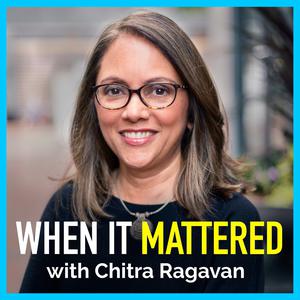

ABOUT THIS EPISODE
Ep. 4 — A Single Dad’s Quest for Parenting Advice Positions him to Expose Russian Interference in U.S. Elections / Jonathon Morgan, CEO and Co-Founder, New Knowledge
In this episode, Jonathon Morgan, CEO and Co-Founder of New Knowledge describes how the social media skills he acquired as a young single dad on the quest for parenting advice and online community gave him the skills and tools 15 years later to uncover the Russian interference in the 2016 U.S. Presidential elections.
Morgan talks about the difficult period in his life when he and his cyber security company were accused — he says mischaracterized — of using social media manipulation tactics similar to the Russians, to influence 650,000 likely voters in an Alabama Senate election to vote in favor of the democratic candidate. And he shares what that experience taught him about leadership.
And Morgan looks at what it will take for society to move from what he describes as online mob rule towards an authentic Internet and the price society will pay if we fail in those efforts.
Transcript
Download the PDF
Chitra: Hello and welcome to When it Mattered. I'm your host, Chitra Ragavan. I'm also the founder and CEO of Good Story Consulting an advisory firm helping technology startups find their narrative. On this weekly podcast, we invite leaders from around the world to share one personal story that changed the course of their life and work and how they lead and deal with adversity. Through these stories, we take you behind the scenes to get an inside perspective of some of the most eventful moments of our time.
Chitra: On this episode, we will be talking to Jonathon Morgan. He is CEO and co-founder of New Knowledge, one of the first organizations outside the US intelligence community to identify Russia systematic campaign to influence the 2016 presidential election a social media and counter terrorism expert. Jonathon has advised the State Department and Congress and he and his team produced the Senate intelligence committees extensive report that revealed the scope of Russia's effort to sway the 2016 elections. Jonathon, welcome to the podcast.
Jonathon: Thanks so much for having me. Excited to be here.
Chitra: Tell us a little bit more about yourself and how you first became involved in social media and understanding its importance.
Jonathon: Well, I mean I guess it goes back kind of a long way. So when I, I lived outside the US when I was younger, especially in high school. And one of the ways that I stayed in touch with all the friends that I had back home was this was the early days. So this was AOL Instant Messenger and it was kind of like a social network at the time. And it really got me into, I don't know, just how much personal connection people could make online and then got into coding and building websites and it's kind of really early days. I was a super geeky. I mean this was almost 20 years ago now, and then I think ultimately I thought my career was going to go a different direction, but kind of stumbled back into social media in the early days of online communities. Like just kind of pre Twitter to properly date myself in early adulthood, kind of right after I'd had a had a baby.
Chitra: So how old were you then?
Jonathon: Well, so it would have been 21 which was daunting at the time, and actually I think that was, that was a big part of it. I think that's why, again, I was kind of in a weird situation where I had a kid at a really young age. For me anyway, very unexpected, it was an odd time. I think now it's pretty commonplace for young parents to retain some sense of their identity that's like outside of being a parent. There was that whole, you know, hipster parenting movement 10 years ago. And so now it's kind of normal. But I think at the time it was, it still felt to me like the only model that I had for parenting was, was my parents, which again, at 21 felt really weird.
In this episode, Jonathon Morgan, CEO and Co-Founder of New Knowledge describes how the social media skills he acquired as a young single dad on the quest for parenting advice and online community gave him the skills and tools 15 years later to uncover the Russian interference in the 2016 U.S. Presidential elections.
Morgan talks about the difficult period in his life when he and his cyber security company were accused — he says mischaracterized — of using social media manipulation tactics similar to the Russians, to influence 650,000 likely voters in an Alabama Senate election to vote in favor of the democratic candidate. And he shares what that experience taught him about leadership.
And Morgan looks at what it will take for society to move from what he describes as online mob rule towards an authentic Internet and the price society will pay if we fail in those efforts.
Transcript
Download the PDF
Chitra: Hello and welcome to When it Mattered. I'm your host, Chitra Ragavan. I'm also the founder and CEO of Good Story Consulting an advisory firm helping technology startups find their narrative. On this weekly podcast, we invite leaders from around the world to share one personal story that changed the course of their life and work and how they lead and deal with adversity. Through these stories, we take you behind the scenes to get an inside perspective of some of the most eventful moments of our time.
Chitra: On this episode, we will be talking to Jonathon Morgan. He is CEO and co-founder of New Knowledge, one of the first organizations outside the US intelligence community to identify Russia systematic campaign to influence the 2016 presidential election a social media and counter terrorism expert. Jonathon has advised the State Department and Congress and he and his team produced the Senate intelligence committees extensive report that revealed the scope of Russia's effort to sway the 2016 elections. Jonathon, welcome to the podcast.
Jonathon: Thanks so much for having me. Excited to be here.
Chitra: Tell us a little bit more about yourself and how you first became involved in social media and understanding its importance.
Jonathon: Well, I mean I guess it goes back kind of a long way. So when I, I lived outside the US when I was younger, especially in high school. And one of the ways that I stayed in touch with all the friends that I had back home was this was the early days. So this was AOL Instant Messenger and it was kind of like a social network at the time. And it really got me into, I don't know, just how much personal connection people could make online and then got into coding and building websites and it's kind of really early days. I was a super geeky. I mean this was almost 20 years ago now, and then I think ultimately I thought my career was going to go a different direction, but kind of stumbled back into social media in the early days of online communities. Like just kind of pre Twitter to properly date myself in early adulthood, kind of right after I'd had a had a baby.
Chitra: So how old were you then?
Jonathon: Well, so it would have been 21 which was daunting at the time, and actually I think that was, that was a big part of it. I think that's why, again, I was kind of in a weird situation where I had a kid at a really young age. For me anyway, very unexpected, it was an odd time. I think now it's pretty commonplace for young parents to retain some sense of their identity that's like outside of being a parent. There was that whole, you know, hipster parenting movement 10 years ago. And so now it's kind of normal. But I think at the time it was, it still felt to me like the only model that I had for parenting was, was my parents, which again, at 21 felt really weird.
English
United States
TRANSCRIPT 🔗
Are you the producer of this podcast?
Add a podcast transcript
Need Audio-to-Text?
Transcribe with Listen411 in Just 60 Seconds
SEARCH PAST EPISODES
Search past episodes of When it Mattered.
OTHER EPISODES IN THIS PODCAST
Ep. 62: She went from poverty in communist-era Poland to becoming the artist of choice of Silicon Valley billionaires for her renaissance-inspired conceptual art of machines and robots/ Agnieszka Pilat, Conceptual Artist.
Born in the shadow of communism, in the grip of poverty, in the cradle of po…
Ep. No. 63 — Kidnapped and held hostage by drug kingpin Pablo Escobar revealed the best and worst of humanity / Francisco Santos Calderón, former Vice President of Colombia and former Colombian Ambassador to the United States.
For months, Pablo Escobar, notorious head of the Medellín drug cartel…
Ep. 60 — How history, geography, lineage, and duty converged to shape this retired four-star General’s decorated career / James L. Jones, Commandant, United States Marine Corps, Commander, United States European Command, Former Supreme Allied Commander, Europe, & Chairman, Jones Group Internati…
Ep. 61 — He became a celebrated anti-landmine crusader after a horrific landmine accident but then began questioning his superhero narrative / Jerry White, Nobel Peace Laureate / Author / Professor of Practice, University of Virginia.
In 1984, Jerry White went to Israel for his junior year, “study …
Ep. No. 64 — Disobeying his boss turned a humanitarian crisis into a calling / Sasha Chanoff, CEO and Founder, RefugePoint and Co-Author, “From Crisis to Calling: Finding Your Moral Center in the Toughest Decisions”.
In 2000, refugee expert and humanitarian aid worker Sasha Chanoff was in the Co…
Disclaimer: The podcast and artwork embedded on this page are from Chitra Ragavan, which is the property of its owner and not affiliated with or endorsed by Listen Notes, Inc.
EDIT
Thank you for helping to keep the podcast database up to date.
