
WEBVTT
00:00:06.160 --> 00:00:14.000
Welcome to Creative Currents, a Michigan Arts podcast, where we explore the power of collaborative creativity and how the arts spark meaningful conversation.
00:00:14.000 --> 00:00:22.000
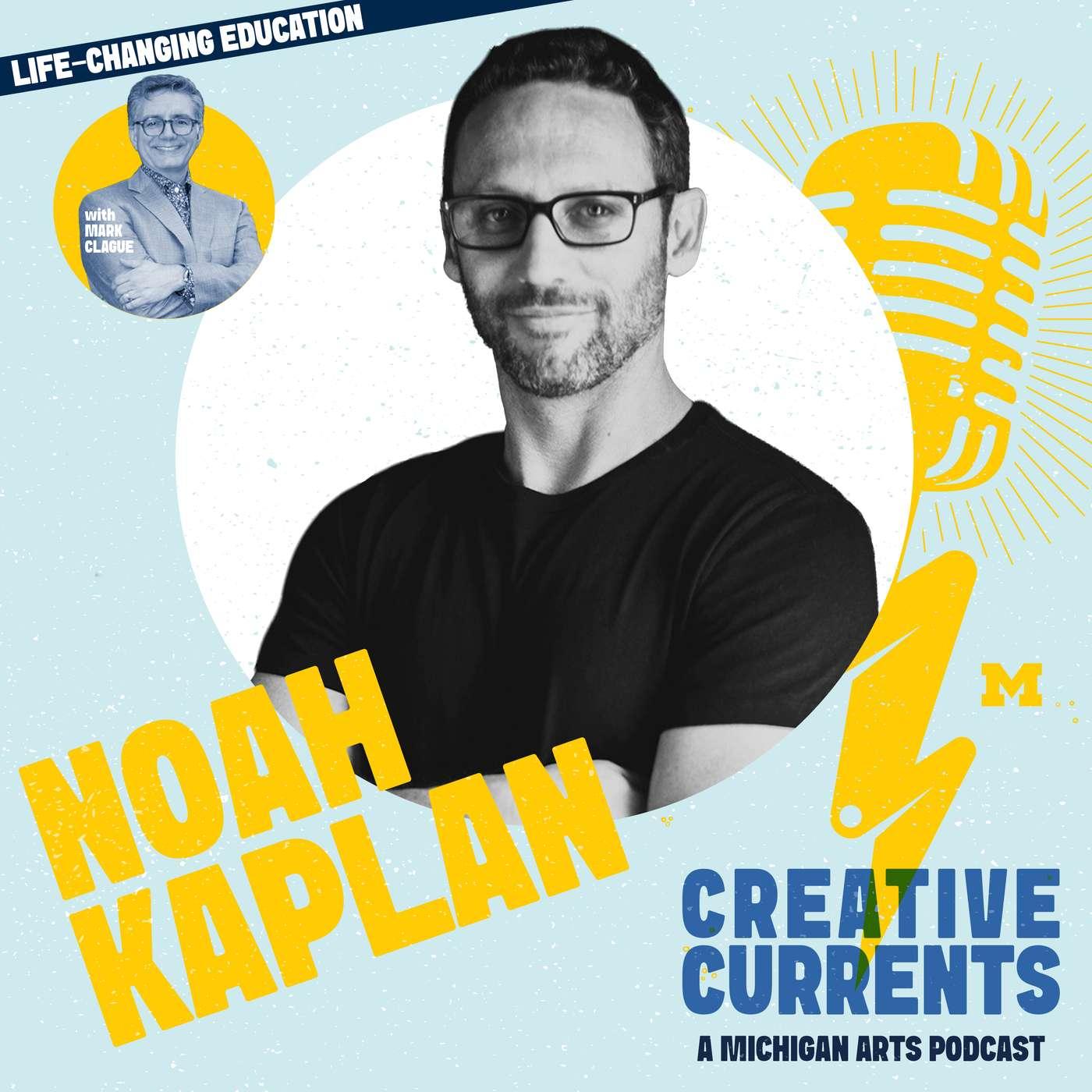
I'm your host, Mark Clague, and today we're joined by University of Michigan alumnus, artist, and Ann Arbor entrepreneur, Noah Kaplan.
00:00:22.480 --> 00:00:24.480
Noah, who just told me to call him "this dude."
00:00:24.719 --> 00:00:25.120
"This guy over here."
00:00:25.120 --> 00:00:28.960
This guy is founder and president of Leon Speakers.
00:00:28.960 --> 00:00:38.719
And over the past 25 years, Noah has used his background as a visual artist, designer, and entrepreneur to drive Leon's vision of blending design with technology and art with audio.
00:00:38.719 --> 00:00:59.280
His passion for building successful, creatively driven, craft-oriented businesses has stretched really across a whole series of businesses, including Mothfire Brewing, York food and drink, and most recently, in a fave of mine, Blimpy Burger, into a thriving creative campus that really reaches not only across the Ann Arbor community, but beyond.
00:00:59.520 --> 00:01:02.159
Noah is also a graduate of U of M's Penny W.
00:01:02.159 --> 00:01:06.159
Stamp School of Art and Design, where he earned a Bachelor of Fine Arts.
00:01:06.159 --> 00:01:15.280
And his arts education will be part of our topic today to talk about how it laid the creative foundation for Leon Speakers and his entrepreneurial ventures that have followed.
00:01:15.280 --> 00:01:17.439
Noah, it's great to welcome you to Creative Currents.
00:01:17.840 --> 00:01:18.879
So nice to be here, Mark.
00:01:18.879 --> 00:01:19.760
Thanks for having me.
00:01:20.079 --> 00:01:22.319
So give me a little bit of story.
00:01:22.319 --> 00:01:24.480
Like how did you go from artist to entrepreneur?
00:01:24.879 --> 00:01:28.719
There was a really interesting time, I think, when I was growing up as an artist.
00:01:28.719 --> 00:01:32.079
This is really almost pre-internet, if you could imagine that.
00:01:32.079 --> 00:01:33.359
So I always I was there.
00:01:33.359 --> 00:01:34.400
There was a time before the internet.
00:01:34.400 --> 00:01:39.200
I know you used to have to give directions to people.
00:01:39.200 --> 00:01:40.159
I gave directions.
00:01:40.159 --> 00:01:44.719
I don't remember exactly how I got anywhere, how I showed up to meetings, how I got on an airplane.
00:01:44.719 --> 00:01:46.319
I'm definitely directionally challenged.
00:01:46.319 --> 00:01:48.000
So it was it was difficult times.
00:01:48.000 --> 00:01:51.920
But as an artist, I think it was a really interesting time to be alive.
00:01:51.920 --> 00:01:55.439
I was born doing art for my whole entire life.
00:01:55.439 --> 00:01:59.040
And so my journey really was always through an art lens.
00:01:59.040 --> 00:02:04.480
And it really took me almost wherever I always wanted to be or go.
00:02:04.719 --> 00:02:09.199
So you grew up in New York and then you came to Ann Arbor to come to the Stamps School, right?
00:02:09.439 --> 00:02:19.599
Even that was, you know, I would call it a curious way to end up here because I really was vested into being a lifelong artist.
00:02:19.599 --> 00:02:23.120
And so as an artist, you go to what's called a portfolio review.
00:02:23.120 --> 00:02:24.800
I had no idea what that meant.
00:02:24.800 --> 00:02:26.639
It was at Pratt University in New York.
00:02:26.639 --> 00:02:31.520
I always imagined going to school in New York City or really highly dedicated art school.
00:02:31.520 --> 00:02:41.360
Um, and so when you create your portfolio at that time, you know, you're working when you think about it, from when you're what, 14 to 18?
00:02:41.599 --> 00:02:42.000
Yeah.
00:02:42.240 --> 00:02:48.719
And I created a portfolio based on everything, all the work I'd been doing, which is really just creative exploration.
00:02:48.719 --> 00:02:51.120
Art school really wasn't super focused.
00:02:51.360 --> 00:02:54.319
So for you, was it drawing or painting, or what was the gateway?
00:02:54.560 --> 00:02:56.159
I always worked in all medias.
00:02:56.159 --> 00:02:57.280
Like I love mixed media.
00:02:57.280 --> 00:03:02.560
Drawing was natural to me, but I also studied drawing through scientific illustration.
00:03:02.560 --> 00:03:05.199
I was really curious about how the body worked.
00:03:05.199 --> 00:03:08.560
Um, life drawing, I studied the old masters myself.
00:03:08.560 --> 00:03:11.840
Art really wasn't part of like education at that time.
00:03:11.840 --> 00:03:23.120
I was in programs, like pace programs, and I was working um within the arts, but um it really wasn't ever thought of as like a career or a foreground thing, especially where I was from.
00:03:23.439 --> 00:03:31.039
So when I went to that portfolio review, I ran into this one professor, his name was Professor Montalvo.
00:03:31.039 --> 00:03:38.319
And as we were reviewing the portfolio, he starts looking through it and he's curiously leafing through it.
00:03:38.319 --> 00:03:40.319
And I'm like, and this was a last-minute decision.
00:03:40.319 --> 00:03:43.439
So my mother, who's from the Bronx, went to the University of Michigan.
00:03:44.240 --> 00:03:49.120
And she's like, "You gotta show your work to the University of Michigan." I was like, "Why would I do that?
00:03:49.360 --> 00:03:50.719
What's the University of Michigan?
00:03:51.120 --> 00:03:55.840
Do they have an art school?" It sounds like a big school, it's in Michigan.
00:03:55.840 --> 00:03:57.759
I wasn't aware exactly where that was.
00:03:58.000 --> 00:03:58.240
Yep.
00:03:58.639 --> 00:03:59.039
Exactly.
00:03:59.039 --> 00:04:10.319
And but at that last minute, and this is what's so interesting about life, like that last minute thing that she told me because we were walking out the door was to go show the portfolio to the University of Michigan.
00:04:10.319 --> 00:04:18.399
So as he's leafing through it, he stopped on one drawing, which was a drawing I did of a scientist kind of looking over a specimen.
00:04:18.399 --> 00:04:24.160
And I drew it chaotically in crayon, tons of color, really expressive.
00:04:24.160 --> 00:04:29.920
And he said, Why did you use crayon when you drew this picture?
00:04:29.920 --> 00:04:33.360
And I told him, because I had a box of 64 crayons.
00:04:33.519 --> 00:04:37.199
And I was like, I think he liked that I wasn't trying to like overthink it.
00:04:37.199 --> 00:04:38.879
And it wasn't an abstract answer.
00:04:38.959 --> 00:04:42.639
And I always actually consider myself an artist as a trade.
00:04:42.639 --> 00:04:47.439
You know, it's something you do, it's work, it's something you learn, it's something you study.
00:04:47.439 --> 00:04:50.240
It's not always that abstract, it's not always that heady.
00:04:50.240 --> 00:04:52.560
It's got stuff and you make stuff.
00:04:52.560 --> 00:04:58.079
And he said, "How are your grades?" And I said, "They're fine." They were not stellar, but they were fine.
00:04:58.079 --> 00:04:58.480
Yeah.
00:04:58.480 --> 00:05:06.480
And he said, "Do you want to come to the University of Michigan?" I said, "I have no idea." And he actually FedEx-ed me an acceptance to the school.
00:05:06.480 --> 00:05:09.199
So I didn't apply to the school in a regular way.
00:05:09.199 --> 00:05:12.079
Um, so that little chance interaction led me to Michigan.
00:05:12.319 --> 00:05:13.120
Wow, that's amazing.
00:05:13.120 --> 00:05:16.240
Yeah, it changed your life, you know, and the turn of a dime.
00:05:16.560 --> 00:05:16.959
Exactly.
00:05:16.959 --> 00:05:20.079
And you're in some ways you'd say, Well, you've just fallen in your mom's footsteps.
00:05:20.079 --> 00:05:21.600
But in fact, that had nothing to do with it.
00:05:21.600 --> 00:05:22.240
It really didn't.
00:05:22.319 --> 00:05:26.319
And my mom isn't appeared because she loved the sweatshirt from the University of Michigan that her friend wore.
00:05:26.319 --> 00:05:32.959
So for my mom's 80th birthday, I drew her a drawing of that sweatshirt, which led our entire family to this state.
00:05:33.199 --> 00:05:33.519
Wow.
00:05:33.519 --> 00:05:34.800
That's that's totally amazing.
00:05:34.800 --> 00:05:35.360
Thank you.
00:05:35.360 --> 00:05:38.879
So you're in art school and you graduate.
00:05:38.879 --> 00:05:40.319
And then what happens?
00:05:40.720 --> 00:05:45.519
As life and luck would have it, I get a call from a friend who was working at the athletic department.
00:05:45.519 --> 00:05:46.560
His name was Stan.
00:05:46.800 --> 00:05:47.279
At Michigan.
00:05:47.519 --> 00:05:48.319
At Michigan.
00:05:48.319 --> 00:05:53.680
And Stan calls me, and we had worked together as artists at like upstate summer camps.
00:05:53.680 --> 00:05:55.360
You know, we are leading art programs.
00:05:55.360 --> 00:06:00.639
And Stan calls me and he says, "Noah, do you know how to draw portraits?" I'm like, "Yes, Stan.
00:06:00.639 --> 00:06:08.639
I know how to draw portraits." Like, good, because I just almost took a job drawing portraits for the University of Michigan, but I don't know how to draw portraits.
00:06:08.639 --> 00:06:10.160
I'm a ceramicist.
00:06:10.160 --> 00:06:14.720
This we knew, but Stan knew to get us in the door.
00:06:14.959 --> 00:06:16.959
So he calls me into this meeting.
00:06:16.959 --> 00:06:20.480
I'm completely not knowing what it's about.
00:06:20.480 --> 00:06:28.160
I come with my normal portfolio, which I had been building for a long time, for four years and from before.
00:06:28.160 --> 00:06:31.519
And I walk into a meeting to learn about this project.
00:06:31.519 --> 00:06:35.839
And there are like 30 people in the meeting wearing suits.
00:06:35.839 --> 00:06:37.360
Like this is old school Michigan.
00:06:37.360 --> 00:06:40.240
They're at a conference room that you could barely see the end of.
00:06:40.240 --> 00:06:44.399
They sit me down at the end of this table and they describe this project.
00:06:44.399 --> 00:06:48.319
It was all about drawing scholar athletes for the University of Michigan.
00:06:48.319 --> 00:06:49.439
Weird backstory.
00:06:49.439 --> 00:06:52.399
I was also a scholar athlete, but in high school.
00:06:52.399 --> 00:06:54.879
So it was also a weird twist for me to just be there.
00:06:54.879 --> 00:06:56.240
Stan was also an athlete.
00:06:56.319 --> 00:06:57.439
So what sport did you do?
00:06:57.600 --> 00:06:58.079
I was a wrestler.
00:06:58.319 --> 00:06:58.800
Wrestler, okay.
00:06:59.040 --> 00:07:08.560
What was amazing about this experience was kind of the approach for me was always just walk in as yourself, be who you are, don't try to oversell yourself.
00:07:08.560 --> 00:07:11.360
And so they started lighting me up.
00:07:11.360 --> 00:07:14.319
There's people that I recognized in the room, executives.
00:07:14.319 --> 00:07:16.720
And they're asking about these portraits and what you could do.
00:07:16.720 --> 00:07:24.000
And it turned out there'd been almost 45 people identified as scholar athletes at the University of Michigan since the turn of the century.
00:07:24.240 --> 00:07:26.720
So some of these were living people, but many of them were historic people.
00:07:26.720 --> 00:07:29.680
There were historic people dating all the way back to the turn of the century.
00:07:29.680 --> 00:07:31.439
So I got to see these photos.
00:07:31.439 --> 00:07:38.160
And the vision that they had was that they wanted to commemorate these people in some kind of way with portraiture and put it up in a building.
00:07:38.319 --> 00:07:40.800
And so I got in there and they started grilling me.
00:07:40.800 --> 00:07:41.600
"Can you draw?
00:07:41.600 --> 00:07:42.879
What kind of drawings can you do?
00:07:42.879 --> 00:07:46.160
How would you mount the all these?" You know, very simple questions.
00:07:46.160 --> 00:07:47.279
And then they wanted to see the work.
00:07:47.439 --> 00:07:48.399
But you had no prep at all.
00:07:48.399 --> 00:07:48.959
You had no idea.
00:07:49.199 --> 00:07:49.600
I really didn't.
00:07:49.600 --> 00:07:52.319
I came with my portfolio, which was like a win.
00:07:52.319 --> 00:07:53.759
So I turned the pages.
00:07:53.759 --> 00:07:55.600
You know, I had studied life drawing a lot.
00:07:55.600 --> 00:07:58.319
I drew hundreds of portraits throughout my life.
00:07:58.319 --> 00:08:01.839
I took life drawing every single semester of all of college.
00:08:01.839 --> 00:08:06.160
So I had tons of work there, and it really is in my wheelhouse to draw portraits.
00:08:06.160 --> 00:08:11.040
And so when I started looking at these portraits, it was just like a pile of photos, black and whites.
00:08:11.040 --> 00:08:13.279
The first thing I noticed was the haircuts.
00:08:13.279 --> 00:08:16.079
Many haircuts have changed.
00:08:16.079 --> 00:08:17.839
Haircuts have changed over time.
00:08:17.839 --> 00:08:19.279
Facial hair has changed.
00:08:19.360 --> 00:08:19.680
Yes.
00:08:19.680 --> 00:08:21.040
People used to look older.
00:08:21.199 --> 00:08:25.519
I think they used to, I don't know if they lived different lives, but like they seemed more mature.
00:08:25.519 --> 00:08:26.720
Some of them look like they were 40.
00:08:26.720 --> 00:08:28.160
And these were these were college athletes.
00:08:28.160 --> 00:08:29.199
These were college athletes.
00:08:29.199 --> 00:08:31.600
And it was really cool, though, is to to see these.
00:08:31.600 --> 00:08:34.080
And as life would have it, I get this project.
00:08:34.320 --> 00:08:35.519
So now you're not going back to New York.
00:08:35.519 --> 00:08:36.559
Now you're staying in Ann Arbor.
00:08:36.960 --> 00:08:37.440
I am here.
00:08:37.440 --> 00:08:37.840
Yeah.
00:08:37.840 --> 00:08:40.480
I'm now working professionally as an artist.
00:08:40.480 --> 00:08:46.720
And these portraits, I don't even want to tell you what I charged them for these portraits because it was not a lot.
00:08:46.720 --> 00:08:49.440
But to me, this was a very simple time.
00:08:49.440 --> 00:08:54.000
You know, my rent in my house back then was $350 a month.
00:08:54.799 --> 00:08:55.279
Different times.
00:08:55.519 --> 00:08:56.000
Different times.
00:08:56.000 --> 00:09:05.759
And like each portrait, while it was barely $1,000 each, um, for me, I can do portraits pretty quickly, especially at small formats.
00:09:05.759 --> 00:09:14.320
So I would do one to two portraits a day as I was starting to build up my other work, my other actual portfolio work, you know, my studied work.
00:09:14.320 --> 00:09:16.159
So this was a great job to launch.
00:09:16.159 --> 00:09:17.600
Crazy great job.
00:09:17.600 --> 00:09:26.879
It also just showed me not only is there a need for art, but almost everybody universally wants art in their lives in some way.
00:09:26.879 --> 00:09:34.879
And so it gave me a quick perspective and a quick job and cash to be able to kind of live this life right away.
00:09:34.879 --> 00:09:37.440
That job happened before I left college.
00:09:37.679 --> 00:09:45.440
So here I am going into my art career with a gigantic commission that would take me almost 16 months to finish.
00:09:45.440 --> 00:09:47.600
That's how I got into music.
00:09:47.600 --> 00:09:54.799
That's how I started meeting all the artists and engineers and friends because I had to not only create drawings, but we had to figure out the woodwork.
00:09:54.799 --> 00:09:57.360
You know, I made all the plaques for them out of mahogany.
00:09:57.360 --> 00:10:01.440
I had to learn about mahogany, how to finish the mahogany, how to cut it, how to write it.
00:10:01.440 --> 00:10:12.639
That's when we started building our first wood shops, so which turned out to eventually be the wood shop of the company, which is now called Leon Speakers, which at that point was a garage wood shop in our basement.
00:10:12.879 --> 00:10:15.120
So then where did Leon Speakers come into the thing?
00:10:15.120 --> 00:10:23.039
Like the technology and the audio and sort of seeing these as I mean, the custom, the handmade, the bespoke, like that's sort of part of your life from the beginning as an artist.
00:10:23.360 --> 00:10:26.559
My father was a doctor, was always he was a true folk artist.
00:10:26.559 --> 00:10:28.639
We always grew up like working in the shop.
00:10:28.639 --> 00:10:30.320
He loved working in the shop.
00:10:30.320 --> 00:10:33.039
He's been a completely raw, untrained artist.
00:10:33.039 --> 00:10:35.039
He makes insane things to this day.
00:10:35.039 --> 00:10:38.720
You know, he'll recreate his house in Brooklyn out of little wood objects.
00:10:38.720 --> 00:10:42.559
He will, you know, craft hundreds of little characters out of wood.
00:10:42.559 --> 00:10:44.080
He'll create projects for us.
00:10:44.080 --> 00:10:45.519
He always was having us work in the shop.
00:10:45.519 --> 00:10:48.080
So I was always working around woodworking.
00:10:48.080 --> 00:10:52.000
And I was doing woodworking and playing in the shop and experimenting in the shop.
00:10:52.000 --> 00:10:59.120
And then I learned a lot more about that in college when used to actually take technical and shop class, you know, learning in wood shops.
00:10:59.120 --> 00:11:03.360
So I knew what to do, but the technical expertise definitely came later.
00:11:03.600 --> 00:11:09.039
What started to happen at that time was something that was a carryover for my whole life.
00:11:09.039 --> 00:11:11.360
Like, so I am an extrovert.
00:11:11.360 --> 00:11:13.440
So I like to be around people a lot.
00:11:13.440 --> 00:11:19.279
And one of the weird things about art is you end up a lot alone.
00:11:19.279 --> 00:11:26.000
You know, some of my days working, I'd be alone for 10 hours working on, you know, a commission or a portrait.
00:11:26.000 --> 00:11:29.120
Even those little portraits, I mean, you got to get in that right headspace.
00:11:29.120 --> 00:11:31.519
So music was always kind of my battery.
00:11:31.759 --> 00:11:36.879
Since I was— for as long back as I can remember, I always had my stereo, I was always obsessed with music.
00:11:36.879 --> 00:11:41.600
It was kind of like not only my energy, but it was a vibration that kept me moving.
00:11:41.600 --> 00:11:45.279
As I started doing this other work, there was a lot of other artists around.
00:11:45.279 --> 00:11:56.559
Because what that translated to over time was I started not only listening to music obsessively, but I would, you know, go into the city, I would start through crates, I would dig into like different genres of music.
00:11:56.559 --> 00:11:59.039
And eventually I was like, I'm playing, I gotta play.
00:11:59.039 --> 00:12:07.279
So I started playing music to kind of just um distract myself or to take a break from drawing and working alone because I like physicality.
00:12:07.519 --> 00:12:07.679
Yeah.
00:12:07.759 --> 00:12:09.120
Did you play a particular instrument?
00:12:09.929 --> 00:12:16.159
I play guitars and percussion and anything that would shake or move, or I could bang or bust or break.
00:12:16.159 --> 00:12:21.279
And I like to play it real physically, so a lot very rhythmic stuff.
00:12:21.279 --> 00:12:22.960
I come from an artistic family.
00:12:22.960 --> 00:12:24.960
So my brother was like a true musician.
00:12:24.960 --> 00:12:28.879
I watched him playing in New York City and live shows and Ben, he's younger than me.
00:12:28.879 --> 00:12:37.600
And we started playing music a lot, and we started a band, and through that band, we started meeting lots of different artists and engineers and recording people.
00:12:37.600 --> 00:12:42.000
And at U of M, the coolest part is like this amalgamous of people that you meet.
00:12:42.080 --> 00:12:53.840
We met this one person who worked under Amir Bose from MIT, who was living here, and he saw that we were like really into sound and music, and he started hanging around.
00:12:53.840 --> 00:13:02.799
And so I would say organically, like the swirling thought of Leon speakers was coming to formation, but we had no idea that it would be a company.
00:13:02.960 --> 00:13:03.200
Yeah.
00:13:03.440 --> 00:13:04.720
It was more of a collective, you know.
00:13:04.960 --> 00:13:14.159
But in a way, yeah, you've built this collective, you built a community of creative people just through your work, and then then that becomes then the catalyst for a range of ideas.
00:13:14.399 --> 00:13:20.480
It was really organic and time felt really slow then in a beautiful way.
00:13:20.480 --> 00:13:24.799
I every morning, every day, we'd wake up and meet outside and play.
00:13:24.799 --> 00:13:29.279
Till sometimes at sunrise, sometimes we'd be awake all night.
00:13:29.440 --> 00:13:29.679
Yeah.
00:13:29.840 --> 00:13:36.399
You know, sometimes I'd work through the night and play in the morning all day and like, you know, walk and then meet the community, meet in the town.
00:13:36.399 --> 00:13:42.080
And so as we started to think about things, like we started to look at the way things were being built and being made.
00:13:42.080 --> 00:13:47.840
Like we explored making instruments, we explored making guitars, we built a pirate radio station.
00:13:47.840 --> 00:13:54.639
We built a 30-foot antenna off of the house and broadcast ridiculous music shows from it.
00:13:54.639 --> 00:14:00.000
Um, and so we were just doing a lot of exploration within the arts, and there was no boundaries.
00:14:00.639 --> 00:14:02.399
And so the days floated.
00:14:02.399 --> 00:14:09.200
And in a day, I could create where I can do a portrait and then write a song and then go next door.
00:14:09.200 --> 00:14:14.240
We could work on, hey, we want to make, you want to think about a product, or go help somebody else with what they were working on.
00:14:14.240 --> 00:14:20.159
Help one of the engineers figure out a problem they were having with electronics or how to plug stuff in or how to create a system.
00:14:20.320 --> 00:14:28.960
And once we started recording more, I started becoming really interested in all that equipment and how it worked, the whole signal path from the microphone all the way to playback.
00:14:28.960 --> 00:14:31.120
And you start getting really invested in this.
00:14:31.120 --> 00:14:36.639
I started getting moderately obsessed, which I realize is like a thread that keeps me moving to this day.
00:14:36.639 --> 00:14:40.399
I get obsessed, I dive as deep as possible and I'll explore it forever.
00:14:40.399 --> 00:14:42.480
You know, and I still explore it forever.
00:14:42.639 --> 00:14:48.559
But so, like when we were doing those original things, we started looking at the products that you could actually get at the time.
00:14:48.559 --> 00:14:54.000
And this is in the mid-90s, when really mass market had taken over the entire world.
00:14:54.000 --> 00:14:55.600
We didn't know what that meant.
00:14:55.600 --> 00:14:58.399
We we were we couldn't really afford fancy things anyway.
00:14:58.399 --> 00:15:05.519
You know we saw those fancy things in studios and you start hearing, you're like, wait, why is that so good and this is so bad?
00:15:05.519 --> 00:15:10.159
And like, oh well, this is from 1975, you know, this is a NIV recording console.
00:15:10.159 --> 00:15:11.279
You're like, what is that?
00:15:11.279 --> 00:15:20.240
So I started just becoming really curious about why it looks so beautiful, you know, why it had wooded accents, why the knobs were so tactile, why the lights look so interesting.
00:15:20.399 --> 00:15:26.000
And this goes back to like understanding that things used to be drawn, everything started as art.
00:15:26.000 --> 00:15:27.200
Ah, I see, yeah.
00:15:27.200 --> 00:15:33.600
And it led to my belief that every literal thing is created through an artistic lens.
00:15:33.919 --> 00:15:40.639
So when we started imagining like speakers or studio monitors trying to get them and seeing like, I remember I typed into the early internet.
00:15:40.639 --> 00:15:45.200
I was not technically savvy, but I was a searcher and explorer.
00:15:45.200 --> 00:15:53.360
So I uh in the early internet, I typed in like studio monitor speakers, and slowly pages after pages of black boxes came up.
00:15:53.360 --> 00:15:57.440
So even when you think of a speaker in your mind now, what do you see?
00:15:57.440 --> 00:15:59.039
Yeah, you see a black box.
00:15:59.200 --> 00:15:59.679
A black box.
00:15:59.679 --> 00:16:03.120
Pretty, pretty ubiquitous, boring standard.
00:16:03.440 --> 00:16:06.159
And boring was not in our vernacular at that time.
00:16:06.159 --> 00:16:15.360
We were like borderline extremists when it came to like, you know, creativity and what we thought creativity should be and how much output and how much work we were doing.
00:16:15.360 --> 00:16:18.320
So we started just seeing why were they built this way.
00:16:18.320 --> 00:16:23.440
So we'd go to like Kiwanis or like the PTO and like buy old speakers and chop them up.
00:16:23.440 --> 00:16:25.840
Then we bought both speakers and like cut them in half.
00:16:25.840 --> 00:16:28.240
And we're like, oh my god, they're making out of plastic.
00:16:28.240 --> 00:16:30.799
And wait, they just colored in this little part.
00:16:30.799 --> 00:16:36.639
Like these speakers from the 60s, 70s, 80s were made of like wood and beautiful veneers, and they had interesting grills.
00:16:36.639 --> 00:16:41.360
And then you'd go and see the ones we had now, and you cut them, it's like made of plastic and yeah, you know, as cheap as possible.
00:16:41.360 --> 00:16:44.080
That didn't sit right with us.
00:16:44.080 --> 00:16:50.559
So we started making the original speakers for our studios in the wood shop out of solid hardwoods.
00:16:50.720 --> 00:16:51.120
Got it.
00:16:51.279 --> 00:16:52.159
And we would paint them.
00:16:52.159 --> 00:16:57.840
And one of our first moves was actually to go to Zingerman's, which everybody who went to University of Michigan knows.
00:16:57.840 --> 00:17:01.919
We went to Zingerman's where we thought a possible customer base could be.
00:17:01.919 --> 00:17:13.200
And we said, "Hey, can we leave these little catalogs here?" Where we had created these little, we over the time speeding up, we had started making speakers for friends and family or for us people.
00:17:13.200 --> 00:17:16.720
For our studio, for playback, for playing.
00:17:17.200 --> 00:17:24.319
We started looking at all the electronics and the amplifiers and the woofers and the tweeters, and again, obsessed at that point.
00:17:24.319 --> 00:17:28.079
And you start realizing it's a really beautifully simple device, like an instrument.
00:17:28.079 --> 00:17:33.759
We had the woodworking skills to be able to build them, and we learned a lot from each other and learned about wood.
00:17:33.759 --> 00:17:36.079
And it was just like a really fun thing to explore.
00:17:36.240 --> 00:17:37.920
Was it a business at that point?
00:17:38.160 --> 00:17:39.440
I wouldn't say so.
00:17:39.440 --> 00:17:42.240
I was a lucky man in that I had that art gig.
00:17:42.240 --> 00:17:47.759
But from a musical standpoint, we were playing so many shows, but it really wasn't paying the bills.
00:17:47.759 --> 00:17:50.880
So, you know, this was another beautiful distraction.
00:17:50.880 --> 00:17:56.000
Keep me out of the studio to get around people and really collaborate and learn.
00:17:56.240 --> 00:17:59.200
So, what was the thing that clicked that turned it into a business?
00:17:59.519 --> 00:18:04.319
I really never thought of a business, you know, working as a business.
00:18:04.319 --> 00:18:09.920
Like, I thought of everything as an approach, you know, like a an exploration or an approach.
00:18:09.920 --> 00:18:14.160
I learned through this art lens that some things are universal.
00:18:14.160 --> 00:18:25.200
Like the thing I learned as an artist that I always tell young artists is that if you ask or inquire about what people love or what they want, like I'll ask you the question right now like, do you like music?
00:18:25.519 --> 00:18:26.079
I love music.
00:18:26.079 --> 00:18:26.400
Yeah.
00:18:26.559 --> 00:18:27.759
Would you ever want a piece of art?
00:18:28.000 --> 00:18:28.400
Absolutely.
00:18:28.720 --> 00:18:30.960
So I learned that those questions were always yeses.
00:18:30.960 --> 00:18:32.720
To me, they're absolute yeses.
00:18:32.720 --> 00:18:37.519
And so I was always like, I knew that there was a desire there for people to have something meaningful.
00:18:37.519 --> 00:18:42.960
Art is all about like finding and discovering meaning through imagery or through exploration.
00:18:42.960 --> 00:18:48.079
And so, similarly with the speaker company, I just was super curious.
00:18:48.079 --> 00:18:50.480
I never thought I would be a business person.
00:18:50.640 --> 00:18:53.519
You know, years past, I have a wood shop at this point.
00:18:53.519 --> 00:18:54.960
I have a little space downtown.
00:18:54.960 --> 00:18:58.240
It's called Noah's Underground Gallery, Leon Speakers.
00:18:58.240 --> 00:19:00.000
It's a collaborative art space.
00:19:00.000 --> 00:19:02.559
We used to do the U of M art shows down there.
00:19:02.559 --> 00:19:05.519
We were kind of like an underground counterculture.
00:19:05.680 --> 00:19:10.000
So just to lend a little bit of context there, we opened this place.
00:19:10.000 --> 00:19:16.480
It is a business and it has retail, and we had designed it and made it beautiful and people started coming down.
00:19:16.480 --> 00:19:18.640
And one of those people is from U of M.
00:19:18.799 --> 00:19:26.960
His name was Jack, and he said, "Oh my God, this place is amazing." He's like, "How'd you become so entrepreneurial?" I was like, "What is entrepreneurial?
00:19:26.960 --> 00:19:27.599
What does that mean?
00:19:27.599 --> 00:19:28.240
I've never heard of that.
00:19:28.240 --> 00:19:29.599
What is that?" And he's like, "You're like a n entrepreneur".
00:19:30.559 --> 00:19:36.559
I'm like, "What the hell is that?" And so I became curious about what he was talking about.
00:19:36.640 --> 00:19:40.400
He's like, "No, you know, like, you'd create a business plan?" I'm like, "A business plan?
00:19:40.400 --> 00:19:40.799
No.
00:19:40.799 --> 00:19:43.359
I'm an artist, you know, I'm a musician.
00:19:43.359 --> 00:19:51.359
Um, I could create a, I could paint for you." Um, which is funny because I realize now like visualization is part of a business plan.
00:19:51.440 --> 00:20:02.240
But he's like, "Oh, there's a program at U of M that helps local businesses create business plans." So I literally went home, looked up in the directory, and called the business school.
00:20:02.400 --> 00:20:02.880
Wow.
00:20:03.119 --> 00:20:04.160
On the telephone.
00:20:04.160 --> 00:20:06.480
This is a thing with a cord and you hold everything.
00:20:06.799 --> 00:20:08.480
Yeah, I've seen those in the museums.
00:20:08.720 --> 00:20:09.359
Yeah, exactly.
00:20:09.359 --> 00:20:11.599
So I do this, and what happens?
00:20:11.599 --> 00:20:14.640
The guy who created the map program picked up the phone.
00:20:14.799 --> 00:20:15.039
Wow.
00:20:15.119 --> 00:20:19.599
I'm like, "Hey, I heard you can help local business owners with a business plan." He said, "Yeah, we have a program.
00:20:19.599 --> 00:20:21.279
Like, we're actually doing this right now.
00:20:21.279 --> 00:20:24.880
Do you want to present your idea?" I'm like, "Yeah, I do."
00:20:24.880 --> 00:20:31.680
So at that point, I worked collaboratively again with the industrial design people from the U of M to create a presentation.
00:20:31.680 --> 00:20:38.319
And at that point, we learned that the bookshelf speakers were really drawing people's attention because of the natural hardwoods.
00:20:38.640 --> 00:20:42.799
But this is at the beginning of a new era of television that was also going on.
00:20:42.799 --> 00:20:49.359
I mean, I had a local friend who worked at a company called Morantz, and they had just put out some of the first flat panel plasma TVs.
00:20:49.359 --> 00:20:52.880
And we got one in our little space somehow.
00:20:52.880 --> 00:20:53.839
We beg barred.
00:20:53.839 --> 00:20:57.039
We're like, we need this thing, it's super important, it's going to change everything.
00:20:57.039 --> 00:20:58.400
And it did change everything.
00:20:58.559 --> 00:21:04.640
So we had designed these studio monitors that we were making and we changed the form factor of them after seeing like what people wanted.
00:21:04.640 --> 00:21:10.559
So accidentally, we had made some of the first speakers to match flat panel televisions at the time.
00:21:10.559 --> 00:21:12.160
So they were like studio monitors.
00:21:12.160 --> 00:21:15.200
We weren't really seeing this contextually, how important it would be.
00:21:15.839 --> 00:21:19.839
We also did other things like we filed patents for a product called Picture Sound.
00:21:19.839 --> 00:21:24.000
So, like we were seeing that like technology was moving onto the wall and into living spaces.
00:21:24.000 --> 00:21:28.400
We were too young and definitely too broke to be able to afford anything fancy.
00:21:28.400 --> 00:21:36.000
But we started to see and look through a window where people were buying these televisions for like $25,000 for a small television.
00:21:36.240 --> 00:21:56.160
And so it really opened us up as we traveled back to New York and started showing our products to other stores in New York City, the hi fi stores that we had grown up seeing, getting their feedback and coming back and realizing like, oh my God, like there's definitely no one trying to work on new technologies for making sound for these TVs and definitely nothing artistic.
00:21:56.319 --> 00:21:59.440
So, like the first products had like silk screens on the surface of the speaker.
00:21:59.440 --> 00:22:00.640
And guess what?
00:22:00.640 --> 00:22:02.400
We created a presentation.
00:22:02.400 --> 00:22:04.720
We called the speakers Plasmax.
00:22:04.720 --> 00:22:09.039
We came to like the most clunky, hysterical 3D presentation.
00:22:09.039 --> 00:22:10.079
Um, and we did it.
00:22:10.079 --> 00:22:16.240
At that time, I had like long dreadlocks, probably four feet long and I'm like presenting to the business school with my partners.
00:22:16.240 --> 00:22:20.240
PS, we won the competition.
00:22:20.400 --> 00:22:20.640
Wow.
00:22:20.799 --> 00:22:25.759
And so we got an amazing group of young business people who helped us write a business plan.
00:22:25.759 --> 00:22:28.960
And that really opened up my eyes to what this was.
00:22:28.960 --> 00:22:30.640
So I was born with hustle.
00:22:30.640 --> 00:22:31.680
I was never afraid.
00:22:31.680 --> 00:22:37.440
Uh, you know, I never actually planned on getting a job because my job was clear to me from day one be an artist.
00:22:37.440 --> 00:22:42.960
And so through curiosity and really not knowing what I'm doing, it's led me down amazing pathways.
00:22:42.960 --> 00:22:44.720
And you get to meet so many smart people.
00:22:44.720 --> 00:22:56.799
And that's what I love about being at the U of M and still being here 25, 30 years later is I can't believe the projects that we've done and the people we've met and how diverse it's been.
00:22:57.200 --> 00:23:00.559
And so what is it about art thinking that makes that possible?
00:23:00.559 --> 00:23:02.880
Is that is it the willingness to put stuff out there?
00:23:02.880 --> 00:23:06.720
Is it the willingness to experiment and iterate and try something new?
00:23:06.720 --> 00:23:13.039
Are there things that you think are sort of the key to why an entrepreneur or why an artist can go into that space and not even know it?
00:23:13.519 --> 00:23:14.720
I love that question.
00:23:14.720 --> 00:23:25.599
I think it's very different in introspective for anybody who's answering, but for me, art is an approach towards life that leads you towards exploration and expression.
00:23:25.599 --> 00:23:38.799
You know, so when you're always expressing something, and sometimes that expression isn't that deep or that meaningful, or like when you're even just drawing something to see if you can, there's a learning that's going on there, and you're wondering like, how am I gonna do this?
00:23:38.799 --> 00:23:40.640
Why, why do I know how to do this?
00:23:40.640 --> 00:23:45.279
And it also left me always imagining different ways to do it.
00:23:45.759 --> 00:23:49.279
There's immense ways to approach the same exact thing.
00:23:49.279 --> 00:23:55.599
You know, if you put a skull on the table and you have 50 artists around, they're all gonna see it a different way.
00:23:55.599 --> 00:23:57.119
They're gonna use different mediums.
00:23:57.119 --> 00:24:00.480
So you're seeing the same object, but you're seeing it through different lenses.
00:24:00.480 --> 00:24:09.599
So it gave me this strange thoughts about the way human beings look at things and how our senses perceive them and then how we output them.
00:24:09.920 --> 00:24:15.440
And so I always allow myself to let my imagination float wild, which I still take time to do.
00:24:15.440 --> 00:24:19.519
So I allow myself those thoughts to break free of convention.
00:24:19.519 --> 00:24:23.839
And I think convention can be a cage, but I always felt free of it.
00:24:24.160 --> 00:24:30.079
Well, one of the conventions you're also breaking, seems to me anyway, is the the notion that arts are a team sport at all.
00:24:30.079 --> 00:24:35.359
Like that you're seeing art as something that is part of your extroverted proclivities, right?
00:24:35.440 --> 00:24:37.039
It's about connecting with people.
00:24:37.039 --> 00:24:40.240
As opposed to, I think, the notions that I was raised in with art.
00:24:40.240 --> 00:24:44.240
You know, there's the lone genius sort of in the wilderness, nobody understands them.
00:24:44.240 --> 00:24:54.880
They're sort of misanthropic and and nobody, you know, you sort of totally so and nobody gets them and they're ahead of their time and they're they, you know, they're lonely.
00:24:54.880 --> 00:24:57.759
And uh and yours you're just totally the opposite.
00:24:57.759 --> 00:25:07.759
You know, art is about, you know, hanging out and sharing ideas and bouncing things around and exploring through other people the possibilities that they would add to your creative vision.
00:25:07.839 --> 00:25:07.920
Right.
00:25:07.920 --> 00:25:08.880
I love that.
00:25:08.960 --> 00:25:14.960
Um it's like you think about a group like the Beatles, who were a massively powerful art group.
00:25:14.960 --> 00:25:21.359
Not only are they creating music, but they're creating the visuals, the stories, impossible depth that they created by collaborating.
00:25:21.359 --> 00:25:24.799
Though I think because I worked with music too, that I just was so open to it.
00:25:24.880 --> 00:25:28.880
And I wasn't the best musician ever, you know, at playing, but I was always there for it.
00:25:28.880 --> 00:25:32.640
I could always appreciate everybody else's skills and talents.
00:25:32.640 --> 00:25:43.279
And so I think, you know, appreciation of others and what has been come before us and the study of what comes before us and like leaving yourself open to learning as like a lifelong thing.
00:25:43.440 --> 00:25:43.680
Yeah.
00:25:43.680 --> 00:25:44.079
Right.
00:25:44.160 --> 00:25:46.640
So like art is about learning and exploring.
00:25:46.640 --> 00:25:50.160
And so all these collaborations always lead you somewhere.
00:25:50.160 --> 00:25:54.720
The other thing I've let go of is even needing to know where they're going.
00:25:54.720 --> 00:25:56.240
That was a whole different phase of life.
00:25:56.240 --> 00:25:59.119
You know, in your first phase of life, you're like, can I pay the damn bills?
00:25:59.119 --> 00:26:01.279
You know, what's going, what's coming up next?
00:26:01.279 --> 00:26:04.319
You know, you're building a family, you're building a house, you're building a business.
00:26:04.319 --> 00:26:06.000
At a certain point, it flips.
00:26:06.160 --> 00:26:08.559
And I always allowed myself to do non-commercial work.
00:26:08.559 --> 00:26:14.640
In fact, probably most of my best work was done procrastinating for instead of doing what I was supposed to be doing.
00:26:14.640 --> 00:26:18.000
But no, I think art is incredibly collaborative.
00:26:18.000 --> 00:26:29.599
And even the projects we're doing right now, like the one we just finished, was with a group called Mesantoukani that was an artist I met at a trade show doing a Leon Speakers event at a design show.
00:26:29.599 --> 00:26:37.920
And through our collaboration, you know, even today, we are exploring the depths of new work, new products, new imaginative things.
00:26:38.240 --> 00:26:45.279
You know, we can't forget to talk about Mothfire because I have become a big fan of craft beer and love Mothfire Brewing.
00:26:45.279 --> 00:26:48.319
And so, how did how do you get from speakers to beer?
00:26:48.640 --> 00:26:49.839
Speakers to beer.
00:26:50.000 --> 00:26:51.200
That is an incredibly important.
00:26:51.680 --> 00:26:52.559
Musicians never drink.
00:26:52.559 --> 00:26:55.119
So I wouldn't have possibly have happened by accident.
00:26:55.440 --> 00:26:56.480
Exactly, exactly.
00:26:56.480 --> 00:27:01.200
S o as we were building Leon Speakers, I never would have imagined how much travel I would do.
00:27:01.200 --> 00:27:07.599
You know, I was traveling to different states, coast to coast, all the time, you know, spending almost a third of my life on the road.
00:27:07.599 --> 00:27:15.680
And at night, what I would do is I would look for who was playing local music and what breweries were open, and then what vintage shops I can go to.
00:27:15.839 --> 00:27:19.839
So I started living through that lens of craft breweries.
00:27:20.079 --> 00:27:20.720
I see.
00:27:20.720 --> 00:27:21.599
And then you st—
00:27:21.599 --> 00:27:28.720
I started becoming completely enthralled by the styles that were going on on, you know, the West Coast versus the East Coast.
00:27:28.880 --> 00:27:32.720
Oh, I remember, yeah, going to Denver and going to left-hand brewing and all over it.
00:27:32.960 --> 00:27:33.839
It's it's incredible.
00:27:33.839 --> 00:27:36.799
And you start noticing like, wait, how did the style evolve?
00:27:36.799 --> 00:27:39.279
Like, why and why how did hazy IPAs come up?
00:27:39.279 --> 00:27:42.319
I'm like, this was as interesting to me as rock and roll itself.
00:27:42.319 --> 00:27:53.599
The other cool thing was like watching them start in these little industrial lots and seeing them just evolve into full-scale businesses and campuses and you know, lines forming when people are releasing beers.
00:27:53.759 --> 00:28:01.279
That's when the spark came like, wait, we have to create something that will bring the energy to our campus, to our factory.
00:28:01.279 --> 00:28:06.799
I had been working there at that point where we are currently in the campus for almost 10 years.
00:28:06.799 --> 00:28:08.079
We worked all the time.
00:28:08.079 --> 00:28:11.359
We're just we're still like a crazy obsessive art studio.
00:28:11.359 --> 00:28:13.839
And we'd be working there all day and then it'd be in the dark.
00:28:13.839 --> 00:28:14.880
No one's around.
00:28:14.880 --> 00:28:18.000
We decided at a certain point, we're like, you know what?
00:28:18.000 --> 00:28:21.119
We need, why isn't Ann Arbor have any hazy IPAs?
00:28:21.119 --> 00:28:22.640
Why don't we have any West Coast IPAs?
00:28:22.640 --> 00:28:23.680
Who's making the beers?
00:28:23.680 --> 00:28:27.680
We have like three breweries at the time where like, we need to start making beer.
00:28:27.680 --> 00:28:30.160
So we started like almost a beer club in the file room.
00:28:30.160 --> 00:28:38.319
Fast forward a few months, all of a sudden we had a professional one-barrel custom-made system from Colorado with all the stainless steel rigged into the back of the factory.
00:28:38.720 --> 00:28:52.319
In a way, you've been answering this question the whole way, but in terms of like what you say to young artists today, whether they're current students or recent alums, what are the keys do you think of of helping them uncover their artistic potential?
00:28:52.559 --> 00:28:56.319
I love talking to people about the trade and the craft and the work.
00:28:56.319 --> 00:28:58.319
You know, not to get in your head.
00:28:58.319 --> 00:29:02.160
You can get in your head because of all these myths and stories that we've all grown up with.
00:29:02.160 --> 00:29:09.359
You know, we only see the top .0001% of what's ever been created right in museums or in books.
00:29:09.359 --> 00:29:12.880
And now you're exposed to so much on social media, it can almost become overwhelming.
00:29:12.880 --> 00:29:13.200
Right.
00:29:13.519 --> 00:29:16.880
The best thing to do is the work, relentlessly work.
00:29:16.880 --> 00:29:28.640
And when you're doing that work, to be around friends, to be around other people thinking about other things besides art, you know, the the multidisciplinary thinking that it takes to like just move beyond what you were doing.
00:29:28.640 --> 00:29:36.799
So I'll meet with young artists now and I'll look at a work and be like, "Can you do this same work again?" "What do you mean?" I'm like, "This is the first thought you had to do this.
00:29:36.799 --> 00:29:47.680
Maybe you can try it, treat the background differently." "What do you mean?" "Do you know what a ground is?" "No." So by studying all art throughout history, like, you know, at least I can now aim people at new thoughts.
00:29:47.680 --> 00:29:52.640
And like when you look back on art history, you know, it wasn't Michelangelo just working by himself, right?
00:29:52.640 --> 00:29:54.079
It wasn't Da Vinci working.
00:29:54.079 --> 00:29:56.720
They were companies of people behind them.
00:29:56.880 --> 00:29:57.039
Right.
00:29:57.039 --> 00:29:57.359
Yeah.
00:29:57.599 --> 00:30:02.799
All these early marble studios, these were factories of brilliant workers and crafts.
00:30:02.799 --> 00:30:03.920
The studio of Rembrandt.
00:30:03.920 --> 00:30:07.279
The studio of Rembrandt, these are craftspeople and they're led by vision.
00:30:07.279 --> 00:30:14.480
So figuring out what your vision is, your purest self, and like knowing that it's just an exploration and not don't take it too seriously.
00:30:14.480 --> 00:30:23.759
Play around, absorb it, change it, break it, shred it, throw it out, throw wine on it, step on it, ruin your favorite thing.
00:30:23.759 --> 00:30:28.319
Those are the thoughts I love to do because art school did definitely get heady at times.
00:30:28.720 --> 00:30:31.440
And I think it was more like a crash into it kind of person.
00:30:31.440 --> 00:30:35.599
And I still am like, I don't throw a lot of thought at it for better or for worse.
00:30:35.599 --> 00:30:39.119
It's like, let's go, let's make this happen, let's create the vision.
00:30:39.359 --> 00:30:45.119
That sense of play and the sense of feels like today, like there's so much like weight put on every little thing.
00:30:45.119 --> 00:30:50.319
And you know, you're gonna put it online and everybody, the world's gonna judge you for every little thing.
00:30:50.319 --> 00:30:59.200
And part of it was that that moment you were saying earlier in your career where you could play and it wasn't that expensive to do stuff and you didn't care about it, and you just made it happen.
00:30:59.440 --> 00:31:09.119
You made it happen and like you did a lot of work, and you know, a lot of the studio artists I work with, like the best work, you know, those little scraps of paper where you doodled on or you wrote this thing that inspired you.
00:31:09.119 --> 00:31:11.279
And those are the things I'm looking at now.
00:31:11.279 --> 00:31:14.000
The finished work is beautiful at the end, often too.
00:31:14.000 --> 00:31:15.920
The museums, the galleries, what it takes.
00:31:15.920 --> 00:31:19.599
But that journey to get there to me is definitely the more interesting part.
00:31:19.599 --> 00:31:23.279
Once it gets to commerce, you're like, okay, let's hope people buy this work.
00:31:23.279 --> 00:31:25.119
And that's a lot of pressure for people.
00:31:25.279 --> 00:31:29.279
S o it is real, like it is real business at the end, and you got to really think about that.
00:31:29.279 --> 00:31:32.160
So I'm not saying career-wise or business plan-wise.
00:31:32.160 --> 00:31:35.920
Like, I love thought of planning about what you want out of your art career.
00:31:35.920 --> 00:31:37.039
What do you want?
00:31:37.039 --> 00:31:41.759
Discovering what you want out of your career is very hard for people to do.
00:31:41.759 --> 00:31:42.960
I didn't realize that.
00:31:43.119 --> 00:31:47.759
I wrote a piece of paper when I was 21 years old of what I imagined I'd be doing right now.
00:31:47.759 --> 00:31:50.799
And I have the drawing, it's terrible drawing.
00:31:50.799 --> 00:31:59.680
But I had imagined this world, you know, and in this world, you know, that it was a music venue and a stage and a gallery and a space for people.
00:31:59.680 --> 00:32:01.359
It's so weirdly right.
00:32:01.359 --> 00:32:05.440
So to get to where we are now, like, how do you get into spaces and places?
00:32:05.519 --> 00:32:22.799
And I've learned to love throughout all this, that my favorite parts about this has been the people I've met and the times where we're all just put everything aside and just be together, be people, be connected through whatever we're doing, laugh, drink, eat a burger, order a quad, order a triple.
00:32:23.119 --> 00:32:30.799
S o in this town where I've been now for 30 years, where we have factory spaces and a campus, and now, you know, campus at York.
00:32:30.799 --> 00:32:37.599
Like, if you go look around, you'll look in the details that like these are all art and music spaces, yeah.
00:32:37.599 --> 00:32:39.759
Um, and places for people to be together.
00:32:39.759 --> 00:32:51.279
And my hope is that people are hanging out and being together and creating and living and expressing themselves and spending time with friends, because sometimes today you could feel so disconnected and it's insane.
00:32:51.519 --> 00:33:05.200
And so that's really still what keeps me here and draws me here is like all these real historical spaces, the culture of the campus, and like kind of the open atmosphere for thinking, you know, intellectually, academically, artistically, musically.
00:33:05.200 --> 00:33:06.000
It's still alive.
00:33:06.400 --> 00:33:10.960
Well, I hope everyone listening to this just feels inspired to just go hang out and see what the possibilities are.
00:33:10.960 --> 00:33:13.119
And thank you so much for coming in and talking with us today.
00:33:13.119 --> 00:33:14.160
It's been an awesome conversation.
00:33:14.480 --> 00:33:14.960
Same, same.
00:33:14.960 --> 00:33:15.920
Thanks for having me, Mark.
00:33:15.920 --> 00:33:17.119
Appreciate it.
00:33:20.400 --> 00:33:23.839
Creative Currents is a project of the University of Michigan's Arts Initiative.
00:33:23.839 --> 00:33:30.240
Please subscribe to hear more great conversations with artists, scholars, and arts leaders from across the campus and across the globe.
00:33:30.480 --> 00:33:34.160
Send your comments and suggestions via email to creativecurrents@ umich.edu.
00:33:35.519 --> 00:33:40.480
This episode of Creative Currents was produced by Jessica Jenks and edited by Brian Lilly.
00:33:40.480 --> 00:33:48.559
Our original theme music is composed and performed by Ansel Neely, an alumnus of the University of Michigan's School of Music, Theater, and Dance.
00:33:48.799 --> 00:33:55.279
To learn more about the University of Michigan's Arts Initiative, please visit our website at arts.umich.edu.
00:33:55.440 --> 00:33:58.640
Thank you for listening and for being part of the Michigan Arts community.
00:33:58.640 --> 00:34:00.799
It makes our campus so fabulous.
00:34:00.799 --> 00:34:06.480
Until next time, stay curious, stay inspired, and keep your creative currents flowing.
00:00:06.160 --> 00:00:14.000
Welcome to Creative Currents, a Michigan Arts podcast, where we explore the power of collaborative creativity and how the arts spark meaningful conversation.
00:00:14.000 --> 00:00:22.000
I'm your host, Mark Clague, and today we're joined by University of Michigan alumnus, artist, and Ann Arbor entrepreneur, Noah Kaplan.
00:00:22.480 --> 00:00:24.480
Noah, who just told me to call him "this dude."
00:00:24.719 --> 00:00:25.120
"This guy over here."
00:00:25.120 --> 00:00:28.960
This guy is founder and president of Leon Speakers.
00:00:28.960 --> 00:00:38.719
And over the past 25 years, Noah has used his background as a visual artist, designer, and entrepreneur to drive Leon's vision of blending design with technology and art with audio.
00:00:38.719 --> 00:00:59.280
His passion for building successful, creatively driven, craft-oriented businesses has stretched really across a whole series of businesses, including Mothfire Brewing, York food and drink, and most recently, in a fave of mine, Blimpy Burger, into a thriving creative campus that really reaches not only across the Ann Arbor community, but beyond.
00:00:59.520 --> 00:01:02.159
Noah is also a graduate of U of M's Penny W.
00:01:02.159 --> 00:01:06.159
Stamp School of Art and Design, where he earned a Bachelor of Fine Arts.
00:01:06.159 --> 00:01:15.280
And his arts education will be part of our topic today to talk about how it laid the creative foundation for Leon Speakers and his entrepreneurial ventures that have followed.
00:01:15.280 --> 00:01:17.439
Noah, it's great to welcome you to Creative Currents.
00:01:17.840 --> 00:01:18.879
So nice to be here, Mark.
00:01:18.879 --> 00:01:19.760
Thanks for having me.
00:01:20.079 --> 00:01:22.319
So give me a little bit of story.
00:01:22.319 --> 00:01:24.480
Like how did you go from artist to entrepreneur?
00:01:24.879 --> 00:01:28.719
There was a really interesting time, I think, when I was growing up as an artist.
00:01:28.719 --> 00:01:32.079
This is really almost pre-internet, if you could imagine that.
00:01:32.079 --> 00:01:33.359
So I always I was there.
00:01:33.359 --> 00:01:34.400
There was a time before the internet.
00:01:34.400 --> 00:01:39.200
I know you used to have to give directions to people.
00:01:39.200 --> 00:01:40.159
I gave directions.
00:01:40.159 --> 00:01:44.719
I don't remember exactly how I got anywhere, how I showed up to meetings, how I got on an airplane.
00:01:44.719 --> 00:01:46.319
I'm definitely directionally challenged.
00:01:46.319 --> 00:01:48.000
So it was it was difficult times.
00:01:48.000 --> 00:01:51.920
But as an artist, I think it was a really interesting time to be alive.
00:01:51.920 --> 00:01:55.439
I was born doing art for my whole entire life.
00:01:55.439 --> 00:01:59.040
And so my journey really was always through an art lens.
00:01:59.040 --> 00:02:04.480
And it really took me almost wherever I always wanted to be or go.
00:02:04.719 --> 00:02:09.199
So you grew up in New York and then you came to Ann Arbor to come to the Stamps School, right?
00:02:09.439 --> 00:02:19.599
Even that was, you know, I would call it a curious way to end up here because I really was vested into being a lifelong artist.
00:02:19.599 --> 00:02:23.120
And so as an artist, you go to what's called a portfolio review.
00:02:23.120 --> 00:02:24.800
I had no idea what that meant.
00:02:24.800 --> 00:02:26.639
It was at Pratt University in New York.
00:02:26.639 --> 00:02:31.520
I always imagined going to school in New York City or really highly dedicated art school.
00:02:31.520 --> 00:02:41.360
Um, and so when you create your portfolio at that time, you know, you're working when you think about it, from when you're what, 14 to 18?
00:02:41.599 --> 00:02:42.000
Yeah.
00:02:42.240 --> 00:02:48.719
And I created a portfolio based on everything, all the work I'd been doing, which is really just creative exploration.
00:02:48.719 --> 00:02:51.120
Art school really wasn't super focused.
00:02:51.360 --> 00:02:54.319
So for you, was it drawing or painting, or what was the gateway?
00:02:54.560 --> 00:02:56.159
I always worked in all medias.
00:02:56.159 --> 00:02:57.280
Like I love mixed media.
00:02:57.280 --> 00:03:02.560
Drawing was natural to me, but I also studied drawing through scientific illustration.
00:03:02.560 --> 00:03:05.199
I was really curious about how the body worked.
00:03:05.199 --> 00:03:08.560
Um, life drawing, I studied the old masters myself.
00:03:08.560 --> 00:03:11.840
Art really wasn't part of like education at that time.
00:03:11.840 --> 00:03:23.120
I was in programs, like pace programs, and I was working um within the arts, but um it really wasn't ever thought of as like a career or a foreground thing, especially where I was from.
00:03:23.439 --> 00:03:31.039
So when I went to that portfolio review, I ran into this one professor, his name was Professor Montalvo.
00:03:31.039 --> 00:03:38.319
And as we were reviewing the portfolio, he starts looking through it and he's curiously leafing through it.
00:03:38.319 --> 00:03:40.319
And I'm like, and this was a last-minute decision.
00:03:40.319 --> 00:03:43.439
So my mother, who's from the Bronx, went to the University of Michigan.
00:03:44.240 --> 00:03:49.120
And she's like, "You gotta show your work to the University of Michigan." I was like, "Why would I do that?
00:03:49.360 --> 00:03:50.719
What's the University of Michigan?
00:03:51.120 --> 00:03:55.840
Do they have an art school?" It sounds like a big school, it's in Michigan.
00:03:55.840 --> 00:03:57.759
I wasn't aware exactly where that was.
00:03:58.000 --> 00:03:58.240
Yep.
00:03:58.639 --> 00:03:59.039
Exactly.
00:03:59.039 --> 00:04:10.319
And but at that last minute, and this is what's so interesting about life, like that last minute thing that she told me because we were walking out the door was to go show the portfolio to the University of Michigan.
00:04:10.319 --> 00:04:18.399
So as he's leafing through it, he stopped on one drawing, which was a drawing I did of a scientist kind of looking over a specimen.
00:04:18.399 --> 00:04:24.160
And I drew it chaotically in crayon, tons of color, really expressive.
00:04:24.160 --> 00:04:29.920
And he said, Why did you use crayon when you drew this picture?
00:04:29.920 --> 00:04:33.360
And I told him, because I had a box of 64 crayons.
00:04:33.519 --> 00:04:37.199
And I was like, I think he liked that I wasn't trying to like overthink it.
00:04:37.199 --> 00:04:38.879
And it wasn't an abstract answer.
00:04:38.959 --> 00:04:42.639
And I always actually consider myself an artist as a trade.
00:04:42.639 --> 00:04:47.439
You know, it's something you do, it's work, it's something you learn, it's something you study.
00:04:47.439 --> 00:04:50.240
It's not always that abstract, it's not always that heady.
00:04:50.240 --> 00:04:52.560
It's got stuff and you make stuff.
00:04:52.560 --> 00:04:58.079
And he said, "How are your grades?" And I said, "They're fine." They were not stellar, but they were fine.
00:04:58.079 --> 00:04:58.480
Yeah.
00:04:58.480 --> 00:05:06.480
And he said, "Do you want to come to the University of Michigan?" I said, "I have no idea." And he actually FedEx-ed me an acceptance to the school.
00:05:06.480 --> 00:05:09.199
So I didn't apply to the school in a regular way.
00:05:09.199 --> 00:05:12.079
Um, so that little chance interaction led me to Michigan.
00:05:12.319 --> 00:05:13.120
Wow, that's amazing.
00:05:13.120 --> 00:05:16.240
Yeah, it changed your life, you know, and the turn of a dime.
00:05:16.560 --> 00:05:16.959
Exactly.
00:05:16.959 --> 00:05:20.079
And you're in some ways you'd say, Well, you've just fallen in your mom's footsteps.
00:05:20.079 --> 00:05:21.600
But in fact, that had nothing to do with it.
00:05:21.600 --> 00:05:22.240
It really didn't.
00:05:22.319 --> 00:05:26.319
And my mom isn't appeared because she loved the sweatshirt from the University of Michigan that her friend wore.
00:05:26.319 --> 00:05:32.959
So for my mom's 80th birthday, I drew her a drawing of that sweatshirt, which led our entire family to this state.
00:05:33.199 --> 00:05:33.519
Wow.
00:05:33.519 --> 00:05:34.800
That's that's totally amazing.
00:05:34.800 --> 00:05:35.360
Thank you.
00:05:35.360 --> 00:05:38.879
So you're in art school and you graduate.
00:05:38.879 --> 00:05:40.319
And then what happens?
00:05:40.720 --> 00:05:45.519
As life and luck would have it, I get a call from a friend who was working at the athletic department.
00:05:45.519 --> 00:05:46.560
His name was Stan.
00:05:46.800 --> 00:05:47.279
At Michigan.
00:05:47.519 --> 00:05:48.319
At Michigan.
00:05:48.319 --> 00:05:53.680
And Stan calls me, and we had worked together as artists at like upstate summer camps.
00:05:53.680 --> 00:05:55.360
You know, we are leading art programs.
00:05:55.360 --> 00:06:00.639
And Stan calls me and he says, "Noah, do you know how to draw portraits?" I'm like, "Yes, Stan.
00:06:00.639 --> 00:06:08.639
I know how to draw portraits." Like, good, because I just almost took a job drawing portraits for the University of Michigan, but I don't know how to draw portraits.
00:06:08.639 --> 00:06:10.160
I'm a ceramicist.
00:06:10.160 --> 00:06:14.720
This we knew, but Stan knew to get us in the door.
00:06:14.959 --> 00:06:16.959
So he calls me into this meeting.
00:06:16.959 --> 00:06:20.480
I'm completely not knowing what it's about.
00:06:20.480 --> 00:06:28.160
I come with my normal portfolio, which I had been building for a long time, for four years and from before.
00:06:28.160 --> 00:06:31.519
And I walk into a meeting to learn about this project.
00:06:31.519 --> 00:06:35.839
And there are like 30 people in the meeting wearing suits.
00:06:35.839 --> 00:06:37.360
Like this is old school Michigan.
00:06:37.360 --> 00:06:40.240
They're at a conference room that you could barely see the end of.
00:06:40.240 --> 00:06:44.399
They sit me down at the end of this table and they describe this project.
00:06:44.399 --> 00:06:48.319
It was all about drawing scholar athletes for the University of Michigan.
00:06:48.319 --> 00:06:49.439
Weird backstory.
00:06:49.439 --> 00:06:52.399
I was also a scholar athlete, but in high school.
00:06:52.399 --> 00:06:54.879
So it was also a weird twist for me to just be there.
00:06:54.879 --> 00:06:56.240
Stan was also an athlete.
00:06:56.319 --> 00:06:57.439
So what sport did you do?
00:06:57.600 --> 00:06:58.079
I was a wrestler.
00:06:58.319 --> 00:06:58.800
Wrestler, okay.
00:06:59.040 --> 00:07:08.560
What was amazing about this experience was kind of the approach for me was always just walk in as yourself, be who you are, don't try to oversell yourself.
00:07:08.560 --> 00:07:11.360
And so they started lighting me up.
00:07:11.360 --> 00:07:14.319
There's people that I recognized in the room, executives.
00:07:14.319 --> 00:07:16.720
And they're asking about these portraits and what you could do.
00:07:16.720 --> 00:07:24.000
And it turned out there'd been almost 45 people identified as scholar athletes at the University of Michigan since the turn of the century.
00:07:24.240 --> 00:07:26.720
So some of these were living people, but many of them were historic people.
00:07:26.720 --> 00:07:29.680
There were historic people dating all the way back to the turn of the century.
00:07:29.680 --> 00:07:31.439
So I got to see these photos.
00:07:31.439 --> 00:07:38.160
And the vision that they had was that they wanted to commemorate these people in some kind of way with portraiture and put it up in a building.
00:07:38.319 --> 00:07:40.800
And so I got in there and they started grilling me.
00:07:40.800 --> 00:07:41.600
"Can you draw?
00:07:41.600 --> 00:07:42.879
What kind of drawings can you do?
00:07:42.879 --> 00:07:46.160
How would you mount the all these?" You know, very simple questions.
00:07:46.160 --> 00:07:47.279
And then they wanted to see the work.
00:07:47.439 --> 00:07:48.399
But you had no prep at all.
00:07:48.399 --> 00:07:48.959
You had no idea.
00:07:49.199 --> 00:07:49.600
I really didn't.
00:07:49.600 --> 00:07:52.319
I came with my portfolio, which was like a win.
00:07:52.319 --> 00:07:53.759
So I turned the pages.
00:07:53.759 --> 00:07:55.600
You know, I had studied life drawing a lot.
00:07:55.600 --> 00:07:58.319
I drew hundreds of portraits throughout my life.
00:07:58.319 --> 00:08:01.839
I took life drawing every single semester of all of college.
00:08:01.839 --> 00:08:06.160
So I had tons of work there, and it really is in my wheelhouse to draw portraits.
00:08:06.160 --> 00:08:11.040
And so when I started looking at these portraits, it was just like a pile of photos, black and whites.
00:08:11.040 --> 00:08:13.279
The first thing I noticed was the haircuts.
00:08:13.279 --> 00:08:16.079
Many haircuts have changed.
00:08:16.079 --> 00:08:17.839
Haircuts have changed over time.
00:08:17.839 --> 00:08:19.279
Facial hair has changed.
00:08:19.360 --> 00:08:19.680
Yes.
00:08:19.680 --> 00:08:21.040
People used to look older.
00:08:21.199 --> 00:08:25.519
I think they used to, I don't know if they lived different lives, but like they seemed more mature.
00:08:25.519 --> 00:08:26.720
Some of them look like they were 40.
00:08:26.720 --> 00:08:28.160
And these were these were college athletes.
00:08:28.160 --> 00:08:29.199
These were college athletes.
00:08:29.199 --> 00:08:31.600
And it was really cool, though, is to to see these.
00:08:31.600 --> 00:08:34.080
And as life would have it, I get this project.
00:08:34.320 --> 00:08:35.519
So now you're not going back to New York.
00:08:35.519 --> 00:08:36.559
Now you're staying in Ann Arbor.
00:08:36.960 --> 00:08:37.440
I am here.
00:08:37.440 --> 00:08:37.840
Yeah.
00:08:37.840 --> 00:08:40.480
I'm now working professionally as an artist.
00:08:40.480 --> 00:08:46.720
And these portraits, I don't even want to tell you what I charged them for these portraits because it was not a lot.
00:08:46.720 --> 00:08:49.440
But to me, this was a very simple time.
00:08:49.440 --> 00:08:54.000
You know, my rent in my house back then was $350 a month.
00:08:54.799 --> 00:08:55.279
Different times.
00:08:55.519 --> 00:08:56.000
Different times.
00:08:56.000 --> 00:09:05.759
And like each portrait, while it was barely $1,000 each, um, for me, I can do portraits pretty quickly, especially at small formats.
00:09:05.759 --> 00:09:14.320
So I would do one to two portraits a day as I was starting to build up my other work, my other actual portfolio work, you know, my studied work.
00:09:14.320 --> 00:09:16.159
So this was a great job to launch.
00:09:16.159 --> 00:09:17.600
Crazy great job.
00:09:17.600 --> 00:09:26.879
It also just showed me not only is there a need for art, but almost everybody universally wants art in their lives in some way.
00:09:26.879 --> 00:09:34.879
And so it gave me a quick perspective and a quick job and cash to be able to kind of live this life right away.
00:09:34.879 --> 00:09:37.440
That job happened before I left college.
00:09:37.679 --> 00:09:45.440
So here I am going into my art career with a gigantic commission that would take me almost 16 months to finish.
00:09:45.440 --> 00:09:47.600
That's how I got into music.
00:09:47.600 --> 00:09:54.799
That's how I started meeting all the artists and engineers and friends because I had to not only create drawings, but we had to figure out the woodwork.
00:09:54.799 --> 00:09:57.360
You know, I made all the plaques for them out of mahogany.
00:09:57.360 --> 00:10:01.440
I had to learn about mahogany, how to finish the mahogany, how to cut it, how to write it.
00:10:01.440 --> 00:10:12.639
That's when we started building our first wood shops, so which turned out to eventually be the wood shop of the company, which is now called Leon Speakers, which at that point was a garage wood shop in our basement.
00:10:12.879 --> 00:10:15.120
So then where did Leon Speakers come into the thing?
00:10:15.120 --> 00:10:23.039
Like the technology and the audio and sort of seeing these as I mean, the custom, the handmade, the bespoke, like that's sort of part of your life from the beginning as an artist.
00:10:23.360 --> 00:10:26.559
My father was a doctor, was always he was a true folk artist.
00:10:26.559 --> 00:10:28.639
We always grew up like working in the shop.
00:10:28.639 --> 00:10:30.320
He loved working in the shop.
00:10:30.320 --> 00:10:33.039
He's been a completely raw, untrained artist.
00:10:33.039 --> 00:10:35.039
He makes insane things to this day.
00:10:35.039 --> 00:10:38.720
You know, he'll recreate his house in Brooklyn out of little wood objects.
00:10:38.720 --> 00:10:42.559
He will, you know, craft hundreds of little characters out of wood.
00:10:42.559 --> 00:10:44.080
He'll create projects for us.
00:10:44.080 --> 00:10:45.519
He always was having us work in the shop.
00:10:45.519 --> 00:10:48.080
So I was always working around woodworking.
00:10:48.080 --> 00:10:52.000
And I was doing woodworking and playing in the shop and experimenting in the shop.
00:10:52.000 --> 00:10:59.120
And then I learned a lot more about that in college when used to actually take technical and shop class, you know, learning in wood shops.
00:10:59.120 --> 00:11:03.360
So I knew what to do, but the technical expertise definitely came later.
00:11:03.600 --> 00:11:09.039
What started to happen at that time was something that was a carryover for my whole life.
00:11:09.039 --> 00:11:11.360
Like, so I am an extrovert.
00:11:11.360 --> 00:11:13.440
So I like to be around people a lot.
00:11:13.440 --> 00:11:19.279
And one of the weird things about art is you end up a lot alone.
00:11:19.279 --> 00:11:26.000
You know, some of my days working, I'd be alone for 10 hours working on, you know, a commission or a portrait.
00:11:26.000 --> 00:11:29.120
Even those little portraits, I mean, you got to get in that right headspace.
00:11:29.120 --> 00:11:31.519
So music was always kind of my battery.
00:11:31.759 --> 00:11:36.879
Since I was— for as long back as I can remember, I always had my stereo, I was always obsessed with music.
00:11:36.879 --> 00:11:41.600
It was kind of like not only my energy, but it was a vibration that kept me moving.
00:11:41.600 --> 00:11:45.279
As I started doing this other work, there was a lot of other artists around.
00:11:45.279 --> 00:11:56.559
Because what that translated to over time was I started not only listening to music obsessively, but I would, you know, go into the city, I would start through crates, I would dig into like different genres of music.
00:11:56.559 --> 00:11:59.039
And eventually I was like, I'm playing, I gotta play.
00:11:59.039 --> 00:12:07.279
So I started playing music to kind of just um distract myself or to take a break from drawing and working alone because I like physicality.
00:12:07.519 --> 00:12:07.679
Yeah.
00:12:07.759 --> 00:12:09.120
Did you play a particular instrument?
00:12:09.929 --> 00:12:16.159
I play guitars and percussion and anything that would shake or move, or I could bang or bust or break.
00:12:16.159 --> 00:12:21.279
And I like to play it real physically, so a lot very rhythmic stuff.
00:12:21.279 --> 00:12:22.960
I come from an artistic family.
00:12:22.960 --> 00:12:24.960
So my brother was like a true musician.
00:12:24.960 --> 00:12:28.879
I watched him playing in New York City and live shows and Ben, he's younger than me.
00:12:28.879 --> 00:12:37.600
And we started playing music a lot, and we started a band, and through that band, we started meeting lots of different artists and engineers and recording people.
00:12:37.600 --> 00:12:42.000
And at U of M, the coolest part is like this amalgamous of people that you meet.
00:12:42.080 --> 00:12:53.840
We met this one person who worked under Amir Bose from MIT, who was living here, and he saw that we were like really into sound and music, and he started hanging around.
00:12:53.840 --> 00:13:02.799
And so I would say organically, like the swirling thought of Leon speakers was coming to formation, but we had no idea that it would be a company.
00:13:02.960 --> 00:13:03.200
Yeah.
00:13:03.440 --> 00:13:04.720
It was more of a collective, you know.
00:13:04.960 --> 00:13:14.159
But in a way, yeah, you've built this collective, you built a community of creative people just through your work, and then then that becomes then the catalyst for a range of ideas.
00:13:14.399 --> 00:13:20.480
It was really organic and time felt really slow then in a beautiful way.
00:13:20.480 --> 00:13:24.799
I every morning, every day, we'd wake up and meet outside and play.
00:13:24.799 --> 00:13:29.279
Till sometimes at sunrise, sometimes we'd be awake all night.
00:13:29.440 --> 00:13:29.679
Yeah.
00:13:29.840 --> 00:13:36.399
You know, sometimes I'd work through the night and play in the morning all day and like, you know, walk and then meet the community, meet in the town.
00:13:36.399 --> 00:13:42.080
And so as we started to think about things, like we started to look at the way things were being built and being made.
00:13:42.080 --> 00:13:47.840
Like we explored making instruments, we explored making guitars, we built a pirate radio station.
00:13:47.840 --> 00:13:54.639
We built a 30-foot antenna off of the house and broadcast ridiculous music shows from it.
00:13:54.639 --> 00:14:00.000
Um, and so we were just doing a lot of exploration within the arts, and there was no boundaries.
00:14:00.639 --> 00:14:02.399
And so the days floated.
00:14:02.399 --> 00:14:09.200
And in a day, I could create where I can do a portrait and then write a song and then go next door.
00:14:09.200 --> 00:14:14.240
We could work on, hey, we want to make, you want to think about a product, or go help somebody else with what they were working on.
00:14:14.240 --> 00:14:20.159
Help one of the engineers figure out a problem they were having with electronics or how to plug stuff in or how to create a system.
00:14:20.320 --> 00:14:28.960
And once we started recording more, I started becoming really interested in all that equipment and how it worked, the whole signal path from the microphone all the way to playback.
00:14:28.960 --> 00:14:31.120
And you start getting really invested in this.
00:14:31.120 --> 00:14:36.639
I started getting moderately obsessed, which I realize is like a thread that keeps me moving to this day.
00:14:36.639 --> 00:14:40.399
I get obsessed, I dive as deep as possible and I'll explore it forever.
00:14:40.399 --> 00:14:42.480
You know, and I still explore it forever.
00:14:42.639 --> 00:14:48.559
But so, like when we were doing those original things, we started looking at the products that you could actually get at the time.
00:14:48.559 --> 00:14:54.000
And this is in the mid-90s, when really mass market had taken over the entire world.
00:14:54.000 --> 00:14:55.600
We didn't know what that meant.
00:14:55.600 --> 00:14:58.399
We we were we couldn't really afford fancy things anyway.
00:14:58.399 --> 00:15:05.519
You know we saw those fancy things in studios and you start hearing, you're like, wait, why is that so good and this is so bad?
00:15:05.519 --> 00:15:10.159
And like, oh well, this is from 1975, you know, this is a NIV recording console.
00:15:10.159 --> 00:15:11.279
You're like, what is that?
00:15:11.279 --> 00:15:20.240
So I started just becoming really curious about why it looks so beautiful, you know, why it had wooded accents, why the knobs were so tactile, why the lights look so interesting.
00:15:20.399 --> 00:15:26.000
And this goes back to like understanding that things used to be drawn, everything started as art.
00:15:26.000 --> 00:15:27.200
Ah, I see, yeah.
00:15:27.200 --> 00:15:33.600
And it led to my belief that every literal thing is created through an artistic lens.
00:15:33.919 --> 00:15:40.639
So when we started imagining like speakers or studio monitors trying to get them and seeing like, I remember I typed into the early internet.
00:15:40.639 --> 00:15:45.200
I was not technically savvy, but I was a searcher and explorer.
00:15:45.200 --> 00:15:53.360
So I uh in the early internet, I typed in like studio monitor speakers, and slowly pages after pages of black boxes came up.
00:15:53.360 --> 00:15:57.440
So even when you think of a speaker in your mind now, what do you see?
00:15:57.440 --> 00:15:59.039
Yeah, you see a black box.
00:15:59.200 --> 00:15:59.679
A black box.
00:15:59.679 --> 00:16:03.120
Pretty, pretty ubiquitous, boring standard.
00:16:03.440 --> 00:16:06.159
And boring was not in our vernacular at that time.
00:16:06.159 --> 00:16:15.360
We were like borderline extremists when it came to like, you know, creativity and what we thought creativity should be and how much output and how much work we were doing.
00:16:15.360 --> 00:16:18.320
So we started just seeing why were they built this way.
00:16:18.320 --> 00:16:23.440
So we'd go to like Kiwanis or like the PTO and like buy old speakers and chop them up.
00:16:23.440 --> 00:16:25.840
Then we bought both speakers and like cut them in half.
00:16:25.840 --> 00:16:28.240
And we're like, oh my god, they're making out of plastic.
00:16:28.240 --> 00:16:30.799
And wait, they just colored in this little part.
00:16:30.799 --> 00:16:36.639
Like these speakers from the 60s, 70s, 80s were made of like wood and beautiful veneers, and they had interesting grills.
00:16:36.639 --> 00:16:41.360
And then you'd go and see the ones we had now, and you cut them, it's like made of plastic and yeah, you know, as cheap as possible.
00:16:41.360 --> 00:16:44.080
That didn't sit right with us.
00:16:44.080 --> 00:16:50.559
So we started making the original speakers for our studios in the wood shop out of solid hardwoods.
00:16:50.720 --> 00:16:51.120
Got it.
00:16:51.279 --> 00:16:52.159
And we would paint them.
00:16:52.159 --> 00:16:57.840
And one of our first moves was actually to go to Zingerman's, which everybody who went to University of Michigan knows.
00:16:57.840 --> 00:17:01.919
We went to Zingerman's where we thought a possible customer base could be.
00:17:01.919 --> 00:17:13.200
And we said, "Hey, can we leave these little catalogs here?" Where we had created these little, we over the time speeding up, we had started making speakers for friends and family or for us people.
00:17:13.200 --> 00:17:16.720
For our studio, for playback, for playing.
00:17:17.200 --> 00:17:24.319
We started looking at all the electronics and the amplifiers and the woofers and the tweeters, and again, obsessed at that point.
00:17:24.319 --> 00:17:28.079
And you start realizing it's a really beautifully simple device, like an instrument.
00:17:28.079 --> 00:17:33.759
We had the woodworking skills to be able to build them, and we learned a lot from each other and learned about wood.
00:17:33.759 --> 00:17:36.079
And it was just like a really fun thing to explore.
00:17:36.240 --> 00:17:37.920
Was it a business at that point?
00:17:38.160 --> 00:17:39.440
I wouldn't say so.
00:17:39.440 --> 00:17:42.240
I was a lucky man in that I had that art gig.
00:17:42.240 --> 00:17:47.759
But from a musical standpoint, we were playing so many shows, but it really wasn't paying the bills.
00:17:47.759 --> 00:17:50.880
So, you know, this was another beautiful distraction.
00:17:50.880 --> 00:17:56.000
Keep me out of the studio to get around people and really collaborate and learn.
00:17:56.240 --> 00:17:59.200
So, what was the thing that clicked that turned it into a business?
00:17:59.519 --> 00:18:04.319
I really never thought of a business, you know, working as a business.
00:18:04.319 --> 00:18:09.920
Like, I thought of everything as an approach, you know, like a an exploration or an approach.
00:18:09.920 --> 00:18:14.160
I learned through this art lens that some things are universal.
00:18:14.160 --> 00:18:25.200
Like the thing I learned as an artist that I always tell young artists is that if you ask or inquire about what people love or what they want, like I'll ask you the question right now like, do you like music?
00:18:25.519 --> 00:18:26.079
I love music.
00:18:26.079 --> 00:18:26.400
Yeah.
00:18:26.559 --> 00:18:27.759
Would you ever want a piece of art?
00:18:28.000 --> 00:18:28.400
Absolutely.
00:18:28.720 --> 00:18:30.960
So I learned that those questions were always yeses.
00:18:30.960 --> 00:18:32.720
To me, they're absolute yeses.
00:18:32.720 --> 00:18:37.519
And so I was always like, I knew that there was a desire there for people to have something meaningful.
00:18:37.519 --> 00:18:42.960
Art is all about like finding and discovering meaning through imagery or through exploration.
00:18:42.960 --> 00:18:48.079
And so, similarly with the speaker company, I just was super curious.
00:18:48.079 --> 00:18:50.480
I never thought I would be a business person.
00:18:50.640 --> 00:18:53.519
You know, years past, I have a wood shop at this point.
00:18:53.519 --> 00:18:54.960
I have a little space downtown.
00:18:54.960 --> 00:18:58.240
It's called Noah's Underground Gallery, Leon Speakers.
00:18:58.240 --> 00:19:00.000
It's a collaborative art space.
00:19:00.000 --> 00:19:02.559
We used to do the U of M art shows down there.
00:19:02.559 --> 00:19:05.519
We were kind of like an underground counterculture.
00:19:05.680 --> 00:19:10.000
So just to lend a little bit of context there, we opened this place.
00:19:10.000 --> 00:19:16.480
It is a business and it has retail, and we had designed it and made it beautiful and people started coming down.
00:19:16.480 --> 00:19:18.640
And one of those people is from U of M.
00:19:18.799 --> 00:19:26.960
His name was Jack, and he said, "Oh my God, this place is amazing." He's like, "How'd you become so entrepreneurial?" I was like, "What is entrepreneurial?
00:19:26.960 --> 00:19:27.599
What does that mean?
00:19:27.599 --> 00:19:28.240
I've never heard of that.
00:19:28.240 --> 00:19:29.599
What is that?" And he's like, "You're like a n entrepreneur".
00:19:30.559 --> 00:19:36.559
I'm like, "What the hell is that?" And so I became curious about what he was talking about.
00:19:36.640 --> 00:19:40.400
He's like, "No, you know, like, you'd create a business plan?" I'm like, "A business plan?
00:19:40.400 --> 00:19:40.799
No.
00:19:40.799 --> 00:19:43.359
I'm an artist, you know, I'm a musician.
00:19:43.359 --> 00:19:51.359
Um, I could create a, I could paint for you." Um, which is funny because I realize now like visualization is part of a business plan.
00:19:51.440 --> 00:20:02.240
But he's like, "Oh, there's a program at U of M that helps local businesses create business plans." So I literally went home, looked up in the directory, and called the business school.
00:20:02.400 --> 00:20:02.880
Wow.
00:20:03.119 --> 00:20:04.160
On the telephone.
00:20:04.160 --> 00:20:06.480
This is a thing with a cord and you hold everything.
00:20:06.799 --> 00:20:08.480
Yeah, I've seen those in the museums.
00:20:08.720 --> 00:20:09.359
Yeah, exactly.
00:20:09.359 --> 00:20:11.599
So I do this, and what happens?
00:20:11.599 --> 00:20:14.640
The guy who created the map program picked up the phone.
00:20:14.799 --> 00:20:15.039
Wow.
00:20:15.119 --> 00:20:19.599
I'm like, "Hey, I heard you can help local business owners with a business plan." He said, "Yeah, we have a program.
00:20:19.599 --> 00:20:21.279
Like, we're actually doing this right now.
00:20:21.279 --> 00:20:24.880
Do you want to present your idea?" I'm like, "Yeah, I do."
00:20:24.880 --> 00:20:31.680
So at that point, I worked collaboratively again with the industrial design people from the U of M to create a presentation.
00:20:31.680 --> 00:20:38.319
And at that point, we learned that the bookshelf speakers were really drawing people's attention because of the natural hardwoods.
00:20:38.640 --> 00:20:42.799
But this is at the beginning of a new era of television that was also going on.
00:20:42.799 --> 00:20:49.359
I mean, I had a local friend who worked at a company called Morantz, and they had just put out some of the first flat panel plasma TVs.
00:20:49.359 --> 00:20:52.880
And we got one in our little space somehow.
00:20:52.880 --> 00:20:53.839
We beg barred.
00:20:53.839 --> 00:20:57.039
We're like, we need this thing, it's super important, it's going to change everything.
00:20:57.039 --> 00:20:58.400
And it did change everything.
00:20:58.559 --> 00:21:04.640
So we had designed these studio monitors that we were making and we changed the form factor of them after seeing like what people wanted.
00:21:04.640 --> 00:21:10.559
So accidentally, we had made some of the first speakers to match flat panel televisions at the time.
00:21:10.559 --> 00:21:12.160
So they were like studio monitors.
00:21:12.160 --> 00:21:15.200
We weren't really seeing this contextually, how important it would be.
00:21:15.839 --> 00:21:19.839
We also did other things like we filed patents for a product called Picture Sound.
00:21:19.839 --> 00:21:24.000
So, like we were seeing that like technology was moving onto the wall and into living spaces.
00:21:24.000 --> 00:21:28.400
We were too young and definitely too broke to be able to afford anything fancy.
00:21:28.400 --> 00:21:36.000
But we started to see and look through a window where people were buying these televisions for like $25,000 for a small television.
00:21:36.240 --> 00:21:56.160
And so it really opened us up as we traveled back to New York and started showing our products to other stores in New York City, the hi fi stores that we had grown up seeing, getting their feedback and coming back and realizing like, oh my God, like there's definitely no one trying to work on new technologies for making sound for these TVs and definitely nothing artistic.
00:21:56.319 --> 00:21:59.440
So, like the first products had like silk screens on the surface of the speaker.
00:21:59.440 --> 00:22:00.640
And guess what?
00:22:00.640 --> 00:22:02.400
We created a presentation.
00:22:02.400 --> 00:22:04.720
We called the speakers Plasmax.
00:22:04.720 --> 00:22:09.039
We came to like the most clunky, hysterical 3D presentation.
00:22:09.039 --> 00:22:10.079
Um, and we did it.
00:22:10.079 --> 00:22:16.240
At that time, I had like long dreadlocks, probably four feet long and I'm like presenting to the business school with my partners.
00:22:16.240 --> 00:22:20.240
PS, we won the competition.
00:22:20.400 --> 00:22:20.640
Wow.
00:22:20.799 --> 00:22:25.759
And so we got an amazing group of young business people who helped us write a business plan.
00:22:25.759 --> 00:22:28.960
And that really opened up my eyes to what this was.
00:22:28.960 --> 00:22:30.640
So I was born with hustle.
00:22:30.640 --> 00:22:31.680
I was never afraid.
00:22:31.680 --> 00:22:37.440
Uh, you know, I never actually planned on getting a job because my job was clear to me from day one be an artist.
00:22:37.440 --> 00:22:42.960
And so through curiosity and really not knowing what I'm doing, it's led me down amazing pathways.
00:22:42.960 --> 00:22:44.720
And you get to meet so many smart people.
00:22:44.720 --> 00:22:56.799
And that's what I love about being at the U of M and still being here 25, 30 years later is I can't believe the projects that we've done and the people we've met and how diverse it's been.
00:22:57.200 --> 00:23:00.559
And so what is it about art thinking that makes that possible?
00:23:00.559 --> 00:23:02.880
Is that is it the willingness to put stuff out there?
00:23:02.880 --> 00:23:06.720
Is it the willingness to experiment and iterate and try something new?
00:23:06.720 --> 00:23:13.039
Are there things that you think are sort of the key to why an entrepreneur or why an artist can go into that space and not even know it?
00:23:13.519 --> 00:23:14.720
I love that question.
00:23:14.720 --> 00:23:25.599
I think it's very different in introspective for anybody who's answering, but for me, art is an approach towards life that leads you towards exploration and expression.
00:23:25.599 --> 00:23:38.799
You know, so when you're always expressing something, and sometimes that expression isn't that deep or that meaningful, or like when you're even just drawing something to see if you can, there's a learning that's going on there, and you're wondering like, how am I gonna do this?
00:23:38.799 --> 00:23:40.640
Why, why do I know how to do this?
00:23:40.640 --> 00:23:45.279
And it also left me always imagining different ways to do it.
00:23:45.759 --> 00:23:49.279
There's immense ways to approach the same exact thing.
00:23:49.279 --> 00:23:55.599
You know, if you put a skull on the table and you have 50 artists around, they're all gonna see it a different way.
00:23:55.599 --> 00:23:57.119
They're gonna use different mediums.
00:23:57.119 --> 00:24:00.480
So you're seeing the same object, but you're seeing it through different lenses.
00:24:00.480 --> 00:24:09.599
So it gave me this strange thoughts about the way human beings look at things and how our senses perceive them and then how we output them.
00:24:09.920 --> 00:24:15.440
And so I always allow myself to let my imagination float wild, which I still take time to do.
00:24:15.440 --> 00:24:19.519
So I allow myself those thoughts to break free of convention.
00:24:19.519 --> 00:24:23.839
And I think convention can be a cage, but I always felt free of it.
00:24:24.160 --> 00:24:30.079
Well, one of the conventions you're also breaking, seems to me anyway, is the the notion that arts are a team sport at all.
00:24:30.079 --> 00:24:35.359
Like that you're seeing art as something that is part of your extroverted proclivities, right?
00:24:35.440 --> 00:24:37.039
It's about connecting with people.
00:24:37.039 --> 00:24:40.240
As opposed to, I think, the notions that I was raised in with art.
00:24:40.240 --> 00:24:44.240
You know, there's the lone genius sort of in the wilderness, nobody understands them.
00:24:44.240 --> 00:24:54.880
They're sort of misanthropic and and nobody, you know, you sort of totally so and nobody gets them and they're ahead of their time and they're they, you know, they're lonely.
00:24:54.880 --> 00:24:57.759
And uh and yours you're just totally the opposite.
00:24:57.759 --> 00:25:07.759
You know, art is about, you know, hanging out and sharing ideas and bouncing things around and exploring through other people the possibilities that they would add to your creative vision.
00:25:07.839 --> 00:25:07.920
Right.
00:25:07.920 --> 00:25:08.880
I love that.
00:25:08.960 --> 00:25:14.960
Um it's like you think about a group like the Beatles, who were a massively powerful art group.
00:25:14.960 --> 00:25:21.359
Not only are they creating music, but they're creating the visuals, the stories, impossible depth that they created by collaborating.
00:25:21.359 --> 00:25:24.799
Though I think because I worked with music too, that I just was so open to it.
00:25:24.880 --> 00:25:28.880
And I wasn't the best musician ever, you know, at playing, but I was always there for it.
00:25:28.880 --> 00:25:32.640
I could always appreciate everybody else's skills and talents.
00:25:32.640 --> 00:25:43.279
And so I think, you know, appreciation of others and what has been come before us and the study of what comes before us and like leaving yourself open to learning as like a lifelong thing.
00:25:43.440 --> 00:25:43.680
Yeah.
00:25:43.680 --> 00:25:44.079
Right.
00:25:44.160 --> 00:25:46.640
So like art is about learning and exploring.
00:25:46.640 --> 00:25:50.160
And so all these collaborations always lead you somewhere.
00:25:50.160 --> 00:25:54.720
The other thing I've let go of is even needing to know where they're going.
00:25:54.720 --> 00:25:56.240
That was a whole different phase of life.
00:25:56.240 --> 00:25:59.119
You know, in your first phase of life, you're like, can I pay the damn bills?
00:25:59.119 --> 00:26:01.279
You know, what's going, what's coming up next?
00:26:01.279 --> 00:26:04.319
You know, you're building a family, you're building a house, you're building a business.
00:26:04.319 --> 00:26:06.000
At a certain point, it flips.
00:26:06.160 --> 00:26:08.559
And I always allowed myself to do non-commercial work.
00:26:08.559 --> 00:26:14.640
In fact, probably most of my best work was done procrastinating for instead of doing what I was supposed to be doing.
00:26:14.640 --> 00:26:18.000
But no, I think art is incredibly collaborative.
00:26:18.000 --> 00:26:29.599
And even the projects we're doing right now, like the one we just finished, was with a group called Mesantoukani that was an artist I met at a trade show doing a Leon Speakers event at a design show.
00:26:29.599 --> 00:26:37.920
And through our collaboration, you know, even today, we are exploring the depths of new work, new products, new imaginative things.
00:26:38.240 --> 00:26:45.279
You know, we can't forget to talk about Mothfire because I have become a big fan of craft beer and love Mothfire Brewing.
00:26:45.279 --> 00:26:48.319
And so, how did how do you get from speakers to beer?
00:26:48.640 --> 00:26:49.839
Speakers to beer.
00:26:50.000 --> 00:26:51.200
That is an incredibly important.
00:26:51.680 --> 00:26:52.559
Musicians never drink.
00:26:52.559 --> 00:26:55.119
So I wouldn't have possibly have happened by accident.
00:26:55.440 --> 00:26:56.480
Exactly, exactly.
00:26:56.480 --> 00:27:01.200
S o as we were building Leon Speakers, I never would have imagined how much travel I would do.
00:27:01.200 --> 00:27:07.599
You know, I was traveling to different states, coast to coast, all the time, you know, spending almost a third of my life on the road.
00:27:07.599 --> 00:27:15.680
And at night, what I would do is I would look for who was playing local music and what breweries were open, and then what vintage shops I can go to.
00:27:15.839 --> 00:27:19.839
So I started living through that lens of craft breweries.
00:27:20.079 --> 00:27:20.720
I see.
00:27:20.720 --> 00:27:21.599
And then you st—
00:27:21.599 --> 00:27:28.720
I started becoming completely enthralled by the styles that were going on on, you know, the West Coast versus the East Coast.
00:27:28.880 --> 00:27:32.720
Oh, I remember, yeah, going to Denver and going to left-hand brewing and all over it.
00:27:32.960 --> 00:27:33.839
It's it's incredible.
00:27:33.839 --> 00:27:36.799
And you start noticing like, wait, how did the style evolve?
00:27:36.799 --> 00:27:39.279
Like, why and why how did hazy IPAs come up?
00:27:39.279 --> 00:27:42.319
I'm like, this was as interesting to me as rock and roll itself.
00:27:42.319 --> 00:27:53.599
The other cool thing was like watching them start in these little industrial lots and seeing them just evolve into full-scale businesses and campuses and you know, lines forming when people are releasing beers.
00:27:53.759 --> 00:28:01.279
That's when the spark came like, wait, we have to create something that will bring the energy to our campus, to our factory.
00:28:01.279 --> 00:28:06.799
I had been working there at that point where we are currently in the campus for almost 10 years.
00:28:06.799 --> 00:28:08.079
We worked all the time.
00:28:08.079 --> 00:28:11.359
We're just we're still like a crazy obsessive art studio.
00:28:11.359 --> 00:28:13.839
And we'd be working there all day and then it'd be in the dark.
00:28:13.839 --> 00:28:14.880
No one's around.
00:28:14.880 --> 00:28:18.000
We decided at a certain point, we're like, you know what?
00:28:18.000 --> 00:28:21.119
We need, why isn't Ann Arbor have any hazy IPAs?
00:28:21.119 --> 00:28:22.640
Why don't we have any West Coast IPAs?
00:28:22.640 --> 00:28:23.680
Who's making the beers?
00:28:23.680 --> 00:28:27.680
We have like three breweries at the time where like, we need to start making beer.
00:28:27.680 --> 00:28:30.160
So we started like almost a beer club in the file room.
00:28:30.160 --> 00:28:38.319
Fast forward a few months, all of a sudden we had a professional one-barrel custom-made system from Colorado with all the stainless steel rigged into the back of the factory.
00:28:38.720 --> 00:28:52.319
In a way, you've been answering this question the whole way, but in terms of like what you say to young artists today, whether they're current students or recent alums, what are the keys do you think of of helping them uncover their artistic potential?
00:28:52.559 --> 00:28:56.319
I love talking to people about the trade and the craft and the work.
00:28:56.319 --> 00:28:58.319
You know, not to get in your head.
00:28:58.319 --> 00:29:02.160
You can get in your head because of all these myths and stories that we've all grown up with.
00:29:02.160 --> 00:29:09.359
You know, we only see the top .0001% of what's ever been created right in museums or in books.
00:29:09.359 --> 00:29:12.880
And now you're exposed to so much on social media, it can almost become overwhelming.
00:29:12.880 --> 00:29:13.200
Right.
00:29:13.519 --> 00:29:16.880
The best thing to do is the work, relentlessly work.
00:29:16.880 --> 00:29:28.640
And when you're doing that work, to be around friends, to be around other people thinking about other things besides art, you know, the the multidisciplinary thinking that it takes to like just move beyond what you were doing.
00:29:28.640 --> 00:29:36.799
So I'll meet with young artists now and I'll look at a work and be like, "Can you do this same work again?" "What do you mean?" I'm like, "This is the first thought you had to do this.
00:29:36.799 --> 00:29:47.680
Maybe you can try it, treat the background differently." "What do you mean?" "Do you know what a ground is?" "No." So by studying all art throughout history, like, you know, at least I can now aim people at new thoughts.
00:29:47.680 --> 00:29:52.640
And like when you look back on art history, you know, it wasn't Michelangelo just working by himself, right?
00:29:52.640 --> 00:29:54.079
It wasn't Da Vinci working.
00:29:54.079 --> 00:29:56.720
They were companies of people behind them.
00:29:56.880 --> 00:29:57.039
Right.
00:29:57.039 --> 00:29:57.359
Yeah.
00:29:57.599 --> 00:30:02.799
All these early marble studios, these were factories of brilliant workers and crafts.
00:30:02.799 --> 00:30:03.920
The studio of Rembrandt.
00:30:03.920 --> 00:30:07.279
The studio of Rembrandt, these are craftspeople and they're led by vision.
00:30:07.279 --> 00:30:14.480
So figuring out what your vision is, your purest self, and like knowing that it's just an exploration and not don't take it too seriously.
00:30:14.480 --> 00:30:23.759
Play around, absorb it, change it, break it, shred it, throw it out, throw wine on it, step on it, ruin your favorite thing.
00:30:23.759 --> 00:30:28.319
Those are the thoughts I love to do because art school did definitely get heady at times.
00:30:28.720 --> 00:30:31.440
And I think it was more like a crash into it kind of person.
00:30:31.440 --> 00:30:35.599
And I still am like, I don't throw a lot of thought at it for better or for worse.
00:30:35.599 --> 00:30:39.119
It's like, let's go, let's make this happen, let's create the vision.
00:30:39.359 --> 00:30:45.119
That sense of play and the sense of feels like today, like there's so much like weight put on every little thing.
00:30:45.119 --> 00:30:50.319
And you know, you're gonna put it online and everybody, the world's gonna judge you for every little thing.
00:30:50.319 --> 00:30:59.200
And part of it was that that moment you were saying earlier in your career where you could play and it wasn't that expensive to do stuff and you didn't care about it, and you just made it happen.
00:30:59.440 --> 00:31:09.119
You made it happen and like you did a lot of work, and you know, a lot of the studio artists I work with, like the best work, you know, those little scraps of paper where you doodled on or you wrote this thing that inspired you.
00:31:09.119 --> 00:31:11.279
And those are the things I'm looking at now.
00:31:11.279 --> 00:31:14.000
The finished work is beautiful at the end, often too.
00:31:14.000 --> 00:31:15.920
The museums, the galleries, what it takes.
00:31:15.920 --> 00:31:19.599
But that journey to get there to me is definitely the more interesting part.
00:31:19.599 --> 00:31:23.279
Once it gets to commerce, you're like, okay, let's hope people buy this work.
00:31:23.279 --> 00:31:25.119
And that's a lot of pressure for people.
00:31:25.279 --> 00:31:29.279
S o it is real, like it is real business at the end, and you got to really think about that.
00:31:29.279 --> 00:31:32.160
So I'm not saying career-wise or business plan-wise.
00:31:32.160 --> 00:31:35.920
Like, I love thought of planning about what you want out of your art career.
00:31:35.920 --> 00:31:37.039
What do you want?
00:31:37.039 --> 00:31:41.759
Discovering what you want out of your career is very hard for people to do.
00:31:41.759 --> 00:31:42.960
I didn't realize that.
00:31:43.119 --> 00:31:47.759
I wrote a piece of paper when I was 21 years old of what I imagined I'd be doing right now.
00:31:47.759 --> 00:31:50.799
And I have the drawing, it's terrible drawing.
00:31:50.799 --> 00:31:59.680
But I had imagined this world, you know, and in this world, you know, that it was a music venue and a stage and a gallery and a space for people.
00:31:59.680 --> 00:32:01.359
It's so weirdly right.
00:32:01.359 --> 00:32:05.440
So to get to where we are now, like, how do you get into spaces and places?
00:32:05.519 --> 00:32:22.799
And I've learned to love throughout all this, that my favorite parts about this has been the people I've met and the times where we're all just put everything aside and just be together, be people, be connected through whatever we're doing, laugh, drink, eat a burger, order a quad, order a triple.
00:32:23.119 --> 00:32:30.799
S o in this town where I've been now for 30 years, where we have factory spaces and a campus, and now, you know, campus at York.
00:32:30.799 --> 00:32:37.599
Like, if you go look around, you'll look in the details that like these are all art and music spaces, yeah.
00:32:37.599 --> 00:32:39.759
Um, and places for people to be together.
00:32:39.759 --> 00:32:51.279
And my hope is that people are hanging out and being together and creating and living and expressing themselves and spending time with friends, because sometimes today you could feel so disconnected and it's insane.
00:32:51.519 --> 00:33:05.200
And so that's really still what keeps me here and draws me here is like all these real historical spaces, the culture of the campus, and like kind of the open atmosphere for thinking, you know, intellectually, academically, artistically, musically.
00:33:05.200 --> 00:33:06.000
It's still alive.
00:33:06.400 --> 00:33:10.960
Well, I hope everyone listening to this just feels inspired to just go hang out and see what the possibilities are.
00:33:10.960 --> 00:33:13.119
And thank you so much for coming in and talking with us today.
00:33:13.119 --> 00:33:14.160
It's been an awesome conversation.
00:33:14.480 --> 00:33:14.960
Same, same.
00:33:14.960 --> 00:33:15.920
Thanks for having me, Mark.
00:33:15.920 --> 00:33:17.119
Appreciate it.
00:33:20.400 --> 00:33:23.839
Creative Currents is a project of the University of Michigan's Arts Initiative.
00:33:23.839 --> 00:33:30.240
Please subscribe to hear more great conversations with artists, scholars, and arts leaders from across the campus and across the globe.
00:33:30.480 --> 00:33:34.160
Send your comments and suggestions via email to creativecurrents@ umich.edu.
00:33:35.519 --> 00:33:40.480
This episode of Creative Currents was produced by Jessica Jenks and edited by Brian Lilly.
00:33:40.480 --> 00:33:48.559
Our original theme music is composed and performed by Ansel Neely, an alumnus of the University of Michigan's School of Music, Theater, and Dance.
00:33:48.799 --> 00:33:55.279
To learn more about the University of Michigan's Arts Initiative, please visit our website at arts.umich.edu.
00:33:55.440 --> 00:33:58.640
Thank you for listening and for being part of the Michigan Arts community.
00:33:58.640 --> 00:34:00.799
It makes our campus so fabulous.
00:34:00.799 --> 00:34:06.480
Until next time, stay curious, stay inspired, and keep your creative currents flowing.