

Speaker 1 | 00:01
Welcome to Trust Issues. Only the kind that make you richer.
Speaker 2 | 00:07
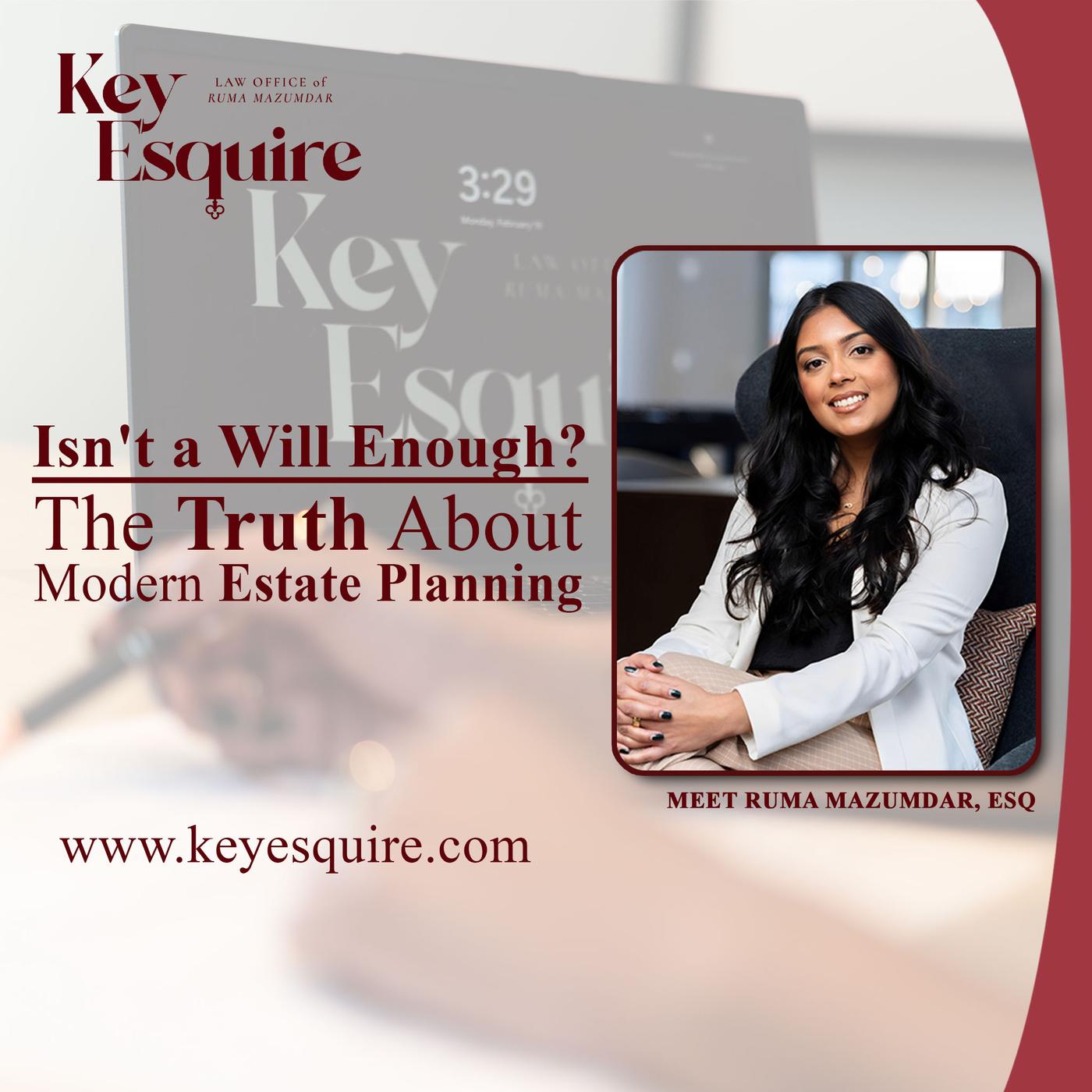
Welcome back to Trust Issues, only the kind that make you richer. I'm your host, Ruma Mazumdar, founder of Key Esquire. And today we're diving into something that comes up more than almost any other question in estate planning. Isn't a will enough? This episode is for anyone who's ever checked that off the to-do list thinking it's all taken care of, or for the loved ones who might one day be left to figure it all out. Because while a will can be part of a great plan, it's just that. Apart. There's so much more to think about when you want to protect what you've built and to take care of the people that you love.
So today I'm going to walk you through some of the biggest misunderstandings, common mistakes I've seen firsthand, and what a thoughtful modern estate plan actually looks like. Okay, let's get into it.
So there's this idea that if you have a will, you're all set. It's one of the most common things that people say to me, my clients, my friends, even other lawyers sometimes, especially the ones that don't specialize in this practice area. I've got a will. I'm covered. But what I often see is people being given the bare minimum, especially from attorneys who aren't asking the deeper questions. They'll hand over a three-page will because the client asked for it, really without explaining that a will only comes into place after you pass away and that it doesn't cover anything while you're actually alive. That gap can be a really big problem. We're talking about things like who makes decisions if you're incapacitated? Who can handle your bank accounts or your business if you end up in the hospital? Who has access to your health records? What if your assets are titled in a way that bypass the will altogether?
That's why we talk about living documents in estate planning tools like a durable power of attorney, a medical power of attorney. HIPAA release, advance directive, guardianship designations. Without these, your family may be legally blocked from doing anything.
So when someone tells me they just have a will, I pause. Not to push anything, but to help them think about the full picture. One of my first estate planning clients, he was an older gentleman, a straight shooter, very New Jersey energy. He called me because he finally wanted to get his will done. What stood out to me immediately was just how cooperative he was. And for that being my first estate planning client, I was like, thank God. He gave me every piece of information I asked for and he took the process seriously.
I mean, at times there were some trust issues because he was like, why are you asking me all this personal information? And then once I told him it's really to make sure that we're planning for everything that could possibly happen, he loosened up and he let me know what was going on.
And then he realized he wanted to make sure that his family would be taken care of and that nothing would fall through the cracks. We worked through everything, his assets, his health care wishes, who he wanted to make decisions for him if anything happened while he was still living, where he wanted to be buried, what he wanted to be done, cremated or not.
And then by the time he came in to sign, I had everything ready, full detailed estate plan tailored to him. He looked down at the binder. It was well organized. And it was about 60 pages. It was long. We had to flip through every page, explain to him what everything meant. And at the end, he said, wow. The will that I had 10 years ago was like three pages and I had no idea all of this existed.
So that package included a comprehensive will, a power of attorney, a medical power of attorney, a HIPAA release, an advance directive, burial and memorial instructions, a personal property memorandum, instructions about digital assets, notes about guardianship and future updates. And in that moment, I felt like he had such an honest reaction to just the whole world of estate planning.
Like, wow, I just didn't know it entailed all of this. And that really stuck with me. And he didn't come in thinking that he had everything figured out. He came in wanting to do it right this time. And it was only when he saw the scope of his new plan, how comprehensive it was that he realized just how much his old will didn't cover it. And that's why I always say a good plan isn't about having a document. It's about having the right ones. Now, Another common misconception is that having a will means your family can avoid probate, and that's just not the case.
So even with a will, your estate still needs to go through the probate process, especially in New Jersey. But here's the thing, probate in New Jersey is actually much simpler and more streamlined than in many states. During that process, though, bank accounts get frozen, property can't be sold, bills and taxes might go unpaid, and it can all be challenged if someone doesn't agree with the existing will.
So, what's the best way to avoid probate? If there is a properly executed will in place, meaning you've worked with an attorney, the process is usually pretty straightforward. Most of the time, the person named as the executor can go to the surrogate's court, present the original will, present a certified death certificate and their ID, and they'll be formally appointed to carry out the wishes that are in the will. In most cases, especially when you work with an attorney, You'll will ensure that a bond isn't required, which is one of those extra court imposed expenses that can otherwise become a headache during probate.
So yes, probate still happens. But in New Jersey, it's generally not as messy, expensive or drawn out as it might be in other states like California and New York. That said, Even if the process is simpler here, it still exists. There's paperwork, there's deadlines, court involvement, and delays in accessing the assets, especially if beneficiaries need the funds right away or if there's tension in the family.
So having a will is important. It's a good thing, but it's not a magic shield from the court system. It's still worth understanding what the process actually looks like so you and your loved ones can be prepared and not surprised. There are ways around the court system, like using a trust or changing how assets are titled, but You don't get that level of strategy in a just-a-will type of setup. Okay, now let's talk about something that has been a huge topic lately, especially with the rise of technology and AI trying to replace lawyers, the phase of DIY estate planning, the $99 templates that are online and downloadable wills and trusts that you can just print at home. I get the appeal. Okay. It's cheap, it's fast, you don't really have to interact with someone, you don't have to talk to someone about all of your personal things. You just plug it into your computer and it spits out a document. And I've reviewed these documents. And here's what's actually happening. They're missing state-specific legal language. There's contradictory instructions making the whole plan really confusing. They don't account for unique family dynamics like stepchildren or unmarried partners. They aren't signed or witnessed properly, making the whole thing invalid. They're outdated the minute life changes, like getting divorced, or moving, or having a new child. And they just don't change with the laws.
So I get these downloaded templates and the wills sometimes still list ex-spouses. The guardianship instructions for children no longer make any sense. Business succession plans that never got updated after a partnership ended. It's crazy. And I've seen people think that the document was complete only to learn it wasn't even valid because it was signed digitally or lacked proper witnesses and a notary stamp. These systems are built to get you something, but they're not built to really guide you through your nuances of your actual life. Estate planning is legal, but it's deeply personal. And most people need someone to ask them the questions they wouldn't even think to ask themselves.
So this computer generated document is not going to account for what's really going on in your life. Working with an actual attorney, taking the time. Investing your money and making sure you have a solid plan is the way to go. Now, even if you do have a good plan, you worked with an attorney in the past, that's great. If it hasn't been reviewed and updated every three years, it might not protect what matters most anymore. I've seen clients with a full estate plan, a will, a power of attorney, the healthcare documents, but it's all been created like 10 years ago when life was so different before they got married or maybe before they bought a house or before they had their children.
And then it's They've gotten divorced, they've gotten remarried, they've had more kids, they've bought more property, they've started a business, or they've suffered a major life loss. And the people named in the will or the estate plan might no longer be alive.
So these documents don't reflect any of those changes. So the estate plan really should evolve with you when your relationships are shifting, when your net worth changes, when your priorities are different. For me personally, I updated everything after my divorce. My beneficiaries changed. My business grew. My views around legacy really deepened. I'm a dog mom, so I had to think about if something happens to me, what happens? Who takes care of my dog? And it's not all one and done. Estate planning is living. It's evolving set of instructions for a life that you're building. Which brings me to my next point. Why do millennials completely avoid it? And I think it's a mindset thing, especially among the millennials. We think we're young, we'll deal with it later. It's something for older people, our parents, our grandparents. But I can't tell you how many brilliant, accomplished people I talk to all the time. Doctors, attorneys, real estate investors, entrepreneurs, everyone who's built real wealth and still have nothing in place.
And then when I share what it costs to build a proper plan, they pause. Even when their net worth is in the millions. There's a mental block over spending a few thousand dollars to protect their legacy and what they've built. I don't necessarily get it. But I don't see that same hesitation when it comes to investing in the stock market, in real estate, in starting businesses, hiring a coach, traveling, or even having kids. You have no idea what the ROI on those things are going to be, but something that is meant to protect your entire legacy and what you've built. You worry about the couple thousand dollars it takes to actually protect it.
So why do we flinch at investing a few thousand dollars to protect everything we've worked for, everything you've built, the beautiful life and family you've created? We think estate planning is about death, but really it's about control, clarity, and impact. I think part of the reason that estate planning feels so heavy is because of thinking about what happens after you're gone. And it feels like it's something that only older people do. But it's not. It's something that responsible people do. And if you got into a certain level of success, you must be a responsible person.
So do the responsible thing and look at your life and decide, you know, does it make sense to have a plan? Another thing you should know is you don't need to be a millionaire to have a plan. Regardless of what's going on in your life, if you have something you care about, people, possessions, property, you're already someone who should be thinking about this. Now, what happens if you don't have a plan? These are the stories that you hear about and then you wonder, okay, that'll never happen to me. But these are the hardest stories that I've had to go through. Young parents who pass away unexpectedly without naming any guardians. Now Child Protective Services is involved. Both sides of the family are so distraught, grieving, fighting over custody. The kids are scared. The whole process is super traumatic. Or what's more common these days, just unmarried partners who live together for years. They build a life together, but they never formalized anything.
So when one passes, the other isn't legally entitled to anything. No property, no access, no say. And what about the siblings who you would think will never fight if anything ever happened, but now end up in litigation because there was a will that was outdated, things that never got moved into a trust, a family business left behind, but there's no plan. Everything is vague. But these are real preventable outcomes that happen when estate planning feels optional. And no one wants to think about these scenarios, but they happen every day. These are emotional, high stakes moments. And the lack of a plan really makes everything worse.
So if you've made it this far, this is your invitation to check in. Do you have something in place? Does it reflect your current life? Have you reviewed it recently? A will is important, but it's just a starting point, not the finish line. And if you don't have anything at all, it's totally fine. You're not behind. But now is really a great time to start. At Key Esquire, we help our clients create clear, complete plans that feel aligned, not overwhelming. It can be empowering. It can be grounded. And it can give you peace. It's not morbid. It's not confusing when you work with the right people.
So if you're listening and thinking, I've been meaning to do this is your sign. Thanks for being here. I'll see you in the next episode.
Speaker 1 | 12:15
Thanks for watching. Be sure to hit that like and subscribe button and leave us a review in the comments.
