


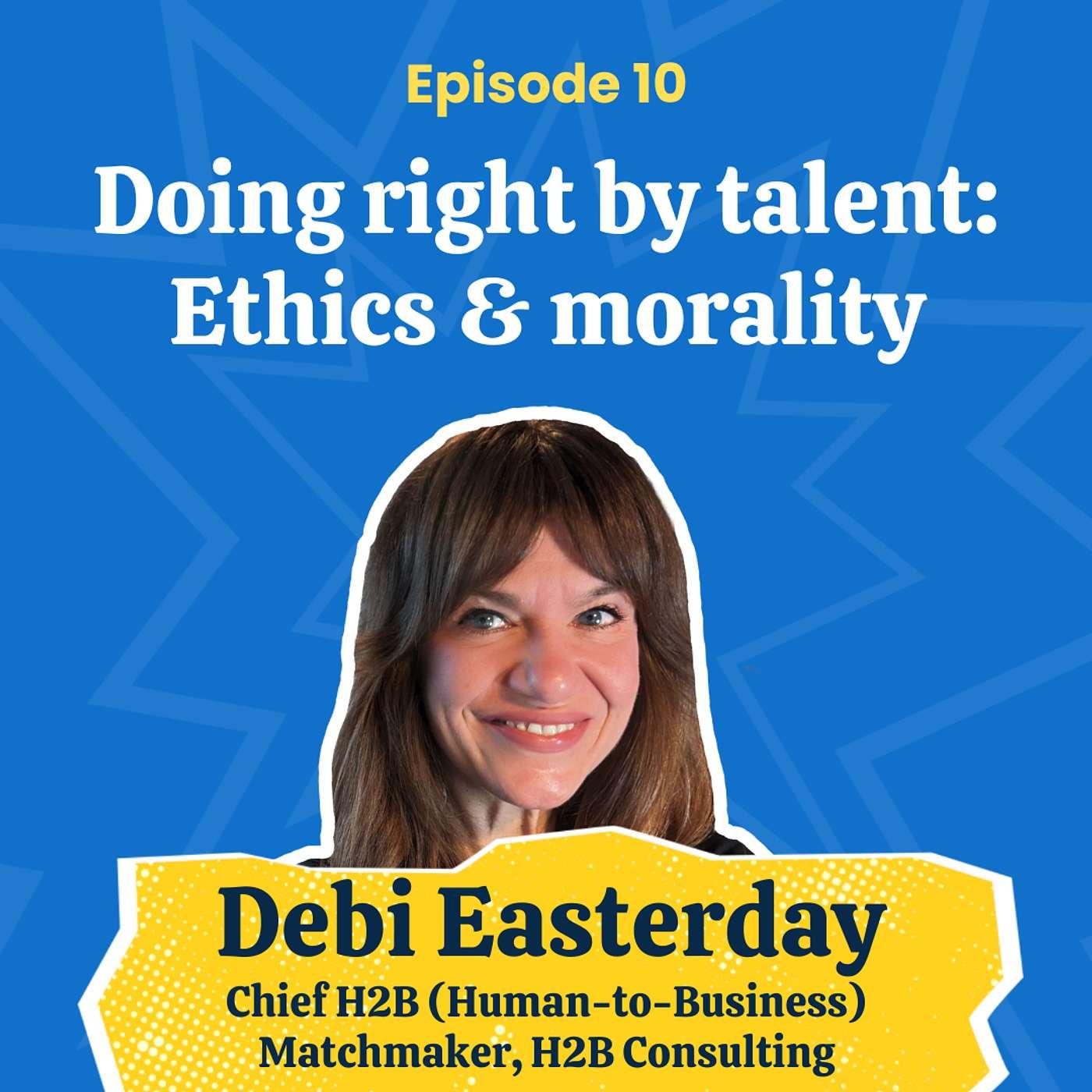
Kate: Hello, everybody. Welcome back to The Recruitment Podcast by Recruit CRM with myself as the host. I'm Kate O'Neill, and I am back to bring you another amazing conversation with one of the best minds in recruitment. So we're gonna get ready to deep dive now into another really interesting and informative topic that's gonna help you learn, grow and develop, me included in that as well. So I'm really pleased today to have Debi Easterday on with me to talk about a very important and I would say a topic of focus, both in 2024 and 2025, ethics and morality in recruitment.
So before we dive into the questions, I'm gonna introduce Debi. She is an accomplished recruitment and talent acquisition professional with around twenty-five years of full life cycle recruitment experience across diverse industries, including IT, life sciences, and government services as well. Now she is the founder and chief matchmaker at H2B Consulting, and she specializes in connecting top-tier talent with organizations that foster growth, support, and empowerment. So hi, Debi. Welcome to the podcast.
Do you wanna tell everybody a little bit more about yourself before we get started?
Debi: Thank you for having me. I so appreciate it. Yeah. I just you know what?
I, have spent the last twenty-five years working across number of different industries, primarily tech health care, which encompasses dental, pharma, biotech. I like to go where the innovation lies. So, H2B stands for human to business, and I refer to myself as a human to business matchmaker because I think above all else, it really is about remembering you're dealing with human beings. And the idea that when we are creating a match, we are matching a human to a business, Makes it feel a little bit less transactional.
So it's one of the reasons that I've adopted that phrase, for my business and for my own self. Constant reminder that we have to be human centric first.
Kate: Yeah. Do you know what? It's so funny because I would say in pretty much every guest I've had on, even if the topic has not been around, sort of that people-focused approach and recruitment, it has come up in every single episode.
And it makes me smile because it makes me realize I'm not the only one that knows how important relationships are in recruitment. It is paramount. And, yeah, it's literally it's flowing through very nicely in every episode. So I'm so glad that you value that as well and love that that meaning behind your business name. I am gonna dive really quickly now into this because we have got a lot to cover today, and this is a meaty subject.
And I know I can only speak for the UK on this, but I know, ethics and morality is a massive part now of our agencies, our industry. And, yes, we've we've got work to do, but I do feel we're starting to get better at it, but we're definitely not there yet. And it's I would say it's a subject that I think a lot of people are sometimes quite, overwhelmed by because there's lots to know when everybody wants to do the right thing, don't they? And I'm one of those people. I've got an agency now.
Debi: Well, not everybody wants to do the right thing. That's one of the reasons you need to be.
Kate: You're right there. Not everybody wants to. But the ones that do, I'm I'm really conscious of it.
You know? I really want to do the right thing. So I'm really excited to learn from you about this today. And hopefully, the people that aren't doing it the right way get some decent inspo from hearing you speak about this today and start doing things the right way. So for you, how do you ensure that your recruitment process is fair and unbiased?
Debi: I think it's, it starts with ensuring that we've got the right tools and the right training and the right tech in place. You know, bias can occur on so many levels. I mean, it can start with the job description and how you're framing this job. If your entire job description refers to he and him and, the postman, you paint a picture of who's going to be hired for that position, and that may be turning people away right from the start before the actual interview process has even begun.
Kate: Yeah.
Debi: So it's really about being thoughtful about where bias can be inserted across the process. So when I'm working with new clients, it's really about first, figuring out what your hiring workflow looks like. And then saying along the way, where can bias be checked? Yeah. And if we check, you know, do we have the right tools and we're doing all of the right things on the recruiting side, but everything falls apart once they go to interview with the hiring teams, well, then that means that we need to involve teams that are beyond ours.
The problem is that that buy in needs to come from the top. So the very first thing that I do to ensure that, my recruit my recruitment process is going to be fair and unbiased is to ensure that I have buy in from the very top that says this is a critical mandate for our organization. Otherwise, it's lip service, right? So we can put in as many tools and and, training protocols as possible, but if no one intends to follow them or abide by them, it's a moot point.
So I would say the very first and most critical step is ensuring that the leadership who can enforce it is engaged in the mission. Yeah. No. I'm really glad you pointed that out.
Kate: So what, what strategies can be implemented to reduce that unconscious bias during sort of that early process?
You know, the candidate screening and selection part because that's, like, where we start, isn't it?
Debi: It is. And I think that it starts with training, ensuring you know, you said it I I had the same sort of onboarding experience when I jumped into recruiting. Here's the list of bricks. Here's your laptop and your access.
Good luck, kid. Good luck. You know? And it was I I was I'm mortified when I think of how I was doing recruiting to start because I was fumbling at best. And thinking back, why was anyone letting me do recruiting?
I am your brand ambassador. I am your first touch to the candidate pool. And I know nothing. Is that a smart business move?
Probably not. So I feel like it starts with training, ensuring, you know, just like we we were talking about before you're posting jobs on Indeed or any of these job boards, Recruit CRM. I mean, any of these wherever you're posting, be thoughtful about the impression that you're sending out. That's your first impression. So it's in your verbiage.
It's in the content. It's in the transparency of the job description, you know? If you're saying this position is remote and I am stoked because this is what I look for, and then I'm two interviews deep before I realize it's really hybrid. You can work remote sometimes, but you have to be on-site three days a week.
I feel deceived, and I have been deceived because it's not transparent. And if you are deceptive at the very first handshake, it's probably going to go downhill from there in terms of employment experience. So I feel like it's it's very important to just, make sure that everyone's trained. Here's the piece of verbiage. Here are the ways that you can say this, you know? And I've heard people say, well, it's just it's it's not grammatically correct to use they, them, here, so I just put him. Oh, there are other ways that you can say the same thing without
Kate: Yeah. It's not just laziness, isn't it?
Debi: Laziness.
It's looking for excuses not to change my mindset Yeah. To include. We fumble I'm resisting. And we're clumsy with it for a little while until we retrain our brains to think of inclusive ways to say this same exact statement. And then it becomes easier and easier because now our brains have this vocabulary, and we have the right pronouns, and we have the right verbiage available to us because we haven't closed ourselves out to that as a mindset.
And then it's avid, right? It's putting processes in place and ensuring your team is accountable to them.
Kate: Yeah.
Debi: Because accountability is the other thing.
You can't just put training out there and hope folks engage in it. You have to hold creative training sessions so that you know everybody on board sees the importance, first of all, of removing bias. You know, this is our invitation. Because if I am only hiring people that I like-
Kate: Yeah.
Debi: We're gonna have a really, really good time at the Christmas party.
But we are going to be missing out on a whole lot of perspective that is outside of what migraine offers. So we're going to limit our growth right out of the gate. There's a reason for diversity, and there's a reason for leading your recruitment on an ethical path. And it's, you know, ninety-four percent of people who have been, I it was, gosh, probably about a year ago, there was a study, candidate pools, job seekers. 94% said that they wanted to align with a company that was ethical.
That's huge.
Kate: Massive.
Debi: And, you feel whether or not a company is ethical in the interview process as a candidate.
Kate: Yeah. Definitely.
Debi: If they are transparent, if they make you feel valued as an individual, if you feel included, if you feel like you are being given every single opportunity that anyone else might be to strong sell your skills, that's what ethical recruiting feels like from a candidate side. Yeah. They're excited. They feel like they've really got a shot at this one.
Kate: Yeah.
Debi: And so it's training on job descriptions. How do we write this? Training on ensuring that everybody gets the same interview experience. Because I have sat in on interviews, Kate, where I am like, there's no interviewing happening here. There's no this is not an interview.
You two just really like each other and can't wait to work together.
Kate: Yeah. You just have the job.
Debi: We are twenty five minutes in, and I have no idea if this person's qualified for the job. But I'm pretty sure this one's getting high.
That's not ethical recruiting. And so we need to let people know that part of removing bias is making sure that you're asking every candidate the same questions. Making sure that you're giving every single candidate an opportunity to strong sell their strengths. Making sure that you're not just giving this person a little bit of extra wiggle room because you really like them.
Kate: Yeah.
Debi: Such a great personality. You know, you're gonna have such a good time working with them. Because I've seen people hired because they had a great personality. And inevitably, three to six months in, everyone's like, I don't know what happened. I mean, we all liked her so much in the interview.
She's just not delivering, you know? And nine times a week, again, I just
Kate: It happens all the time, isn't it?
Debi: All the time. We loved her in the interview.
She was so great. I don't know what's happening. Well, you never interviewed her. Yep. You just really, really liked her.
She got hired. She wasn't qualified for the job, so she was doomed from the start. She probably figured that out a month in, so she's kinda quiet, quitting and looking for her new job in the wings.
Kate: Recruitment agencies do it all the time. All the time.
Debi: That’s why I opened my own, Kate, because I was like, this is transactional. This isn't smart hiring, and it's not healthy for you, client, and it's not healthy for you, candidate. No. Because you're going to be looking for a new job in six months, and you will have spent the last six months paying this person to get ready for their next job.
Kate: How do you now this is a big one.
How do you ensure candidate data privacy and ethical data handling in your recruitment process, especially when it comes to recruiting software. Because I remember I can't remember how many years ago it was now when we had all these big GDPR, regs come into the UK, and it really shook up. We how we you know, my agency I was with at the time, they were luckily really they knew how important it was. We'd go through the CRM. We had so many changes to make for the better, obviously.
But how how do you ensure that sort of data privacy and ethical data handling?
Debi: You have to, first of all, understand what your regulations and your and and what sort of compliance standards you're responsible for. It'll be different if you are based in one country or if you're an international firm. There are going to be a completely different set of standards that you need to adhere to.
So the first thing you need to do is get educated about what your requirements are. If you're using technology and most organizations are using some sort of CRM or applicant tracking system, you have to ensure that you know that the tools that you're using are going to be security-forward. It's not oh, yeah. Yeah.
We're secure. You you betcha. You know, you have to look at who you're partnering with. If your if your if your information is being downloaded downloaded into this system, you are assuming risk, right?
I put this resume and this candidate's information into this. I put them at risk. So you are responsible for ensuring that any system you're entering their information into is security-first.
Kate: Yeah.
Debi: And you should absolutely, during the demo, ask them what their security framework looks like.
Do you have a CISO? You know, what is your company's security policy look like? It's okay to ask. If they fumble, chances are they're not going to be a great partner for you.
Kate: Yeah.
Debi: If they can't produce any sort of security documentation process policy guarantee, yeah, they're probably not thinking about it. It's not a good match. You don't it's not a good match. No. So, know what you're responsible for.
Know the information that your recruiters are capturing.
Kate: Yeah.
Debi: If your recruiters are capturing passing along information about this candidate is eight months pregnant. This I mean, you've gotta know what you can, what you can't, the data that you can and cannot ask, store, and pass along.
Kate: Yeah.
Debi: So it's yeah. Keep yourself informed. Ensure that the software that you are using is secure and also has, data privacy and policy in place. And, yeah, that's about all you can do. The hackers are getting really good.
So, be proactive, I guess, is the biggest part of it.
Kate: Yeah.
Debi: I think that everybody gets really, really serious after they've been hacked. Yeah. Oh, god.
It's literally, like, my worst nightmare.
Kate: And that actually your first priority all of a sudden. Yeah. And that's led me very nicely into my, little plug of Recruit CRM. Now I know I joke about this every episode, but I use recruit CRM as my own with my agency.
And, as we've been talking about sort of data privacy, all of that stuff, security is a top priority. Now one of the things that I like about I mean, I I'm sure a lot of CRMs do this, but for me, the important things that matter, little things like the two set two-step authentication to log in. So I know you know, I wanna make sure that all my candidates and clients' data is being kept secure, but also what's important is consent management. And if we're talking about, that on the candidate side of things, there is a function that I actually discovered recently in Recruit CRM that addresses this. So there is a very comprehensive SMS consent system where any recruiters in your organization, I'm the only one in mine, so it's me, can not only obtain and track candidate consent for any sort of communications, but there's a very easy opt-out option for people, which is important.
Not everybody is gonna want to stay on our database forever, and they they are they they have they're perfectly within their rights to opt out, and it's making it easy for them, not difficult and jumping through hoops to do that. And what I like is that it's integrated across multiple touch touch points. So, again, that ease. So job applications to talent pool pages, it's there.
So I think it's just if I think back to the recruitment tools that I had when I started, you can have access to to things like this. It wasn't integrated. Now we can really prioritize that candidate privacy and compliance, which is, as we've already been talking about, so important. So I'll come to how you can get a free demo with Recruit CRM and test things like these functions out towards the end. But I'm gonna come back to the questions.
Now social media is now such a big part of what we do as recruiters and business owners as well. How do you feel about using social media to screen candidates? Because I I suppose what's important is we know the sort of ethical boundaries that we need to be aware of in this area as well.
Debi: Yeah. Look at it.
If you put your LinkedIn profile on your resume, I'm clicking it. Everybody is. Of course. But, yeah, I think it's absolutely a tool, you know?
There's a lot that you can tell, for example, from a LinkedIn profile. Every once in a while, you see these recommendations where you read that rec those recommendations and you just know this person is an all star. Yeah. An all star. And then there are people and they've done these courses and their interests are all professional, you know, professionally related.
And they're reading books and, you know, putting content on their pages and posts that are all about their professional line of okay. That's that sells me on that person being incredibly passionate and invested in their, professional growth and success. Man, I want that person on my team.
Kate: I'm gonna give them a call.
Debi: I I'm inspired. Yeah. To follow people who look like they are above and beyond because they end up being ace. They
Kate: You get excited before you've even spoken to them, don't you?
Debi: Right.
You know, you know, like they what they don't know, they'll be driven to learn because this looks like a person who is so engaged in what they're doing professionally that, like me, work never feels like work. So I never feel overworked. I love what I do. And when you hire that person, it's always a fantastic hire. You're always going to be that person who will do the extra thing, who will run the extra mile, who will research that project.
We need research because they're learners and they're driven and they're doers. So do I look at social media? Yeah. Absolutely. Absolutely.
I do. It's, I think, an extension of your resume. If you put it on the resume, it's an extension of the resume, and it's an invitation to review. Now should you go out and stalk a candidate? You know?
Well, probably not. Have I? Yeah. I have. But in two years have, by the way.
It's it's typically look. It this is one of three people in the country that I found who has the skill set. I must reach this person. And so then I figure out creative ways to engage with that person on a personal level. Sometimes I do a little research.
Oh, you, you know, you have a passion for microbrewing beers? Okay. Great. So maybe I use that in my initial plug for you. But it's just that's it.
Is it judgment? No. I think it's more research. That said, don't put anything out on social media that you wouldn't want a hiring manager to find if you are looking. And if you are looking and you like to post things on social media that might not be, palatable to everyone, it's a good idea to make your profile to to block your profile from the public.
Kate: Private. Make it private.
Debi: Yeah. Just make it private. Then you don't run that risk.
I would never say censor yourself, but yourself isn't always digestible to the greater public. Yeah. And if you are in a job market, you have to have enough self-awareness to know whether or not what you're putting out on social media is going to jeopardize your chances of being hired. And maybe if you're one of these people that says, I don't wanna be hired by any company that would that wouldn't like what I'm putting out here. Leave it out.
That will help you find your people too.
Kate: Yeah. No. I agree. I think what you said there as well is about not holding judgment.
So if you are a recruiter and you're looking at, I don't know, the LinkedIn profile they've put on the resume or the CV or the application, whatever it is. You know, just be careful you're not going into that sort of judgment mode. You know, you need to speak to the I I always think, look at it, but, ultimately, you need to speak to that person and and learn about them. You can't just look at someone's profile and think, nah, they're not good enough.
And, you know, unless, say, there's a critical, I don't know, course, for example. So it's a technical judgment thing is is big, isn't it? Because I wish I'd been trained in that when I was young about, kind of leaving that at the door and going into it with a different sort of hat on. It's that sort of unconscious bias piece again, isn't it, basically, that comes into it, isn't it?
Debi: It is.
Now that said, I'm I'm thinking of a scenario. Okay. I'm a company where my core values are all about diversity and inclusion and, being ethical. Okay. I'm this company and I'm, I'm researching this candidate who is, very expressly a white supremacist on their social media platforms.
Kate: Well, concerning
Debi: That point, you think about whether or not this is a culture fit because the moment this person
Kate: And, also, you've got to it's about, you know, if you want to retain the great stuff you've already got and you bring somebody like that in How does that upset the balance? Exactly. People could feel uncomfortable, leave, be treated badly by that person. You don't know what's gonna happen. So you've got to think about what the good thing you've got going.
Don't don't spoil it. You know? That so, yeah, that obviously, is something we need to sort of take in consideration.
Debi: But I think my mind is Kate, that's still research to me and not bias because that is a voice of toxicity that does not resonate with my client's core values. And, again, this is all about ethical recruiting is making sure that what's good is good for the client and the candidate.
Yeah. Right? And so that's not just a skills based math.
Kate: Oh, no. It's more than I mean, yeah.
It's about, you know, you could have three people with all the same skills, qualifications, but they're all gonna bring something different, aren't they? Different life experiences.
Debi: They're humans. Yeah. They're different.
Kate: Yeah. Different personalities, strengths, thing you know, and it's about what's gonna complement your culture, what you your values, and what the role needs, the team needs. And there's loads that goes into it. That's why you need to use recruiters because we know all this stuff. We can help you with it.
Because I think for some companies, even if, you know, even when it is on their agenda and it's very important, recruiters can really help them improve and sort of, develop the ethics and morality side as long as, you know, we're we're aligned and, you know, people have been trained and all that stuff. Because I'm sure you add so much value to the organizations you work with in helping them meet that part of their strategy and their agenda.
Debi: You come in and you ask different questions, right? You know, I think that companies many companies do want to do the right thing, Kate.
They just don't know what the right thing looks like, you know? And I had one client that I was working with, and they're like, oh, yeah. We're trying to remove the bias. We're we're centralizing the entire interview process, and it's all completely standardized now.
We do, you know, the ATS screens out the candidates. So then they go to a video interview, and then they go to and I said, stop right there, you know? Video interviewing. That she won.
Mhmm. Yes. It does save the team time, but it right out of the gate is going to give the advantage to people who are extroverted. Right out of the gate won't be comfortable with that. Some people get on there, and I've I've been I've been on the receiving end of some of these video interviews.
Some people are like this. They just I've one I did blah blah. They they don't know where to look. It's the craziest, most awkward thing in the world. Had you put another person on the other side of that?
Wouldn't have looked like that. Wouldn't have felt like that. I'm not a fan of them.
Kate: I think you need to at least have yeah. Jump on jump on and have a live video interview.
But all these I I honestly and I'm confident in in stuff like that, and I find them disjointed. And I'm just not able to connect. For me, an interview is about connecting, and it's like you're just speaking to nothing. Personally, I I don't think they work, and I don't like them.
Debi: No.
And I I've seen some fantastic ones, but it's typically the folks who are extremely extroverted. You can tell that you could put this person in front of just about anyone in an organization, and they'd, you know, be able to, have a perfectly engaged, you know, engaging conversation. But that is not everyone's superpower. And so you are not providing those folks who maybe struggle to communicate. You're not giving those folks the same advantage.
You're not giving them the same opportunity that you're giving them.
Kate: But if they're not doing a role where they've got to be in front of the camera and record videos, what's what's benefit have you got to knowing what they're like? Unless they're gonna be a TV producer or a a podcast host, then it's useless. Oh, I'm not sure. Administrator, guys.
Yeah. They're gonna be a IT project manager. They're not like, do you know what I mean? It just yeah. Personally, they're not my not for me, but people out there may have had great success in like them.
But, yeah, I'm with you. When I'm speaking to, candidates, I like to give them an opportunity the the choice. So would you prefer to speak to me over the phone, or would you like to jump on the video call together? You know, because some people most people go for the phone for a first chat, but some people want face-to-face to see you, not just hear you. But, yeah, I'm I think some people will never be comfortable in front of the camera, but it doesn't matter because the role they're doing, it's not relevant.
Debi: So why is that the standard? Why is a Java developer going to be measured on communication skills at the same level as a business development professional or an account manager would be? It doesn't make sense. So it's not providing people with the same opportunity. And I think that's really what it is.
It's you know, the problem is that this is a choice for an organization. It's not a a mandate. You have to choose an as an organization that you want to do the right thing. And that you're going to hold your hiring managers across the organization to that standard to make sure that everybody is interviewed in a fair way and that everybody who has applied, who is qualified for the job is given the same opportunity to interview for it. And not just this person because I saw a picture on LinkedIn.
She's really pretty. So we're it doesn't have anything to do with it. You know? Is this person also qualified? Let's take this person through.
You might find out that your alpha didn't perform so well downstream at the technical level. But this person who you thought was a c just escalated to a b plus because they are wicked smart and can solve probably several of the problems that we've got on our plate right now. Yeah. But if you had never given that person an opportunity to interview with the team, you almost cost that team that person's ability. So Yeah.
It's not about who you like best. Likability is absolutely a piece of it because we have to spend forty hours a week or so with this person. But, if you're hiring first based on who you like, you're doing a disservice to your organization.
Kate: Yeah. Yeah.
Well, look. We have come to the end of the podcast. I could carry on talking about this for ages. I found that I wanna thank you so much for coming on, Debi, because I found that hugely informative, and I know everyone listening and watching, will have done as well. So today, we've talked about ethics and morality in recruitment.
Of course, you can listen back to this as much as you want, and please do join us for the remaining episodes as well. But thank you so much for engaging with today's podcast. If you found this helpful, which I'm absolutely sure you will have, I would encourage you to connect with both of us. So Debi's details will be in the podcast description, her LinkedIn details. Mine will be there as well.
There's my website details in there. I did mention about Recruit CRM earlier as well. And if you are looking to, explore those features I talked about, then I would head over to recruitcrm.io. You can book it for free today. You can book a free demo.
It's very easy to do. There will be a link in the description for you to do it as well. But, again, thank you for joining us. In the next episode, we'll be discussing talent acquisition as a strategic function with Stephanie Cramer. So that's gonna be a brilliant episode.
Don't miss out. Thank you again, Debi, for joining me, and thanks everybody for watching. We'll see you soon.
