
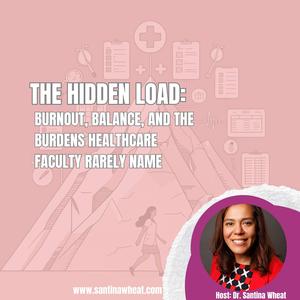


Dr Santina Wheat: And then just so you know from what I see, it looks like you're looking down. ⁓ so I don't know if that is where your camera is if you want to lift it. Perfect. That looks a little bit better. Okay. Welcome back to the hidden load. I am your host, Dr. Santina or Tina Wheat. When we talk about the crisis in healthcare today, we spend a lot of time looking at hospital balance sheets, staffing ratios, and patient access numbers.
Neil J. Farber, MD: Better.
Dr Santina Wheat: But underneath all of those metrics is an invisible daily weight that is quietly driving seasoned clinicians out of the profession. The slow, steady erosion of the patient physician relationship beneath a mountain of clerical tasks. And when doctors raise their hands to say that they are drowning in this administrative workload, the institutional response is often to offer resilience modules. But telling a clinician who is charting at 10 p.m. that they just need to be more resilient certainly isn't helpful. It misses the core problem entirely. So our guest today is Dr. Neil J. Farber. Neil is a professor emeritus of medicine at University of California, San Diego, with over 40 years of academic medicine experience spanning patient care, medical ethics, and teaching. And he is the author of the upcoming book, Treating a Broken System, a Physician's Cure for the Healthcare Crisis. Neil brings a truly unique three-part perspective to this conversation. He spent four decades as an academic clinician, twenty-five years as a dedicated caregiver for his terminally ill wife, and the last three years navigating the healthcare system as a patient himself. Neil, thank you so much for coming on the show and welcome. You have practiced medicine ⁓ no no, I'm so happy you're here. ⁓ you practice medicine for four decades. From where you sit, when did the daily practice of medicine start shifting away from the importance of that patient care connection toward the clerical treadmill?
Neil J. Farber, MD: Thank you so much. I mean it was a very gradual shift, so it's kinda hard to pinpoint. I would say though in the last three or four years of my practice, and I retired seven years ago, so ten to seven years ago were was the real shift that I saw where it was becoming more and more obvious that we were having less and less time with our patients.
Dr Santina Wheat: Absolutely. So as you just said, the last few years of active practice, that's where you saw a bit of a surge. ⁓ And if I can just guess what those are, that includes prior authorizations, portal messages, documentation, all of the things that keep me doing the admin time that I don't really want to be doing. ⁓ And in our information that we shared in before this session, you pointed out that policies like The Cures Act, which immediately released the lab and test results to patients, actually created a huge wave of inbox traffic. Tell me, from your viewpoint, what did that sudden influx of data look like on, let's say, a typical Friday afternoon for a busy physician?
Neil J. Farber, MD: So i i it does two things. One is you the the the nurse that I had was having to do more and more, which took more and more of the time that was allotted for my time with the patient, which meant that from a twenty minute visit with the patient, now I had only ten minutes. And and ten minutes is just not enough to be able to spend time finding out what the patient how the patient has been doing, what new problems they have, as well as getting to know the patient. ⁓ but the other thing is it it means are you going to spend the time on a Friday afternoon or over the weekend or when are you going to catch up? And a lot of people I've talked to say they never catch up, that they're always behind. that's not sustainable.
Dr Santina Wheat: Absolutely. I I see sometimes on social media, people will take the picture of the very red or the very rare, excuse me, zero inbox. ⁓ I can say that my inbox is almost never zero in part because I not only have my own inbox, I also have my learners' inboxes attached to mine, but it's so rare to ever have that clean inbox and it feels like this amazing win when it happens and then five minutes later it comes back. When you were dealing with that growing digital workload at clinic, ⁓ you were also carrying a very heavy load at home as the primary caregiver for your wife during her long illness. How did those escalating administrative demands at work impact the energy that you had and the time that you so desperately needed with your family?
Neil J. Farber, MD: So it was di it was no twos away but two ways about it. I mean it was extremely difficult. ⁓ what I ended up doing ⁓ was I so I had been hired to be the ⁓ director of the ⁓ clinical practice at ⁓ in La Jolla at UC UCSD. And so I had a couple of sessions that were free to do administrative work. ⁓ what I ended up having to do is say, I cannot do everything anymore. ⁓ so I basically said, you know, ⁓ take the administrative job away from me. Don't give me back to a extra clinic sessions. ⁓ take away my that part of my salary. I don't care. I have I have to be able to manage both sides of the coin and it's just not sustainable if I Try to do everything.
Dr Santina Wheat: How that feel when you did that? Did you feel like you were losing an important part or did it feel like a relief?
Neil J. Farber, MD: And it I I felt ⁓ i it did feel like I was losing ⁓ an important part because my my theory and my the way I worked, ⁓ sort of being an administrator of a practice was to be a mentor to the other practitioners. That's how I handled it. ⁓ I let the practice administrator handle the business. I I just didn't touch it. ⁓ so The ⁓ unfortunately my boss who was the division director encouraged it because he was being put upon by administration to to pay more attention to the business side. So h he was okay with it. I felt bad because I I felt like I could no longer be sort of overall administrating and mentoring my the people in the practice. But I sort of did it anyway from from the side. but I just didn't have the responsibility anymore, which allowed me to catch up on a lot of the outpatient work.
Dr Santina Wheat: And what was the response like from your team, from your supervisors when you made that decision to step back in the way that you did?
Neil J. Farber, MD: Okay. As I said, ⁓ my boss was okay with it. ⁓ I you know, I went to him and and said, I can't do it. And I said, Does that mean you're gonna have to let me go? And he said, I hired you as a professor of medicine. I don't care what you do, as long as you're doing your job. You know, you don't have to be in charge of the practice. So he was he was a great guy and and was very welcoming my my Because he was worried about me caring for my wife and doing the the job. above him, I think they probably welcomed it because ⁓ they had someone who was gonna pay attention to the numbers, which I just wouldn't do.
Dr Santina Wheat: Mm-hmm. I'm so happy that you had support as you stood, stood, stood back like that. ⁓ I do feel like when some people raise the alarm or say that this is too much, this is is too much, that it's not always the response. Sometimes the answer is, ⁓ well, you just need to be more resilient. Can you tell me your thoughts about that?
Neil J. Farber, MD: Yeah, I've seen that. And the you know, my my feeling about that is if you were hitting if you if you had a hammer and were hitting somebody on the head with a hammer and kept on doing it, and they said, Stop, stop, and you just kept on doing it and saying you just need resilience, one of two things would happen. They either in between swings would run away. Or in between swings, take the hammer away and start hitting the person on the head with the hammer who was trying to hit you. And that's what's happening in medicine. Physicians are burned out and leaving, ⁓ or reducing their hours, or going into concierge medicine, or they're unionizing. And the incidence of unionization has skyrocketed. And that is not a good way to approach this.
Dr Santina Wheat: And so what is your what is your response when you hear others saying that they're they're being told this? What advice do you have for them?
Neil J. Farber, MD: So the thing I've looking through I and I didn't know this because we were under the gun the same way. along with everybody else, this the same kinds of responses, the same kind of thing. No, you're gonna see patients the same way, no you don't have any more time with patients, etc. And and ⁓ so I had seen it too. And ⁓ I began doing some research about it because any of the things that administrators throw at physicians, ⁓ you know, ⁓ call centers, which is supposed to relieve the nurses so they could do more work. Well, the nurses then don't have are are doing more work, but you don't have time with the patients. And now the patients are frustrated because they're not able to speak with your nurse or with you. ⁓ Or ⁓ AI is gonna solve everything and AI doesn't because it it makes more mistakes than speech rec recognition technology does. So there's no one thing that really works. ⁓ the answer I found was actually looking through the literature and found an article by somebody in Mail Clinic Proceedings, where at the Mail Clinic They had this program called Listen Act Develop, where they invite physicians and administrators to sit down together. The administrators listen to what problems the physicians have. ⁓ and then they empower the physicians to make change with the backing of administration, both monetarily and and administratively. ⁓ and then they invite Other physicians to join those physicians to keep on developing it. ⁓ They had a tremendous problem with burnout before they enacted this, which is why they did it. Afterwards, burnout was gone. They came up with all kinds of innovative ways of dealing with the problems. And for the institution, they actually made more money, not less. So if you can convince administrators to sit down with physicians, they will solve the problem.
Dr Santina Wheat: some really important things in there. There is the the curiosity and allowing administration and position teams to work together. Sometimes I hear many people say that administration is not curiosity about what the real problems on the ground floor are. And so I I think that's really a key piece to this. ⁓ In some of my work with burnout I've really seen that lack of autonomy is also a a real challenge with burnout. And so When we're not being asked about our potential solution to the problem, we feel like our hands are being tied and there's nothing that's going on there. And then also what you also just said is really providing the support that's needed for development, whether that's fixing the problem or developing the individual so that they can work within that system in a different way. ⁓ that also really helps. If you have somebody that cares about you, that is one of those things that really helps people. ⁓ not go into burnout or come out of it if they're already there. So so it makes sense that that strategy would work. We need more institutions to be really paying attention to
Neil J. Farber, MD: Yeah. And I think administrators need to hear that physicians really are drowning. And if they if they just reach out and say, let's work together, instead of saying you're the enemy, ⁓ or or you're just one of the employees, you know, I know what's best, they don't because they're not in in in that position. And as if they would just reach out to physicians. Excuse me, sorry. If they would just reach out to physicians and say, Let's work together, I think it would ⁓ really take care of the problem eventually and and make more money for the institution.
Dr Santina Wheat: Absolutely. ⁓ so you have shared a little bit about how you have been on all different sides of healthcare. You've been there as the physician, you've been there as the caregiver, you've been there as a patient. How did sitting in each of those chairs change the way you view what's really going on inside the exam room?
Neil J. Farber, MD: I you know being a physician for for forty years who was interested in communication, who loved my interaction with patients, ⁓ you know, I thought everything was copysthetic until ⁓ a and and along the way I saw physicians who did not adequately communicate with my wife, which is why I when in I I changed to some degree some of the teaching I did, which was in communication skills, but oriented more towards ⁓ giving bad news and living and and supporting patients when they're going through a chronic and or terminal illness. ⁓ so that sort of shifted my interests in teaching a bit. ⁓ but When I became a patient and and saw that I couldn't get appointments like I needed ⁓ right away, or couldn't ⁓ I I I waited two hours in an emergency room with acute appendicitis and couldn't get anybody to see me ⁓ for two hours. Luckily ⁓ somebody who an emergency surrounding physician who happened to come on shift and knew me got me back right away. But otherwise I would have been s sitting there for another several hours. ⁓ potentially rupturing my appendix. So ⁓ that made me open my eyes to the fact that, you know, physicians are leaving in droves. It's leaving the patients ⁓ unprotected in some ways and uncared for in some ways. And that's what really encouraged me to write the book.
Dr Santina Wheat: It's such an interesting ⁓ perspective. I spent a lot of time in the hospital ⁓ when my mom was ill, ⁓ being her advocate when she was there. ⁓ and I've talked a lot about how when you become a patient, it really changes. I will say your identity in the world. ⁓ I I sometimes share the story about how my mom was a very accomplished woman. She was A principal, she was always the in charge, she was a leader, she was very well educated. and when she would show up in the hospital on a teaching service, it was like she was another number or she was the person that they wanted to try the ABG on. And I I felt like I was able to advocate for her in many ways because I understood the system. And for me, it really changed the ways. that I thought about medical education. ⁓ and now have conversations with my own residents about it because I was so horrified on on how the impact of being a trainee could impact someone's healthcare in that way. but I I also have seen it as a as a parent with my children when when we go, the different interactions, it it really is different when you see it from the other side. And I ⁓
Neil J. Farber, MD: Absolutely. I I I was just gonna
Dr Santina Wheat: And I understand where patients are frustrated when they can't get a hold of us too. I seeing both of those sides is is so hard.
Neil J. Farber, MD: Right. Yeah. I I ⁓ I I have seen both. you know, why can't I get you, etcetera, et cetera, towards the end. ⁓ and it's like my patients knew they could get me if they needed. But but they they also complained about, you know, the call center that it's it's someone who doesn't know me now. You know, that kind of thing. The thing one of the things that really struck me caring for my wife was sitting in a hallway waiting for her ⁓ chemotherapy ⁓ chemotherapy follow-up appointment, ⁓ you know, with the key with the oncologist and ⁓ with the neurocologist. And sitting there in the hall and someone who I knew well walking down the hall, looking right at me and didn't recognize it was me. And it's like, I'm just another number. You know, I'm just another patient sitting there in the hallway. ⁓ it was it was startling to see that.
Dr Santina Wheat: So we know that patients say that they often don't feel heard by their doctors, ⁓ especially when the doctor can't really look up from their computer screen because they have to do all of the clicks and meet all of the metrics that their institution is asking them to. ⁓ from your perspective and background, ⁓ teaching the physician patient communication, how did we get here? How did we get to a point that our environments were so mismatched? ⁓ with what patients and doctors really need from each other.
Neil J. Farber, MD: So I I I I think there's you know, the the the interventions that have been put into place, the electronic health record, the patient portal, ⁓ the Cures Act are all meant for the right things. They're they're meant to make it better for the physician and better for the patient. Unfortunately, what it ended up doing is separating the patient from the physician and ⁓ make it more of an electronic era. and patients aren't things to be handled in an electronic era. They're they're people who need another person to interact with them. And that has become a l a a a luxury that most physicians don't find unless they go into something like concierge medicine. ⁓ where they do have that luxury, but unfortunately only for a f few patients, which then lessens the number of physicians available for the rest of the patients.
Dr Santina Wheat: Absolutely. And to your point, that means the access circle is just getting more difficult and more difficult along the way.
Neil J. Farber, MD: Right. Right.
Dr Santina Wheat: ⁓ and for the medical educators who are listening to this, I think this is a really important point. We are trying to teach our learners how to connect empathetically with our patients. But the system around us is telling us to type as fast as they can just to finish the chart. ⁓ and this can really become a conflict. ⁓ of course, we we know that ⁓ AI scribes are coming in and maybe will help with this ⁓ as long as they don't. then encourage us to go even faster. ⁓ I I'm hoping that it allows most in institutions will allow us to use this in a way that we can actually have connection with our patients. But it's something that we do need to pay attention to.
Neil J. Farber, MD: Yeah, absolutely.
Dr Santina Wheat: So in writing your book, ⁓ Treating a Broken System, you were looking for constructive ways forward, which I I really love. I I think it's important for us to try to improve our system to help both our patients and us as physicians. ⁓ rather than having physicians and healthcare systems on opposite sides of the table, how do you think it's important for us to start working together so that we can solve some of these headaches, these operational headaches?
Neil J. Farber, MD: I think it's the only way we really can solve these headaches, as you put it. you know, that the the things that have been tried have been tried in a piecemeal fashion and don't just don't work. ⁓ so it it requires physicians working with administrators ⁓ to elucit what the ⁓ specific problems are at an in an institution. and then allow the physicians the resources to be able to approach those problems and figure out ways to to lessen their burnout. I think that's the only way it's gonna work.
Dr Santina Wheat: Yeah. And what role do you feel like educators potentially have in supporting this and helping their trainees through this?
Neil J. Farber, MD: ⁓ so I I think basically trainees need to know what's going on. I I I I think we should not ⁓ you know like hide it from them. ⁓ there's a there's a tendency to want to hide it from them because we want them to go into medicine. And we need them to go into medicine. ⁓ but I think they need to know what's going on so that they can wholesale go to administration and say, You know We know what's going on, you need to listen to all of us to to to work this out. ⁓ otherwise there's not going to be the kind of care that's available to patients.
Dr Santina Wheat: Absolutely. ⁓ And then let's talk a little bit about the win-win framework. Administrators naturally have to focus on the finances and the operations, while physicians ⁓ often are focusing on hopefully on patient safety and clinical time. ⁓ How does the collaborative model that you outline in your book create a win for the doctor, a win for the patient, and also for the hospital's bottom line?
Neil J. Farber, MD: You know, one of the thing you know, so ⁓ b before I actually s sat down to write the book, I had been thinking about it and and you know, after my experience in the emergency room and thought, you know, ⁓ there's there's gotta be a better way. maybe they need to just spend the money on physicians and forget about all these things like robotic surgery and stuff like that. Well Then I went through a robotic partial nephrectomy. And let me tell you, I'm glad it was there. Okay. ⁓ you know, one in less than 24 hours after surgery, I was only on acetaminophen. ⁓ two days later, I was on my feet out of the hospital. ⁓ you wouldn't I wouldn't have had that if I had an open partial nephrectomy. It wouldn't be I would have been, you know, on opioids for a week, maybe, ⁓ home. After a week, et cetera, et cetera. So so I'm grateful it was there. And I know that I began thinking that administrators have multiple things to pay attention to. Yes, they have to pay attention to physicians and then physicians' needs. But yes, they also have to pay attention to the things that make it better for the patients other than physicians' needs, like the surgery, etc., etc. ⁓ But you know, this this collaborative effort among physicians and administrators and patients ⁓ in in the long run make it better for the physicians, which in the long run makes it much, much better for the patients because we then have the time to spend with the patients to get to know them, to understand what feelings they have about what they're going through, so that we can address those as well, for example. And in in the long run, it ends up being financially more viable for for the administrators. If an administration loses twenty physicians, they have to rehire twenty more physicians who have to pick up all those other patients, which takes time, which means less money coming in. because you can only see a certain number of of patients. when you're first starting. So if if they were smart and and realized that this is not in their best interest to to just keep on doing this and work with physicians and and ⁓ they will find that basically that it will be financially vi better for them, not just viable, better for them to do it that way. And that was shown at the Mayo Clinic.
Dr Santina Wheat: Absolutely. I think that that's a point that we have to just keep reiterating. The retention of physicians and keeping them happy is is not only good for the physician, it's good for the patient and it's good for the bottom line of the institution. it helps with access, it helps with ensuring those procedures happen. It helps to ensure that patients are feeling the support of their primary care physicians. ⁓ it's it's just good all all the way around. And when we treat physicians like cogs in the wheel and tell them that they're replaceable, ⁓ then it really is is detrimental for everyone in the cycle.
Neil J. Farber, MD: Yeah, and and I was just talking with someone the other day and saying those same kinds of things and saying how, you know, there's an increasing ⁓ incidence of unionization. And they looked at me and said, you know, I just heard about the first work walkout I ever heard of in terms of physicians doing it in this country. And and they looked at me and said, I'm really fearful this is gonna be the norm. in the future. And it will be unless administrators come and talk to us.
Dr Santina Wheat: And it it's so hard when when there's this feeling of being pit against each other. It's just not productive for either side.
Neil J. Farber, MD: It's it's not product it's not productive at all. I mean you ha you b basically have two people on the opposite side, you negotiate, which means neither gets what they really need, and that means the patient doesn't get what they need.
Dr Santina Wheat: Absolutely. So I really believe in small steps can really can change your life, that it doesn't always have to be a massive 180 to make things better. So in line with that, for a busy physician or other clinician who wants to improve their connection with patients tomorrow morning without getting further behind in their day. ⁓ what is one simple communication habit that you might recommend that can really make a big difference?
Neil J. Farber, MD: ⁓ ask the patients to bring in a checklist of the things that are really important to them and negotiate with the patient for fifteen seconds what things they want to address that day. And then take one or two minutes of your time somewhere along the way where you if it's a new patient or someone you haven't really gotten to know. ask them to say something really interesting about themselves. ⁓ and ⁓ it's good for the patient because they get to speak about themselves. And it's great for the physician because you find out all kinds of really interesting things about your patients. And again, it doesn't have to be long, it doesn't have to be involved. and ⁓ it it's, you know, within a minute or two you you get to understand them better.
Dr Santina Wheat: I love that. I I love that that really sparks that human connection that I feel like is contrary to all of what we see with the electronic medical record. It really helps ⁓ repair that digital divide or at least start on the way to repair that digital divide. ⁓ I also love the checklist. I am definitely the physician that tells my patients bring a list to your next visit so that I make can make sure I'm hearing everything and so that you don't feel like You're walking out of our visits, not telling me the things that are important to you. I love that one.
Neil J. Farber, MD: Right, right. ⁓ in terms of the the issue of getting to know your patients, Faith Fitzcheryl wrote this wonderful article in the Annals of Internal Medicine called Curiosity. I ⁓ she tells a story in there that just blows your mind. And I I would suggest it to everybody.
Dr Santina Wheat: Mm-hmm. Great. ⁓ It's definitely one we'll have to read. And curiosity is one of those words that as I have have really gone on my own pathway out of burnout, of being happier as a physician, figuring out a way to thrive at home and at work together. Curiosity is one of those things that I find myself saying over and over and over again. ⁓ And it works in so many different ways. So we'll have to look for that. ⁓ so if there is a physician right now who feels completely maxed out by the inbox and the administrative load, what is a piece of encouragement or perspective that you would like to leave with them leave them with today?
Neil J. Farber, MD: I would say don't give up hope. ⁓ I'm I'm I'm hopeful that that this book, if it really, you know, gets a lot of readership, will change the game. That my my my fantasy is that hopeful ⁓ that physicians and administrators both read this and realize we have a problem and work start working together. so that physicians are able to have the time they need with their patients and the time they need at home. And that that it could be a game changer. I'm I'm hopeful for that. ⁓ but but regardless, there are ways of dealing. you know if if you have a two income family and and you're both professionals, let let your other half take the lead in making the money and you step back a little bit ⁓ and and you know maybe decrease your hours a bit so that you can catch up, things like that. There there are ways of trying to cope.
Dr Santina Wheat: ⁓ so you just ⁓ you you just mentioned your book. Tell us a little bit about how people will be able to find your book, sort of ⁓ what you're doing with it. Tell us a little bit about
Neil J. Farber, MD: So a couple things. ⁓ it's ⁓ I'll re-infra re reiterate the title. It's it's called Treating a Broken System, a Physician's Cure for the Healthcare Crisis. It's a it's published by Boyle and Dalton. It's coming out October 5th. ⁓ it'll be available on Amazon, on Barnes and Noble, and as and also ⁓ any bookstore can order it for you. ⁓ it'll be available in a Hardback, softback, and ebook. So you can make notes as which whatever you're comfortable with. and ⁓ I'm doing I promoted it ⁓ out of my own pocket because I believe it's an important issue. ⁓ I am I I've dedicated myself to ⁓ I I will take the money that I've used to publicize it ⁓ because I need to make that up. But anything above that will go to two charities in particular, one being the Academy of Communication and Healthcare, and the other being the Patient Centered Outcomes Research Institute, both of which deal with patient patient physician communication. And I won't take another penny beyond that. ⁓ And anybody in the San Diego area, if you want to know more,
Dr Santina Wheat: Amazing.
Neil J. Farber, MD: ⁓ there's ⁓ I don't know when this podcast is coming out, but on October twentieth, ⁓ hosting a ⁓ lunch party at six PM in Camino Books in Del Mar. Anybody in the San Diego area knows where Del Mar is. and refreshments will be served. And I'll be I'll be doing Yeah, the book will be out October fifth, so
Dr Santina Wheat: Wonderful. And this will be out before that.
Neil J. Farber, MD: ⁓ I'm I'm hopeful that as many people ⁓ can, you know, purchase it, read it, do something with it. My ⁓ I I would this is not to get to my publisher. I would be perfectly happy if one book was bought and passed around every physician and patient in this country. I'd be and who read it. I'd be perfectly happy.
Dr Santina Wheat: making sure that the word gets out there. It sounds wonderful.
Neil J. Farber, MD: Just making sure the word gets out there.
Dr Santina Wheat: Okay, Dr. Neil Farber, thank you so much for sharing your story with us today, your wisdom and a constructive way forward for us with healthcare leadership that does not feel like fighting against each other. ⁓ I will make sure to link Neil's website ⁓ in the show notes in case you didn't get to write that down or if you're driving. ⁓ and make sure to look for his book, Treating a Broken System, a Physician's Cure for the Healthcare Crisis. ⁓ to our listeners, remember that your time and attention are valuable clinical assets. Taking care of yourself is taking care of the system as well. I'm Dr. Santina Wheat and this has been The Hidden Load, and I look forward to seeing you next week.
Neil J. Farber, MD: Better.
Dr Santina Wheat: But underneath all of those metrics is an invisible daily weight that is quietly driving seasoned clinicians out of the profession. The slow, steady erosion of the patient physician relationship beneath a mountain of clerical tasks. And when doctors raise their hands to say that they are drowning in this administrative workload, the institutional response is often to offer resilience modules. But telling a clinician who is charting at 10 p.m. that they just need to be more resilient certainly isn't helpful. It misses the core problem entirely. So our guest today is Dr. Neil J. Farber. Neil is a professor emeritus of medicine at University of California, San Diego, with over 40 years of academic medicine experience spanning patient care, medical ethics, and teaching. And he is the author of the upcoming book, Treating a Broken System, a Physician's Cure for the Healthcare Crisis. Neil brings a truly unique three-part perspective to this conversation. He spent four decades as an academic clinician, twenty-five years as a dedicated caregiver for his terminally ill wife, and the last three years navigating the healthcare system as a patient himself. Neil, thank you so much for coming on the show and welcome. You have practiced medicine ⁓ no no, I'm so happy you're here. ⁓ you practice medicine for four decades. From where you sit, when did the daily practice of medicine start shifting away from the importance of that patient care connection toward the clerical treadmill?
Neil J. Farber, MD: Thank you so much. I mean it was a very gradual shift, so it's kinda hard to pinpoint. I would say though in the last three or four years of my practice, and I retired seven years ago, so ten to seven years ago were was the real shift that I saw where it was becoming more and more obvious that we were having less and less time with our patients.
Dr Santina Wheat: Absolutely. So as you just said, the last few years of active practice, that's where you saw a bit of a surge. ⁓ And if I can just guess what those are, that includes prior authorizations, portal messages, documentation, all of the things that keep me doing the admin time that I don't really want to be doing. ⁓ And in our information that we shared in before this session, you pointed out that policies like The Cures Act, which immediately released the lab and test results to patients, actually created a huge wave of inbox traffic. Tell me, from your viewpoint, what did that sudden influx of data look like on, let's say, a typical Friday afternoon for a busy physician?
Neil J. Farber, MD: So i i it does two things. One is you the the the nurse that I had was having to do more and more, which took more and more of the time that was allotted for my time with the patient, which meant that from a twenty minute visit with the patient, now I had only ten minutes. And and ten minutes is just not enough to be able to spend time finding out what the patient how the patient has been doing, what new problems they have, as well as getting to know the patient. ⁓ but the other thing is it it means are you going to spend the time on a Friday afternoon or over the weekend or when are you going to catch up? And a lot of people I've talked to say they never catch up, that they're always behind. that's not sustainable.
Dr Santina Wheat: Absolutely. I I see sometimes on social media, people will take the picture of the very red or the very rare, excuse me, zero inbox. ⁓ I can say that my inbox is almost never zero in part because I not only have my own inbox, I also have my learners' inboxes attached to mine, but it's so rare to ever have that clean inbox and it feels like this amazing win when it happens and then five minutes later it comes back. When you were dealing with that growing digital workload at clinic, ⁓ you were also carrying a very heavy load at home as the primary caregiver for your wife during her long illness. How did those escalating administrative demands at work impact the energy that you had and the time that you so desperately needed with your family?
Neil J. Farber, MD: So it was di it was no twos away but two ways about it. I mean it was extremely difficult. ⁓ what I ended up doing ⁓ was I so I had been hired to be the ⁓ director of the ⁓ clinical practice at ⁓ in La Jolla at UC UCSD. And so I had a couple of sessions that were free to do administrative work. ⁓ what I ended up having to do is say, I cannot do everything anymore. ⁓ so I basically said, you know, ⁓ take the administrative job away from me. Don't give me back to a extra clinic sessions. ⁓ take away my that part of my salary. I don't care. I have I have to be able to manage both sides of the coin and it's just not sustainable if I Try to do everything.
Dr Santina Wheat: How that feel when you did that? Did you feel like you were losing an important part or did it feel like a relief?
Neil J. Farber, MD: And it I I felt ⁓ i it did feel like I was losing ⁓ an important part because my my theory and my the way I worked, ⁓ sort of being an administrator of a practice was to be a mentor to the other practitioners. That's how I handled it. ⁓ I let the practice administrator handle the business. I I just didn't touch it. ⁓ so The ⁓ unfortunately my boss who was the division director encouraged it because he was being put upon by administration to to pay more attention to the business side. So h he was okay with it. I felt bad because I I felt like I could no longer be sort of overall administrating and mentoring my the people in the practice. But I sort of did it anyway from from the side. but I just didn't have the responsibility anymore, which allowed me to catch up on a lot of the outpatient work.
Dr Santina Wheat: And what was the response like from your team, from your supervisors when you made that decision to step back in the way that you did?
Neil J. Farber, MD: Okay. As I said, ⁓ my boss was okay with it. ⁓ I you know, I went to him and and said, I can't do it. And I said, Does that mean you're gonna have to let me go? And he said, I hired you as a professor of medicine. I don't care what you do, as long as you're doing your job. You know, you don't have to be in charge of the practice. So he was he was a great guy and and was very welcoming my my Because he was worried about me caring for my wife and doing the the job. above him, I think they probably welcomed it because ⁓ they had someone who was gonna pay attention to the numbers, which I just wouldn't do.
Dr Santina Wheat: Mm-hmm. I'm so happy that you had support as you stood, stood, stood back like that. ⁓ I do feel like when some people raise the alarm or say that this is too much, this is is too much, that it's not always the response. Sometimes the answer is, ⁓ well, you just need to be more resilient. Can you tell me your thoughts about that?
Neil J. Farber, MD: Yeah, I've seen that. And the you know, my my feeling about that is if you were hitting if you if you had a hammer and were hitting somebody on the head with a hammer and kept on doing it, and they said, Stop, stop, and you just kept on doing it and saying you just need resilience, one of two things would happen. They either in between swings would run away. Or in between swings, take the hammer away and start hitting the person on the head with the hammer who was trying to hit you. And that's what's happening in medicine. Physicians are burned out and leaving, ⁓ or reducing their hours, or going into concierge medicine, or they're unionizing. And the incidence of unionization has skyrocketed. And that is not a good way to approach this.
Dr Santina Wheat: And so what is your what is your response when you hear others saying that they're they're being told this? What advice do you have for them?
Neil J. Farber, MD: So the thing I've looking through I and I didn't know this because we were under the gun the same way. along with everybody else, this the same kinds of responses, the same kind of thing. No, you're gonna see patients the same way, no you don't have any more time with patients, etc. And and ⁓ so I had seen it too. And ⁓ I began doing some research about it because any of the things that administrators throw at physicians, ⁓ you know, ⁓ call centers, which is supposed to relieve the nurses so they could do more work. Well, the nurses then don't have are are doing more work, but you don't have time with the patients. And now the patients are frustrated because they're not able to speak with your nurse or with you. ⁓ Or ⁓ AI is gonna solve everything and AI doesn't because it it makes more mistakes than speech rec recognition technology does. So there's no one thing that really works. ⁓ the answer I found was actually looking through the literature and found an article by somebody in Mail Clinic Proceedings, where at the Mail Clinic They had this program called Listen Act Develop, where they invite physicians and administrators to sit down together. The administrators listen to what problems the physicians have. ⁓ and then they empower the physicians to make change with the backing of administration, both monetarily and and administratively. ⁓ and then they invite Other physicians to join those physicians to keep on developing it. ⁓ They had a tremendous problem with burnout before they enacted this, which is why they did it. Afterwards, burnout was gone. They came up with all kinds of innovative ways of dealing with the problems. And for the institution, they actually made more money, not less. So if you can convince administrators to sit down with physicians, they will solve the problem.
Dr Santina Wheat: some really important things in there. There is the the curiosity and allowing administration and position teams to work together. Sometimes I hear many people say that administration is not curiosity about what the real problems on the ground floor are. And so I I think that's really a key piece to this. ⁓ In some of my work with burnout I've really seen that lack of autonomy is also a a real challenge with burnout. And so When we're not being asked about our potential solution to the problem, we feel like our hands are being tied and there's nothing that's going on there. And then also what you also just said is really providing the support that's needed for development, whether that's fixing the problem or developing the individual so that they can work within that system in a different way. ⁓ that also really helps. If you have somebody that cares about you, that is one of those things that really helps people. ⁓ not go into burnout or come out of it if they're already there. So so it makes sense that that strategy would work. We need more institutions to be really paying attention to
Neil J. Farber, MD: Yeah. And I think administrators need to hear that physicians really are drowning. And if they if they just reach out and say, let's work together, instead of saying you're the enemy, ⁓ or or you're just one of the employees, you know, I know what's best, they don't because they're not in in in that position. And as if they would just reach out to physicians. Excuse me, sorry. If they would just reach out to physicians and say, Let's work together, I think it would ⁓ really take care of the problem eventually and and make more money for the institution.
Dr Santina Wheat: Absolutely. ⁓ so you have shared a little bit about how you have been on all different sides of healthcare. You've been there as the physician, you've been there as the caregiver, you've been there as a patient. How did sitting in each of those chairs change the way you view what's really going on inside the exam room?
Neil J. Farber, MD: I you know being a physician for for forty years who was interested in communication, who loved my interaction with patients, ⁓ you know, I thought everything was copysthetic until ⁓ a and and along the way I saw physicians who did not adequately communicate with my wife, which is why I when in I I changed to some degree some of the teaching I did, which was in communication skills, but oriented more towards ⁓ giving bad news and living and and supporting patients when they're going through a chronic and or terminal illness. ⁓ so that sort of shifted my interests in teaching a bit. ⁓ but When I became a patient and and saw that I couldn't get appointments like I needed ⁓ right away, or couldn't ⁓ I I I waited two hours in an emergency room with acute appendicitis and couldn't get anybody to see me ⁓ for two hours. Luckily ⁓ somebody who an emergency surrounding physician who happened to come on shift and knew me got me back right away. But otherwise I would have been s sitting there for another several hours. ⁓ potentially rupturing my appendix. So ⁓ that made me open my eyes to the fact that, you know, physicians are leaving in droves. It's leaving the patients ⁓ unprotected in some ways and uncared for in some ways. And that's what really encouraged me to write the book.
Dr Santina Wheat: It's such an interesting ⁓ perspective. I spent a lot of time in the hospital ⁓ when my mom was ill, ⁓ being her advocate when she was there. ⁓ and I've talked a lot about how when you become a patient, it really changes. I will say your identity in the world. ⁓ I I sometimes share the story about how my mom was a very accomplished woman. She was A principal, she was always the in charge, she was a leader, she was very well educated. and when she would show up in the hospital on a teaching service, it was like she was another number or she was the person that they wanted to try the ABG on. And I I felt like I was able to advocate for her in many ways because I understood the system. And for me, it really changed the ways. that I thought about medical education. ⁓ and now have conversations with my own residents about it because I was so horrified on on how the impact of being a trainee could impact someone's healthcare in that way. but I I also have seen it as a as a parent with my children when when we go, the different interactions, it it really is different when you see it from the other side. And I ⁓
Neil J. Farber, MD: Absolutely. I I I was just gonna
Dr Santina Wheat: And I understand where patients are frustrated when they can't get a hold of us too. I seeing both of those sides is is so hard.
Neil J. Farber, MD: Right. Yeah. I I ⁓ I I have seen both. you know, why can't I get you, etcetera, et cetera, towards the end. ⁓ and it's like my patients knew they could get me if they needed. But but they they also complained about, you know, the call center that it's it's someone who doesn't know me now. You know, that kind of thing. The thing one of the things that really struck me caring for my wife was sitting in a hallway waiting for her ⁓ chemotherapy ⁓ chemotherapy follow-up appointment, ⁓ you know, with the key with the oncologist and ⁓ with the neurocologist. And sitting there in the hall and someone who I knew well walking down the hall, looking right at me and didn't recognize it was me. And it's like, I'm just another number. You know, I'm just another patient sitting there in the hallway. ⁓ it was it was startling to see that.
Dr Santina Wheat: So we know that patients say that they often don't feel heard by their doctors, ⁓ especially when the doctor can't really look up from their computer screen because they have to do all of the clicks and meet all of the metrics that their institution is asking them to. ⁓ from your perspective and background, ⁓ teaching the physician patient communication, how did we get here? How did we get to a point that our environments were so mismatched? ⁓ with what patients and doctors really need from each other.
Neil J. Farber, MD: So I I I I think there's you know, the the the interventions that have been put into place, the electronic health record, the patient portal, ⁓ the Cures Act are all meant for the right things. They're they're meant to make it better for the physician and better for the patient. Unfortunately, what it ended up doing is separating the patient from the physician and ⁓ make it more of an electronic era. and patients aren't things to be handled in an electronic era. They're they're people who need another person to interact with them. And that has become a l a a a luxury that most physicians don't find unless they go into something like concierge medicine. ⁓ where they do have that luxury, but unfortunately only for a f few patients, which then lessens the number of physicians available for the rest of the patients.
Dr Santina Wheat: Absolutely. And to your point, that means the access circle is just getting more difficult and more difficult along the way.
Neil J. Farber, MD: Right. Right.
Dr Santina Wheat: ⁓ and for the medical educators who are listening to this, I think this is a really important point. We are trying to teach our learners how to connect empathetically with our patients. But the system around us is telling us to type as fast as they can just to finish the chart. ⁓ and this can really become a conflict. ⁓ of course, we we know that ⁓ AI scribes are coming in and maybe will help with this ⁓ as long as they don't. then encourage us to go even faster. ⁓ I I'm hoping that it allows most in institutions will allow us to use this in a way that we can actually have connection with our patients. But it's something that we do need to pay attention to.
Neil J. Farber, MD: Yeah, absolutely.
Dr Santina Wheat: So in writing your book, ⁓ Treating a Broken System, you were looking for constructive ways forward, which I I really love. I I think it's important for us to try to improve our system to help both our patients and us as physicians. ⁓ rather than having physicians and healthcare systems on opposite sides of the table, how do you think it's important for us to start working together so that we can solve some of these headaches, these operational headaches?
Neil J. Farber, MD: I think it's the only way we really can solve these headaches, as you put it. you know, that the the things that have been tried have been tried in a piecemeal fashion and don't just don't work. ⁓ so it it requires physicians working with administrators ⁓ to elucit what the ⁓ specific problems are at an in an institution. and then allow the physicians the resources to be able to approach those problems and figure out ways to to lessen their burnout. I think that's the only way it's gonna work.
Dr Santina Wheat: Yeah. And what role do you feel like educators potentially have in supporting this and helping their trainees through this?
Neil J. Farber, MD: ⁓ so I I think basically trainees need to know what's going on. I I I I think we should not ⁓ you know like hide it from them. ⁓ there's a there's a tendency to want to hide it from them because we want them to go into medicine. And we need them to go into medicine. ⁓ but I think they need to know what's going on so that they can wholesale go to administration and say, You know We know what's going on, you need to listen to all of us to to to work this out. ⁓ otherwise there's not going to be the kind of care that's available to patients.
Dr Santina Wheat: Absolutely. ⁓ And then let's talk a little bit about the win-win framework. Administrators naturally have to focus on the finances and the operations, while physicians ⁓ often are focusing on hopefully on patient safety and clinical time. ⁓ How does the collaborative model that you outline in your book create a win for the doctor, a win for the patient, and also for the hospital's bottom line?
Neil J. Farber, MD: You know, one of the thing you know, so ⁓ b before I actually s sat down to write the book, I had been thinking about it and and you know, after my experience in the emergency room and thought, you know, ⁓ there's there's gotta be a better way. maybe they need to just spend the money on physicians and forget about all these things like robotic surgery and stuff like that. Well Then I went through a robotic partial nephrectomy. And let me tell you, I'm glad it was there. Okay. ⁓ you know, one in less than 24 hours after surgery, I was only on acetaminophen. ⁓ two days later, I was on my feet out of the hospital. ⁓ you wouldn't I wouldn't have had that if I had an open partial nephrectomy. It wouldn't be I would have been, you know, on opioids for a week, maybe, ⁓ home. After a week, et cetera, et cetera. So so I'm grateful it was there. And I know that I began thinking that administrators have multiple things to pay attention to. Yes, they have to pay attention to physicians and then physicians' needs. But yes, they also have to pay attention to the things that make it better for the patients other than physicians' needs, like the surgery, etc., etc. ⁓ But you know, this this collaborative effort among physicians and administrators and patients ⁓ in in the long run make it better for the physicians, which in the long run makes it much, much better for the patients because we then have the time to spend with the patients to get to know them, to understand what feelings they have about what they're going through, so that we can address those as well, for example. And in in the long run, it ends up being financially more viable for for the administrators. If an administration loses twenty physicians, they have to rehire twenty more physicians who have to pick up all those other patients, which takes time, which means less money coming in. because you can only see a certain number of of patients. when you're first starting. So if if they were smart and and realized that this is not in their best interest to to just keep on doing this and work with physicians and and ⁓ they will find that basically that it will be financially vi better for them, not just viable, better for them to do it that way. And that was shown at the Mayo Clinic.
Dr Santina Wheat: Absolutely. I think that that's a point that we have to just keep reiterating. The retention of physicians and keeping them happy is is not only good for the physician, it's good for the patient and it's good for the bottom line of the institution. it helps with access, it helps with ensuring those procedures happen. It helps to ensure that patients are feeling the support of their primary care physicians. ⁓ it's it's just good all all the way around. And when we treat physicians like cogs in the wheel and tell them that they're replaceable, ⁓ then it really is is detrimental for everyone in the cycle.
Neil J. Farber, MD: Yeah, and and I was just talking with someone the other day and saying those same kinds of things and saying how, you know, there's an increasing ⁓ incidence of unionization. And they looked at me and said, you know, I just heard about the first work walkout I ever heard of in terms of physicians doing it in this country. And and they looked at me and said, I'm really fearful this is gonna be the norm. in the future. And it will be unless administrators come and talk to us.
Dr Santina Wheat: And it it's so hard when when there's this feeling of being pit against each other. It's just not productive for either side.
Neil J. Farber, MD: It's it's not product it's not productive at all. I mean you ha you b basically have two people on the opposite side, you negotiate, which means neither gets what they really need, and that means the patient doesn't get what they need.
Dr Santina Wheat: Absolutely. So I really believe in small steps can really can change your life, that it doesn't always have to be a massive 180 to make things better. So in line with that, for a busy physician or other clinician who wants to improve their connection with patients tomorrow morning without getting further behind in their day. ⁓ what is one simple communication habit that you might recommend that can really make a big difference?
Neil J. Farber, MD: ⁓ ask the patients to bring in a checklist of the things that are really important to them and negotiate with the patient for fifteen seconds what things they want to address that day. And then take one or two minutes of your time somewhere along the way where you if it's a new patient or someone you haven't really gotten to know. ask them to say something really interesting about themselves. ⁓ and ⁓ it's good for the patient because they get to speak about themselves. And it's great for the physician because you find out all kinds of really interesting things about your patients. And again, it doesn't have to be long, it doesn't have to be involved. and ⁓ it it's, you know, within a minute or two you you get to understand them better.
Dr Santina Wheat: I love that. I I love that that really sparks that human connection that I feel like is contrary to all of what we see with the electronic medical record. It really helps ⁓ repair that digital divide or at least start on the way to repair that digital divide. ⁓ I also love the checklist. I am definitely the physician that tells my patients bring a list to your next visit so that I make can make sure I'm hearing everything and so that you don't feel like You're walking out of our visits, not telling me the things that are important to you. I love that one.
Neil J. Farber, MD: Right, right. ⁓ in terms of the the issue of getting to know your patients, Faith Fitzcheryl wrote this wonderful article in the Annals of Internal Medicine called Curiosity. I ⁓ she tells a story in there that just blows your mind. And I I would suggest it to everybody.
Dr Santina Wheat: Mm-hmm. Great. ⁓ It's definitely one we'll have to read. And curiosity is one of those words that as I have have really gone on my own pathway out of burnout, of being happier as a physician, figuring out a way to thrive at home and at work together. Curiosity is one of those things that I find myself saying over and over and over again. ⁓ And it works in so many different ways. So we'll have to look for that. ⁓ so if there is a physician right now who feels completely maxed out by the inbox and the administrative load, what is a piece of encouragement or perspective that you would like to leave with them leave them with today?
Neil J. Farber, MD: I would say don't give up hope. ⁓ I'm I'm I'm hopeful that that this book, if it really, you know, gets a lot of readership, will change the game. That my my my fantasy is that hopeful ⁓ that physicians and administrators both read this and realize we have a problem and work start working together. so that physicians are able to have the time they need with their patients and the time they need at home. And that that it could be a game changer. I'm I'm hopeful for that. ⁓ but but regardless, there are ways of dealing. you know if if you have a two income family and and you're both professionals, let let your other half take the lead in making the money and you step back a little bit ⁓ and and you know maybe decrease your hours a bit so that you can catch up, things like that. There there are ways of trying to cope.
Dr Santina Wheat: ⁓ so you just ⁓ you you just mentioned your book. Tell us a little bit about how people will be able to find your book, sort of ⁓ what you're doing with it. Tell us a little bit about
Neil J. Farber, MD: So a couple things. ⁓ it's ⁓ I'll re-infra re reiterate the title. It's it's called Treating a Broken System, a Physician's Cure for the Healthcare Crisis. It's a it's published by Boyle and Dalton. It's coming out October 5th. ⁓ it'll be available on Amazon, on Barnes and Noble, and as and also ⁓ any bookstore can order it for you. ⁓ it'll be available in a Hardback, softback, and ebook. So you can make notes as which whatever you're comfortable with. and ⁓ I'm doing I promoted it ⁓ out of my own pocket because I believe it's an important issue. ⁓ I am I I've dedicated myself to ⁓ I I will take the money that I've used to publicize it ⁓ because I need to make that up. But anything above that will go to two charities in particular, one being the Academy of Communication and Healthcare, and the other being the Patient Centered Outcomes Research Institute, both of which deal with patient patient physician communication. And I won't take another penny beyond that. ⁓ And anybody in the San Diego area, if you want to know more,
Dr Santina Wheat: Amazing.
Neil J. Farber, MD: ⁓ there's ⁓ I don't know when this podcast is coming out, but on October twentieth, ⁓ hosting a ⁓ lunch party at six PM in Camino Books in Del Mar. Anybody in the San Diego area knows where Del Mar is. and refreshments will be served. And I'll be I'll be doing Yeah, the book will be out October fifth, so
Dr Santina Wheat: Wonderful. And this will be out before that.
Neil J. Farber, MD: ⁓ I'm I'm hopeful that as many people ⁓ can, you know, purchase it, read it, do something with it. My ⁓ I I would this is not to get to my publisher. I would be perfectly happy if one book was bought and passed around every physician and patient in this country. I'd be and who read it. I'd be perfectly happy.
Dr Santina Wheat: making sure that the word gets out there. It sounds wonderful.
Neil J. Farber, MD: Just making sure the word gets out there.
Dr Santina Wheat: Okay, Dr. Neil Farber, thank you so much for sharing your story with us today, your wisdom and a constructive way forward for us with healthcare leadership that does not feel like fighting against each other. ⁓ I will make sure to link Neil's website ⁓ in the show notes in case you didn't get to write that down or if you're driving. ⁓ and make sure to look for his book, Treating a Broken System, a Physician's Cure for the Healthcare Crisis. ⁓ to our listeners, remember that your time and attention are valuable clinical assets. Taking care of yourself is taking care of the system as well. I'm Dr. Santina Wheat and this has been The Hidden Load, and I look forward to seeing you next week.
