


WEBVTT
00:00:04.480 --> 00:00:14.960
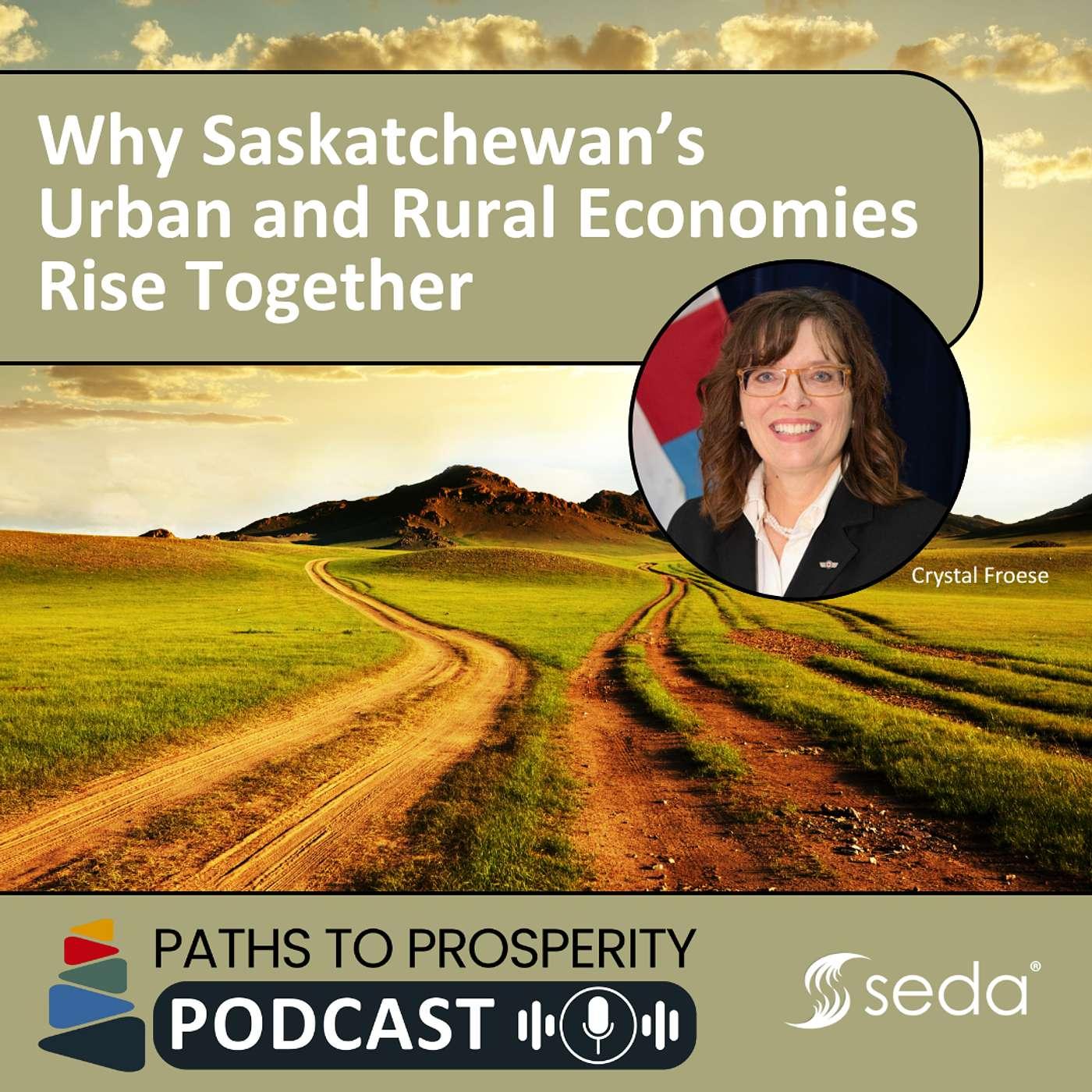
Welcome to Paths to Prosperity, the podcast from the Saskatchewan Economic Development Alliance, where we explore the ideas, leadership, and conversations shaping the future of Saskatchewan.
00:00:15.199 --> 00:00:16.640
Hi, I'm Crystal Froze.
00:00:16.960 --> 00:00:24.399
And today I want to talk about something that quietly shapes almost every conversation we have about growth in this province.
00:00:24.719 --> 00:00:28.719
The way we think about urban and rural Saskatchewan.
00:00:29.120 --> 00:00:38.320
For generations, Saskatchewan has been framed as a province of contrasts, urban and rural, city and small town, Main Street and Grid Road.
00:00:38.479 --> 00:00:42.560
And honestly, those distinctions are familiar to all of us.
00:00:42.719 --> 00:00:50.560
We hear them in political conversations, in economic discussions, even in how communities sometimes describe themselves.
00:00:50.960 --> 00:01:02.880
But maybe the bigger question is this are we still looking at Saskatchewan through a lens that no longer reflects how our province actually works?
00:01:05.920 --> 00:01:11.200
The truth is Saskatchewan's economy does not operate as two separate systems.
00:01:11.439 --> 00:01:17.599
It operates as one interconnected engine, powered by both urban and rural strengths.
00:01:18.079 --> 00:01:21.840
And when those engines are aligned, the province moves forward.
00:01:22.159 --> 00:01:26.400
When they're not, progress slows for everyone.
00:01:26.879 --> 00:01:39.439
As Saskatchewan looks towards growth, resilience, and long-term competitiveness, it may be time to stop thinking in terms of us versus them and start designing for the system we already have.
00:01:40.000 --> 00:01:47.599
And that starts with challenging one of the oldest narratives in this province, the idea of urban versus rural.
00:01:48.319 --> 00:01:57.599
The idea that communities are somehow competing for people, investment, or political attention shows up often in policy debates and public conversations.
00:01:58.239 --> 00:02:07.680
But if you actually look at how people live, work, and move across Saskatchewan, that narrative starts to fall apart pretty quickly.
00:02:08.080 --> 00:02:11.680
People commute across municipal boundaries every single day.
00:02:11.919 --> 00:02:15.599
Business operates across regions, not postal codes.
00:02:15.840 --> 00:02:20.639
Supply chains, labor markets, and investment flows don't stop at town limits.
00:02:20.879 --> 00:02:26.400
A producer in west central Saskatchewan relies on urban processing, logistics, and export capacity.
00:02:26.560 --> 00:02:33.759
And at the same time, cities rely on rural Saskatchewan for food security, energy, resources, and export revenue.
00:02:34.000 --> 00:02:37.439
Families move between community types over the course of a lifetime.
00:02:37.680 --> 00:02:46.800
A young person may leave a small town for education, build a career in a city, and later return to a rural community to raise a family or start their business.
00:02:47.120 --> 00:02:48.879
This isn't a hierarchy.
00:02:49.120 --> 00:02:51.039
It's interdependence.
00:02:51.599 --> 00:02:54.159
And I think this quote captures it perfectly.
00:02:54.400 --> 00:02:58.000
Urban and rural Saskatchewan aren't competing economies.
00:02:58.400 --> 00:03:05.280
They are interdependent parts of the same system, says Elon Boin from Scholy Research and Consulting.
00:03:05.680 --> 00:03:12.800
Now, while Saskatchewan functions as one system, different places absolutely play different roles.
00:03:13.120 --> 00:03:24.560
Rural and smaller communities are often where production begins, agriculture, agri food, energy and mining, forestry and the bioeconomy, tourism, culture, and land-based assets.
00:03:24.960 --> 00:03:29.919
And urban centers, like Saskatoon and Regina, tend to concentrate capacity.
00:03:30.400 --> 00:03:40.639
Postsecondary education and research, specialized labor and professional services, healthcare, finance, governance, transportation, logistics, and investment capital.
00:03:40.879 --> 00:03:44.639
And neither role works particularly well without the other.
00:03:45.360 --> 00:03:52.080
Rural Saskatchewan depends on urban services, markets and institutions to scale and sustain the production.
00:03:52.319 --> 00:04:00.080
And urban Saskatchewan depends on rural regions for the assets that drive exports, employment, and economic resilience.
00:04:00.719 --> 00:04:04.400
So maybe the question isn't whether one matters more.
00:04:05.120 --> 00:04:11.280
Maybe the real question is why do we still talk about them as though they're separate?
00:04:12.240 --> 00:04:21.199
As Mayor Gerald Elbers from Lloyd Minister has put it, strong cities need strong regions, and strong regions need strong cities.
00:04:22.240 --> 00:04:29.519
And yet, even though the interdependence seems obvious, the system still feels strained sometimes.
00:04:29.920 --> 00:04:30.560
Why?
00:04:30.879 --> 00:04:38.879
Well, because many of Saskatchewan's policies, programs, and investments were designed as though urban and rural were separate worlds.
00:04:39.360 --> 00:04:44.720
We plan infrastructure by jurisdiction instead of by economic corridor.
00:04:44.959 --> 00:04:50.639
We fund initiatives as either urban or rural, even when the outcomes are regional.
00:04:50.959 --> 00:04:57.199
We measure success locally despite province wide labor shortages and housing pressures, and the result?
00:04:57.600 --> 00:05:02.959
Well, we see labor shortages across a province, even where talent exists nearby.
00:05:03.199 --> 00:05:08.240
We see housing pressure in cities while surrounding communities still have capacity.
00:05:09.040 --> 00:05:16.639
We see industrial land, workers, and services planned in isolation from one another instead of as a connected system.
00:05:17.360 --> 00:05:21.759
And I think this is an important point to stop and reflect on for just a moment.
00:05:22.639 --> 00:05:25.920
What if these aren't actually community failures?
00:05:26.480 --> 00:05:29.600
What if they're system design failures?
00:05:30.560 --> 00:05:40.240
Because when systems aren't designed to connect people, labor, housing, transportation, and investment across regions, friction becomes inevitable.
00:05:40.639 --> 00:05:44.800
And maybe that leads us to the real conversation Saskatchewan needs to have.
00:05:45.120 --> 00:05:51.439
The question is no longer how do we support urban growth or how do we save rural communities?
00:05:51.759 --> 00:05:53.519
The real question is this.
00:05:54.000 --> 00:06:01.839
How do we design systems that allow urban and rural strengths to reinforce each other by default?
00:06:02.319 --> 00:06:04.079
Because that changes everything.
00:06:04.240 --> 00:06:07.439
It changes how we think about labor and training pipelines.
00:06:07.759 --> 00:06:10.639
It changes how we think about infrastructure investment.
00:06:11.040 --> 00:06:17.199
It changes how we think about economic development, housing, governance, and even collaboration itself.
00:06:18.000 --> 00:06:25.920
It means building systems around how people actually live and work, not around outdated boundaries.
00:06:26.160 --> 00:06:33.120
It means planning infrastructure around economic function and corridors instead of just jurisdictional lines.
00:06:33.439 --> 00:06:39.199
And it means thinking about investment readiness as ecosystems, not isolated sites.
00:06:39.759 --> 00:06:48.560
And maybe, most importantly, it means creating governance and funding models that reward collaboration instead of competition.
00:06:49.120 --> 00:06:54.160
This isn't about erasing differences between communities, it's about aligning them.
00:06:54.560 --> 00:07:10.480
And honestly, this moment matters because Saskatchewan is entering a period where demographic shifts, labor constraints, climate risk, and global competition for capital are all intensifying at the same time.
00:07:10.959 --> 00:07:14.720
Regions that remain fragmented will struggle to respond.
00:07:14.959 --> 00:07:20.720
Regions that act as integrated systems will be better positioned to adapt, compete, and grow.
00:07:21.040 --> 00:07:22.399
And the good news?
00:07:22.639 --> 00:07:26.319
Well, Saskatchewan already has one major advantage.
00:07:26.639 --> 00:07:29.439
We have a strong culture of collaboration.
00:07:29.680 --> 00:07:36.959
We have deep connections between communities already, and we share a common interest in long-term prosperity.
00:07:37.360 --> 00:07:44.399
But realizing that advantage requires intentional design and a willingness to move beyond outdated narratives.
00:07:44.639 --> 00:07:56.399
As Jean-Marc Nadeau from the CEO from Saskatchewan Urban Municipalities Association has said, continued success in Saskatchewan will depend on how well our communities can work together.
00:07:56.879 --> 00:08:00.879
And maybe that's the takeaway from this entire conversation.
00:08:01.519 --> 00:08:15.120
If Saskatchewan's economy is powered by two engines, then responsibility is shared, shared by urban and rural leaders, shared by Indigenous and non-Indigenous communities, shared by business, government, and institutions.
00:08:15.759 --> 00:08:20.000
Because growth is not a zero-sum game between places.
00:08:20.319 --> 00:08:25.360
It's a collective outcome of how well the system is designed to work.
00:08:25.920 --> 00:08:33.840
And when both engines are aligned, Saskatchewan doesn't just move forward, it moves forward together.
00:08:35.519 --> 00:08:41.279
Well, thanks to listening to Paths to Prosperity from Saskatchewan Economic Development Alliance.
00:08:41.759 --> 00:08:52.799
If today's conversation gave you something to think about, we invite you to subscribe for more monthly thought leadership and conversations focused on the future of Saskatchewan and the people helping shape it.
00:08:53.200 --> 00:09:04.480
And if this episode resonated with you, share it with a leader, practitioner, elected official, or community builder who believes Saskatchewan's future is strongest when communities work together.
00:09:04.720 --> 00:09:10.720
Because conversations like this can help build even greater collaboration across our province.
00:09:11.039 --> 00:09:15.440
Until next time, I'm Crystal Froze, and thanks for listening.
00:00:04.480 --> 00:00:14.960
Welcome to Paths to Prosperity, the podcast from the Saskatchewan Economic Development Alliance, where we explore the ideas, leadership, and conversations shaping the future of Saskatchewan.
00:00:15.199 --> 00:00:16.640
Hi, I'm Crystal Froze.
00:00:16.960 --> 00:00:24.399
And today I want to talk about something that quietly shapes almost every conversation we have about growth in this province.
00:00:24.719 --> 00:00:28.719
The way we think about urban and rural Saskatchewan.
00:00:29.120 --> 00:00:38.320
For generations, Saskatchewan has been framed as a province of contrasts, urban and rural, city and small town, Main Street and Grid Road.
00:00:38.479 --> 00:00:42.560
And honestly, those distinctions are familiar to all of us.
00:00:42.719 --> 00:00:50.560
We hear them in political conversations, in economic discussions, even in how communities sometimes describe themselves.
00:00:50.960 --> 00:01:02.880
But maybe the bigger question is this are we still looking at Saskatchewan through a lens that no longer reflects how our province actually works?
00:01:05.920 --> 00:01:11.200
The truth is Saskatchewan's economy does not operate as two separate systems.
00:01:11.439 --> 00:01:17.599
It operates as one interconnected engine, powered by both urban and rural strengths.
00:01:18.079 --> 00:01:21.840
And when those engines are aligned, the province moves forward.
00:01:22.159 --> 00:01:26.400
When they're not, progress slows for everyone.
00:01:26.879 --> 00:01:39.439
As Saskatchewan looks towards growth, resilience, and long-term competitiveness, it may be time to stop thinking in terms of us versus them and start designing for the system we already have.
00:01:40.000 --> 00:01:47.599
And that starts with challenging one of the oldest narratives in this province, the idea of urban versus rural.
00:01:48.319 --> 00:01:57.599
The idea that communities are somehow competing for people, investment, or political attention shows up often in policy debates and public conversations.
00:01:58.239 --> 00:02:07.680
But if you actually look at how people live, work, and move across Saskatchewan, that narrative starts to fall apart pretty quickly.
00:02:08.080 --> 00:02:11.680
People commute across municipal boundaries every single day.
00:02:11.919 --> 00:02:15.599
Business operates across regions, not postal codes.
00:02:15.840 --> 00:02:20.639
Supply chains, labor markets, and investment flows don't stop at town limits.
00:02:20.879 --> 00:02:26.400
A producer in west central Saskatchewan relies on urban processing, logistics, and export capacity.
00:02:26.560 --> 00:02:33.759
And at the same time, cities rely on rural Saskatchewan for food security, energy, resources, and export revenue.
00:02:34.000 --> 00:02:37.439
Families move between community types over the course of a lifetime.
00:02:37.680 --> 00:02:46.800
A young person may leave a small town for education, build a career in a city, and later return to a rural community to raise a family or start their business.
00:02:47.120 --> 00:02:48.879
This isn't a hierarchy.
00:02:49.120 --> 00:02:51.039
It's interdependence.
00:02:51.599 --> 00:02:54.159
And I think this quote captures it perfectly.
00:02:54.400 --> 00:02:58.000
Urban and rural Saskatchewan aren't competing economies.
00:02:58.400 --> 00:03:05.280
They are interdependent parts of the same system, says Elon Boin from Scholy Research and Consulting.
00:03:05.680 --> 00:03:12.800
Now, while Saskatchewan functions as one system, different places absolutely play different roles.
00:03:13.120 --> 00:03:24.560
Rural and smaller communities are often where production begins, agriculture, agri food, energy and mining, forestry and the bioeconomy, tourism, culture, and land-based assets.
00:03:24.960 --> 00:03:29.919
And urban centers, like Saskatoon and Regina, tend to concentrate capacity.
00:03:30.400 --> 00:03:40.639
Postsecondary education and research, specialized labor and professional services, healthcare, finance, governance, transportation, logistics, and investment capital.
00:03:40.879 --> 00:03:44.639
And neither role works particularly well without the other.
00:03:45.360 --> 00:03:52.080
Rural Saskatchewan depends on urban services, markets and institutions to scale and sustain the production.
00:03:52.319 --> 00:04:00.080
And urban Saskatchewan depends on rural regions for the assets that drive exports, employment, and economic resilience.
00:04:00.719 --> 00:04:04.400
So maybe the question isn't whether one matters more.
00:04:05.120 --> 00:04:11.280
Maybe the real question is why do we still talk about them as though they're separate?
00:04:12.240 --> 00:04:21.199
As Mayor Gerald Elbers from Lloyd Minister has put it, strong cities need strong regions, and strong regions need strong cities.
00:04:22.240 --> 00:04:29.519
And yet, even though the interdependence seems obvious, the system still feels strained sometimes.
00:04:29.920 --> 00:04:30.560
Why?
00:04:30.879 --> 00:04:38.879
Well, because many of Saskatchewan's policies, programs, and investments were designed as though urban and rural were separate worlds.
00:04:39.360 --> 00:04:44.720
We plan infrastructure by jurisdiction instead of by economic corridor.
00:04:44.959 --> 00:04:50.639
We fund initiatives as either urban or rural, even when the outcomes are regional.
00:04:50.959 --> 00:04:57.199
We measure success locally despite province wide labor shortages and housing pressures, and the result?
00:04:57.600 --> 00:05:02.959
Well, we see labor shortages across a province, even where talent exists nearby.
00:05:03.199 --> 00:05:08.240
We see housing pressure in cities while surrounding communities still have capacity.
00:05:09.040 --> 00:05:16.639
We see industrial land, workers, and services planned in isolation from one another instead of as a connected system.
00:05:17.360 --> 00:05:21.759
And I think this is an important point to stop and reflect on for just a moment.
00:05:22.639 --> 00:05:25.920
What if these aren't actually community failures?
00:05:26.480 --> 00:05:29.600
What if they're system design failures?
00:05:30.560 --> 00:05:40.240
Because when systems aren't designed to connect people, labor, housing, transportation, and investment across regions, friction becomes inevitable.
00:05:40.639 --> 00:05:44.800
And maybe that leads us to the real conversation Saskatchewan needs to have.
00:05:45.120 --> 00:05:51.439
The question is no longer how do we support urban growth or how do we save rural communities?
00:05:51.759 --> 00:05:53.519
The real question is this.
00:05:54.000 --> 00:06:01.839
How do we design systems that allow urban and rural strengths to reinforce each other by default?
00:06:02.319 --> 00:06:04.079
Because that changes everything.
00:06:04.240 --> 00:06:07.439
It changes how we think about labor and training pipelines.
00:06:07.759 --> 00:06:10.639
It changes how we think about infrastructure investment.
00:06:11.040 --> 00:06:17.199
It changes how we think about economic development, housing, governance, and even collaboration itself.
00:06:18.000 --> 00:06:25.920
It means building systems around how people actually live and work, not around outdated boundaries.
00:06:26.160 --> 00:06:33.120
It means planning infrastructure around economic function and corridors instead of just jurisdictional lines.
00:06:33.439 --> 00:06:39.199
And it means thinking about investment readiness as ecosystems, not isolated sites.
00:06:39.759 --> 00:06:48.560
And maybe, most importantly, it means creating governance and funding models that reward collaboration instead of competition.
00:06:49.120 --> 00:06:54.160
This isn't about erasing differences between communities, it's about aligning them.
00:06:54.560 --> 00:07:10.480
And honestly, this moment matters because Saskatchewan is entering a period where demographic shifts, labor constraints, climate risk, and global competition for capital are all intensifying at the same time.
00:07:10.959 --> 00:07:14.720
Regions that remain fragmented will struggle to respond.
00:07:14.959 --> 00:07:20.720
Regions that act as integrated systems will be better positioned to adapt, compete, and grow.
00:07:21.040 --> 00:07:22.399
And the good news?
00:07:22.639 --> 00:07:26.319
Well, Saskatchewan already has one major advantage.
00:07:26.639 --> 00:07:29.439
We have a strong culture of collaboration.
00:07:29.680 --> 00:07:36.959
We have deep connections between communities already, and we share a common interest in long-term prosperity.
00:07:37.360 --> 00:07:44.399
But realizing that advantage requires intentional design and a willingness to move beyond outdated narratives.
00:07:44.639 --> 00:07:56.399
As Jean-Marc Nadeau from the CEO from Saskatchewan Urban Municipalities Association has said, continued success in Saskatchewan will depend on how well our communities can work together.
00:07:56.879 --> 00:08:00.879
And maybe that's the takeaway from this entire conversation.
00:08:01.519 --> 00:08:15.120
If Saskatchewan's economy is powered by two engines, then responsibility is shared, shared by urban and rural leaders, shared by Indigenous and non-Indigenous communities, shared by business, government, and institutions.
00:08:15.759 --> 00:08:20.000
Because growth is not a zero-sum game between places.
00:08:20.319 --> 00:08:25.360
It's a collective outcome of how well the system is designed to work.
00:08:25.920 --> 00:08:33.840
And when both engines are aligned, Saskatchewan doesn't just move forward, it moves forward together.
00:08:35.519 --> 00:08:41.279
Well, thanks to listening to Paths to Prosperity from Saskatchewan Economic Development Alliance.
00:08:41.759 --> 00:08:52.799
If today's conversation gave you something to think about, we invite you to subscribe for more monthly thought leadership and conversations focused on the future of Saskatchewan and the people helping shape it.
00:08:53.200 --> 00:09:04.480
And if this episode resonated with you, share it with a leader, practitioner, elected official, or community builder who believes Saskatchewan's future is strongest when communities work together.
00:09:04.720 --> 00:09:10.720
Because conversations like this can help build even greater collaboration across our province.
00:09:11.039 --> 00:09:15.440
Until next time, I'm Crystal Froze, and thanks for listening.
