


ABOUT THIS EPISODE

Around 90% of commercial software is built on open source, yet only a small fraction of the companies using it give anything back. Meanwhile, the maintainers who keep it running are burning out, and a 2025 survey found 58% of them have considered quitting.
In this episode, Brian Wilson and Andi Grabner talk with Sebastian Kister, Chief AI Architect and Lead of OSPO Contribution & Maintainership at Volkswagen Group (assigned by Audi AG). Andi met Sebastian at Cloud Native Days Austria, where his talk on enterprise AI foundations made one point very clear: passive consumption of open source is a long-term risk.
Sebastian explains why upstream contribution is a business case and not charity. It shapes the standards your products depend on, extends your product lifecycle, and prevents short-sighted migrations. It also gets you ready for regulation like the EU AI Act and SBOM mandates, and it’s one of the strongest recruiting signals for top engineering talent. He also shows how it can be organized in practice: a group-level OSPO that frees employees to contribute to projects like OpenTelemetry and OpenSearch during work time, and connects the inside world with the outside one.
We also dig into:
And yes, the world’s best limoncello of 2025 doesn’t come from Italy. It comes from Sebastian’s distillery in Bavaria.
Links we discussed
Sebastians LinkedIn: https://www.linkedin.com/in/sebastiankister/
Cloud Native Austria Talk: https://www.youtube.com/watch?v=zue4cg8lcR0
Sebastians new blog: https://sebastiankister.de/keynote/
In this episode, Brian Wilson and Andi Grabner talk with Sebastian Kister, Chief AI Architect and Lead of OSPO Contribution & Maintainership at Volkswagen Group (assigned by Audi AG). Andi met Sebastian at Cloud Native Days Austria, where his talk on enterprise AI foundations made one point very clear: passive consumption of open source is a long-term risk.
Sebastian explains why upstream contribution is a business case and not charity. It shapes the standards your products depend on, extends your product lifecycle, and prevents short-sighted migrations. It also gets you ready for regulation like the EU AI Act and SBOM mandates, and it’s one of the strongest recruiting signals for top engineering talent. He also shows how it can be organized in practice: a group-level OSPO that frees employees to contribute to projects like OpenTelemetry and OpenSearch during work time, and connects the inside world with the outside one.
We also dig into:
- Sovereignty: why it has less to do with geography than with control, business continuity, and being able to leave the room on your own terms.
- Make or buy: Andi plays devil’s advocate on whether buying enterprise software is a safe alternative to contributing.
- Evaluating vendors: why contribution should become a criterion when enterprises choose vendors.
- Writing for AI: whether to write blogs for humans or for AI agents.
And yes, the world’s best limoncello of 2025 doesn’t come from Italy. It comes from Sebastian’s distillery in Bavaria.
Links we discussed
Sebastians LinkedIn: https://www.linkedin.com/in/sebastiankister/
Cloud Native Austria Talk: https://www.youtube.com/watch?v=zue4cg8lcR0
Sebastians new blog: https://sebastiankister.de/keynote/
English
United States
explicit content
TRANSCRIPT 🔗
Are you the producer of this podcast?
Add a podcast transcript
Need Audio-to-Text?
Transcribe with Listen411 in Just 60 Seconds
OTHER EPISODES IN THIS PODCAST
In this episode, we explore how AI is transforming education, from classrooms to corporate training. What changes are needed in schools and universities? How does AI affect both students and educators? And how should companies rethink internal training and hiring to stay competitive?To answer these…
Its rare - but it happens: A guest-free episode of PurePerformance, allowing Andi Grabner and Brian Wilson reconnect to share real-world insights from recent months in the cloud-native and observability space. From KubeCon Amsterdam experiences and the strength of open-source collaboration to emerg…
I still hear people say, “OpenTelemetry is vendor-neutral, so you can switch any time!”In this episode, Adriana Villela and Josh Lee (both active OpenTelemetry contributors) help bust that myth.While OTel standardizes instrumentation and signal transport—and unlocks a rich ecosystem of tools—switch…
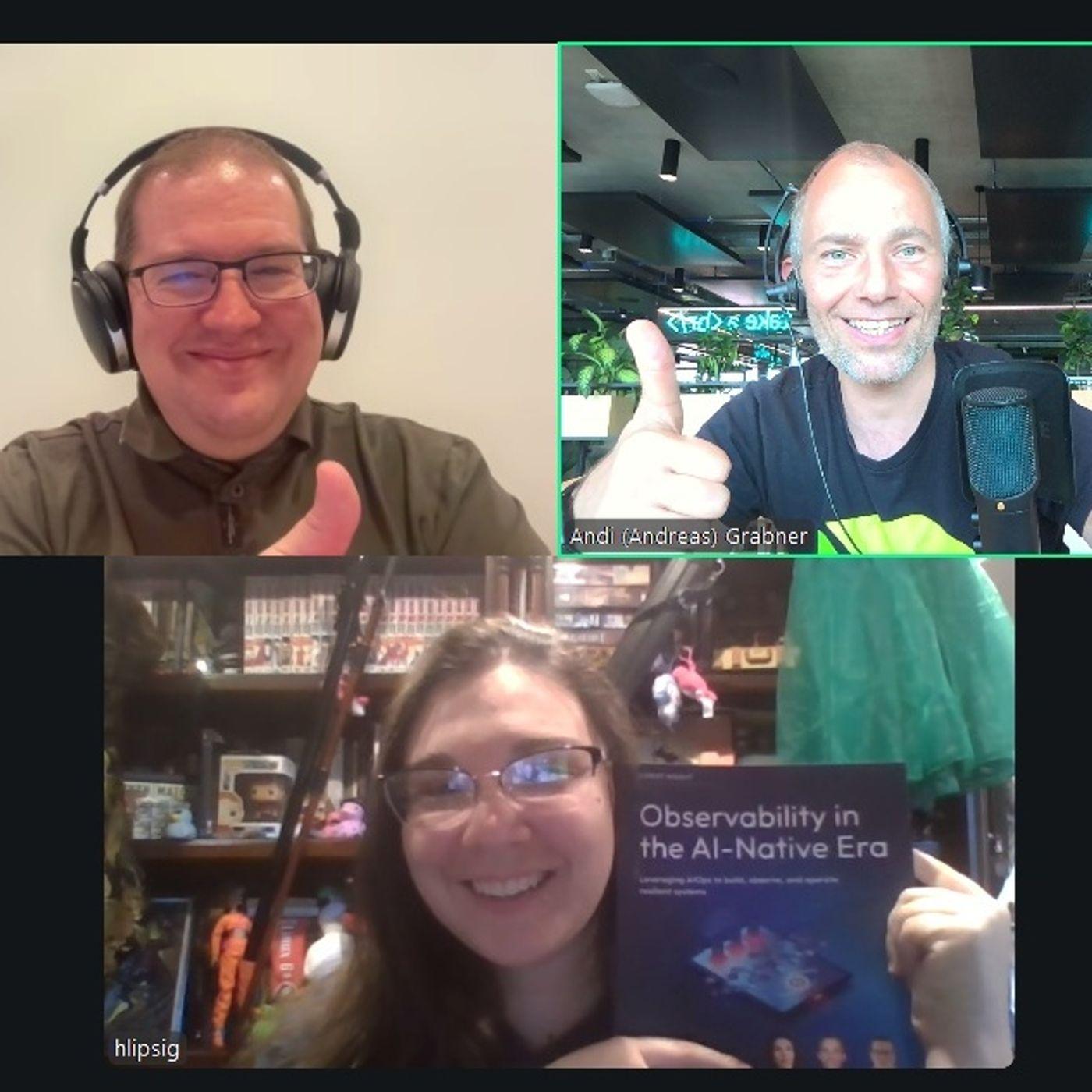
As the software world is transforming from cloud native to AI-native, observability must transform with it. But how exactly? How do we apply this in an existing enterprise with established processes and practices?In this PurePerformance episode, Andi Grabner hosts Hilliary Lipsig and Rob Rati to di…
In 2011 Heroku defined the 12 factor app to remove emerging bottlenecks as developers tried to scale their output when they moved from building monoliths to microservices. In Platform Engineer we see a repeating pattern called the "8 Factor Platform Producers". AI allows engineering teams to speed…
Disclaimer: The podcast and artwork embedded on this page are from PurePerformance, which is the property of its owner and not affiliated with or endorsed by Listen Notes, Inc.
EDIT
Thank you for helping to keep the podcast database up to date.
