


WEBVTT
1
00:00:00.140 --> 00:00:06.100
When I talk about the canvas becoming obsolete, I really mean like the infinite canvas as an abstraction.
2
00:00:06.160 --> 00:00:19.140
I do think like a restricted canvas that uses the things you are allowed to use, but understands when you're talking about or moving something about in plain English, it can reply to you in plain English.
3
00:00:19.160 --> 00:00:28.060
But under the hood, there is a full understanding of the props, the guidance, honestly, even more than just your design system- Your whole code base...
4
00:00:28.100 --> 00:00:37.740
or your code base, but your regulatory environment, your accessibility requirements, your brand guidelines, all of these things that exist in a broader product context.
5
00:00:37.860 --> 00:00:50.720
Tell me more about this idea of the restricted canvas, because I think it's very hard for designers to imagine not having that free blank space. If we don't start there, what do we start with?
6
00:00:50.880 --> 00:01:08.020
You start with the problem statement and what you're trying to achieve, and then you c- if you have the right context, you can have AI populate that canvas with what your design system as interpreted by an AI
7
00:01:08.980 --> 00:01:19.740
would build to solve that problem. A lot of the questions I hear is like, "How do I go from my Figma design of a product to that implemented in code?"
8
00:01:20.440 --> 00:01:29.570
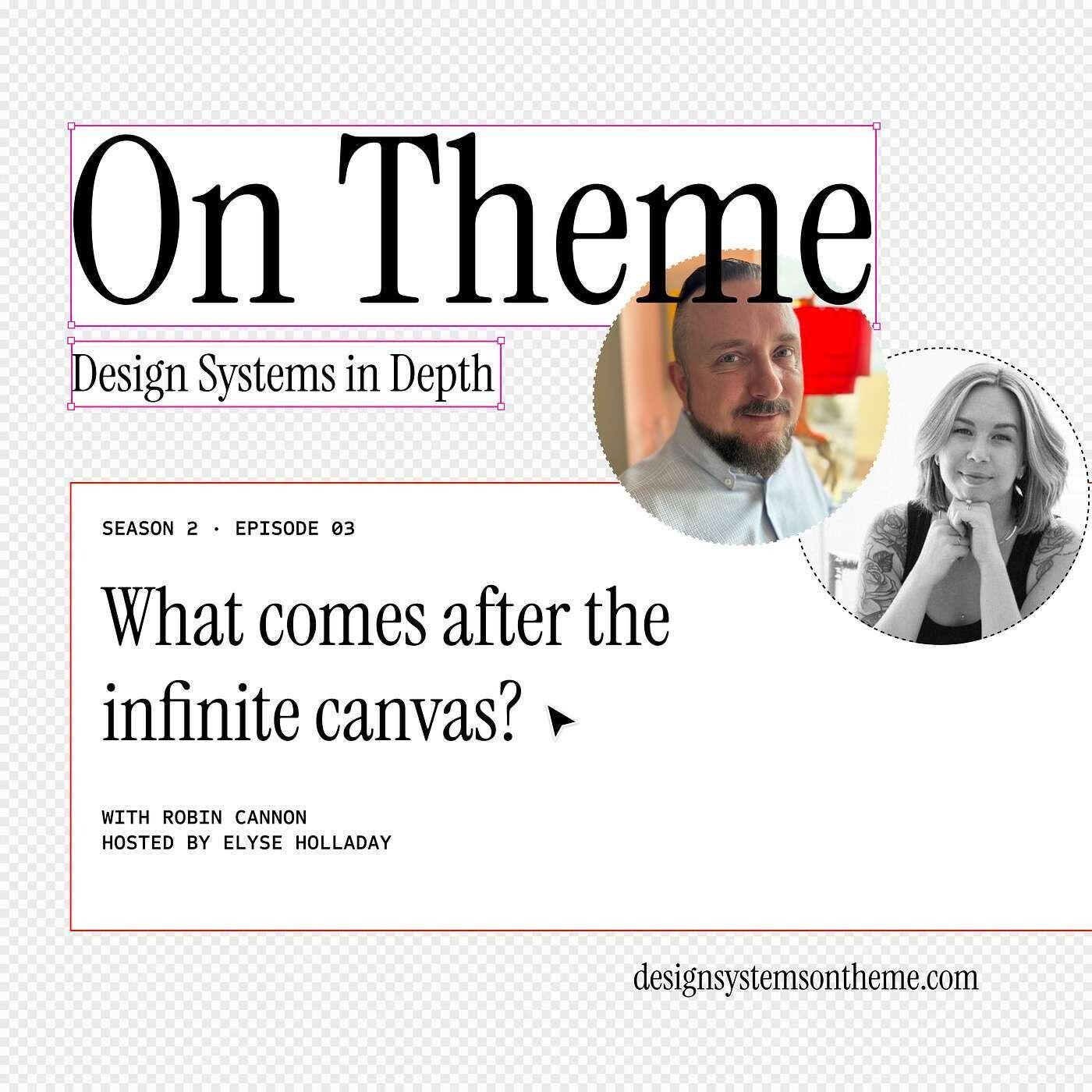
And my question is, "Well, why are you trying to create the abstraction in the first place?" Say it again. Say it again. [upbeat music] This is On Theme: Design Systems In Depth, and I'm Elise Holiday.
9
00:01:30.260 --> 00:01:35.840
Together, we'll be exploring how successful design systems get built, maintained, and deliver impact.
10
00:01:36.640 --> 00:01:49.580
Design systems is due for a major reinvention moment, and I wanna share what's working from design system practitioners out there forging a way. Let's dive into the show. Today's guest is Robin Cannon.
11
00:01:49.760 --> 00:01:58.100
He is a product and design exec with a decade of design system leadership experience, including at IBM's Carbon and JP Morgan's Salt design system.
12
00:01:58.780 --> 00:02:06.520
He is now at Knabstack as the VP of product to work on the hard problem of what happens when the canvas isn't the center of the design process anymore.
13
00:02:06.540 --> 00:02:16.280
He writes essays on design and AI infrastructure, as well as speculative fiction exploring what complex systems do to the humans inside them. You can check that out at robin-cannon.com.
14
00:02:16.760 --> 00:02:27.960
Robin, thanks for coming on the podcast. Yeah, thank you. I'm really excited. It's a fun topic to be talking about, and generally I think leads to a lot of spicy takes and controversy and good fun debates.
15
00:02:29.180 --> 00:02:38.760
We love a spicy take on this show. So I'm really looking forward to this conversation because you are one of the most vocal people, at least in my LinkedIn bubble, about designing with code.
16
00:02:39.310 --> 00:02:44.980
And listeners of this podcast, you probably know I'm extremely bullish on the idea of designing with code.
17
00:02:45.020 --> 00:02:58.200
And so I wanna get right into that thesis, which is f- I believe, and I, and I think you do too, Robin, that for 90% of what we build in software, we can design using code and using the design system.
18
00:02:59.100 --> 00:03:08.080
Vector design programs are never gonna make anything more than a fancy screenshot, a picture of the UI, maybe a very close picture, but not actually the real deal.
19
00:03:08.680 --> 00:03:15.310
And I think that we both believe that the future of designing software is gonna be code under the hood. But today,
20
00:03:16.480 --> 00:03:37.120
you know, we're recording this in March of 2026, and today when we say design with code, I think most designers' experience and what they picture is generating some Tailwind slop UI via a natural language prompt, you know, in something like Lovable or Bolt or Subframe where your interface is your natural language prompt.
21
00:03:37.160 --> 00:03:44.020
So I wanna hand it right over to you. Tell me the world that you envision when you say we should be designing with code.
22
00:03:44.320 --> 00:03:58.760
It's the idea of you don't need to be using an abstraction, that we've reached the point in technology where designers and developers can be working in the same plane with different views, designing in something that's real.
23
00:03:58.840 --> 00:03:59.800
I think that's the biggest thing.
24
00:03:59.940 --> 00:04:12.280
Years ago on Carbon, I would have designers who would start to learn how to do bits of JavaScript or bits of CSS because they, they were getting annoyed at how long it would take to fix a single small thing that had been bugging them.
25
00:04:12.520 --> 00:04:26.080
But now I think we're really talking about something that for a designer it can look like Figma and have an interface similar to Figma, and for a developer it can have an interface like Cursor, and you're switching back and forth with them in a really effective way.
26
00:04:26.520 --> 00:04:35.800
It's the product context. It's not canvas as an abstraction. I keep saying this, like we have the code components already.
27
00:04:35.860 --> 00:04:46.330
In any effective and established design system, you have Figma components and you have code components, but you already have the code components, and they are always gonna have more states- Correct...
28
00:04:46.380 --> 00:04:56.810
more functionality, more behavior than is representable in a vector program. And so I'm really excited about the idea of being able to
29
00:04:58.180 --> 00:05:07.600
work as I'm designing with all of those details and states, with all of the actual capabilities of any given component, right?
30
00:05:07.660 --> 00:05:19.800
If you have something like an autocomplete search, there's all kinds of things that it can do that aren't necessarily represented in Figma. But also, there's just the sensation of actually using it.
31
00:05:20.240 --> 00:05:32.540
And so when you're building something that you can actually type in, see it on mobile, see how fast it is, if it feels smooth, if that feels like it makes sense, and that's the kind of stuff that I think is just impossible to do in a vector program.
32
00:05:33.160 --> 00:05:38.780
And I think a lot of designers would agree that they get a lot of value out of seeing it happen, right?
33
00:05:38.900 --> 00:05:46.400
Once they see the real thing that the engineer built, they have more thoughts about how it should work, and they have more opinions about what it should do.
34
00:05:46.440 --> 00:06:01.340
And I will also say that right now a lot of, or most of the design with your design system in code tools don't really give you the experience that I'm actually envisioning. Yeah.
35
00:06:01.380 --> 00:06:10.084
I'm not sure we're quite there yet in the sense of it should be equally smooth for a designer to make-Tweaks and refinements.
36
00:06:10.504 --> 00:06:24.504
I think that we're at the point now where you can vibe code something that can reference your design system and can reference the coded components even, and give you something that is of a decent quality.
37
00:06:24.704 --> 00:06:26.204
AI gets you to okay.
38
00:06:27.204 --> 00:06:40.404
The problem right now in all our tools is designers need to be able to tweak that in a design interface, um, and that doesn't exist, and that's why you're seeing some of these, to me, weird pushes back.
39
00:06:40.454 --> 00:06:53.284
"Hey, we've got something coded that works. We need to make some minor refinements to the UX or the UI. Let's take it back to an abstraction stage." Let's actually break down some of the use cases here.
40
00:06:53.344 --> 00:06:56.624
The one that you just mentioned is a designer needs to actually
41
00:06:58.284 --> 00:07:17.394
polish, and I'm putting that in nice big air quotes because I don't really believe that it's polish, but look at something that's actually in production and do some refinement of the UI in a very precise way, down to spacing, sizing, alignment, just like r- really doing that refinement work.
42
00:07:17.944 --> 00:07:33.164
So that's one use case. I think there's another use case where there is building or prototyping something entirely new using your system, but you know- Mm-hmm... is this even the right flow? Is this even the right UX?
43
00:07:33.464 --> 00:07:39.364
What might it feel like if we used a checklist here or cards or a search or whatever?
44
00:07:40.104 --> 00:07:48.704
And then I think there's actually a third use case, which is a really substantial one, which is we just need to build something that works exactly like all the other things that we have in the system.
45
00:07:48.784 --> 00:07:57.154
We're building our umpteenth form that works exactly like all of the other forms that came before it, and I just need to put those things together and make sure that it all
46
00:07:58.064 --> 00:08:03.804
is right and follows my product or design requirements- Mm-hmm... but I'm building it entirely with the system.
47
00:08:03.864 --> 00:08:18.544
And I think here's where the parallels are similar for developers, where developers are looking and this is a really simple fix that I am comfortable letting AI vibe code the solution for because it's low risk, low blast radius.
48
00:08:18.924 --> 00:08:26.124
There are design solutions and design tasks that are very similar, and then there are like this is a bigger feature, this is more exploratory.
49
00:08:26.684 --> 00:08:38.844
Even if I have a coded prototype, now I wanna be able to drag and drop and resize and change and update and move the flows around because this is something that is more creative or brand new.
50
00:08:39.544 --> 00:08:49.924
Um- I wanna talk a little bit more about what we think the actual future of these tools and these workflows is gonna look like, because we've said, "Okay, I don't think the tools are there."
51
00:08:51.044 --> 00:09:01.944
What do you imagine the tools are going to be like? You know what the funniest thing is? That we kind of invented these tools about 30 years ago, and we didn't have the technology to do it.
52
00:09:02.024 --> 00:09:25.864
Because if you go back and look at the things like Macromedia Dreamweaver, even before Adobe bought it, or Microsoft FrontPage, what they were trying to do is, "Hey, look, here's the code, and here's the visual view, and when you change it in one place, it changes in the other place, and you can work on this as a, a non-technical designer, or you can work on it as a non-design expert developer."
53
00:09:26.544 --> 00:09:37.984
Um, now we know that the... if we wanna talk about slop, then the code that those things created was terrifying, but it's that concept, and I, and I think we're starting to see it.
54
00:09:38.004 --> 00:09:51.184
There are definitely some products out there now where they have here's the code view, here's the design view, and they might have some limited in-app tools, either from a code perspective or from a design perspective.
55
00:09:51.764 --> 00:10:04.184
But I think fundamentally what you're gonna need is something that is close to as good as Figma and as good or close to as good as Cursor in the same experience.
56
00:10:05.184 --> 00:10:22.024
That's the creative experience, but then also that needs to be able to take in the context it needs so that what you're creating is of a decent quality first so that you can then apply the human judgment that you need, either as a developer or a designer.
57
00:10:22.624 --> 00:10:29.284
This is actually a place I think that AI is doing something that the tools that you were just referencing couldn't do.
58
00:10:29.764 --> 00:10:42.104
Webflow really did this for websites, but FlutterFlow, WeWeb, there's a, like a handful of other tools that were trying to make a visual UI for building a website or a web app.
59
00:10:42.164 --> 00:11:05.724
And I think what was so challenging about those is if you're gonna build a UI that lets you do CSS, you have to put the entirety of CSS into a UI, and I actually see this as a place where we will not have a Figma-like visual interface in these tools because you can't put literally everything that's possible to do with the entire CSS API into a UI.
60
00:11:06.324 --> 00:11:13.844
And one of the things that I think AI actually can do is interpret via natural language some of the
61
00:11:14.944 --> 00:11:25.984
ways that designers want to explore and experiment and turn that into, "Oh, I can do this with a prop on the component," or, "These are the available props on the component," or, "These are the things that the CSS spec can do."
62
00:11:26.784 --> 00:11:28.894
One of the things that I'm seeing is that designers,
63
00:11:30.124 --> 00:11:38.224
I mean, this is the entirety of bridging the gap between design and engineering, but designers speak about the things that they wanna do in a very different way than engineers.
64
00:11:38.984 --> 00:11:52.224
The kinds of words that designers use isn't code words. They're not saying, "Change this prop." They're saying, "Make it do this. Make it not go away when I click." Right.
65
00:11:52.364 --> 00:11:54.844
And those are, but those are props in the components or the API.
66
00:11:54.944 --> 00:12:08.844
And so that interpretation layer I think is the really interesting thing because I actually don't think that pixel pushing UI, change this padding to seven pixels, is actually the...
67
00:12:09.424 --> 00:12:19.636
Maybe we need the ability to do that sometimes, but actually in a lot of use cases, we don't.When I talk about the canvas becoming obsolete, I really mean like the infinite canvas as an abstraction.
68
00:12:20.336 --> 00:12:33.336
I do think like a restricted canvas that uses the things you are allowed to use, but understands when you're talking about or moving something about in plain English, it can reply to you in plain English.
69
00:12:33.356 --> 00:12:42.246
But under the hood, there is a full understanding of the props, the guidance, honestly, even more than just your design system ideally- Your whole code base...
70
00:12:42.396 --> 00:12:55.756
your code base, but your regulatory environment, your accessibility requirements, your brand guidelines, all of these things that exist in a broader product context than just your design system guidance and your design system code.
71
00:12:55.816 --> 00:13:07.736
Tell me more about this idea of the restricted canvas or like what do you mean by the canvas? Because I think it's very hard for designers to imagine not having that free blank space.
72
00:13:08.436 --> 00:13:20.516
And even on the code side, I've been designing with CSS for the entirety of my career, and even when I start, I'm like, new page, blank screen- Right... start putting some frames on the page.
73
00:13:20.596 --> 00:13:29.456
That's divs, it's code rather than using a Figma frame, but it's still starting from that blank space. So if we don't start there, what do we start with?
74
00:13:30.156 --> 00:13:47.996
Well, I think where we are now, particularly if you have that context, you start with the problem statement and what you're trying to achieve, and then you c- if you have the right context, you can have AI populate that canvas with what your design system
75
00:13:48.936 --> 00:13:54.016
as interpreted by an AI would build to solve that problem.
76
00:13:54.696 --> 00:14:04.816
And I think this is one of the biggest things, like a lot of the questions I hear is like how do I go from my Figma design of a product to that implemented in code?
77
00:14:05.496 --> 00:14:10.096
And my question is, well, why are you trying to create the abstraction in the first place? Say it again. Say it again.
78
00:14:10.456 --> 00:14:25.465
[laughs] If you have the context that your design system provides, you can say, "Make me a login form," or, "I need to explore a couple of different flows for sign-up and registration for X service."
79
00:14:26.356 --> 00:14:36.086
And it should be able to create something that is much more adherent than a contextless, non-determinative generation. Future is here. We literally do that every day at Color now. Yeah.
80
00:14:36.116 --> 00:14:39.816
Being able to start with that and not have that translation layer.
81
00:14:39.876 --> 00:14:51.136
And, and I'm excited about that for the, the plain reason of the best designs that I've created in my career have been working with a designer and an engineer.
82
00:14:51.516 --> 00:14:54.326
Sometimes I'm playing the design role, sometimes I'm playing the engineer role.
83
00:14:54.556 --> 00:15:05.636
We always come to some better solution, a better visual solution, a better functional solution, a better code solution when we can all get together and actually work on the same thing in a really collaborative way.
84
00:15:05.646 --> 00:15:13.196
And I agree, I don't think the tools are 100% there, but I'm seeing that shift happen in real time, and I think that's really, really exciting.
85
00:15:13.536 --> 00:15:26.056
But I know that listeners are thinking right now, "Elyse, you work at a small company, and I work at a really big company, and, uh, I can't do that." So Robin, you obviously have worked at some massive organizations.
86
00:15:26.116 --> 00:15:35.826
These tools are starting to emerge, but if you work at a really big enterprise, you can't just say, "Hey, let's just turn this on today. Let's all start working in this way."
87
00:15:35.856 --> 00:15:40.996
What is making it not possible for big organizations to work in this way right now?
88
00:15:41.736 --> 00:15:51.556
Yeah, I mean, I think big organizations have always struggled to work in an agile way, and I mean the description rather, [laughs] rather than the process. And there's lots of reasons for that.
89
00:15:51.576 --> 00:16:02.536
There's cultural inertia, there's procurement issues, there's a lot more checks and balances for being able to just go ahead and use software and experiment with it.
90
00:16:03.416 --> 00:16:06.196
But I think that you also hit tipping points very quickly.
91
00:16:06.716 --> 00:16:20.116
So if I think back to IBM, my first couple of years at IBM, IBM was using Sketch, even at a point where Figma was becoming bigger and bigger and really taking over in terms of this is the tool designers want to use.
92
00:16:21.476 --> 00:16:41.396
And it took a long time, and then suddenly there was just like a flip where the internal pressure from practitioners became so large that IBM essentially just then basically had to say, "The only way we can move forward, uh, and get the talent we want and the design quality we want is to make the right tools available."
93
00:16:41.436 --> 00:16:52.876
So there's that part of it. I think the other thing, and you talked about it a little bit, is that for individuals, there's a point there where you can say, "Hey, I did X thing. I've done my part in this task."
94
00:16:53.716 --> 00:17:00.776
And that is something that is a natural handover point, which means it's a natural checkpoint.
95
00:17:01.436 --> 00:17:24.816
And so I think one of the biggest things and the biggest problems that large scale enterprises are having is like, well, where are the human touchpoints, and how can we integrate human touchpoints into an AI-accelerated workflow in an effective way so that for all our legal, regulatory, business requirements, we're reducing risk?
96
00:17:24.916 --> 00:17:34.476
Because I think the biggest thing about non-determinative AI is risk, and at an enterprise scale, that risk is also- Yeah... enterprise scale.
97
00:17:34.636 --> 00:17:45.196
One of the things that I'm hearing you say is also the idea of iterating on software being a living, constantly in creation thing that we're building and we're constantly releasing.
98
00:17:46.116 --> 00:17:56.136
The way you want to work often is very iterative. You wanna sit down with your PM and your engineer and the, your requirements and iterate on the thing.
99
00:17:56.756 --> 00:18:05.416
And you get to some point and you're like, "Okay, let's get that out because we're at a MVP moment, and let's come back and work on this edge case. Let's come back and work on this feature.
100
00:18:05.516 --> 00:18:09.816
Let's come back and work on improving this once we get a little bit of information."
101
00:18:10.536 --> 00:18:24.138
But that's actually a very challenging way for organizations big or small to work because there's no moment where you can say, "Okay, this part is done."But we're just doing stuff, and we are just keeping on doing stuff until we get to some place where we're happy.
102
00:18:24.668 --> 00:18:35.827
And that is not trackable, or it's very hard to track. It opens up a lot of, like, ambiguous room for risk and for confusion and for communication problems.
103
00:18:36.348 --> 00:18:48.408
I wonder, from your perspective, how much of the challenge for organizations is not actually around the tools? We work in health tech, like, we are very sensitive to the risk of PHI and security, so I hear you on that.
104
00:18:48.448 --> 00:19:02.108
But aside from that, how much of the hesitation here or the resistance here is simply around we don't know how to do this process if everybody is getting to just be in it together? Oh, yeah.
105
00:19:02.208 --> 00:19:13.508
I mean, it's very kind of, like, improvisational jazz delivery. [laughs] The new agile, folks. But if you think about any- anywhere I work, there's always a pressure, like, you have to ship something.
106
00:19:13.608 --> 00:19:27.788
And w- however good the intentions are, you're never gonna go back and fix all of those edge cases. [laughs] So I think that, like, having some demonstration of some capacity to, within a new workflow,
107
00:19:29.008 --> 00:19:36.998
determine, okay, here is a release. Here is something that we can point to as a feature being shipped. Is that gonna stay the same?
108
00:19:37.488 --> 00:19:47.168
If it doesn't stay the same, then what does it get replaced with in terms of measurement? I think a lot of this is just much more rapid iteration.
109
00:19:47.228 --> 00:20:00.388
If you think about the double diamond, then you're fundamentally, you're talking about, like, design, build, measure, iterate, go around again, where you're making design and build become the same thing.
110
00:20:00.868 --> 00:20:12.008
Measurement gets much, much faster. Iteration gets much, much faster. And so instead of that being a quarterly process, now it's, like, a weekly process or even less.
111
00:20:12.448 --> 00:20:26.288
And I think that's terrifying for big enterprise because big enterprise is not used to moving that fast. And I, not to be grim about it, but I really do believe that there's a moment coming up.
112
00:20:26.368 --> 00:20:28.548
You were talking about the Figma to Sketch transition.
113
00:20:28.648 --> 00:20:41.788
I do think that there's a moment coming for big organizations where the rug is being pulled out from under you is gonna happen, where I do think these design with code tools are gonna become really powerful quickly.
114
00:20:42.128 --> 00:20:50.328
Like, they're not totally there yet, but I think this year we're gonna see really substantial improvements in how these design with code tools work.
115
00:20:50.928 --> 00:20:59.788
Right now, I'm seeing so much focus on Figma to code, and everybody lost their minds when it was like, "Oh, now we can go Claude to Figma."
116
00:20:59.908 --> 00:21:12.737
You can have it generate in Figma some frames of a thing that you've built in code, which is a better direction, I guess, but we're still doing this kind of unnecessary translation.
117
00:21:13.188 --> 00:21:26.408
And I think there's gonna come a moment where a couple of these tools are going to really successfully figure out what this UI looks like, not the process inside organizations, but just simply the UI, the ability to have
118
00:21:27.988 --> 00:21:32.857
a canvas, for lack of a better term, with your code components under the hood that has your context.
119
00:21:33.928 --> 00:21:40.548
We're just so focused on Figma right now, especially big companies who n- can't necessarily, like, procure some new tool.
120
00:21:40.628 --> 00:21:51.288
I'm just really afraid that everybody is gonna be like, "Oh, we spent all year of 2026 trying to, like, make Figma generate good code," and then all of a sudden now this other thing is here, and now what do we do?
121
00:21:52.388 --> 00:22:00.568
Yeah, I mean, I think, I think we might. Already we're like, we've stopped trying to help Figma generate good code- Generate Figma... and now we're trying to make good code generate good Figma. Yeah.
122
00:22:00.878 --> 00:22:12.898
And I've, so [laughs] you know, which is bonk- Just, yeah, I say it's bonkers... bonkers to me. Yeah. [laughs] But the way I think about it is maybe it's not designing code. Maybe it's like build with plain English,
123
00:22:13.868 --> 00:22:26.308
because I think, it may be apocryphal, but I have a, an old manager at IBM told me that Steve Wozniak at Apple way back in the day was like, "You should always be able to explain your design intent in prose."
124
00:22:27.348 --> 00:22:37.408
And I think that if you have that plus context, plus then the ability to refine both visually and in code,
125
00:22:38.358 --> 00:22:50.308
that's the way we're gonna be able to go, so that you can get something that is 90% correct if you can give it the right problem. It understands your company's broad product context.
126
00:22:51.608 --> 00:23:02.888
You've got that control plane where you're orchestrating multiple different sources. You're actually orchestrating them in a way that you can resolve conflict, and then your output is
127
00:23:04.488 --> 00:23:12.208
90% complete and 90% correct, and then that's where human excellence comes in.
128
00:23:12.648 --> 00:23:25.628
Because this is my other big thing is, like, we're already getting very quickly to the point where AI can create good, solid, generic, boring stuff very quickly and very cheaply,
129
00:23:26.748 --> 00:23:30.568
and therefore the only differentiating factor at that point- Mm-hmm... becomes how good it is.
130
00:23:30.808 --> 00:23:38.728
Yeah, and I'm honestly getting tired of the taste argument, but I do think that there's something around quality, excellence, taste, something.
131
00:23:38.788 --> 00:23:47.888
Like, if everybody can generate all of these things, what makes mine better or more useful? I wanna touch on something that you said here about
132
00:23:49.028 --> 00:23:53.728
putting all of the context in and that the LLMs can do a pretty good job of generating the boring thing.
133
00:23:54.548 --> 00:24:05.848
I know that for a lot of designers and engineers too, a lot of fear and frustration around, but if it can generate all of this stuff, like, what's my role? What's the thing that I'm doing?
134
00:24:06.528 --> 00:24:22.388
I actually feel like what you were just describing, taking in that context, taking in the business context, taking in the requirements and the constraints, taking in the design system, that is in a lot of cases 90% of what the job is anyway.
135
00:24:22.528 --> 00:24:34.124
One of the-... point, the whole point of a design system was to take some of those decisions and codify them in some way so that you're not having to make those decisions over and over again. And
136
00:24:35.144 --> 00:24:47.194
I see having that stuff documented as incredibly valuable to humans, not just to LLMs. I think one of my favorite like snarky things that I've seen about all of this is it took LLMs to get us to write good documentation.
137
00:24:47.194 --> 00:24:49.844
[laughs] And it's, I know, it would've been really nice for humans this whole time.
138
00:24:49.864 --> 00:25:05.284
Yeah, I mean, I think y- you're right because the design systems, I always think that what makes something a design system is not here's a component library, it's here's what we are trying to strive for in terms of delivering good digital experiences.
139
00:25:05.804 --> 00:25:14.184
So the best design systems are the ones that have places where like, here is how we try to strive for the best accessibility.
140
00:25:14.564 --> 00:25:29.164
Here's what you can get out the box in terms of component accessibility, but then here's the fuzzier part of it that the design system can't control because you can put those components together in lots of different ways.
141
00:25:29.604 --> 00:25:41.924
Or here's how we're trying to think about universal design as a concept, and those are principles as well as just execution standards.
142
00:25:42.424 --> 00:25:55.904
And I think those are the areas where a design system and the broader context of a company is really important in terms of differentiating themselves, whether it's humans building stuff or whether it's LLMs building stuff.
143
00:25:56.314 --> 00:26:05.184
Right, and we've always been trying to do that with the design system to say, "Hey, designer, you have some use case you're designing against. You have some constraints. You have some product requirements.
144
00:26:05.244 --> 00:26:08.444
You have business metrics that you are trying to hit with this thing."
145
00:26:09.064 --> 00:26:20.074
80% of those decisions, those design decisions should already be made for you in the sense that you don't need to think about form spacing or what an input looks like.
146
00:26:20.074 --> 00:26:24.124
I mean, this is like obvious atomic stuff that every design system person who's listening is like, "Yeah, duh."
147
00:26:24.704 --> 00:26:37.004
But imagine if you had to make all those decisions every single time, and then you have this other 20% where you're getting to spend your energy on, does this meet the needs of the thing that I'm trying to make?
148
00:26:37.724 --> 00:26:49.964
Where can I get creative with building the actual problem I'm trying to solve rather than thinking about building all of the little Legos that go into it? Right. This is what we've always been doing. I really
149
00:26:51.024 --> 00:27:02.414
see that happening with design, with code tools in a more precise, higher fidelity, and more defined way. And my hope is,
150
00:27:04.304 --> 00:27:18.664
truly, like my hope is that this is not at all about the LLMs can design and now you aren't needed because at least in this year of our AI overlords 2026, that is not the case.
151
00:27:19.384 --> 00:27:34.023
But also that it gives you, you the designer, more space and time to be thinking about the really hard problem of what it is you're actually trying to make and whether or not it's good, and that is my hope for this way of working.
152
00:27:35.024 --> 00:27:39.984
I think that is the way. I mean, I think that, you know, and this has always been the issue of design systems.
153
00:27:40.124 --> 00:27:53.904
I was, 10 years ago, I was talking about this on Carbon where when you're trying to talk about or allay the fears of design systems are limiting, it's do you wanna design that button again, or do you wanna design the solution that your user needs?
154
00:27:54.374 --> 00:28:06.984
And it's that at speed and at scale even more so now. AI is pattern recognition, and so it can't do anything if there isn't a pattern for it to recognize.
155
00:28:07.024 --> 00:28:20.264
And the only creatures who can do that is us people, who can be like, "I'm going to create something genuinely new. I'm gonna think about this from all different perspectives,
156
00:28:21.224 --> 00:28:29.354
and then I can use AI to accelerate my ability to do that." And that's gonna be true for designers and for coders.
157
00:28:30.054 --> 00:28:42.384
The people who can think of something new with taste judgment, really the ability to accept and understand and deal with ambiguity, um, are the ones who are gonna succeed.
158
00:28:43.623 --> 00:29:00.004
The weird irony, I think, is that we've spent the last 20 years as a society forcing people away from exactly the kind of education that supports that, and we've been forcing people into much more vocational execution-focused- Yeah...
159
00:29:00.084 --> 00:29:04.924
education, and it's execution, which is exactly what AI is automating.
160
00:29:05.624 --> 00:29:15.404
Yeah, and I understand and empathize so much with the fear and the uncertainty that everybody's feeling right now around AI and around the improving quality of AI output.
161
00:29:15.424 --> 00:29:29.434
But I, I also feel very strongly if the only thing that you feel like you can offer is your ability to, you know, write semicolons and functions and move pixels around, like I think you're deeply undervaluing your own- Yeah...
162
00:29:29.464 --> 00:29:39.644
brain and your own value that you can bring, uh, to not just like the value to a business, but like to the world. Like you are not limited to pure production work.
163
00:29:40.044 --> 00:29:46.004
And you know, I've been saying when I'm talking to people about this, that we had the pejorative code monkey like 20 years ago. Yeah.
164
00:29:46.084 --> 00:29:56.684
I think we've known for a really long time that the execution work is not the most exciting or compelling or rewarding or valued- Right... part.
165
00:29:56.724 --> 00:30:01.664
Like yeah, the code is the deliverable to the outcome, but it's not actually the outcome in and of itself.
166
00:30:01.724 --> 00:30:12.784
Yeah, I mean, it might be an old episode of The West Wing where they're having an argument of, oh, it costs some pharmaceutical company, you know, half a cent to make this pill that they're charging $25 for.
167
00:30:13.144 --> 00:30:28.480
It's like, yeah, the second pill costs half a cent, but the first pill costs $6 million in research, and it's that. It's we are, we have the capability to do the exploration-That then allows for the execution.
168
00:30:29.020 --> 00:30:45.540
And I don't think AI can do that yet, and I'm not sure it will ever be able to do that. Yeah, totally. I think one of the things that I also hear is I miss or I will miss the ability to do exploratory things.
169
00:30:45.700 --> 00:30:48.100
And I think this was a problem with the kind of
170
00:30:49.160 --> 00:31:01.500
five years ago iteration of building web apps with UIs tools, was that because you were trying to encode every possible CSS thing that could ever be done into a UI, it did actually become very limiting.
171
00:31:02.440 --> 00:31:09.780
But again, with the LLMs under the hood, you have this interesting opportunity to be like, "I'm using the system, and then I wanna tweak it in this way, or I wanna play with it."
172
00:31:10.580 --> 00:31:18.780
But I also think that the prompting is actually a limiting interface for designers.
173
00:31:18.820 --> 00:31:26.090
Like again, if we think about 80% of the use cases being like, make me the form that's like all of the other forms, and I just use the components out of the box.
174
00:31:26.240 --> 00:31:33.560
But then there's, I wanna make a, a hero moment or like a really interesting animated thing, or like something that's like a brand moment.
175
00:31:33.830 --> 00:31:46.880
That's always been a place where I think a design system to date has not done well. Like, we aren't- Right... traditionally, like design systems are not good at providing tools to let the designers go there.
176
00:31:46.920 --> 00:31:58.080
And I'm curious how you think about those kinds of moments, and that kind of designing the, the 20% or the weird thing, the one-off outlier, and how these tools might actually enable that. Yeah.
177
00:31:58.160 --> 00:32:11.980
I think like the prompting part, I think we're all... we've all had the experience, like the more you try and discuss and refine from the initial prompt, the worse it gets, particularly when it comes to something visual.
178
00:32:12.660 --> 00:32:20.640
Um, that's why you need to be able to see something real, even to the point that you can scribble all over it, and that's the capacity we need.
179
00:32:21.060 --> 00:32:32.360
Maybe it isn't so much a canvas as we need a whiteboard with a bunch of people, like talking and shouting at each other, and riffing on an idea, and drawing weird blocks and circles.
180
00:32:32.400 --> 00:32:43.819
And right now, if you come back to that a week later, nobody has any idea and remembers what they were doing. But if you're automatically transitioning that into, "Okay, here are the components that are available.
181
00:32:44.300 --> 00:32:53.020
Oh, here's a big glowing orange circle," because somebody's put an idea in that isn't a component that exists or a pattern that exists.
182
00:32:53.100 --> 00:33:00.220
Those are the kind of workflows that I think that you can spend a lot of time on, and we're gonna learn how to use these in different ways.
183
00:33:00.320 --> 00:33:10.030
I think that you go back a couple of hundred years, and artists said, "Oh, nobody's gonna be able to explore ideas with painting anymore 'cause they've invented photography."
184
00:33:10.680 --> 00:33:23.780
And not only did painting find its own way, but also photography found its own way to move from just, "Hey, I've captured a thing," to, "Here is compositional intelligence that makes photography art."
185
00:33:24.220 --> 00:33:36.880
And I think we'll be on the same path at some point when... in that... in the ways in which we use AI. I actually see design work and where we're doing different parts of design work just moving around, right?
186
00:33:37.020 --> 00:33:48.380
I think one of my frustrations with the modern design process is that any- anything that you're gonna do starts immediately with a high fidelity canvas and immediately with the design system components.
187
00:33:48.820 --> 00:33:58.660
And I actually have been spending more time sketching. Um, I know one of the designers- Mm-hmm... at my company has been doing that. It's kind of like sketch straight into building in, in code with the code components.
188
00:33:59.680 --> 00:34:09.060
I keep coming back to this idea of like hero moments, but you know, in any given flow of a product that you're trying to build, maybe 80 or 90% of it is st- straight design system stuff.
189
00:34:09.540 --> 00:34:19.409
And then there's one or two places where you can really put something that feels very connected or empathetic, moments that actually make it feel very good. Because you're building for humans- Yeah...
190
00:34:19.420 --> 00:34:32.460
and therefore you have to create human moments. Yes. Yeah. I think one of... Even if we move past even the idea of I am designing a thing, a particular experience, I think the next part is like, actually
191
00:34:33.480 --> 00:34:36.600
we have algorithmic content in social media.
192
00:34:37.580 --> 00:34:52.260
We're starting to get to the point where we can also potentially have algorithmic interfaces, and then that's a whole kind of other design challenge because it's like you're not designing, like this is the default set screen for people.
193
00:34:52.420 --> 00:35:08.660
You're saying, "Here are the parameters and how we like to represent ourselves," and different users with different profiles are going to get different experiences. How do we maintain a brand identity?
194
00:35:08.780 --> 00:35:19.240
How do we maintain human moments? What does design mean at that point? Because it... at that point it becomes a much more fluid thing, and that's where actually I think like
195
00:35:20.220 --> 00:35:33.900
sketching things that are lower fidelity is gonna be even more important because the full fidelity or high fidelity implementations are gonna be much too rigid for us to make any real judgment against.
196
00:35:33.980 --> 00:35:40.380
I'm very curious and excited to see that because I know personalization is such a buzzword and has been for a long time.
197
00:35:40.680 --> 00:35:49.900
You have different parts of your persona, whether that's demographics or use cases, and to date, we just haven't really been able to do a whole lot with that.
198
00:35:50.060 --> 00:35:57.960
I think that there's a really interesting challenge for designers, but for design systems in particular to say, "Okay, here's a dashboard, and you're gonna get really different...
199
00:35:58.140 --> 00:36:11.460
not even just different like content, but maybe even different UI entirely- Yeah... based on your persona, your use cases, the things you're trying to do, uh, you know, the, the tasks you've done in the past."
200
00:36:11.780 --> 00:36:20.420
And right now, that is entirely programmatic, and I'm really curious to see what's gonna happen when that becomes somewhat deterministic.
201
00:36:20.840 --> 00:36:30.300
And what does it mean for a designer to be able to design against something like that, where there is not a single persona A, persona B, persona C, here's the three different variants- Yeah...
202
00:36:30.310 --> 00:36:43.854
on, on the screen?No, that goes all the way back to that idea of, yeah, we have algorithmic content, and algorithmic content silos people. It can silo people in good ways and in bad ways.
203
00:36:44.644 --> 00:36:53.224
Algorithmic interfaces are gonna do the same, and I think it's gonna be really important to go back to those principles and philosophies about design systems.
204
00:36:53.314 --> 00:36:59.044
They're gonna become increasingly important about striving for things like universal design.
205
00:36:59.084 --> 00:37:14.504
Are you going to have algorithmic interfaces that block out people who have a particular disability even though we know that these things tend to happen anyway in, in other aspects of life and online?
206
00:37:15.384 --> 00:37:28.464
But we know also how many people are going to have some kind of disability at some point in their life. So if you can design and create philosophies and principles of design that
207
00:37:29.604 --> 00:37:45.244
strive for universal design, then you're probably gonna get better end results even if you don't have total control over what the interface is gonna be for any individual one person. Yeah. Thinking about that tactically,
208
00:37:46.504 --> 00:38:00.024
you know, what might a design tool or a design system be able to offer to help a designer think systemically about all of those different use cases, those different personas, those different combinations that might need to be made?
209
00:38:00.544 --> 00:38:02.784
Because right now, again, that's very programmatic.
210
00:38:02.904 --> 00:38:15.144
I have no idea what it looks like to let that be deterministic based on not just the user's persona or demographics or the algorithm, but also maybe something that I put in into my own settings or my own preferences.
211
00:38:15.384 --> 00:38:25.254
Thinking about an individual screen or set of flows is something that our tools really lock us into right now, and I don't just mean Figma. That was not a Figma diss. I think that's true in code too. No, that's true.
212
00:38:25.264 --> 00:38:35.504
Our code is programmatic. Our code is in files. Our code is grouped in folders. And I'm getting, you know, very speculative here, but- Right... in, in imagining
213
00:38:36.424 --> 00:38:46.444
and sketching, you have this freedom to say, "Well, and then this could happen, and it could go over here- Right... and that would happen." And so I just...
214
00:38:46.524 --> 00:38:55.004
I think that we might be able to see that come to life in the future, and I don't know what that looks like yet. I've...
215
00:38:56.084 --> 00:39:02.124
Just, you know, a thought randomly just struck me is it's almost the next step is does design become choose your own adventure games?
216
00:39:02.204 --> 00:39:15.184
But beyond that, does design become like tabletop role-playing games where it's very freeform and it's just a general set of principles and rules, but the experience is fundamentally infinite?
217
00:39:15.764 --> 00:39:26.884
And the reason it's fundamentally infinite is still because of the human audience and the way they feed back to it as well. Wasn't Murphy Truman just writing about this? Oh, really? There was another article about MMOs.
218
00:39:28.004 --> 00:39:30.504
Yes. This was an article- Yeah... from Mur- Murphy Truman the other day.
219
00:39:30.604 --> 00:39:38.284
She says, "The dungeon master is the person running the rules and the world, part ref, part simulator, responding in real time to whatever the players attempt.
220
00:39:38.694 --> 00:39:52.244
And a good dun- dungeon master isn't an author who writes the story in advance and delivers it to the table, but they're an interpreter, someone who understands the rules well enough to respond faithfully to whatever a player tries, including things the rule book never explicitly anticipated."
221
00:39:53.404 --> 00:39:58.004
Yes. I like that. It's funny, that seems to be like... So maybe we're all thinking along the same line.
222
00:39:58.084 --> 00:40:08.884
Erica Flowers as well on Zero Vector, she had a piece about how agentic development is like MMOs, so you have like your party, and you essentially...
223
00:40:08.904 --> 00:40:18.984
Agentic development is you have your tank, and you have your DPS, and you have your crowd control, and you have your healer, and maybe it's because there's enough- The nerds...
224
00:40:19.044 --> 00:40:25.804
enough nerds in the design and development space that we're all thinking about that. But I thought that that was quite funny as well. Yeah. I love that.
225
00:40:26.544 --> 00:40:45.113
Okay, so bringing it back from the distant future to today, if you are a designer who is excited about designing in code or thinking about working with your engineers in this way, Robin, what would you tell somebody who's really interested in this?
226
00:40:45.484 --> 00:41:00.904
Maybe they're working at an organization that is resistant, or maybe not even resistant but just not there yet, and they want to work in this way. What are the kinds of skills that they can be exploring? And
227
00:41:01.904 --> 00:41:14.504
even if you can't get your company to procure some piece of software for you, what are the ways that as a designer you might be able to go and work with your engineers or your team or your PMs to kind of work in this way even without the tools?
228
00:41:15.104 --> 00:41:26.324
It's not starting with the tool anyway. It's starting with the seams between all the handover places and understanding different fidelities.
229
00:41:26.844 --> 00:41:37.764
And I don't just mean visual fidelity, and I don't just mean low, medium, and high, like code fidelity or data fidelity. So find something that you can build.
230
00:41:37.884 --> 00:41:50.524
Find something you design a lot, like a form or a mode or a table or something like that, and just learn how to prototype it in code. And that might be learning how to prototype it in something like Webflow.
231
00:41:50.944 --> 00:42:02.484
It might be learning how to prototype it using Claude or Claude Code. Or it might be you just wanna dive in and actually learn how to code this in a static way with HTML and CSS or...
232
00:42:02.524 --> 00:42:16.524
But fundamentally, you're not becoming an engineer, but you are learning about what engineering fidelity can mean as well as design fidelity. So it's not about designer must code or coder must design.
233
00:42:16.564 --> 00:42:29.524
It is about like having enough of that shared language and shared understanding so that whether it's humans working with humans or humans working with agents, the, the communication channels and the...
234
00:42:30.284 --> 00:42:42.340
There's no walls to throw things over.Yes. Yeah, this is the ultimate bridging the gap, right? It's that there is- Yeah... no gap, that we are in the same medium working together on the same thing. I love that.
235
00:42:42.440 --> 00:42:52.040
I love the reminder that the focus isn't about the tools. I think right now everybody is really obsessed with the tools. Can this tool do that? What model are you using? Uh, Figma this, Claude that.
236
00:42:52.310 --> 00:42:54.840
I know that there's a lot of movement in tools right now.
237
00:42:54.900 --> 00:43:04.580
There's a lot of new and exciting tools right now, but if there's any lesson from the last 10 or 20 years of software development, in my opinion, it's being too locked into any particular tool.
238
00:43:05.520 --> 00:43:10.599
And again, that's not a Figma diss. Maybe it's a little bit of a Figma diss. It's Figma, but it's also like- Yeah... it's React, right?
239
00:43:10.840 --> 00:43:18.459
So many people, so many organizations are using React, and I don't even think that React was the best framework that should've won that fight.
240
00:43:18.500 --> 00:43:25.700
But here we are, and so I love the focus to just be like, okay, it's not about the tool. Yeah, I think, yeah, th- those are great examples.
241
00:43:25.880 --> 00:43:35.820
Yeah, Figma, I mean, like, a, a little bit of a diss of Figma, but also whether it's conscious or unconscious, that Figma's work around AI is to keep you in Figma. Of course. Because it's to keep them relevant.
242
00:43:36.300 --> 00:43:43.740
And so they're addressing a business problem rather than your problem, which is what a lot of large companies start to evolve towards doing as well.
243
00:43:43.820 --> 00:44:00.420
Sure, React now is very powerful, very well developed, but how much of an impact on the development of web components and just framework agnostic coding solutions, how much of a negative impact has the dominance of React had on that?
244
00:44:00.820 --> 00:44:07.200
Or on web performance? I, I mean it... Or on web performance or all these kind of things. And, and again, we're not even thinking about universal design.
245
00:44:07.300 --> 00:44:17.260
Okay, if everything's a huge React app and you're in the Global South with a lower technology phone and a very limited bandwidth connection- Mm-hmm... how much are we
246
00:44:18.200 --> 00:44:27.460
undermining so many people's experiences because everything is being built from people with a particular perspective and with a particular technology?
247
00:44:27.960 --> 00:44:37.500
Who are really super, super passionate about technologies and tools, yeah, it's fun to experiment with different things, but I don't get super excited about a hammer I own, right?
248
00:44:37.660 --> 00:44:46.040
[laughs] You know, oh, I'm so excited about that hammer. I must find a use for the hammer. No, I have a bunch of different tools. What's the right tool for this problem?
249
00:44:46.500 --> 00:44:57.560
And we're gonna see a consolidation in all these tools anyway, and we're not gonna have individually a great deal of control over it. So we need to be dealing with the problems, not the tools. Yeah.
250
00:44:57.580 --> 00:45:05.300
And that's a great lesson in general. I think a lot of the fear and uncertainty right now is like, well, I know Figma. Like, that's what I'm good at. That's what I do. I know React.
251
00:45:05.360 --> 00:45:07.300
That's the kind of engineering that I do.
252
00:45:07.380 --> 00:45:22.760
And being a little bit more of a generalist and developing different skills and developing different abilities to work with various tools and various things to solve a problem, to reach for whatever tool you can use or is at hand, I think is a really powerful, uh, reminder.
253
00:45:22.800 --> 00:45:31.500
And I, you know, everybody's saying like, "Oh, in, in the future, like, these are the skills," but I, I think those are always the skills that have made people really successful. Right.
254
00:45:31.720 --> 00:45:36.510
Yeah, and I think this goes back to that, that education aspect I touched on earlier.
255
00:45:36.860 --> 00:45:46.640
So my degree is in politics, and with a focus on like classical Greek political philosophy, but I've worked my whole life in technology.
256
00:45:46.660 --> 00:45:59.880
But that doesn't mean I haven't found all of the skills that I learned useful about critical thinking, about the ability to form a cogent argument, about how to defend a stance, when to change a stance, things like that.
257
00:46:00.390 --> 00:46:12.880
There was like Sam Altman or somebody at OpenAI talking about how AI will make humanities degrees even less valuable, and then you have from the Anthropic side saying it's gonna make humanities degrees more valuable.
258
00:46:13.170 --> 00:46:16.480
And I definitely come down on, like, the Anthropic side, as like
259
00:46:17.680 --> 00:46:37.580
maybe the best users of AI as AI advances are gonna be, like, liberal arts majors [laughs] because a lot of the pressure, and very realistic pressure, particularly post-2008 has been like, move into STEM, not necessarily for your long-term career, but so that you can get your first job and start paying off your student loans.
260
00:46:37.590 --> 00:46:49.620
[laughs] And those- For real... are the kind of execution-based skills- Mm-hmm... that are most under threat by AI. Yeah, and not actually the skills that help you succeed in the long run as a human.
261
00:46:49.820 --> 00:46:54.669
No, they're like, "Can I get hired right now-" Right... "in a difficult economic situation?"
262
00:46:54.740 --> 00:47:06.520
Which is a very real and legitimate question to answer, but now AI is potentially pulling the rug out from under that even more than it would otherwise have been in the long term.
263
00:47:06.560 --> 00:47:25.460
I think it's such an exciting space to speculate about, and I think speculation, even when you're wrong, and which you're gonna be in a lot of cases, is really useful to do because it means that we are preparing ourselves for that future ambiguity.
264
00:47:25.980 --> 00:47:33.720
So we should be speculating and arguing and, and having debates. Those are important and useful debates to have. Yeah.
265
00:47:33.780 --> 00:47:45.860
Yeah, I definitely think that some of those, oh, I hate this term, but soft skills are going to be the things that we're starting to see in interviews because I don't care about your Figma skills anymore or your React skills anymore.
266
00:47:45.920 --> 00:47:54.450
Like, I care about all kinds of other skills that you have. I agree. The debates that I see on LinkedIn are abysmal, um, and I think mostly they're generated by fear.
267
00:47:54.680 --> 00:47:58.740
But I, I think people v- get very entrenched in some particular stance.
268
00:47:58.840 --> 00:48:08.230
Oh, Figma to code or code to Figma, and this is so valuable for me, this is such a game changer, without any of the nuance around why it might be a game changer, and I think we've talked about some of those things today.
269
00:48:08.340 --> 00:48:19.540
Like, if you can't use some of these frontier tools, design with code tools, then the ability to go back and forth between canvas to code and see what happens actually can be really powerful or interesting for you.
270
00:48:20.420 --> 00:48:30.940
And I think anytime we get really, like, too attached to a particular way that things are or that they could be 'cause it's the only thing we understand [laughs]- 'Cause we under- it's the only workflow we understand.
271
00:48:31.000 --> 00:48:42.756
Right And I think that's the thing. And probably for the next year or two, knowing how to do that might be really important for your career, and after that it might be-Terrible. But it's a very legitimate fear.
272
00:48:43.216 --> 00:48:59.496
You know, I, I think you can look at something like Figma in killing Sketch killed a company like InVision, which was very reliant on its ability to work with Sketch and to provide lots of services around Sketch.
273
00:49:00.136 --> 00:49:17.236
And so I think we don't know what those knock-on effects are gonna be, but I think that, yes, having a broader awareness and the ability to deal with ambiguity, but also understand that some of these AI tools support you in being more of a generalist as well.
274
00:49:17.436 --> 00:49:24.916
I am now... 10 years ago, I was a hands-on coder, and I was very productive, but I've not been in that space for the last 10 years.
275
00:49:24.936 --> 00:49:46.396
But I still have a lot of the broader architectural understanding and the ambiguities of code and how to effectively test code, which means I'm very well-placed now to be able to take advantage of some of the things that Claude Code can do, and it's great for me right now because it means I can now be a builder again, and things like that are really exciting.
276
00:49:46.776 --> 00:49:56.156
And it's take advantage of some of these tools, dip your toe in areas that you haven't before, and maybe you'll find a passion for it. Yeah.
277
00:49:56.176 --> 00:50:06.556
There are so many skills that designers have and bring to the table, and Figma and the high-fidelity visual pixel pushing I think is the least of them.
278
00:50:06.636 --> 00:50:14.416
The skills that really good designers have around understanding constraints, understanding the problem, understanding the user, understanding how things go together,
279
00:50:15.376 --> 00:50:25.896
being able to interpret a really challenging user workflow into something that, you know, can actually be functional in some kind of UI. All of that stuff has nothing to do with the tools that you use.
280
00:50:26.596 --> 00:50:46.055
So the last question that I wanna touch on is something that Noel said in the previous episode where we were doing some 2026 trend encapsulation and predictions, um, it's this idea that design systems can't compete on efficiency anymore, and AI is really owning the idea of efficiency, and I think really winning that.
281
00:50:46.066 --> 00:50:59.366
And so I think what a design system brings to the table now is something in the space of excellence, quality, consistency, like some of these other things that we've been talking about.
282
00:50:59.436 --> 00:51:13.236
But I would love your take on that as we're thinking about designing in the medium, designing with the real thing. What do you see as the story or the narrative around design systems and their place in this ecosystem?
283
00:51:13.336 --> 00:51:29.276
I mean, I think if you didn't need good design systems and genuinely opinionated design systems before, you really do now because it's the only way to place some kind of limit on slop.
284
00:51:29.896 --> 00:51:48.776
The primary context that any AI tool is gonna need to understand your brand, your team, your stance at a basic level, your company's judgment and decisions about the way things should be presented and the way things work.
285
00:51:49.376 --> 00:52:07.176
It's the only way to prevent entropy in everything that you create because if you're creating as fast as AI, then without some kind of contextual intelligence and some kind of control plane, you are gonna get massive drift very, very quickly.
286
00:52:07.756 --> 00:52:19.456
Yeah, absolutely. I talk about design systems being a contractual relationship. Here is our intent. Here is our stance, not just an aggregation of our stuff, uh, and I think that's really important.
287
00:52:19.496 --> 00:52:36.476
At Napsack, we talk about what we're trying to really build is some kind of intelligent product engine in the idea that this is something that delivers digital product but in, in an effective and intelligent way that understands that scope and understands that context and understands that contract.
288
00:52:38.636 --> 00:52:49.416
Yeah. I love that. It is time for the best question on this podcast. Robin, wrap us up. Let's finish the episode. What is a spicy take that you have on design systems?
289
00:52:49.436 --> 00:52:57.915
And I'm gonna go ahead and bring that out all the way to designing with AI or designing with code, so- Oh, wow... give us the spicy take. Now you're giving me, like, a much, much broader scope of potentially spicy takes.
290
00:52:58.076 --> 00:53:04.266
I talked about this just a moment ago. Design systems are about preventing entropy. They are not about innovation.
291
00:53:04.936 --> 00:53:17.006
They're about preventing the drift in a company in the designs that go out there, in the products that go out there, and if you reduce that drift, then humans can innovate, but design systems themselves- Mm...
292
00:53:17.016 --> 00:53:19.746
are not innovative. Yes.
293
00:53:20.416 --> 00:53:32.076
Yeah, and I think this touches back on, "Oh, the design system limits my creativity," which is always an argument I've found to be very frustrating because the design system was never, like, a creativity tool. Right.
294
00:53:32.496 --> 00:53:45.276
But, like, constraints are what inspire creativity. Language is a constraint that we use to tell stories. Photography is one constrained method of creating visual stories.
295
00:53:45.286 --> 00:53:50.546
Honestly, they're all constraints about how we tell a story in one way or the other. We're just crafting- Yeah...
296
00:53:50.596 --> 00:54:05.596
narratives within different constraints, and a design system is another constraint that should hopefully inspire us to tell narratives in creative ways, in the right ways for the purpose of that product. I love that.
297
00:54:06.296 --> 00:54:09.576
Robin, thanks so much for coming on the podcast, sharing your thoughts.
298
00:54:09.876 --> 00:54:20.656
I know that there's a lot of fear, uncertainty, doubt about the future right now, but, you know, some of the things that we've been talking about today I'm genuinely really excited about, so thank you for sharing that vision and helping make it real.
299
00:54:20.776 --> 00:54:26.516
I think that we can do a lot to see that reality come true with the companies that we work for.
300
00:54:26.716 --> 00:54:34.326
Listeners, all of you too, like, changing the way that you work in a way that's really positive for humans and not just, like, rolling over and being like, "This sucks."
301
00:54:34.496 --> 00:54:43.616
So thank you for sharing that positivity and optimism and spending your time with us. Thanks so much. Yeah. It... I think it is a very exciting time. It is uncertain, but I do look out upon it optimistically.
302
00:54:45.936 --> 00:54:57.616
[outro music] Thanks for listening to On Theme. If you like what you're hearing, please subscribe now on your favorite podcast platform and at designsystemsontheme.com to stay in the loop. See you next episode.
303
00:54:57.636 --> 00:55:02.556
[outro music]
