


Ben: for me, autonomy sits in how we teach and how we respond to the students and the pupils, not always reinventing that, the knowledge base every time. And I think developing a curriculum that isn't about control. or consistency for its own sake, it's about making sure every child in every school gets access to the very best thinking that we can offer. And that as leaders is what we want to do. We want to make that possible by working together.
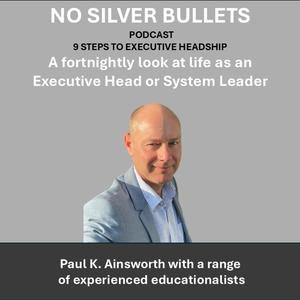
Paul Ainsworth: Those are the wise and measured thoughts of Ben Erskine, the executive principal of Four Seas Mat. In this episode, Ben spoke about how his trust is starting to develop elements for shared curriculum as step four of the nine steps to executive headship. This episode was recorded in December 2025 prior to the publication of the white paper. please like, subscribe and share this episode with colleague. Now let's listen to more of Ben's advice. Hello everybody, I'm Paul K Ainsworth and welcome to the No Silver Bullets podcast. And in this series we are focusing on the nine steps to executive headship. I'm delighted to be joined by Ben Erskine who's the executive principal at the Four C's Mat. This is a trust of seven academies, four primary schools and three secondary schools located in Peterborough. And I know Ben will explain later in the conversation about his role and the schools within the mat. Ben is also writing a
Ben: Okay. Okay.
Paul Ainsworth: writing a book, building on his leadership blogs. So I look forward to seeing that later in the summer when he finishes that. So hi Ben.
Ben: Hi Paul
Paul Ainsworth: So today we're going to focus our conversation on step five, which is developing a curriculum. And this is so often a beginning for executive principals and executive heads. What does curriculum look like across a group of schools? So Ben, let's jump in. If we think about developing a curriculum as an executive principal across your four primary schools, what's your vision and where would you like to get to?
Ben: Okay.
Paul Ainsworth: And maybe what are the benefits of this to your schools as well?
Ben: Yes, great. Thank you. Thank you for having me as well. So my vision for the curriculum is one that guarantees quality and equity, sort of removing the professional agency. We have that debate a lot around the autonomy versus alignment of what we ask or expect of teachers. So like you said, the context is we've got four primary schools within the trust, all of which have varying contexts. And as a trust, we don't have a curriculum that all schools use. Schools have autonomy to make their own decisions. Obviously, we would step in if things weren't going so well, but we don't currently have that. got four very good primary schools within the trust who are doing well. So I do recognise the power of a common curriculum, which is where we're coming from here. started to do some work across the trust, sort of where collaboration has naturally started and how I can support schools with that. I mean, one example of that in terms of writing, of schools, as you know, struggle with writing and it's one of those areas that we're always talking about. I've put together a small working party from leaders across the different primary schools. and they're going to be having a look at writing development, know, researching, visiting schools, bringing the best ideas together and developing something that schools in the trust can use if they wish to, rather than each school going through that process individually, bringing the leaders together to create more of a powerful group to work on something together. So you ask the starting point, where would I like to get to? I'd love to get to the point in the future where we have a full curriculum for the Trust. One that schools can pick into, choose from, different stages to the curriculum within the different subjects. how much that would take into consideration schools choices, how much autonomy they want to give staff in terms of planning, delivery, et cetera. that's where we'd like to get to. I do think there is a place for high level expertise when it comes to the sequencing of knowledge and progression of knowledge, the coherence of the curriculum, the breadth and depth of the curriculum. I've been really fortunate to work with Chris Such. He worked with us at Fullbridge for a couple of years and a lot of the knowledge in terms of the curriculum sequencing he developed in his time there for some subjects around science, geography, history. Looked at reading obviously with us because he's an absolute expert in that. I think there's a higher level expertise when it comes to that curriculum progression, knowledge sequencing. And I guess where teachers then take over is how do we take that knowledge and how is that then delivered to the children in the classroom? So that's something I've considered a lot and taken into consideration autonomy and alignment and schools wanting to have their own choice around that. head teachers wanting to have their own decisions around around those elements. So I've sort of put together three stages, one which is which is from taking the knowledge, the sequence of knowledge and saying, right, this lesson 123, etc. And how do I deliver that? Is that through PowerPoint? Is that through, you know, what whatever that method may be to supportive elements of the curriculum around texts, around etymology, around morphology, which is already pre-prepared for you to pick up and use, like a lot of schemes out there have, to a more direct instruction model. elements of the lesson being more scripted, modelled, worked examples given to teachers, you know, key points for checks for listening and checks for understanding that type of support for the curriculum as well. there's levels of autonomy and alignment within that that you can, you don't have to pick up and use the lot, but you can. And I think, know, there's huge benefits to that collaboration, you know, creating an offer that has a great impact on a wider set of students, not only from your school, but but in other schools and that power of collaborative CPD coaching support that you can develop across schools. And I think if we're really serious about that equity offer, then the quality of what a child learns in year four history, for example, shouldn't depend on what school they go to or what teacher they have at the time. I think that that's where I do sway more towards giving more support is a positive thing. So yeah. I think there's huge benefits. There's the benefits to the wider workload question. A teacher's job isn't easy as we know. There's never enough time to do anything in the job, especially as much as we'd like to. You know, the amount of thought we give to certain subjects around core subjects is given a higher weighting to other subjects. So I think that does come into consideration a lot around around how much is given to teachers as part of a curriculum offer. But I do think, you know, the majority of the time, we want, we do want to give as much support as we can to teachers and teachers will have their own expertise, especially in primary around some subjects, they will feel more comfortable, more and stronger within and other subjects they won't say. And it's looking at that it's looking at the support it's looking at, you know, even if you go to a more prescriptive curriculum or even scripted lesson. The teacher still has their own autonomy. still, know, someone said to me once, it's if you give the same script to two different actors, you'll get a very different, show, a very different response. So, yeah, they've still got to use their adaptive teaching, AFL support for the students within the lesson. So that's where I am at the moment. And it's at the beginnings, but it's looking positive.
Paul Ainsworth: So many interesting thoughts in there and I think that really highlighting maybe that difference between primary and secondary in terms of subject specialism that comes through. I also think what leads on really nicely to the next question is almost the role of the executive principal in terms of how does that shape developing a curriculum and in your case over four effective schools and that's also part of that balance. So tell us a little bit more about your role as executive principal. And how do you think that differs from other executive head roles, maybe, you know, kind of looking after four schools rather than being directly head teacher of two schools,
Ben: Yeah, so we're, as you said at the beginning, we're a trust of seven schools, four primaries, three secondaries. So it's a small medium sized trust, some very large ones out there and there are some smaller ones out there. We don't have a huge central team. I work alongside the CEO and CFO. We have a trust, Senco, early years lead, and then the other side of it in terms of finance support, HR, sites, health and safety and all those other things that we. we deal with in these roles. My role is leading on teaching and learning. It's curriculum assessment and looking at safeguarding as well across primaries and secondaries and I line manage the primary head teachers. So it's a varying role. And I guess it's a bit like a senior leader in a smaller school where you naturally don't have as many leaders to pick up and work across different responsibilities. So how is it different? I mean, I've visited lots of schools and seen lots of different ways of working and some trusts have their set common curriculum that all schools just follow if you decide to be part of the trust. Bigger trusts obviously have bigger teams, responsibilities are shared out like I just referred to. And I guess some... in bigger trusts may not be in the schools with the same level of relationship and how well you know the schools. That is one of the benefits, I guess, of being a smaller trust is with seven schools, I get to be in the schools often, you know, and I get to see the leaders and work with them often. So I guess it's a different oversight in terms of how it works in small trust to a big trust or a trust where things are more aligned. Our alignment within our trust is more around the other elements of HR and finance and support there so that head teachers can focus on the teaching and learning, the curriculum, the support and the coaching within their schools. How does it work differently? Moving from being a head teacher to an executive principal? you referred earlier around the system leadership. I think it's that scale of impact and moving from a head to an executive principal, you're moving further away from the classroom where we all started And I do miss that day-to-day interaction with staff, with children, getting to know the families and getting to know the children's and know, personalities and all of that, you know, that's where we all started as a teacher working with the class and there's real reward in all of that. I guess the reward comes in this role from seeing the heads and the leaders thrive and do well in their jobs because of the way they're supported and the way we work with them. So... going from running the school to supporting heads to running their schools and working more with more leaders and not so much with teachers. I've been creating online and in-person, you know, CPD support so that we can have that sort of evidence-informed approach to everything that we do. around leadership, around curriculum, teaching and learning, safeguarding and those type of things. So I feel it's that next step towards supporting even more strategically and thinking about what do the heads and the leadership teams of the schools needs to enable them to do their job the best that they can do.
Paul Ainsworth: It is interesting, isn't it, about what are the rewards for system leaders or executive heads? know, that kind of reward that we would have received when we were head teacher of seeing that pupil really develop or that member of staff really develop. And I think you're right. The reward becomes seeing how our leadership teams develop and how our teachers develop more. And that's what you're trying to gather. So just tell me a little bit about those four schools, those four academies that you lead. I know a little bit about Peterborough but a lot of our listeners might not. So what are the scale of those schools? Are big, small? I'm imagining they're urban. But yeah, just tell us a little bit then about the schools.
Ben: Yeah, so across our schools, we've got a varying range of schools. Fullbridge is a very large primary with four-form entry in a more inner city, high levels of socioeconomic deprivation, et cetera. So a lot of challenges around that. We've got Hampton Vale, who are a school to the south of the city. They're within a very rapidly growing township of Hampton. So it is within Peterborough, but it's sort of its own township on its own, which has its own challenges. Discovery Primary Academy is a two-form entry school. So just outside the city centre, but in quite a challenging area. in terms of the community it serves with high mobility and challenges, those sorts of challenges. And then Manor Drive Primary, so we've got Manor Drive Primary and Manor Drive Secondary. Now they came into the trust through the free school process. having the experience of growing a school from reception up, so it started just with reception and slowly grown. We have jumped slightly to support the local authority in needing additional numbers. So as you can see, sort of quite a range of, we're not just all inner city schools or all, know, sat in the villages on the outskirts. There's a range of schools and experiences and contexts that we work with.
Paul Ainsworth: Peterborough is a really fascinating city, isn't it, in terms of how it's developing and the education provision in that city.
Ben: Yeah, it really is. There are a lot of challenges around that, then it's making those challenges your challenge, I guess, and really how do we develop and how do we work with those schools? And I think what really matters is that these schools, they do serve different communities, which is exactly why this curriculum question is so complex. How much does the schools... context to play a part on the sequencing and choices of your curriculum. So a lot of those questions we do think about and challenge ourselves with in terms of our thinking. So yeah, that's us really, along with the three secondary schools as well.
Paul Ainsworth: Why did the executive principal model develop? You've been in post for two years now, haven't you, I believe. So what was the catalyst
Ben: that.
Paul Ainsworth: for bringing that role in? Was that the right number of schools that then needed that oversight? Because you obviously had teacher of that largest primary school not too long ago. So why did the model evolve then?
Ben: So the trust started with Fullbridge where I was head and Arthur Mello's secondary school. And we came together to create the trust. over time, so Mike, our CEO was head at Arthur Mello's. Over time, as we've slowly grown, there's just been a need for more primary support with his secondary background. And it's been... really interesting over the last couple of years for me personally because I've managed, I'm now working with the secondary schools as well, which, you know, in terms of my knowledge base, that's been really important for me. And I've learnt a lot that I can bring into primary as well. So the team has grown as the trust has grown, I guess, and it's been developed based on the needs of the school. As we know, across nationally, send is a big important area that needs a real focus alongside early years and early intervention. So that's where those two roles sort of developed from. And most of our central team, being a smaller trust, will work part of the week within their own school and part of the week within the trust in terms of just trying to keep those costs to a minimum that schools pay. as part of their top slice. So yeah, I guess a good example of that in more recent times has been that our secondary, free school is getting to the point where in the next couple of years it will get through to year 11. There's no six form provision going to be on site. It wasn't part of the plans. But the other two six... secondary schools do have a sixth form. So we've brought a role into the trust where we've got someone having a look at how we could create an offer across all three secondary schools, which becomes a more trust-based sixth form, even though it's based in the two schools, but it gives the students a wider offer. So the need for that has come up and we've developed a role that we'll be able to support that moving forwards. my role has grown from supporting the secondaries, to supporting the secondaries, from very much supporting the primaries initially and the need for the support in the schools. And I guess part of that catalyst was not only having Discovery join us, but then Hampton Vale. were a school that we sponsored because they didn't do so well in the Rothstedt and they joined the Trust as a sponsored academy and I went over there for the first couple of terms to a year to steady the ship and support and move things forward before we a head teacher into the school. Yeah, it's just been out of need and I initially was a couple of days a week and over time I've moved to a more full-time role in the job as the trust has grown.
Paul Ainsworth: It's really interesting, isn't it? You think of a mat of seven schools and four primaries and three secondary schools, that's a lot of children. But in that
Ben: Hmm.
Paul Ainsworth: senior, in that central team, it's almost like being the senior leader of a small school where you have to do everything because you haven't got the different role holders. So you've got a big organisation, but in some ways you're working as though you're in a very small one because that's what you've got to do. So if we, we. all through your comments, you're kind of peppering with, you know, conversations around the curriculum. But let's just let's just go into that in a little bit deeper so that that step five developing a curriculum. So you've explained your vision in terms of that curriculum, where you'd maybe like to get to that, you know, having a curriculum available that schools could choose how they opted into it, that was designed by specialists and was really high quality. And you've given us some indication of where you've
Ben: Okay.
Paul Ainsworth: got to. But what are the barriers along the way and what do you think are the barriers to having that full suite of curriculum for your currently four primary schools? You never know in a couple of years time it might be six or eight primary schools. What are the
Ben: Hmm.
Paul Ainsworth: barriers to developing that curriculum?
Ben: Yeah, so far we've developed and looked at history, geography, science based on Chris Such's work that he did with us. And that follows that sort of stage offer that I was describing earlier. We at Fullbridge a few years ago appointed a teacher who had applied from a secondary school background who taught RE, so we've used his expertise. in RE there. And like you said earlier, that is the interesting dynamic around teaching in primary compared to the more specialist teaching in a secondary school. So we've put together a really good offer for those subjects. I talked a little bit about the stages and, you know, having that element of autonomy as well as the alignment element and the professional curiosity, the teachers role in that, the adaptive teaching, their judgment around AFL, what do we need to spend more time on, less time on. So that's still part of it. And I guess, you know, direct instruction isn't commonly talked about across schools, even though a lot of our phonics schemes. are very much scripted nowadays within schools. And one of the things Fullbridge has done recently is look at Distar Maths, which is a full direct instruction scheme. And they're using that within reception at the moment and really starting to see some huge benefits to it as well. And I guess I've just become a bit more comfortable saying that, you know, in most contexts, being explicit and even scripted sometimes. is not a weakness, it's more of an equity move. It's what's best for all. And we're seeing that come through the new Ofsted framework. We started a conversation online around the work we did with the pilot in Ofsted and their real push on inclusion and equity and support for all. So I guess what are the challenges? I think... Because of the way we run as a trust and schools do have that autonomy around teaching and learning and curriculum, this isn't something they have to use or are going to be enforced to use. It's a choice. We don't have so many challenges in those areas. Where do we have challenges? I think we do have challenges around time. We're always challenged with time. the capacity, the... I talked earlier about the efficient use of time. So we are all looking at writing, for example. We could look at that in our individual schools and we could spend, you know, create a little working party as quite often schools do to look at developments within curriculum. They could do that within their schools, but there is a real power to bring in people together across the schools. But then that does bring the barrier and the challenge around when do they come together, know, releasing them to do this work and prioritizing the work. you know, there is a benefit to that. schools are busy places, as we know, and time is precious. And there's lots of other things to be doing as senior leaders in schools. But I do think around the curriculum, we don't want to be chasing initiatives. We don't want to be pushing ourselves into making those decisions because we don't have time and don't prioritize time for this. We want to be deliberately sequencing our priorities and saying, what is next, making an action plan for the future. So for example, with the writing group, are... They're making a couple of visits to other schools in the new year. And then we'll put an action plan together moving forwards for them to look at that as a project across the trust. So what are the challenges? I think other barriers and other challenges, it brings us onto the topic of workload. you know, as an executive principal, I workload becomes a moral issue. It's something that we need to make work. We need to support and serve and help our leaders and help create time for these important things, know, protect that time, work with leaders about how we do protect that time. So I do think in the future, I feel collaborating on projects is going to become I mean, I can't see the budgets getting much better as we move forwards at the moment, if anything tighter. So I do think that collaboration does become even more important so that we can release up time within individual schools to be doing those other things, while some senior leaders are working collaboratively across schools, working on something, like I said, they would have been working on in their individual school, but are now developing across across multiple schools.
Paul Ainsworth: I really like the way that you're kind of talking about those barriers, Ben, but you're also giving us the concrete solutions to those. You so you're saying time's an issue, so let's get specialists working on those, let's free up people to do that. You know, if we work together across our schools, that's going to benefit us. So you must have learned so much over this last two years about, you know, developing that curriculum. know and you've given a really good example of your writing curriculum and how you've worked on that. So what advice would you give to another executive head if they were starting from scratch, you know, were in your position, you know, for good, and I think it's important to say for good schools, I think that's one of the things about that isn't it, for effective schools. How would you advise them? What would your advice be, you know, in this kind of work of developing curriculum across a group of schools?
Ben: Yeah, I I think I'd start by saying that headteachers obviously are understandably protective over their curriculum and choices that they've made so far. And I completely understand that, you know, I was in that position not so long ago. I think making it a choice to be part of it, working collaboratively to research, develop, to cross leaders in different schools and empowering them. you know, trusting them to see the project through, just supporting, listening where you need to is really important. And this would look different in different trusts that have a set curriculum. We don't. We want a curriculum that's an offer, a really strong curriculum that's an offer. It's not a sort of choice where the... It's not a trust where it's a choice whether you follow it or not. It's an equitable offer that all schools can pick into if they want to. But if they've got something that's really working within a particular subject or across a couple of subjects, then yeah, continue with that because that may well be the best thing for the children in the school. In terms of the way in which we work, I've learned that pace does matter. Moving too fast can risk trust. Moving too slowly risks that momentum and keeping things ticking and keeping things going. I think it's a hard balance to strike with that consideration around time and workload, but also what's best for children at the end of the day. I do believe in, I do believe sharing the benefits of trust-wide work is really important because like I've said, schools are busy. we should protect time to stick our heads outside our own four walls and say what's going on, you know, not only across your own trust, but out in other schools as well. So things like shared CPD would become an even more positive, powerful element of a shared curriculum or a shared phonics scheme or whatever that may be. The purposeful curriculum discussions that you can develop and leadership opportunities, you know, We've now got leaders who are having the opportunity to develop curriculum across multiple schools, you know, and that's a really good development for them as a leader to be thinking widely like that and understanding the context of the other schools. So I think there's lots of benefits, lots of benefits, but also lots of potential for staff development as well and opportunities for staff when you work in this sort of more strategic collaborative way.
Paul Ainsworth: And that pace aspect is so important, isn't it? How often do we see executive heads and system leaders misjudging the pace? Because you're not in that school all the time, are you? You're walking into that school and trying to work out what is the right pace that we need to work at to keep my leaders with me whilst also making sure that the children get the very best. It's a real
Ben: Yeah.
Paul Ainsworth: challenge, isn't it? So is there any other general advice you give to a new or aspiring executive head teacher? You know, you've talked... There are some really sage advice in developing that curriculum and also many things that could go wider. But is there anything else that you'd add then to somebody who's thinking about it or
Ben: .
Paul Ainsworth: maybe that's their next post?
Ben: Yeah, I mean, I think you touched on it there in terms of eluded to it in a way. Well, I thought you did anyway around we can't micromanage, we shouldn't micromanage. You know, this is about trusting and empowering others and developing people. And I think it comes back to really thinking about how you lead as a person, you know, what type of leader you are, is it different types of is a different type of leadership position, executive principle to a headship. But I don't feel my style of leadership has changed in terms of for me, you the best way is a servant leadership approach where, you know, you're authentic. It's about service before yourself. It's about listening. It's about showing empathy and humility in all that you do. It's about empowering others like we've talked about in terms of giving them the responsibility, giving them that accountability and. listening to them, trusting them, trusting them to do the job and create that sense of togetherness of a bigger entity than your own school and seeing the power in that. So working more trust wide on certain elements of the role, which sometimes in schools can feel like it's the head teacher's job, but it's not. We are all part of a greater entity and as leaders. senior leaders and middle leaders, curriculum subject leaders, they should feel part of that as well. I feel like this move to collaborate as a leader, creating that opportunity for collaboration does have benefits there. I think you've got to get comfortable with leading through influence, not authority. not that I did as a head teacher lead through authority, but you can have a wider influence as an executive principal. I think the advice would be get to know the schools, get to know the communities. What are they proud of? What do they want to improve? How can you share that practice? Share practice outside the trust, but also more importantly, learn from all the really good practice within your trust and share that and get get collaboration around those elements of the support that you can offer and celebrate what is going well in certain curriculum areas and look to share that. And other schools may then decide to adopt that practice if they wish to. But I think that's a really important element of that identity, of the sort of wider entity of a trust rather than just a school.
Paul Ainsworth: Yeah, really, really sage points again, you collaboration. How do you get your leaders to collaborate together? Servant leadership. Yeah. And I like the idea that influencing you are influencing. think sometimes we underestimate our power when we are head teachers. And even though we don't think we're leading with authority, it's there, isn't it, in the background sometimes. So what are the next steps for you and your trust? Are there some more schools looking at joining or? you know, is it kind of working really well with those four schools that you've got at the moment?
Ben: Yeah, I guess a bit of both really. I mean, we're always open to schools coming and joining and being more collaborative, being collaborative with other schools. And we are collaborative with other schools anyway. It's not just, know, just because you're not in the Trust, it doesn't mean that we're not happy to work with other schools. So developing that curriculum offer further again from within, but using the expertise of lots of other people and trusts and schools out there that are doing a really good job of it. One of the things I've been looking at is how we can develop further our instructional coaching work. So developing that across the schools, that common teaching and learning toolkit offer the inclusive teaching element of what we do. So creating more shared opportunities for CPD around curriculum and teaching and learning. I think when people hear sort of common curriculum, they often hear loss of autonomy, which we've referred to a lot. And I do understand that. But for me, autonomy sits in how we teach and how we respond to the students and the pupils, not always reinventing that, the knowledge base every time. And I think developing a curriculum that isn't about control. or consistency for its own sake, it's about making sure every child in every school gets access to the very best thinking that we can offer. And that as leaders is what we want to do. We want to make that possible by working together. You know, a good curriculum doesn't just happen by chance. It happens when leaders choose to collaborate. It's that clarity and it's that service over ego, I guess. looking wider than your own school about how you can develop as leaders, but how we can develop a curriculum as well for all students and have that wider impact.
Paul Ainsworth: so insightful. Good schools don't happen by accident, they don't happen by chance, they happen because the leaders that work within them. Thanks so much Ben for sharing your thoughts on step five and developing a curriculum of the nine steps to executive headship. I'm really grateful for your time and I'm really looking forward to listening back to what you've said today.
Ben: Thank you, thank you very much for having me and good luck with the podcast and the book.
Paul Ainsworth: Those are the wise and measured thoughts of Ben Erskine, the executive principal of Four Seas Mat. In this episode, Ben spoke about how his trust is starting to develop elements for shared curriculum as step four of the nine steps to executive headship. This episode was recorded in December 2025 prior to the publication of the white paper. please like, subscribe and share this episode with colleague. Now let's listen to more of Ben's advice. Hello everybody, I'm Paul K Ainsworth and welcome to the No Silver Bullets podcast. And in this series we are focusing on the nine steps to executive headship. I'm delighted to be joined by Ben Erskine who's the executive principal at the Four C's Mat. This is a trust of seven academies, four primary schools and three secondary schools located in Peterborough. And I know Ben will explain later in the conversation about his role and the schools within the mat. Ben is also writing a
Ben: Okay. Okay.
Paul Ainsworth: writing a book, building on his leadership blogs. So I look forward to seeing that later in the summer when he finishes that. So hi Ben.
Ben: Hi Paul
Paul Ainsworth: So today we're going to focus our conversation on step five, which is developing a curriculum. And this is so often a beginning for executive principals and executive heads. What does curriculum look like across a group of schools? So Ben, let's jump in. If we think about developing a curriculum as an executive principal across your four primary schools, what's your vision and where would you like to get to?
Ben: Okay.
Paul Ainsworth: And maybe what are the benefits of this to your schools as well?
Ben: Yes, great. Thank you. Thank you for having me as well. So my vision for the curriculum is one that guarantees quality and equity, sort of removing the professional agency. We have that debate a lot around the autonomy versus alignment of what we ask or expect of teachers. So like you said, the context is we've got four primary schools within the trust, all of which have varying contexts. And as a trust, we don't have a curriculum that all schools use. Schools have autonomy to make their own decisions. Obviously, we would step in if things weren't going so well, but we don't currently have that. got four very good primary schools within the trust who are doing well. So I do recognise the power of a common curriculum, which is where we're coming from here. started to do some work across the trust, sort of where collaboration has naturally started and how I can support schools with that. I mean, one example of that in terms of writing, of schools, as you know, struggle with writing and it's one of those areas that we're always talking about. I've put together a small working party from leaders across the different primary schools. and they're going to be having a look at writing development, know, researching, visiting schools, bringing the best ideas together and developing something that schools in the trust can use if they wish to, rather than each school going through that process individually, bringing the leaders together to create more of a powerful group to work on something together. So you ask the starting point, where would I like to get to? I'd love to get to the point in the future where we have a full curriculum for the Trust. One that schools can pick into, choose from, different stages to the curriculum within the different subjects. how much that would take into consideration schools choices, how much autonomy they want to give staff in terms of planning, delivery, et cetera. that's where we'd like to get to. I do think there is a place for high level expertise when it comes to the sequencing of knowledge and progression of knowledge, the coherence of the curriculum, the breadth and depth of the curriculum. I've been really fortunate to work with Chris Such. He worked with us at Fullbridge for a couple of years and a lot of the knowledge in terms of the curriculum sequencing he developed in his time there for some subjects around science, geography, history. Looked at reading obviously with us because he's an absolute expert in that. I think there's a higher level expertise when it comes to that curriculum progression, knowledge sequencing. And I guess where teachers then take over is how do we take that knowledge and how is that then delivered to the children in the classroom? So that's something I've considered a lot and taken into consideration autonomy and alignment and schools wanting to have their own choice around that. head teachers wanting to have their own decisions around around those elements. So I've sort of put together three stages, one which is which is from taking the knowledge, the sequence of knowledge and saying, right, this lesson 123, etc. And how do I deliver that? Is that through PowerPoint? Is that through, you know, what whatever that method may be to supportive elements of the curriculum around texts, around etymology, around morphology, which is already pre-prepared for you to pick up and use, like a lot of schemes out there have, to a more direct instruction model. elements of the lesson being more scripted, modelled, worked examples given to teachers, you know, key points for checks for listening and checks for understanding that type of support for the curriculum as well. there's levels of autonomy and alignment within that that you can, you don't have to pick up and use the lot, but you can. And I think, know, there's huge benefits to that collaboration, you know, creating an offer that has a great impact on a wider set of students, not only from your school, but but in other schools and that power of collaborative CPD coaching support that you can develop across schools. And I think if we're really serious about that equity offer, then the quality of what a child learns in year four history, for example, shouldn't depend on what school they go to or what teacher they have at the time. I think that that's where I do sway more towards giving more support is a positive thing. So yeah. I think there's huge benefits. There's the benefits to the wider workload question. A teacher's job isn't easy as we know. There's never enough time to do anything in the job, especially as much as we'd like to. You know, the amount of thought we give to certain subjects around core subjects is given a higher weighting to other subjects. So I think that does come into consideration a lot around around how much is given to teachers as part of a curriculum offer. But I do think, you know, the majority of the time, we want, we do want to give as much support as we can to teachers and teachers will have their own expertise, especially in primary around some subjects, they will feel more comfortable, more and stronger within and other subjects they won't say. And it's looking at that it's looking at the support it's looking at, you know, even if you go to a more prescriptive curriculum or even scripted lesson. The teacher still has their own autonomy. still, know, someone said to me once, it's if you give the same script to two different actors, you'll get a very different, show, a very different response. So, yeah, they've still got to use their adaptive teaching, AFL support for the students within the lesson. So that's where I am at the moment. And it's at the beginnings, but it's looking positive.
Paul Ainsworth: So many interesting thoughts in there and I think that really highlighting maybe that difference between primary and secondary in terms of subject specialism that comes through. I also think what leads on really nicely to the next question is almost the role of the executive principal in terms of how does that shape developing a curriculum and in your case over four effective schools and that's also part of that balance. So tell us a little bit more about your role as executive principal. And how do you think that differs from other executive head roles, maybe, you know, kind of looking after four schools rather than being directly head teacher of two schools,
Ben: Yeah, so we're, as you said at the beginning, we're a trust of seven schools, four primaries, three secondaries. So it's a small medium sized trust, some very large ones out there and there are some smaller ones out there. We don't have a huge central team. I work alongside the CEO and CFO. We have a trust, Senco, early years lead, and then the other side of it in terms of finance support, HR, sites, health and safety and all those other things that we. we deal with in these roles. My role is leading on teaching and learning. It's curriculum assessment and looking at safeguarding as well across primaries and secondaries and I line manage the primary head teachers. So it's a varying role. And I guess it's a bit like a senior leader in a smaller school where you naturally don't have as many leaders to pick up and work across different responsibilities. So how is it different? I mean, I've visited lots of schools and seen lots of different ways of working and some trusts have their set common curriculum that all schools just follow if you decide to be part of the trust. Bigger trusts obviously have bigger teams, responsibilities are shared out like I just referred to. And I guess some... in bigger trusts may not be in the schools with the same level of relationship and how well you know the schools. That is one of the benefits, I guess, of being a smaller trust is with seven schools, I get to be in the schools often, you know, and I get to see the leaders and work with them often. So I guess it's a different oversight in terms of how it works in small trust to a big trust or a trust where things are more aligned. Our alignment within our trust is more around the other elements of HR and finance and support there so that head teachers can focus on the teaching and learning, the curriculum, the support and the coaching within their schools. How does it work differently? Moving from being a head teacher to an executive principal? you referred earlier around the system leadership. I think it's that scale of impact and moving from a head to an executive principal, you're moving further away from the classroom where we all started And I do miss that day-to-day interaction with staff, with children, getting to know the families and getting to know the children's and know, personalities and all of that, you know, that's where we all started as a teacher working with the class and there's real reward in all of that. I guess the reward comes in this role from seeing the heads and the leaders thrive and do well in their jobs because of the way they're supported and the way we work with them. So... going from running the school to supporting heads to running their schools and working more with more leaders and not so much with teachers. I've been creating online and in-person, you know, CPD support so that we can have that sort of evidence-informed approach to everything that we do. around leadership, around curriculum, teaching and learning, safeguarding and those type of things. So I feel it's that next step towards supporting even more strategically and thinking about what do the heads and the leadership teams of the schools needs to enable them to do their job the best that they can do.
Paul Ainsworth: It is interesting, isn't it, about what are the rewards for system leaders or executive heads? know, that kind of reward that we would have received when we were head teacher of seeing that pupil really develop or that member of staff really develop. And I think you're right. The reward becomes seeing how our leadership teams develop and how our teachers develop more. And that's what you're trying to gather. So just tell me a little bit about those four schools, those four academies that you lead. I know a little bit about Peterborough but a lot of our listeners might not. So what are the scale of those schools? Are big, small? I'm imagining they're urban. But yeah, just tell us a little bit then about the schools.
Ben: Yeah, so across our schools, we've got a varying range of schools. Fullbridge is a very large primary with four-form entry in a more inner city, high levels of socioeconomic deprivation, et cetera. So a lot of challenges around that. We've got Hampton Vale, who are a school to the south of the city. They're within a very rapidly growing township of Hampton. So it is within Peterborough, but it's sort of its own township on its own, which has its own challenges. Discovery Primary Academy is a two-form entry school. So just outside the city centre, but in quite a challenging area. in terms of the community it serves with high mobility and challenges, those sorts of challenges. And then Manor Drive Primary, so we've got Manor Drive Primary and Manor Drive Secondary. Now they came into the trust through the free school process. having the experience of growing a school from reception up, so it started just with reception and slowly grown. We have jumped slightly to support the local authority in needing additional numbers. So as you can see, sort of quite a range of, we're not just all inner city schools or all, know, sat in the villages on the outskirts. There's a range of schools and experiences and contexts that we work with.
Paul Ainsworth: Peterborough is a really fascinating city, isn't it, in terms of how it's developing and the education provision in that city.
Ben: Yeah, it really is. There are a lot of challenges around that, then it's making those challenges your challenge, I guess, and really how do we develop and how do we work with those schools? And I think what really matters is that these schools, they do serve different communities, which is exactly why this curriculum question is so complex. How much does the schools... context to play a part on the sequencing and choices of your curriculum. So a lot of those questions we do think about and challenge ourselves with in terms of our thinking. So yeah, that's us really, along with the three secondary schools as well.
Paul Ainsworth: Why did the executive principal model develop? You've been in post for two years now, haven't you, I believe. So what was the catalyst
Ben: that.
Paul Ainsworth: for bringing that role in? Was that the right number of schools that then needed that oversight? Because you obviously had teacher of that largest primary school not too long ago. So why did the model evolve then?
Ben: So the trust started with Fullbridge where I was head and Arthur Mello's secondary school. And we came together to create the trust. over time, so Mike, our CEO was head at Arthur Mello's. Over time, as we've slowly grown, there's just been a need for more primary support with his secondary background. And it's been... really interesting over the last couple of years for me personally because I've managed, I'm now working with the secondary schools as well, which, you know, in terms of my knowledge base, that's been really important for me. And I've learnt a lot that I can bring into primary as well. So the team has grown as the trust has grown, I guess, and it's been developed based on the needs of the school. As we know, across nationally, send is a big important area that needs a real focus alongside early years and early intervention. So that's where those two roles sort of developed from. And most of our central team, being a smaller trust, will work part of the week within their own school and part of the week within the trust in terms of just trying to keep those costs to a minimum that schools pay. as part of their top slice. So yeah, I guess a good example of that in more recent times has been that our secondary, free school is getting to the point where in the next couple of years it will get through to year 11. There's no six form provision going to be on site. It wasn't part of the plans. But the other two six... secondary schools do have a sixth form. So we've brought a role into the trust where we've got someone having a look at how we could create an offer across all three secondary schools, which becomes a more trust-based sixth form, even though it's based in the two schools, but it gives the students a wider offer. So the need for that has come up and we've developed a role that we'll be able to support that moving forwards. my role has grown from supporting the secondaries, to supporting the secondaries, from very much supporting the primaries initially and the need for the support in the schools. And I guess part of that catalyst was not only having Discovery join us, but then Hampton Vale. were a school that we sponsored because they didn't do so well in the Rothstedt and they joined the Trust as a sponsored academy and I went over there for the first couple of terms to a year to steady the ship and support and move things forward before we a head teacher into the school. Yeah, it's just been out of need and I initially was a couple of days a week and over time I've moved to a more full-time role in the job as the trust has grown.
Paul Ainsworth: It's really interesting, isn't it? You think of a mat of seven schools and four primaries and three secondary schools, that's a lot of children. But in that
Ben: Hmm.
Paul Ainsworth: senior, in that central team, it's almost like being the senior leader of a small school where you have to do everything because you haven't got the different role holders. So you've got a big organisation, but in some ways you're working as though you're in a very small one because that's what you've got to do. So if we, we. all through your comments, you're kind of peppering with, you know, conversations around the curriculum. But let's just let's just go into that in a little bit deeper so that that step five developing a curriculum. So you've explained your vision in terms of that curriculum, where you'd maybe like to get to that, you know, having a curriculum available that schools could choose how they opted into it, that was designed by specialists and was really high quality. And you've given us some indication of where you've
Ben: Okay.
Paul Ainsworth: got to. But what are the barriers along the way and what do you think are the barriers to having that full suite of curriculum for your currently four primary schools? You never know in a couple of years time it might be six or eight primary schools. What are the
Ben: Hmm.
Paul Ainsworth: barriers to developing that curriculum?
Ben: Yeah, so far we've developed and looked at history, geography, science based on Chris Such's work that he did with us. And that follows that sort of stage offer that I was describing earlier. We at Fullbridge a few years ago appointed a teacher who had applied from a secondary school background who taught RE, so we've used his expertise. in RE there. And like you said earlier, that is the interesting dynamic around teaching in primary compared to the more specialist teaching in a secondary school. So we've put together a really good offer for those subjects. I talked a little bit about the stages and, you know, having that element of autonomy as well as the alignment element and the professional curiosity, the teachers role in that, the adaptive teaching, their judgment around AFL, what do we need to spend more time on, less time on. So that's still part of it. And I guess, you know, direct instruction isn't commonly talked about across schools, even though a lot of our phonics schemes. are very much scripted nowadays within schools. And one of the things Fullbridge has done recently is look at Distar Maths, which is a full direct instruction scheme. And they're using that within reception at the moment and really starting to see some huge benefits to it as well. And I guess I've just become a bit more comfortable saying that, you know, in most contexts, being explicit and even scripted sometimes. is not a weakness, it's more of an equity move. It's what's best for all. And we're seeing that come through the new Ofsted framework. We started a conversation online around the work we did with the pilot in Ofsted and their real push on inclusion and equity and support for all. So I guess what are the challenges? I think... Because of the way we run as a trust and schools do have that autonomy around teaching and learning and curriculum, this isn't something they have to use or are going to be enforced to use. It's a choice. We don't have so many challenges in those areas. Where do we have challenges? I think we do have challenges around time. We're always challenged with time. the capacity, the... I talked earlier about the efficient use of time. So we are all looking at writing, for example. We could look at that in our individual schools and we could spend, you know, create a little working party as quite often schools do to look at developments within curriculum. They could do that within their schools, but there is a real power to bring in people together across the schools. But then that does bring the barrier and the challenge around when do they come together, know, releasing them to do this work and prioritizing the work. you know, there is a benefit to that. schools are busy places, as we know, and time is precious. And there's lots of other things to be doing as senior leaders in schools. But I do think around the curriculum, we don't want to be chasing initiatives. We don't want to be pushing ourselves into making those decisions because we don't have time and don't prioritize time for this. We want to be deliberately sequencing our priorities and saying, what is next, making an action plan for the future. So for example, with the writing group, are... They're making a couple of visits to other schools in the new year. And then we'll put an action plan together moving forwards for them to look at that as a project across the trust. So what are the challenges? I think other barriers and other challenges, it brings us onto the topic of workload. you know, as an executive principal, I workload becomes a moral issue. It's something that we need to make work. We need to support and serve and help our leaders and help create time for these important things, know, protect that time, work with leaders about how we do protect that time. So I do think in the future, I feel collaborating on projects is going to become I mean, I can't see the budgets getting much better as we move forwards at the moment, if anything tighter. So I do think that collaboration does become even more important so that we can release up time within individual schools to be doing those other things, while some senior leaders are working collaboratively across schools, working on something, like I said, they would have been working on in their individual school, but are now developing across across multiple schools.
Paul Ainsworth: I really like the way that you're kind of talking about those barriers, Ben, but you're also giving us the concrete solutions to those. You so you're saying time's an issue, so let's get specialists working on those, let's free up people to do that. You know, if we work together across our schools, that's going to benefit us. So you must have learned so much over this last two years about, you know, developing that curriculum. know and you've given a really good example of your writing curriculum and how you've worked on that. So what advice would you give to another executive head if they were starting from scratch, you know, were in your position, you know, for good, and I think it's important to say for good schools, I think that's one of the things about that isn't it, for effective schools. How would you advise them? What would your advice be, you know, in this kind of work of developing curriculum across a group of schools?
Ben: Yeah, I I think I'd start by saying that headteachers obviously are understandably protective over their curriculum and choices that they've made so far. And I completely understand that, you know, I was in that position not so long ago. I think making it a choice to be part of it, working collaboratively to research, develop, to cross leaders in different schools and empowering them. you know, trusting them to see the project through, just supporting, listening where you need to is really important. And this would look different in different trusts that have a set curriculum. We don't. We want a curriculum that's an offer, a really strong curriculum that's an offer. It's not a sort of choice where the... It's not a trust where it's a choice whether you follow it or not. It's an equitable offer that all schools can pick into if they want to. But if they've got something that's really working within a particular subject or across a couple of subjects, then yeah, continue with that because that may well be the best thing for the children in the school. In terms of the way in which we work, I've learned that pace does matter. Moving too fast can risk trust. Moving too slowly risks that momentum and keeping things ticking and keeping things going. I think it's a hard balance to strike with that consideration around time and workload, but also what's best for children at the end of the day. I do believe in, I do believe sharing the benefits of trust-wide work is really important because like I've said, schools are busy. we should protect time to stick our heads outside our own four walls and say what's going on, you know, not only across your own trust, but out in other schools as well. So things like shared CPD would become an even more positive, powerful element of a shared curriculum or a shared phonics scheme or whatever that may be. The purposeful curriculum discussions that you can develop and leadership opportunities, you know, We've now got leaders who are having the opportunity to develop curriculum across multiple schools, you know, and that's a really good development for them as a leader to be thinking widely like that and understanding the context of the other schools. So I think there's lots of benefits, lots of benefits, but also lots of potential for staff development as well and opportunities for staff when you work in this sort of more strategic collaborative way.
Paul Ainsworth: And that pace aspect is so important, isn't it? How often do we see executive heads and system leaders misjudging the pace? Because you're not in that school all the time, are you? You're walking into that school and trying to work out what is the right pace that we need to work at to keep my leaders with me whilst also making sure that the children get the very best. It's a real
Ben: Yeah.
Paul Ainsworth: challenge, isn't it? So is there any other general advice you give to a new or aspiring executive head teacher? You know, you've talked... There are some really sage advice in developing that curriculum and also many things that could go wider. But is there anything else that you'd add then to somebody who's thinking about it or
Ben: .
Paul Ainsworth: maybe that's their next post?
Ben: Yeah, I mean, I think you touched on it there in terms of eluded to it in a way. Well, I thought you did anyway around we can't micromanage, we shouldn't micromanage. You know, this is about trusting and empowering others and developing people. And I think it comes back to really thinking about how you lead as a person, you know, what type of leader you are, is it different types of is a different type of leadership position, executive principle to a headship. But I don't feel my style of leadership has changed in terms of for me, you the best way is a servant leadership approach where, you know, you're authentic. It's about service before yourself. It's about listening. It's about showing empathy and humility in all that you do. It's about empowering others like we've talked about in terms of giving them the responsibility, giving them that accountability and. listening to them, trusting them, trusting them to do the job and create that sense of togetherness of a bigger entity than your own school and seeing the power in that. So working more trust wide on certain elements of the role, which sometimes in schools can feel like it's the head teacher's job, but it's not. We are all part of a greater entity and as leaders. senior leaders and middle leaders, curriculum subject leaders, they should feel part of that as well. I feel like this move to collaborate as a leader, creating that opportunity for collaboration does have benefits there. I think you've got to get comfortable with leading through influence, not authority. not that I did as a head teacher lead through authority, but you can have a wider influence as an executive principal. I think the advice would be get to know the schools, get to know the communities. What are they proud of? What do they want to improve? How can you share that practice? Share practice outside the trust, but also more importantly, learn from all the really good practice within your trust and share that and get get collaboration around those elements of the support that you can offer and celebrate what is going well in certain curriculum areas and look to share that. And other schools may then decide to adopt that practice if they wish to. But I think that's a really important element of that identity, of the sort of wider entity of a trust rather than just a school.
Paul Ainsworth: Yeah, really, really sage points again, you collaboration. How do you get your leaders to collaborate together? Servant leadership. Yeah. And I like the idea that influencing you are influencing. think sometimes we underestimate our power when we are head teachers. And even though we don't think we're leading with authority, it's there, isn't it, in the background sometimes. So what are the next steps for you and your trust? Are there some more schools looking at joining or? you know, is it kind of working really well with those four schools that you've got at the moment?
Ben: Yeah, I guess a bit of both really. I mean, we're always open to schools coming and joining and being more collaborative, being collaborative with other schools. And we are collaborative with other schools anyway. It's not just, know, just because you're not in the Trust, it doesn't mean that we're not happy to work with other schools. So developing that curriculum offer further again from within, but using the expertise of lots of other people and trusts and schools out there that are doing a really good job of it. One of the things I've been looking at is how we can develop further our instructional coaching work. So developing that across the schools, that common teaching and learning toolkit offer the inclusive teaching element of what we do. So creating more shared opportunities for CPD around curriculum and teaching and learning. I think when people hear sort of common curriculum, they often hear loss of autonomy, which we've referred to a lot. And I do understand that. But for me, autonomy sits in how we teach and how we respond to the students and the pupils, not always reinventing that, the knowledge base every time. And I think developing a curriculum that isn't about control. or consistency for its own sake, it's about making sure every child in every school gets access to the very best thinking that we can offer. And that as leaders is what we want to do. We want to make that possible by working together. You know, a good curriculum doesn't just happen by chance. It happens when leaders choose to collaborate. It's that clarity and it's that service over ego, I guess. looking wider than your own school about how you can develop as leaders, but how we can develop a curriculum as well for all students and have that wider impact.
Paul Ainsworth: so insightful. Good schools don't happen by accident, they don't happen by chance, they happen because the leaders that work within them. Thanks so much Ben for sharing your thoughts on step five and developing a curriculum of the nine steps to executive headship. I'm really grateful for your time and I'm really looking forward to listening back to what you've said today.
Ben: Thank you, thank you very much for having me and good luck with the podcast and the book.
