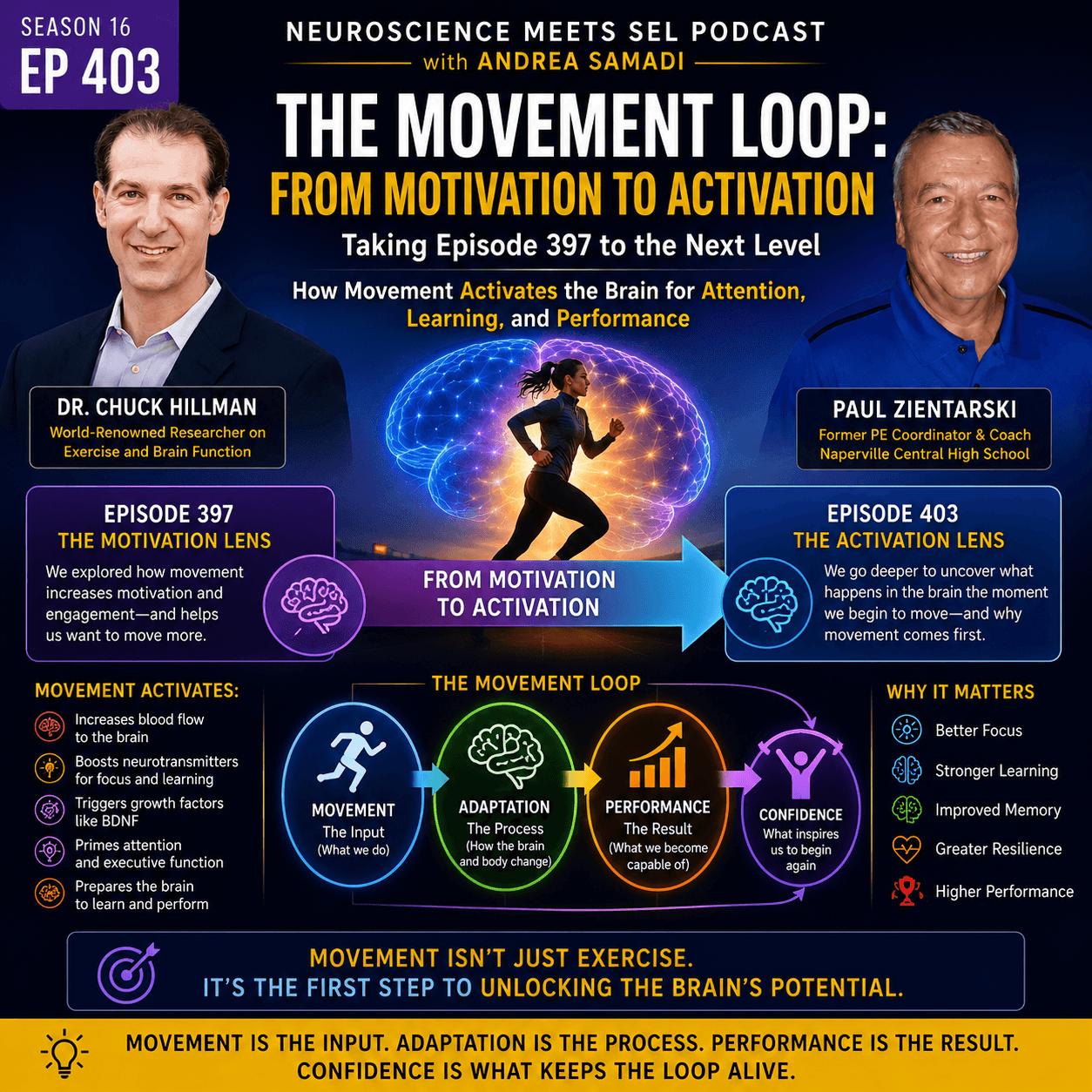
ABOUT THIS EPISODE
Welcome back to Season 16 of the Neuroscience Meets Social and Emotional Learning Podcast.
I'm Andrea Samadi, and this is where we bridge neuroscience, social and emotional learning, and human performance so we can create measurable improvements in our well-being, achievement, leadership, productivity, and results.
In this episode 403 The Movement Loop: How Movement Activates the Brain for Learning, Adaptation & Performance we will cover:
✔ Why movement is the biological input that prepares the brain for learning, adaptation, and performance.
✔ How Dr. Chuck Hillman's groundbreaking neuroscience research explains what happens inside the brain during and immediately after exercise.
✔ Why even one bout of physical activity can improve attention, executive function, and learning readiness.
✔ How Paul Zientarski translated neuroscience into practice through Naperville Central High School's internationally recognized Zero Hour PE Program.
✔ The science behind brain activation, neuroplasticity, positive stress, and cognitive reserve.
✔ Why movement isn't a break from learning—it's preparation for learning.
✔ How teachers, coaches, parents, and workplace leaders can use movement to improve focus, decision-making, creativity, and performance.
✔ How to apply the Movement Loop in everyday life using practical strategies you can begin today.
✔ Why movement is the input, adaptation is the process, and performance is the result.
If you're just joining us, Season 16 explores Phase 3 of the Brain's Operating System for Human Performance—the Movement Loop. This season asks one central question: How does movement change the brain, adaptation change the body, and together create measurable improvements in performance? If you'd like the full overview of the five-phase framework, I encourage you to start with Episode 402.
In Episode 402[i], we introduced Phase 3 of the Brain's Operating System for Human Performance—where we introduced The Movement Loop.
We discovered one powerful idea.
Movement is the input.
When you move, your body sends a powerful biological signal to the brain that says:
"Prepare. Activate. Adapt."
Adaptation is the process.
With movement, repetition, and recovery, the brain and body strengthen, rewire, and become more efficient.
Performance is the output.
The changes become visible in everyday life—clearer thinking, better decisions, stronger health, and improved performance.
Then the loop begins again.
Today we're asking the next question.
Why does movement come first?
Not simply because exercise is good for our bodies.
But because movement is one of the most powerful biological signals we can send to the brain.
Before we can focus...
Before we can learn...
Before we can adapt...
The brain must first be activated.
That's why movement isn't the outcome.
It's the beginning.
When we first interviewed Dr. Chuck Hillman on Episode 123[ii], (back in April 2021) I wanted to understand how his neuroscience research inspired Paul Zientarski's revolutionary Zero Hour PE Program at Naperville Central High School.
It was Naperville's extraordinary performance on the Trends in International Mathematics and Science Study (TIMSS) that caught the eye of Dr. John Ratey. Naperville District 203 entered the international comparison as if it were its own "country" and ranked #1 in the world in science and #6 in the world in math. Those results made Dr. Ratey ask, "What are they doing differently?" That question ultimately led him to Naperville, (IL) where he discovered Zientarksi’s Zero Hour PE initiative and made it the opening case study in his book Spark. We will cover this story on our next episode
Then years later, we revisited that conversation in Episode 397[iii] through the lens of motivation—exploring how movement increases engagement and helps us want to move more.
But looking back through the lens of Phase 3, I realized I had been asking the wrong question.
The bigger question isn't whether movement motivates us.
The bigger question is:
What happens inside the brain the moment we begin to move?
That's the question we're answering today.
And it's the reason movement sits at the beginning of the Brain's Operating System for Human Performance.
Let's begin where every performance story begins...
with movement.
As we begin Phase 3, Dr. Chuck Hillman's research helps us understand why movement is the first step in the Movement Loop.
In our interview, he mentioned that his lab has consistently demonstrated that even a single bout of physical activity can improve attention, cognition, and academic performance.
But what fascinated me most wasn't simply that exercise works.
It was why it works.
Listen carefully as Dr. Hillman explains how movement acts as a positive biological stressor that prepares the brain for learning.
EP 403 — Clip 1 Summary Movement is the First SignalAs we begin Phase 3 of the Brain's Operating System, the first question is simple:
Why does movement come first?
Dr. Chuck Hillman has spent his career studying how physical activity changes the brain—from childhood through older adulthood. His research doesn't just focus on exercise, but on understanding how different life experiences shape brain health across the lifespan.
One insight from our conversation completely changed how I think about movement.
Dr. Hillman explained that even a single session of exercise can improve attention, cognition, and academic performance in children. His team is now studying why that happens, exploring how exercise acts as a positive stressor that activates biological pathways supporting brain function.
But what struck me even more was why he chose to study children in the first place.
Rather than waiting until someone reaches their 60s and begins experiencing cognitive decline, his goal is to help children build a stronger brain from the very beginning—to create what he calls a cognitive reserve that may protect brain health throughout life.
That idea captures exactly what Phase 3 is all about.
Movement isn't simply something we do to stay fit.
It's one of the earliest investments we can make in the future health and performance of our brain.
______
This is the first piece of the Movement Loop.
Movement isn't valuable because we eventually become fitter.
This is what many of us used to think? I can’t be alone in this…I used to move for fitness alone.
Until I studied the brain…and learned that:
It's valuable because it immediately changes the state of the brain.
Before learning improves...
Before memory improves...
Before performance improves...
The brain has to be activated.
That's exactly what movement does.
Key Takeaways from Dr. Hillman
There are three ideas I'd like all of us to remember from this first clip.
-
Movement is Information
The Neuroscience
Every movement you make sends information throughout your nervous system.
As your muscles contract, they don't just move your body—they communicate with your brain. Your heart pumps faster, blood flow increases, oxygen and glucose are delivered more efficiently, and neurons begin communicating more actively.
Movement also changes your brain's neurochemistry. Exercise increases the release of neurotransmitters like dopamine, norepinephrine, and serotonin, which help regulate attention, motivation, mood, and learning. At the same time, it stimulates the production of growth factors such as brain-derived neurotrophic factor (BDNF), which supports neuroplasticity—the brain's ability to form and strengthen new neural connections.
That's why I like to think of movement as sending a message to the brain:
"Wake up. Pay attention. Get ready to learn."
Movement isn't simply burning calories.
It's providing your brain with the biological conditions it needs to perform at its best.
-
Stress Isn't Always Harmful
The Neuroscience
When we hear the word stress, we usually think of chronic stress—too much cortisol, too little recovery, and the negative effects that follow.
But the brain actually needs short, manageable challenges to become stronger.
Exercise is an example of what's often called eustress, or positive stress.
When you exercise, your body briefly increases stress hormones like cortisol and activates your sympathetic nervous system. At the same time, it stimulates beneficial signaling molecules and growth factors that help the brain adapt.
Dr. Hillman's research explores how these temporary changes—including biomarkers like cortisol and salivary alpha-amylase—may help explain why even a single bout of exercise improves attention and cognition.
The important point is that the stress is temporary.
When it's followed by recovery, your brain and body adapt.
Without recovery, stress becomes harmful.
With recovery, stress becomes the signal that drives growth.
That's why adaptation sits in the middle of the Movement Loop.
The challenge isn't the goal.
The adaptation is.
-
Activation Comes Before Performance
The Neuroscience
One of the biggest misconceptions about learning is that we can simply decide to pay attention.
The brain doesn't work that way.
Before the prefrontal cortex—the part of the brain responsible for focus, planning, decision-making, and executive function—can perform well, it must first be activated.
Movement helps create that activation.
Exercise increases cerebral blood flow, raises arousal to an optimal level, and improves communication across large-scale brain networks involved in attention and cognitive control.
Think of it like warming up an orchestra before a concert.
Before the musicians can perform together, they first need to tune their instruments.
Movement helps the brain tune itself.
That's why research consistently shows improvements in attention and executive function immediately after moderate physical activity.
Performance doesn't begin when you sit down to work.
Performance begins the moment you prepare your brain.
That's why movement sits at the beginning of the Movement Loop.
One final thought
Movement isn't magic.
It changes the brain because it changes the brain's biology.
It increases blood flow.
It changes neurochemistry.
It activates neural networks.
It stimulates neuroplasticity.
And when those changes are repeated over time—and supported by recovery—they become adaptation.
That's why movement is the input.
Adaptation is the process.
Performance is the result.
TIPS to IMPLEMENT
So what can we do with this research?
Here are three simple ways to put the Movement Loop into practice this week.
✅ 1. Move with purpose.
Before asking your brain to perform...
Prepare it.
Take a 10–20 minute walk.
Ride your bike.
Do a short workout.
Climb the stairs instead of taking the elevator.
Don't think of movement as taking time away from your work.
Think of it as the first step toward doing your best work.
I always park my car at the back of the parking lot, not afraid add bits of movement into the day.
✅ 2. Prepare the brain before expecting learning.
Whether you're a parent...
A teacher...
A coach...
Or a leader...
Create opportunities to move before asking people to think.
Movement isn't a reward after learning.
It's preparation before learning.
I discovered this one early on with this podcast. I can’t focus on this topic, without moving first.
✅ 3. Start measuring brain performance—not just physical performance.
The next time you move, don't just ask:
"How many calories did I burn?"
Ask:
-
Did I think more clearly today?
Did I focus more easily?
Did I feel more energized?
Did I recover better tonight?
Am I becoming more resilient?
Those are the real returns on your investment.
Movement for me, is at the root of each of these questions. If I lacked movement (and sometimes I can’t fit it in) I’ll notice it show up in one of these questions, and know how important it is to get it back on track.
Final Reflection
Remember...
Movement is the input.
It's what we do.
Every step you take sends a message to your brain:
"Prepare. Activate. Adapt."
The more consistently you send that signal, the more opportunities your brain and body have to change.
Over time, those changes become visible.
You think more clearly.
You learn more effectively.
You recover more efficiently.
You perform at a higher level.
But here's the part I find most fascinating.
When I look at the Movement Loop...
I don't stop at Performance.
I look at the final circle.
Confidence.
Because confidence is what keeps the loop alive.
I’ll be the first to say I can’t always do this. Something gets in the way.
It's not always easy to move.
Some days we're busy.
Some days we're tired.
Some days we simply don't feel like it.
But every time you complete the loop, you collect another piece of evidence.
"I showed up."
"I felt better afterward."
"I handled that challenge differently."
"I'm becoming stronger than I was yesterday."
Those moments become evidence.
Evidence builds confidence.
And confidence makes it easier to begin again tomorrow.
That's how lasting change happens.
Not through one workout.
Not through one perfect week.
But by repeating the loop.
Again.
And again.
And again.
Because every movement today is an investment in the person you're becoming tomorrow.
Movement is the input.
Adaptation is the process.
Performance is the result.
And confidence is what inspires us to begin again.
Brain Activation Creates Readiness to Learn
Paul Zientarski explains how Naperville Central High School achieved remarkable academic results through its Zero Hour PE Program and the use of heart rate monitoring. His work around getting students to move was inspired by Dr. Hillman’s research.
In this clip, Paul Zientarski describes how Dr. Chuck Hillman's research transformed physical education from something schools did for physical health into something they could use to improve learning itself.
The research that ignited him showed that after just 20 minutes of walking, students demonstrated measurable increases in brain activation and performed better on cognitive tasks.
For Paul, this wasn't simply evidence that exercise works.
It explained why movement belongs at the beginning of the school day.
Movement wasn't taking time away from learning.
It was preparing the brain to learn.
Looking at this through the lens of the Movement Loop, we can now see what was happening biologically.
Movement activated the brain.
An activated brain was better able to pay attention.
Better attention improved learning.
Repeated learning created adaptation.
And over time, those adaptations translated into stronger academic and life performance.
That's why movement is the first step in Phase 3.
Key Takeaways
✔ 1. Brain activation is the bridge between movement and performance.
Movement doesn't improve learning—or performance—directly.
It first changes the brain into a state that's ready to focus, solve problems, make decisions, and learn.
Whether you're in a classroom, on the athletic field, or leading a team at work, performance begins with brain activation.
✔ 2. Readiness comes before instruction/teaching/learning.
One of Paul Zientarski's greatest insights was that not every student needed more movement. Sometimes they needed more recovery.
By monitoring students' heart rates, he learned to recognize when a student was physiologically ready to learn and when the brain and body needed time to recover.
That's a lesson for all of us.
Teachers can observe energy before beginning a lesson.
Coaches can balance challenge with recovery.
Leaders can recognize when their teams need a reset before asking for peak performance.
The question isn't simply,
"What am I teaching?"
It's, "Are people ready to learn?"
✔ 3. Small actions create lasting adaptation.
One walk.
One movement break.
One active lesson.
One walking meeting.
None of these seem significant on their own.
But repeated consistently, they become the biological signals that drive adaptation.
Small actions, repeated often, create lasting change.
✔ 4. Performance begins long before the moment that matters.
A student's success doesn't begin when they open the exam.
An athlete's success doesn't begin when the whistle blows.
A leader's success doesn't begin when the meeting starts.
Performance begins much earlier—
when we prepare the brain to perform.
✔ 5. Movement isn't a break from work.
It's preparation for better work.
Whether you're teaching a lesson...
Coaching a team...
Leading a meeting...
Or solving a complex problem...
Movement should be viewed as part of the performance process—not time taken away from it.
Tips to Implement
-
Prepare the brain before expecting performance.
Before teaching...
Before coaching...
Before presenting...
Before solving difficult problems...
Ask one question:
"Is the brain ready to perform?"
Sometimes the best way to improve performance is to begin with five to ten minutes of purposeful movement.
-
Build movement into the rhythm of the day.
Instead of viewing movement as a separate activity, make it part of how you work and learn.
Teachers can begin lessons with movement.
Coaches can use dynamic warm-ups with a cognitive focus.
Leaders can replace one seated meeting each week with a walking meeting.
Movement becomes the signal that says,
"It's time to focus."
-
Balance challenge with recovery.
Paul didn't simply encourage students to move more.
He also recognized when they needed recovery.
High performance isn't created by constant effort.
It's created by alternating challenge with recovery.
That's true in classrooms.
It's true in sports.
And it's true in the workplace.
-
Think beyond fitness.
Don't ask,
"How do I fit exercise into my day?"
Instead ask,
"How can movement improve everything I do afterward?"
That one shift changes movement from another task on your calendar...
into the first step toward better thinking, better learning, better leadership, and better performance.
Closing Reflection
Every time we move...
We send a message to the brain.
"Prepare. Activate. Adapt."
That's why movement isn't just something we do for our bodies.
It's one of the most practical performance tools available to teachers, coaches, leaders, parents, and anyone who wants to think more clearly, learn more effectively, and perform at a higher level.
Because in the end...
Movement is the input. (What we do.)
Adaptation is the process. (How the brain and body change.)
Performance is the result. (What we're capable of becoming.)
Paul Zientarski didn't change physical education at Naperville HS. He changed the purpose of physical education. Instead of asking, "How do we build fitter students?" he helped us ask, "How do we build brains that are ready to learn?"
EP 403 Review and Conclusion
As we review and close out this episode, I'd like to leave you with one final thought.
When we first interviewed Dr. Chuck Hillman, I was fascinated by what exercise did for the brain.
When we interviewed Paul Zientarski, I was inspired by how he translated that research into a school that changed lives.
But looking back through the lens of Phase 3, I realize they were teaching us something even bigger.
They were teaching us where human performance begins.
Not with talent.
Not with intelligence.
Not with motivation.
It begins with a biological signal.
Movement.
Every step you take...
Every walk...
Every workout...
Every hike...
Every time you choose to move...
You're telling your brain:
"Prepare. Activate. Adapt."
That's the first instruction your brain receives.
From there, everything else becomes possible.
Movement activates the brain.
An activated brain pays attention.
Attention makes learning possible.
Learning creates adaptation.
Adaptation improves performance.
And performance builds confidence.
Confidence is what inspires us to move again tomorrow.
That's the Movement Loop.
A Personal Journey
This season has become personal for me.
For years, I interviewed experts and shared their research.
Over the past year, I began testing these ideas (their research) in my own life.
Not to become a better athlete.
Not to chase perfect numbers on my wearable device (as much as I would like to have them).
But to see whether the neuroscience actually showed up in everyday life.
It did.
The more consistently I moved...
The more consistently I recovered...
The more my brain and body adapted.
My recovery improved.
My resting heart rate dropped.
My hikes became easier.
My thinking became clearer.
Those weren't isolated improvements.
They were evidence that the Movement Loop was working.
And with every small improvement...
my confidence grew.
Not because someone told me I was improving.
Because I could see it.
I could measure it.
I could feel it.
That confidence became more than the result of movement.
It became something I began carrying into other areas of my life.
Into my work.
Into my relationships.
Into the challenges I was willing to take on.
And that's when I realized something...
Confidence doesn't end the Movement Loop.
It becomes the beginning of another part of the Brain's Operating System.
But...
that's a conversation for another episode.
Your challenge for the week
So before our next episode, I'd like to leave you with a simple challenge.
Don't focus on changing your life overnight.
Just begin the loop.
Tomorrow morning...
Before work...
Before studying...
Before an important conversation...
Move.
Even if it's just for ten or twenty minutes.
Then ask yourself one question:
How did that movement prepare my brain today?
Start paying attention.
Notice your focus.
Notice your energy.
Notice how you think.
Because once you begin looking for the changes...
You'll start seeing them everywhere.
Write down what you notice…because if you don’t write things down, you won’t remember that the change occurred.
Looking ahead
In our next episode, we'll continue exploring Phase 3 with one of the pioneers in this field, Dr. John Ratey, author of Spark.
If Dr. Hillman showed us that movement activates the brain...
Dr. Ratey helps us understand why exercise has been called "Miracle-Gro for the brain" and how movement literally changes the brain's ability to learn, adapt, and grow.
We'll continue building the Movement Loop...
one step at a time.
Until next time...
Remember...
Movement is the input. It's what we do.
Adaptation is the process. It's how the brain and body change.
Performance is the result. It's the measurable improvement we experience in our thinking, learning, health, leadership, and daily lives.
And perhaps most importantly...
Confidence is what keeps the loop alive.
Because every step you take today is building the brain you'll depend on tomorrow.
By the end of this season, my hope is that we don't just understand the neuroscience of human performance—we put it into practice.
That we begin moving with purpose. That we notice how our brain and body respond. That we embrace adaptation as part of the process. And that we experience measurable improvements in our thinking, learning, health, leadership, and everyday performance.
I'm Andrea Samadi, and this has been the Neuroscience Meets Social and Emotional Learning Podcast. I'll see you next time.
EP 403: How did movement prepare my brain today?
EP 404: How did today's movement help my brain learn?
EP 405: How did recovery help my brain adapt?
EP 406: How did attention improve my performance?
EP 407: How will I keep the loop going?
RESOURCES:
Full interview Dr. Chuck Hillman https://www.youtube.com/watch?v=6ip5s2iDFLE&list=PLb5Z3cA_mnKhiYc5glhacO9k9WTrSgjzW&index=88
Full interview Paul Zientarski
https://www.youtube.com/watch?v=UHYNEhxkxfE
Paul Zientarski’s clip https://www.youtube.com/shorts/DmtkP_licdA
REFERENCES:
[i] Neuroscience Meets Social and Emotional Learning Podcast EPISODE 402 “Phase 3 Intro: How Movement Builds the Brain https://andreasamadi.podbean.com/e/movement-loop-how-everyday-action-rewires-your-brain-and-boosts-performance/
[ii] Neuroscience Meets Social and Emotional Learning Podcast EPISODE 123 https://andreasamadi.podbean.com/e/northeastern-university-professor-chuck-hillman-phd-on-the-impact-of-exercise-on-the-brain-and-learning/
[iii] Neuroscience Meets Social and Emotional Learning Podcast EPISODE 397
SHOW NOTES 🔗
TRANSCRIPT 🔗
00:00:02.484 --> 00:00:09.682
Welcome back to Season 16 of the Neuroscience Meets Social and Emotional Learning podcast.
00:00:10.123 --> 00:00:14.436
I'm Andrea Samadhi, and this is where we bridge neuroscience,
00:00:14.639 --> 00:00:20.277
social and emotional learning, and human performance so we can create measurable
00:00:20.277 --> 00:00:22.656
improvements in our well-being,
00:00:22.993 --> 00:00:28.107
our achievements, our leadership, productivity, and results.
00:00:28.623 --> 00:00:35.227
And if you're just joining us, Season 16 explores Phase 3 of our brain's operating
00:00:35.227 --> 00:00:37.354
system for human performance.
00:00:37.749 --> 00:00:42.596
We call it the Movement Loop, and this season asks one central question.
00:00:43.147 --> 00:00:48.720
How does movement change the brain? How does adaptation change the body?
00:00:49.306 --> 00:00:53.799
And how, together, they create measurable improvements in performance.
00:00:54.252 --> 00:00:58.627
And if you'd like the full overview of the five phases and how they all work
00:00:58.627 --> 00:01:05.328
together and come online one at a time, I encourage you to start with episode 402 from last week.
00:01:05.787 --> 00:01:10.813
In episode 402, we introduced phase three of our brain's operating system,
00:01:11.144 --> 00:01:16.270
where we introduced the movement loop, and we discovered one powerful idea.
00:01:16.775 --> 00:01:23.487
Movement is actually the input. When you move, your body sends a powerful biological
00:01:23.487 --> 00:01:26.858
signal to the brain that says you've got to prepare.
00:01:27.172 --> 00:01:31.015
You're going to activate now, and then your body will adapt.
00:01:31.346 --> 00:01:35.276
So adaptation is the actual process of what's happening.
00:01:35.670 --> 00:01:40.997
With movement, repetition, and recovery, the brain and body strengthen,
00:01:40.997 --> 00:01:44.656
they rewire, and they become more efficient.
00:01:44.947 --> 00:01:52.702
So performance is the output the change becomes visible in everyday life we'll see clearer thinking
00:01:53.085 --> 00:02:00.092
better decisions stronger health and improved performance and then the loop begins again.
00:02:01.015 --> 00:02:06.495
So today, we're asking the next question. Why does movement come first?
00:02:06.901 --> 00:02:11.788
Not simply because exercise is good for our bodies, but because movement is
00:02:11.788 --> 00:02:16.630
one of the most powerful biological signals that we can send to the brain.
00:02:17.071 --> 00:02:22.749
Before we can focus, before we can learn, before we can even adapt,
00:02:23.074 --> 00:02:25.634
the brain must first of all be activated.
00:02:25.988 --> 00:02:29.924
It's why movement isn't the outcome. It's the beginning.
00:02:30.448 --> 00:02:37.594
And when we first interviewed Dr. Chuck Hillman on episode 123 back in April of 2021,
00:02:38.001 --> 00:02:43.638
I wanted to understand how his neuroscience research inspired Paul Zantarsky's
00:02:43.638 --> 00:02:51.103
revolutionary zero-hour PE program that's famous at Naperville Central High School in Chicago.
00:02:51.637 --> 00:02:56.288
And it was Naperville's extraordinary performance on the Trends in International
00:02:56.288 --> 00:03:02.711
Mathematics and Science Study, T-I-M-S-S, that caught the eye of Dr. John Rady.
00:03:03.321 --> 00:03:09.028
Naperville District 203 entered the international comparison as if it were its
00:03:09.028 --> 00:03:15.697
own country, and it ranked number one in the world in science and number six in the world in math.
00:03:16.103 --> 00:03:21.235
And those results made Dr. Rady ask, what are they doing differently?
00:03:21.641 --> 00:03:25.519
And that question ultimately led him to Naperville, Illinois,
00:03:25.798 --> 00:03:31.378
where he discovered Paul Zantarsky's Zero Hour PE Initiative and made it the
00:03:31.378 --> 00:03:33.948
opening case study in his book, SPARK.
00:03:34.343 --> 00:03:37.332
And we'll cover this story on our next episode.
00:03:38.221 --> 00:03:44.497
And years later, we revisited that conversation just recently on episode 397,
00:03:44.671 --> 00:03:50.371
Through the Lens of Motivation, exploring how movement increases engagement
00:03:50.679 --> 00:03:52.960
and helps us to want to move more.
00:03:53.579 --> 00:04:00.143
But looking back now, through the lens of phase 3, I realized I'd been asking the wrong question.
00:04:00.711 --> 00:04:04.589
The bigger question isn't whether movement motivates us.
00:04:05.112 --> 00:04:11.340
The bigger question is, what happens inside the brain the moment we begin to move?
00:04:11.758 --> 00:04:14.371
And that's the question we're answering today.
00:04:15.039 --> 00:04:19.404
And it's the reason that movement sits at the beginning of the brain's operating
00:04:19.404 --> 00:04:21.175
system for human performance.
00:04:21.547 --> 00:04:26.492
So let's begin where every performance story begins, with movement.
00:04:26.893 --> 00:04:32.158
And as we begin phase three, Dr. Chuck Hillman's research helps us to understand
00:04:32.292 --> 00:04:35.270
why movement is the first step in the movement loop.
00:04:35.744 --> 00:04:40.884
In our interview, he mentioned that his lab had consistently demonstrated that
00:04:40.884 --> 00:04:45.056
even a single bout of physical activity can improve attention.
00:04:45.346 --> 00:04:48.225
Cognition, and academic performance.
00:04:48.684 --> 00:04:53.484
But what fascinated me most wasn't simply that exercise works.
00:04:53.943 --> 00:04:59.884
It's why it works. So listen carefully as Dr. Hillman explains how movement
00:04:59.884 --> 00:05:05.012
acts as a positive biological stressor that prepares the brain for learning.
00:05:05.560 --> 00:05:08.634
Some of the things you're working on, can you just share what you're working
00:05:08.634 --> 00:05:11.661
on at your Center for Cognitive and Brain Health right now?
00:05:12.166 --> 00:05:18.133
Sure. The Center for Cognitive Brain Health in Northeastern University now has five faculty in it.
00:05:18.522 --> 00:05:21.604
And we're not just interested in physical activity.
00:05:21.944 --> 00:05:25.144
That's certainly my area of interest in children. And my colleague,
00:05:25.144 --> 00:05:28.037
R. Kramer, his interest as well in older adults.
00:05:28.310 --> 00:05:33.439
But we have interests in early childhood experiences, both positive and negative,
00:05:33.718 --> 00:05:39.938
music, and then mental health-related issues as well with some of the other faculty in there.
00:05:40.308 --> 00:05:45.204
The two projects I think you're referring to, one is a longitudinal study of
00:05:45.204 --> 00:05:48.344
physical activity involvement in older adults.
00:05:48.344 --> 00:05:53.024
And so there, we have the IGNITE trial. It's headed up by my colleague Kirk
00:05:53.024 --> 00:05:57.954
Erickson at University of Pittsburgh, and it's a multi-site trial between Pittsburgh,
00:05:57.954 --> 00:06:00.597
Northeastern, and University of Kansas Medical Center,
00:06:01.067 --> 00:06:05.274
and we're bringing in 639 older
00:06:05.274 --> 00:06:09.471
adults for a year-long physical activity intervention with testing it.
00:06:10.283 --> 00:06:15.480
Baseline six months and 12 months, and it's a comprehensive battery from cellular,
00:06:15.480 --> 00:06:17.000
molecular, and genetics.
00:06:18.415 --> 00:06:23.024
To multiple modes of imaging, including MRI, fMRI, and PET scans,
00:06:23.500 --> 00:06:25.387
to a huge cognitive battery.
00:06:25.770 --> 00:06:29.980
And we're trying to understand whether different doses of physical activity,
00:06:29.980 --> 00:06:35.680
so people get either 150 minutes of moderate to vigorous physical activity per week, which is,
00:06:36.489 --> 00:06:39.870
the physical activity guidelines for americans or they're getting a larger dose
00:06:39.870 --> 00:06:47.744
225 minutes a week or they're they get stretching and flexibility training so it's not aerobic it's,
00:06:48.640 --> 00:06:52.980
it's it's health-based physical activity training just not aerobic and we're
00:06:52.980 --> 00:06:56.791
looking to see whether there's differences you know at six months in a year following,
00:06:57.740 --> 00:07:01.650
this inter these intervention arms and so that's that and that's those are 65
00:07:01.650 --> 00:07:06.617
to 80 year olds and then the kids study is more about this it's called sneaky
00:07:06.878 --> 00:07:09.352
and it's more about this acute dose,
00:07:09.995 --> 00:07:13.513
idea and that we're we we know now through multiple,
00:07:14.151 --> 00:07:19.160
published findings that that single doses of exercise benefit brain and cognition
00:07:19.160 --> 00:07:22.990
academic performance in kids what we don't know is what the mechanism is and
00:07:22.990 --> 00:07:26.354
so this particular study is focusing on.
00:07:27.580 --> 00:07:34.670
On salivary alpha amylase and cortisol two stress markers that we think may
00:07:34.670 --> 00:07:39.160
underlie the benefits, maybe the mechanistic reason in which,
00:07:39.900 --> 00:07:44.850
a short dose of physical activity benefits brain function and cognition in kids.
00:07:45.879 --> 00:07:52.125
Exercise is a stressor. It's a positive stressor. And so, we believe that we're
00:07:52.125 --> 00:07:57.135
upregulating these neural markers or these biomarkers that benefit both the
00:07:57.135 --> 00:07:59.291
function of the brain and cognitive output.
00:08:00.957 --> 00:08:05.955
And when you were talking about your aging study, are you doing anything to
00:08:05.955 --> 00:08:11.475
show how exercise is slowing down cognitive decline?
00:08:11.475 --> 00:08:16.782
Are you seeing, measuring maybe BDNF, anything like that?
00:08:17.316 --> 00:08:22.135
Yeah. So, I mean, you know, we are collecting all those cellular molecular markers,
00:08:22.135 --> 00:08:27.385
BDNF, IGF-1, you know, we're looking at different genetic, you know,
00:08:27.385 --> 00:08:30.985
variables as well, telomeres, you know, so forth.
00:08:30.985 --> 00:08:35.505
And the idea is, is that, you know, we'll know at the end, we're still collecting
00:08:35.505 --> 00:08:39.045
data. And so, you know, with this is actually, I should step back to say,
00:08:39.045 --> 00:08:42.748
this is the largest randomized controlled trial of exercise in older adults
00:08:43.125 --> 00:08:44.164
in the history of NIH. age.
00:08:44.855 --> 00:08:49.135
And so, you know, we're not able to crack into the data until we're done collecting it.
00:08:49.501 --> 00:08:50.815
Um, everyone's, you know, blind
00:08:50.815 --> 00:08:53.443
and all those good things that happen from randomized control trials.
00:08:53.907 --> 00:08:57.187
But the idea is to look at, at these variables and see, you know,
00:08:57.407 --> 00:09:01.152
what, what are the markers that are, that are benefited by physical activity?
00:09:01.506 --> 00:09:06.022
Are, you know, are they simply curbing cognitive aging or are they actually
00:09:06.190 --> 00:09:09.865
ameliorating and benefiting the brain and not just, you know,
00:09:09.865 --> 00:09:13.284
slowing down the cognitive aging process? And so these are open questions.
00:09:14.270 --> 00:09:18.355
Got it. And it's such an interest for me going from the child,
00:09:18.355 --> 00:09:24.025
making that child a lifelong exerciser for the benefit of the health in the
00:09:24.025 --> 00:09:29.035
future to prevent Alzheimer's and aging and everything.
00:09:29.035 --> 00:09:31.125
It's a whole big step. Yeah.
00:09:31.676 --> 00:09:33.915
I mean, I guess, you know, if we go back to your first question,
00:09:33.915 --> 00:09:36.965
one of the main reasons I really want to study kids is because I didn't want
00:09:36.965 --> 00:09:41.075
to wait until someone was in their 60s to say, hey, exercise is good for your brain.
00:09:41.075 --> 00:09:44.436
Let's, you know, let's get you going to ameliorate these cognitive aging effects,
00:09:44.790 --> 00:09:47.215
you know, or worse, dementia, right?
00:09:48.035 --> 00:09:53.045
Ones of dementia, things like that. And so I want to look and see whether we
00:09:53.045 --> 00:09:58.003
could benefit the brains early, build up a neural reserve or a cognitive reserve.
00:09:58.995 --> 00:10:04.412
And maybe we never had that sedentary adult that is suffering from age-related decline.
00:10:05.077 --> 00:10:09.106
So to summarize this clip, movement is the first signal.
00:10:09.338 --> 00:10:14.934
So as we begin phase three of the brain's operating system, the first question is simple.
00:10:15.451 --> 00:10:21.294
Why does movement come first? And Dr. Hillman has spent his entire career studying
00:10:21.294 --> 00:10:27.152
how physical activity changes the brain, from childhood through older adulthood.
00:10:27.547 --> 00:10:33.024
His research doesn't just focus on exercise, but on understanding how different
00:10:33.024 --> 00:10:37.131
life experiences shape brain health across our lifespan.
00:10:37.601 --> 00:10:42.704
And one insight from our conversation completely changed how I think about movement.
00:10:43.255 --> 00:10:48.433
Dr. Hillman explained that even a single session of exercise can improve attention,
00:10:48.637 --> 00:10:51.620
cognition, and academic performance in children.
00:10:52.056 --> 00:10:58.064
And his team is now studying why that happens, exploring how exercise acts as
00:10:58.064 --> 00:11:03.915
a positive stressor that activates biological pathways supporting brain function.
00:11:04.420 --> 00:11:09.952
But what struck me even more was why he chose to study children in the first place.
00:11:10.562 --> 00:11:16.437
Rather than waiting until someone reaches their 60s and begins experiencing cognitive decline,
00:11:16.750 --> 00:11:21.766
his goal is to help children build a stronger brain from the very beginning
00:11:22.073 --> 00:11:29.334
to create what he calls a cognitive reserve that may protect brain health throughout their entire lifespan.
00:11:29.816 --> 00:11:34.553
And that idea captures exactly what Phase 3 is all about.
00:11:35.040 --> 00:11:38.569
Movement isn't simply something we do to stay fit.
00:11:39.023 --> 00:11:44.414
It's one of the earliest investments that we can make in our future health and
00:11:44.414 --> 00:11:45.912
performance of our brains.
00:11:46.537 --> 00:11:51.799
And this is the first piece of the movement loop. Movement isn't valuable because
00:11:51.799 --> 00:11:53.434
we eventually become fitter.
00:11:53.956 --> 00:11:58.246
That's what many of us used to think. I can't be alone in this way of thinking.
00:11:58.397 --> 00:12:04.619
I used to move for fitness alone until I started to study the brain and learn
00:12:04.619 --> 00:12:08.933
that it's valuable because it immediately changes the state of the brain.
00:12:09.426 --> 00:12:15.299
So before learning improves, before memory improves, before our performance
00:12:15.299 --> 00:12:21.097
improves, the brain has to be activated and that's exactly what movement does.
00:12:21.730 --> 00:12:27.418
So some key takeaways from Dr. Hillman. There's three ideas I'd like us to all
00:12:27.418 --> 00:12:29.253
remember from his first clip.
00:12:29.834 --> 00:12:34.875
Number one, movement is information. The neuroscience behind this.
00:12:35.287 --> 00:12:40.413
Every movement you make sends information throughout your entire nervous system.
00:12:40.999 --> 00:12:46.914
As your muscles contract, they don't just move your body, they communicate with your brain.
00:12:47.303 --> 00:12:53.018
Your heart pumps faster, blood flow increases, oxygen and glucose are delivered
00:12:53.018 --> 00:12:57.270
more efficiently, and neurons begin communicating more actively.
00:12:57.775 --> 00:13:03.728
So movement changes your brain's neurochemistry. Exercise increases the release
00:13:03.728 --> 00:13:08.509
of neurotransmitters like dopamine, norepinephrine, and serotonin,
00:13:08.834 --> 00:13:13.240
which helps to regulate attention, motivation, mood, and learning.
00:13:13.617 --> 00:13:17.808
And at the same time, it stimulates the production of growth factors,
00:13:18.133 --> 00:13:21.645
like brain-derived neurotrophic factors, or BDNF,
00:13:21.976 --> 00:13:28.861
which supports neuroplasticity, the brain's ability to form and strengthen new neural connections.
00:13:29.343 --> 00:13:33.405
And that's why I like to think of movement as sending a message to the brain.
00:13:33.777 --> 00:13:38.926
It's telling us to wake up, to pay attention, and get ready to learn.
00:13:39.256 --> 00:13:44.598
Movement isn't simply just burning calories. It's providing our brain with the
00:13:44.598 --> 00:13:48.753
biological conditions it needs to perform at its best.
00:13:49.571 --> 00:13:55.515
Takeaway two, stress isn't always harmful. Here's the neuroscience behind this.
00:13:55.910 --> 00:14:00.502
When we hear the word stress, we usually think of chronic stress or too much
00:14:00.502 --> 00:14:04.652
cortisol, too little recovery, the negative effects that follow.
00:14:05.111 --> 00:14:10.330
But the brain actually needs short, manageable challenges to become stronger.
00:14:10.736 --> 00:14:16.721
And exercise is an example of what we often call eustress or positive stress.
00:14:17.139 --> 00:14:22.652
When you exercise, your brain briefly increases stress hormones like cortisol
00:14:22.652 --> 00:14:25.603
and activates your sympathetic nervous system.
00:14:25.974 --> 00:14:31.215
At the same time, it stimulates beneficial signaling molecules and growth factors
00:14:31.557 --> 00:14:33.287
that help the brain to adapt.
00:14:33.740 --> 00:14:37.925
Dr. Hillman's research explores how these temporary changes,
00:14:38.192 --> 00:14:42.082
including biomarkers like cortisol and salivary alpha
00:14:42.402 --> 00:14:50.058
amylase, may help explain why even a single bout of exercise improves attention and cognition.
00:14:50.597 --> 00:14:55.862
The important part is that stress is temporary When it's followed by recovery,
00:14:56.071 --> 00:14:59.402
your brain and body adapt Without recovery,
00:14:59.762 --> 00:15:06.752
stress becomes harmful But with recovery, stress becomes the signal that drives our growth,
00:15:07.222 --> 00:15:12.562
And that's why adaptation sits in the middle of the movement loop The challenge
00:15:12.562 --> 00:15:15.459
isn't the goal, the adaptation is.
00:15:16.272 --> 00:15:21.468
And then takeaway three, activation comes before performance.
00:15:21.793 --> 00:15:26.710
In the neuroscience behind this, one of the biggest misconceptions about learning
00:15:26.993 --> 00:15:30.098
is that we can simply decide to pay attention.
00:15:30.540 --> 00:15:34.653
The brain doesn't work that way. Before the prefrontal cortex,
00:15:34.653 --> 00:15:38.953
the part of the brain responsible for focus, planning, decision-making,
00:15:38.953 --> 00:15:44.808
and executive function, can perform well, it must first of all be activated.
00:15:45.255 --> 00:15:52.094
And movement helps to create that activation. Exercise increases cerebral blood flow,
00:15:52.401 --> 00:15:58.123
raises arousal to an optimal level, and improves communication across large-scale
00:15:58.123 --> 00:16:02.461
brain networks involved in attention and cognitive control.
00:16:02.862 --> 00:16:06.809
So think of it like warming up an orchestra before a concert.
00:16:07.216 --> 00:16:12.183
Before the musicians can perform together, they must first of all need to tune
00:16:12.183 --> 00:16:17.061
their instruments, and movement helps the brain to tune itself.
00:16:17.481 --> 00:16:23.063
And that's why research consistently shows improvement in attention and executive
00:16:23.063 --> 00:16:27.035
function immediately after moderate physical activity.
00:16:27.604 --> 00:16:33.013
Performance doesn't begin when you sit down to work. Performance begins the
00:16:33.013 --> 00:16:35.452
moment you prepare your brain.
00:16:36.060 --> 00:16:43.409
One final thought, movement isn't magic. It changes the brain because it changes the brain's biology.
00:16:43.867 --> 00:16:47.699
It increases blood flow. It changes neurochemistry.
00:16:48.018 --> 00:16:52.343
It activates neural networks. It stimulates neuroplasticity.
00:16:52.784 --> 00:16:57.573
And when those changes are repeated over time and supported by recovery,
00:16:57.910 --> 00:16:59.825
they become adaptation.
00:17:00.243 --> 00:17:02.827
And that's why movement is the input.
00:17:03.424 --> 00:17:09.659
Adaptation is the process of what's happening. And performance is the result.
00:17:11.528 --> 00:17:16.810
So what can we do with this research? Here are three simple ways to put the
00:17:16.810 --> 00:17:19.226
movement loop into practice this week.
00:17:19.690 --> 00:17:25.338
Number one, move with purpose. Before asking your brain to perform,
00:17:25.565 --> 00:17:28.612
prepare it with a 10 to 20 minute walk.
00:17:28.856 --> 00:17:31.294
Ride your bike. Do a short workout.
00:17:31.648 --> 00:17:34.402
Climb the stairs instead of taking the elevator.
00:17:34.871 --> 00:17:38.709
Don't think of movement as taking time away from your work.
00:17:39.039 --> 00:17:43.341
Think of it as a way to step toward doing your best work.
00:17:43.730 --> 00:17:48.220
And I always park my car at the back of the parking lot, not afraid to add bits
00:17:48.220 --> 00:17:49.529
of movement into the day.
00:17:49.825 --> 00:17:53.389
See where you can add just 10 to 20 minutes of movement.
00:17:53.983 --> 00:17:58.569
Number two, prepare the brain before expecting to learn.
00:17:58.946 --> 00:18:04.316
Whether you're a parent, a teacher, a coach, or a leader, create opportunities
00:18:04.461 --> 00:18:07.601
to move before asking anyone to think.
00:18:08.031 --> 00:18:14.242
Movement isn't a reward after learning. It's the preparation before learning.
00:18:14.672 --> 00:18:19.730
And I've discovered this one early on with this podcast. I can't focus on this
00:18:19.730 --> 00:18:21.905
topic without moving first.
00:18:22.329 --> 00:18:28.360
And tip three, start measuring your brain's performance, not just your physical performance.
00:18:28.720 --> 00:18:34.020
Next time you move, don't just ask yourself, hey, how many calories did I burn
00:18:34.020 --> 00:18:35.499
with that exercise session?
00:18:35.958 --> 00:18:39.155
Ask yourself, did I think more clearly today?
00:18:39.580 --> 00:18:45.867
Did I focus more easily? Did I feel more energized? Did I recover better tonight?
00:18:46.465 --> 00:18:52.432
And am I becoming more resilient? Those are the real returns on your investment of movement.
00:18:52.955 --> 00:18:56.606
Movement for me is at the root of each of these questions.
00:18:56.936 --> 00:19:02.120
If I lacked movement, and sometimes I just can't fit it in, I'll notice it will
00:19:02.120 --> 00:19:07.733
show up in one of those questions, and I know how important it is to get back on track.
00:19:08.546 --> 00:19:14.152
Remember, movement is the input. It's what we do. It's every step you take that
00:19:14.152 --> 00:19:15.732
sends a message to your brain.
00:19:16.330 --> 00:19:19.709
It tells you to prepare, to activate, and to adapt.
00:19:20.133 --> 00:19:21.992
The more consistently you send
00:19:21.992 --> 00:19:26.681
that signal, the more opportunities your brain and body have to change.
00:19:27.041 --> 00:19:31.445
And over time, those changes become visible. You think more clearly,
00:19:31.701 --> 00:19:38.284
you learn more effectively, you recover more efficiently, and you perform at a higher level.
00:19:38.835 --> 00:19:43.162
But here's the part I find the most fascinating. When I look at the movement
00:19:43.162 --> 00:19:45.830
loop, I don't stop at performance.
00:19:46.085 --> 00:19:49.621
I look at the end of the circle, and that's confidence.
00:19:50.068 --> 00:19:53.411
Because confidence is what keeps the loop alive.
00:19:54.074 --> 00:19:58.342
And I'll be the first to say that I can't always do this. something gets in
00:19:58.342 --> 00:20:00.430
the way of me doing a movement loop.
00:20:00.813 --> 00:20:05.446
It's not always easy to move. Some days we're busy, some days we're tired,
00:20:05.747 --> 00:20:08.470
and some days we simply just don't feel like it.
00:20:08.842 --> 00:20:13.631
But every time you complete the loop, you collect another piece of evidence.
00:20:14.025 --> 00:20:20.260
You say to yourself, I showed up. I felt better afterwards. I handled challenge differently.
00:20:20.597 --> 00:20:23.412
I became stronger than I was yesterday.
00:20:23.772 --> 00:20:28.629
And those movements become evidence. And evidence builds your confidence.
00:20:28.978 --> 00:20:32.460
And confidence makes it easier to begin again tomorrow.
00:20:32.872 --> 00:20:38.432
That's how lasting change happens. Not through one workout, not through one
00:20:38.432 --> 00:20:43.809
perfect week, but by repeating the loop again and again and again.
00:20:44.116 --> 00:20:49.788
Because every movement today is an investment in the person you're becoming tomorrow.
00:20:50.755 --> 00:20:54.570
Then let's look at clip number two with Paul Zantarsky.
00:20:55.242 --> 00:21:00.732
Paul Zantarsky explains in this clip how Naperville Central High School achieved
00:21:00.732 --> 00:21:08.163
remarkable academic results through his zero-hour PE program and the use of heart rate monitoring.
00:21:08.787 --> 00:21:13.993
His work around getting students to move was inspired by Dr. Hillman's research.
00:21:14.412 --> 00:21:20.162
And in this clip, Paul Zantarsky described how Chuck Hillman's research transformed
00:21:20.162 --> 00:21:26.072
physical education from something schools did for physical health into something
00:21:26.072 --> 00:21:29.203
that they could use to improve learning itself.
00:21:29.673 --> 00:21:35.281
And the research that ignited him showed that just after 20 minutes of walking,
00:21:35.460 --> 00:21:40.872
students demonstrated measurable increases in brain activation and performed
00:21:40.872 --> 00:21:42.903
better on cognitive tasks.
00:21:43.372 --> 00:21:47.965
So for Paul, this wasn't simply evidence that exercise works.
00:21:48.371 --> 00:21:52.499
It explained why movement belongs at the beginning of the school day.
00:21:52.927 --> 00:21:58.078
Movement wasn't taking away from learning. It was preparing the brain to learn.
00:21:58.575 --> 00:22:03.162
Now looking at this through the lens of the movement loop, we can now see what
00:22:03.162 --> 00:22:05.223
was happening biologically.
00:22:05.413 --> 00:22:07.560
Movement activated the brain.
00:22:08.082 --> 00:22:13.663
Inactivated brain was better able to pay attention, and better attention improves
00:22:13.663 --> 00:22:18.009
learning, and repeated learning creates adaptation.
00:22:18.392 --> 00:22:25.492
And over time, those adaptations translate into stronger academic and life performance.
00:22:25.857 --> 00:22:29.787
And that's why movement is the first part of phase three.
00:22:30.298 --> 00:22:33.983
Dr. Chuck Kilman, what he was doing at the time at the University of Illinois,
00:22:33.983 --> 00:22:36.883
he was doing MRI scans on students.
00:22:36.883 --> 00:22:42.413
And what he found is that students' brains were more active taking a test after
00:22:42.413 --> 00:22:44.603
merely doing a 20-minute walk.
00:22:44.603 --> 00:22:48.113
So they sat down, they took the test, they took a 20-minute walk,
00:22:48.113 --> 00:22:52.363
took the same test, and their brain scans just were vibrant colors.
00:22:52.363 --> 00:22:56.773
I mean, it was just lit up. So that really got me excited. He took the study,
00:22:56.773 --> 00:22:57.943
went a little bit further.
00:22:57.943 --> 00:23:02.223
He separated kids into two groups, higher-fit students and lower-fit students.
00:23:02.223 --> 00:23:06.623
And the criteria wasn't very hard. If you were an eight or nine-year-old and
00:23:06.623 --> 00:23:09.813
you could run a quarter mile without stopping, you were a high-fit student.
00:23:09.813 --> 00:23:12.893
If you had to stop and rest, you were a low-fit student. I mean,
00:23:12.893 --> 00:23:15.113
really a very low standard, if you ask me.
00:23:15.113 --> 00:23:19.423
Anyway, then he put them through. And again, the tests were not cognitive tests.
00:23:19.423 --> 00:23:23.603
They're a flanker and switch tests. If you're familiar with something like lubosity,
00:23:24.023 --> 00:23:27.823
there's a red square. The next thing you see is either a red square or a different
00:23:27.823 --> 00:23:30.043
shape or whatever, and you react.
00:23:30.783 --> 00:23:35.083
And again, the higher-fit students, their brains just lit up when they were
00:23:35.083 --> 00:23:37.493
taking the test as opposed to the lower-fit students.
00:23:37.493 --> 00:23:40.353
When they got down to the harder test, their brains were all red,
00:23:40.353 --> 00:23:44.283
it was just all lit up and the lower-fit students still couldn't recruit enough
00:23:44.283 --> 00:23:45.907
brain power to do well on the.
00:23:46.969 --> 00:23:53.581
And some key takeaways, the brain activation is the bridge between movement and performance.
00:23:53.929 --> 00:23:58.259
Movement doesn't improve learning or performance directly.
00:23:58.573 --> 00:24:04.128
It changes the brain into a state that's ready to focus, ready to solve problems,
00:24:04.436 --> 00:24:06.555
make decisions, and learn.
00:24:06.886 --> 00:24:12.173
So whether you're in the classroom or on the athletic field or leading a team
00:24:12.173 --> 00:24:15.901
at work, performance begins with brain activation.
00:24:16.808 --> 00:24:22.474
Takeaway two Readiness comes before instruction, teaching, or learning
00:24:22.845 --> 00:24:28.543
And one of Paul Zantarsky's greatest insights Was that not every student needed
00:24:28.543 --> 00:24:32.017
more movement Sometimes they needed more recovery
00:24:32.371 --> 00:24:36.903
And by monitoring students' heart rates He learned to recognize when a student
00:24:36.903 --> 00:24:43.047
was physiologically ready to learn And when the brain and body needed time to recover
00:24:43.430 --> 00:24:49.192
And that's a lesson for all of us Teachers can observe energy before beginning a lesson.
00:24:49.849 --> 00:24:55.083
Coaches can balance challenge with recovery. And leaders can recognize when
00:24:55.083 --> 00:24:59.479
their teams need a reset before asking for peak performance.
00:24:59.891 --> 00:25:02.904
The question isn't simply, what am I teaching?
00:25:03.421 --> 00:25:06.973
It's, are people ready and able to learn?
00:25:07.895 --> 00:25:12.684
Takeaway three, small actions create lasting adaptation.
00:25:13.149 --> 00:25:19.796
One walk, one movement break, one active lesson, one walking meeting.
00:25:20.312 --> 00:25:25.229
None of these seem significant on their own, but repeated consistently,
00:25:25.351 --> 00:25:29.710
they become the biological signals that drive adaptation.
00:25:30.216 --> 00:25:34.987
Small actions, repeated often, create lasting change.
00:25:35.742 --> 00:25:41.985
Takeaway four Performance begins long before that movement matters A student's
00:25:41.985 --> 00:25:45.017
success doesn't begin when they open the exam
00:25:45.435 --> 00:25:51.025
An athlete's success doesn't begin when the whistle blows And a leader's success
00:25:51.025 --> 00:25:56.005
doesn't begin when the meeting starts Performance begins much earlier
00:25:56.425 --> 00:25:59.048
when we prepare the brain to perform.
00:25:59.887 --> 00:26:06.028
And takeaway five Movement isn't a break from work It's preparing for better work.
00:26:06.232 --> 00:26:09.965
Whether you're teaching a lesson or coaching a team, leading a meeting,
00:26:10.325 --> 00:26:15.685
or solving a complex problem, movement should be viewed as part of the performance
00:26:15.685 --> 00:26:18.846
process, not time taken away from it.
00:26:19.652 --> 00:26:27.020
So how do we implement these tips? Number one, prepare the brain before expecting any performance.
00:26:27.363 --> 00:26:31.635
Before teaching, coaching, or presenting, ask one question.
00:26:32.099 --> 00:26:37.677
Is the brain ready to perform? And sometimes the best way to improve performance
00:26:37.892 --> 00:26:42.275
is to begin with 5 to 10 minutes of purposeful movement.
00:26:43.636 --> 00:26:47.549
Tip 2. Build movement into the rhythm of the day.
00:26:47.996 --> 00:26:53.673
Instead of viewing movement as a separate activity, make it a part of how you work and learn.
00:26:54.068 --> 00:27:00.854
Teachers can begin lessons with movement. Coaches can use dynamic warm-ups with a cognitive focus.
00:27:01.278 --> 00:27:05.898
Leaders can replace one seated meeting each week with a walking meeting.
00:27:06.357 --> 00:27:10.722
Movement becomes the signal that says it's time to focus.
00:27:11.327 --> 00:27:15.687
And finally, tip three, balance challenge with recovery.
00:27:16.110 --> 00:27:22.124
Paul didn't simply encourage students to move more. He also recognized when they needed recovery.
00:27:22.461 --> 00:27:25.648
High performance isn't created by constant effort.
00:27:25.996 --> 00:27:29.717
It's created by alternating challenge with recovery.
00:27:30.031 --> 00:27:35.389
And that's true in classrooms, it's true in sports, and true in the workplace.
00:27:35.888 --> 00:27:42.312
And tip four, think beyond fitness. Don't ask, how do I fit exercise into my day?
00:27:42.596 --> 00:27:47.931
Instead, ask, how can movement improve everything that I do afterwards?
00:27:48.361 --> 00:27:53.634
That one shift changes movement from another task on your calendar into the
00:27:53.634 --> 00:27:58.524
first step towards better thinking, better learning, better leadership,
00:27:58.524 --> 00:28:00.127
and better performance.
00:28:00.638 --> 00:28:05.996
So every time we move, we're sending a message to the brain to prepare,
00:28:06.298 --> 00:28:08.678
to activate and then adapt.
00:28:09.079 --> 00:28:12.591
That's why movement isn't just something we do for our bodies.
00:28:12.898 --> 00:28:17.464
It's one of the most practical performance tools available for teachers,
00:28:17.464 --> 00:28:21.989
coaches, leaders, parents, and anyone who wants to think more clearly,
00:28:22.221 --> 00:28:25.983
learn more effectively, and perform at a higher level.
00:28:26.395 --> 00:28:30.865
Because in the end, movement is the input. It's what we do.
00:28:31.410 --> 00:28:36.258
Adaptation is the process. It's how the body and brain change,
00:28:36.629 --> 00:28:39.061
and performance is the result.
00:28:39.398 --> 00:28:41.748
It's what we're capable of becoming.
00:28:42.410 --> 00:28:47.344
Paul Zantarsky didn't change physical education at Naperville High School.
00:28:47.791 --> 00:28:52.493
He changed the purpose of physical education. Instead of asking,
00:28:52.644 --> 00:28:54.908
how do we build fitter students?
00:28:55.344 --> 00:29:00.824
He helped us to ask, how do we build brains that are ready to learn?
00:29:02.013 --> 00:29:07.876
And as we review and close out this episode, I'd like to leave you with one final thought.
00:29:08.358 --> 00:29:14.586
When we first interviewed Dr. Chuck Hillman, I was fascinated by what exercise did for the brain.
00:29:15.068 --> 00:29:19.881
And when we interviewed Paul Zantarsky, I was inspired by how he translated
00:29:19.881 --> 00:29:23.584
that research into a school that changed students' lives.
00:29:24.328 --> 00:29:29.025
But looking back now through the lens of phase three, I realized that they were
00:29:29.025 --> 00:29:31.039
teaching us something even bigger.
00:29:31.538 --> 00:29:35.207
They were teaching us where human performance begins.
00:29:35.700 --> 00:29:40.350
Not with talent, not with intelligence, not by being motivated.
00:29:40.710 --> 00:29:46.230
It begins with a biological signal, movement, every step you take,
00:29:46.358 --> 00:29:51.676
every walk, every workout, every hike, every time you choose to move,
00:29:51.937 --> 00:29:53.823
you're telling your brain to prepare,
00:29:54.288 --> 00:29:55.977
activate, and adapt.
00:29:56.395 --> 00:30:01.075
And that's the first instruction that your brain receives. From there,
00:30:01.395 --> 00:30:03.621
everything else becomes possible.
00:30:04.016 --> 00:30:08.694
Movement activates the brain. An activated brain pays attention.
00:30:09.037 --> 00:30:11.846
And attention is what makes learning possible.
00:30:12.403 --> 00:30:17.663
Learning creates that adaptation. And adaptation improves performance.
00:30:18.064 --> 00:30:23.675
And finally, performance builds that confidence, and confidence is what inspires
00:30:23.675 --> 00:30:25.679
us to move again tomorrow.
00:30:25.981 --> 00:30:27.625
And that's the movement loop.
00:30:28.302 --> 00:30:33.405
Now, this season has become personal for me. For years, I interviewed experts
00:30:33.405 --> 00:30:34.862
and shared their research.
00:30:35.246 --> 00:30:40.510
And over the past year, I began testing these ideas, their research, in my own life.
00:30:40.841 --> 00:30:45.525
Not to become a better athlete, not to chase perfect numbers on my wearable
00:30:45.525 --> 00:30:50.835
device as much as I'd love to have them be perfect, but to actually see whether
00:30:50.835 --> 00:30:54.692
the neuroscience showed up in everyday life. And it did.
00:30:55.174 --> 00:31:00.578
The more consistently I moved, the more consistently I allowed recovery,
00:31:01.008 --> 00:31:03.621
the more my brain and body adapted.
00:31:03.997 --> 00:31:09.461
My recovery improved. Resting heart rate dropped. My hikes became easier.
00:31:09.640 --> 00:31:11.440
My thinking became clearer.
00:31:11.776 --> 00:31:14.202
And they weren't isolated improvements—.
00:31:14.917 --> 00:31:18.916
They were evidence that the movement loop was working for me.
00:31:19.369 --> 00:31:22.591
With every small improvement, my confidence grew.
00:31:22.898 --> 00:31:27.029
Not because someone told me I was improving, but because I could actually see
00:31:27.029 --> 00:31:29.939
it. I could measure it, and I could feel it.
00:31:30.353 --> 00:31:34.451
And the confidence became more than just the result of the movement.
00:31:34.881 --> 00:31:39.310
It became something I began carrying into other areas of my life,
00:31:39.507 --> 00:31:45.771
into my work, into my relationships, and into the challenges I was willing to take on.
00:31:46.160 --> 00:31:51.361
And that's when I realized something. Confidence doesn't just end the motivation loop.
00:31:51.704 --> 00:31:55.755
It becomes the beginning of another part of the brain's operating system.
00:31:56.121 --> 00:31:58.850
But that's a conversation for another episode.
00:31:59.648 --> 00:32:04.565
And to close out this episode, I'd like to leave you with a simple challenge.
00:32:05.001 --> 00:32:09.319
Don't focus on changing your life overnight. Begin with the loop.
00:32:09.587 --> 00:32:15.473
Tomorrow morning, before work or before studying or before an important conversation,
00:32:15.804 --> 00:32:19.397
just move, even if it's for 10 or 20 minutes.
00:32:19.751 --> 00:32:21.626
Then ask yourself one question.
00:32:22.003 --> 00:32:25.345
How did that movement prepare my brain today?
00:32:25.728 --> 00:32:29.019
Start paying attention. Notice your focus.
00:32:29.350 --> 00:32:34.492
Notice your energy. Notice how you think, because once you begin looking for
00:32:34.492 --> 00:32:37.338
the changes, you'll start seeing them everywhere.
00:32:37.698 --> 00:32:41.242
Write down what you notice, because if you don't write things down,
00:32:41.242 --> 00:32:43.799
you won't remember that the change occurred.
00:32:44.348 --> 00:32:49.219
And looking ahead, on our next episode, we'll continue exploring phase three
00:32:49.555 --> 00:32:54.890
with one of the pioneers in the field, Dr. John Rady, the author of the book Spark.
00:32:55.320 --> 00:32:59.842
If Dr. Hillman showed us that movement activates the brain, Dr.
00:32:59.842 --> 00:33:05.052
Rady will help us to understand why exercise has been called miracle grow for
00:33:05.052 --> 00:33:11.591
the brain and how movement literally changes the brain's ability to learn, adapt, and grow.
00:33:11.957 --> 00:33:16.212
And we'll continue building the movement loop one step at a time.
00:33:16.717 --> 00:33:21.998
And until next time, remember that movement is the input. It's what we do.
00:33:22.596 --> 00:33:27.275
Adaptation is the process. It's how that we change our brain and body.
00:33:27.687 --> 00:33:33.488
And performance is the result. It's the measurable improvement that we experience
00:33:33.488 --> 00:33:38.293
in our thinking, our learning, our health, leadership, and daily lives.
00:33:38.722 --> 00:33:43.459
And perhaps most importantly, confidence is what keeps the loop alive.
00:33:43.819 --> 00:33:49.252
Because every step you take today is building the brain you'll depend on tomorrow.
00:33:49.746 --> 00:33:54.988
By the end of this season, my hope is that we don't just understand the neuroscience
00:33:54.988 --> 00:34:01.275
of human performance, but that we put it into practice, that we begin moving with purpose,
00:34:01.629 --> 00:34:06.795
that we notice how our brain and body respond, and then we embrace adaptation
00:34:06.958 --> 00:34:11.478
as part of this process, and we experience measurable improvements
00:34:11.798 --> 00:34:17.109
in our thinking, our learning, health, leadership, and everyday performance.
00:34:18.247 --> 00:34:22.903
And if you've stayed to the end, I want to thank you for listening and I'll see you next time.
00:34:28.185 --> 00:34:32.638
If you're enjoying the neuroscience meets social and emotional learning podcast,
00:34:32.638 --> 00:34:36.448
please don't forget to subscribe so you'll stay up to date with our new episode.
00:34:36.448 --> 00:34:40.728
While you're there, please feel free to give us a review or a five-star rating
00:34:40.728 --> 00:34:42.338
as it helps others find us.
00:34:42.338 --> 00:34:47.428
For more information on our programs, books and tools for schools and the workplaces,
00:34:47.428 --> 00:34:52.687
Visit us at www.achieveit360.com.