
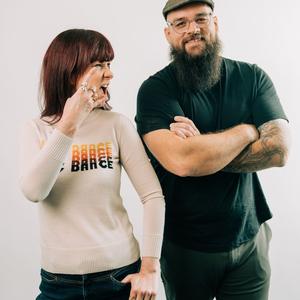

MrBenBurns: I could never work with my wife or husband or partner. You've probably heard somebody say that. Maybe you said it. And every time that I hear it, I think the same two things. One, you're missing out. And two, what does that say about your partnership? Here's why it's on my mind. You know, this year Steph and I both started working with our spouses full time. Same six months, completely different situations. And We realized that we'd never actually talked about it publicly, even though it's changed everything, you know, how every single one of our days works now. So let's talk about it. I'm Ben Burns. I'm a designer, entrepreneur, and father of the year who spent the last decade helping creatives build businesses. And today I run Maker Division with my co-founder Stephanie Owens, an incredibly talented lettering artist who loves sparkly guitars and a good whiskey. Maker Division Is coursework, coaching, and community for creatives who want a real business around their craft. It's 10 modules, weekly coaching calls, real feedback on your portfolio and your capabilities deck. And Steph and I in there every single week working actual business problems with our members. If you've been trying to figure out all of this alone, that's what we built this for. If you want more information, the link is in the description. Now, in this episode, the one conversation almost nobody has before they go into business with their life partner, and the one that decides whether it works. Why at least one of you has to have a business brain, what to do when a client treats your partner badly, and why two perfectionists in one marriage is a genuine business risk. All right, if you work with your spouse or you've been thinking about it, this one is for you. Well, if I'm taking you way, way back, I met I met my husband Nathan, who is our chief creative officer here at Maker Division. ⁓ I met him in our school. So it we've always been creative together. Even before we were married, we we it's just sort of how we came up in the world together and how we grew was was through our own creativity and supporting the other person while also allowing the other person to have their own creative voice and interests and medium. But in terms of actually working together with client projects, it it started, and I talked about this just kind of in passing in the niching episode a couple episodes back, when I was an interior designer and he was working as an art director and also beginning to ⁓ get his feet wet with digital illustration, I needed branding for my interior design studio and I leaned on him for that. Just like I, you know, when I was a classroom teacher and I needed help setting up a website, he taught me Dreamweaver. You know, it's we've always sort of I'm telling you, back in the Dreamweaver, back in the day, my website looked great. ⁓ I coded that thing all by myself. Did not look so great. But I had a classroom website in like 2005. So Who can say that? Not very many people. ⁓ but so he helped me with with my website and he helped me with my kind of my identity design for for like the layman's terms of my branding. And from there we started getting a lot of attention from other interior designers wanting to know who did our branding, and it was it was me and Nathan who worked on it together, sort of me kind of maybe f being the art director of sorts because I knew what I wanted it to look like and him on the implementation side of things. And we just started taking on branding clients together. And I would work on the messaging and the overall aesthetic and art direction and he would do a lot of the implementation. And it's been, you know, sometimes he's been more of the lead than me. It kind of also depended on what was going on at our jobs because we were also working full time jobs and doing the studio part time, if not full time at times and I was the first one to go full time. Then he would help from time to time, but now he's he's in it full time with me. So it's the first time that we've been working together in the last month, ⁓ full time together. But we've been we've been doing this together mm since maybe two thousand fifteen. So maybe eleven years we've been working on this together. Yeah. Yeah. ⁓ my path was a little different because, like, you know, my wife and I got married and we've been together since 2012. And from the time that we got married until this year, we've played very different roles. I can remember right before she was pregnant with with my oldest, she was kind of like our office manager at my studio. And so she would come in and make sure that like We had snacks, make sure that the, you know, water guy was was paid on time and would deliver those big chugs of water and then make sure that like the cleaner was doing her thing and ⁓ schedule a whole bunch of stuff for us, but it was more of like a support role. And she has kind of led the house since day one. And so, you know, I didn't have to do anything. In in life outside of work. Like my doctor's appointments were scheduled, my prescriptions were picked up, like meals were made, everything. Like it was the it was it was the ultimate in in support. And so recently in February, she started baking bread and then posting it online. And her business, her little micro bakery, has just taken off. And so now she's working full-time plus. In a bakery that our house has become like half of our house is dedicated to this bakery. We've got like commercial mixers and commercial ovens and drying racks and proofing chambers and all sorts of stuff. And so she's more dedicated to that at this point, which has shifted a lot of the responsibility for the house and the kids and all that kind of stuff onto my shoulders. We're sharing that. And ⁓ it's just been a really interesting thing to to to watch. Because not only has the responsibility shifted, but then also we're collaborating on this bakery. Like our nights where we used to watch a show, like we're scheming how to get her into a new farmer's market or like problem solving some of the logistics around a a bake. And we've ventured down the branding path, but hit kind of a brick wall, which we can talk about later. But it's been a really interesting thing to like to see this transition happen and how the business and and our the place where we not only live but also run two or three businesses out of ⁓ it's just changed so much. So I thought it'd be cool to like compare notes and see how things have changed for you and see how like you guys have not only collaborated on creative projects together successfully, but then just life. You know? All of life. Well, I think that's it's interesting because what you said is true. It's like there's there's business and there's life and when does one stop and when does the other begin. But I think you kinda nailed it. The business becomes a big part of the relationship. And while I I think that both you and Elise and but first of all, I love that we're having this episode just so we can clear the air that you and I are not married. Important fact. Important fact. This is just Maker Division 101. Ben and Steph are not married. we probably talk to each other almost as much as we talk to our spouses, but that's what happens when you're a business partner with someone. But what happens when you're business partners with someone and also you're married to them? And I think that, you know, you guys got married in two thousand twelve and you're starting in your just now, like in twenty twenty six, starting to work together in a business capacity. And I think that kind of mirrors somewhat with myself and Nathan, even though Nathan and I have always been creative together since creative together since nineteen ninety nine. that's new slogan. New slogan alert. we and we were married in two thousand five. We didn't start really working together on a business capacity, making money together until like ten years into our marriage. So I think that just from my own experience, I kind of knew that the marriage was solid. You know what I mean? Yeah. Yeah. And that made it really easy to just naturally move into it. And so I don't want to take that for granted. I think that you need to have a solid personal connection and relationship with someone before you are in business with them, if you're going into business with your spouse or your life partner, because it really does take up the life and you need to be able to already know how to kind of problem solve together. And when things get rough in the business or there's challenges or even disagreements, it's not going to bleed into the marriage. And that's always been really important for me and Nathan. And I think that we've always been very patient with one another. ⁓ sometimes, you know, especially when, you know, things aren't growing as much as we'd like, or a client's giving us a particularly difficult time, and how do we when we decided to unnease, like there were difficult conversations to have, but like I know that he's the most important person in my life, and so it's gonna work out. It's gonna be great. But Just knowing that you are comfortable having those uncomfortable conversations with someone without thinking like, okay, now is our marriage okay? 'Cause I know it is. It's like we disagreed in business, but you still love me? Like we we've never had to have that conversation because I know the answer. Yeah, I don't think we we have either. ⁓ in in so many different aspects. Like the business is new, but we've always made decisions together, like The decision to pack up shop from Richmond and move to LA, like that was a big deal because we were moving, you know, we were already six hours away from her family and six hours away from my family. But that's like a plane ride, you know, going from Richmond to to LA. And that was one of those moments where, you know, s she made the decision quicker than I did. She was like, Yeah, we're going. And I was like, well, hold now. We gotta think through this. Like she was like, No, no, no. We're going. It's a good opportunity. You need to do this. Let's go. Which is also why when it came to her starting her bakery, it was like, No, we're buying the commercial oven. And she was like, Well, let's think about it. It's like, nope, this is it. You're enjoying this. You need to do this. Let's do it. And so it's like we almost are better at supporting each other than we are supporting our own stuff. And That that has been our through line that kind of like avoids conflict while simultaneously like handling a lot of really tough stuff, you know? Mm-hmm. I think it's also important, like something you said of like Elie saying, No, we're gonna go do this. This is a good opportunity for you, and then you reciprocating that many years later with her and her bakery now. I think it's important to recognize that if you're and I would I would put Elise in this camp of creative business owner. Owning a creative business, like she creates things. She's creative in her brain. She's coming up with all sorts of cool different ways to market. She's coming up with cool different ways to create the recipe. And it's it's her brain child. And I know that you've thrown down on some bruleeed rice crispy treats and things like that, but Which crazy story. Crazy story. We were in a coffee shop this weekend on Saturday. And I look up and there's bruleeed Rice Krispie Treats in a local coffee shop. They copied her. I'm wearing it as a badge of honor, you know what I mean? Because like this is pretty big coffee shop in our area. They totally got that from Elise and Ben. Just saying. Yeah. Just saying. Yeah. ⁓ Tangent timer over. When you have two people in a business together and the business is creative, I think you kind of need and I don't even think it's necessarily just creative, but like the face of the business. I think you need to have like a good conversation about are you both going to be creative? Cause one person's creative is not more important than the other person's creative in the business. ⁓ that's huge. It's it's really big. And I think a good example of how this was done was with my grandparents because My grandparents owned a creative business together. they had an interior design studio in like the 50s and 60s in LA. My grandfather, flip of the gender dynamic of the time, my grandfather was the interior dec he was decorator. And he was the face of the business. His name was literally on the building. And he was very charismatic. He was very good with people, knew a lot about upholstery because he apprenticed at an upholstery shop. So a big part of his business was reupholstering old furniture for people. And he would do that in-house in the back of his workroom. And my grandmother, ⁓ she was very business minded. She was very entrepreneurial. She she only had one kid, which for you know, for the time was probably illegal. So I hope that I'm glad I'm glad the patriarchy didn't find her. ⁓ she was she was very much the boss. And she was the business mind. And I was thinking about this this morning because I knew I wanted to talk about her. And you know that she's ⁓ she was a huge part of my life. And I think that she was an introvert. When I look back at it, and I I never really thought about it because she passed away so long ago, and it was such a kind of newer conversation. She passed away in 2003. And I think for the time. Like it was good for her for business purposes to go to parties and to go to dances and to, you know, have all the friends over and play hostess. But I think she truly liked her quiet time. I think she probably very much enjoyed when my grandfather was out at clients' houses so she could be at the studio getting the bills done, getting the finances taken care of, making sure things got ordered. And she was okay with that. She never wanted to be the face of the business. She never wanted to be the creative of the business. She just wanted to make sure that the business was successful and ran and was able to they were able to support their life and she had a very nice life. And I think that that's one way to go about it. And I don't think that she was that person, but I was the person who was doing that for a very long time. When we transitioned from me being the interior designer to us working together in a branding studio, I was very much the person on sales calls. I was the one kind of project managing everything and I did a lot of the strategic work, but I also I did the messaging, but that's not the work that I wanted to do. And so I was sort of in the role of my grandmother, but I didn't want to be. I wanted to be equally as creative as Nathan. But I also, as soon as I started To become more creative in my role at Gold Sheep, I had someone tell me, What you're doing is not important. You just need to be there to support your husband because he's the important one and his work is better than yours. shit. No way. Yeah. Like this was not easy to hear. Was this a dude or a lady? It was a dude. Of course she knew. Some dumb guy. Right? Gross. As as Courtney Love so famously says, who made this rule? Some dumb guy. It was a guy. we need to su we need to superimpose that little clip of her saying that in this episode. Yeah. I don't have to ⁓ like listen to a rule. Who made that rule? Some dumb guy. Some dumb guy. ⁓ yeah, and I stopped talking to him after that because I was just like, fuck the fuck off. ⁓ at least for me at that point, I knew that he was full of shit, but it still wasn't great to hear. And of course Nathan never thought that. So we've purposely moved towards his creative is equal to my creative. One is not better than the other. But I think and we can talk more about how we handle that with client work and our own creative. Like I think that's something, you know. To consider, like, how does that work when your two creative powerhouses, not that I'm like saying I'm a powerhouse, but like when your two creative powerhouses come together, how does one not how does one not compete with the other? ⁓ but I think these are important conversations to have and to be honest about it, to not just be the person that's like, yeah, I'm gonna be there to support. Let's be real. It's normally the wife. saying I'm gonna be there to support my husband because he's the important one. ⁓ I'll just do paperwork. I'll send invoices. And if that's what you truly want to do, like my grandmother, because ⁓ my grandmother was not a shy person. She was very authoritative. Her dad was a judge. So it's like she was she was in charge. There was no part of Gloria that ever thought I'm not as important as my husband. Quite quite the opposite. Their relationship was very atypical for the time period. ⁓ and it's a big reason why I am the way that I am. And if you're in the community, you know what that means. You're all like thank you, thank you, Stephs, grandma. But I think just having an honest conversation with your partner about do you want to be equal creatives? Or will one be the creative and one be like the business minded one? Because I don't really see it working any other way. But with a big caveat, at least one of you does need to have a business mind. Cause you can't both just be business owners and the business minded ones. And you can't both just be the creative. At least one of you needs to have a business mindset. And I think Nathan is more of a marketing mindset. And I'm more of like the business operations mindset, which can there. Adam Savage has this thing where he's he talks about balancing creativity and commerce. And the cool thing is that when you have a business partner, it's like one of you can be really more towards the creative side and the other one can be really towards the commerce side, or a combination of anywhere else, as long as there's balance in the unit. like in the partnership unit. And I find that just keeping that concept in mind has helped me navigate things. ⁓ because like Elise is totally the creative when it comes to her bakery. Like she's very competitive. That five foot nothing little girl wants to go out there and just crush it. ⁓ but she she she really just wants to focus on like I want to bake really good bread. And then be an incredible customer service person to whoever I'm selling the bread to or negotiating with and stuff. ⁓ whereas I'm kind of like way more behind the scenes and going like, Hey, you should post a reel today, or like, hey, you should ⁓ give your wholesaler a call because we haven't heard from them. You know, I'm kind of like nudging her to to go out and and and do this these things. So the the balance is there. But it's almost easier for us because I have absolutely no interest in baking other than like eating the stuff that she makes. Or coming up with a cool idea, which she can implement. But yeah, I think like being open to receiving the feedback on the creative. If you are the creative one, if your situation is like you and Elise with the bakery, if you're the creative one and your partner is more of the business minded one. Let the business minded one give you some feedback on the creative. I think that's that's important. Cause I know Gloria gave my grandfather feedback on probably the color of drapes or something like that. Because if I look at the two of them, I'm like, grandma had way better taste than grandpa. How did that even work? But I think that you just need to let go of the ego in general. Can we all just like s have this be the era of ego death, please? But especially when it comes to working with your spouse, you have got to get rid of the ego. Because there's no one who's gonna be more honest with you than your spouse. I hope. Yeah, hopefully, right? Like afterward. Yeah. And you have to be open to it because most of the time it's really good feedback. Because they care about you more than anyone else. Mm-hmm. Yeah. Absolutely. Nathan will t push me. Nathan will push me. I will do I if I'm doing A roll and he's just like, You gotta film it again. You gotta film it again. And I'm like, fuck, I don't wanna film it again. I was good enough. And he was like, No, more energy, more energy, smile. And I'm like, Ugh, it's the only time a man can tell me to smile when I'm not like, Don't tell me to smile. But he he sees what I'm not seeing. He sees the resting bitch face that's in the camera, like, ⁓ ⁓ And he's just like, You can do better, you can do better. And it's not me thinking like, Why are you so mean to me? It's like, No, you're right. You know I can do better because you see me do better. Mm-hmm. Yeah. And I think that you're also gonna bring different experience levels in different areas to the table too. Because like I can take one glance at an email that Elisa's gonna send out to a wholesaler and go like, here's the three changes that you can make that'll help this convert better, you know? And simultaneously, sometimes with with the kids stuff, I'm just like help. And she's like You gave them way too much sugar or whatever you know I did wrong. It's ⁓ so you're telling me you're learning how to dad? Pretty much the kids the kids are like Yes Dad's in charge. But I think this is this brings up a another good point. It's when you're both working in the business who takes care of the house. Mm-hmm. And I think that, you know, Nathan and I, we we don't have children, but we each have our own challenges in life. And we sometimes I'll do the dishes, sometimes he'll do the dishes. I think this is where it's like if he went to the grocery store last night because I was I was I was supposed to go to the grocery store last night. But I was still in B-roll hell working on a video and a very ambitious video, trying to get as many angles and using a new setup. And I was running behind and I was just like, Can you go to the grocery store? I actually didn't ask him that nicely. I which he pointed out, I was like, I think I'm gonna have you go to the grocery store. And he was like, ⁓ you gonna ask? I'm like, I'm sorry, I said that wrong. Could you please go to the grocery store? I'm making sure that I say it correctly because he's our editor and he will be like, Babe, that is not what I said. That is not what you said. You straight up told me to go to the grocery store. So, ⁓ so he went to the grocery store because I had to wrap up and I think that's where communicating what you're doing in the business and having like we have daily check-ins where it's like, What are you doing today? I'm doing this, what are you doing today? Okay, this is also what needs to get done around the house. Who's gonna be doing that today? It's same. Yeah. We do that daily check-in too. It's like whenever we're brewing coffee, we stand there, it's like, okay, what you got? What are you what are you doing today? because like she has days where her stuff is either really intense or things that just can kind of fit into normal life. Like when she's mixing dough, for example, that's like a hands-on activity. She can't do much else for an hour. Same thing with like shaping loaves. ⁓ but like putting stuff in the oven and taking it out she can be in total mom mode while she does that. So it's it's been interesting kind of like learning her process to know when I need to support and then identifying ⁓ things that's like, hey, I've got this. You need to do this. I've got fourteen calls today. I'm gonna be out of pocket, you know? ⁓ and it's just a Every single day we kind of have to check in and and figure out how the day is gonna go so that we get to the end of the day and we're not like totally, absolutely fried. But one thing I I also have really appreciated and it's not new to me, but it's a little bit newer to Elise is that for years she's had a really good monitor on my energy. Cause like I'm I will work until I go to bed. Like I'll I'll wake up, roll out of bed, start working, work all the way through, taking time for the kids, of course. But then after bedtime, I'll be up until two or three in the morning. She's known for years when to point to me and go like, Hey, no work tonight. You need to go to bed. I'm finding myself doing that for her now. And it's just kind of like this this weird and wonderful thing where when you do have a life partner that can kind of meter your energy in that way, they can be, I don't know, your watchdog, where it's like, hey, it's likely that if you keep going, you're gonna poison somebody, so you need to go to bed. ⁓ For the love of all, go to bed. Seriously. And I think it's also something that Nathan and I have started doing now in the last month that he's been, you know, full-time working with me. ⁓ is, you know, we're not each other's bosses, but telling telling, like, hey, you need to do this. And for him, he needs to have Friday be the day where he is not working on anything for Maker Division. And not anything for gold sheep that requires both of us. It is his day to just work on his creative. I'm like, that is your day. Just do that. And he loves it. And for me, I'm always working. I'm always working. We we have he his friend will come over on the weekends. I'll be sitting at my desk and he's like, always working. I'm like, Yeah. But Nathan will say, like, you need to you need to take a week off. I'm making you take a week off. When is the next week you can take off when you when you don't have a one on one? Because you you always tell me, Steph, calm down, 'cause you know I have health challenges, but Nathan sees it. He's here in the house with me. And so for him to point out like, you need to take a vacation, you're not allowed to work on anything for maker division for an entire week. When is the next week you don't have a one on one where you can step away? He was like, the podcast doesn't need to be re we don't need to record podcasts in advance. And he's total but he's also like, We need to get a podcast out every week. We need to get a podcast out every week, every week, every week, every week. But he's like, ⁓ we'll have one week where we don't have a podcast because you have to take a vacation. You c when was the last time you had a day off? And I'm like, I have no idea. So looking out for each other on that sort of like you and I look out for each other on a personal level, but it's much deeper. And different when the lives yeah, it hits harder. Yeah. Yeah. Yeah. I've I've I've noticed that. And that's that's just like one more reason why when people say like, ⁓ my God, you work with your wife, I could never do that. Like I've heard that in the past. Like, ⁓ I could never work with my partner. Number one, you're missing out. And number two, how are they your life partner then? Like it just doesn't under I d don't get it. I don't get that either because I think it's like that's kind of a red flag for your marriage in my opinion. Sorry to anyone who A little bit. It's a little red flag that's like you can't do life in all its ways with your life partner. ⁓ okay. Like you wouldn't say I couldn't have kids with that person. Right. Yeah. And and it's so weird. It does it makes no sense. ⁓ one thing I do want to touch on is How do you handle when you're both creative? When you are both the creator. Yeah. I was gonna ask you about that and then like how you collaborate on clients and like how that flow basically goes. Yeah. Let's start with clients. I think that's probably the most relevant for a lot of our audience. There's kind of two aspects to this. One is who kind of takes lead on a client project. And it depends on the client. for the podcast artwork that we did for a UFO disclosure podcast. ⁓ Friends We Haven't Met Yet. Nathan took a lead on the art direction on that one because that's very much his wheelhouse. It's his world. They came for Nathan's illustration style. And I I just made my lettering fit within that style. I still was the one who had the calls with the client because that's just that's my wheelhouse. And I was the one who invoiced and contracts and all of that stuff. But when it came to the the art direction of the project, Nathan took lead. Flip side, ⁓ the Bloom House that we did last year, which was this kind of historical church being turned into an event space in rural Arkansas, very ⁓ kind of art nouveau driven. I took lead on that one. I I did what I normally do. he and I will throw down on mood boards together, stylescapes, whatever you want to call them. Typically we'll work on that together. But for this one, I was just like, I've got it. I've I'm I've got it. All I need for you is to illustrate some flowers around the lettering. And he was like, okay, I got it. And so I took lead on that because of the style. was more in line with my work. ⁓ and I then directed him on, you know, the style of flowers and the type of flowers and kind of where they should go. But I didn't over manage him because I know he knows what he's doing. Right. Yeah. I just I just handed him my illustrator file with the with the lettering and I was like, now make flowers all around it and and he nailed it. ⁓ is there anything else you want to know on a deeper level with that? Well, I think that it's interesting that the thing that you trade on and off is the art direction because Nathan as an illustrator has like a really clear lane. You as a lettering artist has a really clear lane. And then the overlap, like the the part in the middle where you both could do and are equally as good at, operations, creative direction. Anything else in there that that like would kind of cross over? I don't think so. I mean, he's always got great ideas. And a lot of times I will bring the brief to him and he'll add ideas to it. And that kind of sometimes lends itself to the mood board concepts that we send to clients. The less he can talk to clients, the better for him. Not that he's a horrible person to talk to. It's just that's not a part of this that he enjoys is the the presenting. He doesn't like the idea of presenting. And so when we do work with clients and he is on the call presenting with me, I take lead there. ⁓ one it's just one of my strengths because of of teaching for so long. And he just does not like public speaking. He doesn't like presenting. It's there's nothing about that that Is comfortable for him. And he's definitely not the type of person who's like has to stay inside his comfort zone all the time. Like he and I have been talking about how he needs to make video. But I think that's on his terms. And it's not a live studio audience watching him. And that's why it's like we were not gonna do this for his first video, having it sounding. That's just he needs to find his own path with video, and that's not really like the way it is with. presenting to clients. It's a it's a slow build. We're gonna like we're we're gonna build and then unveil Nathan. And it's gonna and you'll all see him and you'll all fall in love with him and you'll all think he's more important than me. No, just kidding. But that was another thing I wanted to bring up was when you're working with clients, I wish this was not the way it was. And obviously I'm talking about relationships where ⁓ it's a man and a woman who are married that I just big ass right there. I don't wanna leave anyone out. But if you're in if the marriage is a man and a woman, and I wish this was not the way that it is, but it is. There are corners of the design internet that are very female, and there are corners of the design internet that are very male. And I think it's very important that whichever one you end up in, if you end up in one of those, I'm not saying all of the design world is gendered like that. But it's true. And we've been in both. We've been in both. And we started with a very leaning, very female. And it got really toxic really quick with clients saying things like, Your husband just doesn't get it because he's a man. He doesn't understand how to pick the right yellow because he's a man. And I was like, first of all Ain't no one picking colors in this house but me. That's not Nathan's strength. That's color is my strength. And it's not that it's not his strength, it's just more of my strength. So I always take lead on color, no matter what the project is. I've I've taken lead on color. And I just have to stick up for my husband. And it's tricky. And it's more so of not necessarily a well, listen, let me tell you what's up. It's not about confronting the client. It's about figuring out how do we make sure that this doesn't happen again. How can we make sure that I'm never putting my husband in a situation where someone is just falsely accusing him of being a man who doesn't understand color, which is just weird. Flip side of that. There's a very male dominated side of the industry, which I would say is a side that I'm on right now, or I'm in right now. And luckily, on the client side of things, I've never had to deal with anything. Because just we have good people in our in our client roster. Like sometimes they're a little shocked to find out I'm the guitar player. And they're like, wait, what, those are all yours? And they're fine with it. They I've never been asked, like, well, name me three songs from Muse before I bought I saw you this guitar. I'll be like, I owe three songs you under the table, friend. I've never been asked that. I've just always been like celebrated in the corner of the internet that I'm in with clients. With the education side of things, not so much. And and I talked about that in our very first episode. And it's one of the big reasons why I have a hard time being on camera and things like that. But that's where Nathan has always done a really good job of just making sure that I'm presented in the best possible way because he knows how nasty some people who live in their mom's basements can be on the internet. And Being there. No shade if you're a delightful person living in your mom's basement. I am I I didn't mean to offend, but you guys know what I'm talking about. You guys know what I'm talking about. Yeah. ⁓ I'm like, okay, you're you're obviously ⁓ a a troll on the internet. ⁓ but those things they they they aren't always the best to hear. Especially when you, you know, you Have a disease that radically shifts the way your face looks from day to day. And ⁓ it's just not it's just not fun. And he not only, you know, always wants to make sure that I'm presented in the best possible way, but also is there to support me when nasty things do happen. And just sometimes he will get vocal on the internet about it. And sometimes it's just more of like just, you know, saying nice things to me and. Telling me how dumb they are. But so I think there's there's that aspect of it. It's like if the clients are not treating one of you correctly because there's some issues with gender there, you have to remember that your partner is the most important person in that relationship. They're more important than clients. And sometimes We have just been like, okay, we just need to get through this project and get this person out of our lives because they're miserable. And luckily it's only happened like one or two times. But we've always afterwards said, okay, how can we make sure that we never work with that kind of person again? What were the red flags? Do we need to change copy on the website? And that is literally when we decided to burn down the entire business, change the name of the business because we just kept getting these sort of toxic. clients that treated him so badly that I was just like, I can't have this. I can't have it because it's like not substantiated in any fat. Because Nathan is like not a sexist person. He he's the nicest person. And and I was just like, why is he getting so much hate because the colors are off? Like calm calm down. So just look looking out for one another in that way. Yeah, I think that that's that's really interesting because Elisa's had conflicts that have been resolved. ⁓ And in wanting to protect her from conflict, I've actually had to prevent myself from stepping in and then like inserting my side fourteen shoe into somebody's ass. ⁓ but like there's a big difference between like real business problems, conflicts, because they're just rough to work with, and inappropriate conflicts. ⁓ she was dealing with this person that wanted ⁓ her to ship this bread all over South Carolina. And we don't, you know, she didn't want to offer shipping because the moment you put her products in a resealable pack, it just ruins the quality. ⁓ and so like this person was really getting kind of abusive. And he found her phone number online and he was sending her text messages and Facebook messenger messages. And ⁓ thankfully it wasn't anything extreme. But it was to the point where I was like, give me the phone. Yeah. And I handled it. You know what mean? But then there's like real conflicts that are as a new entrepreneur dealing with a difficult wholesaler, for example. You know, somebody that pays the invoices late or is a little bit picky on the the the ordering size. That's when I'm looking at it going like, hey, I've been coaching people through these for years. Here's what you do, you know, and I kind of like push her out of her comfort zone to hold a boundary or like draw a line. I think knowing the difference is really key when you're in this partnership world with your life partner, because like you do want to maintain the client relationship and provide great service and and and that kind of thing and see your partner grow. But then there's the line, and the moment somebody crosses that line and enters my domain. I'm really kind of thrilled about it and ready to go, you know? ⁓ so's Nathan. He's ready to throw down. Yeah, but if I if I think back to the one client who d who specifically said Nathan didn't understand her color choices, Nathan in that moment didn't feel violated. He didn't feel unsafe. So it wasn't it wasn't a time for me to be like, wait, listen, you're being unfair to Nathan. I was just like ⁓ interesting that you say that, because I'm actually the one that chooses all of the colors. And this is the this is the infamous story inside of Maker Division where I was like, okay, tell you what I'm gonna do. I'm gonna mock up your logo with ten different yellows so we can get to the root of what kind of yellow you really are looking for. And I did, and she pointed to of course she pointed to the one that was the original one. She's like, ⁓ my god, it's that one. That one's amazing. I was like, fabulous. That's actually the one that we had originally picked for you. And she was like, shut up, no way. And I was just like, ⁓ get her out of my life. But Nat Nathan just took it in stride. It didn't bother him. And then afterwards we were like, okay, so no more bloggers, no more bloggers, right? We can't be working with bloggers. Okay. We're not working with fashion bloggers anymore. Got it. Awesome. ⁓ but when people say nasty things about my looks on the internet. That's when Nathan wants to step in and he doesn't always. And sometimes like when that happened to me at the future, he very much wanted to comment. But it wasn't my platform to comment. I think if it was done now on Maker Division, that this is our business, I would be the one to comment. But I didn't feel safe because it wasn't. Followed by his size twelve and my size fourteen. Boom Shut up. But I but with like yeah, but with this like guy calling Elise, that is not okay. That is definitely a line. Give Ben the phone. So you have to just make sure that your partner feels safe and supported and if it's not crossing the line but it's a problem, either, you know, coach coach the like you did with Elise her through the challenges because this is it's not the easiest gig. Owning your own business. But if it's, you know, if it's a systemic problem, how can we move the business away from this problem that continues to happen? Yep. Yeah. But then there's also when you're both creative and you're doing your own personal work, how do you do that? And that's always been kind of tricky. And we've come to just sort of embrace That that's the way it's going to be. Because What's tricky about it? Well, Instagram algorithms. Okay. Yeah. ⁓ when you are making something that you want to see in the world and you also want your partner to make something that's theirs in the world, algorithms don't like that. And algorith algorithms like clarity. And it would make absolutely no sense, even though I think that stylistically, my work and Nathan's work belong together. They do. That's just that that's just it's just sort of how I knew when I became a lettering artist that I was, you know, my brain was, I'm here to support Nathan. So I'm gonna learn a a particular style of lettering that complements his work. And actually just kind of like that style anyway. And so Now that I'm like not seeing myself as I'm here to support Nathan, if he's making illustrations on Hermeticism and esoteric philosophy and UAP disclosure, and I'm making cocktail videos about rock songs that I love that are also have like title treatments, those those seem like two very different worlds. And so what we've just decided to do is just embrace that. And keep Instagram separate. We don't need to have the same Instagram, even though we work under the same umbrella of gold sheep. ⁓ we've just decided that I'm the one that's gonna have the gold sheep name as my username, and he's just gonna keep his artist name Z prep that he's had for years before we even worked together. But all of the work visually looks like it goes together well on a website. That's fine. I'm far I'm far less concerned about the website and more about You know, anything where it's like if we're making videos and content and creating a world around our art, how can we do that together? But also feed the algorithm what it wants. And it's just it just came to the decision of his work is on his Instagram, my work is on our Instagram, it's all the same studio and I give him feedback on his on his creative. Like he's working on a piece right now and it's his second in this series that he's working on. And I was looking at some of the curves and I was like, that really reminds me of Art Nouveau. And this is where I think having not the same style all the time really helps. Because I'm looking at his work from my perspective, and I'm like, ⁓ what if you made this more whiplash, these corner borders like more whiplashy, like a like an Art Nouveau? And he was just like, Do you have any Art Nouveau books I can look at? And I was like, Yes, I do. Let me go get them. And then with my work, he's looking at the type. in the videos and he's just like, ⁓ you should probably you should probably align them right here. Make sure don't do center. Make sure it's left. He's helping me out with the things that he's really strong at. But making sure that there's that clear separation of I can do whatever I want on my Instagram and you can do whatever you want on your Instagram. And we're fine with that. It's like I keep saying, I keep referencing the Ryan Holiday book. The obstacle is the way and the obstacle forever for us is like, how do we make everything work together? You don't. And that's okay. Two Instagrams. Yeah. And I think that that's more just social media in general. Like that's the problem with a lot of these brand accounts. ⁓ because if you have a brand where you don't see the humans behind the brand, that's one thing. Like that brand could be all of your work combined. But the moment you see humans, the moment you get to interact with faces or hear somebody's opinions or whatever, people are gonna be drawn to one person more than the other. Like individual humans are gonna are gonna align themselves with one person more than the other. ⁓ my favorite brand, ⁓ Alcalon Trio. I could listen to Dan Andriano all day. He's like the bass player in the band and he also sings. But he sings on like 20% of the songs, but that's why I show up is for him and his voice. And ⁓ I'm in the minority, you know what I mean? Like most people like Matt Skiba, the main singer. And I I think that like the moment you can tell who's behind the brand, there's an alignment thing. And so like that automatically puts one person higher in the importance ranking. ⁓ than the other one, which never really works. Never interpersonally, you know? It doesn't work w even when you're not married. Yeah. But when you're married, it like it's really important. Especially if you're going like the the me and Nathan route and not my grandparents, where my grandmother did not care. But there should never be one person who's more important than the other in If you're both in the public eye. True partners. Yeah. Yeah. And so it's something that you and I struggle with. And and we're how do we fix that? And we have no real solution for that. ⁓ maybe someday we'll figure it out, but maybe we don't need to. Maybe that's the obstacle is the way we don't need to for us. But for gold sheep, I have a clear creative voice. He has a clear creative voice. Those voices work really well together on a client project. He feeds me good information for my personal studio work. I can help him with his personal studio work, but we're never dictating the point of view. Yeah. I will say that like something that you mentioned about you guys both critiquing your work and giving suggestions and stuff like that. That's something that is new to me recently. with Elise going And creating a bunch of content. I mean, number one, watching her work with no baggage, like zero expectation. She's just like, Let me just make a reel. I'm like, ⁓ okay. Are you gonna script it? ⁓ pr schedule product and she's already recording the reel. ⁓ but like having somebody to bounce ideas off that like actually has not only experience but like, you know, a a s say, like an opinion that I value above all others come to me and go like, hey, that reel that you were working on, wouldn't it be cool if X, Y, and Z happened? Mm-hmm. It's like, ⁓ man, yeah, you're right. And, you know, watching her go and create a bunch of s ⁓ TikTok. I was gonna say Snapchat, but TikTok content. It's like, she's like, no, no, no, TikTok is a superpower. I'm getting like thousands of views on these videos versus Instagram. And I'm like What? Really? She's like, yeah, I don't know any of these people. You should get on there. It's like, ⁓ okay. It's because she's lo-fi. I don't know if Ben Burns content would do well on TikTok. It was a good experiment. You might as well try it. But I think that's I that's another point where I don't think if b ⁓ if I'm gonna get in trouble. If both people are perfectionists. That's gonna be hard because I'm married to a perfectionist. You are a perfectionist. I am surrounded by perfectionists, and I see what Elise is doing, and I'm just like, that is so refreshing. She doesn't come with that baggage of perfectionism, and the video has to be perfect. But I also think that having one of you, and I would say I'm more of a perfectionist than Elise. But not as I'm on the scale of Nathan to Elise and Ben and Nathan to Elise, I'm somewhere in the middle. But I think having one person in the relationship who is not so much of a perfectionist is really helpful because then you can start pointing out like at what point is this a diminishing return? Right. But I will say, as a self-professed perfectionist, ⁓ Sometimes just having an external perspective can help, right? Like I remember when Elise was was testing out a whole bunch of new recipes and she was fighting with ingredient ratios. It's like should I do this much more cheddar versus Asiago and you know all this kind of stuff? ⁓ and it got to a point where I was just like, can't really tell the difference, but she could. And I was just like, you know what? I think it's I think it's good enough. And I rarely say those like those kinds of things that's not in my frequently uttered vocabulary list. Mm-hmm. But it's you're looking at it, you're looking at it from you're not the baker, you're the consumer. Mm-hmm. Yeah. And this is where you're able to drop the perfectionism. But what if Elise was your partner in Alden? And she was a designer and she made videos and was working with clients, it might be a little and and she might be more challenging, yeah. In she was equally as ⁓ much of a perfectionist as you are. I think that's where it would be a little tricky. ⁓ and I also realize that my husband gets to taste test cocktails and you get to eat bread and your sad lives. ⁓ We're so unlucky. So unlucky. No, yeah. And but I do think that identifying how your partner is strong and and where they may be a little weaker is just a good thing to kind of keep in mind because I think you knowing that I am a perfectionist allows you to go, hey, cut the shit, get this out. And I think even if we were similar, you know, just knowing that, hey, we're probably falling into this trap together, ⁓ would be would be really beneficial, you know. I think that that external perspective on your own mind ⁓ is super valuable, especially if you're working with somebody that, you know, knows you best. And I I think that there's also an aspect of Nathan you know it too, but you don't pick up on it as much as Nathan. Nathan sees every he sees all. Like you will call out I think you said something like, I have a disdain for the camera where Nathan knew immediately I was uncomfortable on camera. You both were able to call out something about my ability to show up in front of a camera and read a script where you were the one that let me know there was a problem. Not that there was a problem, but that it just wasn't my best day. He was the one that was able to diagnose why it wasn't my best day. And he was And offer a solution too. Yeah, he was like, You don't like scripts. Why don't we just throw out the script and just riff? And I was like, Okay, let's try that. And while having both is great. I think that deeper connection with your partner of like this is why because I know you like no one and I know why you're having a problem with this and let's fix it was very helpful to hear both from you, Hey, Steph, we gotta figure something out and then for them to be like, Yeah, I know it I know why. You don't wanna do you don't wanna do video like that. It's not that I don't wanna do video, I didn't wanna do video like that. So that helps a lot. Right. Yeah. So I guess to to really wrap this up, ⁓ we don't have anybody any any actionable tips, but You know, if you've never worked with your partner in life, maybe give it a shot because there's two people right here who absolutely love it. And we are seeing we're seeing more of it in the in the division. I just remembered Caitlin, one of our members also works w also works with with her with her partner and then the coaching call that you had. It's it's great. I just It's a thing and it's cool. Yeah. My biggest my biggest advice. If I were to just give one tip, lose the ego. That's it with your spouse, like you have to it has to be an equal playing field. What's one tip that you would leave people with? I'll give two. ⁓ know your partner, know their strengths and weaknesses, right? And just know what the right support is to give them at the right moment. Because sometimes your partner's gonna need to slow down. Sometimes they need a gentle push ⁓ and knowing when the right time to do both is is is everything. And then something you said, you know, something that we do, communicate, you know, have that morning meeting where you're like sipping coffee and then like rocking a baby is like, What do you got going on today? Me, it's more like letting our dog to each other letting our dog out for the fifth time in the morning. He'll just be like, I'm like, Okay, I'll get the dog. You figure out what you're doing today. It's not as much as a baby, but yeah. Communication's huge. Yeah. Go work with your spouse, maybe. But do it. Have fun. And I will see you next time. Quick recap. If you're gonna work with your partner, the marriage comes first, obviously. And it has to already be solid. You need to know how the two of you handle a hard conversation before you're having one about a client. And then have the conversation that nobody has. You know, are you both going to be the creative? Or is one of you going to be the creative and one of you the business mind? Are you going to split those roles? Both answers are fine. You know, Steph's grandparents ran a design studio on the second model for decades, and her grandmother wanted it that way. What breaks people is leaving it unsaid, because then somebody quietly becomes the support act and starts to resent it. And one rule holds, no matter which answer you pick, at least one of you needs a business brain. You can't both be artists and creative all the time, 100%. Then, super important, lose the ego. That's Steph's whole tip, and she's right. No ego about who does the dishes, who sends the email, whose work matters more. Equal playing field or it isn't a partnership. I'll give you two. Know your partner's strengths and weaknesses well enough to know whether this moment calls for a push or a full stop. And communicate. You know, we do ours over coffee every morning. The business and the house in the same conversation. So if you're interested in having that kind of room and those kind of people, people like us around you all year, that is maker division. Coursework, coaching, community, and Stephanie in there with you every single week. helping you with your business's problems. The link is in the description below. And ⁓ you know drop a comment. You know, do you work with your partner? Tell us what's actually difficult about it and tell us how it's changed your studio over time. I think that's it. We'll see you next time.
ABOUT THIS EPISODE
Could you build a business with the person you share your life with—or would working together wreck the relationship?
Steph and Ben have both started working full-time with their spouses, but under very different circumstances. Nathan joined Steph at Maker Division after more than a decade of creative collaboration, while Elise’s growing micro-bakery has changed how she and Ben divide their work, home, and family responsibilities.
In this episode, they discuss the conversation couples need to have before mixing marriage and business: Will you both be creatives? Will one person lead the creative while the other manages the business? Whose work gets prioritized—and who handles everything else?
They also get honest about creative equality, protecting your partner from toxic clients, knowing when to step in, sharing household responsibilities, handling perfectionism, and keeping two distinct creative voices alive within one studio.
In this episode:
• Why a solid relationship must come before the business
• Choosing between equal creative roles and creative/business roles
• Why at least one partner needs a business mindset
• Avoiding the “supporting act” dynamic
• Giving honest feedback without bringing ego into it
• Deciding who leads each client project
• Protecting your partner when clients cross the line
• Dividing business, household, and family responsibilities
• Managing two different creative identities under one studio
• Knowing when your partner needs a push—or permission to stop
• How the person closest to you can see what you cannot
Working with your spouse will not solve problems already present in the relationship. But with trust, communication, clear roles, and an equal playing field, your partner may become the best business partner you could have.
Learn more about Maker Division:
https://www.makerdivision.com/
CHAPTERS
00:00 “I could never work with my spouse”
01:54 Steph and Nathan’s creative partnership
04:45 Ben and Elise’s unexpected business shift
07:42 When business and life become inseparable
08:00 Ben and Steph are not married
09:25 The relationship must come first
10:51 Supporting each other’s opportunities
13:18 Who is the creative—and who runs the business?
16:40 When Steph was told Nathan’s work mattered more
19:00 Why someone needs a business mindset
21:35 Honest feedback and losing the ego
24:21 Who takes care of the house?
28:06 Protecting each other from burnout
30:03 Is refusing to work together a relationship red flag?
31:13 How Steph and Nathan divide client projects
35:28 Gender, visibility, and creative recognition
39:52 Your partner matters more than the client
41:15 Knowing when to coach—and when to intervene
43:47 The infamous ten yellows
46:08 Two creatives making personal work
48:32 Separate accounts, shared studio
49:49 When audiences prefer one partner
52:20 Creative feedback from the person you trust most
53:38 The risk of two perfectionists
57:22 Your partner sees what you cannot
58:55 Final advice for working with your spouse
1:00:50 The essential recap
Do you work with your spouse or partner? Tell us what has been rewarding, what has been difficult, and how it has changed your studio.
Interested in joining Maker Division’s next Las Vegas retreat?
English
United States
explicit content
TRANSCRIPT 🔗
Disclaimer: The podcast and artwork embedded on this page are from Ben Burns & Stephanie Owens, which is the property of its owner and not affiliated with or endorsed by Listen Notes, Inc.
EDIT
Thank you for helping to keep the podcast database up to date.
