
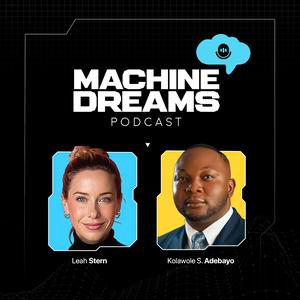


speaker-0: Hey everyone, and welcome back to Machine Dreams, where we speak to the people who are building the future of AI about what's working, what's not working, and what comes next. My name is Sam Adebayo. I'm a technology analyst working at the intersection of AI, cybersecurity, business, and society. My co-host, Leia Stan, unfortunately couldn't join us today, but will be back with us soon. Today I'm joined by Joan Torcel is a co-founder and CEO of Speech. Speech is a Stockholm-based company building AI agents for sales teams. And Johan has an interesting story. Before building Speech, he says that he turned down opportunities to join companies like Polantier Matter because he wanted to build this company. And today's speech is backed by investors and operators from across the AI and enterprise software world. And Yohan and his team are Trying to answer what I think is a really, really interesting question about the future of sales in an AI-driven world. Johan, welcome to Machine Dreams.
speaker-2: Thank you very much. Great to be here.
speaker-0: Great to have you. how's it going in Sweden today? What's the web?
speaker-2: Very well. It's a it's a Sunday. I've had three new customer onboardings today and lots of continuous customer conversations. So that's the best way to spend a Wednesday.
speaker-0: that's exciting. That's exciting. And I think it it it would leave some bit of inspiration with some of our listeners and viewers. The the fact that you you turned down opportunities to work at some of the biggest companies in the world to do this. Why did you do that?
speaker-2: I mean, I would lie if I said it was a super easy decision. It never is. And the ones that dame deems it to be so, yeah, they're either lying or they're just oblivious to reality. But my reasoning behind it was simply the opportunity to build this is now. Companies like Palantir, like Meta, like whatever big company today, they'll probably be there in the future and there will be many more so. However, the opportunity to build what we build now is now. So why wait? The opportunity won't exist in the future. Let's capture it now.
speaker-0: Great answer. So let's let's get right into it. a lot of companies are rushing to put AI agents everywhere, including in the sales cycle, but you believe that sales is fundamentally human, right? I'm I'm curious to hear what you have to say. do you think that in a world where a lot of companies are rushing to automate things, do you think that a lot of these companies are automating the wrong thing in the sales cycle?
speaker-2: I think many companies do, but I think also you only hear about companies that try to automate everything, especially the ones that want to do controversial things like replacing the human in these type of activities. However, what I hear from most people is that they actually do not want to replace the human in, for example, sales, that you want to automate all the administration around it. I mean our entire thesis is, as you mentioned, that sales is intrinsically human. In the end People buy from people, they want to have someone they can trust. And that is the entire thing that we build the company on. We have kind of an anti thesis as well against these companies that provide AI sales reps. Because we simply think that is not how people buy today, how people would buy in the coming three to five years. And we see that the human has a strong fundament there. Yeah.
speaker-0: I I think it's really exciting what you're trying to do because I've heard a lot of rhetoric about from some of the biggest people in the space about how AI is gonna replace this role, it's gonna replace this person. And there's real fear in the minds of a lot of knowledge workers, especially across the world. And so it's it's kinda like a breath of fresh air to hear someone say, Hey, we shouldn't be replacing that. but I want you to get into some specifics of those things that AI shouldn't be replacing, especially i in sales.
speaker-2: Yeah. I mean I think there's only one thing that people should do, and that is what is intrinsically human. That is building relationships, building trust. An AI agent cannot do that in the same way. I mean, when you go for a coffee with someone, you go for a lunch, you cannot have a robot to replace you there. You cannot trust it in the same way that you can trust a human. Now, I'm not saying that that's gonna be the case forever, but I think that's the case for today, and again for the coming three to five years. Now, what does that mean then that humans should not do? If you look into sales, today roughly 78% of the time of sales rep is spent on everything around this relationship building. They do everything from identifying which companies to approach, qualifying them, researching them, identifying who to contact at these companies, finding the contact details, looking into their background, what hook should I use, and then making a cold call to actually do the human piece. I think that entire prospecting, the lead generation of prospecting should be automated by AI agents. The second piece of that is. When you have made that connection, you have booked the next meeting, lots and lots of time is wasted on just research, like base research, understanding what the company actually does, what their competitors are, who works at the company, who are you speaking to, what's their background, what are their hopes and dreams. Like all of this that is super important to do prior to a session, but that simply takes lots of time. Then after the session, mechanistic things like just keeping your CRM updated. On average, I think it's like 10 to 15 minutes. That spent on just updating your CRM. And this means just moving deals in a pipeline, updating different fields, like setting up follow-up tasks. Again, these types of activities were not meant for people, and it has purely been an administration exercise, perfect for AI agents to take care of. And then beyond that, with follow-up emails, getting advice on how to push deals forward, or just how to improve your overall sales processes. Like there are so many things around the sale that People might not really think about when it comes from outside the industry, but that the majority of the time is actually wasted on.
speaker-0: Great. there's so many things that I wanna ask you. you know, I I've seen this pretty remarkable, I think pretty remarkable number. And I think you've also written about it recently, that salespeople apparently spend only around twenty-two percent of their week actually talking to customers. And you know, you would think that in a world where we have a lot of sales technology, things like CRMs, you know, automation. And now AI agents. You will think that, you know, a lot of salespeople will be doing more talking to people because now they have these systems that can automate the other things that they're they're supposed to do. So I'm I'm curious about this, really, really curious. Why are salespeople still spending so little of their time actually talking to people?
speaker-2: I think it's because these kind of legacy solutions or the traditional sales tools, they have been nothing more than tools. It's like a shovel. But you still need to use that shovel. You still need to dig that hole. Whereas today with AI agents, I mean with our solution as an example, you get that hole, you get the outcome, the output that you can act upon. So it is more about giving you what you need when you need it so that you can do the top of everything, the truly value added activity where the human has their USP by giving everything else away to the agents. Now I think also there's a second problem here that there has been lots and lots of tools for sales teams. However, most of these have been point solutions or the CRM. Instead of point solutions, the problems with these is that they only see the context of that particular activity. So let's say for lead generation, well There's a database that can be used as a tool to find new companies. But that database, that solution, has no context about what deals are actually converting. What deals are you retaining? What companies are you upselling? So it doesn't really see what moves beyond that stage. And it's the same across every single point solution in the sales stack today. Now, with our solution as an example, and when you deploy AI agents across the board for sales, they can own the end-to-end context. And thereby do every single step so much better. The second piece here is that given that you have traditionally had to have all these different point solutions, a sales rep can easily sit in five, six different solutions, which is just a crazy amount of context switching, knowing different tools, and being able to switch all these small contexts context together between them. So there's partly a question about context, partly a question about having to do the work yourself instead of having the tool doing the work for you.
speaker-0: Hmm. Interesting. I think that gets us into what you're building at Speech. The platform or the tool can do things like prospecting, CRM updates and what have you. tell us a bit more about the platform and and why you I know that you've talked a little about it, but while you've drawn the line in a way, when it comes to what people, what salespeople can do and what they shouldn't be doing.
speaker-2: Our entire thesis is that again, sales is human. You should only spend time with customers, with prospects, just building these relationships, building the trust and close the deals. So our platform does essentially everything else. So speech is an agentic solution that does everything from the lead generation and prospecting to meeting preparation, CRM administration, post meeting follow-up emails, and just everything in between to give you what you need to push deals forward and close more deals. It's also very much an intelligence layer on top of everything, with the agent using the context from all the email conversations, all the meeting transcripts, all the external signals, all the internal notes to give you more advice on how to improve your overall sales process.
speaker-0: So let's talk about autonomy, which is essentially I think a big but part of all of this. I'll tell you a s a short story. It's not really a story. I saw a post yesterday where somebody quite funny, but it's very, very I think poignant and points out to some of the concerns that people have. and the person essentially was talking about an AI agent for a bank app that could help make transfers on your behalf. And you know, the person then posted an apology from the agent saying, I I meant to send ten thousand to so and so person, but I sent hundred thousand to that person. If you would like, I would want to resend the ten thousand once again. It was real real funny because this agent's already made a mistake and now he wants to send the ten thousand again. And so it's funny, but it's a very big concern about your autonomy that agency systems should have. So how do you do how do you bring autonomy into all of this? What are the guardrails? What should agents be doing and what shouldn't they be doing?
speaker-2: I think the main thing here is to truly understand what is non-reversible versus what is. So, to give an example, to generate a lead to qualify that lead, identify who to approach, that an AD can do fully autonomously. And it gives you what you need to make that next decision, to make that outreach. When it comes to sending a follow-up email, I would not have an agent to actually send that email for me. I would have it draft the entire email for me. But then I would want to be the one to own that relationship and hence be the one to finally confirm and press send. So our philosophy there is that everything that is rooted in some kind of relationship between two people, you should be the human in looping and make the final decision to go or no go. Whilst the agent should just give you what you need to make that decision with confidence.
speaker-0: Does this mean that companies need fewer salespeople? Or that maybe the current sales team that they have can now do more things?
speaker-2: I get this question all the time and I I I think the it depends a lot on the organization and what your targets are. I think for most it's gonna be about increasing sales. Because if you look at the time that you can save and that you can reduce the amount of sales reps, I mean it's sure, it can be decent cost savings, but the true value lies in just increasing the amount of sales you can do. And I mean, I don't know any company that says that they do not want to increase their sales. And therefore I think that's definitely gonna be the biggest lever, that every single sales rep can just do so much more. And therefore you can run a bigger company, bigger revenues with smaller teams, but without reducing the team, but rather expanding everything around it, if that makes sense. I think there are some caveats to this and some outliers where this is not the case. For example, industries where you have a very, very narrow, addressable market. And where you simply cannot scale more, where it's more about maintaining the existing market you have. And then it could be the case of reducing the sales force. But I'd say for a great majority of the companies, it's gonna be to increase their sales and thus getting more of what you have.
speaker-0: You know, here's something that I've been thinking about. We're we're talking about salespeople have having this AI agents at their disposal. But I imagine that the buyers also would have agents of their own. And I know that a lot of buyers are starting to build agents that help them handle things like customer research or deciding on things to buy and things to purchase. you know, helping them make those decisions. Right? So I am wondering what that world looks like where you have agent versus agent.
speaker-2: That's going be a very interesting future. I think that's gonna happen in the coming, let's say between five and ten years in the future. I think it's gonna take quite some time before the agents take more autonomous decisions even early in the purchasing process. But I think it's gonna get there. And I think at that point, a sale is gonna be based on very, very different factors than it is today. It's not really gonna be based on trust in the same way anymore. Maybe some trust between the agents. But it's gonna be more about data, how this agent can share data between each other in terms of how the solution that you offer brings value to your customers, what type of customers you have, and then that the purchasing agent will kind of review that against your internal use cases, making more data-driven decisions in terms of how much value the solution can bring based on the kind of seller agent's information, if that makes sense. So I think it's gonna go from relationship and trust based to more data driven. However, with that being said, I think it depends entirely on the industry, the region, and the contract values you have. I think for the really big contracts, it is gonna take a lot of time until we are there. And I think humans will still have a key part, even when agents are driving a large portion of the purchasing decisions.
speaker-0: What do you think people using AI for sales, building AI for s sales today, are gonna look back over the next few years and realize that, you know, they got it all completely wrong.
speaker-2: I think it will be replacing human. that has gone so much venture capital into companies that are trying to replace the human in building relationships. And I don't buy that for a second. I can understand like for very small ACVs where it's just about making thousands and thousands of f phone calls to completely random people where you're trying to sell something for a hundred bucks. Sure. However, I think there's a kind of competing technology there with Apple, for example, launching their agents that are picking up the calls for you and validating that it's actually a reasonable phone call. So I mean, I don't see a place right now for them and I don't see it in the coming three to five years. I think it's going to be very difficult for them to break through. And I think we've seen lots of controversy around companies like L1X, for example, and also with Artusan being very explicit about hiring their AI agents instead of people. But now they have to pull back on it and hire sales reps themselves. So I think that's gonna be the one thing that we look back upon and say, How could we be so stupid and believing that we really could replace the human in one of the most human things?
speaker-0: Just building off on that, Johan, take me three to five years into the future. AI agents today, they're no longer new, they're just another part, you know, normal part of our companies operate. What does a really good salesperson look like in that world?
speaker-2: I think there will only be two types of salespeople there. People that are building systems and people that are building relationships. The systems are going to support with everything that is not directly related to building the relationships. So as a sales rep, you're gonna be just going from meeting to meeting, just building this trust. I think things will reverse a little bit and go away from digital meetings to more in-person meetings. Just informal coffee chats or lunches or dinners. I think that is the direction where it goes. I think in these sessions, there's gotta be some I see two kind of competing futures here too. That one of them is gonna be where everything is recorded and automated and that both people feel comfortable with that. But I can also very much see a future where people go for a walk where nothing is recorded to keep things real between themselves, to truly build these relationships. I think though that after the session, It is in some way going to be recorded and somebody will speak to an agent to get everything registered in some underlying knowledge graph that will never be touched by humans, but only by agents. But that there will still be this super high trust element. I think the key here is gonna be one more time that you're just gonna go from meeting to meeting, building the relationship, building the trust, much more in person, where you don't have to do anything around it.
speaker-0: Yoan, this is my last question, hopefully. But what is your one big piece of advice to sales leaders or people in sales who are looking now to deploy AI at scale and they're confused about where to start?
speaker-2: Very good question. As number one, I would try to map out where the value actually lies in your sales team. What is your true USP here? Is it that you can make a bunch of cold calls? Is it because you can can build the best relationships? Is it because you have the best systems? It depends from organization to organization and there are many more aspects to it, but really drilling down and understanding what is the one core value our sales team provides? And then just optimizing like crazy around that one core value. USP building all the systems around this so that you can maximize the time you spend on it. and yeah, just do nothing else.
speaker-0: Do nothing else. That's it from Yohan. and I think this is a really great place to leave it. Thank you so much for joining me on Machine Dreams today and thank you to everyone watching and listening. Leia will be back with us soon, as I said, and we have plenty more conversations coming with the people building AI and thinking seriously about where all this technology goes next. Thank you again.
speaker-2: Thank you very much.
