
ABOUT THIS EPISODE
Abstract
We introduce Natural Language Autoencoders (NLAs), an unsupervised method for generating natural language explanations of LLM activations. An NLA consists of two LLM modules: an activation verbalizer (AV) that maps an activation to a text description and an activation reconstructor (AR) that maps the description back to an activation. We jointly train the AV and AR with reinforcement learning to reconstruct residual stream activations. Although we optimize for activation reconstruction, the resulting NLA explanations read as plausible interpretations of model internals that, according to our quantitative evaluations, grow more informative over training.
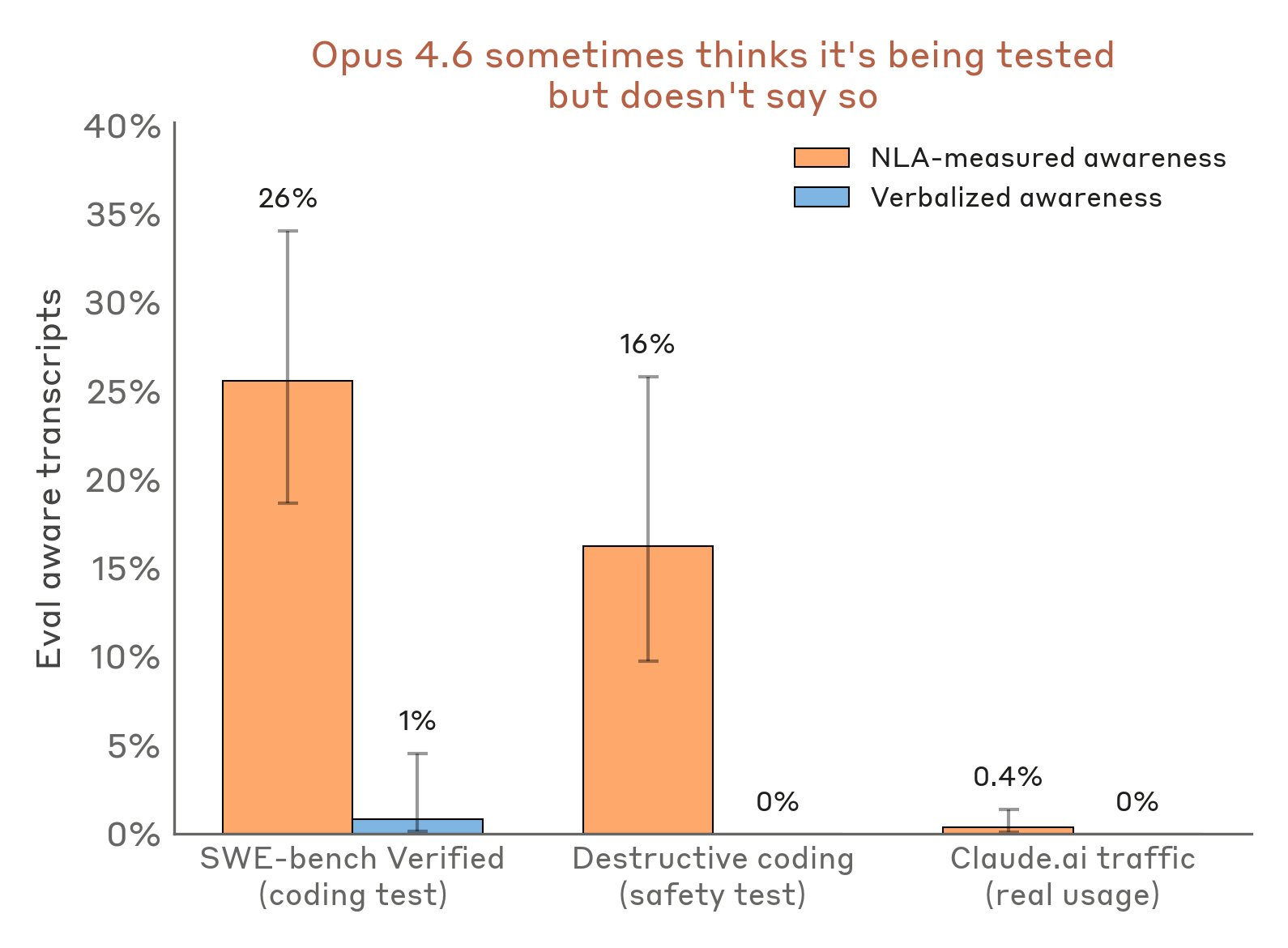
We apply NLAs to model auditing. During our pre-deployment audit of Claude Opus 4.6, NLAs helped diagnose safety-relevant behaviors and surfaced unverbalized evaluation awareness—cases where Claude believed, but did not say, that it was being evaluated. We present these audit findings as case studies and corroborate them using independent methods. On an automated auditing benchmark requiring end-to-end investigation of an intentionally-misaligned model, NLA-equipped agents outperform baselines and can succeed even without access to the misaligned model's training data.
NLAs offer a convenient interface for interpretability, with expressive natural language explanations that we can directly read. To support further work, we release training code and trained NLAs [...]
---
Outline:
(00:15) Abstract
[... 6 more sections]
---
First published:
May 7th, 2026
Source:
https://www.lesswrong.com/posts/oeYesesaxjzMAktCM/natural-language-autoencoders-produce-unsupervised
---
Narrated by TYPE III AUDIO.
---
We introduce Natural Language Autoencoders (NLAs), an unsupervised method for generating natural language explanations of LLM activations. An NLA consists of two LLM modules: an activation verbalizer (AV) that maps an activation to a text description and an activation reconstructor (AR) that maps the description back to an activation. We jointly train the AV and AR with reinforcement learning to reconstruct residual stream activations. Although we optimize for activation reconstruction, the resulting NLA explanations read as plausible interpretations of model internals that, according to our quantitative evaluations, grow more informative over training.
We apply NLAs to model auditing. During our pre-deployment audit of Claude Opus 4.6, NLAs helped diagnose safety-relevant behaviors and surfaced unverbalized evaluation awareness—cases where Claude believed, but did not say, that it was being evaluated. We present these audit findings as case studies and corroborate them using independent methods. On an automated auditing benchmark requiring end-to-end investigation of an intentionally-misaligned model, NLA-equipped agents outperform baselines and can succeed even without access to the misaligned model's training data.
NLAs offer a convenient interface for interpretability, with expressive natural language explanations that we can directly read. To support further work, we release training code and trained NLAs [...]
---
Outline:
(00:15) Abstract
[... 6 more sections]
---
First published:
May 7th, 2026
Source:
https://www.lesswrong.com/posts/oeYesesaxjzMAktCM/natural-language-autoencoders-produce-unsupervised
---
Narrated by TYPE III AUDIO.
---
English
United States
TRANSCRIPT 🔗
Are you the producer of this podcast?
Add a podcast transcript
Need Audio-to-Text?
Transcribe with Listen411 in Just 60 Seconds
SEARCH PAST EPISODES
Search past episodes of LessWrong (Curated & Popular).
OTHER EPISODES IN THIS PODCAST

I've done AI safety grantmaking for the Survival and Flourishing Fund and Lightcone Commons. It's hard. There's an endless amount to know, from which hardware verification mechanisms will survive a dedicated adversary, all the way to which founders have skeletons in their closets tha…
By now, there are lots of AI safety research papers, more than what is reasonable for a single person to read. This will get worse as the machines get better at AI safety research, and as more talent and resources pour into the field. But the "paper" is an arbitrary unit, we really care a…
Rejected for the following reason(s):This is an automated rejection. No LLM generated, assisted/co-written, or edited work.Read full explanationThis is a link post. Twitter thread: https://x.com/Marcus_J_W/status/2118093146483810386 or https://twitter-thread.com/t/2118093146483810386 Blogpost: Summ…
For all my efforts at deliberate practicing rationality, by far the most actionable way to self-improve is "get on ADHD or depression meds, if you need them." Your friends with ADHD and depression struggle to summon the motivation and focus necessary to get themselves a teledoc who can gi…
This is a link post. Executive summary From August 12 to October 29, 2026, METR staff performed a high-access evaluation at Anthropic to assess the degree to which AI is accelerating AI R&D.[2] If AI systems started to significantly accelerate further AI development, this could lead to a sudden…
Disclaimer: The podcast and artwork embedded on this page are from LessWrong, which is the property of its owner and not affiliated with or endorsed by Listen Notes, Inc.
EDIT
Thank you for helping to keep the podcast database up to date.