


Jason
00:00:00
Biggest source of inspiration.
Jason
00:00:02
That's an easy one for me.
Jason
00:00:03
It's my mom, single mom.
Jason
00:00:04
She was an emergency department nurse.
Jason
00:00:06
That's when I picked up my love of healthcare.
Jason
00:00:09
I watched my mom go through night classes as she was becoming a nurse.
Jason
00:00:13
I would get to hear stories from the battlefield of everyday healthcare delivery.
Jason
00:00:18
What that layered on for me beyond healthcare and human connection is leading with empathy.
Jason
00:00:24
So supporting people in their pursuit of happiness and their pursuit of dreams.
Jason
00:00:29
You know, I got that from my mom.
Casey Marquette
00:00:33
Welcome to Lead it, where the greatest minds in technology and security share their hard earned lessons, insights and stories.
Casey Marquette
00:00:41
These are the transformation champions in tech.
Casey Marquette
00:00:44
You'll discover the keys to success for leading innovation, growth and change within your organization.
Casey Marquette
00:00:51
This podcast is powered by Covenant Technologies and CyberTrust Network, providing the best cybersecurity and IT solutions for your business.
Casey Marquette
00:01:00
Here's your host, CEO Casey Marquette.
Casey Marquette
00:01:04
Let's go.
Speaker C
00:01:05
Hey there, lead IT nation.
Speaker C
00:01:07
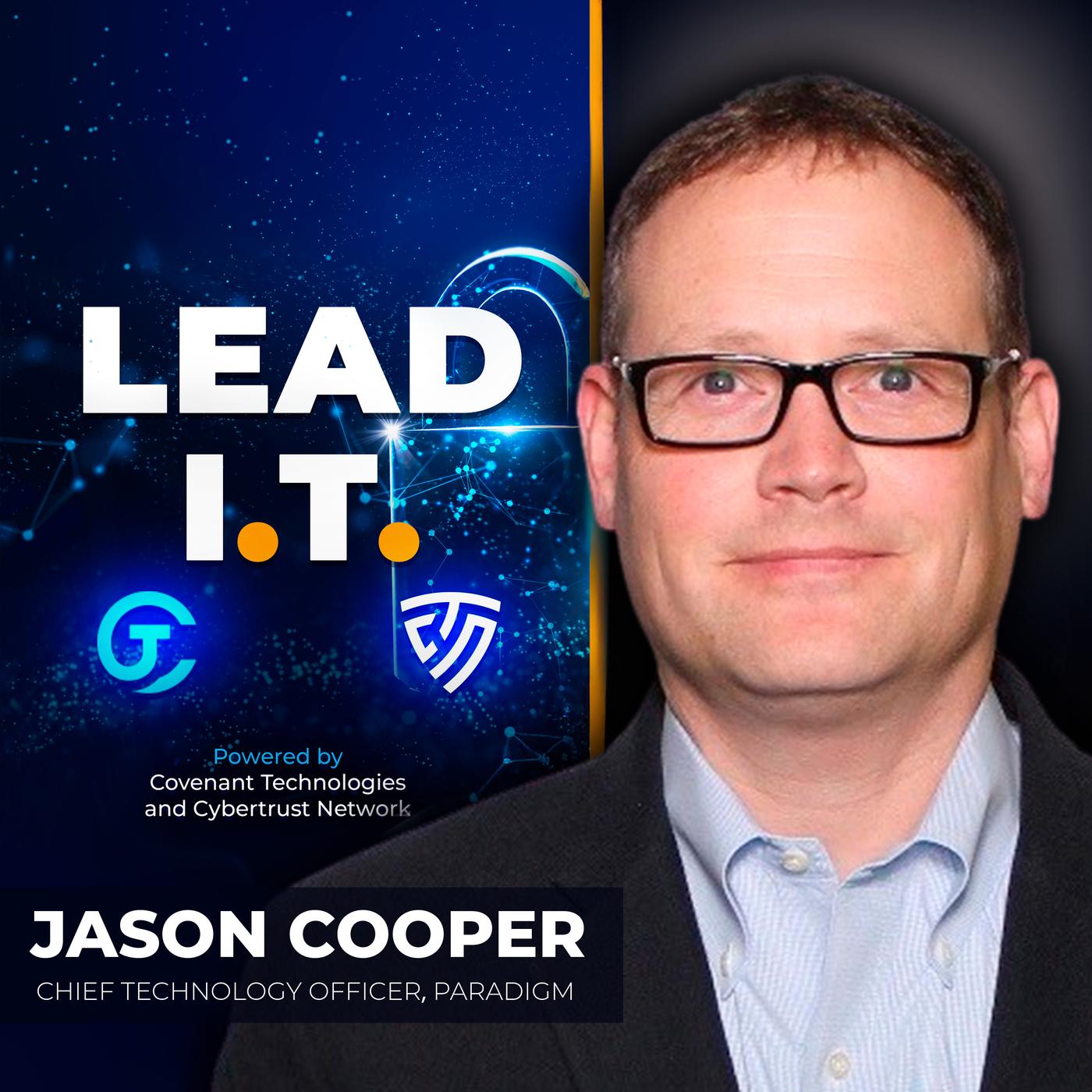
Today I have for you Jason Cooper.
Speaker C
00:01:10
Jason serves as Paradigm's Chief Technology Officer, spearheading innovation and growth for the enterprise through his technology data and analytics group.
Speaker C
00:01:20
He excels in leveraging technology, data and analytics to drive clinical, operational and financial outcomes across multiple health care sectors.
Speaker C
00:01:32
A proud contributor to his field, Jason has authored many peer reviewed works and is a sought after thought leader for conferences, symposia and industry events.
Speaker C
00:01:43
He has also had the unique opportunity to experience health care systems in seven different countries, including the United States, Israel, Scotland, Denmark, Australia, India and Italy.
Speaker C
00:01:58
There's a lot in store for you in this episode and you definitely don't want to miss it.
Speaker C
00:02:02
But before we dive in, congratulations Jason, on such an illustrious and remarkable career.
Jason
00:02:09
Yeah, thanks Casey.
Jason
00:02:10
And really appreciate the invite to share some of my leadership stories and inputs.
Speaker C
00:02:16
Absolutely.
Jason
00:02:17
Thank you Jason.
Speaker C
00:02:18
Yeah, it's great to chat with you.
Speaker C
00:02:20
So why don't we kick it off with the leadership story.
Speaker C
00:02:24
How have your experiences highlighted the significance of actively listening and considering others perspectives?
Jason
00:02:34
Sure, yeah.
Jason
00:02:35
I think active listening is a really important leadership skill.
Jason
00:02:40
We need to be able to hear there's perspectives and there are a lot of diverse opinions.
Jason
00:02:45
And that's why it's actually a really great thing to compile a diverse set of individuals when you're brainstorming or thinking about a new topic.
Jason
00:02:51
So I have a couple of active listening examples that I wanted to share with your audience and we're going to take a little trip in the Wayback Machine, if you will.
Jason
00:03:00
Right.
Jason
00:03:00
So one comes from my high school education actually.
Jason
00:03:04
I attended an all male college preparatory school.
Jason
00:03:08
I was a boarding student There were also day students there.
Jason
00:03:10
It's called Lindsley, the Linsley School.
Jason
00:03:12
And I was the 175th graduating a class of that institution.
Jason
00:03:16
But when we were juniors, it was a big change for our senior year, because our senior year the school was going to become co ed from all male and we had just different things.
Jason
00:03:28
We were concerned about what that was going to change from an educational and curriculum perspective, what it meant for sports and events and other things.
Jason
00:03:36
And kudos to the administration, right?
Jason
00:03:38
So you're talking like the headmaster, the head of the upper school, lower school, and they got us juniors together between junior and senior year.
Jason
00:03:46
And we just had a really open conversation about what it was meaning to go co educational, right, and to bring women into the educational fold of that school.
Jason
00:03:56
And the fact that they brought us together to hear us out, even though, look, the decision had already been made that we were going to be a co ed institution.
Jason
00:04:04
It let all of us feel like we had a voice and that we were being heard, right?
Jason
00:04:09
And so it took away the, the starkness of a big change and some folks got their questions answered, right?
Jason
00:04:17
And so it was just hats off to the administration.
Jason
00:04:20
And by the way, it was the right decision to go co ed.
Jason
00:04:22
Look, in education, in college, right, you have a diverse set of profiles of individuals you're going to have to work with, and the same is true in your work experience.
Jason
00:04:33
And so I thought it was actually really important to be a true college prep school that they go, that they go co ed.
Jason
00:04:40
The other example I would give would be as I was transitioning, and we'll talk about this a little late later in the episode too, but when I was transitioning for undergraduate to graduate school, and we'll talk about what, what triggered that.
Jason
00:04:52
But I had a instance where I basically was going right, from undergrad to grad school in the same university.
Jason
00:05:00
So I went to West Virginia University for my bachelor's and master's in comp sci, ended up going for another master's degree later in life.
Jason
00:05:07
But I had to take the gre, the Graduate Record Examination.
Jason
00:05:11
And I didn't understand why I had to take the gre.
Jason
00:05:14
My kind of sense was, are you telling me that a bachelor's degree from your institution is not good enough, Right, to qualify me to be in your master's degree program?
Jason
00:05:24
It didn't make any sense to me and it wasn't like I had a horrible GPA or anything.
Jason
00:05:28
And so I just set up some time with the chairperson of the computer science department.
Jason
00:05:32
He sat me down like an adult, as he should have listened to me and my concerns and said, you know what, you're making really good points.
Jason
00:05:42
And we probably should change some of our criteria for acceptance.
Jason
00:05:45
So we're going to accept you as a provisional graduate student.
Jason
00:05:49
Still got to go take the gre.
Jason
00:05:51
Sorry, we can't change requirements overnight, but you can start taking classes right away as a grad student, and then we'll work on full acceptance later.
Jason
00:06:00
So I went and took the GRE and everything was fine.
Jason
00:06:02
And then they.
Jason
00:06:03
I think they ended up changing some acceptance criteria later.
Jason
00:06:07
But again, that person and their position of power did not have to necessarily give me time or listen to me, but they did.
Jason
00:06:14
They understood my perspective.
Jason
00:06:16
And even if I'd gotten a different answer, like, sorry, we can't accept you this semester.
Jason
00:06:20
You have to take the gre.
Jason
00:06:22
I was heard.
Jason
00:06:23
And so my point is, for active listening and why I think it's a critical leadership skill, is we need to hear out others and we ourselves need to be heard.
Jason
00:06:33
Right.
Jason
00:06:33
And there are times when you're either not going to be able to give the answers that someone wants, or you're not going to get the answers yourself that you want.
Jason
00:06:41
But just the fact of having that conversation, having your perspective tested and heard out and have a good conversation, that's worth its weight in gold.
Jason
00:06:51
It's really important to staff members and associates and others to feel like they can do that, you know, so, yeah, I mean, the point is, and the reason I gave some really old examples is leadership matures throughout our life, not just our careers.
Jason
00:07:08
And I feel like the foundation of good leadership gets set pretty early in life, which is why I feel middle school, high school, even as a, as a young undergraduate, schools and teachers and administrations should be placing a fair amount of focus on molding young leaders, because your leadership starts and those sort of early molding of the clay starts earlier in life, likely oftentimes before you even have begun your career.
Speaker C
00:07:37
Yes.
Speaker C
00:07:38
And I love, Jason, that you started with this, because for me, I think it's probably one of the most underutilized skills.
Speaker C
00:07:48
And I struggled with it early.
Speaker C
00:07:49
I remember, I can literally remember in corporate America in my notebook, I would write an L in the top left of the notebook on every page to listen.
Speaker C
00:08:02
And I will tell you, I struggled with it, but then I became obsessed with leadership and I kept reading leadership books and just, I kept reading on the importance of listening.
Speaker C
00:08:12
So I feel like it's almost like a muscle the more you train it and really listen with the heart.
Speaker C
00:08:18
I remember one quote which resonated with me said, God gave you two ears and one mouth.
Speaker C
00:08:23
Listen twice as much as you talk.
Speaker C
00:08:25
And then another thing.
Speaker C
00:08:26
So that's a leadership thing, but just for winning with people.
Speaker C
00:08:32
I know.
Speaker C
00:08:33
I just heard a podcast probably three weeks ago that said, be interested.
Speaker C
00:08:37
Not interesting.
Speaker C
00:08:39
So in another book I read years ago was 25 ways to win with People.
Speaker C
00:08:44
And this is so true.
Speaker C
00:08:46
And one of the chapters said, everybody wants to talk about themselves.
Speaker C
00:08:51
If you let them and listen, they will love you.
Speaker C
00:08:54
And it's true.
Speaker C
00:08:56
I've seen it.
Speaker C
00:08:56
Like, I want to talk about myself too.
Speaker C
00:08:58
But if you can refrain from doing that and ask people and really listen with the heart.
Speaker C
00:09:04
So impactful.
Speaker C
00:09:05
So I love that you started with that, because I feel like that is.
Jason
00:09:07
Right.
Speaker C
00:09:09
It doesn't cost anything.
Speaker C
00:09:11
It's just training that muscle.
Jason
00:09:14
Yeah.
Jason
00:09:14
What better way to include people?
Jason
00:09:16
Right.
Jason
00:09:17
So I feel like listening is a part of inclusion.
Jason
00:09:20
And to your point, you're likely, through those conversations, going to learn some new facts or new information about your team and you therefore become a better, more connected leader.
Speaker C
00:09:30
Well, yes.
Speaker C
00:09:31
And who wants the leader that just tells you what to do and doesn't ask you a question and listen.
Speaker C
00:09:37
Not, not, not insincere, like they don't care what you say, but asking a question, what should we be doing?
Speaker C
00:09:43
How should.
Speaker C
00:09:43
How do you think we should do it?
Speaker C
00:09:45
And actually listen to them, that's motivating for someone.
Speaker C
00:09:48
But being told, go do this because I said so, not so much.
Speaker C
00:09:52
Excellent, Excellent.
Speaker C
00:09:53
Next.
Speaker C
00:09:54
What advice would you give your younger self today?
Speaker C
00:09:57
Or something you'd tell them to try?
Jason
00:10:01
Yeah.
Jason
00:10:01
So this one, I had to think a little bit, but.
Jason
00:10:03
But I'd say one of the strongest point pieces of advice that I can give is don't be afraid of failure.
Jason
00:10:09
Early in our careers, failure is seen as a bit of a no, no.
Jason
00:10:13
Right.
Jason
00:10:14
Like you want to succeed all the time and improve and take that next grab at the rung in the leadership hierarchy, if you will.
Jason
00:10:22
But we learn far more from our failures than we do our best successes.
Jason
00:10:28
Right.
Jason
00:10:28
It's almost like, yep, Next, success.
Jason
00:10:31
Right.
Jason
00:10:31
Whereas a failure comes, causes you to do some root cause analysis, understand what happened, get it in context, and then learn and grow as a result of it.
Jason
00:10:41
And I think that young people in their career and young leaders should not be afraid to fail.
Jason
00:10:49
I've heard several times in different venues it's fail fast and succeed fast.
Jason
00:10:56
It's a really important thing to embrace like, like test and learn cycles and to get in there.
Jason
00:11:01
Because one of the quickest ways to succeed is.
Jason
00:11:04
And you likely fail 10 times more than you succeed.
Jason
00:11:07
But it makes your successes richer.
Jason
00:11:09
Right.
Jason
00:11:10
In perspective and what it took to get you there.
Jason
00:11:13
But you also just learn so much more along the way.
Jason
00:11:16
So if there's a F word at work that I tell people not to be afraid of, it's failure.
Jason
00:11:22
Right.
Jason
00:11:22
Please fail.
Jason
00:11:24
Fail fast.
Jason
00:11:25
Right.
Jason
00:11:25
Don't take forever to fail.
Jason
00:11:26
Fail fast, will succeed faster as a result of that failure.
Jason
00:11:30
Let's just not repeat the failures.
Jason
00:11:32
Let's learn from them.
Speaker C
00:11:33
Yeah.
Speaker C
00:11:34
Wow.
Speaker C
00:11:34
I was just at a Tony Robbins event, and the fear of failure holds so many people back.
Speaker C
00:11:42
And at the end of the day, when you really think about all those fears in your mind that are running crazy, what small percentage actually are realized?
Speaker C
00:11:49
I mean, it's a small percentage, but the most successful people take those risks even though they have the fear of failure and they figure it out.
Jason
00:11:59
Yeah.
Jason
00:11:59
To your point.
Jason
00:12:00
Failure.
Jason
00:12:00
Right.
Jason
00:12:00
The fear of failure can stifle creativity and creative thinking.
Jason
00:12:05
It certainly can stifle innovation, and it does negatively affect, like, pace of progress.
Jason
00:12:11
And so I feel like if you want to be creative and innovative and have a fast pace in your work life.
Jason
00:12:20
Right.
Jason
00:12:20
You need to not be afraid to fail.
Jason
00:12:23
We're going to hit our knees, we're going to stub our toes.
Jason
00:12:26
That's.
Jason
00:12:26
That's okay.
Jason
00:12:27
That's how we learn.
Speaker C
00:12:28
Yeah.
Speaker C
00:12:29
I'll tell you, Jason, just starting this company, I was scared to death.
Speaker C
00:12:32
I mean, I was.
Speaker C
00:12:33
I'd been a CISO my whole life.
Speaker C
00:12:35
This is kind of something totally different.
Speaker C
00:12:37
And if it didn't work out, then.
Speaker C
00:12:39
So I had a lot of fear, but I did it.
Speaker C
00:12:42
And I will tell you, it's the best thing I ever did in my life.
Speaker C
00:12:44
But if I didn't get over that fear of failure, I wouldn't be living this beautiful life.
Jason
00:12:50
So.
Speaker C
00:12:50
Could not agree more.
Speaker C
00:12:52
Next one.
Speaker C
00:12:53
Over the years, what was your biggest source of inspiration and why?
Speaker C
00:12:57
What's a challenging time?
Speaker C
00:12:59
It got you through.
Jason
00:13:01
Yeah.
Jason
00:13:02
So biggest source of inspiration.
Jason
00:13:04
That's an easy one for me.
Jason
00:13:05
It's my mom.
Jason
00:13:06
She raised my brother and I in a very rural part of West Virginia as a single mom working long hours as a nurse in an emergency department.
Jason
00:13:16
So she was an emergency department nurse.
Jason
00:13:19
And that's when I picked up my love of healthcare, Casey, which I've focused pretty much my entire career on.
Jason
00:13:25
I mean, I like to call it like, healthcare through osmosis.
Jason
00:13:28
Right.
Jason
00:13:28
I watched my mom go through night classes as she was becoming a nurse.
Jason
00:13:33
I almost consumed every one of her nursing books that she brought from.
Jason
00:13:37
I would just flip through them and read them.
Jason
00:13:39
And of course there were plenty of things that I didn't understand, but I just found the whole concept of nursing and all that it took to be really, really fascinating.
Jason
00:13:47
And then not sharing phi or pii, but I would get to hear stories from what I call the battlefield of everyday healthcare delivery.
Jason
00:13:58
And her life day in a life of a nurse in the emergency department.
Jason
00:14:02
And either it's sort of feast or famine in the ed, right?
Jason
00:14:05
It's either slow and can be boring at times, or other times it's just crazy busy.
Jason
00:14:12
And so that that sort of her stick to itiveness to hold down a job, go to night class, become a nurse and then be working hard nursing hours that, that really put into me like perseverance, right?
Jason
00:14:24
And just working hard.
Jason
00:14:25
And because of that she had high expectations of her boys, of us.
Jason
00:14:30
But then to bring in sort of the human component, right?
Jason
00:14:33
Because nursing, in my opinion is very patient centered, very human centered.
Jason
00:14:38
Later in her career, she got a chance to join the Army Nurse Corps and then she actually joined the Indian Health Service, right, which is an arm of the hhs.
Jason
00:14:48
And she spent three years in Barrow, Alaska, right, Which is hundreds of miles north of the Arctic Circle.
Jason
00:14:55
And then she spent about seven years in Gallup, New Mexico, taking care of underserved and underrepresented populations as part of the Indian Health Service in Barrow and Gallup.
Jason
00:15:07
And so what that layered on for me beyond healthcare and human connection is leading with empathy, right?
Jason
00:15:14
Like caring about your peers, your colleagues, and actually just individuals randomly on the street that you meet.
Jason
00:15:23
And that's when I knew to some degree when I was transitioning from high school to college, look, I'm not going to be a put hands on patient person.
Jason
00:15:32
I'm not going to be a direct caregiver in that way.
Jason
00:15:37
Ones and zeros made more sense to me, right?
Jason
00:15:39
But I wanted to at least utilize the capabilities that I was learning in computer science and technology to help people lead healthier lives.
Jason
00:15:48
And my mom built that foundation as I was growing up.
Jason
00:15:52
And just watching her through her career and to watch her pursue a dream, a passion of hers to go do something.
Jason
00:15:59
She started that when I was in grad school.
Jason
00:16:01
So empathy, human connection, but also supporting people in their pursuit of happiness and their pursuit of dreams.
Jason
00:16:09
I got that from my mom.
Speaker C
00:16:10
Two of my favorite quotes.
Speaker C
00:16:12
And we give way more proportionally than we should to be honest, as a company.
Speaker C
00:16:16
But I love it.
Speaker C
00:16:17
I love two quotes, living is giving.
Speaker C
00:16:20
And then one of my favorite quotes I heard was for those who think money doesn't matter, they haven't given enough away.
Speaker C
00:16:28
And so that is a culture.
Speaker C
00:16:29
We've built a covenant that I'm so the team's amazing.
Speaker C
00:16:32
We are constantly giving and I just want to continue to grow the company so we can just give more and more.
Speaker C
00:16:38
The more we make, the more we're going to give and just feel blessed to do that.
Speaker C
00:16:42
So kudos to your mom and doing going up there for the underprivileged.
Speaker C
00:16:46
And I don't know about you, but the older I get, the more that's.
Speaker C
00:16:49
That's like my.
Speaker C
00:16:50
I actually just developed my mission statement in life.
Speaker C
00:16:53
So I'm going to be 50 and I'm like, you know, what am I going to do?
Speaker C
00:16:56
How am I going to, you know, what's it going to be like these next 30, 40, 50 years?
Speaker C
00:17:00
And that was the top of the mission statement.
Speaker C
00:17:03
I really do.
Speaker C
00:17:03
I want to build healthy companies, but more to give back.
Speaker C
00:17:08
So awesome stuff.
Jason
00:17:10
And it's interesting, if you don't mind, I wanted to comment on your Living is giving, right?
Jason
00:17:16
And your whole point about giving, sometimes our greatest gift is not necessarily monetary and going back to listening and giving people time.
Jason
00:17:26
Time is our most precious resource, right?
Jason
00:17:28
When you give someone the gift of your time, you can't ever get that back.
Jason
00:17:32
There's no returning that, right?
Jason
00:17:34
And so my request of people where I, whether I'm mentoring or advising or doing something else with my time, my point to them always is this is a gift that can never be returned.
Jason
00:17:48
The only way you can return this gift is to give this same gift to someone else, right?
Jason
00:17:53
So pay it forward.
Jason
00:17:54
Our time is so precious, right?
Jason
00:17:56
We only get so many orbits on this beautiful orb that we're on around the sun.
Jason
00:18:03
And so we can't forget that sometimes folks may not have the monetary independence to give money, but I'll bet they have great advice.
Speaker C
00:18:12
I love what you said because.
Speaker C
00:18:15
So I want to tell a little story because of the impact it had on people.
Speaker C
00:18:18
So the first year I launched the company, we lost $175,000.
Speaker C
00:18:25
I'm sitting in bed.
Speaker C
00:18:27
Hurricane Ian comes by.
Speaker C
00:18:29
It was coming right at the island, but it took a right turn like 36 hours before and blasted Fort Myers.
Speaker C
00:18:38
And I was thankful.
Speaker C
00:18:39
I woke up, thank God we're okay.
Speaker C
00:18:41
But it didn't feel okay to just say, thank God we're okay, knowing people to our south were totally destroyed.
Speaker C
00:18:48
So we got about 20 people together, neighbors, employees, and Jason.
Speaker C
00:18:53
It was one of the best days of my Life.
Speaker C
00:18:54
We took two vans down.
Speaker C
00:18:56
We donated $22,000, which isn't going to change anybody's life, but.
Speaker C
00:19:01
And we literally, the sheriff's department down there, they nominated 20 sheriffs that were actually outworking the storm when their homes were getting destroyed, and they sent us pictures.
Speaker C
00:19:13
So we went to one deputy's house, him and his wife, and we pull up and here's what happened to their house.
Speaker C
00:19:22
The deputies out working the storm, his wife and kids are at the house.
Speaker C
00:19:27
The neighbor has a candle that catches their house on fire.
Speaker C
00:19:32
The wind blows and catches their house on fire.
Speaker C
00:19:36
Her and her kids have to come out in the middle of a hurricane because their house is on fire.
Speaker C
00:19:41
So total devastation.
Speaker C
00:19:43
The home is destroyed.
Speaker C
00:19:44
We pull up.
Speaker C
00:19:46
And I will tell you, they were just crying their eyes out.
Speaker C
00:19:50
And I know it wasn't because of the money.
Speaker C
00:19:53
It's because we were there.
Speaker C
00:19:55
And so.
Jason
00:19:57
Right.
Jason
00:19:57
Someone showed up.
Jason
00:19:58
Yes.
Speaker C
00:19:59
And that is a policy we have.
Speaker C
00:20:01
Like, as a company, we're not just going to send money.
Speaker C
00:20:04
But to your point, the personal touch, listening, being there, being present was amazing.
Speaker C
00:20:10
Was amazing.
Jason
00:20:11
Give your.
Jason
00:20:11
Give your time and show up.
Jason
00:20:13
Right.
Jason
00:20:13
So, I mean, kudos, Casey, to you and your organization for doing that.
Speaker C
00:20:17
Yeah, it was really cool.
Speaker C
00:20:18
And everybody said we were crazy because we're losing money, but I have found you give, you get paid back 10 times, easy.
Speaker C
00:20:27
Okay, next one.
Speaker C
00:20:28
When's the time you had an unexpected twist or failure in your career?
Speaker C
00:20:34
How did it lead to growth or success down the road?
Jason
00:20:37
Yeah, this is an interesting one.
Jason
00:20:39
Right.
Jason
00:20:39
So I'm 21, about to become 22.
Jason
00:20:43
I'm getting ready to finish my bachelor's in Comp Sci.
Jason
00:20:46
I was in ROTC and was also in the Army Reserves all through college.
Jason
00:20:51
Held down a lot, by the way, because I also wrote on the crew team, busy, busy, and also in really good shape.
Jason
00:20:58
So I started to wonder.
Jason
00:20:59
I'm not feeling well.
Jason
00:21:01
I'm starting to not perform at peak on the army physical fitness test.
Jason
00:21:06
And gosh, I'm only three months away from getting commissioned in the Signal Corps, which is actually the branch of the army that I wanted to go in.
Jason
00:21:13
And this was during some downsizing, too.
Jason
00:21:15
So it was kind of rare to get an active duty appointment in the branch of service that you wanted to go in.
Jason
00:21:21
And that was my career.
Jason
00:21:23
I was assuming I'm going to go in, become an officer, and I'm doing my 20 or 30 years, then come to find out that my not feeling well and losing some weight and not doing so well physically was because of Crohn's disease, which is one type of inflammatory bowel disease.
Jason
00:21:41
And per army regulation, etcetera, etcetera.
Jason
00:21:46
This is disqualifying for military service.
Jason
00:21:48
So I'm staring at an opportunity just three months away, and I got an honorable medical discharge, and therefore, the kind of proverbial career rug got yanked out from under me.
Jason
00:22:00
And so my point here and my piece of advice is, always have a backup plan.
Jason
00:22:06
Regardless of how sure you might be or how simple, you know, a thing might seem.
Jason
00:22:11
Have a backup plan, right?
Jason
00:22:13
Oh, you're going on an international vacation.
Jason
00:22:15
Have a backup plan.
Jason
00:22:17
Right.
Jason
00:22:17
Not just in career, but in personal life.
Jason
00:22:20
And that's what actually led me to immediately apply to graduate school, right?
Jason
00:22:25
Because I worked all through my undergrad and worked through grad school, but it was very humbling, right?
Jason
00:22:31
And you had mentioned or asked in the previous question about my mom and how some of those experiences helped me with a tougher time in life.
Jason
00:22:40
And this was a tougher time.
Jason
00:22:41
I was adjusting to a new reality.
Jason
00:22:43
I was a crazy healthy guy, rowing and doing all kinds of army stuff.
Jason
00:22:48
And now I had this thrown at me and had sort of my commission taken away, and it just felt like one hit after the other, right?
Jason
00:22:56
Like some physical hits, some career hits, but really, really what it taught me was resilience and adaptability.
Jason
00:23:04
And I can go back to watching my mom struggle in some of her career, but also just have a extreme pursuit for her dreams and not letting anything get in the way of eventually seeing those out.
Jason
00:23:18
And I just think resilience and adaptability is so important.
Jason
00:23:22
But it's one of those early life lessons that carries throughout your career, and that is literally always have a backup plan.
Jason
00:23:30
Be thinking about what positive things can accelerate you and therefore put you in a different spot earlier than you thought, or, right, turn on the other side of your mind and think about the negative things that may occur and what will you do to pivot in those.
Jason
00:23:46
And I would say there's always the.
Jason
00:23:48
The known unknown, right, that you can kind of go, okay, I can plan for A, B, and C.
Jason
00:23:52
It's actually really important, in my opinion, to also park some mind space for.
Jason
00:23:57
I don't know what's going to come up, but I'm going to be ready for it.
Jason
00:24:00
Right?
Jason
00:24:01
I'm just going to.
Jason
00:24:02
I'm going to let a little bit of my mind think about the possibility of something unplanned.
Jason
00:24:08
Happening, so you can plan and you can think about backups for different scenarios.
Jason
00:24:13
But it's also important to say, and there's a chance that something's going to come up that I had never even thought of and let me be able to be flexible and adaptable to that change.
Jason
00:24:24
And change can be really hard depending on, is it a career change?
Jason
00:24:28
You just mentioned that you were terrified, right.
Jason
00:24:31
To start this new role as a CEO of your own company.
Jason
00:24:35
And some of the best career advice is there are oftentimes that you're going to apply for a job and for a fact, you don't have all of the qualifications.
Jason
00:24:45
You have the foundation.
Jason
00:24:46
Right.
Jason
00:24:47
You may have 70% or 60%.
Jason
00:24:49
It's important to actually stretch yourself, step into that role, learn what needs to be learned throughout it.
Jason
00:24:56
Right.
Jason
00:24:57
And.
Jason
00:24:57
And persevere.
Jason
00:24:59
Some of the.
Jason
00:24:59
Some of the best new steps that I've taken in my career are ones where I did not know everything and I don't want to.
Jason
00:25:07
By the way, it's.
Jason
00:25:08
What.
Jason
00:25:09
There's a great quote that it's at least attributed to JFK during his moon speech down at Rice University, and it goes, the greater our knowledge increases, the further our ignorance unfolds.
Jason
00:25:21
Right?
Jason
00:25:22
So the more we think we know a lot and the more that we learn through life, the more we realize we actually don't know a whole lot.
Jason
00:25:29
Right.
Jason
00:25:29
You and I could spend the rest of our lives trying to accumulate knowledge and get as many degrees as we can, and we will still never be able to do that.
Jason
00:25:37
Right?
Jason
00:25:38
So yet knowledge is a gift.
Jason
00:25:40
And stepping into uncomfortable positions where you have to do new knowledge acquisition, new relationship building, probably new process engineering actually is a great thing, Kasey.
Jason
00:25:50
Right.
Jason
00:25:50
Because.
Jason
00:25:51
Sorry to turn the.
Jason
00:25:52
The interviewer on the interviewee or whatnot, but I mean, from your perspective, right, I'll bet you learned and grew a lot in that uncomfortable position in starting in the new, new role, right?
Jason
00:26:03
As a CEO of Covenant.
Speaker C
00:26:05
Yes.
Speaker C
00:26:06
And frankly, failed.
Speaker C
00:26:07
I mean, there was one point in the company's history where I literally was like, how are we losing money?
Speaker C
00:26:13
We're making a lot of money.
Speaker C
00:26:15
Well, I didn't know how to run a business, so I had to hire a fractional CFO because we were making money, but we weren't making money at the end of the day after all expenses.
Speaker C
00:26:26
So I learned a lot.
Speaker C
00:26:29
But now we've write.
Speaker C
00:26:30
We're in good shape now.
Jason
00:26:31
But.
Speaker C
00:26:31
But to your point, yes, I.
Speaker C
00:26:32
I was scared and I made plenty of mistakes.
Speaker C
00:26:35
But.
Speaker C
00:26:35
But if I didn't take that risk and.
Speaker C
00:26:37
And got that fear of failure out of my mind, I wouldn't be here now.
Speaker C
00:26:41
I'm just.
Speaker C
00:26:42
Just doing what I love to do and impacting people in a positive way.
Speaker C
00:26:45
So it's been amazing.
Speaker C
00:26:47
And I.
Speaker C
00:26:48
With.
Speaker C
00:26:49
With the Crohn's, I.
Speaker C
00:26:50
I don't know much about it, but I'm active and I love moving and exercise.
Speaker C
00:26:55
And my dad had Ms.
Speaker C
00:26:57
And he actually ended up killing himself.
Speaker C
00:27:00
And I know he was an athlete.
Speaker C
00:27:02
He ran marathons.
Speaker C
00:27:03
And so I've always thought, like, I can't even imagine, as active as I am, if one day, boom, I couldn't be that.
Speaker C
00:27:11
That would be tough.
Speaker C
00:27:14
So.
Jason
00:27:14
So I guess therein.
Jason
00:27:16
So, first of all.
Jason
00:27:19
First of all, really sorry to hear about your father.
Jason
00:27:21
Ms.
Jason
00:27:22
Is.
Jason
00:27:22
It can be a not so bad diagnosis, or it can be severely debilitating.
Jason
00:27:27
And multiple sclerosis just comes in different forms.
Jason
00:27:31
There's four types of ms, by the way.
Jason
00:27:33
Relapsing, remitting is the most common, but there's no going back from the lesions that happen from a neuro perspective with Ms.
Jason
00:27:42
And my only point there, Casey, is that in and of itself is have a backup plan.
Jason
00:27:50
Right?
Jason
00:27:50
Like, what if someday you had that because it was a genetic thing and you had to be wheelchair bound?
Jason
00:27:57
You can still exercise in a wheelchair.
Speaker C
00:28:00
Yes.
Jason
00:28:00
There are ways to get around this, and for a little bit, you know, and when something happens, like a new diagnosis or whatever, you go through these sort of stages of grief.
Jason
00:28:12
Right.
Jason
00:28:13
And I just had to get out of the way.
Jason
00:28:15
Either I let that define who I am as an individual, or it's just another attribute, like having blue eyes and brown hair, and you just push it out of the way and you make life happen anyway.
Jason
00:28:28
Right?
Speaker C
00:28:29
Yes.
Jason
00:28:29
And once I had that flip in my brain that like.
Jason
00:28:33
No, right.
Jason
00:28:34
It's.
Jason
00:28:34
It's not a defining attribute of who I am as an individual.
Jason
00:28:38
It's just something that I'm going to have to deal with, like a flat tire or, you know, something else, or I have migraines or whatever.
Jason
00:28:46
Now, look, I struggled a bit, to be quite honest, with Crohn's.
Jason
00:28:50
I failed on every oral medication known to man.
Jason
00:28:53
Had to have a surgery in Knockwood.
Jason
00:28:55
It's the only surgery I've had to have back in 1999.
Jason
00:28:58
But better living through chemistry.
Jason
00:29:00
I mean, I now have what are called specialty medications, right?
Jason
00:29:04
So biologic medications that almost make it like, I don't have Crohn's disease.
Jason
00:29:09
I still have to watch my diet, but I can exercise I can hang out with my friends wherever I want and lead a very active lifestyle.
Jason
00:29:17
And I just was not going to let that get in the way.
Speaker C
00:29:21
That's excellent.
Jason
00:29:22
Right?
Jason
00:29:22
Don't.
Jason
00:29:23
Don't let.
Jason
00:29:23
Yeah.
Jason
00:29:24
I mean, again, power through adversity.
Jason
00:29:27
And.
Jason
00:29:27
And to be honest, a lot of it's.
Jason
00:29:29
It's up here.
Jason
00:29:30
I was just gonna say that.
Jason
00:29:32
The power of the mindset.
Jason
00:29:34
Yeah.
Speaker C
00:29:35
So it's fresh in my mind because I just went to Tony Robbins, but he always says there's good and bad to choose from.
Speaker C
00:29:42
You can choose.
Speaker C
00:29:43
And he said he works with billionaires that are miserable, and he works with people that make no money and they're happy as can be.
Speaker C
00:29:51
He actually, I went to one of his events four years ago.
Speaker C
00:29:53
Guy got up there with no arms and legs.
Speaker C
00:29:55
Guy was doing flips and running like the guy was happy as could be.
Speaker C
00:29:59
And then in this latest one, this girl got up.
Speaker C
00:30:01
It was so sad.
Speaker C
00:30:03
The whole place was crying.
Speaker C
00:30:04
She was molested.
Speaker C
00:30:05
A terrible story.
Speaker C
00:30:07
And she said.
Speaker C
00:30:08
And I.
Speaker C
00:30:09
It was the most.
Speaker C
00:30:10
It was incredible, she said, But I was still grateful because I could feel pain.
Speaker C
00:30:18
So she was alive.
Speaker C
00:30:20
So she chose to take the good, even though it was a horrible situation and be grateful because she was alive.
Speaker C
00:30:27
So to your point, you can always choose the bad, and then that becomes kind of like a muscle, and then you're living.
Speaker C
00:30:34
That's your mindset all the time.
Speaker C
00:30:36
Or you could choose the good.
Speaker C
00:30:37
So, awesome conversation.
Speaker C
00:30:40
I think it's a good point to wrap it up, although I have more questions.
Speaker C
00:30:43
I think it's a good point to conclude.
Speaker C
00:30:45
And, Jason, I respect you.
Speaker C
00:30:48
Great career.
Speaker C
00:30:49
Great.
Speaker C
00:30:49
But even more important, better person.
Speaker C
00:30:51
It's great.
Speaker C
00:30:52
I've known you for, I don't know, a year and a half, two years now, and I just want to thank you for coming on the show.
Jason
00:30:57
Oh, Casey, I really appreciate it.
Jason
00:30:59
Thanks so much for having me.
Jason
00:31:00
Enjoyed our conversation as well.
Speaker C
00:31:03
Yes, sir.
Speaker C
00:31:03
Thank you.
Speaker C
00:31:04
Have a good day out there, everyone.
Casey Marquette
00:31:06
Thanks for listening to lead it.
Casey Marquette
00:31:08
This podcast is powered by Covenant Technologies and CyberTrust Network, providing the best cybersecurity and IT solutions for your business.
Casey Marquette
00:31:17
Make sure to subscribe to the show where you listen to your podcast so you're notified when a new episode is released.
