


00:00:07
Speaker 1: One of the questions that I get asked so frequently these days is why should I care about Americans going back to the moon. We've got enough problems here on planet Earth, and there seems to be an endless list of things that we could be doing before we go back to the moon. Well, I feel that it is vital for America to not only go back to the Moon, but to establish a permanent presence. And I'm going to tell you why. Hello Future, It's me keV. This is a dispatch from the Digital Frontier. The planet is Earth. The year is twenty twenty six. My name is Kevin Surreally. Remember, you can listen to all of the latest Hello Future episodes however you get your podcasts and on the iHeartMedia app. My guest today is someone who helps me think through all of these big questions, coaches it from not only a scientific perspective, but a regulatory perspective, and he's just really good at indulging me and answering all of my dumb questions. I just put them to him, and I always walk away feeling a little bit smarter. His name is Alex Gilbert. He's on the front lines, really the top space regulatory expert in the nation, and I would argue because we have the best space program. Alex, thank you so much for joining me. I am am a huge peek when it comes to mining in space. I love the idea of mining asteroids, of mining Moods and Saturn, Europa and Jupiter. But the Moon, our moon that we can look up and see in the sky, is really the first step to unleashing the infinite number of resources in our universe. If we can master that, we can do it arguably anywhere. But why should folks care about astronauts and Americans going back to the Moon and ultimately mining it. What's up there?
00:02:12
Speaker 2: Yeah, Kevin, thanks so much for having me and thanks for the kind words. The primary reason that we want to go back to the Moon is that we have discovered water and we think that there is sufficient quantities of water for us to begin mining it and using it. Now we live on an ocean planet. We have plenty of water here. Why do we want water in space. It's because water has hydrogen and oxygen, and we can use that to make rocket fuel. If we can refuel in space, the economics of going to space and doing anything in space changes completely. We can have refueling architecture so that we send something up from Earth and it uses water delivered from the Moon to refuel and then go to Mars or going to keep space, or do all other sorts of activities that are economically valuable to us on Earth.
00:02:58
Speaker 1: So I love this. Is when I was a kid, I remember I would watch, like, you know, the Magic School Bus with Miss Frizzle or whatever, and I remember being a kid, and I think it was time for kids or one of the scholastic things. I was in elementary school and there was this talk of water being found or is there water on the Moon, And I'm thinking to myself, that means we could live there and drink it. But what you're saying is that that is too elementary. First of all, it's not liquid water. It's blocks of ice. And you and I were talking about this. It's not like it's a giant iceberg like that whacked the Titanic. Okay, this is like in the lunar material or what would the human eye see, if anything, when they see the ice on the moon.
00:03:48
Speaker 2: So the reality is we don't know yet. Well we do know is that we have detections of water and we have had a major impact or the Alcross impact or that told us that the percentage abundance of water is actually relatively high. It's in single digit percentages. That means that if you were to be able to take a pound of material on the.
00:04:10
Speaker 1: Moon regular it's called regulith.
00:04:13
Speaker 2: You might have one or two ounces of water in there, but it's going to be frozen because the areas that it exists on the Moon are areas that are in permanent shadow. They're very cold, and so we don't know within that pound, is it completely mixed up, is it little ice nodules, is it little layers? And we don't know if we're looking at a column, so sorry the surface and going down, we don't know the distribution. We don't know if it's at the top, if it's a meter down, We don't know if there's a lot deeper. And so these are all the scientific questions that right now we know enough that we can probably mine it, but we don't know where to mind, and we don't know how much it will cost to mind, and we don't know the technology we need specifically. So all the science, all the stuff that we're trying to do right now is to answer those questions of what form the water is in and how do we get it.
00:05:02
Speaker 1: So, what's the first thing that Americans are going to want to do when they mine the water on the Moon.
00:05:09
Speaker 2: Just think about like you're at a beach and you're digging in sand, so reguleth the moon dirt. It's just like sand. It's this stuff that's super crumbly, it's very coarse. You basically are going to have to probably scoop it up, and you're going to then have to figure out how to get the water out. You can use heat, you might be able to use some other sorts of techniques to maybe crumble the rock out and be able to get the ice crystals in there. But the challenge, more than anything is how do you operate in these type of environments. Because it's the Moon, it's very harsh, and the areas where the ice exists, they're super cold. They're negative hundreds of degrees.
00:05:43
Speaker 1: Cold, so older than any place on Earth.
00:05:45
Speaker 2: Yeah, colder than any place on Earth by far.
00:05:48
Speaker 1: So when you look up at the moon, my understanding and correct me if I'm wrong, because you're the expert. But when I look up at the moon at night, you can see the different shades of color on the moon. Those are the craters, meteorites or whatever stuff wax into the moon and so on the south pole the bottom of the moon that's hanging up there in the sky. And I would argue, is it the north pole too, or just the south pole?
00:06:12
Speaker 2: Okay, we'rell and north pole, but.
00:06:14
Speaker 1: It's easier for us to get to the South pole.
00:06:16
Speaker 2: No, So the south pole has expected higher concentrations of water than the North pole, but it's actually not as much as you would think, saring how much people talk about the South Pole. Both of them are economically attractive targets.
00:06:28
Speaker 1: For whatever reason, we're focused on the south pole.
00:06:31
Speaker 2: Yes, Why because there are more craters there and there's likely higher overall abundance of water. So it's just kind of one of those things that it happened to be, Hey, we're looking at the south pole and then trying to set looking at the south pole, and everyone started being, Okay, the south poles where all these resources are, and it probably is where the most favorable resources are. But I always like to point out that north pole is as well. But to answer your question, why do we have this North pole and South pole? Deposits of water. Think about the seasons. So we have seasons on Earth because we're inclined pretty heavily to the Sun. The Moon is not. The Moon has a very limited incline and so on.
00:07:10
Speaker 1: Because it doesn't rotate.
00:07:12
Speaker 2: The moon always the Moon rotates, but it rotates around the Earth. It always faces the same side towards Earth. But relative to the Sun, the South pole, in the North pole, they never see sunlight in these craters because the inclination relative to the Sun is about two or three percent. It's very, very tiny and has been that tiny for billions of years.
00:07:31
Speaker 1: So there are parts of the of the south it's the south pole and the north pole of the Moon that are in constant sunlight.
00:07:39
Speaker 2: Correct, there's a handful of them on the very tops of craters and mountains.
00:07:44
Speaker 1: And that's prime real estate for development because of solar energy until we can use more nuclear stuff for lack of a better word. But there are parts of the Moon within inches it's very light and then very very dark. This is a place of extremes. I mean the fact this is where you know, I don't want to get deep because I'm not that deep alex as you know. But the fact that some meteor wax into the bottom of the Moon and creates a crater and as a result, creates shadows. And in those shadows, because where the sunlight hits it's very very hot. It makes it the Arizona Desert look like it's Santa Claus's workshop with all the snow. It's very very hot at the south pole of the Moon. And then because of these shadows, it's freezing cold and pitch black darkness. So the light allows us to establish a base there, and the shadows and the dark and the cold allows us to extract mining water. I mean, talk about hitting the cosmic jackpot.
00:08:48
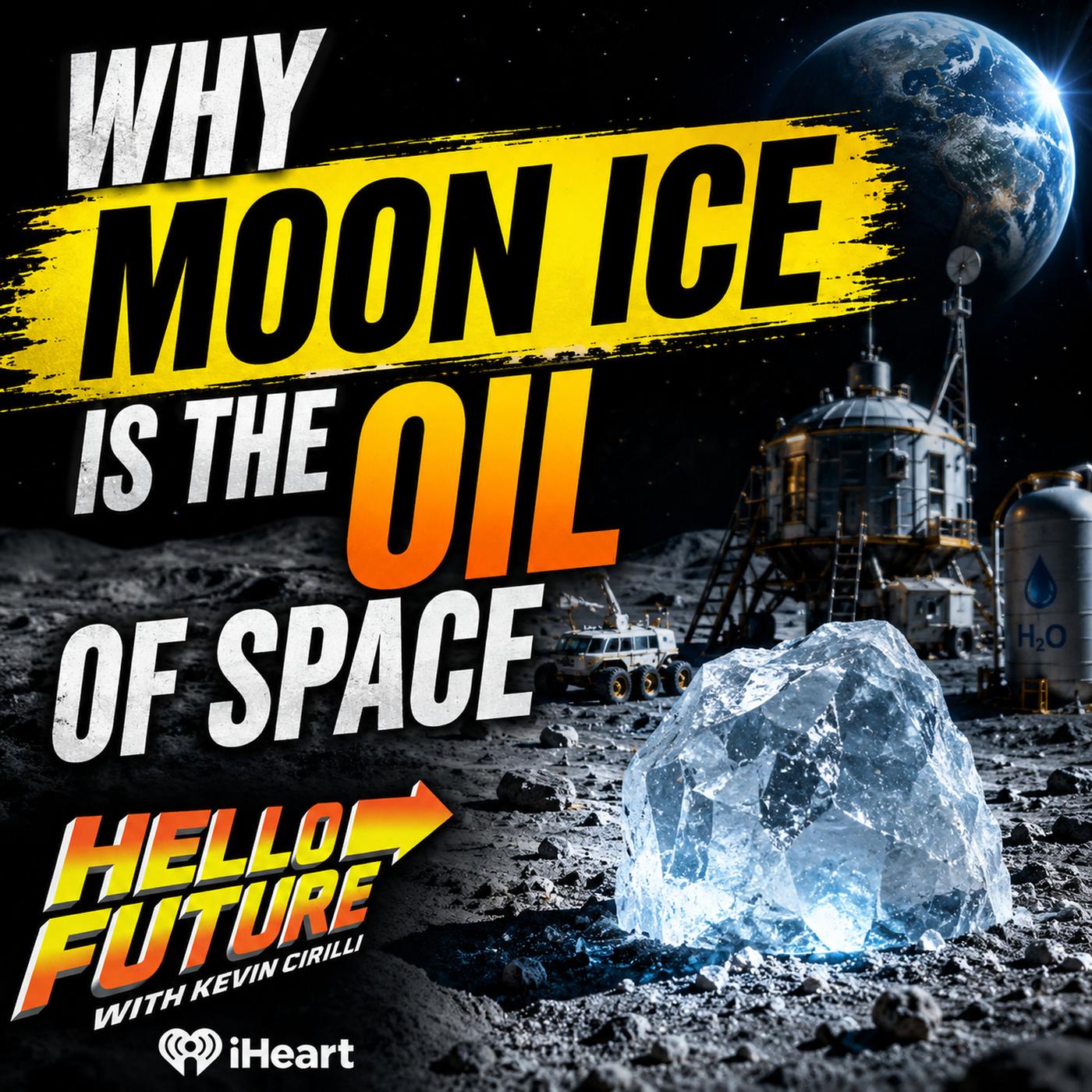
Speaker 2: Yeah, I like to describe this. This is the land of shadow and ice. Shadows are super dramatic, and there's these very these high up peaks that are almost always in the sun, and so you might be able to put a base up there, but then you surrounded by vast potential ice planes that you can go down and you can go do this mining into And look, this is not oil, but this is kind of like the oil of space. This is like the Bocan. This is like shale production on the Moon, except for rocket fuel. That is the type of resource that we're talking about here. It is a big geoeconomic prize because of how much water is potentially there. It's a massive resource.
00:09:24
Speaker 1: So that's the thing I want to get because people are probably wondering, if you're uninitiated like me, well, why can't we just take the fuel here on planet Earth and blast off to Mars. The gravity on the Moon is significantly less than here on planet Earth, which means you don't need as much thrust and fuel to blast off to go to Mars or elsewhere in the Solar System. Mind you, then you would need to launch from here. So really the south pole of the Moon is going to be like our airport to the Solar System exactly. And the water on the Moon is I love what you said.
00:10:00
Speaker 2: It's it's essentially the oil of outer space.
00:10:02
Speaker 1: Water oil of outer space. Water is the oil of outer space to someone like me, how because you can extract what to make oil. That's the part of missing.
00:10:13
Speaker 2: Yeah, So when we're looking just think chemically, just when you're looking at how we burn things on Earth, you basically are just using different combinations of carbon, hydrogen, and oxygen to burn them. That's all that you're doing with oil in the car it's a hydrocarbon. It's hydrogen and carbon chains. So when we're looking at the Moon, particularly when we're looking at things that don't necessarily need carbon, we have certain types of fuels that we can use. We also can get the carbon from elsewhere. But if you can get a portion of that hydrogen, you can then convert that into rocket fuel, and you can there's a variety of different propulsion methods you can use. For nuclear thermal propulsion, you actually just want the hydrogen because it's a super mass efficient. If you're just trying to use a traditional chemical engine, having the oxygen hydrogen for certain engines is all that you need. You're using something like a starship, you do need carbon. But the best way to really think about this right now, it costs a million dollars per kilogram to land anything on the moon. If you land on the moon, if you land astronauts on the moon, do we want to spend a million dollars for all of their fuel to get back here. Well, we can just go mine that there instead of costing a million dollars per kilogram, maybe ten thousand dollars per kilogram, because you get that hydrogen and get that oxygen there and potentially that might be the all that you need.
00:11:30
Speaker 1: So I think from where I sit, I think, and I'm having so many meat the future moments, and it really underscores how kebeyis is such an important crater on the Moon. And I mean, I don't want to call it a gas station. I think it sounds reductive because I actually do believe in climate change. And when I hear this, I feel so optimistic and hopeful because the critics, I would say that they're misinformed and it's a bunch of disinformation. You know. I'm critical of the legacy because I just think they've totally dropped the ball and explaining to the public we're at the start of the Fifth Industrial Revolution, we have a limited number of resources here on planet Earth, and we are so blessed to live on this planet, and so why would we continue to not protect our planet when we are in a solar system? Forget galaxy for a second. We are in a solar system with millions, potentially tens of millions of objects in our community. Because the Solar System is a system, but it's also a community. It would be completely reckless to not keep exploring to protect the gift of planet Earth by not looking for resources elsewhere, and we have to establish a presence on the moon. You know our friend doctor Kirby Runyan, I call him my coach Kirby. He's training me to go to space. I can't wait. Alex, you're invited if you'd like to come in our shuttle, if you would like to join us. He says, the Moon is a planet. I buy it. I think the Moon is a planet, and I think Pluto is a planet. I mean, who am I to say what's a planet and what's not? But I really, truthfully do think that being able to extract resources elsewhere in the Solar System is our responsibility as Americans to the rest of the world so that we can protect our planet from climate change and from pollution. And it's just what I believe at Alex Gilbert, I cannot thank you enough for coming on and really explaining you're going to have to come back because I really want to talk to you about how to power all of this, Alex Gilbert. If folks want to want to learn more about you, where should they go.
00:13:48
Speaker 2: My website Rosinante Fieldworks dot com Rosinante roc I n A M.
00:13:53
Speaker 1: The awesome, all right. Alex Gilbert, the guy when it comes to all things space, Space Watch and big ideas and translating the future to today
Speaker 1: One of the questions that I get asked so frequently these days is why should I care about Americans going back to the moon. We've got enough problems here on planet Earth, and there seems to be an endless list of things that we could be doing before we go back to the moon. Well, I feel that it is vital for America to not only go back to the Moon, but to establish a permanent presence. And I'm going to tell you why. Hello Future, It's me keV. This is a dispatch from the Digital Frontier. The planet is Earth. The year is twenty twenty six. My name is Kevin Surreally. Remember, you can listen to all of the latest Hello Future episodes however you get your podcasts and on the iHeartMedia app. My guest today is someone who helps me think through all of these big questions, coaches it from not only a scientific perspective, but a regulatory perspective, and he's just really good at indulging me and answering all of my dumb questions. I just put them to him, and I always walk away feeling a little bit smarter. His name is Alex Gilbert. He's on the front lines, really the top space regulatory expert in the nation, and I would argue because we have the best space program. Alex, thank you so much for joining me. I am am a huge peek when it comes to mining in space. I love the idea of mining asteroids, of mining Moods and Saturn, Europa and Jupiter. But the Moon, our moon that we can look up and see in the sky, is really the first step to unleashing the infinite number of resources in our universe. If we can master that, we can do it arguably anywhere. But why should folks care about astronauts and Americans going back to the Moon and ultimately mining it. What's up there?
00:02:12
Speaker 2: Yeah, Kevin, thanks so much for having me and thanks for the kind words. The primary reason that we want to go back to the Moon is that we have discovered water and we think that there is sufficient quantities of water for us to begin mining it and using it. Now we live on an ocean planet. We have plenty of water here. Why do we want water in space. It's because water has hydrogen and oxygen, and we can use that to make rocket fuel. If we can refuel in space, the economics of going to space and doing anything in space changes completely. We can have refueling architecture so that we send something up from Earth and it uses water delivered from the Moon to refuel and then go to Mars or going to keep space, or do all other sorts of activities that are economically valuable to us on Earth.
00:02:58
Speaker 1: So I love this. Is when I was a kid, I remember I would watch, like, you know, the Magic School Bus with Miss Frizzle or whatever, and I remember being a kid, and I think it was time for kids or one of the scholastic things. I was in elementary school and there was this talk of water being found or is there water on the Moon, And I'm thinking to myself, that means we could live there and drink it. But what you're saying is that that is too elementary. First of all, it's not liquid water. It's blocks of ice. And you and I were talking about this. It's not like it's a giant iceberg like that whacked the Titanic. Okay, this is like in the lunar material or what would the human eye see, if anything, when they see the ice on the moon.
00:03:48
Speaker 2: So the reality is we don't know yet. Well we do know is that we have detections of water and we have had a major impact or the Alcross impact or that told us that the percentage abundance of water is actually relatively high. It's in single digit percentages. That means that if you were to be able to take a pound of material on the.
00:04:10
Speaker 1: Moon regular it's called regulith.
00:04:13
Speaker 2: You might have one or two ounces of water in there, but it's going to be frozen because the areas that it exists on the Moon are areas that are in permanent shadow. They're very cold, and so we don't know within that pound, is it completely mixed up, is it little ice nodules, is it little layers? And we don't know if we're looking at a column, so sorry the surface and going down, we don't know the distribution. We don't know if it's at the top, if it's a meter down, We don't know if there's a lot deeper. And so these are all the scientific questions that right now we know enough that we can probably mine it, but we don't know where to mind, and we don't know how much it will cost to mind, and we don't know the technology we need specifically. So all the science, all the stuff that we're trying to do right now is to answer those questions of what form the water is in and how do we get it.
00:05:02
Speaker 1: So, what's the first thing that Americans are going to want to do when they mine the water on the Moon.
00:05:09
Speaker 2: Just think about like you're at a beach and you're digging in sand, so reguleth the moon dirt. It's just like sand. It's this stuff that's super crumbly, it's very coarse. You basically are going to have to probably scoop it up, and you're going to then have to figure out how to get the water out. You can use heat, you might be able to use some other sorts of techniques to maybe crumble the rock out and be able to get the ice crystals in there. But the challenge, more than anything is how do you operate in these type of environments. Because it's the Moon, it's very harsh, and the areas where the ice exists, they're super cold. They're negative hundreds of degrees.
00:05:43
Speaker 1: Cold, so older than any place on Earth.
00:05:45
Speaker 2: Yeah, colder than any place on Earth by far.
00:05:48
Speaker 1: So when you look up at the moon, my understanding and correct me if I'm wrong, because you're the expert. But when I look up at the moon at night, you can see the different shades of color on the moon. Those are the craters, meteorites or whatever stuff wax into the moon and so on the south pole the bottom of the moon that's hanging up there in the sky. And I would argue, is it the north pole too, or just the south pole?
00:06:12
Speaker 2: Okay, we'rell and north pole, but.
00:06:14
Speaker 1: It's easier for us to get to the South pole.
00:06:16
Speaker 2: No, So the south pole has expected higher concentrations of water than the North pole, but it's actually not as much as you would think, saring how much people talk about the South Pole. Both of them are economically attractive targets.
00:06:28
Speaker 1: For whatever reason, we're focused on the south pole.
00:06:31
Speaker 2: Yes, Why because there are more craters there and there's likely higher overall abundance of water. So it's just kind of one of those things that it happened to be, Hey, we're looking at the south pole and then trying to set looking at the south pole, and everyone started being, Okay, the south poles where all these resources are, and it probably is where the most favorable resources are. But I always like to point out that north pole is as well. But to answer your question, why do we have this North pole and South pole? Deposits of water. Think about the seasons. So we have seasons on Earth because we're inclined pretty heavily to the Sun. The Moon is not. The Moon has a very limited incline and so on.
00:07:10
Speaker 1: Because it doesn't rotate.
00:07:12
Speaker 2: The moon always the Moon rotates, but it rotates around the Earth. It always faces the same side towards Earth. But relative to the Sun, the South pole, in the North pole, they never see sunlight in these craters because the inclination relative to the Sun is about two or three percent. It's very, very tiny and has been that tiny for billions of years.
00:07:31
Speaker 1: So there are parts of the of the south it's the south pole and the north pole of the Moon that are in constant sunlight.
00:07:39
Speaker 2: Correct, there's a handful of them on the very tops of craters and mountains.
00:07:44
Speaker 1: And that's prime real estate for development because of solar energy until we can use more nuclear stuff for lack of a better word. But there are parts of the Moon within inches it's very light and then very very dark. This is a place of extremes. I mean the fact this is where you know, I don't want to get deep because I'm not that deep alex as you know. But the fact that some meteor wax into the bottom of the Moon and creates a crater and as a result, creates shadows. And in those shadows, because where the sunlight hits it's very very hot. It makes it the Arizona Desert look like it's Santa Claus's workshop with all the snow. It's very very hot at the south pole of the Moon. And then because of these shadows, it's freezing cold and pitch black darkness. So the light allows us to establish a base there, and the shadows and the dark and the cold allows us to extract mining water. I mean, talk about hitting the cosmic jackpot.
00:08:48
Speaker 2: Yeah, I like to describe this. This is the land of shadow and ice. Shadows are super dramatic, and there's these very these high up peaks that are almost always in the sun, and so you might be able to put a base up there, but then you surrounded by vast potential ice planes that you can go down and you can go do this mining into And look, this is not oil, but this is kind of like the oil of space. This is like the Bocan. This is like shale production on the Moon, except for rocket fuel. That is the type of resource that we're talking about here. It is a big geoeconomic prize because of how much water is potentially there. It's a massive resource.
00:09:24
Speaker 1: So that's the thing I want to get because people are probably wondering, if you're uninitiated like me, well, why can't we just take the fuel here on planet Earth and blast off to Mars. The gravity on the Moon is significantly less than here on planet Earth, which means you don't need as much thrust and fuel to blast off to go to Mars or elsewhere in the Solar System. Mind you, then you would need to launch from here. So really the south pole of the Moon is going to be like our airport to the Solar System exactly. And the water on the Moon is I love what you said.
00:10:00
Speaker 2: It's it's essentially the oil of outer space.
00:10:02
Speaker 1: Water oil of outer space. Water is the oil of outer space to someone like me, how because you can extract what to make oil. That's the part of missing.
00:10:13
Speaker 2: Yeah, So when we're looking just think chemically, just when you're looking at how we burn things on Earth, you basically are just using different combinations of carbon, hydrogen, and oxygen to burn them. That's all that you're doing with oil in the car it's a hydrocarbon. It's hydrogen and carbon chains. So when we're looking at the Moon, particularly when we're looking at things that don't necessarily need carbon, we have certain types of fuels that we can use. We also can get the carbon from elsewhere. But if you can get a portion of that hydrogen, you can then convert that into rocket fuel, and you can there's a variety of different propulsion methods you can use. For nuclear thermal propulsion, you actually just want the hydrogen because it's a super mass efficient. If you're just trying to use a traditional chemical engine, having the oxygen hydrogen for certain engines is all that you need. You're using something like a starship, you do need carbon. But the best way to really think about this right now, it costs a million dollars per kilogram to land anything on the moon. If you land on the moon, if you land astronauts on the moon, do we want to spend a million dollars for all of their fuel to get back here. Well, we can just go mine that there instead of costing a million dollars per kilogram, maybe ten thousand dollars per kilogram, because you get that hydrogen and get that oxygen there and potentially that might be the all that you need.
00:11:30
Speaker 1: So I think from where I sit, I think, and I'm having so many meat the future moments, and it really underscores how kebeyis is such an important crater on the Moon. And I mean, I don't want to call it a gas station. I think it sounds reductive because I actually do believe in climate change. And when I hear this, I feel so optimistic and hopeful because the critics, I would say that they're misinformed and it's a bunch of disinformation. You know. I'm critical of the legacy because I just think they've totally dropped the ball and explaining to the public we're at the start of the Fifth Industrial Revolution, we have a limited number of resources here on planet Earth, and we are so blessed to live on this planet, and so why would we continue to not protect our planet when we are in a solar system? Forget galaxy for a second. We are in a solar system with millions, potentially tens of millions of objects in our community. Because the Solar System is a system, but it's also a community. It would be completely reckless to not keep exploring to protect the gift of planet Earth by not looking for resources elsewhere, and we have to establish a presence on the moon. You know our friend doctor Kirby Runyan, I call him my coach Kirby. He's training me to go to space. I can't wait. Alex, you're invited if you'd like to come in our shuttle, if you would like to join us. He says, the Moon is a planet. I buy it. I think the Moon is a planet, and I think Pluto is a planet. I mean, who am I to say what's a planet and what's not? But I really, truthfully do think that being able to extract resources elsewhere in the Solar System is our responsibility as Americans to the rest of the world so that we can protect our planet from climate change and from pollution. And it's just what I believe at Alex Gilbert, I cannot thank you enough for coming on and really explaining you're going to have to come back because I really want to talk to you about how to power all of this, Alex Gilbert. If folks want to want to learn more about you, where should they go.
00:13:48
Speaker 2: My website Rosinante Fieldworks dot com Rosinante roc I n A M.
00:13:53
Speaker 1: The awesome, all right. Alex Gilbert, the guy when it comes to all things space, Space Watch and big ideas and translating the future to today
