

ABOUT THIS EPISODE
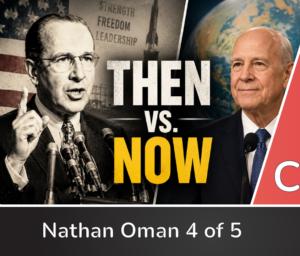
What do you do when your personal conscience clashes with official LDS Church positions? Why did the LDS Church transition from the fiery, anti-communist speeches of Ezra Taft Benson in the 1960s to the strict political neutrality we see today?
https://youtu.be/cDExXX00Y0o
Oman is the author of 2 volumes of Law and the Restoration Volume 1 and Volume 2, from Greg Kofford Books.
Don’t miss our other conversations Nathan: https://gospeltangents.com/people/nathan-oman
Copyright © 2026
Gospel Tangents
All Rights Reserved
In this episode of Gospel Tangents, I sat down with Nathan Oman, law professor and author of Law and the Restoration, to explore the fascinating evolution of Mormon political theology and the realities of modern Church discipline.
We dive into the Church's shift toward "quietism"—a strategy of withdrawing from global political conflict to focus on personal righteousness and international missionary work. Discover why praise for the U.S. Constitution has largely vanished from General Conference, replaced by an emphasis on the 12th Article of Faith and being an unthreatening, law-abiding citizen in international environments.
Personal Conscience
The conversation also tackles the complex tension between personal conscience and institutional authority. Oman explains the "epistemic advantage" of church doctrine and shares practical, ethical advice on how faithful members can navigate deep personal disagreements with the Church without undermining its global mission.
Finally, we pull back the curtain on LDS Church discipline. While liberal intellectuals and internet critics dominate the media headlines, Oman reveals a surprising historical truth: the modern concept of apostasy was primarily developed for, and is overwhelmingly used against, polygamist fundamentalists.
In this video, we cover:
The legacy of Ezra Taft Benson's Cold War apocalypticism.
Why the Church avoids taking stances on hot-button political issues like immigration.
The "epistemic advantage" of obedience and trusting Church doctrine.
How to ethically handle personal disagreements with Church leaders without being insubordinate.
The truth about who actually gets excommunicated for apostasy.
📚 Guest: Nathan Oman, law professor at William & Mary and author of Law and the Restoration.
🔓 Want the full, uncut conversation? Sign up at patreon.com/gospeltangents to hear this entire interview without interruptions and to support the Gospel Tangents podcast network!
Oman is the author of 2 volumes of Law and the Restoration Volume 1 and Volume 2, from Greg Kofford Books.
CHAPTERS
0:00 Taking on Hugh Nibley
9:13 Civil Disobedience (Hubener)
Don’t miss our other conversations Nathan: https://gospeltangents.com/people/nathan-oman
Copyright © 2026
Gospel Tangents
All Rights Reserved
English
United States
IN THIS EPISODE
TRANSCRIPT 🔗
Are you the producer of this podcast?
Add a podcast transcript
Need Audio-to-Text?
Transcribe with Listen411 in Just 60 Seconds
SEARCH PAST EPISODES
Search past episodes of Gospel Tangents Podcast.
OTHER EPISODES IN THIS PODCAST

Brigham didn’t dissolve Relief Society! That’s what Katie Rich’s recent article on Brigham Young & the Relief Society claimed. It goes against the historical consensus and won an award at the Mormon History Association. She will explain her reasons here. We’ll also discu…

Where did Joseph Smith get the idea of temples?
It sounds like a simple question, but historian John Hamer’s answer stretches from the Bible to a domed assembly hall in Independence, Missouri, and includes a temple that was called for by revelation, designed by an architect, and never built.…

Over the past three segments, Dr. Thomas Murphy, author of Unsettling Scripture: Iroquois and the Book of Mormon, has walked us through his research connecting Haudenosaunee history to the origins of the Book of Mormon — from the Dartmouth/Moor's Charity School connection, to the prophet Handsome L…

What happened to the Nauvoo Endowment after Joseph Smith’s death? What happens to a temple idea when a group won’t follow Brigham Young west? In this third conversation of the series, historian John Hamer and host Rick Bennett follow two small groups that carried the Nauvoo endowment in…

We’re moving beyond LDS Temples and looking at Fundamentalist Mormon temples. Nauvoo gave Latter-day Saints a temple built around Old Testament ordinances, and then the pioneers left it behind. In this second conversation of the series, historian John Hamer and host Rick Bennett follow that i…
Disclaimer: The podcast and artwork embedded on this page are from Rick B, which is the property of its owner and not affiliated with or endorsed by Listen Notes, Inc.
EDIT
Thank you for helping to keep the podcast database up to date.
