

WEBVTT
1
00:00:00.000 --> 00:00:12.000
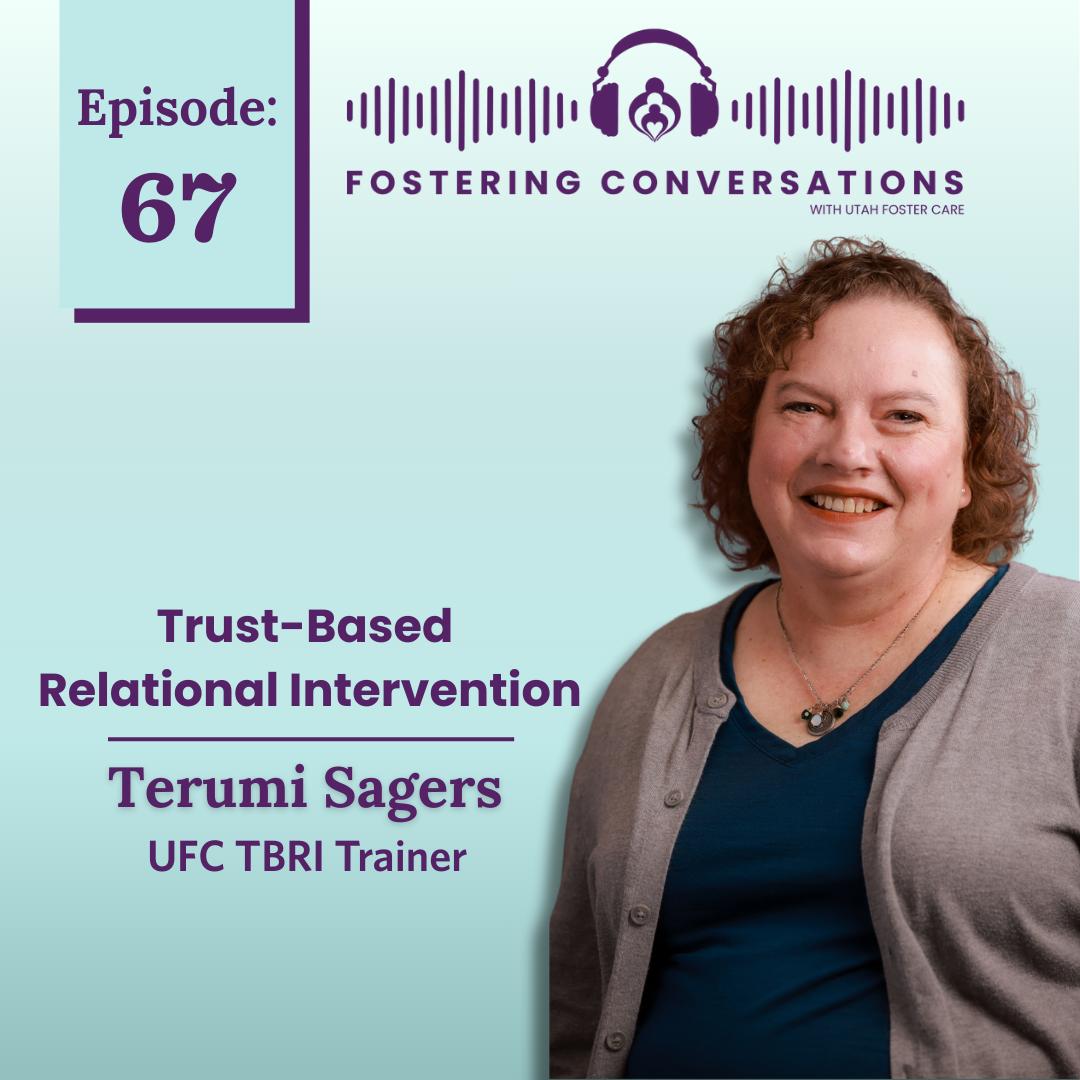
On today's episode, we will be talking to Tammy from Utah Foster Care about TBRI principles. This is a parenting strategy for anybody parenting kids with trauma or anyone with kids in the home.
2
00:00:12.000 --> 00:00:36.000
This is Fostering Conversations with Utah Foster Care, where we have insightful conversations about parenting for bio foster, adoptive or blended families to better understand the experiences we all face as families.
3
00:00:36.000 --> 00:00:47.000
Welcome to Fostering Conversations. I'm your host, Amy Smith. Today we have as our guest Tami Sagers, who is the TBRI specialist for Utah Foster Care. Welcome, Tami.
4
00:00:47.000 --> 00:00:49.000
Thank you. Thank you for having me here.
5
00:00:49.000 --> 00:00:58.000
So you are the specialist. You've been teaching for a while. Tell us a little bit about yourself. So listeners just have a little bit of background.
6
00:00:58.000 --> 00:01:23.000
So my husband and I were foster parents for 20 years. Fostered and did respite for a long time. We also adopted three of our four children from the foster care system. And I have been with Utah Foster Care for coming up on 15 years now. Okay. Working on the training team.
7
00:01:23.000 --> 00:01:26.000
So you are more than qualified is what I hear.
8
00:01:26.000 --> 00:01:29.000
I would hope so. I love that.
9
00:01:29.000 --> 00:01:34.000
That's amazing. So tell us, let's just start from the beginning. What is tbri?
10
00:01:34.000 --> 00:01:54.000
So TBRI stands for Trust Based Relational Intervention. And it is a parenting philosophy based out of research done by Dr. Karen Purvis and and Dr. David Cross out of TCU.
11
00:01:54.000 --> 00:02:08.000
So I've taken the TBR trainings as a foster parent. Something I always wonder, I don't know. So I'm asking, is TBRI only for kids with trauma or can it be used to parent any type of child?
12
00:02:08.000 --> 00:02:23.000
I love that question because when we first learned about it, it was in the context of working with kids that have experienced trauma or have had toxic levels of stress.
13
00:02:23.000 --> 00:02:24.000
Yeah.
14
00:02:24.000 --> 00:02:58.000
But as the research has gone on, they have realized this works for all kids. This works in other relationships as well. And I have had families come through TBRI training and say, I don't have any kids in my home, but I've been doing this with my co workers or I've been doing this with my spouse. And this works everywhere. And I love that. The reality is, yes, it works everywhere with everyone.
15
00:02:58.000 --> 00:03:16.000
Yeah. And why is that? Maybe give us like a very small. I know TBRI is very intense and has so many layers, but can you give us like a little bit of a nutshell overview of what the basis of it is for listeners that maybe we don't know what it is?
16
00:03:16.000 --> 00:03:55.000
So we go back to that name, Trust Based Relational Intervention, that we build trust in relationships and that helps us have influence on behaviors of others. And when we put that relationship at the forefront and connecting with people on a really basic level, they feel that safety with us, and it allows us to then empower them. It allows us to correct behaviors when we need to. Because they know they can trust us.
17
00:03:55.000 --> 00:04:34.000
Yeah. Yeah. Some of the basic things that I remember when I took the training years ago, or is when one of the activities during the training is they have a pretend hurt, essentially, and you ask, where is your hurt? May I put a band aid on it? And I. I think it really is so basic. You're just doing these basic things of, like you say, building trust. And with. Especially with kids with trauma, they don't have that on any foundational level. And so starting with these really simple band aid activities makes them start being more comfortable and being able to trust their caregivers.
18
00:04:34.000 --> 00:04:50.000
Yeah. When we think about trust, we tend to think starting maybe at zero and going forward, but our kids in care have had traumas to the level that you're not starting at zero, you're starting at negative.
19
00:04:50.000 --> 00:04:51.000
Yeah. That's interesting.
20
00:04:51.000 --> 00:04:54.000
I hadn't thought about that time to get to zero.
21
00:04:54.000 --> 00:04:55.000
Yeah.
22
00:04:54.000 --> 00:05:08.000
And so all of these activities, all of these strategic things that were being very intentional about teaching are to get you to zero, to then start going forward in that relationship.
23
00:05:08.000 --> 00:05:15.000
Yeah. And I think as a caregiver or a parent, that can be overwhelming, because, first of all, we want instant results.
24
00:05:15.000 --> 00:05:16.000
Right.
25
00:05:15.000 --> 00:05:22.000
We want kids to just be amazing and trust us and obey and do everything that would be amazing.
26
00:05:22.000 --> 00:05:23.000
But.
27
00:05:22.000 --> 00:05:35.000
And that's just not reality for any child. But I think having that perspective of you're trying to even just get to zero, I think that's a really good perspective for caregivers to think about. I had never thought about that before, so I really like that.
28
00:05:35.000 --> 00:05:48.000
Yeah. When you have a baby that is born to you from the moment, even in the womb, you are doing things that they learn to, hey, this person's taking care of me. I can trust.
29
00:05:48.000 --> 00:05:49.000
Yeah.
30
00:05:49.000 --> 00:05:57.000
I'm safe. When a child just lands on your doorstep, they don't know you.
31
00:05:57.000 --> 00:05:58.000
Right.
32
00:05:57.000 --> 00:06:14.000
They don't know that you can be trusted in any way. And sometimes we forget that because we think everything that was in the past is in the past, but trauma doesn't go away the moment they hit your doorstep. Right.
33
00:06:14.000 --> 00:06:19.000
You just added another pile on. Actually, this is an additional trauma.
34
00:06:19.000 --> 00:06:34.000
Correct. Yeah. Now I'm living with, hopefully, if we're able to find kinship providers, someone I know at least. Otherwise I'm being placed on the doorstep of well intentioned, total strangers. I know.
35
00:06:34.000 --> 00:07:05.000
I, when I explain foster care to people, I, I say think of how many people you have if you and your spouse were unavailable to care for your kids. The list is probably long. Right. Kids in foster care, Literally, there's no list. So they're coming to a stranger's house. And it is like, still to me, it's so mind boggling to think, wow, we have this many kids and this many adults, really, in the state of Utah and in the country that they have no one. And so their kids are going to strangers when they're in a terrible situation. That's really sad.
36
00:07:05.000 --> 00:07:14.000
Yes. As hard as it is to be in that stressful situation, having someone you can count on helps buffer that stress.
37
00:07:14.000 --> 00:07:15.000
Yeah.
38
00:07:14.000 --> 00:07:24.000
And these kids haven't had someone that could count on and in fact have been hurt in relationships where they should have been kept safe.
39
00:07:24.000 --> 00:07:25.000
Yeah.
40
00:07:25.000 --> 00:07:42.000
And so it puts you again at that deficit below zero. Because moms aren't necessarily safe or dads aren't necessarily safe. And now I have a mom and a dad. I have no history that tells me I can trust them.
41
00:07:42.000 --> 00:08:35.000
Yeah. I remember the first night we got our now adopted daughter. She was 14 months and the middle of the night and a caseworker brought her in a car seat and I came outside, took her out of the car seat, carried her to my couch. She was filthy. I didn't choose to bathe her right then. I was like, this poor kid is going through a lot. So we. I just sat and held her. But it was so interesting because she was tired and it was a lot. But that morning she would not let me hold her. She would let my husband hold her, she would let my kids hold her. But the mom figure, it was a no. And it was so interesting. It took a few days for her to be okay with me holding her. But really, these kids do have barriers and things that have happened to them that they can't trust the adult female figure or they can't. They're scared when you have no idea why. So it's crazy.
42
00:08:35.000 --> 00:09:07.000
And part of what we talk about with TBRi and a lot of the trainings that we present to foster parents is about attachment and the attachment cycle and that you keep showing up, they will show you what their needs are and you keep showing up. What I love about TBRi is it's not theoretical about what attachment is and how you build it. It is very practical. Yeah, do this, then do this.
43
00:09:07.000 --> 00:09:08.000
Yeah, yeah.
44
00:09:08.000 --> 00:09:18.000
And we still cover that overarching idea around attachment, but it's very hands on, very holistic, very practical.
45
00:09:18.000 --> 00:09:27.000
Yeah. So tell us a little bit about the TBRI training that Utah foster parents can participate in.
46
00:09:27.000 --> 00:10:01.000
So we offer what is called the Caregiver series. And it is a series of eight classes. They are two and a half hours each. So by the time you Finish, you have 20 hours of training. There has been a new curriculum that has come out in the last six months and I love it because it not only takes those principles, but it does widen the audience. This kit is available too, and it makes it more user friendly.
47
00:10:01.000 --> 00:10:02.000
Yeah.
48
00:10:01.000 --> 00:11:45.000
Even than it was before. And so we have nights where we're talking about the brain and understanding the basics about the brain, a night about attachment. And then we go into what are called the principles. And there's three principles of TBRi. We will spend two nights talking about connecting and building those relationships. We will spend two nights talking about empowering. And this is some of the structures that we put in place to help kids calm their bodies and to help our homes be safe and calm places for them. And then we spend two nights talking about correcting behavior. Now, if we've put in the time as parents, which is what I always tell parents, when you choose to become a parent, you will put in time and you get to choose how you spend your time. You can either front load it with a lot of connecting and a lot of empowering, or you can choose to do a lot of correcting. And in TBRi, we look at this as a pyramid that we want that foundation of connecting and empowering. And then the very top is the correcting. And even in that, we break it down into we're going to teach the life skills we want. And at the very top is correcting behaviors in that moment. Because that's the least effective time too. I know. Teach. And we get that as adults. Yes.
49
00:11:45.000 --> 00:11:49.000
And it's always, at least for me, it's always, oh, immediately that's. I'm like, we have to fix that.
50
00:11:49.000 --> 00:11:52.000
Right. And it's, oh, not the time. It's.
51
00:11:52.000 --> 00:11:57.000
I don't know if it's human nature to just want to go exactly there or if it's my personality or what.
52
00:11:57.000 --> 00:12:27.000
But yeah, it takes a lot of effort. We want to fix it and we want to fix it right now. Yeah. And we are frustrated and they are frustrated and we use way too many words. True. When they are not in a space that their brain is comprehending a lot of words. So what we tend to do when we put in time sometimes is we flip back and forth between having the triangle or look like a pyramid and having inverted.
53
00:12:27.000 --> 00:12:28.000
Yeah.
54
00:12:27.000 --> 00:12:43.000
We are spending all our time correcting. We'll figure out the empowering things. And that connection comes last, you know? Yeah. And I tell parents the way you can tell where you're at, because we all do it, and we all flip back and forth between them.
55
00:12:43.000 --> 00:12:44.000
Yeah.
56
00:12:44.000 --> 00:12:56.000
But if you are frustrated as a parent, if you are feeling like every interaction I have is correcting behavior, my hunch is you've inverted that pyramid.
57
00:12:56.000 --> 00:12:57.000
Yeah. That makes sense.
58
00:12:57.000 --> 00:13:07.000
And if you can go, I gotta flip it back. It starts with you as a parent going, I've got to focus on that connection.
59
00:13:07.000 --> 00:13:08.000
Yeah.
60
00:13:08.000 --> 00:13:24.000
And I've got to focus on positive interactions with my child. I had a child that at one point was so struggling with his mental health that he literally did not leave our house more than five times over the course of a year and a half.
61
00:13:24.000 --> 00:13:25.000
Yeah. Wow.
62
00:13:25.000 --> 00:13:34.000
I struggle with that. And I struggled to connect with him because he was so withdrawn.
63
00:13:34.000 --> 00:13:35.000
Yeah.
64
00:13:35.000 --> 00:13:48.000
There was a time when the most I could come up with was, thank you for showering. You smell really nice today. And that was my feeble effort at connecting with that child.
65
00:13:48.000 --> 00:13:49.000
Yeah.
66
00:13:48.000 --> 00:14:07.000
But when I started doing that every day, finding one way to connect with him. Yeah. It flipped that relationship again. And he knew I had his back. I was on his side. And eventually it built.
67
00:14:07.000 --> 00:14:08.000
Yeah.
68
00:14:08.000 --> 00:14:21.000
Where it was not hard to find things to be positive about. Easy to continue to build and to continue to empower him towards better mental health.
69
00:14:21.000 --> 00:14:50.000
Yeah. No, I think every parent can relate to that. And I always. Anytime we're talking, you know, about parenting aspects, I'm always laughing in my head. Cause I'm like, oh, I have this kid who's really easy to parent and this kid who's really hard to parent. And it's a personality conflict for some of us, but ultimately it does. It comes back on us as the parents to find the ways to connect, to find the ways to take a deep breath and try again. And it's hard. It's hard as a parent.
70
00:14:50.000 --> 00:15:03.000
It is. We are human, and we get frustrated, too. But remembering, oh, wait, yes, I am the adult. I know whether I want to be or not right now.
71
00:15:03.000 --> 00:15:04.000
There you go. That's exactly right.
72
00:15:04.000 --> 00:15:06.000
I actually am the adult.
73
00:15:06.000 --> 00:15:14.000
Yes. So tell us a little bit. If people are not foster parents, is there a way that they can access this type of training?
74
00:15:14.000 --> 00:16:04.000
Yes. There are multiple community resources. My healing home here in Salt Lake county offers it. They offer it statewide. You can look into Raise the Future offers community classes as well. And it's also available online through TCU. So Texas Christian University has a TBRi 101 class that you can take there. Additionally, TCU has put out multiple YouTube videos that'll just give you brief glimpses into TBRi and some of these principles we're starting to spread statewide in the number of what we call practitioners. People like myself who've been trained to teach tbri.
75
00:16:04.000 --> 00:16:05.000
Yeah.
76
00:16:05.000 --> 00:16:10.000
And so it's becoming more prevalently available in schools.
77
00:16:10.000 --> 00:16:11.000
Oh, that's awesome.
78
00:16:11.000 --> 00:16:21.000
In therapy agencies and things like that. So it's starting to spread. But Race Future and My Healing Home are two that I would recommend for. Okay.
79
00:16:21.000 --> 00:16:44.000
Yeah, that's really good to know because I like, I had literally never even heard of this concept until I became a foster parent. And then even still, when I've told other people about it, I've had. Once you become a foster parent, people think you're like this all knowing magical being. And it's. No, actually, I'm just a human who signed up to do something really crazy. But thank you for that empowering comment.
80
00:16:44.000 --> 00:16:45.000
But people will reach out, right.
81
00:16:45.000 --> 00:16:59.000
And be like, I have this difficult niece or nephew or I'm not a therapist. I. Anyways, so I think it's great to know where we can refer people to or if somebody's listening that is not a foster parent. Where are these resources that they can access?
82
00:16:59.000 --> 00:17:10.000
And now that you said that, two books I'm going to recommend. Yeah. The Connected Child and the Connected Parent. And they are Both based on TBRi principles by Karen Purvis.
83
00:17:10.000 --> 00:17:43.000
Okay. That's amazing. Yeah. So that just gives a little bit of a foundation and some options for people to go look at. I would love for you to chat a little bit about what the training's like to become a TBRI practitioner. I've talked to a few of the other people at Utah Foster Care who have gone through that and I think it's super fascinating. So I don't know if you have any. I know that's a random question, but I just found it really fascinating who just explained a little bit of what becoming a practitioner for it is and what it entails. And I would love if you'd be willing to share a little bit about that.
84
00:17:43.000 --> 00:17:55.000
It is rather intense. Apply for the opportunity to do it. I do it late in Covid, so my experience was entirely online.
85
00:17:55.000 --> 00:17:56.000
Okay.
86
00:17:55.000 --> 00:18:31.000
It's not the ideal way and it's not the way they do it now, but they have you do about 10 weeks of studying and deep diving into TBRA principles. And then they set up an appointment to do something called the adult attachment interview. I told you earlier, we talk about attachment and different attachment styles. With the adult attachment interview. This is a several hour process, one on one with an interviewer where they have you talk about your childhood.
87
00:18:31.000 --> 00:18:32.000
Oh, wow.
88
00:18:32.000 --> 00:18:52.000
And your parents and their personalities. Your personalities, how what worked, what didn't. What your memories are like. And then at the end of that, they tell you what your attachment style is with each of your parents.
89
00:18:52.000 --> 00:18:53.000
Okay.
90
00:18:53.000 --> 00:19:12.000
Because that then shows up in how you parent and how you interact in other relationships. It can show up in romantic relationships. It can show up in parenting relationships. So that in and of itself is very intense.
91
00:19:12.000 --> 00:19:15.000
How do we all get one of those?
92
00:19:15.000 --> 00:19:22.000
They are very expensive to do. That is not a random thing you just click on online.
93
00:19:22.000 --> 00:19:26.000
No kidding. But how fascinating was it so eye opening to you?
94
00:19:26.000 --> 00:19:29.000
Oh, very eye opening and slightly horrifying.
95
00:19:29.000 --> 00:19:32.000
I think it would be like also didn't want to know about myself.
96
00:19:32.000 --> 00:19:44.000
Yes. And it, it gave me deeper insight into some of the choices that I have made as an adult. And back.
97
00:19:44.000 --> 00:19:45.000
Wow.
98
00:19:44.000 --> 00:19:45.000
Wow.
99
00:19:45.000 --> 00:19:48.000
That's really. Yeah, that would be so, so interesting.
100
00:19:48.000 --> 00:20:07.000
And then after that there is a one week long intensive where you are in a training session with them nine to five for five days. And they move it around the country. I think they have one coming up in Las Vegas and one up in Washington.
101
00:20:07.000 --> 00:20:08.000
Okay.
102
00:20:08.000 --> 00:20:15.000
It's a rather intense process and a lot of self discovery. Yeah. I betting that out.
103
00:20:15.000 --> 00:20:31.000
Wow. I just think that's. It's awesome and really neat to hear how intensive it is to become to train this. Because TBRI is not easy to do. It's not like you're gonna go into this class and then you're like, wow, I am a spectacular parent all of a sudden.
104
00:20:31.000 --> 00:20:33.000
It takes effort.
105
00:20:33.000 --> 00:20:44.000
It takes a lot of effort. And so I think even just becoming an educator in it, like it shows. You took a lot of effort and a lot of time and probably a lot of soul searching to become qualified to.
106
00:20:44.000 --> 00:20:47.000
To teach it. Yes, absolutely.
107
00:20:47.000 --> 00:20:50.000
You're like, maybe I didn't want to do this.
108
00:20:50.000 --> 00:20:55.000
There were times where I was like, this felt like a really good idea.
109
00:20:55.000 --> 00:20:59.000
I love that. That's so funny a lot.
110
00:20:59.000 --> 00:21:08.000
I look back now though, and it has done a world of good to use principles with my own children.
111
00:21:08.000 --> 00:21:09.000
Yeah.
112
00:21:08.000 --> 00:21:22.000
And helping those relationships in helping my marriage, in helping my relationships with my own siblings and my parents to just put things in context a little differently.
113
00:21:22.000 --> 00:21:24.000
Yeah.
114
00:21:24.000 --> 00:21:25.000
It's been amazing.
115
00:21:25.000 --> 00:21:26.000
That's so cool.
116
00:21:26.000 --> 00:21:27.000
I would Love.
117
00:21:27.000 --> 00:21:43.000
If you would be willing to share just one or two successes. You shared about one of the kids that lived with you that was struggling with mental health. But do you have any other examples that could be mentioned either about your family or people you've worked with? Anything? Just beautiful success stories from it.
118
00:21:43.000 --> 00:22:46.000
So one of the things that we spend a lot of time talking about is sensory challenges. Because a lot of our kids in care have sensory challenges of a variety of kinds. They may be seeking sensory experiences. They may be trying to avoid certain sensory experiences. In the empowering principles. We talk about how we help kids calm their bodies. And some of it has to do with these sensory experiences. Some of it has to do with making sure their blood sugar is at a regular level and making sure they're not dehydrated. So it's fun when I teach these classes and it's once a week because parents are giving, given an assignment. Go try something that we've taught this week and come back and tell us what worked, what didn't work. And when there's five or six of us doing this, we're getting a whole bunch more ideas.
119
00:22:46.000 --> 00:22:47.000
Yeah.
120
00:22:47.000 --> 00:23:00.000
From each other. One of the things was the blood sugar and hydration. And I said, make sure right after school they are getting a snack that's going to help regulate their blood sugar and make sure they're getting water.
121
00:23:00.000 --> 00:23:01.000
Yeah.
122
00:23:00.000 --> 00:23:26.000
The next week curls around. The parent comes back and she said, I went and bought high protein snacks instead of the garbage. I'd been, yeah, nice out for them to eat. And she said it's more expensive. But my kids every day are like, where is our special snacks? I love it. And she said all of those after school meltdowns that we were having went away.
123
00:23:26.000 --> 00:23:27.000
Yeah.
124
00:23:27.000 --> 00:23:39.000
When they were getting fed and hydrated right after school. Because we walked through the process of what does a day look like at school? When was the last time they ate?
125
00:23:39.000 --> 00:23:40.000
True.
126
00:23:40.000 --> 00:23:51.000
When was the last time they moved their bodies? That's probably around 1 o', clock. But they're probably eating around 11 o' clock and you're not seeing them until 3.
127
00:23:51.000 --> 00:23:52.000
Yeah.
128
00:23:52.000 --> 00:23:58.000
Or 3:30. So they have gone four hours and we need to get something in them fast.
129
00:23:58.000 --> 00:23:59.000
Yeah.
130
00:23:58.000 --> 00:24:07.000
And so now we have a lot of families that are keeping many water bottles or their child's water bottle in the car.
131
00:24:07.000 --> 00:24:08.000
Yeah.
132
00:24:08.000 --> 00:24:24.000
And some type of snack with them in the car. So as they get in the car, they hand it to them. Do not speak, eat this or anyone can melt down. Please eat this food, drink this water. And are Coming back going, that was game changing.
133
00:24:24.000 --> 00:24:50.000
And it's so silly, right? Like, I find that all the time. I have one specific child and he's, I'm sorry that I was hangry yesterday. He can't even think straight. He's losing his mind. And I'm like, let's just get you some. Going crazy. Finally, the next day. I'm so sorry that I was hangry. I'm like, yes, you were. Thank you for recognizing it now. But it is simple. But it really matters. It really does.
134
00:24:50.000 --> 00:25:04.000
It really does. And families have come back saying, okay, I've tried this. Oh, have you tried this particular type of water bottle? Love it. Working with kids of all ages just to meet those really basic needs.
135
00:25:04.000 --> 00:25:05.000
Yeah.
136
00:25:04.000 --> 00:25:09.000
And being aware of those timeframes. Have they moved their body in the last two hours?
137
00:25:09.000 --> 00:25:10.000
Yeah.
138
00:25:10.000 --> 00:25:16.000
Don't make them sit down and do homework right after school until you've gotten a snack in them and they've moved their body.
139
00:25:16.000 --> 00:25:17.000
Yeah.
140
00:25:17.000 --> 00:25:22.000
Because they've just been so pent up for so long sitting in a classroom.
141
00:25:22.000 --> 00:25:23.000
Yeah.
142
00:25:23.000 --> 00:25:35.000
They are gonna struggle unless you get them hydrated, get their blood sugar, get. Meet those sensory needs of moving their body. It's gonna go a whole lot smoother after school.
143
00:25:35.000 --> 00:25:43.000
Yeah. And I think that's what you were talking about with TBRi. There are tangible things to do. Do this, then do this. And yes, it's a lot of things.
144
00:25:43.000 --> 00:25:44.000
Right.
145
00:25:43.000 --> 00:26:05.000
As a parent, we're like, we just wanna snap our fingers and have it magically work. But this is not that there's no snapping of fingers, but there is actual steps and information and things you can do, which I as a parent really appreciate because so many times it's just, do just be a better parent and they'll be better. So I really appreciate that aspect of.
146
00:26:05.000 --> 00:26:11.000
TBRI and I love. I truly, every time I teach it, I'm like, oh, I should try that too.
147
00:26:11.000 --> 00:26:12.000
Yeah.
148
00:26:12.000 --> 00:26:16.000
My kids are all young adults now. But I still, oh, that's even more.
149
00:26:16.000 --> 00:26:18.000
Reason to try it.
150
00:26:18.000 --> 00:26:34.000
We should go back and try this. Or maybe in that next conversation I have with that child, I can do this to reconnect with them, to help have influence. They're young adults. I'm not going to be changing their minds on certain things.
151
00:26:34.000 --> 00:26:35.000
Right.
152
00:26:34.000 --> 00:27:02.000
But I can have influence still. And I'm still using these principles. I'm still, every time I take it, I learn something new and I try something new. And that's the other thing that I've told parents. Every time they take the TBRA courses, come back you're going to learn something new. You're going to have a new insight with a different relationship. This is going to be helping you with.
153
00:27:02.000 --> 00:27:15.000
And relationships are always evolving and changing and you always have stronger or weaker ones or new ones. So there's always something that can be worked on with somebody. At least for me. There's just so many options, really.
154
00:27:15.000 --> 00:27:17.000
Exactly.
155
00:27:17.000 --> 00:27:43.000
Oh, I love that. I have enjoyed taking the TBRI course. I should absolutely take it again because I'm in new stages of life and new things. But I really appreciate you sharing all of this information. It's beyond helpful for listeners. Yeah. Yes. No, it really is great. So we will just Refer listeners to utahfostercare.org if they want to learn more or to sign up to take one of the courses. Thanks for joining us, Tammy.
156
00:27:43.000 --> 00:27:44.000
Thank you.
157
00:27:44.000 --> 00:27:55.000
Thanks for joining us for Fostering Conversations. I'm your host, Amy Smith. To learn more, head over to utahfostercare.org.
158
00:27:55.000 --> 00:28:11.000
This has been fostering Conversations with Utah Foster Care. Thank you for joining us. For more information, go to utahfostercare.org we'll see you next time.
