
ABOUT THIS EPISODE
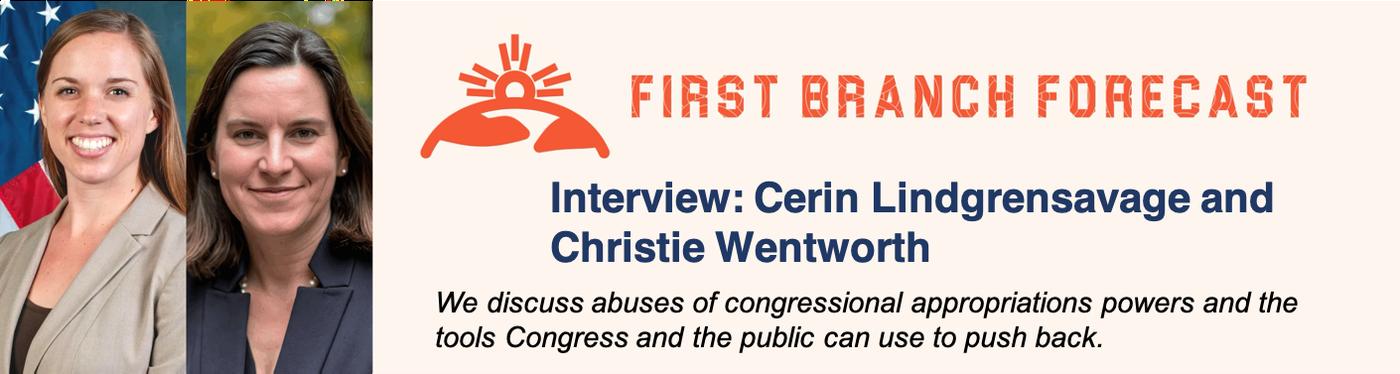
For this episode, I spoke with two experts in appropriations law who have worked in and out of government — Cerin Lindgrensavage of Protect Democracy and Christie Wentworth of Citizens for Responsibility and Ethics in Washington — about White House attempts to appropriate funds as it sees fit, not as Congress has directed, and the legal and political means available for Congress and civil society to push back.
Lindgrensavage is counsel at Protect Democracy and previously worked at the Department of Justice’s Antitrust Division and for Senator Barbara Boxer. She also clerked at the U.S. Court of Appeals for the District of Columbia.
Wentworth is a senior policy counsel at CREW and previously served as an attorney at the Government Accountability Office and as counsel for the House Budget Committee.
Chris Nehls: Hi, this is Chris Nehls with the American Governance Institute. I’m here with Cerin Lindgrensavage and of Protect Democracy and Christie Wentworth of Citizens for Responsibility and Ethics in Washington. We’ll do our best to put all of that on the title card of this podcast. We’re here to talk today about appropriations and appropriations law and how when Congress approves appropriations, how does the federal government spend it? And what’s been going on in this administration that’s made it kind of unusual. So, thanks for joining me today.
Christie Wentworth: Thanks for having us.
Cerin Lindgrensavage: Yeah, happy to be here.
Nehls: We have 12 appropriations bills a year, theoretically, that Congress approves. Sometimes, it doesn’t get there and does a continuing resolution, but there’s still the money it gets out to the federal agencies to spend. Well, how does that work after these bills move from the president’s desk to the agencies.
Wentworth: A great question to start with. I’m going to take us back a second and just emphasize at the top here, because Cerin and I are both very power of the purse friendly individuals in that Congress does have the power of the purse, which is why they are the ones that are in charge of actually figuring out how much money the federal government has to spend. So that’s based in the Constitution. And as you mentioned, Chris, that usually results in 12 different bills appropriating funds for the federal government, including all three branches.
After those funds are appropriated, they go through a process called apportionment at OMB. This is a responsibility that Congress gave to the president back in the day because agencies were blowing through their appropriations. They would enter into contracts, they would promise to spend money, and then they’d say, well, Congress, you know, we already said we’re going to spend this stuff. I know that you only gave us $10 and we spent $100, but we’re obligated now, and you have to give us this money. Congress said to the president, do a better job managing these funds and gave the president the responsibility to say, okay, agencies, you’re going to get 25% of your funding in quarter one for salaries and expenses, and then you’ll get another 25% in quarter two and so on and so forth. So, OMB now has that responsibility pursuant to a delegation from the president and they can apportion funds by time. They can apportion funds by program and they can do it through a combination of those two things. The purpose of that is still to make sure that the agencies aren’t spending funds too quickly so that they have to go back to Congress and ask for a deficiency appropriation. So that is the general framework for apportionments.
I will say when I worked at GAO, we spent two and a half days teaching appropriations law principles to folks at agencies, so doing this in 2 to 3 minutes is a challenge. But that’s the apportionment process.
I’m going to briefly share some of the components that we see in appropriations acts that agencies have to look for when they’re actually spending the funds. And then, Cerin, I’ll kick it to you to talk a little bit about the Impoundment Control Act and how Congress can act to actually claw back some of that money if it agrees with the president that it should. In the appropriations acts, the three things that agencies are looking for are the purpose, time, and amount of the appropriation: So, what they can spend this on, how much they can spend and how long they have to spend it. And there have always been disagreements between Congress and the executive about what exactly falls into each of these buckets, especially with respect to purpose. But those are the three general things that you’re looking for and that the agencies have to comply with when they’re spending these funds. So Cerin, do you want to talk about the Impoundment Control Act?
Lindgrensavage: Sure. One thing of interest to know about the apportionment process is that it has at some various points in history been abused. And that’s important because it’s the mechanism that OMB and past presidents have used essentially to rob Congress of its power of the purse to steal some of that power for the president, the White House, in this case, the Office of Management and Budget. If you went back and looked at the hearings in 1972 and three over the Nixon era impoundments, what you will find is actually page after page of accounts where they’ve used the apportionment process in some cases to actually affect delay to what they did at the time, called creating a reserve. And there was a provision in law that was a little bit squishy, a little bit of a choose your own adventure for the president and his budget officers to try and say, oh, well, we’re just creating a reserve for this sort of broad purpose.
Nehls: So, what was Nixon actually trying to trying to do there?
Lindgrensavage: What he was trying to do was actually say, hey, I don’t want to spend these funds. Congress passed the money, but I don’t want to. And he was trying to just essentially assert his power not to spend the funds.
As you can imagine, Congress reacted poorly to this assertion of the executive authority. And the law that they passed was both a remaking of the budget process that really put foundationally in place the fiscal years and steps as we know them today, and also what we call the Impoundment Control Act. That passed in 1974 and essentially said, no, we’re, we’re erasing that provision that made you think that you could just hold on to money for whatever purpose you wish to. And now you have three options: you can defer; you can delay spending the money -- but then you have to tell Congress, and Congress has a chance to tell you not to through a resolution they can pass. You can propose a rescission, but that only goes into effect if Congress passes a law rescinding the appropriations that were previously passed in a law. And the third option is you can spend the money. Those are the three options contemplated by the Impoundment Control Act.
Here are some things that are not contemplated in the Impoundment Control Act: unjustified delays for programmatic review -- the entire category of programmatic delay invented in the early ‘70s -- none of that is contemplated in the act. The act contemplates those three options: deferral, rescission, spending the money. It also left three different purposes that OMB can use to establish reserves, but they’re narrower. It’s to provide for contingencies to achieve savings or as specifically provided by law. So if you have a law that you can point to that says, okay, you can hold on this money for these purposes, that’s okay, but it has to be specific in the law. It really did ground and narrow OMB’s ability to screw around with money using the apportionment process or any other process because it doesn’t just bind OMB, it also binds folks at the agency level as well.
Nehls: Well, we’ve had a couple of rescissions bills, this Congress and, and there have been some in the past. So how has that how has that worked generally since the passage of the Impoundment Control Act as a congressional tool?
Lindgrensavage: I would say that your mileage may vary. There’s been some hiccups in the road. I think one of the things that’s happened more recently is that deferrals haven’t been reported in this century. We’re going on our 26th year of the administration not using the deferral provision. If you look at OMB management of funds, there are arguably a bunch of things that probably would or should qualify and be reported as a deferral, but I wouldn’t hold your breath on that happening anytime soon.
One of the things that’s happened is but I think that entire third of the sort of statute of the scheme has been rendered inoperable in a really significant way. And for whatever reason, Congress and GAO haven’t come back at OMB or the administrations across Democratic or Republican administrations for not for not adhering to that part of the statute. And the other thing that went awry is that OMB has interpreted the rescissions provision in a way that at least the current OMB has said what gives them the authority to essentially cancel funds unilaterally. And Christie, do you want to walk through the mechanics of how that rescission gone awry can happen?
Wentworth: Sure. In the law, it says that funds can be proposed for rescission, and it doesn’t provide a specific time frame for which those funds can be proposed for rescission. What that means is, we talked earlier about how funds have certain time limitations. And some funds might expire at the end of the fiscal year. Some funds might be available for multiple years and some funds might be available forever. They might be no-year funds. For those funds that expire at the end of the fiscal year, you have this problem where under the Impoundment Control Act, while a rescission proposal is pending, the president is authorized to withhold those funds.
You can see the practical reason for this, right? If the president says, okay, you gave me $100 for DoD for this year -- just bear with me on that -- give me $100 for DoD for this year, I only need 50 of it, and so they propose $50 for rescission. You don’t want the agency to have to continue to spend that $50 while Congress is considering the rescission proposal because if they end up clawing back that money by law, then you have DoD in a position where maybe they spent more than they were allowed to because now they only have $50 and that money is now gone. And so it gives Congress time to actually give good faith consideration to a rescission proposal. And then the ICA prescribes a 45-day period for that temporary withholding, the funds have to be released. That is how much time Congress has for these expedited procedures. I think Cerin mentioned this earlier, but again, you only need a simple majority under the ICA to actually pass the rescission bill that that cancels these funds. That’s generally how the process works.
So, if you have a rescission proposal that comes in near the expiration date of those funds -- let’s operate on a fiscal year basis that ends September 30th. If you have a rescission proposal that comes on September 1st, then that withholding period in a very technical sense will span past the expiration date of those funds. And so, in theory, the president could withhold the funds for 45 days going into October 15th. The funds will have expired. They can no longer be used for obligation, and so they’re effectively unilaterally canceled.
Now, the reason that that is not allowed under the ICA is because the ICA says that the funds have to be made available for obligation after 45 days. And you just can’t do that if you withhold for the 45-day period. There are several folks, the GAO included, who believe that that is how the law should be interpreted.
The executive branch has taken a different view. And so last year, we saw this happen near the end of the fiscal year with a proposal to rescind billions of dollars in foreign aid funding. We got past October 1st, and the administration was still withholding the funds and they expired and were effectively unilaterally canceled. So that is a new use of the ICA. I will say it’s an abuse of the ICA. We are at August 12th right now, so we can see this timeline coming forward again at this time in the fiscal year. So that is one way in which this process has, has been abused. Go ahead Cerin.
Lindgrensavage: I will say that like there are folks at OMB who have pointed at a literal handful of historical examples from just after the passage of the Impoundment Control Act to say like, hey, Ford did it. Hey, Carter did it. This is like just a normal thing that people have done. But if you actually go and take a look at those examples -- and I absolutely did -- you find a lot of breadcrumbs to understand why this is a world apart from what those examples were. First, in response to several of those attempts, Congress actually passed laws forcing the administration to spend the funds. In response to that initial encroachment on Congress’s authority laid out in the Impoundment Control Act, when the administration put in a late rescissions request, Congress said no, thank you, and then they actually reappropriated the funds. They had a follow-up hearing. They looked the political appointee who had not spent the funds in the eye, and they said, you saw that we appropriated those, right? And they’re like, yes. And you’re going to spend it this time, right? And he said, yes. I think it’s important to unpack that history because if you just look at the fact that the request went in and you don’t look at how Congress responded, you might read it as sort of this initial grant of permission they try to claim and it’s really not. And so that’s one thing to put in context.
I think the other thing to pause and reflect on is how alone OMB is [on pocket rescissions]. Former appropriations and OMB staff have gone on the record saying that this is an impermissible interpretation of the law. A variety of law professors who are expert in appropriations laws have gone on the record saying that this is an impermissible interpretation of the law. Like literally the only folks familiar with these laws that are comfortable with this interpretation are the folks who are actively using that misinterpretation at OMB right now.
Nehls: This Congress hasn’t really taken up this issue, have they? You’ve been tracking this probably more closely than I have. How has the Congress 119th responded then?
Wentworth: So I’ll give an example from back in, oh, I’m going to forget the exact year, but I think it was 2018 or 2019. At that time, the Office of Management and Budget had implemented two different things. Number one was what they refer to as brief withholding of funds, while agencies provided an accounting of how much money was left in their accounts. This was supposedly so that they could get information to figure out how much money to propose for rescission. And this was in August of that fiscal year. So again, pretty close to the end of the fiscal year. That year, the president ultimately did not send up a rescission proposal, but they had paused this foreign aid funding for a certain period of time and then after that pause had started trickling out funding for foreign aid. So typically, that funding it depends on the account, how it’s apportioned, but typically it’s not given in one day, one week or one month increments because that is really hard for program implementation.
But that is exactly what OMB did: They said, okay, you’re going to get a certain percentage of funding every day from now until the end of the fiscal year. For anybody who’s ever implemented a grant program, you will know that that makes it pretty much impossible to get the funding out the door by September 30th. So, the agencies went back to OMB and said, can you please give us more money? OMB said, okay, you can have a weekly rate. And it made it really hard for that funding to get out the door.
At the same time, we saw that there was funding withheld for Ukraine. In that situation, the Office of Management and Budget had put a footnote on Ukraine funding that said, this is not available for a certain period of time. I think we’re all familiar with the facts of that, so I won’t go into that particular example [It led to Trump’s first impeachment]. But in that situation, the agency was not able to get all the funding out the door by the end of the year, even though OMB ended up giving it access to all the funds at a certain point. Congress went back and reappropriated that funding that had expired in the next fiscal year. They recognized that this had been a violation of the law, as we saw in the impeachment proceedings and then said, you know what? We still want the agency to execute this program, so they reappropriated the money. And so, it’s not an example of a pocket rescission per se, but it is a way, an analogy by which funding expired at the end of the fiscal year and then Congress took action to say, we disagree with how you did this and we’re going to re-appropriate this money to make sure that you can actually do this thing.
I think the question about the current Congress and how it’s responded is much more challenging, because we haven’t seen that same kind of response, bipartisan response to the actions from last year. But it doesn’t mean that across the board, Congress is acquiescing or agreeing that this is a lawful use of the Impoundment Control Act. We have seen some responses from some of the appropriations leadership. There was an initial version of I think what used to be the state foreign ops bill, but is now, I think the national security appropriations bill that would have put in a restriction against these kinds of rescissions proposals, particularly for those foreign aid funds, which were the ones that were subject to the pocket rescissions proposal last year. Now that came out when the bill went up to the full committee, but I think it was incredibly telling that was the subcommittee that even under majority leadership of the bill on the House side contemplated making that kind of movement.
Even though that one didn’t go forward, there are a lot of other places that if you’re looking at the details of the appropriations bills, you can see appropriators working to tighten the language and reduce the discretion that OMB has. For example, one of the things they did in the Labor, Health and Human Services bill, where there’s a lot of discrepancies between what Congress has funded and what the administration asked Congress to fund was, they started incorporating several of the tables that lay out specific funding amounts for specific programs within an appropriation or within an account into the text of the law. They made them binding on OMB and binding on the agency in a new way. Now, I think, again, the mileage is varied on how much those decisions were respected by both OMB and the agencies, but it was an initial attempt. And the thing that Congress has going for it is that it’s an iterative player in this back and forth with the administration. So, if that method doesn’t work, the Appropriations Committee in the Congress as a whole is going to have another chance in fiscal year ‘27 to take a bite at the apple that could actually constrain OMB and the agencies more effectively.
Nehls: Outside of a rescissions message or just the announcement, we’ve seen a lot of announcements of canceling of grants and things like that coming out of the white House. How can Congress kind of understand or if you’re, if you’re on the Appropriations Committee, how can you track what’s going on with spending and make sure that OMB is following the law.
Lindgrensavage: In 2022, Congress passed a wonderful law requiring the Office of Management and Budget to post apportionments online, including the footnotes. And they were very specific about it. And so, in 2022, OMB started doing that. Congress made the law permanent in ‘23, and we got to look at what apportionments looked like for the first time as the public. Then at the beginning of the current administration in 2025, they took the website dark. I think it gives you an idea of their preference that they would like to be able to manipulate this process without the sunlight of public scrutiny or congressional scrutiny on their day to day.
Christie and my organization sued OMB and secured an injunction requiring them to put that information back on the internet. And PD is actually supported what’s called OpenOMB.org, which is a site that you can go to, search and browse apportionments and you can subscribe to updates. For example, if you wanted to follow the money on the White House ballroom, you could actually put in White House as a search and just subscribe to updates. Every time there’s a new apportionment giving the ballroom more ballroom money, you can find out at the same time as the [Washington] Post and Congress and everybody else. Those are actually done on a two-business day delay, so it’s not real time, but it’s pretty great. It can give members of Congress and also like folks like you and me, advocates, reporters, whoever needs to know a lot more visibility into at least that one part of the process where OMB is deciding whether or not to push the button or not to move money out to make it available for agencies to spend.
Nehls: That’s great.
Wentworth: I think I’ll provide one example that was pretty extreme about how the availability of this information allowed public civil society members of Congress to push back on an OMB apportionment action. So back in, I guess it was almost a year ago, the end of September 2025, right before the beginning of fiscal year 2026, Congress got a letter from the from the Council of Inspectors General on Integrity and Efficiency, also known as CIGIE, that said, OMB has made a policy decision to not apportion any funds for us for the entirety of fiscal year 2026.
I’m going to pause for a second to flag another provision that Congress has included an annual appropriations acts every year that encourages that kind of communication with Congress and can flag when issues arise so that folks can go to places like OpenOMB and look to see what’s actually happening. I almost said behind closed doors, but it’s not behind closed doors anymore because of this law. Right? You can actually see what OMB is doing with the money.
There is there’s a rider in the in one of the appropriations acts every year -- and this is relatively new, but it requires agencies to tell Congress when OMB is not apportioning funds in the way that it should. We refer to this as the tattle provision and would love for that to go viral if we can make that happen. But typically, it’s section 749 of the Financial Services and General Government Appropriations Act, and this requires agencies, not OMB, to tell the Appropriations and Budget Committees if an apportionment is not made in the time required, if it [OMB] conditions the ability, the availability of the appropriation on additional action, or if it would hinder what we refer to as the prudent obligation of funds. So basically, can you get this out the door in a way that is responsible and that actually furthers the intent of the appropriation? And so instead of having OMB say, oh, we’re not going to apportion these funds, it’s actually on the agency that is affected by those apportionment actions to go to Congress and say, mom or dad is not giving us the money that we asked for.
Nehls: Now, do they have to do this in like a public letter, or is this an agency had to have to put their name on this, or is this done anonymously?
Wentworth: One of the flaws of the law is that it does not require that the letter be public, it just has to go to these particular committees. We on the outside do not know how often agencies are using this. My Spidey sense is that it is not as much as they should be based on all of the apportionment abuses that we are seeing at the moment. But the letter became public -- and I should caveat that the letter itself does not cite those provisions, so we don’t know that that’s why they sent it, but it lines up pretty well with the requirements of this provision and also gave us those particular committees the information that they needed to say what is going on OMB. We saw responses from Congress to OMB saying, why are you withholding this money? When do you plan to make it available? What is your legal justification for this? And asking all of the questions that you would want Congress to ask in an oversight capacity.
One of the beautiful things about OpenOMB and the requirement that this information be made public is that you can also go and see what’s not there. The apportionment statute requires that apportionments be made within certain time frames of when an appropriation is enacted or when or the availability of funds. If you’re wondering like, oh, usually I apply for a grant through this particular program. I wonder how much money they’ve gotten -- you can go and see, has there been an apportionment? How much is it for? Are there any conditions on it? And you can actually go there and look.
I’m saying OpenOMB because that is the only place that I go for this information. But you could technically go to OMB less user-friendly website as well, but you can go to OpenOMB, you can go to an apportionment and you can see how much money they got in prior years. You can see that typically they get a big lump sum at the at the beginning of the fiscal year that allows them to use their funding for the whole year, and that that did not happen this year, so it allowed for that oversight.
So, the story there is that CIGIE had to shut down, right? They did not get an apportionment because apportionments are legally binding and an agency needs one to be able to spend money they could not operate. They had to send all their staff home, they had to shut down all of their programs, all of their supports that they give to inspectors general. And for about a month and a half, they were totally shut down. Now eventually, they got a little tiny apportionment -- I’ll call it a pittance -- through January 30th that was available for salaries and expenses for legally required expenses while OMB conducted a programmatic review. So, they did get some money and that was on Open OMB. You could go you could look you could see how much money they got. And then when they later got an apportionment for the rest of quarter two, you could see how much money they got. You could compare that to prior years, and that allows you to see what is actually happening with these agencies and how much money they’re getting on this really piecemeal basis as OMB drags them along.
Now, one additional part of that that I’ll flag is that there is another public database that unfortunately, Protect Democracy has not made a more user-friendly version for yet.
Lindgrensavage: I’m going to try to do it someday. It’s on my list.
Wentworth: But you can look at SF 133, and this is a very comprehensive resource that that shows you obligation and expenditure data. You can see if you pull up cities’ SF 133 for example, that as they got fewer funds apportioned during this fiscal year, they’ve also spent a lot less. You can see that by the end of January in in prior years, they had obligated more than $8.8 million, and in this year they had only obligated $3.2 million.
Nehls: Inspectors general are the people that are investigating agencies themselves internally investigating agencies for all sorts of things, including waste, fraud and abuse. And they’re under kind of a slow shutdown.
Wentworth: So yeah. And CIGIE does more than that, right? They support those entities by providing trainings and providing facilitating peer reviews, but they also are the watchdog of those watchdogs, right? They run the integrity committee and facilitate those investigations so that if an IG is itself committing wrongdoing or fraud, waste and abuse, you have somebody else that’s checking that. With fewer funds and fewer staff now and in a lessened ability to do that, how can they effectively do that work? So, that’s one example of how you can see both apportionments, which are SF 132 and SF 133, and use that data together to see how this again, like hamstringing of the funding that was supposed to go to CIGIE that had been appropriated is affecting its actual ability to get the funds out the door.
Nehls: Let’s say you’re a public health or you’re a state and you have block grant programs, or you’re a hospital, you’re waiting for federal funds for something, and you’re not quite sure where the money is. This is beyond a Congress problem: civil society is probably in the same boat. So what can people do about that when their state program is delayed because of a delayed grant or what have you?
Lindgrensavage: Well, the first thing you can do is go look up your money on open OMB, and you can subscribe for updates. You can look it up and if it hasn’t come out, you can hit that little subscribe button, and the next time there is an apportionment, it will email you if you’re waiting for your money and you haven’t gotten it and you’re going to get an update. Especially if it’s causing heartburn, you should reach out to your member of Congress and complain because there’s a lot that members of Congress can do in response to these kinds of delays.
There’re two things that I’ve seen move funds after there’s a delay at the agency or OMB level. One of them is in particular bipartisan outrage. If there’s a bipartisan group of members who raise concerns, I’ve seen that really effectively overcome delays. Last summer, there was an announcement that there were concerns that OMB was holding up NIH funds, and there was a bipartisan group of members of Congress who raised concerns about that. You can actually see in the apportionment data, because we got a release after that, the apportionment was redone about four days later to remove the footnote that was holding things up. So, you can literally see the effect that that kind of opposition has. And you should absolutely advocate with your members of Congress. If you’re a member or their staff, you should be working together to get the folks that you need to weigh in with the agency or OMB leadership to make clear with them that Congress is paying attention and they’re concerned.
The other thing, unfortunately, that I’ve seen move money is litigation. That there are a number of folks who’ve taken a difficult step in a lot of cases to bring litigation. It’s time consuming. It’s resource consuming. It also causes, I think, a lot of heartburn for folks who really don’t want to be in the position of suing but did everything else right to engage with programs that serve their communities and their missions. I think, really unfortunate that now it’s not enough to advocate with Congress to get the appropriations at the committee level to get the appropriations law passed by Congress, but that you have this whole new sort of area of work that’s starting to open up to have to advocate to get the law implemented, which is crazy to me, but that is what’s happening right now.
Wentworth: I would plus one to all of that and just double plus one the squeaky wheel gets the grease aspect of this. There are so many different important government programs that have different constituencies that rely on them and either receive the funding directly or benefit from it as just people in this country who are relying on those services. Making sure that your member of Congress knows about that is incredibly helpful because figuring out what is being withheld is really hard.
There are a couple of reasons for that. Part of it is not everything is going to be in the public data. We have the data that we have, which is great, but there are sometimes legitimate delays in in program execution. If you look at GAO’s impoundment decisions from before 2016, for example, there aren’t many in this century at least, but you’ll see that there have been situations where there are legitimate reasons that funds aren’t going out the door. So, it’s not somebody sitting there saying, we have a policy disagreement with this appropriation, we have an issue with this program in general, but we don’t have -- let’s see, I was going to say something about not having enough staff, but that is a totally different issue that I don’t want to get into right now. But as an example, if an agency is trying to hire and nobody is applying, then that might be a reason that there aren’t as many salaries and expenses funds going out the door. If they are trying to implement a grant program and there aren’t applications, that might be a legitimate reason why they haven’t actually awarded the grants yet because they are waiting for better applicants. So, there are a couple of things that we’ve seen in the past that might legitimately delay funds.
Figuring out whether there are legitimate delays behind closed doors or whether this is part of a process that is not lawful and is not consistent with the appropriations acts, with the Impoundment Control Act, is something that it’s really hard to get information on. Making sure that you are raising these issues so that members of Congress can do that oversight and reach out and get that information that isn’t always public is just so it’s so important. I can’t emphasize that enough because without information, we don’t have anything to go off of, right? So again, it’s also really important to keep in mind lawmaking is not the only tool that members of Congress have. Like all these different incidents we’re talking about, it’s not like they passed a new spending law that’s like, hey, we really mean it. I mean, they can do that, but a lot of these cases, it was members raising things outside of the formal legislative process.
I’ll give you another example: There was a series of apportionments for Smithsonian funds that were on their face like a straight up impoundment. The president had asked for a lower amount of money, Congress had passed a higher number of money that provided the funds that the agency had had the last year, plus enough to account for inflation, and the apportionment literally said only take the amount that the president requested. Don’t touch any of the money that Congress gave you above that. And they re-upped it, I think, about 4 or 5 times until Senator Merkley asked in a question for the record, in Mr. [Hal] Duncan’s recent nominations hearing [for Deputy Director of OMB], hey, what are you doing? This doesn’t seem legal. And OMB defended the legality. They’re like, oh, it’s just an apportionment. That’s just us using our apportionment process. But the next apportionment did not have that language. And I found that like a really instructive example that even raising things in this method that’s not necessarily in the public eye, but is in the permanent record, can be effective in that back and forth between Congress and the agencies and OMB.
Nehls: That’s a great example. Let’s just say hypothetically or maybe, maybe semi hypothetically, that a presidential administration is ideologically against spending money on X, something it doesn’t like it, doesn’t want to spend money on and Congress appropriates it and they just refuse. What, consequences are there legally? What would happen to you basically if you just never spent the money? If you’re the director of the OMB. You’re both smiling and laughing at me like I just asked a question that you either ...
Wentworth: I guess let’s start by talking about the only appropriations law that has any teeth on its own. We probably should have started with this in the framework because I know we’ve referred to it without actually it’s the elephant in the room, right? So, the Antideficiency Act is a law that.
Nehls: Yes, of course we forgot the Antideficiency Act.
Wentworth: Well, we didn’t forget because we know that we know that our listeners know exactly what this is. But for those who would like to talk more about it specifically says that agencies cannot spend more than Congress appropriates. They can’t spend money before Congress appropriates it. Also, they can’t spend more than OMB, than the president apportions. And so, they have these limits, and if an agency goes over those limits, then an official shall be subject to administrative penalties and may be subject to criminal penalties. That could be jail time, it could be up to $5,000, which has never been adjusted for inflation. So, there are penalties associated with the Antideficiency Act.
Now I’ll share a couple of practical limits on that. Number one, nobody has ever been prosecuted under the Antideficiency Act. And you might be surprised to hear that the Department of Justice has never prosecuted somebody in the executive branch, but perhaps you are not surprised by that.
Nehls: Shocked.
Wentworth: Second, GAO collects and compiles Antideficiency Act reports from agencies. So, another quote-unquote consequence of the ADA is that agencies have to report these violations to the president with a copy to GAO and GAO takes these and puts them all together and gives them to Congress. If you read through them, when the agency is identifying the responsible official, they’ll say, oh, you know, Jan did this, but Jan retired last year. It’s all it’s very frequently somebody who is no longer with the agency who conveniently retired. When you think about the effectiveness of these administrative penalties, they’re not necessarily the strongest.
We do see a lot of times agencies make really good faith mistakes that result in ADA violations. It might be a systemic issue. It might be somebody put in a zero. It might be that funds were apportioned and were rounded to a certain number, and so they went over by $0.20 because they didn’t realize that they actually had been apportioned fewer funds than they could spend. And so that might result in an additional training for staff. It might result in in better systems in making sure that they’re actually working. So, there are ways in which the ADA has positive consequences and also deterrent effects because nobody wants to have the threat of criminal prosecution hanging over them. None of that exists, flaws and all, for the Impoundment Control Act.
In recent years, Congress has required in the annual appropriations acts that agencies report ICA violations in the same way that they report ADA violations. But the administrative penalties and the criminal penalties have not carried over to the Impoundment Control Act. As far as what consequences there are, as far as what’s in the law there, there isn’t much there. I do think that because impoundments have an effect on people in a way that some other funding violations don’t -- for example, if I am relying on a service that is provided by a nonprofit who typically gets a grant from the federal government, and I no longer get that service, I feel that, right? I feel that withholding as somebody who is directly connected to the federal government in that way. There might be political consequences, right, if you can make those connections. But as far as consequences in the law, I don’t really see any. Cerin, have you thought of any consequences that might come from Impoundment Control Act violations?
Lindgrensavage: Well, no, I think it’s an area for improvement. I think it’s an area where absolutely like we would be looking to, if not this Congress, then the next Congress to really dig in on ways to improve it. And I think it’s going to be a difficult conversation to have, but one that’s necessary if Congress is going to guard its prerogatives over the purse.
The one thing that is a benefit of this is that we do have years of experience that are now, I think, making it quite clear that there is this need for a middle ground between the penalties that are too weak on the administrative side and the criminal penalties that are strong, but because they’re so severe, they’re so rarely used. And so, what that middle ground exactly looks like, I think there’s folks who have good ideas, but the thing that they really need is a bipartisan group of members who are willing to take on the project of pushing something like that forward.
I think there’s a few other things too that that Congress could come together on, but in the meantime, there’s also stuff on the books that they could use to combat this kind of stuff. There’s a provision that David [Super, Georgetown Law professor] and I wrote a piece in the Hill about section 739 of the government wide general provisions of the FSGG Appropriations Act that actually says that there are no funds provided for the administration to make effective cuts proposed by the president that were rejected by Congress. In each of the instances that you’re talking about, if they try and put through a pocket rescission, if, say, the OMB director puts through a pocket rescission, and it was a cut that was proposed by the president’s budget that the Congress rejected by providing the funding anyway, he could be held responsible, actually, under the Antideficiency Act, for any act that he took. There’s no de minimis requirement for these provisions.
There’s actually a really great Department of Transportation provision where they violated a rider on an appropriations bill by retweeting something and even something as small as hitting that retweet button on something you shouldn’t can trigger a no funds provision. So apportioning funds to withhold them in a way that can absolutely trigger it. The act doesn’t have to be huge. It doesn’t have to use a ton of government resources to trigger consequences.
And it’s really important to keep that provision in mind because there are a bunch of places where the president’s budget proposed cuts -- and we see in the data that Christie and I sued to make public that they’re actually using abusing this authority to make them. There’s actually a remedy that Congress has already given itself to start holding them responsible: they have only to use it. They can send letters to those people who are making those apportionments to put them on notice that if they continue that behavior, they could see a criminal referral. And while the criminal penalties haven’t been used very much, they do have a five-year statute of limitations, so you’re really making a bet on who’s going to be sitting at the DOJ in the next five years if you keep on doubling down on that kind of misbehavior.
Nehls: It seems to me, just as somebody kind of new this issue like that the worry because government seems to be primed to act that you assume that the bad actors are going to be spending more money on stuff that underneath the radar, right. And you’re not maybe it just didn’t -- aside from the Nixonian abuses that just didn’t want to spend money on a certain social safety program -- maybe people didn’t theorize that enough an administration that just didn’t want to help the people that were getting the grants right?
Lindgrensavage: It took it took 100 years for Congress -- year after year, Congress, after Congress of agencies blowing through their budgets too quick. It wasn’t until 1870 that Congress is finally like, okay, okay, we think that, when somebody shows up the way they’re going to show up, you gotta believe them about themselves. It’s been 100 years. We’ve finally learned about you. You are incapable of sticking to your own budgets. I kind of feel like we’re maybe now, just now coming up on the 100 years since impoundments kind of started becoming a thing.
Honestly, we did this retrospective called “The Myth of Presidential Impoundment Power,” and the person who has the longest section of the appendix is FDR. Whatever is 100 years from FDR, I feel like that’s about maybe when Congress might be ready to come back around and say, okay, we believe you. Impoundments are the shape of the risk we’re dealing with to the constitutional structure.
Wentworth: And I would also say that just because we are talking a lot about impoundments doesn’t mean that we don’t also see ADA violations left and right. So, I don’t want to take that off the table. When we think about different kinds of spending violations that folks should be looking out for, it’s also what type of thing you’re allowed to spend money on and how you’re spending it.
So as we see, for example, private donations coming into the government and kind of being shuttled around through different mechanisms, that is, if you’re looking to issue spot and think about what kinds of things might be working might be worth looking into as, as a congressional staffer, that that is one red flag that I would encourage folks to look into because the federal government cannot accept and keep gifts unless Congress gives it specific authority to do so. When it does so, it typically says when you take money in, you either have to give it to Treasury or here are the specific things that you can use it for. There are pretty much always going to be some kind of specific purpose limitation on those funds, so that is something to look out for. Obviously, we have seen during recent very, very long shutdowns, lots of programs that kept running that we did not think should keep running. So that is another red flag that I would say folks should look out for. That’s, that is not something that we’re sleeping on, but obviously, because impoundments have not always been the hot topic of the day, it is important to think about where we are now and what kind of reforms we think could elevate that issue to make sure that it’s something that we’re addressing.
Lindgrensavage: The ballroom funds actually provide an example. First of all, I could not agree more with what Christie said, but the ballroom funds provide an example of both of those issues that she raised about both the purpose violations and the gifts, because they’re actually combining both of those to find the funds they need for the ballroom. I think the purpose violations are particularly important to pause on because that also means that they’re robbing funds from something Congress did provide money for and taking it away to something that Congress didn’t.
At the same time that there was a conversation where the White House was asking Congress to provide funds in the second reconciliation bill for the ballroom, and there weren’t the votes for it, Congress effectively said no to the request. They repurposed like $400 million from Secret Service funds passed as part of the first reconciliation bill, the One Big Beautiful Bill Act, to White House security measures and transfer the money to the repair and restoration account they’re using for ballroom construction. At the same time, the Congress said, oh, no, thank you, not for us, the White House helped themselves. And they could because the flexibility and the reconciliations laws provide them some latitude to do that. And also, sometimes they’re just running roughshod over the guardrails that do exist to make those kinds of decisions. And then to the extent that that money wasn’t enough for the ballroom, they’re buttressing it with the gifts that they get from the National Park Service Gift Authority.
Nehls: Right, right. Well, I mean, the drones on the roof aren’t going to pay for themselves, right? So you gotta shake down some more folks.
Lindgrensavage: There is a whole different drone repurposed violation for Senator Cruz got his $170 million in the reconciliation bill for maritime domain awareness and they used that money for monitoring the World Cup games for security purposes.
Nehls: Oh goodness.
Lindgrensavage: So, purpose violations abound for all Chris.
Nehls: So we’ve got a lot of problems: where do we start on trying to bring this under some kind of order with some kind of reforms? What’s at the top of your list for things that either the next Congress or future Congresses should be thinking of? I should clarify if the goal is for the money that Congress appropriates to be -- with all caveats that, yes, it’s complicated to spend money sometimes -- that the money that it’s appropriating gets spent as the way that Congress has designed the programs and appropriated the funds.
Lindgrensavage: I think I would just plus one a lot of the suggestions Christie’s already made. And I’ll just sort of tick through them a little bit because we’ve been like, weaving them in something that prevents pocket rescissions that forces the administration to spend funds, even if they’ve been proposed for rescission before they expire. Again, that’s what we understand the law to require now, but clearly there is this difference reading by the current OMB, so buttoning it up to make it even more clear would be wonderful. A middle ground of penalties for the Antideficiency Act to make the act more effective and imposing penalties on Impoundment Control Act violations to prevent impoundments. And then I think guardrails on the gift authorities to provide some limits. And I think to make those guardrails, Congress is going to need some more information about how agencies are actually using these gift authorities. So initially some accounting of, okay, who’s taking in gifts and what for? And how much money are talking about? And where is it coming from? Which, let’s just pause, is probably answers to questions that Congress should have already been asking and should have already been getting, but better late than never to start doing that now.
Wentworth: I think on that, Cerin, I 100% agree with you. What I would urge Congress to do is to not hold all the information itself. One of the most powerful things about the apportionment transparency law is that it required that the information be made public. What that does is it allows groups like ours, the media litigators, members of Congress, anybody can go in there, look at the information and analyze it. And that’s really powerful to have so many people that can go in and do that. And I know, Chris, you all focus so much on Congress’s institutional capacity. It’s helpful to Congress to have groups like ours be able to go and look at the data and figure out what’s there, what’s not. What kind of trends that we’re seeing. To the extent that Congress is putting in new requirements in law that require agencies to provide information or data to Congress, make that to the public, there, there is very little risk in doing that. And there’s a ton of reward to getting others to be able to look at and evaluate this information.
And then something else that I would add coming from an organization where we file a lot of FOIA requests, is that FOIA is an incredible information law. And for those unfamiliar, it’s the Freedom of Information Act. But requests filed under FOIA require somebody to make the effort to make the request. They do not always comply with the statutory timelines. In fact, they frequently do not. It might take years to get information back. Particularly in the funding context, when you’re thinking about impoundments that are happening now or other funding abuses that are happening now, circling back to what we talked about at the top about the time availability of funds, appropriations related issues are inherently urgent. Getting information as quickly as possible to as many people as possible is important. As we’re thinking about reporting requirements or sending information to Congress, I would urge Congress to consider making those requirements public, whether it’s on a public website or having the agency disclose it otherwise, but that that is a really a really critical accountability measure.
Lindgrensavage: Two, I would also urge Congress to think about the schedule for updating. I think one of the reasons this information is so meaningful is because it comes out only two business days after it’s done. And so that means that it’s not real time, but like pretty close. It’s certainly actionable information when the public and when Congress gets it. Imagine how much more useful the Plum act database would be -- the database of all the political appointees across the federal government that was passed in law several years ago. Imagine how much more useful that information would be if it was updated every time a new person came on board in their next pay period or something like that instead of agencies updating the database once a year, so that actually multiple people could have held the job in different capacities over that period of time and nobody will have any visibility into that unless you have a tighter requirement for that reporting.
Are agencies going to be happy about reporting that information? No, of course there’s going to be some burden. But the opposite choice is to burden everybody else who’s trying to do business with those agencies with the ignorance of not having the information about who’s running our government. I think like questions about burden should be approached by understanding who the burden is falling on and the absence of the data and the absence of the data about apportionments, the burden is falling on, as Christie said, everybody who’s on the wrong end of an empowerment.
Nehls: I totally agree with you on obviously on the on the public angle, on the political pressure angle of the public being able to know things as it’s as it’s happening, as you said, pretty close to a daily accounting. And we just kind of stumbled upon this story on the Washington Post picked it up. This professor, Matthew Dull, was doing some research on the appropriations oversight capacity and there was actually a team of investigators they could hire detailees from the FBI and GAO and other agencies to go and do these stealthy fiscal investigations of big spending programs. It was started in the middle of World War II, so particularly on defense projects and programs. And it basically got starved for resources and winnowed down and shut down a couple of years ago. But, that’s another way that maybe Congress can take back some of its own power is reinvesting in some of its own capacity. I’m just kind of curious what you guys think about that.
Lindgrensavage: I would obviously be very happy to sign up for that kind of enterprise. In some ways, that is the kind of work that we spend at least some of our time doing now is we’re flagging apportionments that are at risk for withholding funds. And so to Christie’s point, one of the benefits of sharing information publicly is that even though you don’t have a staff of people doing that, in some sense, you’ve deputized everybody who has capacity to engage in the exercise to help you doing it. I think it would be great if there was a more regular form of cooperation and communication by folks who could use that information within Congress and the people who are generating that information outside of Congress. To the extent that there’s a mechanism to formalize that, I think that would be hugely useful. And so literally, call any time, please. But I think that Congress has a lot of capacity constraints and a lot of things that they could be putting resources towards. I think it will depend on their ability to do that. I would certainly be fascinated to see these records. But by and large, that’s true of most legislative records as well. And I just shout out to the legislative archives, the National Archives building for being really willing to entertain requests about appropriations and other laws that we’ve been digging into.
Nehls: Amazing. Any last thoughts or words?
Wentworth: If anyone’s if anyone’s still, still listening, I’d love to scream into the void about things that things that we can be doing. I guess what I would say as we wrap up here is power of the purse issues have historically, they have really great history of bipartisan support because it is an institutional concern. Members of Congress want their constituents to be supported and they want a federal government that that operates effectively and that does the things that Congress wants. And the money runs the world, right? And so this is the most powerful tool that that the legislative branch has to give money to the executive branch to make it do things, and to keep money from the executive branch to prevent it from doing things. There has been a lot of really positive engagement in this area in the past. I hope it continues into the future.
But I would just hammer home a couple of the top lines that that we’ve talked about today, which are number one, public pressure really matters. Number two, a lot of the work that folks are doing now to conduct oversight to investigate these issues is creating a historical record so that, as Cerin mentioned, as these 100 years keep passing, we can look back in ten years when there’s some new issue that we’re dealing with and say, you know, impoundments is something that we should still consider tightening up if this becomes an issue in the future. Building that historical record is incredibly important.
And then lastly, there are a lot of resources out there right now that that members can be using to both evaluate existing data and conduct that oversight, so use what’s out there now. Obviously, we are always happy to talk about potential reforms, way to make ways to make that data more accessible, more useful, other kind of information that in our list of dreams we would want to ask for. But there is a lot out there now that can allow members to really dig into what’s happening in the executive branch.
Nehls: Great. Thanks so much, both of you. This was a very illuminating conversation, and I’m sure folks are going to really enjoy. Thanks again for your time.
Get full access to First Branch Forecast at firstbranchforecast.substack.com/subscribe